DEFINATION OF VECTOR SPACE
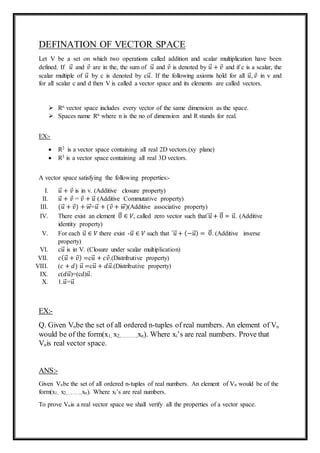
Let V be a set on which two operations called addition and scalar multiplication have been
defined. If 𝑢⃗ and 𝑣 are in the, the sum of 𝑢⃗ and 𝑣 is denoted by 𝑢⃗ + 𝑣 and if c is a scalar, the
scalar multiple of 𝑢⃗ by c is denoted by c𝑢⃗ . If the following axioms hold for all 𝑢⃗ , 𝑣 in v and
for all scalar c and d then V is called a vector space and its elements are called vectors.
 Rn vector space includes every vector of the same dimension as the space.
 Spaces name Rn where n is the no of dimension and R stands for real.
EX:-
 R2 is a vector space containing all real 2D vectors.(xy plane)
 R3 is a vector space containing all real 3D vectors.
A vector space satisfying the following properties:-
I. 𝑢⃗ + 𝑣 is in v. (Additive closure property)
II. 𝑢⃗ + 𝑣 = 𝑣 + 𝑢⃗ (Additive Commutative property)
III. (𝑢⃗ + 𝑣) + 𝑤⃗⃗ =𝑢⃗ + (𝑣 + 𝑤⃗⃗ )(Additive associative property)
IV. There exist an element 0⃗ ∈ 𝑉, called zero vector such that 𝑢⃗⃗⃗ + 0⃗ = 𝑢⃗ . (Additive
identity property)
V. For each 𝑢⃗ ∈ 𝑉 there exist -𝑢⃗ ∈ 𝑉 such that 𝑢⃗⃗⃗ + (−𝑢⃗ ) = 0⃗ . (Additive inverse
property)
VI. c𝑢⃗ is in V. (Closure under scalar multiplication)
VII. 𝑐( 𝑢⃗ + 𝑣) =c𝑢⃗ + 𝑐𝑣.(Distributive property)
VIII. (𝑐 + 𝑑) 𝑢⃗ =c𝑢⃗ + 𝑑𝑢⃗ .(Distributive property)
IX. c(𝑑𝑢⃗ )=(cd)𝑢⃗ .
X. 1.𝑢⃗ =𝑢⃗
EX:-
Q. Given Vnbe the set of all ordered n-tuples of real numbers. An element of Vn
would be of the form(x1, x2,……….,xn). Where xi’s are real numbers. Prove that
Vnis real vector space.
ANS:-
Given Vnbe the set of all ordered n-tuples of real numbers. An element of Vn would be of the
form(x1, x2,……….,xn). Where xi’s are real numbers.
To prove Vnis a real vector space we shall verify all the properties of a vector space.
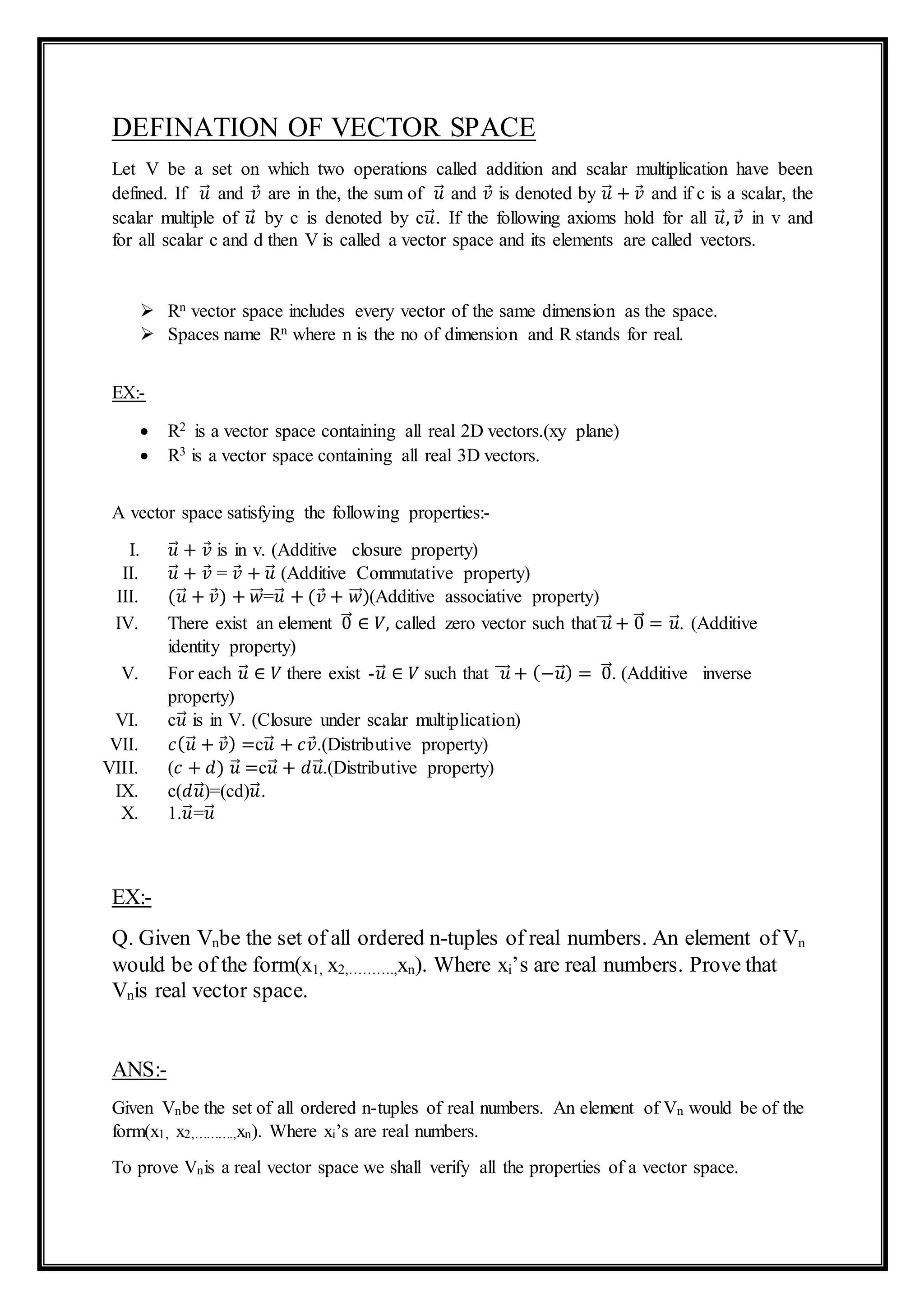
Let u,v,w∈ Vn
u=(x1, x2,……….,xn)
v=(y1,y2………..,yn)
w= (z1,z2………..,zn)
wherexi’s, yi’s, zi’s are real numbers.
1. Additive closure property:-
Now for u, v∈Vn
u+v=(x1, x2,……….,xn)+(y1,y2………..,yn)
=(x1+y1, x2+y2, …………, xn+yn)
Since sum of two real numbers is again a real number it follows that
xi+yi, i= 1,2,……….,n are all real numbers.
Therefore u+v∈Vn
Because the right hand side of u+v is an ordered n-tuples of real numbers .i.eadditive
closure property is satisfied on Vn .
2. Additive Commutative Property:-
Now for u, v∈Vn
u+v=(x1, x2,……….,xn)+(y1,y2………..,yn)
=(x1+y1, x2+y2 , …………, xn+yn)
=(y1+x1 ,y2+x2 , …………, yn+xn)
= (y1,y2………..,yn)+(x1, x2,……….,xn)
= v+u
i.e additive commutative property is satisfied on Vn.
3. Additive Associative Property:-
Now for u, v, 𝑤 ∈Vn
(u+v)+w={(x1, x2,……….,xn)+(y1,y2………..,yn)}+(z1,z2………..,zn)
=(x1+y1,x2+y2 , …………, xn+yn)+(z1,z2………..,zn)
=(x1+y1+z1 , x2+y2 +z2, …………, xn+yn+zn)
Again u+(v+w)= (x1, x2,……….,xn)+{(y1,y2………..,yn)+(z1,z2………..,zn)}
=(x1, x2,……….,xn)+(y1+z1 , y2+z2 , …………, yn+zn)
=(x1+y1+z1 , x2+y2 +z2, …………, xn+yn+zn)
Therefore (u+v)+w=u+(v+w)
i.e additive associative property is satisfied on Vn.
4. Additive Identity Property:-
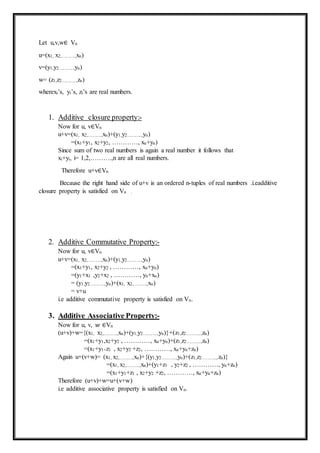
Now for u∈ Vn there exist an element 0⃗ ∈ 𝑉n such that
𝑢⃗ + 0⃗ =(x1, x2,……….,xn)+(0+0+………….+0)
=(x1+0, x2+0,………………...,xn+0)
=(x1, x2,…………………..,xn)
= 𝑢⃗
Thus 0⃗ is called additive identity element of u∈ Vn
5.Additive inverse property:-
Now for u∈ Vn there exist an element (-u) ∈ Vn such that
u+(-u)=(x1, x2,……….,xn)+{-(x1, x2,……….,xn)}
=(x1, x2,……….,xn)+(-x1,-x2,……….,-xn)
=(x1–x1, x2-x2,……….,xn-xn)
= (0+0+………….+0)
=0⃗
6.Closure Under Scalar Multiplication:-
For a real scalar c
cu= c(x1, x2,……….,xn)
= (cx1, cx2,……….,cxn)
Since the product of two real numbers is again a real number it follows that cxi,
i= 1,2………n are real numbers.
Thus the right hand side ofthe equation is an ordered n-tuples of real numbers.
Therefore cu∈ Vn
i.e closure under scalar multiplication property is satisfied on Vn.
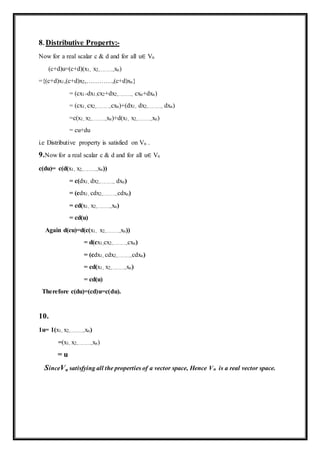
7. Distributive Property:-
Now for a real scalar c and for all u, v∈ Vn
c(u+v)=c(x1+y1,x2+y2 , …………, xn+yn)
={c(x1+y1),c(x2+y2), …………, c(xn+yn)}
= (cx1+cy1, cx2+cy2,……….,cxn+cyn)
= (cx1, cx2,……….,cxn)+(cy1+cy2+…….+cyn)
c(x1, x2,……….,xn)+c(y1,y2………..,yn) = cu+cv
8. Distributive Property:-
Now for a real scalar c & d and for all u∈ Vn
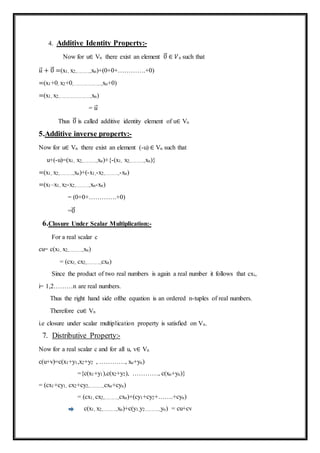
(c+d)u=(c+d)(x1, x2,……….,xn)
={(c+d)x1,(c+d)x2,…………,(c+d)xn}
= (cx1+dx1,cx2+dx2,………., cxn+dxn)
= (cx1, cx2,……….,cxn)+(dx1, dx2,………., dxn)
=c(x1, x2,……….,xn)+d(x1, x2,……….,xn)
= cu+du
i.e Distributive property is satisfied on Vn .
9.Now for a real scalar c & d and for all u∈ Vn
c(du)= c(d(x1, x2,……….,xn))
= c(dx1, dx2,………., dxn)
= (cdx1, cdx2,……….,cdxn)
= cd(x1, x2,……….,xn)
= cd(u)
Again d(cu)=d(c(x1, x2,……….,xn))
= d(cx1,cx2,……….,cxn)
= (cdx1, cdx2,……….,cdxn)
= cd(x1, x2,……….,xn)
= cd(u)
Therefore c(du)=(cd)u=c(du).
10.
1u= 1(x1, x2,……….,xn)
=(x1, x2,……….,xn)
= u
SinceVn satisfying all the properties of a vector space, Hence Vn is a real vector space.
.
NOTE 1:-
If V be any vector space then
a. 𝑐0⃗ = 0,⃗⃗⃗⃗ for every scalar c.
b. 0⃗ 𝑢 = 0⃗ , for every u∈ 𝑉
c. (-1)u= -u, for every u∈ 𝑉
Sub Space:-
A non-empty sub set S of a vector space V is called a subspace of V if S is a vector space
under the same operation of addition ad scalar multiplication as in V.
(A) (B)
(This point is not in the space
The above diagram A is not a sub space. The above diagram B is a subspace
There are 3 types of sub spaces in R2
I. All of R2 (massive plane)
II. Any line through the zero vector
III. Zero vector. (z)
 Zero vector is a subspace.
PF:-
Let w be a vector space and 0∈ 𝑤.
All elements in w are of the form [
0
0
]
[
0
0
] + [
0
0
] = [
0
0
] (Additive Property)
𝑘 [
0
0
] = [
0
0
] (Scalar multiplicative property)
EX:-
Every straight line passing through origin in V2 or V3 is a sub space of V2 or V3 .
Linear Combination:-
Let u1, u2, ………….., un be n vectors of a vector spaceV and c1, c2,…….., cnbe
n scalars then c1u1+ c2u2 +…………+cnun is called the linear combination of the
vectors u1, u2, ………….., un .
Span:-
Let S= {u1, u2, ………….., un} be a set of n vectors of a vector space V then the
span of S is the set of all linear combination of the element of S.
 It is denoted by [S] and is defined as [S] = { c1u1+ c2u2 +…………+cnun/ c1,
c2,…….., cnben scalars}
 If S is a non-empty sub set of a vector space V then [S] is a subspace of V.
 If S is a non-empty sub set of a vector space V then [S] is the smallest subspace
containing S.
More About Subspaces:-
I. If U and W are two subspaces of a vector space V then U ŪW is not
necessarily a subspace of V.
II. If U and W are two subspaces of a vector space V then U nW is a subspace
of a vector space V.
III. If U and W are two subspaces of a vector space V then [U ŪW]is a
subspace of a vector space V.
Addition Sets:-
Let A and B be two subsets of vector space V then the sum of A and B is written as
A+B and is defined as A+B={u+v / 𝑢 ∈ 𝐴, v∈ 𝐵 }
EX:-
Q. In V2, Let A= {(1, 2),(0, 1)}
& B= {(1, 1), (-1, 2)}
Then find A+B.
ANS:-
In V2, Let A= {(1, 2),(0, 1)}
& B= {(1, 1), (-1, 2)}
A+B= {(1, 2),(0, 1)}+{(1, 1), (-1, 2)}
={(1, 2)+(1, 1), (1, 2)+(-1, 2),(0, 1)+(1,1), (0,1)+(-1, 2)}
= {(2, 3), (0, 4), (1, 2), (-1,3)}
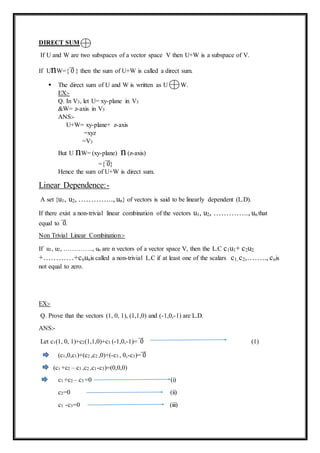
DIRECT SUM
If U and W are two subspaces of a vector space V then U+W is a subspace of V.
If UnW={ 0⃗⃗⃗ } then the sum of U+W is called a direct sum.
 The direct sum of U and W is written as U W.
EX:-
Q. In V3, let U= xy-plane in V3
&W= z-axis in V3
ANS:-
U+W= xy-plane+ z-axis
=xyz
=V3
But U nW= (xy-plane) n(z-axis)
={ 0⃗⃗⃗ }
Hence the sum of U+W is direct sum.
Linear Dependence:-
A set {u1, u2, ………….., un} of vectors is said to be linearly dependent (L.D).
If there exist a non-trivial linear combination of the vectors u1, u2, ………….., un that
equal to 0⃗⃗⃗ .
Non Trivial Linear Combination:-
If u1, u2, ………….., un are n vectors of a vector space V, then the L.C c1u1+ c2u2
+…………+cnunis called a non-trivial L.C if at least one of the scalars c1, c2,…….., cnis
not equal to zero.
EX:-
Q. Prove that the vectors (1, 0, 1), (1,1,0) and (-1,0,-1) are L.D.
ANS:-
Let c1(1, 0, 1)+c2(1,1,0)+c3 (-1,0,-1)= 0⃗⃗⃗ (1)
(c1,0,c1)+(c2 ,c2 ,0)+(-c3 , 0,-c3)= 0⃗⃗⃗
(c1 +c2 – c3 ,c2 ,c1-c3)=(0,0,0)
c1 +c2 – c3 =0 (i)
c2=0 (ii)
c1 -c3=0 (iii)
putting c2 =0 in equation (i) we get
c1 -c3 =0 (iv)
from equation (iii) and (iv) it is cleared that there are infinity no of solutions for c1&c3.
So LHS of equation (1) is a non-trivial L.C of the vectors (1, 0, 1), (1,1,0) and (-1,0,-1).
Hence the three vectors are L.D
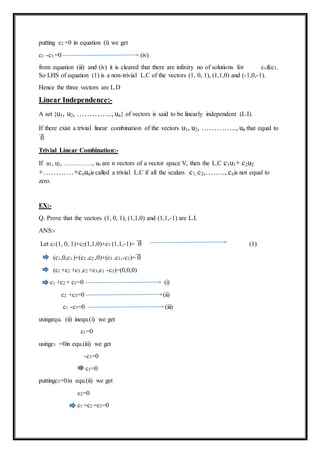
Linear Independence:-
A set {u1, u2, ………….., un} of vectors is said to be linearly independent (L.I).
If there exist a trivial linear combination of the vectors u1, u2, ………….., un that equal to
0⃗⃗⃗ .
Trivial Linear Combination:-
If u1, u2, ………….., un are n vectors of a vector space V, then the L.C c1u1+ c2u2
+…………+cnunis called a trivial L.C if all the scalars c1, c2,…….., cnis not equal to
zero.
EX:-
Q. Prove that the vectors (1, 0, 1), (1,1,0) and (1,1,-1) are L.I.
ANS:-
Let c1(1, 0, 1)+c2(1,1,0)+c3 (1,1,-1)= 0⃗⃗⃗ (1)
(c1,0,c1 )+(c2 ,c2 ,0)+(c3 ,c3,-c3)= 0⃗⃗⃗
(c1 +c2 +c3 ,c2 +c3,c1 -c3)=(0,0,0)
c1 +c2 + c3=0 (i)
c2 +c3=0 (ii)
c1 -c3=0 (iii)
usingequ. (ii) inequ.(i) we get
c1=0
usingc1 =0in equ.(iii) we get
-c3=0
c3=0
puttingc3=0in equ.(ii) we get
c2=0
c1 =c2 =c3=0
Therefore LHS of equ. (1) is trivial L.C of the given vectors.
Hence the given vector (1, 0, 1), (1,1,0) and (1,1,-1) are L.I .
DIMENSION
The dimension of a vector space is the number of elements in it’s basis.
- If Vn is n- dimensional then it’s basis contains n elements.
BASIS
A subject B of a vector space v is called a basis if
(a) B is linearly independent
(b) [B]= v , that is B generates V
Ex- prove that B={(1,0),(0,1)} be a subject of a vector space V2 .
Prove – Let B={(1,0),(0,1)} be a subject of a vector space V2 .
To prove B is a basis for V2 We have to show that .
(a)- B is linearly independent .
(b)- [B]=V2
BAS IS LINEARLY INDEPEDENT
Let 𝛼1(1,0) + 𝛼2(0,1)=0⃗
( 𝛼1,0) + (0, 𝛼2)= 0⃗
𝛼1 = 0 & 𝛼2= 0
Hence ‘B’ is linearly independent.
Now [B] = [(1,0),(0,1)]
= { 𝛼(1,0) + 𝛽(0,1)𝛼, 𝛽 𝑎𝑟𝑒 𝑠𝑐𝑎𝑙𝑎𝑟𝑠}
= {(𝛼, 0) + (0, 𝛽)𝛼, 𝛽 𝑎𝑟𝑒 𝑠𝑐𝑎𝑙𝑎𝑟𝑠}
= {(𝛼, 𝛽)𝛼, 𝛽 𝑎𝑟𝑒 𝑠𝑐𝑎𝑙𝑎𝑟𝑠}
= 𝑣2
Hence B is a basis for 𝑣2 .
Types of basis
There are two types of basis.
1-Standard Basis.
2-Ordered Basis.
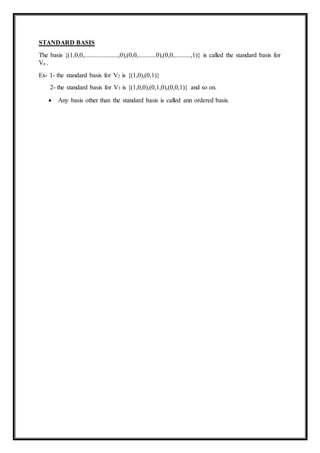
STANDARD BASIS
The basis {(1,0,0,.....................,0),(0,0,...........0),(0,0,..........,1)} is called the standard basis for
Vn .
Ex- 1- the standard basis for V2 is {(1,0),(0,1)}
2- the standard basis for V3 is {(1,0,0),(0,1,0),(0,0,1)} and so on.
 Any basis other than the standard basis is called ann ordered basis.

Vector space

  • 1.
    DEFINATION OF VECTORSPACE Let V be a set on which two operations called addition and scalar multiplication have been defined. If 𝑢⃗ and 𝑣 are in the, the sum of 𝑢⃗ and 𝑣 is denoted by 𝑢⃗ + 𝑣 and if c is a scalar, the scalar multiple of 𝑢⃗ by c is denoted by c𝑢⃗ . If the following axioms hold for all 𝑢⃗ , 𝑣 in v and for all scalar c and d then V is called a vector space and its elements are called vectors.  Rn vector space includes every vector of the same dimension as the space.  Spaces name Rn where n is the no of dimension and R stands for real. EX:-  R2 is a vector space containing all real 2D vectors.(xy plane)  R3 is a vector space containing all real 3D vectors. A vector space satisfying the following properties:- I. 𝑢⃗ + 𝑣 is in v. (Additive closure property) II. 𝑢⃗ + 𝑣 = 𝑣 + 𝑢⃗ (Additive Commutative property) III. (𝑢⃗ + 𝑣) + 𝑤⃗⃗ =𝑢⃗ + (𝑣 + 𝑤⃗⃗ )(Additive associative property) IV. There exist an element 0⃗ ∈ 𝑉, called zero vector such that 𝑢⃗⃗⃗ + 0⃗ = 𝑢⃗ . (Additive identity property) V. For each 𝑢⃗ ∈ 𝑉 there exist -𝑢⃗ ∈ 𝑉 such that 𝑢⃗⃗⃗ + (−𝑢⃗ ) = 0⃗ . (Additive inverse property) VI. c𝑢⃗ is in V. (Closure under scalar multiplication) VII. 𝑐( 𝑢⃗ + 𝑣) =c𝑢⃗ + 𝑐𝑣.(Distributive property) VIII. (𝑐 + 𝑑) 𝑢⃗ =c𝑢⃗ + 𝑑𝑢⃗ .(Distributive property) IX. c(𝑑𝑢⃗ )=(cd)𝑢⃗ . X. 1.𝑢⃗ =𝑢⃗ EX:- Q. Given Vnbe the set of all ordered n-tuples of real numbers. An element of Vn would be of the form(x1, x2,……….,xn). Where xi’s are real numbers. Prove that Vnis real vector space. ANS:- Given Vnbe the set of all ordered n-tuples of real numbers. An element of Vn would be of the form(x1, x2,……….,xn). Where xi’s are real numbers. To prove Vnis a real vector space we shall verify all the properties of a vector space.
  • 2.
    Let u,v,w∈ Vn u=(x1,x2,……….,xn) v=(y1,y2………..,yn) w= (z1,z2………..,zn) wherexi’s, yi’s, zi’s are real numbers. 1. Additive closure property:- Now for u, v∈Vn u+v=(x1, x2,……….,xn)+(y1,y2………..,yn) =(x1+y1, x2+y2, …………, xn+yn) Since sum of two real numbers is again a real number it follows that xi+yi, i= 1,2,……….,n are all real numbers. Therefore u+v∈Vn Because the right hand side of u+v is an ordered n-tuples of real numbers .i.eadditive closure property is satisfied on Vn . 2. Additive Commutative Property:- Now for u, v∈Vn u+v=(x1, x2,……….,xn)+(y1,y2………..,yn) =(x1+y1, x2+y2 , …………, xn+yn) =(y1+x1 ,y2+x2 , …………, yn+xn) = (y1,y2………..,yn)+(x1, x2,……….,xn) = v+u i.e additive commutative property is satisfied on Vn. 3. Additive Associative Property:- Now for u, v, 𝑤 ∈Vn (u+v)+w={(x1, x2,……….,xn)+(y1,y2………..,yn)}+(z1,z2………..,zn) =(x1+y1,x2+y2 , …………, xn+yn)+(z1,z2………..,zn) =(x1+y1+z1 , x2+y2 +z2, …………, xn+yn+zn) Again u+(v+w)= (x1, x2,……….,xn)+{(y1,y2………..,yn)+(z1,z2………..,zn)} =(x1, x2,……….,xn)+(y1+z1 , y2+z2 , …………, yn+zn) =(x1+y1+z1 , x2+y2 +z2, …………, xn+yn+zn) Therefore (u+v)+w=u+(v+w) i.e additive associative property is satisfied on Vn.
  • 3.
    4. Additive IdentityProperty:- Now for u∈ Vn there exist an element 0⃗ ∈ 𝑉n such that 𝑢⃗ + 0⃗ =(x1, x2,……….,xn)+(0+0+………….+0) =(x1+0, x2+0,………………...,xn+0) =(x1, x2,…………………..,xn) = 𝑢⃗ Thus 0⃗ is called additive identity element of u∈ Vn 5.Additive inverse property:- Now for u∈ Vn there exist an element (-u) ∈ Vn such that u+(-u)=(x1, x2,……….,xn)+{-(x1, x2,……….,xn)} =(x1, x2,……….,xn)+(-x1,-x2,……….,-xn) =(x1–x1, x2-x2,……….,xn-xn) = (0+0+………….+0) =0⃗ 6.Closure Under Scalar Multiplication:- For a real scalar c cu= c(x1, x2,……….,xn) = (cx1, cx2,……….,cxn) Since the product of two real numbers is again a real number it follows that cxi, i= 1,2………n are real numbers. Thus the right hand side ofthe equation is an ordered n-tuples of real numbers. Therefore cu∈ Vn i.e closure under scalar multiplication property is satisfied on Vn. 7. Distributive Property:- Now for a real scalar c and for all u, v∈ Vn c(u+v)=c(x1+y1,x2+y2 , …………, xn+yn) ={c(x1+y1),c(x2+y2), …………, c(xn+yn)} = (cx1+cy1, cx2+cy2,……….,cxn+cyn) = (cx1, cx2,……….,cxn)+(cy1+cy2+…….+cyn) c(x1, x2,……….,xn)+c(y1,y2………..,yn) = cu+cv
  • 4.
    8. Distributive Property:- Nowfor a real scalar c & d and for all u∈ Vn (c+d)u=(c+d)(x1, x2,……….,xn) ={(c+d)x1,(c+d)x2,…………,(c+d)xn} = (cx1+dx1,cx2+dx2,………., cxn+dxn) = (cx1, cx2,……….,cxn)+(dx1, dx2,………., dxn) =c(x1, x2,……….,xn)+d(x1, x2,……….,xn) = cu+du i.e Distributive property is satisfied on Vn . 9.Now for a real scalar c & d and for all u∈ Vn c(du)= c(d(x1, x2,……….,xn)) = c(dx1, dx2,………., dxn) = (cdx1, cdx2,……….,cdxn) = cd(x1, x2,……….,xn) = cd(u) Again d(cu)=d(c(x1, x2,……….,xn)) = d(cx1,cx2,……….,cxn) = (cdx1, cdx2,……….,cdxn) = cd(x1, x2,……….,xn) = cd(u) Therefore c(du)=(cd)u=c(du). 10. 1u= 1(x1, x2,……….,xn) =(x1, x2,……….,xn) = u SinceVn satisfying all the properties of a vector space, Hence Vn is a real vector space.
  • 5.
    . NOTE 1:- If Vbe any vector space then a. 𝑐0⃗ = 0,⃗⃗⃗⃗ for every scalar c. b. 0⃗ 𝑢 = 0⃗ , for every u∈ 𝑉 c. (-1)u= -u, for every u∈ 𝑉 Sub Space:- A non-empty sub set S of a vector space V is called a subspace of V if S is a vector space under the same operation of addition ad scalar multiplication as in V. (A) (B) (This point is not in the space The above diagram A is not a sub space. The above diagram B is a subspace There are 3 types of sub spaces in R2 I. All of R2 (massive plane) II. Any line through the zero vector III. Zero vector. (z)  Zero vector is a subspace. PF:- Let w be a vector space and 0∈ 𝑤. All elements in w are of the form [ 0 0 ] [ 0 0 ] + [ 0 0 ] = [ 0 0 ] (Additive Property) 𝑘 [ 0 0 ] = [ 0 0 ] (Scalar multiplicative property)
  • 6.
    EX:- Every straight linepassing through origin in V2 or V3 is a sub space of V2 or V3 . Linear Combination:- Let u1, u2, ………….., un be n vectors of a vector spaceV and c1, c2,…….., cnbe n scalars then c1u1+ c2u2 +…………+cnun is called the linear combination of the vectors u1, u2, ………….., un . Span:- Let S= {u1, u2, ………….., un} be a set of n vectors of a vector space V then the span of S is the set of all linear combination of the element of S.  It is denoted by [S] and is defined as [S] = { c1u1+ c2u2 +…………+cnun/ c1, c2,…….., cnben scalars}  If S is a non-empty sub set of a vector space V then [S] is a subspace of V.  If S is a non-empty sub set of a vector space V then [S] is the smallest subspace containing S. More About Subspaces:- I. If U and W are two subspaces of a vector space V then U ŪW is not necessarily a subspace of V. II. If U and W are two subspaces of a vector space V then U nW is a subspace of a vector space V. III. If U and W are two subspaces of a vector space V then [U ŪW]is a subspace of a vector space V. Addition Sets:- Let A and B be two subsets of vector space V then the sum of A and B is written as A+B and is defined as A+B={u+v / 𝑢 ∈ 𝐴, v∈ 𝐵 } EX:- Q. In V2, Let A= {(1, 2),(0, 1)} & B= {(1, 1), (-1, 2)} Then find A+B. ANS:- In V2, Let A= {(1, 2),(0, 1)} & B= {(1, 1), (-1, 2)} A+B= {(1, 2),(0, 1)}+{(1, 1), (-1, 2)} ={(1, 2)+(1, 1), (1, 2)+(-1, 2),(0, 1)+(1,1), (0,1)+(-1, 2)} = {(2, 3), (0, 4), (1, 2), (-1,3)}
  • 7.
    DIRECT SUM If Uand W are two subspaces of a vector space V then U+W is a subspace of V. If UnW={ 0⃗⃗⃗ } then the sum of U+W is called a direct sum.  The direct sum of U and W is written as U W. EX:- Q. In V3, let U= xy-plane in V3 &W= z-axis in V3 ANS:- U+W= xy-plane+ z-axis =xyz =V3 But U nW= (xy-plane) n(z-axis) ={ 0⃗⃗⃗ } Hence the sum of U+W is direct sum. Linear Dependence:- A set {u1, u2, ………….., un} of vectors is said to be linearly dependent (L.D). If there exist a non-trivial linear combination of the vectors u1, u2, ………….., un that equal to 0⃗⃗⃗ . Non Trivial Linear Combination:- If u1, u2, ………….., un are n vectors of a vector space V, then the L.C c1u1+ c2u2 +…………+cnunis called a non-trivial L.C if at least one of the scalars c1, c2,…….., cnis not equal to zero. EX:- Q. Prove that the vectors (1, 0, 1), (1,1,0) and (-1,0,-1) are L.D. ANS:- Let c1(1, 0, 1)+c2(1,1,0)+c3 (-1,0,-1)= 0⃗⃗⃗ (1) (c1,0,c1)+(c2 ,c2 ,0)+(-c3 , 0,-c3)= 0⃗⃗⃗ (c1 +c2 – c3 ,c2 ,c1-c3)=(0,0,0) c1 +c2 – c3 =0 (i) c2=0 (ii) c1 -c3=0 (iii)
  • 8.
    putting c2 =0in equation (i) we get c1 -c3 =0 (iv) from equation (iii) and (iv) it is cleared that there are infinity no of solutions for c1&c3. So LHS of equation (1) is a non-trivial L.C of the vectors (1, 0, 1), (1,1,0) and (-1,0,-1). Hence the three vectors are L.D Linear Independence:- A set {u1, u2, ………….., un} of vectors is said to be linearly independent (L.I). If there exist a trivial linear combination of the vectors u1, u2, ………….., un that equal to 0⃗⃗⃗ . Trivial Linear Combination:- If u1, u2, ………….., un are n vectors of a vector space V, then the L.C c1u1+ c2u2 +…………+cnunis called a trivial L.C if all the scalars c1, c2,…….., cnis not equal to zero. EX:- Q. Prove that the vectors (1, 0, 1), (1,1,0) and (1,1,-1) are L.I. ANS:- Let c1(1, 0, 1)+c2(1,1,0)+c3 (1,1,-1)= 0⃗⃗⃗ (1) (c1,0,c1 )+(c2 ,c2 ,0)+(c3 ,c3,-c3)= 0⃗⃗⃗ (c1 +c2 +c3 ,c2 +c3,c1 -c3)=(0,0,0) c1 +c2 + c3=0 (i) c2 +c3=0 (ii) c1 -c3=0 (iii) usingequ. (ii) inequ.(i) we get c1=0 usingc1 =0in equ.(iii) we get -c3=0 c3=0 puttingc3=0in equ.(ii) we get c2=0 c1 =c2 =c3=0
  • 9.
    Therefore LHS ofequ. (1) is trivial L.C of the given vectors. Hence the given vector (1, 0, 1), (1,1,0) and (1,1,-1) are L.I . DIMENSION The dimension of a vector space is the number of elements in it’s basis. - If Vn is n- dimensional then it’s basis contains n elements. BASIS A subject B of a vector space v is called a basis if (a) B is linearly independent (b) [B]= v , that is B generates V Ex- prove that B={(1,0),(0,1)} be a subject of a vector space V2 . Prove – Let B={(1,0),(0,1)} be a subject of a vector space V2 . To prove B is a basis for V2 We have to show that . (a)- B is linearly independent . (b)- [B]=V2 BAS IS LINEARLY INDEPEDENT Let 𝛼1(1,0) + 𝛼2(0,1)=0⃗ ( 𝛼1,0) + (0, 𝛼2)= 0⃗ 𝛼1 = 0 & 𝛼2= 0 Hence ‘B’ is linearly independent. Now [B] = [(1,0),(0,1)] = { 𝛼(1,0) + 𝛽(0,1)𝛼, 𝛽 𝑎𝑟𝑒 𝑠𝑐𝑎𝑙𝑎𝑟𝑠} = {(𝛼, 0) + (0, 𝛽)𝛼, 𝛽 𝑎𝑟𝑒 𝑠𝑐𝑎𝑙𝑎𝑟𝑠} = {(𝛼, 𝛽)𝛼, 𝛽 𝑎𝑟𝑒 𝑠𝑐𝑎𝑙𝑎𝑟𝑠} = 𝑣2 Hence B is a basis for 𝑣2 . Types of basis There are two types of basis. 1-Standard Basis. 2-Ordered Basis.
  • 10.
    STANDARD BASIS The basis{(1,0,0,.....................,0),(0,0,...........0),(0,0,..........,1)} is called the standard basis for Vn . Ex- 1- the standard basis for V2 is {(1,0),(0,1)} 2- the standard basis for V3 is {(1,0,0),(0,1,0),(0,0,1)} and so on.  Any basis other than the standard basis is called ann ordered basis.