For any Assignment related queries, Call us at:- +1 678 648 4277
You can mail us at info@mathsassignmenthelp.com or
reach us at: https://www.mathsassignmenthelp.com/
Linear
Algebra
Gauss-Jordan elimination
Use Gauss-Jordan elimination on [UI] to find the upper triangular
Row reduce [UI] to get [IU−1] as follows (here Ri stands for the ith row):
(Recommended) A is a 4 by 4 matrix with 1’s on the diagonal and −a,−b,−c on the diagonal
above. Find A−1 for this bidiagonal matrix.
Solution Row reduce [AI] to get [IA−1] as follows (here Ri stands for the ith row):
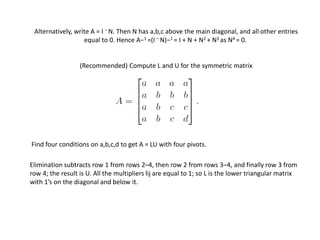
Alternatively, write A = I − N. Then N has a,b,c above the main diagonal, and all other entries
equal to 0. Hence A−1 =(I − N)−1 = I + N + N2 + N3 as N4 = 0.
(Recommended) Compute L and U for the symmetric matrix
Find four conditions on a,b,c,d to get A = LU with four pivots.
Elimination subtracts row 1 from rows 2–4, then row 2 from rows 3–4, and finally row 3 from
row 4; the result is U. All the multipliers lij are equal to 1; so L is the lower triangular matrix
with 1’s on the diagonal and below it.
If A = LDU and also A = L1D1U1 with all factors invertible, then L = L1 and D = D1 and U = U1. “The
three factors are unique.”
Derive the equation L−11LD = D1U1U−1. Are the two sides triangular or diagonal? Deduce L = L1
and U = U1 (they all have diagonal 1’s). Then D = D1.
The pivots are the nonzero entries on the diagonal of U. So there are four pivots when these four
conditions are satisfied: a = 0, b = a, c = b, and d = c.
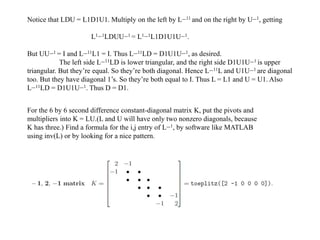
Notice that LDU = L1D1U1. Multiply on the left by L−11 and on the right by U−1, getting
L1−1LDUU−1 = L1−1L1D1U1U−1.
But UU−1 = I and L−11L1 = I. Thus L−11LD = D1U1U−1, as desired.
The left side L−11LD is lower triangular, and the right side D1U1U−1 is upper
triangular. But they’re equal. So they’re both diagonal. Hence L−11L and U1U−1 are diagonal
too. But they have diagonal 1’s. So they’re both equal to I. Thus L = L1 and U = U1. Also
L−11LD = D1U1U−1. Thus D = D1.
For the 6 by 6 second difference constant-diagonal matrix K, put the pivots and
multipliers into K = LU.(L and U will have only two nonzero diagonals, because
K has three.) Find a formula for the i,j entry of L−1, by software like MATLAB
using inv(L) or by looking for a nice pattern.
octave:1> K=toeplitz([2 -1 0 0 0 0]);
octave:2> [L,U]=slu(K);
octave:3> inv(L)ans =
1.00000 0.00000 0.00000 0.00000 0.00000 0.00000
0.50000 1.00000 0.00000 0.00000 0.00000 0.00000
0.33333 0.66667 1.00000 0.00000 0.00000 0.00000
0.25000 0.50000 0.75000 1.00000 0.00000 0.00000
0.20000 0.40000 0.60000 0.80000 1.00000 0.00000
0.16667 0.33333 0.50000 0.66667 0.83333 1.00000
Here is the transcript of a session with the software Octave, which is the open-source GNU
clone of MATLAB. The decomposition K = LU is found using the teaching code slu.m,
available from
If you print K−1, it doesn’t look good. But if you print 7K−1 (when
K is 6 by 6), that matrix looks wonderful. Write down 7K−1 by hand, following this pattern: 1 Row
1 and column 1 are (6, 5, 4, 3, 2, 1).
2 On and above the main diagonal, row i is i times row 1.
3 On and below the main diagonal, column j is j times column 1.
For n = 6, following the pattern yields this matrix:
Here is the transcript of an Octave session that multiplies K times that 7K−1.
octave:1> K=toeplitz([2 -1 0 0 0 0]);
octave:2> M=[6 5 4 3 2 1;5 10 8 6 4 2;4 8 12 9 6 3;3 6 9 12 8 4;2 4 6 8 10 5;1 2 3 4 5 6];
octave:3> K*M
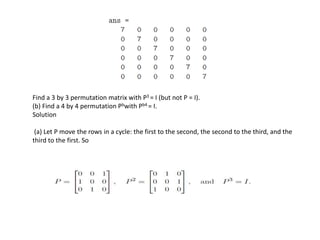
Find a 3 by 3 permutation matrix with P3 = I (but not P = I).
(b) Find a 4 by 4 permutation Pbwith Pb4 = I.
Solution
(a) Let P move the rows in a cycle: the first to the second, the second to the third, and the
third to the first. So
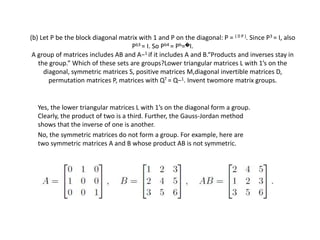
(b) Let P be the block diagonal matrix with 1 and P on the diagonal: P = ( 0 P ). Since P3 = I, also
Pb3 = I. So Pb4 = Pb=�I.
A group of matrices includes AB and A−1 if it includes A and B.“Products and inverses stay in
the group.” Which of these sets are groups?Lower triangular matrices L with 1’s on the
diagonal, symmetric matrices S, positive matrices M,diagonal invertible matrices D,
permutation matrices P, matrices with QT = Q−1. Invent twomore matrix groups.
Yes, the lower triangular matrices L with 1’s on the diagonal form a group.
Clearly, the product of two is a third. Further, the Gauss-Jordan method
shows that the inverse of one is another.
No, the symmetric matrices do not form a group. For example, here are
two symmetric matrices A and B whose product AB is not symmetric.
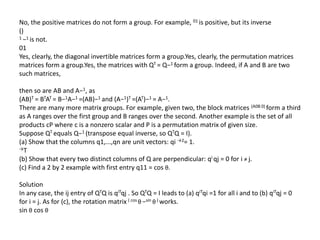
No, the positive matrices do not form a group. For example, 01 is positive, but its inverse
()
1 −1 is not.
01
Yes, clearly, the diagonal invertible matrices form a group.Yes, clearly, the permutation matrices
matrices form a group.Yes, the matrices with QT = Q−1 form a group. Indeed, if A and B are two
such matrices,
then so are AB and A−1, as
(AB)T = BTAT = B−1A−1 =(AB)−1 and (A−1)T =(AT)−1 = A−1.
There are many more matrix groups. For example, given two, the block matrices (A0B 0) form a third
as A ranges over the first group and B ranges over the second. Another example is the set of all
products cP where c is a nonzero scalar and P is a permutation matrix of given size.
Suppose QT equals Q−1 (transpose equal inverse, so QTQ = I).
(a) Show that the columns q1,...,qn are unit vectors: qi →2= 1.
→T
(b) Show that every two distinct columns of Q are perpendicular: qi qj = 0 for i ≠ j.
(c) Find a 2 by 2 example with first entry q11 = cos θ.
Solution
In any case, the ij entry of QTQ is qiTqj . So QTQ = I leads to (a) qiTqi =1 for all i and to (b) qiTqj = 0
for i = j. As for (c), the rotation matrix ( cos θ −sin θ ) works.
sin θ cos θ
True or false (check addition or give a counterexample):
(a) The symmetric matrices in M (with AT = A) form a subspace.
(b) The skew-symmetric matrices in M (with AT = −A) form a subspace.
(c) The unsymmetric matrices in M (with AT =-A) form a subspace.
Solution (a) True: AT = A and BT = B lead to (A + B)T = AT + BT = A + B.
(b) True: AT = −A and BT = −B lead to (A + B)T = AT + BT = −A − B = −(A + B). 11 00 11
(c) False: ( 00 ) + ( 11 ) = ( 11 ).
(Recommended) If we add an extra column b to a matrix A, then the column space
gets larger unless . Give an example where the column space gets larger and an
example where it doesn’t. Why is Ax = b solvable exactly when the column space
doesn’t get larger—it is the same for A and [Ab ]?
Solution The column space gets larger unless it contains b; that is, b is a linear
10
combination of the columns of () ( A). For example, let A = ( 00 ); then the column
space gets larger if b = 10 and it doesn’t if b = 01 . The equation Ax = b is solvable
exactly when b is a (nontrivial) linear combination of the columns of A (with the
components of x as combining coefficients); so Ax = b is solvable exactly when b
lies in the column space, so exactly when the column space doesn’t get larger.
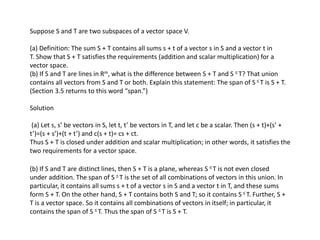
Suppose S and T are two subspaces of a vector space V.
(a) Definition: The sum S + T contains all sums s + t of a vector s in S and a vector t in
T. Show that S + T satisfies the requirements (addition and scalar multiplication) for a
vector space.
(b) If S and T are lines in Rm, what is the difference between S + T and S ≤ T? That union
contains all vectors from S and T or both. Explain this statement: The span of S ≤ T is S + T.
(Section 3.5 returns to this word “span.”)
Solution
(a) Let s, s’ be vectors in S, let t, t’ be vectors in T, and let c be a scalar. Then (s + t)+(s’ +
t’)=(s + s’)+(t + t’) and c(s + t)= cs + ct.
Thus S + T is closed under addition and scalar multiplication; in other words, it satisfies the
two requirements for a vector space.
(b) If S and T are distinct lines, then S + T is a plane, whereas S ≤ T is not even closed
under addition. The span of S ≤ T is the set of all combinations of vectors in this union. In
particular, it contains all sums s + t of a vector s in S and a vector t in T, and these sums
form S + T. On the other hand, S + T contains both S and T; so it contains S ≤ T. Further, S +
T is a vector space. So it contains all combinations of vectors in itself; in particular, it
contains the span of S ≤ T. Thus the span of S ≤ T is S + T.
Show that the matrices A and [A AB ] (with extra columns) have the same column space. But
find a square matrix with C(A2) smaller than C(A). Important point:
An n by n matrix has C(A)= Rn exactly when A is an matrix.
Solution
Each column of AB is a combination of the columns of A (the combining coefficients are the
entries in the corresponding column of B). So any combination of the columns of [A AB ] is a
combination of the columns of A alone. Thus A and [A AB ] have the same column space.
01 1
Let A = ( 00 ). Then A2 = 0, so C(A2)= Z. But C(A) is the line through ( 0 ).
An n by n matrix has C(A)= Rn exactly when A is an invertible matrix, because Ax = b is
solvable for any given b exactly when A is invertible.
Thank You

Linear Algebra Gauss Jordan elimination.pptx

  • 1.
    For any Assignmentrelated queries, Call us at:- +1 678 648 4277 You can mail us at info@mathsassignmenthelp.com or reach us at: https://www.mathsassignmenthelp.com/ Linear Algebra Gauss-Jordan elimination
  • 2.
    Use Gauss-Jordan eliminationon [UI] to find the upper triangular Row reduce [UI] to get [IU−1] as follows (here Ri stands for the ith row):
  • 3.
    (Recommended) A isa 4 by 4 matrix with 1’s on the diagonal and −a,−b,−c on the diagonal above. Find A−1 for this bidiagonal matrix. Solution Row reduce [AI] to get [IA−1] as follows (here Ri stands for the ith row):
  • 4.
    Alternatively, write A= I − N. Then N has a,b,c above the main diagonal, and all other entries equal to 0. Hence A−1 =(I − N)−1 = I + N + N2 + N3 as N4 = 0. (Recommended) Compute L and U for the symmetric matrix Find four conditions on a,b,c,d to get A = LU with four pivots. Elimination subtracts row 1 from rows 2–4, then row 2 from rows 3–4, and finally row 3 from row 4; the result is U. All the multipliers lij are equal to 1; so L is the lower triangular matrix with 1’s on the diagonal and below it.
  • 5.
    If A =LDU and also A = L1D1U1 with all factors invertible, then L = L1 and D = D1 and U = U1. “The three factors are unique.” Derive the equation L−11LD = D1U1U−1. Are the two sides triangular or diagonal? Deduce L = L1 and U = U1 (they all have diagonal 1’s). Then D = D1. The pivots are the nonzero entries on the diagonal of U. So there are four pivots when these four conditions are satisfied: a = 0, b = a, c = b, and d = c.
  • 6.
    Notice that LDU= L1D1U1. Multiply on the left by L−11 and on the right by U−1, getting L1−1LDUU−1 = L1−1L1D1U1U−1. But UU−1 = I and L−11L1 = I. Thus L−11LD = D1U1U−1, as desired. The left side L−11LD is lower triangular, and the right side D1U1U−1 is upper triangular. But they’re equal. So they’re both diagonal. Hence L−11L and U1U−1 are diagonal too. But they have diagonal 1’s. So they’re both equal to I. Thus L = L1 and U = U1. Also L−11LD = D1U1U−1. Thus D = D1. For the 6 by 6 second difference constant-diagonal matrix K, put the pivots and multipliers into K = LU.(L and U will have only two nonzero diagonals, because K has three.) Find a formula for the i,j entry of L−1, by software like MATLAB using inv(L) or by looking for a nice pattern.
  • 7.
    octave:1> K=toeplitz([2 -10 0 0 0]); octave:2> [L,U]=slu(K); octave:3> inv(L)ans = 1.00000 0.00000 0.00000 0.00000 0.00000 0.00000 0.50000 1.00000 0.00000 0.00000 0.00000 0.00000 0.33333 0.66667 1.00000 0.00000 0.00000 0.00000 0.25000 0.50000 0.75000 1.00000 0.00000 0.00000 0.20000 0.40000 0.60000 0.80000 1.00000 0.00000 0.16667 0.33333 0.50000 0.66667 0.83333 1.00000 Here is the transcript of a session with the software Octave, which is the open-source GNU clone of MATLAB. The decomposition K = LU is found using the teaching code slu.m, available from If you print K−1, it doesn’t look good. But if you print 7K−1 (when K is 6 by 6), that matrix looks wonderful. Write down 7K−1 by hand, following this pattern: 1 Row 1 and column 1 are (6, 5, 4, 3, 2, 1). 2 On and above the main diagonal, row i is i times row 1. 3 On and below the main diagonal, column j is j times column 1.
  • 8.
    For n =6, following the pattern yields this matrix: Here is the transcript of an Octave session that multiplies K times that 7K−1. octave:1> K=toeplitz([2 -1 0 0 0 0]); octave:2> M=[6 5 4 3 2 1;5 10 8 6 4 2;4 8 12 9 6 3;3 6 9 12 8 4;2 4 6 8 10 5;1 2 3 4 5 6]; octave:3> K*M
  • 9.
    Find a 3by 3 permutation matrix with P3 = I (but not P = I). (b) Find a 4 by 4 permutation Pbwith Pb4 = I. Solution (a) Let P move the rows in a cycle: the first to the second, the second to the third, and the third to the first. So
  • 10.
    (b) Let Pbe the block diagonal matrix with 1 and P on the diagonal: P = ( 0 P ). Since P3 = I, also Pb3 = I. So Pb4 = Pb=�I. A group of matrices includes AB and A−1 if it includes A and B.“Products and inverses stay in the group.” Which of these sets are groups?Lower triangular matrices L with 1’s on the diagonal, symmetric matrices S, positive matrices M,diagonal invertible matrices D, permutation matrices P, matrices with QT = Q−1. Invent twomore matrix groups. Yes, the lower triangular matrices L with 1’s on the diagonal form a group. Clearly, the product of two is a third. Further, the Gauss-Jordan method shows that the inverse of one is another. No, the symmetric matrices do not form a group. For example, here are two symmetric matrices A and B whose product AB is not symmetric.
  • 11.
    No, the positivematrices do not form a group. For example, 01 is positive, but its inverse () 1 −1 is not. 01 Yes, clearly, the diagonal invertible matrices form a group.Yes, clearly, the permutation matrices matrices form a group.Yes, the matrices with QT = Q−1 form a group. Indeed, if A and B are two such matrices, then so are AB and A−1, as (AB)T = BTAT = B−1A−1 =(AB)−1 and (A−1)T =(AT)−1 = A−1. There are many more matrix groups. For example, given two, the block matrices (A0B 0) form a third as A ranges over the first group and B ranges over the second. Another example is the set of all products cP where c is a nonzero scalar and P is a permutation matrix of given size. Suppose QT equals Q−1 (transpose equal inverse, so QTQ = I). (a) Show that the columns q1,...,qn are unit vectors: qi →2= 1. →T (b) Show that every two distinct columns of Q are perpendicular: qi qj = 0 for i ≠ j. (c) Find a 2 by 2 example with first entry q11 = cos θ. Solution In any case, the ij entry of QTQ is qiTqj . So QTQ = I leads to (a) qiTqi =1 for all i and to (b) qiTqj = 0 for i = j. As for (c), the rotation matrix ( cos θ −sin θ ) works. sin θ cos θ
  • 12.
    True or false(check addition or give a counterexample): (a) The symmetric matrices in M (with AT = A) form a subspace. (b) The skew-symmetric matrices in M (with AT = −A) form a subspace. (c) The unsymmetric matrices in M (with AT =-A) form a subspace. Solution (a) True: AT = A and BT = B lead to (A + B)T = AT + BT = A + B. (b) True: AT = −A and BT = −B lead to (A + B)T = AT + BT = −A − B = −(A + B). 11 00 11 (c) False: ( 00 ) + ( 11 ) = ( 11 ). (Recommended) If we add an extra column b to a matrix A, then the column space gets larger unless . Give an example where the column space gets larger and an example where it doesn’t. Why is Ax = b solvable exactly when the column space doesn’t get larger—it is the same for A and [Ab ]? Solution The column space gets larger unless it contains b; that is, b is a linear 10 combination of the columns of () ( A). For example, let A = ( 00 ); then the column space gets larger if b = 10 and it doesn’t if b = 01 . The equation Ax = b is solvable exactly when b is a (nontrivial) linear combination of the columns of A (with the components of x as combining coefficients); so Ax = b is solvable exactly when b lies in the column space, so exactly when the column space doesn’t get larger.
  • 13.
    Suppose S andT are two subspaces of a vector space V. (a) Definition: The sum S + T contains all sums s + t of a vector s in S and a vector t in T. Show that S + T satisfies the requirements (addition and scalar multiplication) for a vector space. (b) If S and T are lines in Rm, what is the difference between S + T and S ≤ T? That union contains all vectors from S and T or both. Explain this statement: The span of S ≤ T is S + T. (Section 3.5 returns to this word “span.”) Solution (a) Let s, s’ be vectors in S, let t, t’ be vectors in T, and let c be a scalar. Then (s + t)+(s’ + t’)=(s + s’)+(t + t’) and c(s + t)= cs + ct. Thus S + T is closed under addition and scalar multiplication; in other words, it satisfies the two requirements for a vector space. (b) If S and T are distinct lines, then S + T is a plane, whereas S ≤ T is not even closed under addition. The span of S ≤ T is the set of all combinations of vectors in this union. In particular, it contains all sums s + t of a vector s in S and a vector t in T, and these sums form S + T. On the other hand, S + T contains both S and T; so it contains S ≤ T. Further, S + T is a vector space. So it contains all combinations of vectors in itself; in particular, it contains the span of S ≤ T. Thus the span of S ≤ T is S + T.
  • 14.
    Show that thematrices A and [A AB ] (with extra columns) have the same column space. But find a square matrix with C(A2) smaller than C(A). Important point: An n by n matrix has C(A)= Rn exactly when A is an matrix. Solution Each column of AB is a combination of the columns of A (the combining coefficients are the entries in the corresponding column of B). So any combination of the columns of [A AB ] is a combination of the columns of A alone. Thus A and [A AB ] have the same column space. 01 1 Let A = ( 00 ). Then A2 = 0, so C(A2)= Z. But C(A) is the line through ( 0 ). An n by n matrix has C(A)= Rn exactly when A is an invertible matrix, because Ax = b is solvable for any given b exactly when A is invertible.
  • 15.