KINESICS
•Information about the relationship and affect of
these two skaters is communicated by their body
posture , eye gaze and physical contact.
•The term was first used(in1952) by Ray Birdwhistell
, an anthropologist who wished to study how people
communicate through posture, gesture , stance and
movement.
•Kinesics is the non-verbal behaviour related to
•movement, either of any part of the body, or the
body as a whole.
• In short all communicative body movements are
generally classfied as kinesics.
POSTURE
•Posture can be used to determine a participant’s
degree of attention or involvement.
• Studies investigeting the impact of posture on
interpersonal relationships suggest that mirror-image
congruent postures, where one person’s left side is
parallel to the other person’s right side,leads to
favourable perception of communicators and positive
speech;
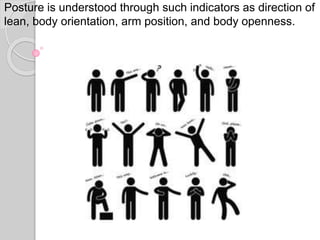
Posture is understood through such indicators as direction of
lean, body orientation, arm position, and body openness.
GESTURE: A wink is a type of
geture :
• A gesture is a non-vocal bodily movement intended to
express meaning. They may be articulated with the hands,
arms or body, and also include movements of the head,face
and eyes, such as winkling, nodding, or rolling ones’ eyes.
The boundary between language and gesture, or verbal and
nonverbal communication, can be hard to identify.
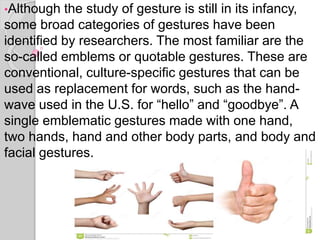
•Although the study of gesture is still in its infancy,
some broad categories of gestures have been
identified by researchers. The most familiar are the
so-called emblems or quotable gestures. These are
conventional, culture-specific gestures that can be
used as replacement for words, such as the hand-
wave used in the U.S. for “hello” and “goodbye”. A
single emblematic gestures made with one hand,
two hands, hand and other body parts, and body and
facial gestures.
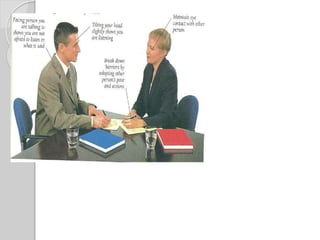
Eye contact
• Eyes can indicate interest, attention, and
involvement with audience members, while failure to
make eye contact may be interpreted as
disintersted,inattentive or rude.
• Different culteres have different rules for eye
contact,
Certain Asian cultures can perceive direct eye
contact as a way to signal competitiveness.
In other countries lower eyes is a signal of respect.
Eye contact is avoided in Nigeria.
Facial expression
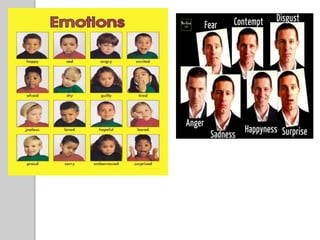
• The face as a whole indicates much about human moods.
• Specific emotional states, such as happiness or sadness,
are expressed through a smile or a frown, respectively.
• Using all the various muscles that presicely control mouth,
lips, eyes, nose, forehead, and jaw, the human face is
estimated to capable of more than 10,000 different
expression.
Personal appearance
• The audience may judge the person on their personal
apperance.
• Clothing, mood, confiedence, interest, authority, and values
can judge the personal apperance of any person.
• Crossed arms, crossed legs is signal for closed posture.
But,open and relaxes hands, a wide stance is signal of open
posture and it communicates friendly and positive attitude.
Kinesics (Communication Skills)

Kinesics (Communication Skills)

  • 1.
    KINESICS •Information about therelationship and affect of these two skaters is communicated by their body posture , eye gaze and physical contact. •The term was first used(in1952) by Ray Birdwhistell , an anthropologist who wished to study how people communicate through posture, gesture , stance and movement. •Kinesics is the non-verbal behaviour related to
  • 2.
    •movement, either ofany part of the body, or the body as a whole. • In short all communicative body movements are generally classfied as kinesics.
  • 3.
    POSTURE •Posture can beused to determine a participant’s degree of attention or involvement. • Studies investigeting the impact of posture on interpersonal relationships suggest that mirror-image congruent postures, where one person’s left side is parallel to the other person’s right side,leads to favourable perception of communicators and positive speech;
  • 4.
    Posture is understoodthrough such indicators as direction of lean, body orientation, arm position, and body openness.
  • 5.
    GESTURE: A winkis a type of geture : • A gesture is a non-vocal bodily movement intended to express meaning. They may be articulated with the hands, arms or body, and also include movements of the head,face and eyes, such as winkling, nodding, or rolling ones’ eyes. The boundary between language and gesture, or verbal and nonverbal communication, can be hard to identify.
  • 6.
    •Although the studyof gesture is still in its infancy, some broad categories of gestures have been identified by researchers. The most familiar are the so-called emblems or quotable gestures. These are conventional, culture-specific gestures that can be used as replacement for words, such as the hand- wave used in the U.S. for “hello” and “goodbye”. A single emblematic gestures made with one hand, two hands, hand and other body parts, and body and facial gestures.
  • 7.
    Eye contact • Eyescan indicate interest, attention, and involvement with audience members, while failure to make eye contact may be interpreted as disintersted,inattentive or rude. • Different culteres have different rules for eye contact, Certain Asian cultures can perceive direct eye contact as a way to signal competitiveness. In other countries lower eyes is a signal of respect. Eye contact is avoided in Nigeria.
  • 9.
    Facial expression • Theface as a whole indicates much about human moods. • Specific emotional states, such as happiness or sadness, are expressed through a smile or a frown, respectively. • Using all the various muscles that presicely control mouth, lips, eyes, nose, forehead, and jaw, the human face is estimated to capable of more than 10,000 different expression.
  • 12.
    Personal appearance • Theaudience may judge the person on their personal apperance. • Clothing, mood, confiedence, interest, authority, and values can judge the personal apperance of any person. • Crossed arms, crossed legs is signal for closed posture. But,open and relaxes hands, a wide stance is signal of open posture and it communicates friendly and positive attitude.