Linear Algebra
15UMTC61
K.Anitha M.Sc., M.Phil.,
G.Nagalakshmi M.Sc., M.phil.,
Linear Independence
Definition and Examples
A subset of a vector space is linearly independent (L.I.) if
none of its elements is a linear combination of the others.
Otherwise, it is linearly dependent (L.D.).
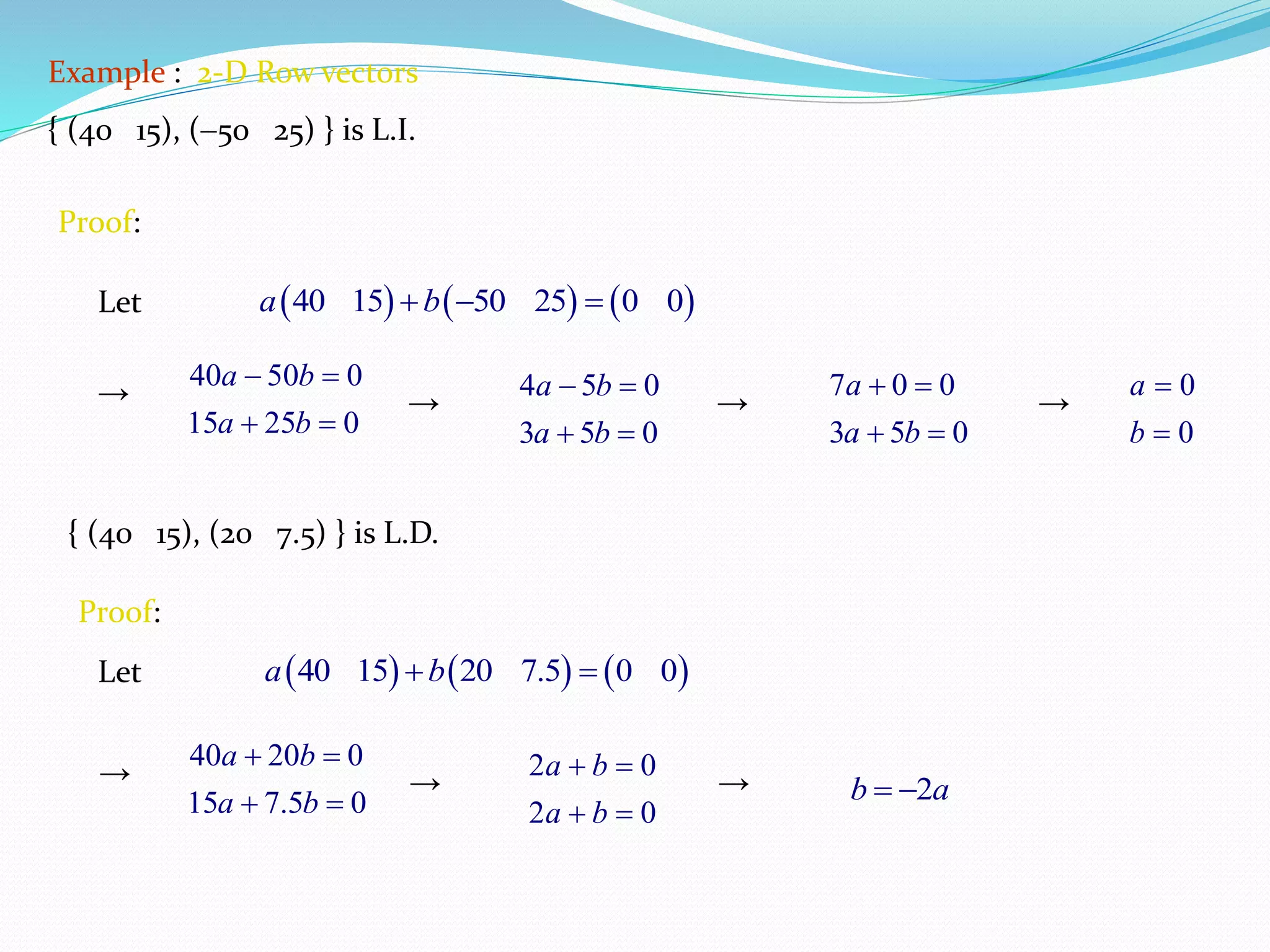
Example : 2-D Row vectors
{ (40 15), (50 25) } is L.I.
Proof:
     40 15 50 25 0 0a b  Let
→
40 50 0
15 25 0
a b
a b
 
 
→
4 5 0
3 5 0
a b
a b
 
 
→
0
0
a
b


→
7 0 0
3 5 0
a
a b
 
 
{ (40 15), (20 7.5) } is L.D.
Proof:
     40 15 20 7.5 0 0a b Let
→
40 20 0
15 7.5 0
a b
a b
 
 
→
2 0
2 0
a b
a b
 
 
→ 2b a 
Example
1 0 1 0 3
0 , 2 , 2 , 1 , 3
0 0 0 1 0
S
          
                     
          
          
spans R3
The independence test equation 1 2 3 4 5
1 0 1 0 3 0
0 2 2 1 3 0
0 0 0 1 0 0
c c c c c
           
                           
           
           
gives
1 0 1 0 3
0 2 2 1 3
0 0 0 1 0
 
  
 
 
3 4
1 0 0 1 3
0 2 1 2 3
0 0 1 0 0
 
 
    
 
 
1 0 0 1 3
0 1 0 1 3/ 2
0 0 1 0 0
 
   
 
 

1
2
4 3 5
3
5
1 3
1 3/ 2
0 0
1 0
0 1
c
c
c c c
c
c
      
           
      
     
     
    
    
1
2
3 3 5
4
5
1 3
1 3/ 2
1 0
0 0
0 1
c
c
c c c
c
c
      
           
      
     
     
    
    
or →
1 0 0
0 , 2 , 1
0 0 1
      
            
      
      
is L.I. & spans R3
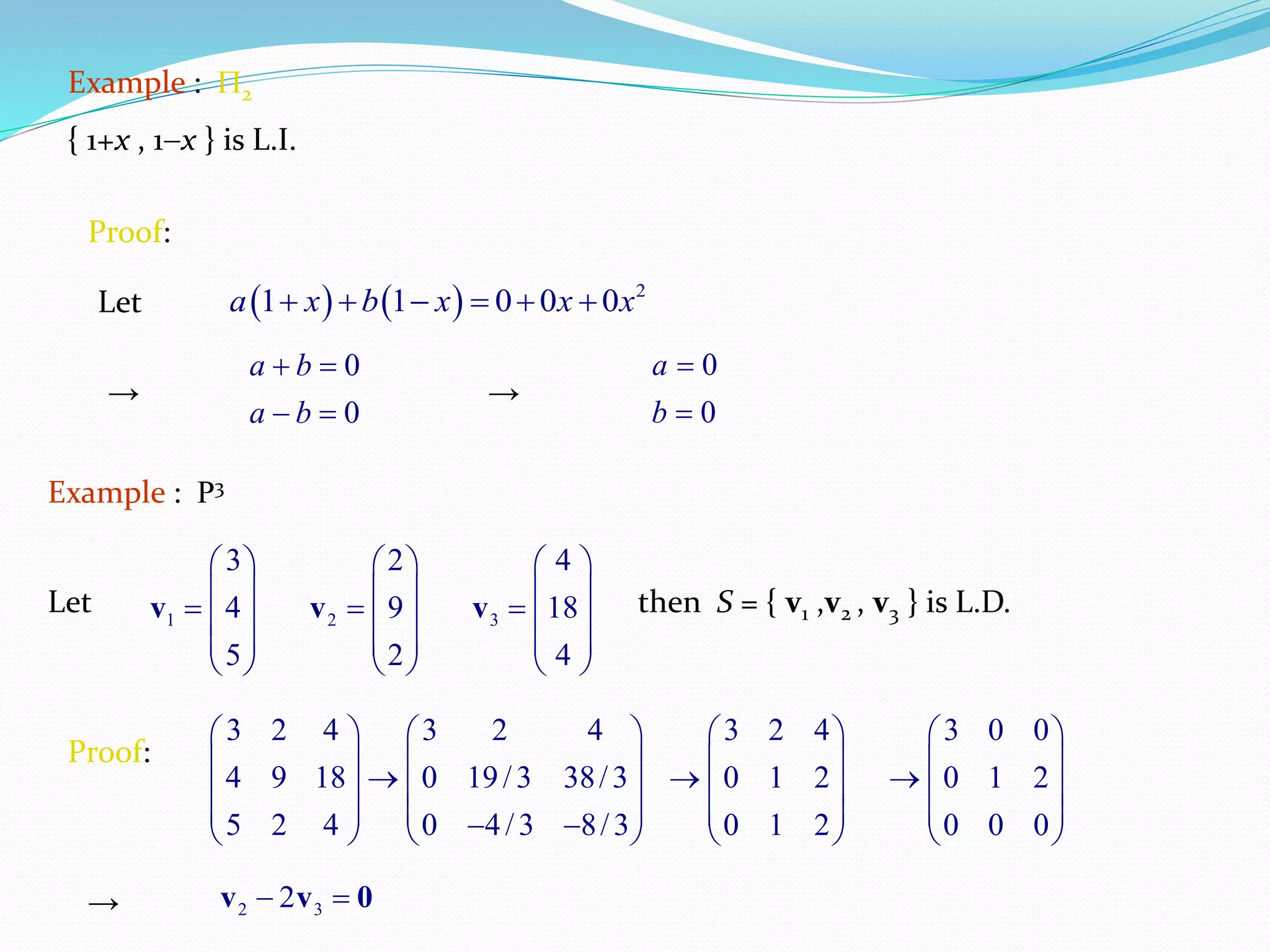
Example : P2
{ 1+x , 1x } is L.I.
Proof:
Let     2
1 1 0 0 0a x b x x x     
→
0
0
a b
a b
 
 
→
0
0
a
b


Example : R3
Let 1 2 3
3 2 4
4 9 18
5 2 4
     
            
     
     
v v v then S = { v1 ,v2 , v3 } is L.D.
Proof:
3 2 4 3 2 4
4 9 18 0 19/3 38/3
5 2 4 0 4/3 8/3
   
      
       
3 2 4
0 1 2
0 1 2
 
   
 
 
3 0 0
0 1 2
0 0 0
 
   
 
 
→ 2 32 v v 0
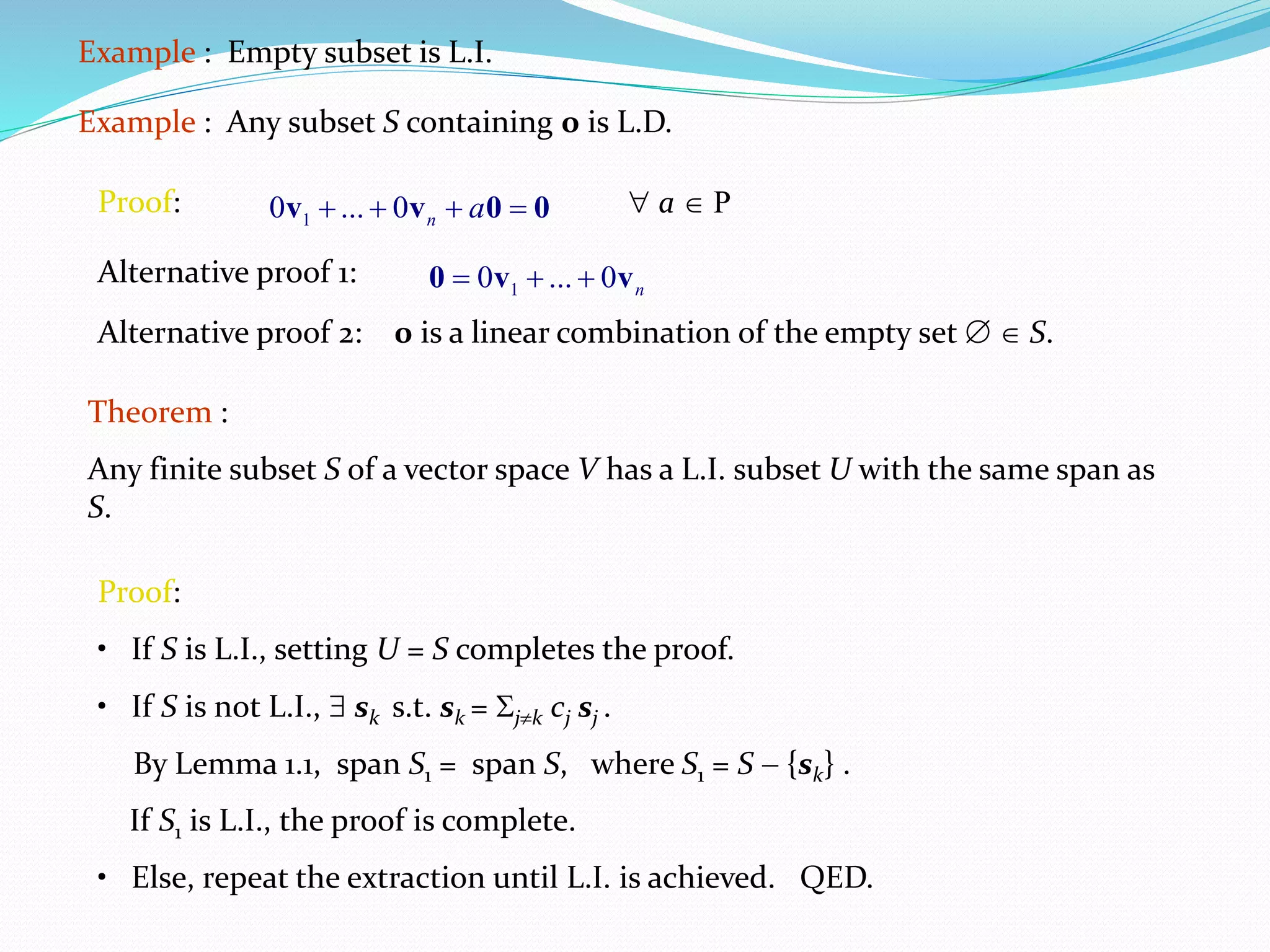
Example : Empty subset is L.I.
Example : Any subset S containing 0 is L.D.
10 ... 0 n a   v v 0 0
Alternative proof 1:
Proof:
Theorem :
Any finite subset S of a vector space V has a L.I. subset U with the same span as
S.
Proof:
• If S is L.I., setting U = S completes the proof.
• If S is not L.I.,  sk s.t. sk = jk cj sj .
By Lemma 1.1, span S1 = span S, where S1 = S  {sk} .
If S1 is L.I., the proof is complete.
• Else, repeat the extraction until L.I. is achieved. QED.
 a  R
10 ... 0 n  0 v v
Alternative proof 2: 0 is a linear combination of the empty set   S.
Lemma :
Any subset of a L.I. set is also L.I. ( L.I.
is preserved by the subset operation.)
Any superset of a L.D. set is also L.D. ( L.D. is
preserved by the superset operation.)
Proof: Trivial.
Subset of a L.D. set can either be L.I. or L.D. (see Example 1.13)
Superset of a L.I. set can either be L.I. or L.D. (see Example 1.15)
Example :
1 0
0 , 1
0 0
S
    
         
    
    
1 0 3
0 , 1 , 2
0 0 0
      
            
      
      
is L.D.
1 0 0
0 , 1 , 0
0 0 1
      
      
      
      
      
is L.I.
S1  S S2  S
S is L.I. S1 is L.I. --
S is L.D. -- S2 is L.D.
Basis
Definition : Basis
A basis of a vector space V is an ordered set of linearly
independent (non-zero) vectors that spans V.
Notation:
1 , , nβ β
Example :
2 1
,
4 1
B
   
    
   
is a basis for R2
B is L.I. :
2 1 0
4 1 0
a b
     
      
     
→
2 0
4 0
a b
a b
 
 
→
0
0
a
b


B spans R2:
2 1
4 1
x
a b
y
     
      
     
→
2
4
a b x
a b y
 
 
→
 
1
2
2
a y x
b x y
 
 
L.I. → Minimal
Span → Complete
Example :
The trivial space { 0 } has only one basis, the empty one  .
Note: By convention, 0 does not count as a basis vector. ( Any
set of vectors containing 0 is linearly dependent. )
Example :
The space of all finite degree polynomials has a basis with infinitely many
elements  1, x, x2, … .
Example : Solution Set of Homogeneous Systems
The solution set of
0
0
x y w
z w
  
 
1 1
1 0
,
0 1
0 1
y w y w
    
    
      
    
        
Ris
1 1
1 0
,
0 1
0 1
Span
    
    
      
    
        
( Proof of L.I. is
left as exercise )
Theorem :
In any finite-dimensional vector space, all of the bases have
the same number of elements.
Proof:
Let B =  β1 , …, βn  be a basis of n elements.
Any other basis D =  δ1 , …, δm  must have m  n.
1 1 1 k k n nc c c    δ β β βLet with ck  0.
By lemma 2.2, D1 =  β1 , …, βk  1 ,δ1 ,βk + 1 , …, βn  is a basis.
Next, replacing βj in D1 begets
D2 =  β1 , …, βk  1 ,δ1 ,βk + 1 , …, βj  1 ,δ2 ,βj + 1 , …, βn 
Repeating the process n times results in a basis Dn =  δ1 , …, δn  that spans V.
Which contradicts with the assumption that D is L.I.
1 1 1n n nc c   δ δ δ with at least one ck  0.If m > n, then we can write
Hence m = n.
Ex : Testing for linear independence
Determine whether the following set of vectors in P2 is L.I. or
L.D.
c1v1+c2v2+c3v3 = 0
i.e., c1(1+x – 2x2) + c2(2+5x – x2) + c3(x+x2) = 0+0x+0x2

c1+2c2 = 0
c1+5c2+c3 = 0
–2c1– c2+c3 = 0
Sol:
 This system has infinitely many solutions
(i.e., this system has nontrivial solutions, e.g., c1=2, c2= – 1, c3=3)
 S is (or v1, v2, v3 are) linearly dependent
1 2 0 0
1 5 1 0
2 1 1 0
 
 
 
   
1 2 0 0
10 1 0
3
0 0 0 0
 
 
 
 
 

G. E.

   2 2 2
1 2 3, , 1 2 ,2 5 ,S x x x x x x      v v v
Theorem : Uniqueness of basis representation for any vectors
If is a basis for a vector space V, then
everyvector in V can be written in one and only one way as a
linear combination of vectors in S
 nS vvv ,,, 21 
Pf:



basisaisS
(1) span(S) = V
(2) S is linearly independent
 span(S) = V Let v = c1v1+c2v2+…+cnvn
v = b1v1+b2v2+…+bnvn
 v + (–1)v = 0 = (c1– b1)v1 + (c2 – b2)v2 + … + (cn – bn)vn
is linearly independent with only the trivial solutionS 
(i.e., unique basis representation) c1 = b1 , c2 = b2 ,…, cn = bn
coefficients for are all zeroi v
Ex: Find the dimension of a vector space according to the standard basis
(1) Vector space Rn
 standard basis {e1 , e2 ,  , en}
(2) Vector space Mmn  standard basis {Eij | 1im , 1jn}
(3) Vector space Pn(x)  standard basis {1, x, x2,  , xn}
(4) Vector space P(x)  standard basis {1, x, x2, }
 dim(R
n
) = n
 dim(Mmn) = mn
 dim(Pn(x)) = n+1
 dim(P(x)) = 
※ The simplest way to find the dimension of a vector space is to count the
number of vectors in the “standard” basis for that vector space
and in Eij
1
other entries are zero
ija 


Pf:
Theorem : Row-equivalent matrices have the same row space
If an mn matrix A is row equivalent to an mn matrix B,
then the row space of A is equal to the row space of B
(1) Since B can be obtained from A by elementary row operations, the row vectors of
B can be expressed as linear combinations of the row vectors of A  The linear
combinations of row vectors in B must be linear combinations of row vectors in
A  any vector in RS(B) lies in RS(A)  RS(B)  RS(A)
(2) Since A can be obtained from B by elementary row operations, the row vectors of
A can be written as linear combinations of the row vectors of B  The linear
combinations of row vectors in A must be linear combinations of row vectors in
B  any vector in RS(A) lies in RS(B)  RS(A)  RS(B)
( ) = ( )RS A RS B
Summary of equivalent conditions for square matrices:
If A is an n×n matrix, then the following conditions are
equivalent
(1) A is invertible
(2) Ax = b has a unique solution for any n×1 matrix b
(3) Ax = 0 has only the trivial solution
(4) A is row-equivalent to In
(5) det (A)  0
(6) rank(A) = n
(7) There are n row vectors of A which are linearly independent
(8) There are n column vectors of A which are linearly independent
(The above five statements are from Slide 3.39)
(The last three statements are from the arguments on Slide 4.95)

Linear algebra

  • 1.
    Linear Algebra 15UMTC61 K.Anitha M.Sc.,M.Phil., G.Nagalakshmi M.Sc., M.phil.,
  • 2.
    Linear Independence Definition andExamples A subset of a vector space is linearly independent (L.I.) if none of its elements is a linear combination of the others. Otherwise, it is linearly dependent (L.D.).
  • 3.
    Example : 2-DRow vectors { (40 15), (50 25) } is L.I. Proof:      40 15 50 25 0 0a b  Let → 40 50 0 15 25 0 a b a b     → 4 5 0 3 5 0 a b a b     → 0 0 a b   → 7 0 0 3 5 0 a a b     { (40 15), (20 7.5) } is L.D. Proof:      40 15 20 7.5 0 0a b Let → 40 20 0 15 7.5 0 a b a b     → 2 0 2 0 a b a b     → 2b a 
  • 4.
    Example 1 0 10 3 0 , 2 , 2 , 1 , 3 0 0 0 1 0 S                                                        spans R3 The independence test equation 1 2 3 4 5 1 0 1 0 3 0 0 2 2 1 3 0 0 0 0 1 0 0 c c c c c                                                                 gives 1 0 1 0 3 0 2 2 1 3 0 0 0 1 0          3 4 1 0 0 1 3 0 2 1 2 3 0 0 1 0 0              1 0 0 1 3 0 1 0 1 3/ 2 0 0 1 0 0            1 2 4 3 5 3 5 1 3 1 3/ 2 0 0 1 0 0 1 c c c c c c c                                                 1 2 3 3 5 4 5 1 3 1 3/ 2 1 0 0 0 0 1 c c c c c c c                                                 or → 1 0 0 0 , 2 , 1 0 0 1                                   is L.I. & spans R3
  • 5.
    Example : P2 {1+x , 1x } is L.I. Proof: Let     2 1 1 0 0 0a x b x x x      → 0 0 a b a b     → 0 0 a b   Example : R3 Let 1 2 3 3 2 4 4 9 18 5 2 4                                v v v then S = { v1 ,v2 , v3 } is L.D. Proof: 3 2 4 3 2 4 4 9 18 0 19/3 38/3 5 2 4 0 4/3 8/3                    3 2 4 0 1 2 0 1 2           3 0 0 0 1 2 0 0 0           → 2 32 v v 0
  • 6.
    Example : Emptysubset is L.I. Example : Any subset S containing 0 is L.D. 10 ... 0 n a   v v 0 0 Alternative proof 1: Proof: Theorem : Any finite subset S of a vector space V has a L.I. subset U with the same span as S. Proof: • If S is L.I., setting U = S completes the proof. • If S is not L.I.,  sk s.t. sk = jk cj sj . By Lemma 1.1, span S1 = span S, where S1 = S  {sk} . If S1 is L.I., the proof is complete. • Else, repeat the extraction until L.I. is achieved. QED.  a  R 10 ... 0 n  0 v v Alternative proof 2: 0 is a linear combination of the empty set   S.
  • 7.
    Lemma : Any subsetof a L.I. set is also L.I. ( L.I. is preserved by the subset operation.) Any superset of a L.D. set is also L.D. ( L.D. is preserved by the superset operation.) Proof: Trivial. Subset of a L.D. set can either be L.I. or L.D. (see Example 1.13) Superset of a L.I. set can either be L.I. or L.D. (see Example 1.15) Example : 1 0 0 , 1 0 0 S                          1 0 3 0 , 1 , 2 0 0 0                                   is L.D. 1 0 0 0 , 1 , 0 0 0 1                                    is L.I. S1  S S2  S S is L.I. S1 is L.I. -- S is L.D. -- S2 is L.D.
  • 8.
    Basis Definition : Basis Abasis of a vector space V is an ordered set of linearly independent (non-zero) vectors that spans V. Notation: 1 , , nβ β Example : 2 1 , 4 1 B              is a basis for R2 B is L.I. : 2 1 0 4 1 0 a b                    → 2 0 4 0 a b a b     → 0 0 a b   B spans R2: 2 1 4 1 x a b y                    → 2 4 a b x a b y     →   1 2 2 a y x b x y     L.I. → Minimal Span → Complete
  • 9.
    Example : The trivialspace { 0 } has only one basis, the empty one  . Note: By convention, 0 does not count as a basis vector. ( Any set of vectors containing 0 is linearly dependent. ) Example : The space of all finite degree polynomials has a basis with infinitely many elements  1, x, x2, … . Example : Solution Set of Homogeneous Systems The solution set of 0 0 x y w z w      1 1 1 0 , 0 1 0 1 y w y w                                Ris 1 1 1 0 , 0 1 0 1 Span                                ( Proof of L.I. is left as exercise )
  • 10.
    Theorem : In anyfinite-dimensional vector space, all of the bases have the same number of elements. Proof: Let B =  β1 , …, βn  be a basis of n elements. Any other basis D =  δ1 , …, δm  must have m  n. 1 1 1 k k n nc c c    δ β β βLet with ck  0. By lemma 2.2, D1 =  β1 , …, βk  1 ,δ1 ,βk + 1 , …, βn  is a basis. Next, replacing βj in D1 begets D2 =  β1 , …, βk  1 ,δ1 ,βk + 1 , …, βj  1 ,δ2 ,βj + 1 , …, βn  Repeating the process n times results in a basis Dn =  δ1 , …, δn  that spans V. Which contradicts with the assumption that D is L.I. 1 1 1n n nc c   δ δ δ with at least one ck  0.If m > n, then we can write Hence m = n.
  • 11.
    Ex : Testingfor linear independence Determine whether the following set of vectors in P2 is L.I. or L.D. c1v1+c2v2+c3v3 = 0 i.e., c1(1+x – 2x2) + c2(2+5x – x2) + c3(x+x2) = 0+0x+0x2  c1+2c2 = 0 c1+5c2+c3 = 0 –2c1– c2+c3 = 0 Sol:  This system has infinitely many solutions (i.e., this system has nontrivial solutions, e.g., c1=2, c2= – 1, c3=3)  S is (or v1, v2, v3 are) linearly dependent 1 2 0 0 1 5 1 0 2 1 1 0           1 2 0 0 10 1 0 3 0 0 0 0            G. E.     2 2 2 1 2 3, , 1 2 ,2 5 ,S x x x x x x      v v v
  • 12.
    Theorem : Uniquenessof basis representation for any vectors If is a basis for a vector space V, then everyvector in V can be written in one and only one way as a linear combination of vectors in S  nS vvv ,,, 21  Pf:    basisaisS (1) span(S) = V (2) S is linearly independent  span(S) = V Let v = c1v1+c2v2+…+cnvn v = b1v1+b2v2+…+bnvn  v + (–1)v = 0 = (c1– b1)v1 + (c2 – b2)v2 + … + (cn – bn)vn is linearly independent with only the trivial solutionS  (i.e., unique basis representation) c1 = b1 , c2 = b2 ,…, cn = bn coefficients for are all zeroi v
  • 13.
    Ex: Find thedimension of a vector space according to the standard basis (1) Vector space Rn  standard basis {e1 , e2 ,  , en} (2) Vector space Mmn  standard basis {Eij | 1im , 1jn} (3) Vector space Pn(x)  standard basis {1, x, x2,  , xn} (4) Vector space P(x)  standard basis {1, x, x2, }  dim(R n ) = n  dim(Mmn) = mn  dim(Pn(x)) = n+1  dim(P(x)) =  ※ The simplest way to find the dimension of a vector space is to count the number of vectors in the “standard” basis for that vector space and in Eij 1 other entries are zero ija   
  • 14.
    Pf: Theorem : Row-equivalentmatrices have the same row space If an mn matrix A is row equivalent to an mn matrix B, then the row space of A is equal to the row space of B (1) Since B can be obtained from A by elementary row operations, the row vectors of B can be expressed as linear combinations of the row vectors of A  The linear combinations of row vectors in B must be linear combinations of row vectors in A  any vector in RS(B) lies in RS(A)  RS(B)  RS(A) (2) Since A can be obtained from B by elementary row operations, the row vectors of A can be written as linear combinations of the row vectors of B  The linear combinations of row vectors in A must be linear combinations of row vectors in B  any vector in RS(A) lies in RS(B)  RS(A)  RS(B) ( ) = ( )RS A RS B
  • 15.
    Summary of equivalentconditions for square matrices: If A is an n×n matrix, then the following conditions are equivalent (1) A is invertible (2) Ax = b has a unique solution for any n×1 matrix b (3) Ax = 0 has only the trivial solution (4) A is row-equivalent to In (5) det (A)  0 (6) rank(A) = n (7) There are n row vectors of A which are linearly independent (8) There are n column vectors of A which are linearly independent (The above five statements are from Slide 3.39) (The last three statements are from the arguments on Slide 4.95)