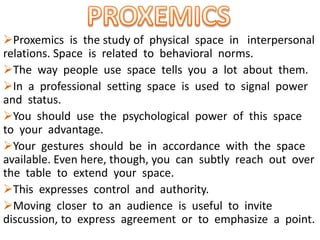
Proxemics is the study of physical space in interpersonal
relations. Space is related to behavioral norms.
The way people use space tells you a lot about them.
In a professional setting space is used to signal power
and status.
You should use the psychological power of this space
to your advantage.
Your gestures should be in accordance with the space
available. Even here, though, you can subtly reach out over
the table to extend your space.
This expresses control and authority.
Moving closer to an audience is useful to invite
discussion, to express agreement or to emphasize a point.
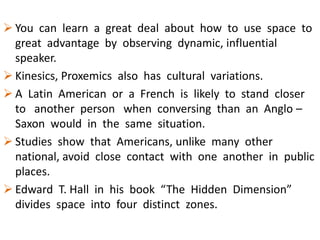
 You can learn a great deal about how to use space to
great advantage by observing dynamic, influential
speaker.
 Kinesics, Proxemics also has cultural variations.
 A Latin American or a French is likely to stand closer
to another person when conversing than an Anglo –
Saxon would in the same situation.
 Studies show that Americans, unlike many other
national, avoid close contact with one another in public
places.
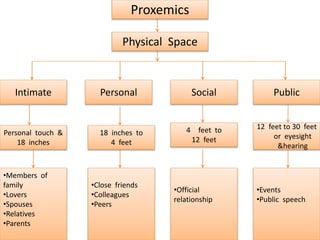
 Edward T. Hall in his book “The Hidden Dimension”
divides space into four distinct zones.
Intimate Personal Social Public
18 inches to
4 feet
Personal touch &
18 inches
4 feet to
12 feet
12 feet to 30 feet
or eyesight
&hearing
•Members of
family
•Lovers
•Spouses
•Relatives
•Parents
•Close friends
•Colleagues
•Peers
•Official
relationship
•Events
•Public speech
Proxemics
Physical Space
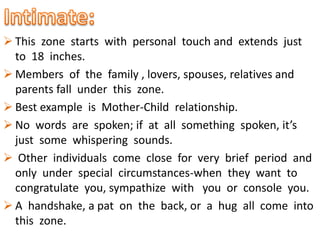
 This zone starts with personal touch and extends just
to 18 inches.
 Members of the family , lovers, spouses, relatives and
parents fall under this zone.
 Best example is Mother-Child relationship.
 No words are spoken; if at all something spoken, it’s
just some whispering sounds.
 Other individuals come close for very brief period and
only under special circumstances-when they want to
congratulate you, sympathize with you or console you.
 A handshake, a pat on the back, or a hug all come into
this zone.
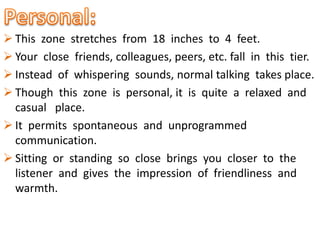
 This zone stretches from 18 inches to 4 feet.
 Your close friends, colleagues, peers, etc. fall in this tier.
 Instead of whispering sounds, normal talking takes place.
 Though this zone is personal, it is quite a relaxed and
casual place.
 It permits spontaneous and unprogrammed
communication.
 Sitting or standing so close brings you closer to the
listener and gives the impression of friendliness and
warmth.
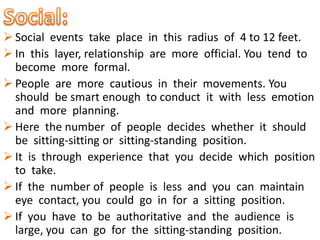
 Social events take place in this radius of 4 to 12 feet.
 In this layer, relationship are more official. You tend to
become more formal.
 People are more cautious in their movements. You
should be smart enough to conduct it with less emotion
and more planning.
 Here the number of people decides whether it should
be sitting-sitting or sitting-standing position.
 It is through experience that you decide which position
to take.
 If the number of people is less and you can maintain
eye contact, you could go in for a sitting position.
 If you have to be authoritative and the audience is
large, you can go for the sitting-standing position.
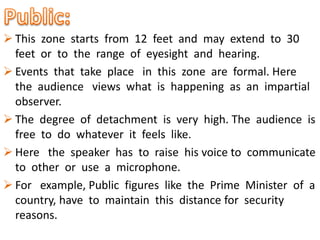
 This zone starts from 12 feet and may extend to 30
feet or to the range of eyesight and hearing.
 Events that take place in this zone are formal. Here
the audience views what is happening as an impartial
observer.
 The degree of detachment is very high. The audience is
free to do whatever it feels like.
 Here the speaker has to raise his voice to communicate
to other or use a microphone.
 For example, Public figures like the Prime Minister of a
country, have to maintain this distance for security
reasons.
Proxemics (2) (Communication Skills)

Proxemics (2) (Communication Skills)

  • 2.
    Proxemics is thestudy of physical space in interpersonal relations. Space is related to behavioral norms. The way people use space tells you a lot about them. In a professional setting space is used to signal power and status. You should use the psychological power of this space to your advantage. Your gestures should be in accordance with the space available. Even here, though, you can subtly reach out over the table to extend your space. This expresses control and authority. Moving closer to an audience is useful to invite discussion, to express agreement or to emphasize a point.
  • 3.
     You canlearn a great deal about how to use space to great advantage by observing dynamic, influential speaker.  Kinesics, Proxemics also has cultural variations.  A Latin American or a French is likely to stand closer to another person when conversing than an Anglo – Saxon would in the same situation.  Studies show that Americans, unlike many other national, avoid close contact with one another in public places.  Edward T. Hall in his book “The Hidden Dimension” divides space into four distinct zones.
  • 4.
    Intimate Personal SocialPublic 18 inches to 4 feet Personal touch & 18 inches 4 feet to 12 feet 12 feet to 30 feet or eyesight &hearing •Members of family •Lovers •Spouses •Relatives •Parents •Close friends •Colleagues •Peers •Official relationship •Events •Public speech Proxemics Physical Space
  • 5.
     This zonestarts with personal touch and extends just to 18 inches.  Members of the family , lovers, spouses, relatives and parents fall under this zone.  Best example is Mother-Child relationship.  No words are spoken; if at all something spoken, it’s just some whispering sounds.  Other individuals come close for very brief period and only under special circumstances-when they want to congratulate you, sympathize with you or console you.  A handshake, a pat on the back, or a hug all come into this zone.
  • 6.
     This zonestretches from 18 inches to 4 feet.  Your close friends, colleagues, peers, etc. fall in this tier.  Instead of whispering sounds, normal talking takes place.  Though this zone is personal, it is quite a relaxed and casual place.  It permits spontaneous and unprogrammed communication.  Sitting or standing so close brings you closer to the listener and gives the impression of friendliness and warmth.
  • 7.
     Social eventstake place in this radius of 4 to 12 feet.  In this layer, relationship are more official. You tend to become more formal.  People are more cautious in their movements. You should be smart enough to conduct it with less emotion and more planning.  Here the number of people decides whether it should be sitting-sitting or sitting-standing position.  It is through experience that you decide which position to take.  If the number of people is less and you can maintain eye contact, you could go in for a sitting position.  If you have to be authoritative and the audience is large, you can go for the sitting-standing position.
  • 8.
     This zonestarts from 12 feet and may extend to 30 feet or to the range of eyesight and hearing.  Events that take place in this zone are formal. Here the audience views what is happening as an impartial observer.  The degree of detachment is very high. The audience is free to do whatever it feels like.  Here the speaker has to raise his voice to communicate to other or use a microphone.  For example, Public figures like the Prime Minister of a country, have to maintain this distance for security reasons.