Fractures of
the Calcaneus
Cory Collinge, MD
Keith Heier, MD
Introduction
“…the man who breaks his heel bone is
done.”
- Cotton and Henderson, 1916
“…results of crush fractures of the os calcis
are rotten.”
- Bankhart, 1942
Introduction
• High potential for disability
─ Pain
─ Gait disturbance
─ Unable to work
• “Best” treatment method controversial
Anatomy
• Subtalar joint
─ Facets: anterior, middle, posterior
• Calcaneocuboid joint
• Sustentaculum
• Tuberosity
• Anterior process
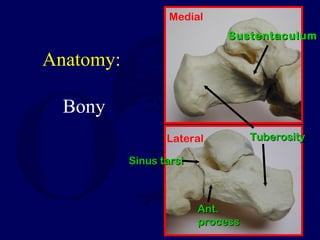
Anatomy:
Bony
SustentaculumSustentaculum
Medial
Lateral
Ant.Ant.
processprocess
TuberosityTuberosity
Sinus tarsiSinus tarsi
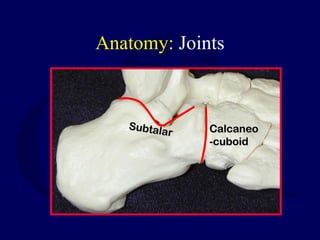
Anatomy: Joints
Subtalar
Subtalar CalcaneoCalcaneo
-cuboid-cuboid
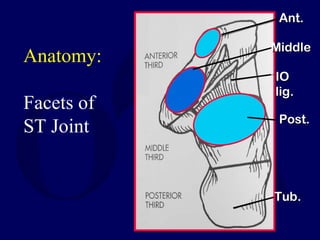
Anatomy:
Facets of
ST Joint
Ant.Ant.
MiddleMiddle
Post.Post.
Tub.Tub.
IOIO
lig.lig.
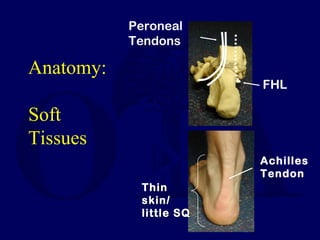
Anatomy:
Soft
Tissues
FHL
Peroneal
Tendons
Achilles
Tendon
ThinThin
skin/skin/
little SQlittle SQ
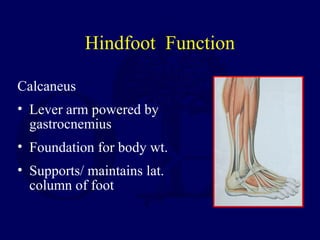
Hindfoot Function
Calcaneus
• Lever arm powered by
gastrocnemius
• Foundation for body wt.
• Supports/ maintains lat.
column of foot
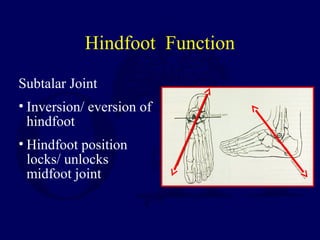
Hindfoot Function
Subtalar Joint
• Inversion/ eversion of
hindfoot
• Hindfoot position
locks/ unlocks
midfoot joint
“Extra-articular” Fractures
• Anterior process fracture
• Tuberosity (body) fracture
• Tuberosity avulsion
• Sustentacular fracture
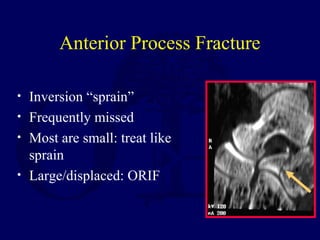
Anterior Process Fracture
• Inversion “sprain”
• Frequently missed
• Most are small: treat like
sprain
• Large/displaced: ORIF
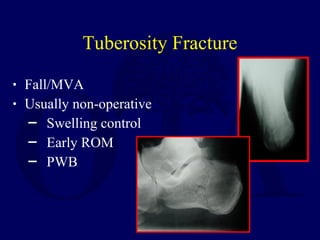
• Fall/MVA
• Usually non-operative
─ Swelling control
─ Early ROM
─ PWB
Tuberosity Fracture
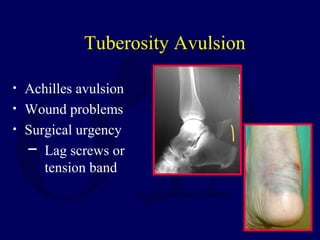
Tuberosity Avulsion
• Achilles avulsion
• Wound problems
• Surgical urgency
─ Lag screws or
tension band
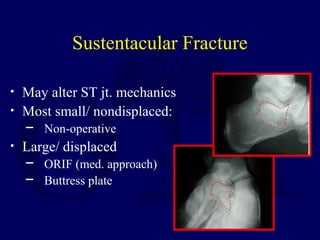
Sustentacular Fracture
• May alter ST jt. mechanics
• Most small/ nondisplaced:
─ Non-operative
• Large/ displaced
─ ORIF (med. approach)
─ Buttress plate
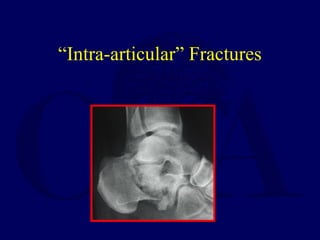
“Intra-articular” Fractures
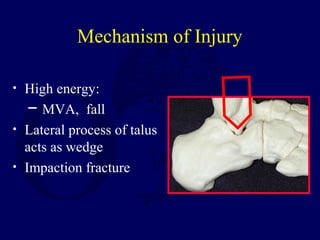
Mechanism of Injury
• High energy:
─ MVA, fall
• Lateral process of talus
acts as wedge
• Impaction fracture
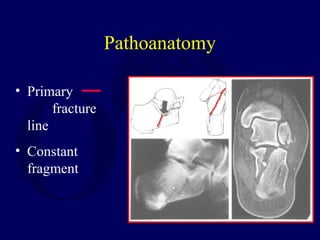
Pathoanatomy
• Primary
fracture
line
• Constant
fragment
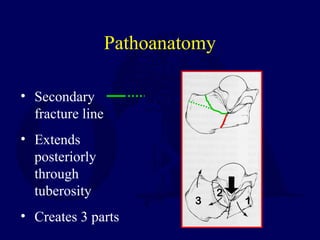
Pathoanatomy
• Secondary
fracture line
• Extends
posteriorly
through
tuberosity
• Creates 3 parts
1
2
3
Pathoanatomy
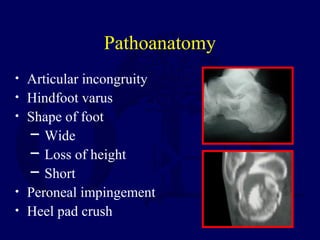
• Articular incongruity
• Hindfoot varus
• Shape of foot
─ Wide
─ Loss of height
─ Short
• Peroneal impingement
• Heel pad crush
Pathoanatomy
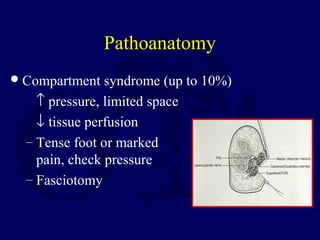
Compartment syndrome (up to 10%)
↑ pressure, limited space
↓ tissue perfusion
– Tense foot or marked
pain, check pressure
– Fasciotomy
Clinical Problems
• Stiffness
• Loss of normal gait
• Shoewear problems
• Arthritic pain
• Peroneal pain
• Heel pad pain
Imaging: Plain Films
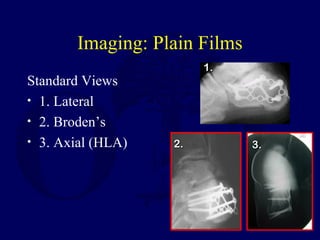
Standard Views
• 1. Lateral
• 2. Broden’s
• 3. Axial (HLA)
1.1.
3.3.2.2.
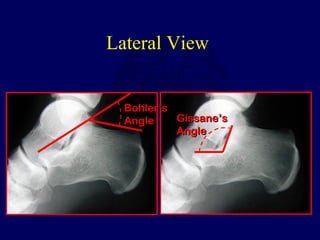
Lateral View
Bohler’sBohler’s
AngleAngle Gissane’sGissane’s
AngleAngle
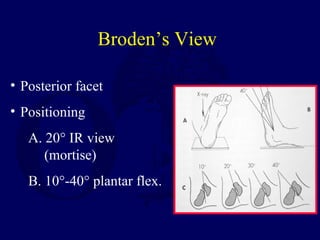
Broden’s View
• Posterior facet
• Positioning
A. 20° IR view
(mortise)
B. 10°-40° plantar flex.
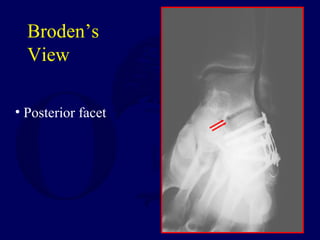
Broden’s
View
• Posterior facet
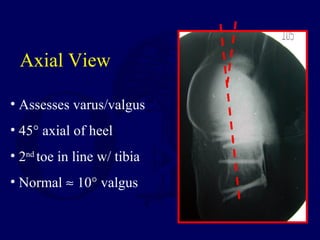
Axial View
• Assesses varus/valgus
• 45° axial of heel
• 2nd
toe in line w/ tibia
• Normal ≈ 10° valgus
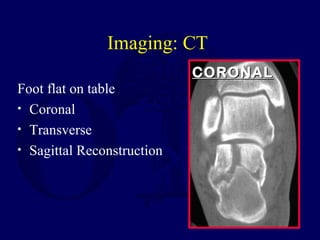
Imaging: CT
Foot flat on table
• Coronal
• Transverse
• Sagittal Reconstruction
CORONALCORONAL
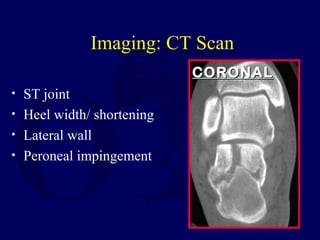
Imaging: CT Scan
• ST joint
• Heel width/ shortening
• Lateral wall
• Peroneal impingement
CORONALCORONAL
Imaging: CT Scan
•
CalcaneocuboidCalcaneocuboid
jt.jt.
• Similar to lateralSimilar to lateral
radiographradiograph
TRANSVERSETRANSVERSE SAGITTALSAGITTALSAGITTALSAGITTAL
• Similar toSimilar to
lateral Xraylateral Xray
Classifications
• Several used- None are ideal
• Most commonly used
─ Essex-Lopresti
─ Sanders
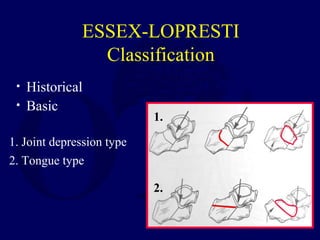
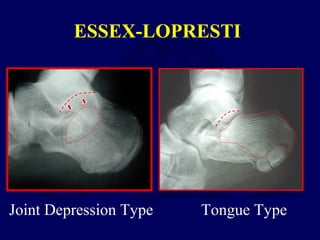
ESSEX-LOPRESTI
Classification
• Historical
• Basic
1. Joint depression type
2. Tongue type
1.
2.
ESSEX-LOPRESTI
Joint Depression Type Tongue Type
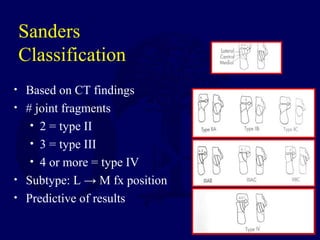
Sanders
Classification
• Based on CT findings
• # joint fragments
• 2 = type II
• 3 = type III
• 4 or more = type IV
• Subtype: L → M fx position
• Predictive of results
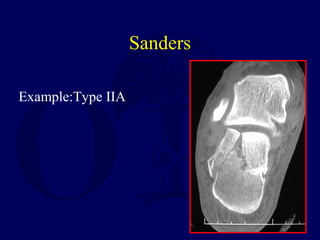
Sanders
Example:Type IIA
Treatment: Historical
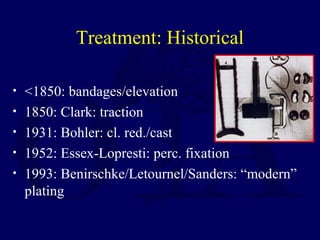
• <1850: bandages/elevation
• 1850: Clark: traction
• 1931: Bohler: cl. red./cast
• 1952: Essex-Lopresti: perc. fixation
• 1993: Benirschke/Letournel/Sanders: “modern”
plating
Non-op Treatment: Natural History
Nade and Monahan, Injury, 1973
• 57% long term symptoms (pain, swelling,
stiffness)
• 95% symptoms on uneven ground
• 76% broad heel
As a standard treatment …..”[results] are not
good enough and deserve further studies”
Non-op Treatment:
Complications
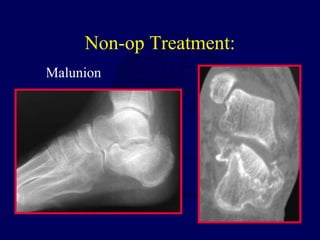
Malunion
• Varus hindfoot
─ Locks midfoot
─ Medializes “foundation” for stance
• Shortened foot = short lever arm
• Peroneal impingement/ dislocation
• Shoewear problems
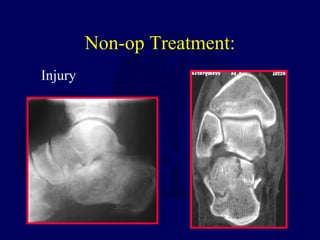
Non-op Treatment:
Injury
Non-op Treatment:
Malunion
Non-op Treatment:
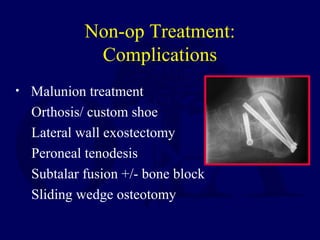
Complications
• Malunion treatment
Orthosis/ custom shoe
Lateral wall exostectomy
Peroneal tenodesis
Subtalar fusion +/- bone block
Sliding wedge osteotomy
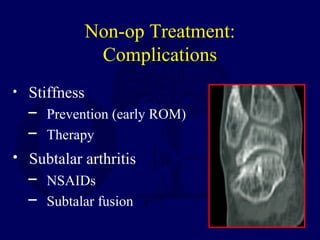
Non-op Treatment:
Complications
• Stiffness
─ Prevention (early ROM)
─ Therapy
• Subtalar arthritis
─ NSAIDs
─ Subtalar fusion
Non-op Treatment:
Complications
• Peroneal tendon problems
─ Tendonitis- NSAIDs, therapy
─ Entrapped-release tendons, exostectomy
─ Dislocated-open reduction
• Sural nerve pain
─ Medications
─ Orthosis
─ Neurectomy
• Heel pad pain
─ Orthosis
Non-op Treatment:
Complications
Operative Treatment:
Natural History
• Early studies recommending non-op treatment:
─ Old ORIF techniques
─ No CT classification
─ No assessment of fracture reduction
Operative Treatment:
Natural History
• Initial results were poor (wound problems)
• Newer ORIF techniques improved results
─ Anatomic reduction for good result
─ Fracture severity correlates with results
─ Learning curve
Operative Treatment:
Rationale
• Restore anatomy
─ Shape and alignment of hindfoot
─ Articular congruency
• Return to function & prevent arthritis
• Typically, restoring articular anatomy gives
improved results if complications are avoided
Operative vs. Non-op Treatment
• Orthopedic literature is lacking
• No prospective, randomized studies with
longterm follow-up
Operative vs. Non-op Treatment
Thodarson and Krueger, F&A, 1996
• Matched set of op and non-op treatment
• Modern operative technique
• AOFAS scores: Operative= 86.7
Non-op= 55
“Operative treatment successful and preferable unless
contrainications present”
Operative Treatment:
Contraindications
• Diabetes
• Vascular insufficiency
• Smoker
• Severe swelling
• Open fractures
• Sanders type IV
(very comminuted)
• Elderly
• Neuropathic
• Non-compliant pt.
• In-experienced
surgeon
Operative Treatment:
Contraindications
Folk et al., JOT, 1999
• Diabetes
• Vascular insufficiency
• Smoker
Wound problems: these factors have additive effects.
If all 3, >90%.
Operative Treatment:
Contraindications
Heier, et al., OTA, 1999/AAOS, 2000
• Open Fractures
– Mostly medial wounds, varied severity
– All treated with I&D/ IV abx
– Grade II-III: 48% infections
– Grade IIIB: 77% infections & 46% BKAs
Operative Treatment:
Contraindications
Open Fracture Recommendations
• ORIF?: Medial grade I open fx
• Closed treatment for all lateral wounds and
grade III medial open fx
• Percutaneous methods?
Treatment:
A Rational Approach?
• Many treatment methods attempted
• “Best” method remains controversial
• Assess each case individually
– Injury/ patient/ surgeon
– Risks vs. benefits
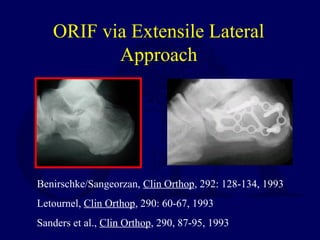
ORIF via Extensile Lateral
Approach
Benirschke/Sangeorzan, Clin Orthop, 292: 128-134, 1993
Letournel, Clin Orthop, 290: 60-67, 1993
Sanders et al., Clin Orthop, 290, 87-95, 1993
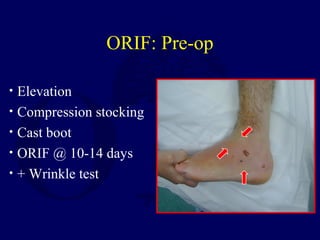
ORIF: Pre-op
• Elevation
• Compression stocking
• Cast boot
• ORIF @ 10-14 days
• + Wrinkle test
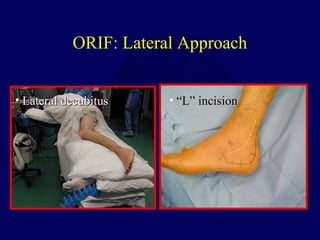
ORIF: Lateral Approach
• Lateral decubitusLateral decubitus • ““L” incisionL” incision
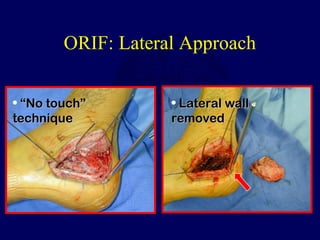
ORIF: Lateral Approach
• ““No touch”No touch”
techniquetechnique
• Lateral wallLateral wall
removedremoved
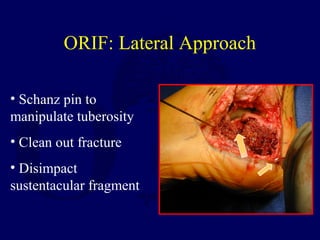
ORIF: Lateral Approach
• Schanz pin to
manipulate tuberosity
• Clean out fracture
• Disimpact
sustentacular fragment
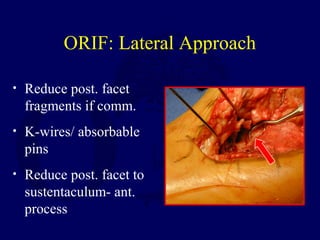
ORIF: Lateral Approach
• Reduce post. facet
fragments if comm.
• K-wires/ absorbable
pins
• Reduce post. facet to
sustentaculum- ant.
process
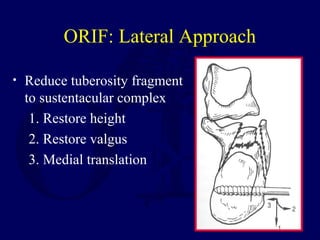
ORIF: Lateral Approach
• Reduce tuberosity fragment
to sustentacular complex
1. Restore height
2. Restore valgus
3. Medial translation
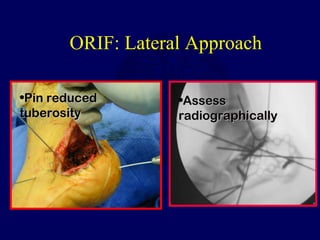
ORIF: Lateral Approach
•Pin reducedPin reduced
tuberositytuberosity
•AssessAssess
radiographicallyradiographically
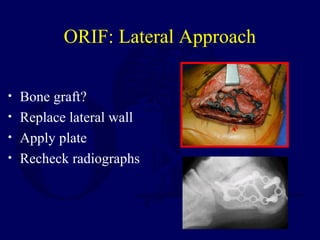
ORIF: Lateral Approach
• Bone graft?
• Replace lateral wall
• Apply plate
• Recheck radiographs
ORIF: Lateral Approach
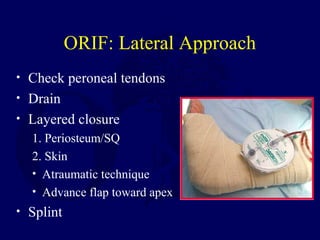
• Check peroneal tendons
• Drain
• Layered closure
1. Periosteum/SQ
2. Skin
• Atraumatic technique
• Advance flap toward apex
• Splint
Postoperative Care
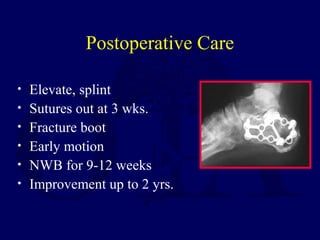
• Elevate, splint
• Sutures out at 3 wks.
• Fracture boot
• Early motion
• NWB for 9-12 weeks
• Improvement up to 2 yrs.
Operative Treatment:
Complications
• All those of non-operative care….
─ Malunion
─ Stiffness
─ Subtalar arthritis
─ Peroneal tendons
─ Sural nerve pain
─ Heel pad problems, plus…
Operative Treatment:
Complications
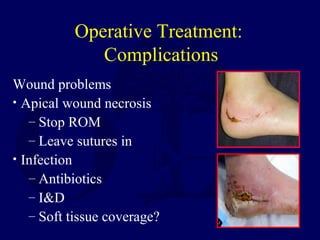
Wound problems
• Apical wound necrosis
– Stop ROM
– Leave sutures in
• Infection
– Antibiotics
– I&D
– Soft tissue coverage?
Operative Treatment:
Other Surgical Options
• Closed Reduction/ Int. Fixation
─ Percutaneous
─ Arthroscopic assisted
• Ilizarov
• Primary Fusion
• Others?
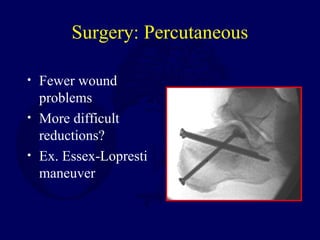
Surgery: Percutaneous
• Fewer wound
problems
• More difficult
reductions?
• Ex. Essex-Lopresti
maneuver
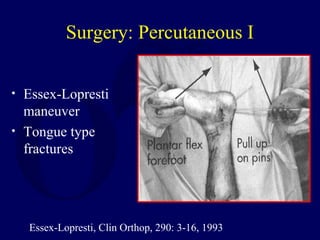
Surgery: Percutaneous I
• Essex-Lopresti
maneuver
• Tongue type
fractures
Essex-Lopresti, Clin Orthop, 290: 3-16, 1993
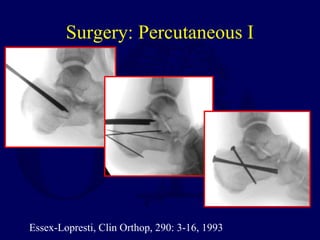
Surgery: Percutaneous I
Essex-Lopresti, Clin Orthop, 290: 3-16, 1993
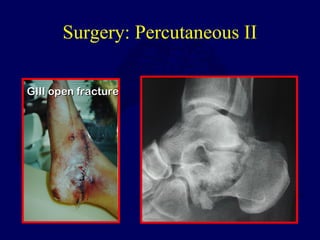
GIII open fractureGIII open fracture
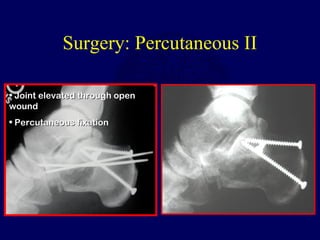
Surgery: Percutaneous II
• Joint elevated through openJoint elevated through open
woundwound
• Percutaneous fixationPercutaneous fixation
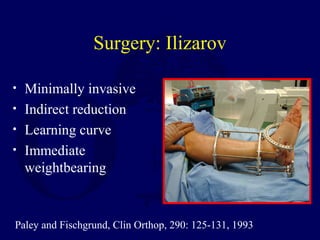
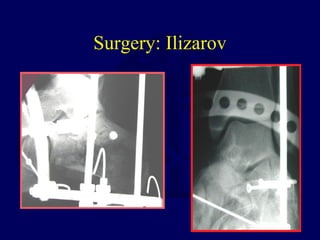
Surgery: Ilizarov
• Minimally invasive
• Indirect reduction
• Learning curve
• Immediate
weightbearing
Paley and Fischgrund, Clin Orthop, 290: 125-131, 1993
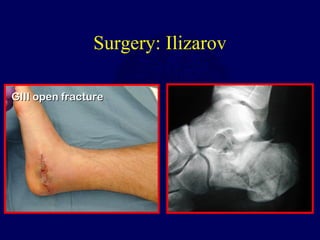
Surgery: Ilizarov
GIII open fractureGIII open fracture
Surgery: Ilizarov
Surgery:
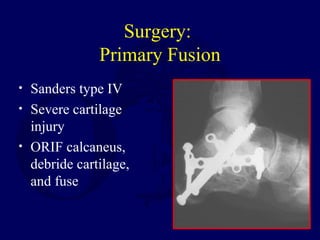
Primary Fusion
• Sanders type IV
• Severe cartilage
injury
• ORIF calcaneus,
debride cartilage,
and fuse
Summary
• High energy injuries
• Risk for long term morbidity
• ORIF can give good, reproducible results if
complications are avoided
• Individualize treatment
• Longterm outcomes studies are needed
comparing treatment alternatives
Return to
Lower Extremity
Index

L15 calcaneus