Fractures and Dislocations
about the Elbow in the
Pediatric Patient
Kevin Shea, MD
Elbow Fractures in Children
• Very common injuries (approximately 65% of
pediatric trauma)
• Radiographic assessment is very difficult for non-
orthopaedists, because of the complexity and
variability of the physeal anatomy and
development
• A thorough physical examination is essential,
because neurovascular injuries can occur before
and after reduction
• Compartment syndromes are rare with elbow
trauma, but can occur
Elbow Fractures in Children:
Physical Examination
• In most cases, children will not move the elbow if a
fracture is present, although this may not be the case for
non-displaced fractures.
• Swelling about the elbow is a constant feature, except for
non-displaced fracture. Swelling may not develop in the
first 12 to 24 hours.
• Complete vascular exam in necessary, especially in
supracondylar fractures. The doppler device may be
necessary to document vascular status
• Neurologic exam is essential, as nerve injuries are
common. In most cases, full recovery can be expected
Elbow Fractures in Children:
Physical Examination
• Neuro-motor exam may be limited by the
childs ability to cooperate because of age,
pain, or fear.
• Thumb extension– EPL (radial – PIN
branch)
• Thumb flexion – FPL (median – AIN
branch)
• Cross fingers - Adductors (ulnar)
Elbow Fractures in Children:
Physical Examination
• Always palpate the arm and forearm for signs of
compartment syndrome.
• Thorough documentation of all findings is
important. A simple record of “neurovascular
status is intact” is unacceptable.
• Individual assessment and recording of motor,
sensory, and vascular function is essential
Elbow Fractures in Children:
Radiographs
• AP and Lateral views are important initial views.
In fracture situations, these views may be less than
ideal, because it can be difficult to position the
injured extremity.
• Oblique views may be necessary for evaluation,
especially for the evaluation of suspected lateral
condyle fractures.
• Comparision views frequently obtained by
primary care or ER physicians, although these are
rarely used by orthopaedists.
Elbow Fractures in Children:
Radiograph Anatomy/Landmarks
• Bauman’s angle is formed by a line
perpendicular to the axis of the
humerus, and a line that goes through
the physis of the capitellum.
• There is a wide range of normal for
this value, and it can vary with
rotation of the radiograph.
• In this case, the medial impaction and
varus position reduces Bauman’s
angle.
Elbow Fractures in Children:
Radiograph Anatomy/Landmarks
• Anterior Humeral
Line: This is drawn
along the anterior
humeral cortex. It
should pass
through the middle
of the capitellum.
Elbow Fractures in Children:
Radiograph Anatomy/Landmarks
• The capitellum is
angulated
anteriorly about 30
degrees.
• The appearance of
the distal humerus
is similar to a
hockey stick.
30
Elbow Fractures in Children:
Radiograph Anatomy/Landmarks
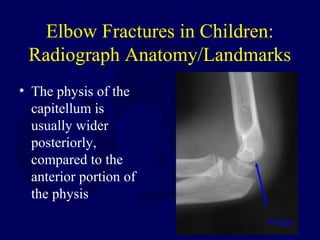
• The physis of the
capitellum is
usually wider
posteriorly,
compared to the
anterior portion of
the physis
Wider
Elbow Fractures in Children:
Radiograph Anatomy/Landmarks
• Radiocapitellar
line – should
intersect the
capitellum
• Make it a habit to
evaluate this line
on every pediatric
elbow film
Supracondylar Humerus Fractures
• Most common fracture around the elbow in
children (60 percent of elbow fractures)
• 95 percent are extension type injuries, which
produces posterior displacement of the distal
fragment
• Occurs from a fall on an outstretched hand
• Ligamentous laxity and hyperextension of the
elbow are important mechanical factors
• May be associated with a distal radius or forearm
fracture
Supracondylar Humerus Fractures:
Classification
• Gartland (1959)
• Type 1 non-displaced
• Type 2 Angulated/displaced fracture with
intact posterior cortex
• Type 3 Complete displacement, with no
contact between fragments
Type 1: Non-displaced
• Note the non-
displaced fracture
(Red Arrow)
• Note the posterior
fat pad (Yellow
Arrows)
Type 2: Angulated/Displaced
Fracture with Intact Posterior Cortex
Type 2: Angulated/Displaced
Fracture with Intact Posterior Cortex
• In many cases, the type 2
fractures will be impacted
medially, leading to varus
angulation.
• The varus malposition
must be considered when
reducing these fractures,
which may require a
valgus moment for
realignment.
Type 3: Complete Displacement,
with No Contact between Fragments
Supracondylar Humerus
Fractures: Associated Injuries
• Nerve injury incidence is high, between 7 and 16 %
(radial, median, and ulnar nerve)
• Anterior interosseous nerve injury is most commonly
injured nerve
• In many cases, assessment of nerve integrity is limited ,
because children can not always cooperate with the exam
• Carefully document premanipulation exam, as
postmanipulation neurologic deficits can alter decision
making
Supracondylar Humerus
Fractures: Associated Injuries
• 5% have associated
distal radius fracture
• Physical exam of
distal forearm
• Radiographs if needed
• If displaced pin radius
also
Supracondylar Humerus
Fractures: Associated Injuries
• Vascular injuries are rare, but pulses should
always be assessed before and after reduction
• In the absence of a radial and/or ulnar pulse, the
fingers may still be well-perfused, because of the
excellent collateral ciculation about the elbow
• Doppler device can be used for assessment
Supracondylar Humerus
Fractures: Associated Injuries
• Type 3 supracondylar
fracture, with absent
ulnar and radial pulses,
but fingers had capillary
refill less than 2
seconds. The normal
hand has capillary refill
less than 0.5 seconds.
• The pink,pulseless
extremity
Supracondylar Humerus
Fractures - Anatomy
• The medial and lateral columns are
connected by a thin wafer of bone, that is
approximately 2-3 mm wide in the central
portion.
• If the fracture is malreduced, it is inherently
unstable. The medial or lateral columns
displace easily into varus or valgus
Supracondylar Humerus
Fractures: Treatment
• Type 1 Fractures:
• In most cases, these can be treated with
immobilization for approximately 3 weeks,
at 90 degrees of flexion. If there is
significant swelling, do not flex to 90
degrees until the swelling subsides.
Supracondylar Humerus
Fractures: Treatment
• Type 2 Fractures: Posterior Angulation
• If minimal (anterior humeral line hits part of
capitellum) -immobilization for 3 weeks. Close
followup is necessary to monitor for loss of
reduction
• Anterior humeral line misses capitellum -
reduction may be necessary. The degree of
posterior angulation that requires reduction is
controversial- check opposite extremity for
hyperextension
• If varus/valgus malalignment exists, most
authors recommend reduction.
Supracondylar Humerus
Fractures: Treatment
• Type 2 Fractures:
• Reduction of these fractures is usually not difficult,
although maintaining the reduction usually requires flexion
beyond 90 degrees.
• Excessive flexion may not be tolerated because of
swelling, and these fractures may require percutaneous
pinning to maintain the reduction.
• Most authors suggest that percutaneous pinning is the
safest form of treatment for many of these fractures, as the
pins maintain the reduction and allow the elbow to be
immobilized in a more extended position
Supracondylar Humerus
Fractures: Treatment
• Type 3 Fractures:
• These fractures have a high risk of neurologic
and/or vascular compromise, and can be
associated with a significant amount of swelling.
• Current treatment protocols use percutaneous pin
fixation in almost all cases.
• In rare cases, open reduction may be necessary,
especially in cases of vascular disruption.
Supracondylar Humerus
Fractures: OR Setup
• The monitor should
be positioned across
from the OR table, to
allow easy
visualization of the
monitor during the
reduction and pinning
Supracondylar Humerus
Fractures: OR Setup
• The C-Arm
fluoroscopy unit can be
inverted, using the base
as a table for the elbow
joint.
• The child should be
positioned close to the
edge of the table, to
allow the elbow to be
visualized by the c-
arm.
Supracondylar Elbow Fractures:
Type 2 with Valgus Impaction
• During reduction of
medially impacted
fractures, valgus
force should be
applied to address
this deformity.
Type 3 Supracondylar Fracture
Type 3 Supracondylar Fracture,
Operative Reduction
• Closed reduction with
flexion
• AP view with elbow
held in flexed
position to maintain
reduction.
Supracondylar Elbow Fractures:
Type 2 with Valgus Impaction
• The elbow may need
to be held in a
hyperflexed position
to maintain the
reduction during
pinning.
• The pins are placed
with the elbow held
in this position
Medial Impaction Fracture
Type II fracture with medial impaction – not recognized
and varus / extension not reduced
Medial Impaction Fracture
Cubitus varus 2 years later
Lateral Pin Placement
• AP and Lateral views with 2 pins
C-arm Views
• Oblique views with the
C-arm can be useful to
help verify the
reduction
Supracondylar Fracture:
Pin Fixation
• Different authors have recommended different pin
fixation methods.
• The medial pin can injury the ulnar nerve. Some
advocate 2 lateral pins to avoid injuring the
median nerve.
• If the lateral pins are placed close together at the
fracture site, the pins may not provide much
resistance to rotation and further displacement. If
2 lateral pins are used, they should be widely
spaced at the fracture site.
• Some recommend one lateral, and one medial pin
Supracondylar Humerus
Fractures- Pin Fixation
• Many children have anterior subluxation of
the ulnar nerve with hyperflexion of the
elbow
• Some recommend place two lateral pins,
assess fracture stability
• If unstable then extend elbow to take
tension off ulnar nerve and place medial pin
Supracondylar Humerus
Fractures
• After the pins have been placed, and a stable
reduction obtained, the elbow can be extended to
review the AP radiograph. Baumann’s angle can
be assessed on these radiographs, although there
can be a wide range of normal values for this
measurement.
• With the elbow extended, the carrying angle of the
elbow should be reviewed, and clinical
comparison as well as radiograph comparison can
be performed to assure an adequate reduction.
Supracondylar Humerus
Fractures
• If pin fixation is used, the pins are usually
bent and cut outside the skin.
• The skin is protected from the pins by placing
felt pad around the pins.
• The arm is immobilized.
• The pins are removed in the clinic 3 to 3 1/2
weeks later.
• If adequate callus formation is present, gentle
range of motion exercises are initiated.
• In most cases, full recovery of motion can be
expected.
Supracondylar Humerus
Fractures: Indications for
Open Reduction
• Inadequate reduction
with closed methods
• Vascular injury
• Open fractures
Supracondylar Humerus
Fractures: Complications
• Compartment syndrome
• Vascular injury /
compromise
• Loss of reduction /
Malunion –cubitus varus
• Loss of motion
• Pin track infection
• Neurovascular injury with
pin placement
Supracondylar Humerus
Fractures- Flexion Type
• Rare, only 2%
• Distal fracture
fragment
anterior,flexed
• Reduce in extension
• Pin or immobilize in
extension
Distal Humeral Complete
Physeal Separation
• Often in very young
children
• May be sign of NAT
• Swollen elbow,“muffled
crepitance” on exam
• Through area of wider
cross sectional area than
SC humerus fx
• Restore alignment, may
need pinning
Lateral Condyle Fractures
• Common fracture,
representing
approximately 15
percent of elbow
trauma in children
• Usually occurs from a
fall on an outstretched
arm
Lateral Condyle Fractures:
Jakob Classification
• Type 1: Non-displaced fracture. Fracture line
does not cross through the articular surface
• Type 2: Minimally displaced. Fracture extends to
the articular surface, but the capitellum is not
rotated or significantly displaced
• Type 3: Completely displaced. Fracture extends
to the articular surface, and the capitellum is
rotated and significantly displaced
Lateral Condyle Elbow
Fractures:
Treatment
• Type 1:
• Oblique radiographs
may be necessary to
confirm that this is not
displaced. Frequent
radiographs in the cast
are necessary to ensure
that the fracture does
not displace in the
cast.
Lateral Condyle Fractures:
Jakob Classification
• Type 2:
• If displaced more than 2 mm on
any radiograph (AP / Lateral /
Oblique views), this will
probably require reduction and
pinning. Closed reduction and
percutaneous pinning can be
attempted, but the reduction at
the articular surface must be
anatomic.
• If displaced, and the articular
surface is not congruous, ORIF
is necessary
Fracture line exiting posterior metaphysis
(arrow) typical for lateral condyle
fractures
Lateral Condyle Fractures:
Jakob Classification
• Type 3:
• ORIF is necessary.
• A lateral Kocher approach
is used for reduction, and
pins are placed to maintain
the reduction.
• Careful dissection needed
to preserve soft tissue
attachments (and thus
blood supply) to the
lateral condyle fragment
Lateral Condyle ORIF
Lateral Condyle Fractures:
Complications
• Non-union: This usually occurs
if the patient is not evaluated by
a physician, or the fracture
displaced despite casting
• This complication is well-
described in fractures which were
displaced more than 2 mm, and
not treated with pin fixation
• Late complication of progressive
valgus and ulnar neuropathy
reported
Lateral Condyle
Fractures - Complications
• AVN can occur after excessive surgical
dissection
• Cubitus varus can occur, may be because of
malreduction or a result of lateral column
overgrowth
Medial Epicondyle Fracture
• Represents 5-10 percent of pediatric elbow
fractures
• Occurs with valgus stress to the elbow,
which avulses the medial epicondyle
• Frequently associated with an elbow
dislocation
Medial Epicondyle Fracture:
Classification and Treatment
• Nondisplaced and minimally displaced (less than 5 mm of
displacement)-
May be treated without fixation, and early motion to avoid
stiffness.
• Displaced more than 5 mm. Treatment is controversial,
with some recommending operative, and others
recommending non-operative treatment. Some have
suggested that surgery is indicated in the presence of
valgus instability, or in patients who are throwing athletes.
• Only absolute indication is entrapped fragment after
dislocation with incongruent elbow joint
• Long term studies – favor nonoperative treatment
Medial Epicondyle Fracture:
Elbow Dislocation with Medial
Epicondyle Avulsion
Medial
Epicondyle
Avulsion
After elbow
reduction, medial
epicondyle
avulsion fragment
is obvious
Medial Epicondyle Fracture:
• Elbow dislocation with medial epicondyle
avulsion, treated with ORIF.
Displaced Medial
Epicondyle Fracture
• 12 year old female UE
weight bearing athlete
• Treated
nonoperatively
• Full motion, no valgus
instability at 6 weeks
• Returned to
competition at 8 weeks
Olecranon Fractures
• Relatively rare fracture in children
(increased incidence in children with OI)
• May be associated with elbow subluxation/
dislocation, or radial head fracture.
• The diagnosis may be difficult in a younger child,
as the olecranon does not ossify until 8-9 years.
• In older children, the fracture may occur through
the olecranon physis.
• Anatomic reduction is necessary in displaced
fractures, restore active elbow extension.
Olecranon Fractures
• Olecranon fracture treated with ORIF in 14
year old, with tension band fixation.
Rare Distal Humeral Fractures
• Lateral Epicondyle: rare,
usually represent a small
avulsion fracture. Treated with
early immobilization.
• T-Condylar fractures: These
occur in patients that are almost
skeletally mature. Treatment is
similar to adult intra-articular
elbow fractures.
• Medial Condyle: rare, treated
with ORIF if displaced.
Proximal Radial Fractures
• 1% of children’s fractures
• 90% involve physis or neck
• Normally some angulation of head to radial
shaft (0-15 degrees)
• No ligaments attach to head or neck
• Much of radial neck extraarticular (no
effusion with fracture)
Proximal Radial Fractures -
Types
• Valgus fractures – Salter I
or II (intraarticular
fractures rare)
• Metaphyseal fractures
• Associated with elbow
dislocations or proximal
ulna fractures
• Can be completely
displaced, rotated
Proximal Radius Fractures-
Treatment
• Greater than 30 degrees
angulation- manipulate
• Usually can obtain
acceptable reduction in
fractures with less than 60
degrees initial angulation
• Traction, varus force in
supination & extension,
flex and pronate
• Ace wrap or Esmarch
reduction
Proximal Radius Fractures-
Treatment
• Unable to reduce
closed
• Percutaneous pin
reduction
• Intramedullary pin
reduction
• Open reduction via
lateral approach
Completely Displaced,
Malrotated Radial Neck Fracture
After closed reduction the articular
surface (arrow) is facing distally, 180
degrees malrotated
Proximal Radial Fractures -
Complications
• Loss of forearm rotation
• Radial head overgrowth
• Premature physeal closure – valgus
• Nonunion of radial neck rare
• AVN
• Proximal synostosis
Monteggia Lesions: Ulnar
Fracture- Radial Head Dislocation
Bado classification
• Type I – anterior radial
head dislocation
• Type II – posterior radial
head dislocation
• Type III – lateral radial
head dislocation
• Type IV – associated
fracture of radius
Monteggia Lesions
• Most important is to make
the diagnosis initially
• Radiocapitellar line
critical
• A commonly missed
diagnosis
• Every ulna fracture should
have good elbow joint
radiographs to avoid
missing Monteggia lesion
Monteggia Lesions
• Be wary of plastic
deformation of ulna or
minimally displaced
ulna fracture with
radial head dislocation
• On lateral radiograph
the ulna should be
straight Note anterior bow of ulnar shaft,
and anterior radial head
dislocation
Monteggia Lesions –
Initial Treatment
• Closed reduction of ulnar angulation
• Direct pressure over radial head
• Usually will reduce with palpable clunk
• Immobilize in reduced position
• Supinate forearm for anterior dislocations
• Frequent radiographic follow-up to
document maintenance of reduction
Monteggia Lesions
• If unable to obtain or
maintain reduction of
radial head
• Operative stabilization of
ulnar fracture to correct
angulation (oblique
fractures may need plate
fixation)
• Assess radial head
stability- flexion may help
for anterior dislocation
Missed Monteggia Lesion
Healed prox ulna fx
with anterior bow
Anterior radial head
dislocation and
heterotopic ossification
Missed Monteggia Lesions-
Possible Long Term Sequelae
• Progressive valgus
• Proximal radial migration
with disruption of normal
forearm and distal
radioulnar joint mechanics
• Posterior interosseous
nerve traction palsy
• Collateral ligament
instability
Missed Monteggia Lesions –
Treatment Options
• Annular ligament
reconstructions – Bell-
Tawse, fascia lata,
Peterson
• Ulnar osteotomy
• Combination
• Transcapitellar
pinning – be wary of
possible pin breakage
Missed Monteggia – Ulnar
Osteotomy and Radiocapitellar Pin
Return to
Pediatrics Index

P05 pediatric elbow

  • 1.
    Fractures and Dislocations aboutthe Elbow in the Pediatric Patient Kevin Shea, MD
  • 2.
    Elbow Fractures inChildren • Very common injuries (approximately 65% of pediatric trauma) • Radiographic assessment is very difficult for non- orthopaedists, because of the complexity and variability of the physeal anatomy and development • A thorough physical examination is essential, because neurovascular injuries can occur before and after reduction • Compartment syndromes are rare with elbow trauma, but can occur
  • 3.
    Elbow Fractures inChildren: Physical Examination • In most cases, children will not move the elbow if a fracture is present, although this may not be the case for non-displaced fractures. • Swelling about the elbow is a constant feature, except for non-displaced fracture. Swelling may not develop in the first 12 to 24 hours. • Complete vascular exam in necessary, especially in supracondylar fractures. The doppler device may be necessary to document vascular status • Neurologic exam is essential, as nerve injuries are common. In most cases, full recovery can be expected
  • 4.
    Elbow Fractures inChildren: Physical Examination • Neuro-motor exam may be limited by the childs ability to cooperate because of age, pain, or fear. • Thumb extension– EPL (radial – PIN branch) • Thumb flexion – FPL (median – AIN branch) • Cross fingers - Adductors (ulnar)
  • 5.
    Elbow Fractures inChildren: Physical Examination • Always palpate the arm and forearm for signs of compartment syndrome. • Thorough documentation of all findings is important. A simple record of “neurovascular status is intact” is unacceptable. • Individual assessment and recording of motor, sensory, and vascular function is essential
  • 6.
    Elbow Fractures inChildren: Radiographs • AP and Lateral views are important initial views. In fracture situations, these views may be less than ideal, because it can be difficult to position the injured extremity. • Oblique views may be necessary for evaluation, especially for the evaluation of suspected lateral condyle fractures. • Comparision views frequently obtained by primary care or ER physicians, although these are rarely used by orthopaedists.
  • 7.
    Elbow Fractures inChildren: Radiograph Anatomy/Landmarks • Bauman’s angle is formed by a line perpendicular to the axis of the humerus, and a line that goes through the physis of the capitellum. • There is a wide range of normal for this value, and it can vary with rotation of the radiograph. • In this case, the medial impaction and varus position reduces Bauman’s angle.
  • 8.
    Elbow Fractures inChildren: Radiograph Anatomy/Landmarks • Anterior Humeral Line: This is drawn along the anterior humeral cortex. It should pass through the middle of the capitellum.
  • 9.
    Elbow Fractures inChildren: Radiograph Anatomy/Landmarks • The capitellum is angulated anteriorly about 30 degrees. • The appearance of the distal humerus is similar to a hockey stick. 30
  • 10.
    Elbow Fractures inChildren: Radiograph Anatomy/Landmarks • The physis of the capitellum is usually wider posteriorly, compared to the anterior portion of the physis Wider
  • 11.
    Elbow Fractures inChildren: Radiograph Anatomy/Landmarks • Radiocapitellar line – should intersect the capitellum • Make it a habit to evaluate this line on every pediatric elbow film
  • 12.
    Supracondylar Humerus Fractures •Most common fracture around the elbow in children (60 percent of elbow fractures) • 95 percent are extension type injuries, which produces posterior displacement of the distal fragment • Occurs from a fall on an outstretched hand • Ligamentous laxity and hyperextension of the elbow are important mechanical factors • May be associated with a distal radius or forearm fracture
  • 13.
    Supracondylar Humerus Fractures: Classification •Gartland (1959) • Type 1 non-displaced • Type 2 Angulated/displaced fracture with intact posterior cortex • Type 3 Complete displacement, with no contact between fragments
  • 14.
    Type 1: Non-displaced •Note the non- displaced fracture (Red Arrow) • Note the posterior fat pad (Yellow Arrows)
  • 15.
    Type 2: Angulated/Displaced Fracturewith Intact Posterior Cortex
  • 16.
    Type 2: Angulated/Displaced Fracturewith Intact Posterior Cortex • In many cases, the type 2 fractures will be impacted medially, leading to varus angulation. • The varus malposition must be considered when reducing these fractures, which may require a valgus moment for realignment.
  • 17.
    Type 3: CompleteDisplacement, with No Contact between Fragments
  • 18.
    Supracondylar Humerus Fractures: AssociatedInjuries • Nerve injury incidence is high, between 7 and 16 % (radial, median, and ulnar nerve) • Anterior interosseous nerve injury is most commonly injured nerve • In many cases, assessment of nerve integrity is limited , because children can not always cooperate with the exam • Carefully document premanipulation exam, as postmanipulation neurologic deficits can alter decision making
  • 19.
    Supracondylar Humerus Fractures: AssociatedInjuries • 5% have associated distal radius fracture • Physical exam of distal forearm • Radiographs if needed • If displaced pin radius also
  • 20.
    Supracondylar Humerus Fractures: AssociatedInjuries • Vascular injuries are rare, but pulses should always be assessed before and after reduction • In the absence of a radial and/or ulnar pulse, the fingers may still be well-perfused, because of the excellent collateral ciculation about the elbow • Doppler device can be used for assessment
  • 21.
    Supracondylar Humerus Fractures: AssociatedInjuries • Type 3 supracondylar fracture, with absent ulnar and radial pulses, but fingers had capillary refill less than 2 seconds. The normal hand has capillary refill less than 0.5 seconds. • The pink,pulseless extremity
  • 22.
    Supracondylar Humerus Fractures -Anatomy • The medial and lateral columns are connected by a thin wafer of bone, that is approximately 2-3 mm wide in the central portion. • If the fracture is malreduced, it is inherently unstable. The medial or lateral columns displace easily into varus or valgus
  • 23.
    Supracondylar Humerus Fractures: Treatment •Type 1 Fractures: • In most cases, these can be treated with immobilization for approximately 3 weeks, at 90 degrees of flexion. If there is significant swelling, do not flex to 90 degrees until the swelling subsides.
  • 24.
    Supracondylar Humerus Fractures: Treatment •Type 2 Fractures: Posterior Angulation • If minimal (anterior humeral line hits part of capitellum) -immobilization for 3 weeks. Close followup is necessary to monitor for loss of reduction • Anterior humeral line misses capitellum - reduction may be necessary. The degree of posterior angulation that requires reduction is controversial- check opposite extremity for hyperextension • If varus/valgus malalignment exists, most authors recommend reduction.
  • 25.
    Supracondylar Humerus Fractures: Treatment •Type 2 Fractures: • Reduction of these fractures is usually not difficult, although maintaining the reduction usually requires flexion beyond 90 degrees. • Excessive flexion may not be tolerated because of swelling, and these fractures may require percutaneous pinning to maintain the reduction. • Most authors suggest that percutaneous pinning is the safest form of treatment for many of these fractures, as the pins maintain the reduction and allow the elbow to be immobilized in a more extended position
  • 26.
    Supracondylar Humerus Fractures: Treatment •Type 3 Fractures: • These fractures have a high risk of neurologic and/or vascular compromise, and can be associated with a significant amount of swelling. • Current treatment protocols use percutaneous pin fixation in almost all cases. • In rare cases, open reduction may be necessary, especially in cases of vascular disruption.
  • 27.
    Supracondylar Humerus Fractures: ORSetup • The monitor should be positioned across from the OR table, to allow easy visualization of the monitor during the reduction and pinning
  • 28.
    Supracondylar Humerus Fractures: ORSetup • The C-Arm fluoroscopy unit can be inverted, using the base as a table for the elbow joint. • The child should be positioned close to the edge of the table, to allow the elbow to be visualized by the c- arm.
  • 29.
    Supracondylar Elbow Fractures: Type2 with Valgus Impaction • During reduction of medially impacted fractures, valgus force should be applied to address this deformity.
  • 30.
  • 31.
    Type 3 SupracondylarFracture, Operative Reduction • Closed reduction with flexion • AP view with elbow held in flexed position to maintain reduction.
  • 32.
    Supracondylar Elbow Fractures: Type2 with Valgus Impaction • The elbow may need to be held in a hyperflexed position to maintain the reduction during pinning. • The pins are placed with the elbow held in this position
  • 33.
    Medial Impaction Fracture TypeII fracture with medial impaction – not recognized and varus / extension not reduced
  • 34.
  • 35.
    Lateral Pin Placement •AP and Lateral views with 2 pins
  • 36.
    C-arm Views • Obliqueviews with the C-arm can be useful to help verify the reduction
  • 37.
    Supracondylar Fracture: Pin Fixation •Different authors have recommended different pin fixation methods. • The medial pin can injury the ulnar nerve. Some advocate 2 lateral pins to avoid injuring the median nerve. • If the lateral pins are placed close together at the fracture site, the pins may not provide much resistance to rotation and further displacement. If 2 lateral pins are used, they should be widely spaced at the fracture site. • Some recommend one lateral, and one medial pin
  • 38.
    Supracondylar Humerus Fractures- PinFixation • Many children have anterior subluxation of the ulnar nerve with hyperflexion of the elbow • Some recommend place two lateral pins, assess fracture stability • If unstable then extend elbow to take tension off ulnar nerve and place medial pin
  • 39.
    Supracondylar Humerus Fractures • Afterthe pins have been placed, and a stable reduction obtained, the elbow can be extended to review the AP radiograph. Baumann’s angle can be assessed on these radiographs, although there can be a wide range of normal values for this measurement. • With the elbow extended, the carrying angle of the elbow should be reviewed, and clinical comparison as well as radiograph comparison can be performed to assure an adequate reduction.
  • 40.
    Supracondylar Humerus Fractures • Ifpin fixation is used, the pins are usually bent and cut outside the skin. • The skin is protected from the pins by placing felt pad around the pins. • The arm is immobilized. • The pins are removed in the clinic 3 to 3 1/2 weeks later. • If adequate callus formation is present, gentle range of motion exercises are initiated. • In most cases, full recovery of motion can be expected.
  • 41.
    Supracondylar Humerus Fractures: Indicationsfor Open Reduction • Inadequate reduction with closed methods • Vascular injury • Open fractures
  • 42.
    Supracondylar Humerus Fractures: Complications •Compartment syndrome • Vascular injury / compromise • Loss of reduction / Malunion –cubitus varus • Loss of motion • Pin track infection • Neurovascular injury with pin placement
  • 43.
    Supracondylar Humerus Fractures- FlexionType • Rare, only 2% • Distal fracture fragment anterior,flexed • Reduce in extension • Pin or immobilize in extension
  • 44.
    Distal Humeral Complete PhysealSeparation • Often in very young children • May be sign of NAT • Swollen elbow,“muffled crepitance” on exam • Through area of wider cross sectional area than SC humerus fx • Restore alignment, may need pinning
  • 45.
    Lateral Condyle Fractures •Common fracture, representing approximately 15 percent of elbow trauma in children • Usually occurs from a fall on an outstretched arm
  • 46.
    Lateral Condyle Fractures: JakobClassification • Type 1: Non-displaced fracture. Fracture line does not cross through the articular surface • Type 2: Minimally displaced. Fracture extends to the articular surface, but the capitellum is not rotated or significantly displaced • Type 3: Completely displaced. Fracture extends to the articular surface, and the capitellum is rotated and significantly displaced
  • 47.
    Lateral Condyle Elbow Fractures: Treatment •Type 1: • Oblique radiographs may be necessary to confirm that this is not displaced. Frequent radiographs in the cast are necessary to ensure that the fracture does not displace in the cast.
  • 48.
    Lateral Condyle Fractures: JakobClassification • Type 2: • If displaced more than 2 mm on any radiograph (AP / Lateral / Oblique views), this will probably require reduction and pinning. Closed reduction and percutaneous pinning can be attempted, but the reduction at the articular surface must be anatomic. • If displaced, and the articular surface is not congruous, ORIF is necessary Fracture line exiting posterior metaphysis (arrow) typical for lateral condyle fractures
  • 49.
    Lateral Condyle Fractures: JakobClassification • Type 3: • ORIF is necessary. • A lateral Kocher approach is used for reduction, and pins are placed to maintain the reduction. • Careful dissection needed to preserve soft tissue attachments (and thus blood supply) to the lateral condyle fragment
  • 50.
  • 51.
    Lateral Condyle Fractures: Complications •Non-union: This usually occurs if the patient is not evaluated by a physician, or the fracture displaced despite casting • This complication is well- described in fractures which were displaced more than 2 mm, and not treated with pin fixation • Late complication of progressive valgus and ulnar neuropathy reported
  • 52.
    Lateral Condyle Fractures -Complications • AVN can occur after excessive surgical dissection • Cubitus varus can occur, may be because of malreduction or a result of lateral column overgrowth
  • 53.
    Medial Epicondyle Fracture •Represents 5-10 percent of pediatric elbow fractures • Occurs with valgus stress to the elbow, which avulses the medial epicondyle • Frequently associated with an elbow dislocation
  • 54.
    Medial Epicondyle Fracture: Classificationand Treatment • Nondisplaced and minimally displaced (less than 5 mm of displacement)- May be treated without fixation, and early motion to avoid stiffness. • Displaced more than 5 mm. Treatment is controversial, with some recommending operative, and others recommending non-operative treatment. Some have suggested that surgery is indicated in the presence of valgus instability, or in patients who are throwing athletes. • Only absolute indication is entrapped fragment after dislocation with incongruent elbow joint • Long term studies – favor nonoperative treatment
  • 55.
    Medial Epicondyle Fracture: ElbowDislocation with Medial Epicondyle Avulsion Medial Epicondyle Avulsion After elbow reduction, medial epicondyle avulsion fragment is obvious
  • 56.
    Medial Epicondyle Fracture: •Elbow dislocation with medial epicondyle avulsion, treated with ORIF.
  • 57.
    Displaced Medial Epicondyle Fracture •12 year old female UE weight bearing athlete • Treated nonoperatively • Full motion, no valgus instability at 6 weeks • Returned to competition at 8 weeks
  • 58.
    Olecranon Fractures • Relativelyrare fracture in children (increased incidence in children with OI) • May be associated with elbow subluxation/ dislocation, or radial head fracture. • The diagnosis may be difficult in a younger child, as the olecranon does not ossify until 8-9 years. • In older children, the fracture may occur through the olecranon physis. • Anatomic reduction is necessary in displaced fractures, restore active elbow extension.
  • 59.
    Olecranon Fractures • Olecranonfracture treated with ORIF in 14 year old, with tension band fixation.
  • 60.
    Rare Distal HumeralFractures • Lateral Epicondyle: rare, usually represent a small avulsion fracture. Treated with early immobilization. • T-Condylar fractures: These occur in patients that are almost skeletally mature. Treatment is similar to adult intra-articular elbow fractures. • Medial Condyle: rare, treated with ORIF if displaced.
  • 61.
    Proximal Radial Fractures •1% of children’s fractures • 90% involve physis or neck • Normally some angulation of head to radial shaft (0-15 degrees) • No ligaments attach to head or neck • Much of radial neck extraarticular (no effusion with fracture)
  • 62.
    Proximal Radial Fractures- Types • Valgus fractures – Salter I or II (intraarticular fractures rare) • Metaphyseal fractures • Associated with elbow dislocations or proximal ulna fractures • Can be completely displaced, rotated
  • 63.
    Proximal Radius Fractures- Treatment •Greater than 30 degrees angulation- manipulate • Usually can obtain acceptable reduction in fractures with less than 60 degrees initial angulation • Traction, varus force in supination & extension, flex and pronate • Ace wrap or Esmarch reduction
  • 64.
    Proximal Radius Fractures- Treatment •Unable to reduce closed • Percutaneous pin reduction • Intramedullary pin reduction • Open reduction via lateral approach
  • 65.
    Completely Displaced, Malrotated RadialNeck Fracture After closed reduction the articular surface (arrow) is facing distally, 180 degrees malrotated
  • 66.
    Proximal Radial Fractures- Complications • Loss of forearm rotation • Radial head overgrowth • Premature physeal closure – valgus • Nonunion of radial neck rare • AVN • Proximal synostosis
  • 67.
    Monteggia Lesions: Ulnar Fracture-Radial Head Dislocation Bado classification • Type I – anterior radial head dislocation • Type II – posterior radial head dislocation • Type III – lateral radial head dislocation • Type IV – associated fracture of radius
  • 68.
    Monteggia Lesions • Mostimportant is to make the diagnosis initially • Radiocapitellar line critical • A commonly missed diagnosis • Every ulna fracture should have good elbow joint radiographs to avoid missing Monteggia lesion
  • 69.
    Monteggia Lesions • Bewary of plastic deformation of ulna or minimally displaced ulna fracture with radial head dislocation • On lateral radiograph the ulna should be straight Note anterior bow of ulnar shaft, and anterior radial head dislocation
  • 70.
    Monteggia Lesions – InitialTreatment • Closed reduction of ulnar angulation • Direct pressure over radial head • Usually will reduce with palpable clunk • Immobilize in reduced position • Supinate forearm for anterior dislocations • Frequent radiographic follow-up to document maintenance of reduction
  • 71.
    Monteggia Lesions • Ifunable to obtain or maintain reduction of radial head • Operative stabilization of ulnar fracture to correct angulation (oblique fractures may need plate fixation) • Assess radial head stability- flexion may help for anterior dislocation
  • 72.
    Missed Monteggia Lesion Healedprox ulna fx with anterior bow Anterior radial head dislocation and heterotopic ossification
  • 73.
    Missed Monteggia Lesions- PossibleLong Term Sequelae • Progressive valgus • Proximal radial migration with disruption of normal forearm and distal radioulnar joint mechanics • Posterior interosseous nerve traction palsy • Collateral ligament instability
  • 74.
    Missed Monteggia Lesions– Treatment Options • Annular ligament reconstructions – Bell- Tawse, fascia lata, Peterson • Ulnar osteotomy • Combination • Transcapitellar pinning – be wary of possible pin breakage
  • 75.
    Missed Monteggia –Ulnar Osteotomy and Radiocapitellar Pin Return to Pediatrics Index