Prof. Muhammad Shahiduzzaman Head,  Department of  Orthopaedics & Traumatology Dhaka Medical College Hospital Paediatric Fracture
In Bangladesh 60% of population are <20 yrs Fractures accounts for 15% of all injuries in children. Different from adult fractures. Vary in different age groups (Infants, children, adolescents) Introduction
Children have different physiology and anatomy Growth plate. Bone. Cartilage. Periosteum. Ligaments. Age-related physiology Children are very special
In infants, GP is stronger than bone.  increased diaphyseal fractures Provides perfect remodeling power. Injury of growth plate causes deformity. A fracture might lead to overgrowth. Growth Plate
Increased collagen: bone ratio lowers modulus of elasticity Increased cancellous bone reduces tensile strength reduces tendency of fracture   to propagate less comminuted fractures Bone fails on both tension and  compression commonly seen “buckle” fracture Bone
Increased ratio of cartilage to bone better resilience difficult x-ray evaluation size of articular fragment often under-estimated Cartilage
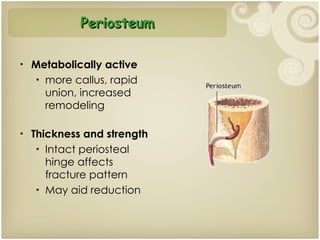
Metabolically active more callus, rapid union, increased remodeling Thickness and strength Intact periosteal hinge affects fracture pattern May aid reduction Periosteum
Age related # pattern
Better blood supply, so less incidence of Delayed or non-union. Physiology
Bones tend to BOW rather than BREAK Compressive force= TORUS fracture Aka. Buckle fracture Force to side of bone may cause break in only one cortex= GREENSTICK fracture The other cortex only BENDS In very young children, neither cortex may break= PLASTIC DEFORMATION Injury Pattern
Green Stick Fracture
Torus Greenstick Green Stick Fracture
Plastic Deformity Injury Pattern
Point at which metaphysis connects to physis is an anatomic point of weakness Ligaments and tendons are stronger than bone when young Bone is more likely to be injured with force. Periosteum is biologically active in children and often stays intact with injury This  stabilizes  fracture and  promotes  healing. Injury Pattern
Many childhood fractures involve the physis 20% of all skeletal injuries in children Can disrupt growth of bone Injury near but not at the physis can stimulate bone to grow  more Physeal Injury
SALTER HARRIS CLASSIFICATION Classification system to delineate risk of growth disturbance Higher grade fractures are more likely to cause growth disturbance Growth disturbance can happen with ANY physeal injury It has grade I upto grade V. Physeal Injury
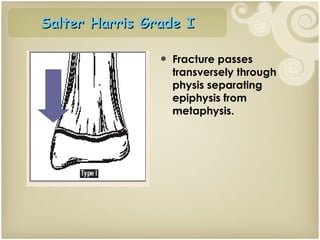
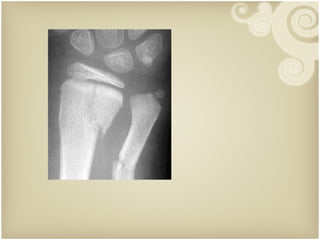
Fracture passes transversely through physis separating epiphysis from metaphysis. Salter Harris Grade I
 
Transversely through physis but exits through metaphysis Triangular fragment Salter Harris Grade II
 
Crosses physis and exits through epiphysis at joint space. Salter Harris Grade III
 
 
Extends upwards from the joint line, through the physis and out the metaphysis. Salter Harris Grade IV
 
Crash Injury to growth plate Salter Harris Grade V
MOST COMMON : Salter Harris  II Followed by I, III, IV, V Refer to orthopedics: III, IV, V I and II effectively managed by primary care with casting (most commonly) Parents should be informed that growth disturbance can happen with any physeal fracture Salter Harris
Tremendous power of remodeling Can accept more angulation and displacement Rotational mal-alignment ?does not remodel   Power of remodeling
Malunion-Remodeling Process
Factors affecting remodeling potential Years of remaining growth –  most important factor Position in the bone –  the nearer to physis the better Plane of motion – greatest in sagittal, the frontal, and least for transverse plane Physeal status –  if damaged, less potential for correction Growth potential of adjacent physis e.g.  upper humerus better than lower humerus Power of remodeling
Children tend to heal fractures faster than adults requiring shorter immobilization time. Anticipate remodeling if child has >2 yrs of growing left – mild angulation deformities often correct themselves but rotational deformities requires reduction. Its good to be young!!!
Fractures in children may stimulate longitudinal growth – some degree of overlap is acceptable and may even be helpful. Children don’t tend to get as stiff as adults after immobilization. Its good to be young…
Law of Two’s  : Two views Two joints Two limbs Two occasions Two physicians Xray examination   2
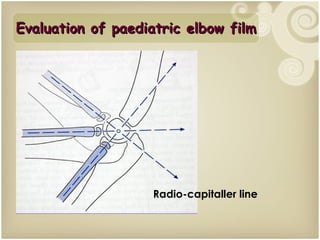
Radio-capitaller line Evaluation of paediatric elbow film
Supracondylar Fracture of Humerus Evaluation of paediatric elbow film
Mostly conservative – closed reduction and cast immobilization Open reduction & internal fixation. Principle of Management
Displaced intra articular fractures (  Salter-Harris  III-IV  ) fractures with  vascular  injury ?  Compartment  syndrome Fractures not reduced by closed reduction ( soft tissue interposition, button-holing of periosteum ) If reduction can not be maintained or could be only maintained in an  abnormal position Indication for operative management
Indication for operative management
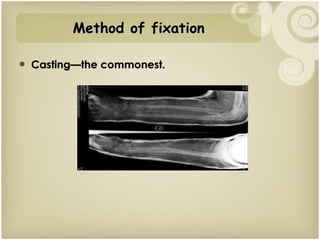
Casting—the commonest. Method of fixation
K-wires  most commonly used Metaphyseal fractures Method of fixation
Intramedullary wires, elastic nails Very useful, Diaphyseal fractures Method of fixation
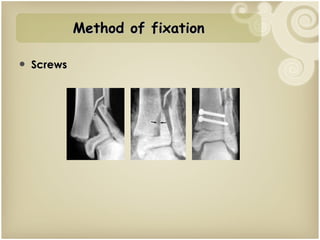
Screws Method of fixation
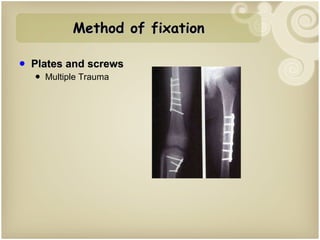
Plates and screws Multiple Trauma Method of fixation
IMN Nailing (adolescent only) Chances of growth disturbences. Method of fixation
External Fixation In open Fractures Method of fixation
Casting  -  still the commonest K-wires  most commonly used Metaphyseal fractures Intramedullary wires, elastic nails Very useful Diaphyseal fractures Screws Plates – multiple trauma IMN  -  adolescents Ex-fix Combination Method of fixation
Malunion is not usually a problem (except cubitus varus) Nonunion is hardly seen (except in lateral condyle of humerus) Growth disturbance – epiphyseal damage Vascular  - volkmann’s ischemia Infection  - rare Complication
Battered Baby Syndrome: Soft tissue injuries - bruising, burns Intra-abdominal injuries Intracranial injuries Delay in seeking treatment # at diff. stage of healing. Non-accidental injury
Radiology of child abuse
Corner’s fracture (traction and rotation)
Bucket handle fracture (traction and rotation)
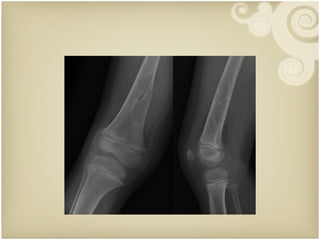
Pathological fracture


Thank You

Paediatric fracture

  • 1.
    Prof. Muhammad ShahiduzzamanHead, Department of Orthopaedics & Traumatology Dhaka Medical College Hospital Paediatric Fracture
  • 2.
    In Bangladesh 60%of population are <20 yrs Fractures accounts for 15% of all injuries in children. Different from adult fractures. Vary in different age groups (Infants, children, adolescents) Introduction
  • 3.
    Children have differentphysiology and anatomy Growth plate. Bone. Cartilage. Periosteum. Ligaments. Age-related physiology Children are very special
  • 4.
    In infants, GPis stronger than bone.  increased diaphyseal fractures Provides perfect remodeling power. Injury of growth plate causes deformity. A fracture might lead to overgrowth. Growth Plate
  • 5.
    Increased collagen: boneratio lowers modulus of elasticity Increased cancellous bone reduces tensile strength reduces tendency of fracture to propagate less comminuted fractures Bone fails on both tension and compression commonly seen “buckle” fracture Bone
  • 6.
    Increased ratio ofcartilage to bone better resilience difficult x-ray evaluation size of articular fragment often under-estimated Cartilage
  • 7.
    Metabolically active morecallus, rapid union, increased remodeling Thickness and strength Intact periosteal hinge affects fracture pattern May aid reduction Periosteum
  • 8.
  • 9.
    Better blood supply,so less incidence of Delayed or non-union. Physiology
  • 10.
    Bones tend toBOW rather than BREAK Compressive force= TORUS fracture Aka. Buckle fracture Force to side of bone may cause break in only one cortex= GREENSTICK fracture The other cortex only BENDS In very young children, neither cortex may break= PLASTIC DEFORMATION Injury Pattern
  • 11.
  • 12.
    Torus Greenstick GreenStick Fracture
  • 13.
  • 14.
    Point at whichmetaphysis connects to physis is an anatomic point of weakness Ligaments and tendons are stronger than bone when young Bone is more likely to be injured with force. Periosteum is biologically active in children and often stays intact with injury This stabilizes fracture and promotes healing. Injury Pattern
  • 15.
    Many childhood fracturesinvolve the physis 20% of all skeletal injuries in children Can disrupt growth of bone Injury near but not at the physis can stimulate bone to grow more Physeal Injury
  • 16.
    SALTER HARRIS CLASSIFICATIONClassification system to delineate risk of growth disturbance Higher grade fractures are more likely to cause growth disturbance Growth disturbance can happen with ANY physeal injury It has grade I upto grade V. Physeal Injury
  • 17.
    Fracture passes transverselythrough physis separating epiphysis from metaphysis. Salter Harris Grade I
  • 18.
  • 19.
    Transversely through physisbut exits through metaphysis Triangular fragment Salter Harris Grade II
  • 20.
  • 21.
    Crosses physis andexits through epiphysis at joint space. Salter Harris Grade III
  • 22.
  • 23.
  • 24.
    Extends upwards fromthe joint line, through the physis and out the metaphysis. Salter Harris Grade IV
  • 25.
  • 26.
    Crash Injury togrowth plate Salter Harris Grade V
  • 27.
    MOST COMMON :Salter Harris II Followed by I, III, IV, V Refer to orthopedics: III, IV, V I and II effectively managed by primary care with casting (most commonly) Parents should be informed that growth disturbance can happen with any physeal fracture Salter Harris
  • 28.
    Tremendous power ofremodeling Can accept more angulation and displacement Rotational mal-alignment ?does not remodel Power of remodeling
  • 29.
  • 30.
    Factors affecting remodelingpotential Years of remaining growth – most important factor Position in the bone – the nearer to physis the better Plane of motion – greatest in sagittal, the frontal, and least for transverse plane Physeal status – if damaged, less potential for correction Growth potential of adjacent physis e.g. upper humerus better than lower humerus Power of remodeling
  • 31.
    Children tend toheal fractures faster than adults requiring shorter immobilization time. Anticipate remodeling if child has >2 yrs of growing left – mild angulation deformities often correct themselves but rotational deformities requires reduction. Its good to be young!!!
  • 32.
    Fractures in childrenmay stimulate longitudinal growth – some degree of overlap is acceptable and may even be helpful. Children don’t tend to get as stiff as adults after immobilization. Its good to be young…
  • 33.
    Law of Two’s : Two views Two joints Two limbs Two occasions Two physicians Xray examination 2
  • 34.
    Radio-capitaller line Evaluationof paediatric elbow film
  • 35.
    Supracondylar Fracture ofHumerus Evaluation of paediatric elbow film
  • 36.
    Mostly conservative –closed reduction and cast immobilization Open reduction & internal fixation. Principle of Management
  • 37.
    Displaced intra articularfractures ( Salter-Harris III-IV ) fractures with vascular injury ? Compartment syndrome Fractures not reduced by closed reduction ( soft tissue interposition, button-holing of periosteum ) If reduction can not be maintained or could be only maintained in an abnormal position Indication for operative management
  • 38.
  • 39.
  • 40.
    K-wires mostcommonly used Metaphyseal fractures Method of fixation
  • 41.
    Intramedullary wires, elasticnails Very useful, Diaphyseal fractures Method of fixation
  • 42.
  • 43.
  • 44.
    Plates and screwsMultiple Trauma Method of fixation
  • 45.
    IMN Nailing (adolescentonly) Chances of growth disturbences. Method of fixation
  • 46.
    External Fixation Inopen Fractures Method of fixation
  • 47.
    Casting - still the commonest K-wires most commonly used Metaphyseal fractures Intramedullary wires, elastic nails Very useful Diaphyseal fractures Screws Plates – multiple trauma IMN - adolescents Ex-fix Combination Method of fixation
  • 48.
    Malunion is notusually a problem (except cubitus varus) Nonunion is hardly seen (except in lateral condyle of humerus) Growth disturbance – epiphyseal damage Vascular - volkmann’s ischemia Infection - rare Complication
  • 49.
    Battered Baby Syndrome:Soft tissue injuries - bruising, burns Intra-abdominal injuries Intracranial injuries Delay in seeking treatment # at diff. stage of healing. Non-accidental injury
  • 50.
  • 51.
  • 52.
    Bucket handle fracture(traction and rotation)
  • 53.
  • 54.
  • 55.
  • 56.
  • 57.

Editor's Notes

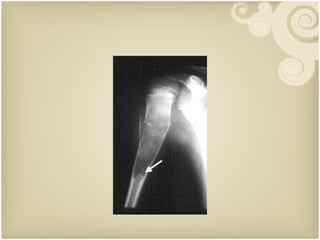
  • #12 Figure 8-178 Greenstick fracture. In the humerus of this elementary school child, a direct blow from the direction of the arrow has caused an incomplete transverse fracture.