Lower limb
fractures
Tibia, Ankle, Foot.
Given Sishekano
201404386
MBChB IV
Feb 17,2017
14h00
Table of content
▪ Fractures of the tibia
▪ Fractures of the ankle
▪ Fractures of the foot
Tibial fractures
▪ 1. Anatomy
▪ 2. Proximal tibia fractures
▪ 3. Tibial shaft fractures.
▪ 4. Distal tibia fractures
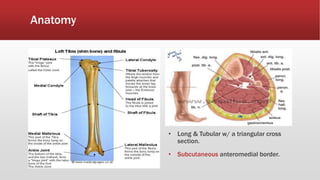
Anatomy
• Long & Tubular w/ a triangular cross
section.
• Subcutaneous anteromedial border.
Fractures of the proximal tibia.
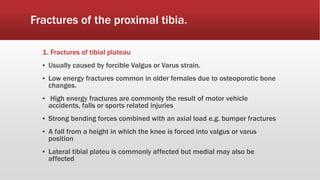
1. Fractures of tibial plateau
▪ Usually caused by forcible Valgus or Varus strain.
▪ Low energy fractures common in older females due to osteoporotic bone
changes.
▪ High energy fractures are commonly the result of motor vehicle
accidents, falls or sports related injuries
▪ Strong bending forces combined with an axial load e.g. bumper fractures
▪ A fall from a height in which the knee is forced into valgus or varus
position
▪ Lateral tibial plateu is commonly affected but medial may also be
affected
Epidemiology & presentation
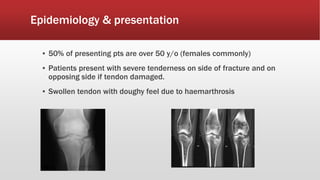
▪ 50% of presenting pts are over 50 y/o (females commonly)
▪ Patients present with severe tenderness on side of fracture and on
opposing side if tendon damaged.
▪ Swollen tendon with doughy feel due to haemarthrosis
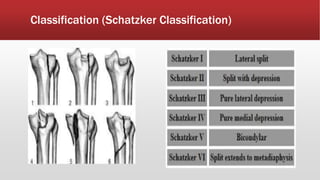
Classification (Schatzker Classification)
Imaging
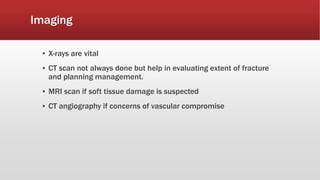
▪ X-rays are vital
▪ CT scan not always done but help in evaluating extent of fracture
and planning management.
▪ MRI scan if soft tissue damage is suspected
▪ CT angiography if concerns of vascular compromise
Management
▪ Treatment is aimed at achieving a stable, aligned, mobile and
painless joint and to minimize the risk of posttraumatic
osteoarthritis.
▪ Undisplaced & minimally displaced(Lc): conservative
management.
▪ Marked displacement/ comminuted(Lc): ORIF
▪ Medial condyle fractures: ORIF
▪ Bicondylar fractures: internal fixation w/ Plates and screws
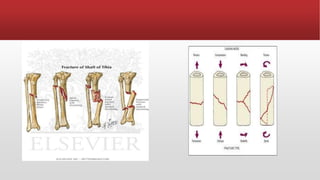
Tibial Shaft Fractures
▪ Commonest long bone fractures.
▪ Men>women
▪ Often Open fractures w/ contaminated wound.
Mechanism of Injury
▪ 1.Direct: High energy: MVA, sporting injury
-Transverse, comminuted, displaced fractures commonly occur.
-Incidence of soft tissue trauma is high
▪ Penetrating: gunshot-The injury pattern is variable.
▪ Bending-Short oblique or transverse fractures occur, with a
possible butterfly fragment.
-Crush injury.
▪ 2. Indirect
▪ Torsional mechanisms
-twisting with foot fixed, falls from low height.
-minimal soft tissue damage.
▪ Stress fractures
-e.g in Ballet dancers.
Clinical Exam
▪ Neurovascular status
▪ Assess soft tissue injury
▪ Examine knee ligament(commonly damaged)
▪ Examine for signs of compartment syndrome.
Imaging
▪ X-ray is usually sufficient
-Two views
-Two joints
-Two occasions
▪ Oblique X-ray to characterise pattern of injury if necessary.
▪ Post reduction X-ray must be done.
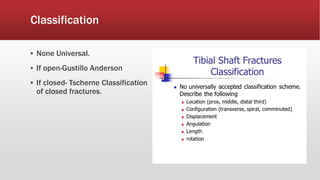
Classification
▪ None Universal.
▪ If open-Gustillo Anderson
▪ If closed- Tscherne Classification
of closed fractures.
Management
▪ Low energy
-Gastillo I, II: Conservatively
▪ Undisplaced/minimally displaced
- full length cast from upper thigh
to metatarsal neck, knee is
slightly flexed and the ankle at a
right angle
▪ Displaced fracture
- reduction under general
anaesthesia
▪ High energy
-External fixation is the method of
choice
-intramedullary nailing is an
alternative
-- Open operations should be
avoided unless there is already an
open wound
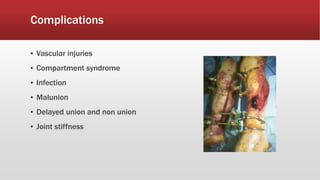
Complications
▪ Vascular injuries
▪ Compartment syndrome
▪ Infection
▪ Malunion
▪ Delayed union and non union
▪ Joint stiffness
3. Distal Tibial fractures
▪ Injury occurs when a large axial force drives the talus upwards
against the tibial plafond
▪ Usually high Energy
▪ Can be rotational with lower energy
▪ Articular Surface is Involved
▪ Can have severe comminution and severe soft tissue injury
Clinical features
▪ Little swelling initially but this rapidly changes
▪ Fracture blisters are common
▪ Ankle may be deformed or dislocated
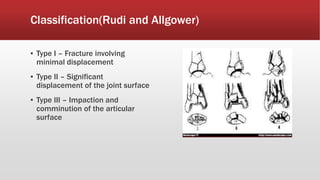
Classification(Rudi and Allgower)
▪ Type I – Fracture involving
minimal displacement
▪ Type II – Significant
displacement of the joint surface
▪ Type III – Impaction and
comminution of the articular
surface
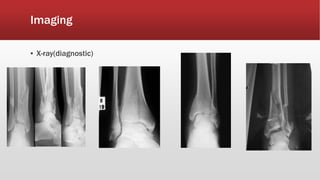
Imaging
▪ X-ray(diagnostic)
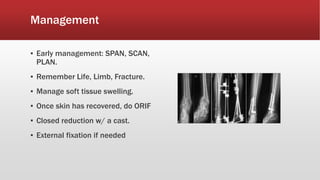
Management
▪ Early management: SPAN, SCAN,
PLAN.
▪ Remember Life, Limb, Fracture.
▪ Manage soft tissue swelling.
▪ Once skin has recovered, do ORIF
▪ Closed reduction w/ a cast.
▪ External fixation if needed
2. Ankle fractures
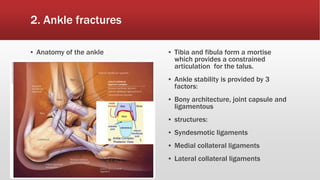
▪ Anatomy of the ankle ▪ Tibia and fibula form a mortise
which provides a constrained
articulation for the talus.
▪ Ankle stability is provided by 3
factors:
▪ Bony architecture, joint capsule and
ligamentous
▪ structures:
▪ Syndesmotic ligaments
▪ Medial collateral ligaments
▪ Lateral collateral ligaments
▪ Stumbling and falling
-Foot is usually anchored to the ground and the body lounges
forward.
▪ Ankle twisting
-Talus tilts or rotates forcibly in mortise causing a low energy
fracture of one or both malleoli with associated injuries of the
ligaments.
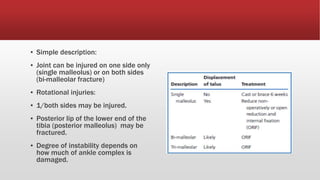
▪ Simple description:
▪ Joint can be injured on one side only
(single malleolus) or on both sides
(bi-malleolar fracture)
▪ Rotational injuries:
▪ 1/both sides may be injured.
▪ Posterior lip of the lower end of the
tibia (posterior malleolus) may be
fractured.
▪ Degree of instability depends on
how much of ankle complex is
damaged.
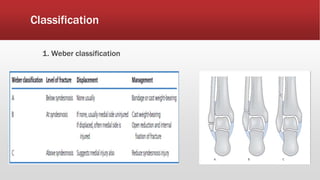
Classification
1. Weber classification
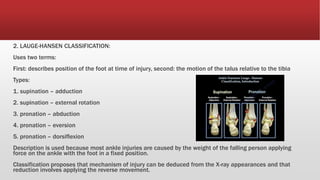
2. LAUGE-HANSEN CLASSIFICATION:
Uses two terms:
First: describes position of the foot at time of injury, second: the motion of the talus relative to the tibia
Types:
1. supination – adduction
2. supination – external rotation
3. pronation – abduction
4. pronation – eversion
5. pronation – dorsiflexion
Description is used because most ankle injuries are caused by the weight of the falling person applying
force on the ankle with the foot in a fixed position.
Classification proposes that mechanism of injury can be deduced from the X-ray appearances and that
reduction involves applying the reverse movement.
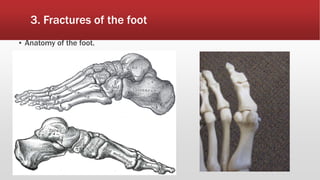
3. Fractures of the foot
▪ Anatomy of the foot.
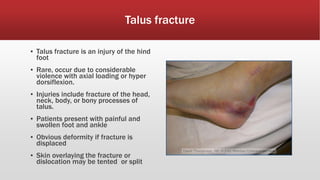
Talus fracture
▪ Talus fracture is an injury of the hind
foot
▪ Rare, occur due to considerable
violence with axial loading or hyper
dorsiflexion.
▪ Injuries include fracture of the head,
neck, body, or bony processes of
talus.
▪ Patients present with painful and
swollen foot and ankle
▪ Obvious deformity if fracture is
displaced
▪ Skin overlaying the fracture or
dislocation may be tented or split
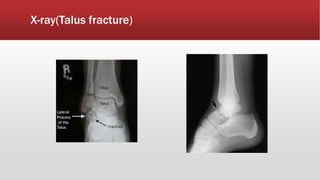
X-ray(Talus fracture)
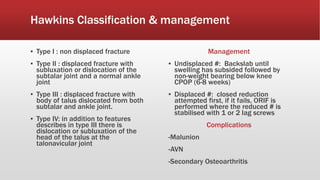
Hawkins Classification & management
▪ Type I : non displaced fracture
▪ Type II : displaced fracture with
subluxation or dislocation of the
subtalar joint and a normal ankle
joint
▪ Type III : displaced fracture with
body of talus dislocated from both
subtalar and ankle joint.
▪ Type IV: in addition to features
describes in type III there is
dislocation or subluxation of the
head of the talus at the
talonavicular joint
Management
▪ Undisplaced #: Backslab until
swelling has subsided followed by
non-weight bearing below knee
CPOP (6-8 weeks)
▪ Displaced #: closed reduction
attempted first, if it fails, ORIF is
performed where the reduced # is
stabilised with 1 or 2 lag screws
Complications
-Malunion
-AVN
-Secondary Osteoarthritis
Calcaneal fractures
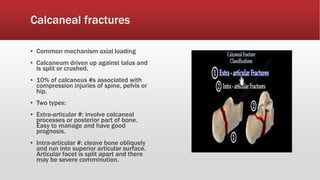
▪ Common mechanism axial loading
▪ Calcaneum driven up against talus and
is split or crushed.
▪ 10% of calcaneus #s associated with
compression injuries of spine, pelvis or
hip.
▪ Two types:
▪ Extra-articular #: involve calcaneal
processes or posterior part of bone.
Easy to manage and have good
prognosis.
▪ Intra-articular #: cleave bone obliquely
and run into superior articular surface.
Articular facet is split apart and there
may be severe comminution.
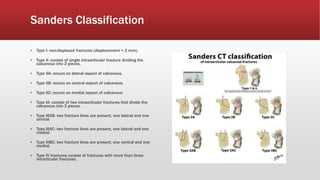
Sanders Classification
▪ Type I: non-displaced fractures (displacement < 2 mm).
▪ Type II: consist of single intraarticular fracture dividing the
calcaneus into 2 pieces.
▪ Type IIA: occurs on lateral aspect of calcaneus.
▪ Type IIB: occurs on central aspect of calcaneus.
▪ Type IIC: occurs on medial aspect of calcaneus.
▪ Type III: consist of two intraarticular fractures that divide the
calcaneus into 3 pieces.
▪ Type IIIAB: two fracture lines are present, one lateral and one
central.
▪ Type IIIAC: two fracture lines are present, one lateral and one
medial.
▪ Type IIIBC: two fracture lines are present, one central and one
medial.
▪ Type IV fractures consist of fractures with more than three
intrarticular fractures.
Presentation
▪ Foot is painful, swollen and bruised.
▪ Wider, shortened, flatter heel when
viewed from behind + varus heel
▪ Tissues are thick and tender and
normal concavity below the lateral
malleolus is lacking.
▪ Subtalar joint cannot be moved but
ankle movement is possible.
▪ Always check for signs of
Compartment syndrome
X-ray views
▪ Lateral, oblique and AP views
▪ Extra-articular #: fairly obvious on
xray
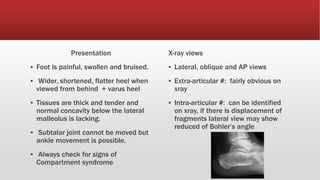
▪ Intra-articular #: can be identified
on xray, if there is displacement of
fragments lateral view may show
reduced of Bohler’s angle
Management
▪ Undisplaced fractures: Closed non-surgical treatment (backslab,
CPOP), use crutches for 4-6 weeks.
▪ Displaced avulsion #: ORIF, Immobilise foot in slight equinus to
relieve tension on tendo Achillis. Non-weight bearing for 4-6 weeks.
▪ Displaced intra-articular #: ORIF with plates and screws.
▪ Bone grafts may be used to fill defects.
▪ Encourage exercise when pain subsides
▪ Pt allowed to use crutches 2-3 weeks after (non-weight bearing) ->
Partial weight bearing only when fracture has healed -> full weight
bearing only 4 weeks after that
Complications
▪ Early: swelling and blistering, Compartment Syndrome
▪ Late: Malunion, Insufficiency of Achilles tendon (due to loss of
heel height), talocalcaneal stiffness and osteoarthritis
Lisfranc fracture
▪ Lisfranc (midfoot) injuries result if bones in the midfoot are broken or
ligaments that support the midfoot are torn.
▪ Varies from minor sprains to severe fracture-dislocations
▪ m.o.i: simple twist and fall.
▪ This is a low-energy injury, commonly seen in football and soccer players.
▪ More severe injuries occur from direct trauma, such as a fall from a
height.
▪ These high-energy injuries can result in multiple fractures and
dislocations of the joints.
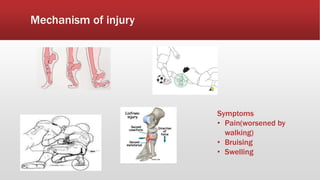
▪ It is often seen when someone stumbles over the top of a foot plantar
flexed.
Mechanism of injury
Symptoms
• Pain(worsened by
walking)
• Bruising
• Swelling
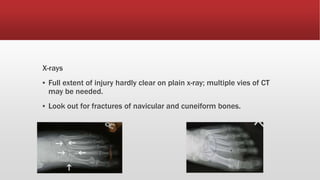
X-rays
▪ Full extent of injury hardly clear on plain x-ray; multiple vies of CT
may be needed.
▪ Look out for fractures of navicular and cuneiform bones.
Management
▪ Undisplaced sprain: cast immobilization for 4-6 weeks.
▪ Subluxation and dislocation: Traction and manipulation under
anaesthesia achieves reduction.
▪ Position is then held with K-wires or screws and cast
immobilization.
▪ Non-weight bearing for 6-8 weeks.
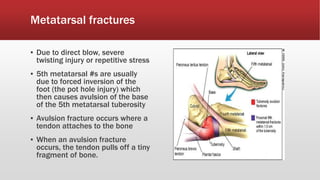
Metatarsal fractures
▪ Due to direct blow, severe
twisting injury or repetitive stress
▪ 5th metatarsal #s are usually
due to forced inversion of the
foot (the pot hole injury) which
then causes avulsion of the base
of the 5th metatarsal tuberosity
▪ Avulsion fracture occurs where a
tendon attaches to the bone
▪ When an avulsion fracture
occurs, the tendon pulls off a tiny
fragment of bone.
Presentation
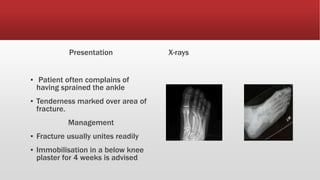
▪ Patient often complains of
having sprained the ankle
▪ Tenderness marked over area of
fracture.
Management
▪ Fracture usually unites readily
▪ Immobilisation in a below knee
plaster for 4 weeks is advised
X-rays
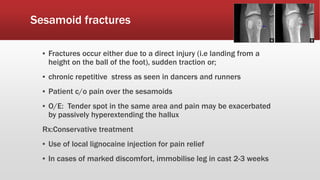
Sesamoid fractures
▪ Fractures occur either due to a direct injury (i.e landing from a
height on the ball of the foot), sudden traction or;
▪ chronic repetitive stress as seen in dancers and runners
▪ Patient c/o pain over the sesamoids
▪ O/E: Tender spot in the same area and pain may be exacerbated
by passively hyperextending the hallux
Rx:Conservative treatment
▪ Use of local lignocaine injection for pain relief
▪ In cases of marked discomfort, immobilise leg in cast 2-3 weeks
References
1. Apley’s consice system of orthopaedics and fractures
2. Toronto notes 2016
3. Orthopaedics and fractures lecture notes(4th ed.), wiley-Blackwell.

Lower limb fractures-Orthopedics

  • 1.
    Lower limb fractures Tibia, Ankle,Foot. Given Sishekano 201404386 MBChB IV Feb 17,2017 14h00
  • 2.
    Table of content ▪Fractures of the tibia ▪ Fractures of the ankle ▪ Fractures of the foot
  • 3.
    Tibial fractures ▪ 1.Anatomy ▪ 2. Proximal tibia fractures ▪ 3. Tibial shaft fractures. ▪ 4. Distal tibia fractures
  • 4.
    Anatomy • Long &Tubular w/ a triangular cross section. • Subcutaneous anteromedial border.
  • 5.
    Fractures of theproximal tibia. 1. Fractures of tibial plateau ▪ Usually caused by forcible Valgus or Varus strain. ▪ Low energy fractures common in older females due to osteoporotic bone changes. ▪ High energy fractures are commonly the result of motor vehicle accidents, falls or sports related injuries ▪ Strong bending forces combined with an axial load e.g. bumper fractures ▪ A fall from a height in which the knee is forced into valgus or varus position ▪ Lateral tibial plateu is commonly affected but medial may also be affected
  • 6.
    Epidemiology & presentation ▪50% of presenting pts are over 50 y/o (females commonly) ▪ Patients present with severe tenderness on side of fracture and on opposing side if tendon damaged. ▪ Swollen tendon with doughy feel due to haemarthrosis
  • 7.
  • 8.
    Imaging ▪ X-rays arevital ▪ CT scan not always done but help in evaluating extent of fracture and planning management. ▪ MRI scan if soft tissue damage is suspected ▪ CT angiography if concerns of vascular compromise
  • 9.
    Management ▪ Treatment isaimed at achieving a stable, aligned, mobile and painless joint and to minimize the risk of posttraumatic osteoarthritis. ▪ Undisplaced & minimally displaced(Lc): conservative management. ▪ Marked displacement/ comminuted(Lc): ORIF ▪ Medial condyle fractures: ORIF ▪ Bicondylar fractures: internal fixation w/ Plates and screws
  • 10.
    Tibial Shaft Fractures ▪Commonest long bone fractures. ▪ Men>women ▪ Often Open fractures w/ contaminated wound.
  • 11.
    Mechanism of Injury ▪1.Direct: High energy: MVA, sporting injury -Transverse, comminuted, displaced fractures commonly occur. -Incidence of soft tissue trauma is high ▪ Penetrating: gunshot-The injury pattern is variable. ▪ Bending-Short oblique or transverse fractures occur, with a possible butterfly fragment. -Crush injury.
  • 12.
    ▪ 2. Indirect ▪Torsional mechanisms -twisting with foot fixed, falls from low height. -minimal soft tissue damage. ▪ Stress fractures -e.g in Ballet dancers.
  • 14.
    Clinical Exam ▪ Neurovascularstatus ▪ Assess soft tissue injury ▪ Examine knee ligament(commonly damaged) ▪ Examine for signs of compartment syndrome.
  • 15.
    Imaging ▪ X-ray isusually sufficient -Two views -Two joints -Two occasions ▪ Oblique X-ray to characterise pattern of injury if necessary. ▪ Post reduction X-ray must be done.
  • 16.
    Classification ▪ None Universal. ▪If open-Gustillo Anderson ▪ If closed- Tscherne Classification of closed fractures.
  • 17.
    Management ▪ Low energy -GastilloI, II: Conservatively ▪ Undisplaced/minimally displaced - full length cast from upper thigh to metatarsal neck, knee is slightly flexed and the ankle at a right angle ▪ Displaced fracture - reduction under general anaesthesia ▪ High energy -External fixation is the method of choice -intramedullary nailing is an alternative -- Open operations should be avoided unless there is already an open wound
  • 18.
    Complications ▪ Vascular injuries ▪Compartment syndrome ▪ Infection ▪ Malunion ▪ Delayed union and non union ▪ Joint stiffness
  • 19.
    3. Distal Tibialfractures ▪ Injury occurs when a large axial force drives the talus upwards against the tibial plafond ▪ Usually high Energy ▪ Can be rotational with lower energy ▪ Articular Surface is Involved ▪ Can have severe comminution and severe soft tissue injury
  • 20.
    Clinical features ▪ Littleswelling initially but this rapidly changes ▪ Fracture blisters are common ▪ Ankle may be deformed or dislocated
  • 21.
    Classification(Rudi and Allgower) ▪Type I – Fracture involving minimal displacement ▪ Type II – Significant displacement of the joint surface ▪ Type III – Impaction and comminution of the articular surface
  • 22.
  • 23.
    Management ▪ Early management:SPAN, SCAN, PLAN. ▪ Remember Life, Limb, Fracture. ▪ Manage soft tissue swelling. ▪ Once skin has recovered, do ORIF ▪ Closed reduction w/ a cast. ▪ External fixation if needed
  • 24.
    2. Ankle fractures ▪Anatomy of the ankle ▪ Tibia and fibula form a mortise which provides a constrained articulation for the talus. ▪ Ankle stability is provided by 3 factors: ▪ Bony architecture, joint capsule and ligamentous ▪ structures: ▪ Syndesmotic ligaments ▪ Medial collateral ligaments ▪ Lateral collateral ligaments
  • 25.
    ▪ Stumbling andfalling -Foot is usually anchored to the ground and the body lounges forward. ▪ Ankle twisting -Talus tilts or rotates forcibly in mortise causing a low energy fracture of one or both malleoli with associated injuries of the ligaments.
  • 26.
    ▪ Simple description: ▪Joint can be injured on one side only (single malleolus) or on both sides (bi-malleolar fracture) ▪ Rotational injuries: ▪ 1/both sides may be injured. ▪ Posterior lip of the lower end of the tibia (posterior malleolus) may be fractured. ▪ Degree of instability depends on how much of ankle complex is damaged.
  • 27.
  • 28.
    2. LAUGE-HANSEN CLASSIFICATION: Usestwo terms: First: describes position of the foot at time of injury, second: the motion of the talus relative to the tibia Types: 1. supination – adduction 2. supination – external rotation 3. pronation – abduction 4. pronation – eversion 5. pronation – dorsiflexion Description is used because most ankle injuries are caused by the weight of the falling person applying force on the ankle with the foot in a fixed position. Classification proposes that mechanism of injury can be deduced from the X-ray appearances and that reduction involves applying the reverse movement.
  • 29.
    3. Fractures ofthe foot ▪ Anatomy of the foot.
  • 30.
    Talus fracture ▪ Talusfracture is an injury of the hind foot ▪ Rare, occur due to considerable violence with axial loading or hyper dorsiflexion. ▪ Injuries include fracture of the head, neck, body, or bony processes of talus. ▪ Patients present with painful and swollen foot and ankle ▪ Obvious deformity if fracture is displaced ▪ Skin overlaying the fracture or dislocation may be tented or split
  • 31.
  • 32.
    Hawkins Classification &management ▪ Type I : non displaced fracture ▪ Type II : displaced fracture with subluxation or dislocation of the subtalar joint and a normal ankle joint ▪ Type III : displaced fracture with body of talus dislocated from both subtalar and ankle joint. ▪ Type IV: in addition to features describes in type III there is dislocation or subluxation of the head of the talus at the talonavicular joint Management ▪ Undisplaced #: Backslab until swelling has subsided followed by non-weight bearing below knee CPOP (6-8 weeks) ▪ Displaced #: closed reduction attempted first, if it fails, ORIF is performed where the reduced # is stabilised with 1 or 2 lag screws Complications -Malunion -AVN -Secondary Osteoarthritis
  • 33.
    Calcaneal fractures ▪ Commonmechanism axial loading ▪ Calcaneum driven up against talus and is split or crushed. ▪ 10% of calcaneus #s associated with compression injuries of spine, pelvis or hip. ▪ Two types: ▪ Extra-articular #: involve calcaneal processes or posterior part of bone. Easy to manage and have good prognosis. ▪ Intra-articular #: cleave bone obliquely and run into superior articular surface. Articular facet is split apart and there may be severe comminution.
  • 34.
    Sanders Classification ▪ TypeI: non-displaced fractures (displacement < 2 mm). ▪ Type II: consist of single intraarticular fracture dividing the calcaneus into 2 pieces. ▪ Type IIA: occurs on lateral aspect of calcaneus. ▪ Type IIB: occurs on central aspect of calcaneus. ▪ Type IIC: occurs on medial aspect of calcaneus. ▪ Type III: consist of two intraarticular fractures that divide the calcaneus into 3 pieces. ▪ Type IIIAB: two fracture lines are present, one lateral and one central. ▪ Type IIIAC: two fracture lines are present, one lateral and one medial. ▪ Type IIIBC: two fracture lines are present, one central and one medial. ▪ Type IV fractures consist of fractures with more than three intrarticular fractures.
  • 35.
    Presentation ▪ Foot ispainful, swollen and bruised. ▪ Wider, shortened, flatter heel when viewed from behind + varus heel ▪ Tissues are thick and tender and normal concavity below the lateral malleolus is lacking. ▪ Subtalar joint cannot be moved but ankle movement is possible. ▪ Always check for signs of Compartment syndrome X-ray views ▪ Lateral, oblique and AP views ▪ Extra-articular #: fairly obvious on xray ▪ Intra-articular #: can be identified on xray, if there is displacement of fragments lateral view may show reduced of Bohler’s angle
  • 36.
    Management ▪ Undisplaced fractures:Closed non-surgical treatment (backslab, CPOP), use crutches for 4-6 weeks. ▪ Displaced avulsion #: ORIF, Immobilise foot in slight equinus to relieve tension on tendo Achillis. Non-weight bearing for 4-6 weeks. ▪ Displaced intra-articular #: ORIF with plates and screws. ▪ Bone grafts may be used to fill defects. ▪ Encourage exercise when pain subsides ▪ Pt allowed to use crutches 2-3 weeks after (non-weight bearing) -> Partial weight bearing only when fracture has healed -> full weight bearing only 4 weeks after that
  • 37.
    Complications ▪ Early: swellingand blistering, Compartment Syndrome ▪ Late: Malunion, Insufficiency of Achilles tendon (due to loss of heel height), talocalcaneal stiffness and osteoarthritis
  • 38.
    Lisfranc fracture ▪ Lisfranc(midfoot) injuries result if bones in the midfoot are broken or ligaments that support the midfoot are torn. ▪ Varies from minor sprains to severe fracture-dislocations ▪ m.o.i: simple twist and fall. ▪ This is a low-energy injury, commonly seen in football and soccer players. ▪ More severe injuries occur from direct trauma, such as a fall from a height. ▪ These high-energy injuries can result in multiple fractures and dislocations of the joints. ▪ It is often seen when someone stumbles over the top of a foot plantar flexed.
  • 39.
    Mechanism of injury Symptoms •Pain(worsened by walking) • Bruising • Swelling
  • 40.
    X-rays ▪ Full extentof injury hardly clear on plain x-ray; multiple vies of CT may be needed. ▪ Look out for fractures of navicular and cuneiform bones.
  • 41.
    Management ▪ Undisplaced sprain:cast immobilization for 4-6 weeks. ▪ Subluxation and dislocation: Traction and manipulation under anaesthesia achieves reduction. ▪ Position is then held with K-wires or screws and cast immobilization. ▪ Non-weight bearing for 6-8 weeks.
  • 42.
    Metatarsal fractures ▪ Dueto direct blow, severe twisting injury or repetitive stress ▪ 5th metatarsal #s are usually due to forced inversion of the foot (the pot hole injury) which then causes avulsion of the base of the 5th metatarsal tuberosity ▪ Avulsion fracture occurs where a tendon attaches to the bone ▪ When an avulsion fracture occurs, the tendon pulls off a tiny fragment of bone.
  • 43.
    Presentation ▪ Patient oftencomplains of having sprained the ankle ▪ Tenderness marked over area of fracture. Management ▪ Fracture usually unites readily ▪ Immobilisation in a below knee plaster for 4 weeks is advised X-rays
  • 44.
    Sesamoid fractures ▪ Fracturesoccur either due to a direct injury (i.e landing from a height on the ball of the foot), sudden traction or; ▪ chronic repetitive stress as seen in dancers and runners ▪ Patient c/o pain over the sesamoids ▪ O/E: Tender spot in the same area and pain may be exacerbated by passively hyperextending the hallux Rx:Conservative treatment ▪ Use of local lignocaine injection for pain relief ▪ In cases of marked discomfort, immobilise leg in cast 2-3 weeks
  • 45.
    References 1. Apley’s consicesystem of orthopaedics and fractures 2. Toronto notes 2016 3. Orthopaedics and fractures lecture notes(4th ed.), wiley-Blackwell.