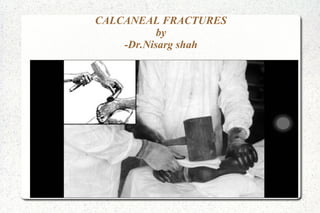
CALCANEAL FRACTURES
by
-Dr.Nisarg shah
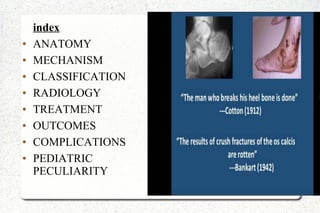
index
● ANATOMY
● MECHANISM
● CLASSIFICATION
● RADIOLOGY
● TREATMENT
● OUTCOMES
● COMPLICATIONS
● PEDIATRIC
PECULIARITY
introduction
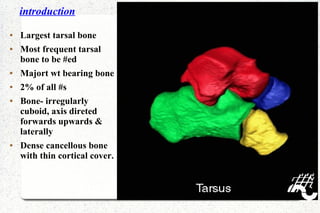
● Largest tarsal bone
● Most frequent tarsal
bone to be #ed
● Majort wt bearing bone
● 2% of all #s
● Bone- irregularly
cuboid, axis direted
forwards upwards &
laterally
● Dense cancellous bone
with thin cortical cover.
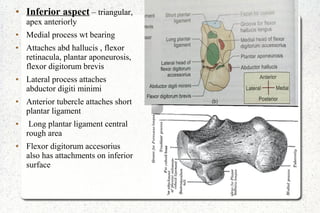
● Inferior aspect – triangular,
apex anteriorly
● Medial process wt bearing
● Attaches abd hallucis , flexor
retinacula, plantar aponeurosis,
flexor digitorum brevis
● Lateral process attaches
abductor digiti minimi
● Anterior tubercle attaches short
plantar ligament
● Long plantar ligament central
rough area
● Flexor digitorum accesorius
also has attachments on inferior
surface
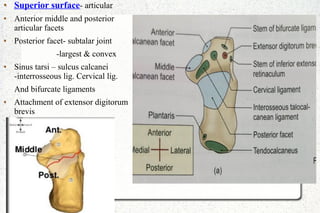
● Superior surface- articular
● Anterior middle and posterior
articular facets
● Posterior facet- subtalar joint
-largest & convex
● Sinus tarsi – sulcus calcanei
-interrosseous lig. Cervical lig.
And bifurcate ligaments
● Attachment of extensor digitorum
brevis
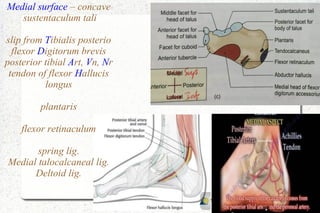
Medial surface – concave
sustentaculum tali
slip from Tibialis posterio
flexor Digitorum brevis
posterior tibial Art, Vn, Nr
tendon of flexor Hallucis
longus
plantaris
flexor retinaculum
spring lig.
Medial talocalcaneal lig.
Deltoid lig.
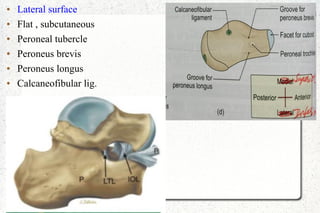
● Lateral surface
● Flat , subcutaneous
● Peroneal tubercle
● Peroneus brevis
● Peroneus longus
● Calcaneofibular lig.
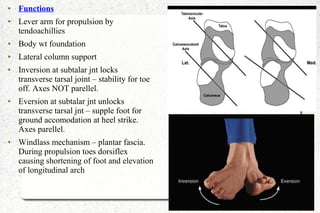
● Functions
● Lever arm for propulsion by
tendoachillies
● Body wt foundation
● Lateral column support
● Inversion at subtalar jnt locks
transverse tarsal joint – stability for toe
off. Axes NOT parellel.
● Eversion at subtalar jnt unlocks
transverse tarsal jnt – supple foot for
ground accomodation at heel strike.
Axes parellel.
● Windlass mechanism – plantar fascia.
During propulsion toes dorsiflex
causing shortening of foot and elevation
of longitudinal arch
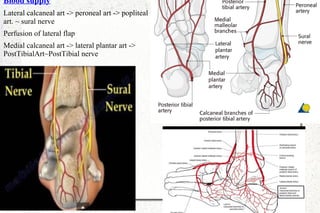
Blood supply
Lateral calcaneal art -> peroneal art -> popliteal
art. ~ sural nerve
Perfusion of lateral flap
Medial calcaneal art -> lateral plantar art ->
PostTibialArt~PostTibial nerve
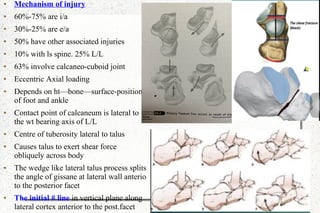
● Mechanism of injury
● 60%-75% are i/a
● 30%-25% are e/a
● 50% have other associated injuries
● 10% with ls spine. 25% L/L
● 63% involve calcaneo-cuboid joint
● Eccentric Axial loading
● Depends on ht—bone—surface-position
of foot and ankle
● Contact point of calcaneum is lateral to
the wt bearing axis of L/L
● Centre of tuberosity lateral to talus
● Causes talus to exert shear force
obliquely across body
● The wedge like lateral talus process splits
the angle of gissane at lateral wall anterio
to the posterior facet
● The initial # line in vertical plane along
lateral cortex anterior to the post.facet
● The primary # line runs from
portereomedial to anterolateral
calcaneus results into two thalamic
fragments
● The anteromedial/superomedial
/sustentacular/constant fragment
● Attached to deltoid lig. Will move
inferiorly medially and posteriorly
● Posterolateral/superolateral/
semilunar/comet fragment
● Will move superiorly laterally and
anteriorly
● Foot in pronation - #line
posterolateral to post.facet [2A]
● Foot Neutral – # line roughly
through middle of post.facet [2B]
● Foot Supination – # line
anteromedial to post.facet [2C]
● Secondary # line
● Exists proximal to tendo
achillies insertion then it is
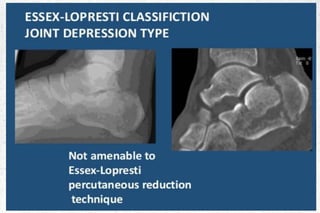
joint depression type
● Exits distal to tendoachillies
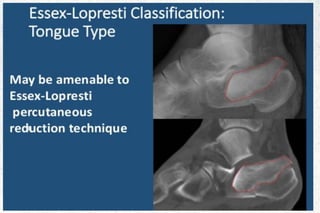
insertion then it is tongue type
● Anteriorly the secondary # line
may extend to calcaneo-cuboid
joint [I/A] or
[E/A] plantar surface , lateral
wall , medial wall
● Clinical feature
● Pain / tenderness
● Soft tissue injuries
● Skin blisters
● Open # are 7%-17%
● Compartment syndrome
● Skin necrosis at posterior edge
● Thompson test – loss of plantar
flexion with manual calf compression
[tuberosity #]
● Hoffa's sign – laxity of achillies
tendon and weakness of plantar
flexion [I/A #]
● Evaluate comorbidyties to guide Rx
and outcomes --- pvd / dm / smoking /
bmi / age / gender / occupation /
?ambulatory
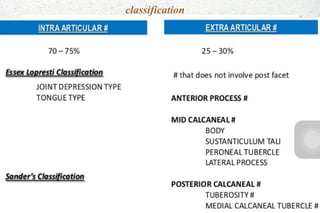
classification
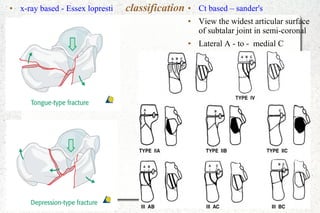
classification● x-ray based - Essex lopresti ● Ct based – sander's
● View the widest articular surface
of subtalar joint in semi-coronal
● Lateral A - to - medial C
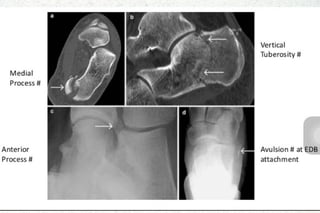
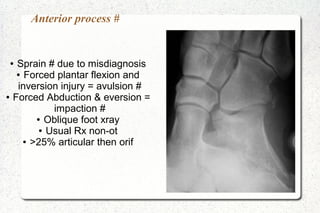
Anterior process #
● Sprain # due to misdiagnosis
● Forced plantar flexion and
inversion injury = avulsion #
● Forced Abduction & eversion =
impaction #
● Oblique foot xray
● Usual Rx non-ot
● >25% articular then orif
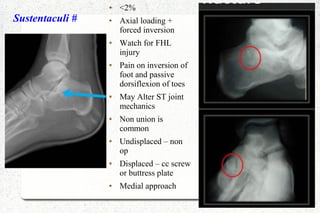
Sustentaculi #
● <2%
● Axial loading +
forced inversion
● Watch for FHL
injury
● Pain on inversion of
foot and passive
dorsiflexion of toes
● May Alter ST joint
mechanics
● Non union is
common
● Undisplaced – non
op
● Displaced – cc screw
or buttress plate
● Medial approach
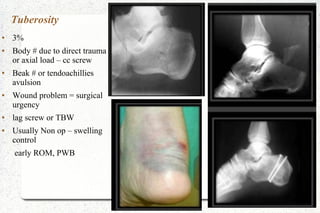
Tuberosity
● 3%
● Body # due to direct trauma
or axial load – cc screw
● Beak # or tendoachillies
avulsion
● Wound problem = surgical
urgency
● lag screw or TBW
● Usually Non op – swelling
control
early ROM, PWB
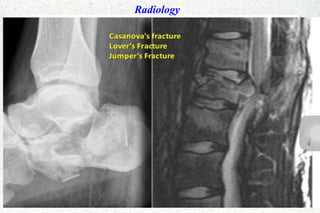
Radiology
Xrays – 5 views
● Ap – calcaneocuboid joint
● Obliq – anterior facet and anterior process.
● Lateral- traction & compression trabecula. Neutral triangle . Thalamic portion is
condensed cortical bone inferior to post. Facet.
● Bohler [tuber angle ] normal 20-40 deg. Decreased in ht loss. Corelates with outcome.
● Crucial angle of gissane –Nr is 100 – 120 deg. Relation between 3 facets
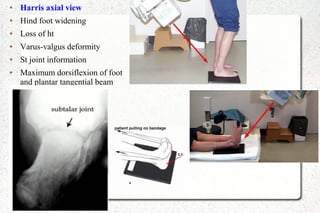
● Harris axial view
● Hind foot widening
● Loss of ht
● Varus-valgus deformity
● St joint information
● Maximum dorsiflexion of foot
and plantar tangential beam
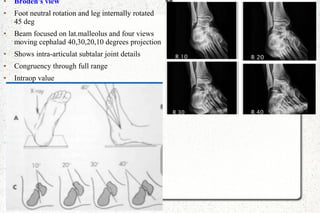
● Broden's view
● Foot neutral rotation and leg internally rotated
45 deg
● Beam focused on lat.malleolus and four views
moving cephalad 40,30,20,10 degrees projection
● Shows intra-articulat subtalar joint details
● Congruency through full range
● Intraop value
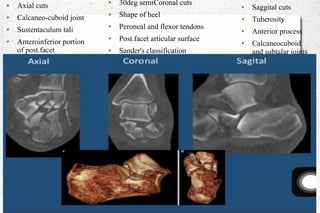
● Axial cuts
● Calcaneo-cuboid joint
● Sustentaculum tali
● Anteroinferior portion
of post.facet
● 30deg semiCoronal cuts
● Shape of heel
● Peroneal and flexor tendons
● Post.facet articular surface
● Sander's classification
● Saggital cuts
● Tuberosity
● Anterior process
● Calcaneocuboid
and subtalar joints
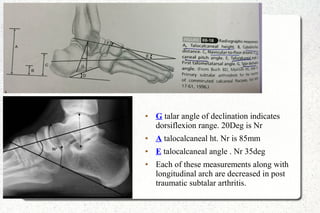
● G talar angle of declination indicates
dorsiflexion range. 20Deg is Nr
● A talocalcaneal ht. Nr is 85mm
● E talocalcaneal angle . Nr 35deg
● Each of these measurements along with
longitudinal arch are decreased in post
traumatic subtalar arthritis.
TREATMENT● Goals
● Congruency of ST and CC joints
● Restoration of ht [Bohler's angle]
● Reduction of width
● Decompression of subfibular
space for peroneal tendons
● Valgus realignment tuberosity
● Stable fixation
● Timing & important factors
● Age & other injuries
● General health & comorbidity
● Soft tissue envelope – tense
fascia - # blebs
● Open wounds & coverage
● Wrinkle test
● Operative
● Displaced I/A of post.facet
● >25% CC joint involved
● Displaced tuberosity #
● # dislocations
● Open #
● Non-operative
● Mini.displaced E/A
● Undisplaced I/A
● <25% CC joint involved
● Severe pvd
● Household ambulators
● Insulin dependent dm
● Medical comorbidity
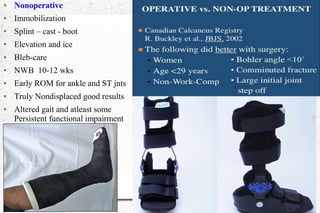
● Nonoperative
● Immobilization
● Splint – cast - boot
● Elevation and ice
● Bleb-care
● NWB 10-12 wks
● Early ROM for ankle and ST jnts
● Truly Nondisplaced good results
● Altered gait and atleast some
Persistent functional impairment
OPERATIVE
METHODS
● Essex Lopresti CRIF
● Benirsche Sangorzan
EXTENSILE
LATERAL
● Mcreynolds'
MEDIAL
APPROACH
● Stephenson
COMBINED
● U [Cincinnatti]
APPROACH
● ANTERIOR
PROCESS
APPROACH
● Bg Weber TBW
● Carr PRIMARY
ARTHRODESIS
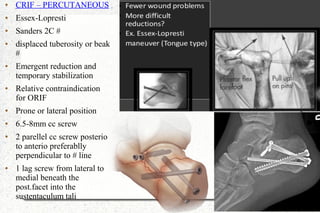
● CRIF – PERCUTANEOUS
● Essex-Lopresti
● Sanders 2C #
● displaced tuberosity or beak
#
● Emergent reduction and
temporary stabilization
● Relative contraindication
for ORIF
● Prone or lateral position
● 6.5-8mm cc screw
● 2 parellel cc screw posterio
to anterio preferablly
perpendicular to # line
● 1 lag screw from lateral to
medial beneath the
post.facet into the
sustentaculum tali
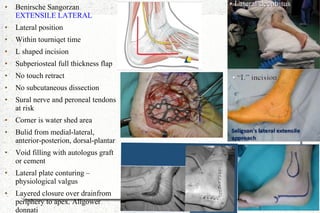
● Benirsche Sangorzan
EXTENSILE LATERAL
● Lateral position
● Within tourniqet time
● L shaped incision
● Subperiosteal full thickness flap
● No touch retract
● No subcutaneous dissection
● Sural nerve and peroneal tendons
at risk
● Corner is water shed area
● Bulid from medial-lateral,
anterior-posterion, dorsal-plantar
● Void filling with autologus graft
or cement
● Lateral plate conturing –
physiological valgus
● Layered closure over drainfrom
periphery to apex. Allgower
donnati
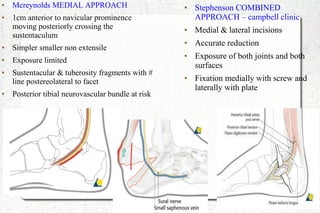
● Mcreynolds MEDIAL APPROACH
● 1cm anterior to navicular prominence
moving posteriorly crossing the
sustentaculum
● Simpler smaller non extensile
● Exposure limited
● Sustentacular & tuberosity fragments with #
line postereolateral to facet
● Posterior tibial neurovascular bundle at risk
● Stephenson COMBINED
APPROACH – campbell clinic
● Medial & lateral incisions
● Accurate reduction
● Exposure of both joints and both
surfaces
● Fixation medially with screw and
laterally with plate
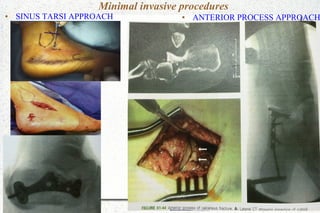
● SINUS TARSI APPROACH ● ANTERIOR PROCESS APPROACH
Minimal invasive procedures
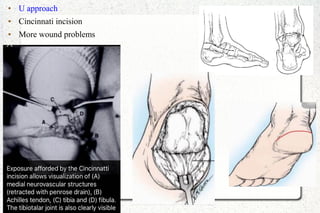
● U approach
● Cincinnati incision
● More wound problems
● Carr [gallie's] primary arthrodesis
● Subtalar or triple arthrodesis
● For sanders 4, severe open sander 3.
● Correct any deformities
● Restore calcaneal ht and orientation
● Maintain talar declination angle and
valgus
● Autologus graft placement
● Denude lateral aspect of talus
● 2 large 6.5-8mm cc screwplaced into
corner of heel, perpendicular to
subtalar joint, entering the talus dome.
● Bg Weber tension band wiring
● For tendo achillies avulsions
● Prone position
● May need tendo achillies
lengthening or gastroc resection
● Splint in plantarflexion
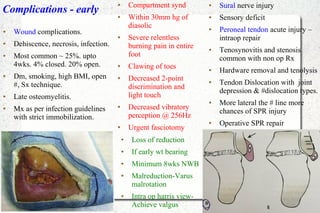
Complications - early
● Wound complications.
● Dehiscence, necrosis, infection.
● Most common ~ 25%. upto
4wks. 4% closed. 20% open.
● Dm, smoking, high BMI, open
#, Sx technique.
● Late osteomyelitis.
● Mx as per infection guidelines
with strict immobilization.
● Compartment synd
● Within 30mm hg of
diasolic
● Severe relentless
burning pain in entire
foot
● Clawing of toes
● Decreased 2-point
discrimination and
light touch
● Decreased vibratory
perception @ 256Hz
● Urgent fasciotomy
● Loss of reduction
● If early wt bearing
● Minimum 8wks NWB
● Malreduction-Varus
malrotation
● Intra op harris view-
Achieve valgus
● Sural nerve injury
● Sensory deficit
● Peroneal tendon acute injury –
intraop repair
● Tenosynovitis and stenosis
common with non op Rx
● Hardware removal and tenolysis
● Tendon Dislocation with joint
depression & #dislocation types.
● More lateral the # line more
chances of SPR injury
● Operative SPR repair
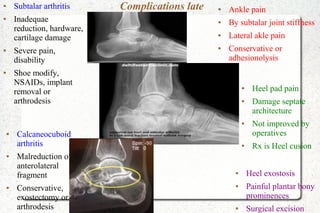
Complications late● Subtalar arthritis
● Inadequae
reduction, hardware,
cartilage damage
● Severe pain,
disability
● Shoe modify,
NSAIDs, implant
removal or
arthrodesis
● Ankle pain
● By subtalar joint stiffness
● Lateral akle pain
● Conservative or
adhesionolysis
● Heel exostosis
● Painful plantar bony
prominences
● Surgical excision
● Heel pad pain
● Damage septate
architecture
● Not improved by
operatives
● Rx is Heel cusion
● Calcaneocuboid
arthritis
● Malreduction of
anterolateral
fragment
● Conservative,
exostectomy or
arthrodesis
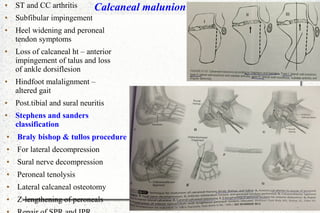
Calcaneal malunion● ST and CC arthritis
● Subfibular impingement
● Heel widening and peroneal
tendon symptoms
● Loss of calcaneal ht – anterior
impingement of talus and loss
of ankle dorsiflesion
● Hindfoot malalignment –
altered gait
● Post.tibial and sural neuritis
● Stephens and sanders
classification
● Braly bishop & tullos procedure
● For lateral decompression
● Sural nerve decompression
● Peroneal tenolysis
● Lateral calcaneal osteotomy
● Z-lengthening of peroneals
●
Pediatric peculiarity
● Pry os. Cntr at 3mnth IUL
● Sec os. Cntr at 6-8 yrs. Cresentic
posterior.
Fuse with body at 14-16yr.
● Resembles adult calcaneum after
10yrs age
● Rare #. largely cartilaginous,
absorbs shock. Less
comminution
● More L/L # associated
● <14yr mostly E/A. >14yr ~
adults
● D/d sever disease, osteomylitis,
stress #
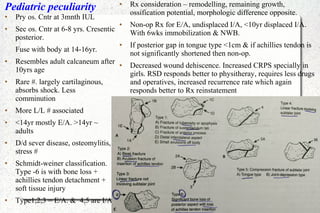
● Schmidt-weiner classification.
Type -6 is with bone loss +
achillies tendon detachment +
soft tissue injury
● Type1,2,3 = E/A. & 4,5 are I/A
● Rx consideration – remodelling, remaining growth,
ossification potential, morphologic difference opposite.
● Non-op Rx for E/A, undisplaced I/A, <10yr displaced I/A.
With 6wks immobilization & NWB.
● If posterior gap in tongue type <1cm & if achillies tendon is
not significantly shortened then non-op.
● Decreased wound dehiscence. Increased CRPS specially in
girls. RSD responds better to physitheray, requires less drugs
and operatives, increased recurrence rate which again
responds better to Rx reinstatement
THANK YOU ALL.........
.......Faculty and Colleagues.......
● References
● Rockwood & Greens
● Rockwood & Wilkins
● Campbell's Operative
● Davangiree Notes
● B.D.Chaurasia
● A.O.Surgical References
● Orthobullets
● Slide Share
● Google !

Calcaneum fractures

  • 1.
  • 2.
    index ● ANATOMY ● MECHANISM ●CLASSIFICATION ● RADIOLOGY ● TREATMENT ● OUTCOMES ● COMPLICATIONS ● PEDIATRIC PECULIARITY
  • 3.
    introduction ● Largest tarsalbone ● Most frequent tarsal bone to be #ed ● Majort wt bearing bone ● 2% of all #s ● Bone- irregularly cuboid, axis direted forwards upwards & laterally ● Dense cancellous bone with thin cortical cover.
  • 4.
    ● Inferior aspect– triangular, apex anteriorly ● Medial process wt bearing ● Attaches abd hallucis , flexor retinacula, plantar aponeurosis, flexor digitorum brevis ● Lateral process attaches abductor digiti minimi ● Anterior tubercle attaches short plantar ligament ● Long plantar ligament central rough area ● Flexor digitorum accesorius also has attachments on inferior surface
  • 5.
    ● Superior surface-articular ● Anterior middle and posterior articular facets ● Posterior facet- subtalar joint -largest & convex ● Sinus tarsi – sulcus calcanei -interrosseous lig. Cervical lig. And bifurcate ligaments ● Attachment of extensor digitorum brevis
  • 6.
    Medial surface –concave sustentaculum tali slip from Tibialis posterio flexor Digitorum brevis posterior tibial Art, Vn, Nr tendon of flexor Hallucis longus plantaris flexor retinaculum spring lig. Medial talocalcaneal lig. Deltoid lig.
  • 7.
    ● Lateral surface ●Flat , subcutaneous ● Peroneal tubercle ● Peroneus brevis ● Peroneus longus ● Calcaneofibular lig.
  • 8.
    ● Functions ● Leverarm for propulsion by tendoachillies ● Body wt foundation ● Lateral column support ● Inversion at subtalar jnt locks transverse tarsal joint – stability for toe off. Axes NOT parellel. ● Eversion at subtalar jnt unlocks transverse tarsal jnt – supple foot for ground accomodation at heel strike. Axes parellel. ● Windlass mechanism – plantar fascia. During propulsion toes dorsiflex causing shortening of foot and elevation of longitudinal arch
  • 9.
    Blood supply Lateral calcanealart -> peroneal art -> popliteal art. ~ sural nerve Perfusion of lateral flap Medial calcaneal art -> lateral plantar art -> PostTibialArt~PostTibial nerve
  • 10.
    ● Mechanism ofinjury ● 60%-75% are i/a ● 30%-25% are e/a ● 50% have other associated injuries ● 10% with ls spine. 25% L/L ● 63% involve calcaneo-cuboid joint ● Eccentric Axial loading ● Depends on ht—bone—surface-position of foot and ankle ● Contact point of calcaneum is lateral to the wt bearing axis of L/L ● Centre of tuberosity lateral to talus ● Causes talus to exert shear force obliquely across body ● The wedge like lateral talus process splits the angle of gissane at lateral wall anterio to the posterior facet ● The initial # line in vertical plane along lateral cortex anterior to the post.facet
  • 11.
    ● The primary# line runs from portereomedial to anterolateral calcaneus results into two thalamic fragments ● The anteromedial/superomedial /sustentacular/constant fragment ● Attached to deltoid lig. Will move inferiorly medially and posteriorly ● Posterolateral/superolateral/ semilunar/comet fragment ● Will move superiorly laterally and anteriorly ● Foot in pronation - #line posterolateral to post.facet [2A] ● Foot Neutral – # line roughly through middle of post.facet [2B] ● Foot Supination – # line anteromedial to post.facet [2C]
  • 12.
    ● Secondary #line ● Exists proximal to tendo achillies insertion then it is joint depression type ● Exits distal to tendoachillies insertion then it is tongue type ● Anteriorly the secondary # line may extend to calcaneo-cuboid joint [I/A] or [E/A] plantar surface , lateral wall , medial wall
  • 13.
    ● Clinical feature ●Pain / tenderness ● Soft tissue injuries ● Skin blisters ● Open # are 7%-17% ● Compartment syndrome ● Skin necrosis at posterior edge ● Thompson test – loss of plantar flexion with manual calf compression [tuberosity #] ● Hoffa's sign – laxity of achillies tendon and weakness of plantar flexion [I/A #] ● Evaluate comorbidyties to guide Rx and outcomes --- pvd / dm / smoking / bmi / age / gender / occupation / ?ambulatory
  • 14.
  • 15.
    classification● x-ray based- Essex lopresti ● Ct based – sander's ● View the widest articular surface of subtalar joint in semi-coronal ● Lateral A - to - medial C
  • 19.
    Anterior process # ●Sprain # due to misdiagnosis ● Forced plantar flexion and inversion injury = avulsion # ● Forced Abduction & eversion = impaction # ● Oblique foot xray ● Usual Rx non-ot ● >25% articular then orif
  • 20.
    Sustentaculi # ● <2% ●Axial loading + forced inversion ● Watch for FHL injury ● Pain on inversion of foot and passive dorsiflexion of toes ● May Alter ST joint mechanics ● Non union is common ● Undisplaced – non op ● Displaced – cc screw or buttress plate ● Medial approach
  • 21.
    Tuberosity ● 3% ● Body# due to direct trauma or axial load – cc screw ● Beak # or tendoachillies avulsion ● Wound problem = surgical urgency ● lag screw or TBW ● Usually Non op – swelling control early ROM, PWB
  • 22.
  • 23.
    Xrays – 5views ● Ap – calcaneocuboid joint ● Obliq – anterior facet and anterior process. ● Lateral- traction & compression trabecula. Neutral triangle . Thalamic portion is condensed cortical bone inferior to post. Facet. ● Bohler [tuber angle ] normal 20-40 deg. Decreased in ht loss. Corelates with outcome. ● Crucial angle of gissane –Nr is 100 – 120 deg. Relation between 3 facets
  • 24.
    ● Harris axialview ● Hind foot widening ● Loss of ht ● Varus-valgus deformity ● St joint information ● Maximum dorsiflexion of foot and plantar tangential beam
  • 25.
    ● Broden's view ●Foot neutral rotation and leg internally rotated 45 deg ● Beam focused on lat.malleolus and four views moving cephalad 40,30,20,10 degrees projection ● Shows intra-articulat subtalar joint details ● Congruency through full range ● Intraop value
  • 26.
    ● Axial cuts ●Calcaneo-cuboid joint ● Sustentaculum tali ● Anteroinferior portion of post.facet ● 30deg semiCoronal cuts ● Shape of heel ● Peroneal and flexor tendons ● Post.facet articular surface ● Sander's classification ● Saggital cuts ● Tuberosity ● Anterior process ● Calcaneocuboid and subtalar joints
  • 27.
    ● G talarangle of declination indicates dorsiflexion range. 20Deg is Nr ● A talocalcaneal ht. Nr is 85mm ● E talocalcaneal angle . Nr 35deg ● Each of these measurements along with longitudinal arch are decreased in post traumatic subtalar arthritis.
  • 28.
    TREATMENT● Goals ● Congruencyof ST and CC joints ● Restoration of ht [Bohler's angle] ● Reduction of width ● Decompression of subfibular space for peroneal tendons ● Valgus realignment tuberosity ● Stable fixation ● Timing & important factors ● Age & other injuries ● General health & comorbidity ● Soft tissue envelope – tense fascia - # blebs ● Open wounds & coverage ● Wrinkle test ● Operative ● Displaced I/A of post.facet ● >25% CC joint involved ● Displaced tuberosity # ● # dislocations ● Open # ● Non-operative ● Mini.displaced E/A ● Undisplaced I/A ● <25% CC joint involved ● Severe pvd ● Household ambulators ● Insulin dependent dm ● Medical comorbidity
  • 29.
    ● Nonoperative ● Immobilization ●Splint – cast - boot ● Elevation and ice ● Bleb-care ● NWB 10-12 wks ● Early ROM for ankle and ST jnts ● Truly Nondisplaced good results ● Altered gait and atleast some Persistent functional impairment
  • 30.
    OPERATIVE METHODS ● Essex LoprestiCRIF ● Benirsche Sangorzan EXTENSILE LATERAL ● Mcreynolds' MEDIAL APPROACH ● Stephenson COMBINED ● U [Cincinnatti] APPROACH ● ANTERIOR PROCESS APPROACH ● Bg Weber TBW ● Carr PRIMARY ARTHRODESIS
  • 31.
    ● CRIF –PERCUTANEOUS ● Essex-Lopresti ● Sanders 2C # ● displaced tuberosity or beak # ● Emergent reduction and temporary stabilization ● Relative contraindication for ORIF ● Prone or lateral position ● 6.5-8mm cc screw ● 2 parellel cc screw posterio to anterio preferablly perpendicular to # line ● 1 lag screw from lateral to medial beneath the post.facet into the sustentaculum tali
  • 32.
    ● Benirsche Sangorzan EXTENSILELATERAL ● Lateral position ● Within tourniqet time ● L shaped incision ● Subperiosteal full thickness flap ● No touch retract ● No subcutaneous dissection ● Sural nerve and peroneal tendons at risk ● Corner is water shed area ● Bulid from medial-lateral, anterior-posterion, dorsal-plantar ● Void filling with autologus graft or cement ● Lateral plate conturing – physiological valgus ● Layered closure over drainfrom periphery to apex. Allgower donnati
  • 33.
    ● Mcreynolds MEDIALAPPROACH ● 1cm anterior to navicular prominence moving posteriorly crossing the sustentaculum ● Simpler smaller non extensile ● Exposure limited ● Sustentacular & tuberosity fragments with # line postereolateral to facet ● Posterior tibial neurovascular bundle at risk ● Stephenson COMBINED APPROACH – campbell clinic ● Medial & lateral incisions ● Accurate reduction ● Exposure of both joints and both surfaces ● Fixation medially with screw and laterally with plate
  • 34.
    ● SINUS TARSIAPPROACH ● ANTERIOR PROCESS APPROACH Minimal invasive procedures
  • 35.
    ● U approach ●Cincinnati incision ● More wound problems
  • 36.
    ● Carr [gallie's]primary arthrodesis ● Subtalar or triple arthrodesis ● For sanders 4, severe open sander 3. ● Correct any deformities ● Restore calcaneal ht and orientation ● Maintain talar declination angle and valgus ● Autologus graft placement ● Denude lateral aspect of talus ● 2 large 6.5-8mm cc screwplaced into corner of heel, perpendicular to subtalar joint, entering the talus dome. ● Bg Weber tension band wiring ● For tendo achillies avulsions ● Prone position ● May need tendo achillies lengthening or gastroc resection ● Splint in plantarflexion
  • 37.
    Complications - early ●Wound complications. ● Dehiscence, necrosis, infection. ● Most common ~ 25%. upto 4wks. 4% closed. 20% open. ● Dm, smoking, high BMI, open #, Sx technique. ● Late osteomyelitis. ● Mx as per infection guidelines with strict immobilization. ● Compartment synd ● Within 30mm hg of diasolic ● Severe relentless burning pain in entire foot ● Clawing of toes ● Decreased 2-point discrimination and light touch ● Decreased vibratory perception @ 256Hz ● Urgent fasciotomy ● Loss of reduction ● If early wt bearing ● Minimum 8wks NWB ● Malreduction-Varus malrotation ● Intra op harris view- Achieve valgus ● Sural nerve injury ● Sensory deficit ● Peroneal tendon acute injury – intraop repair ● Tenosynovitis and stenosis common with non op Rx ● Hardware removal and tenolysis ● Tendon Dislocation with joint depression & #dislocation types. ● More lateral the # line more chances of SPR injury ● Operative SPR repair
  • 38.
    Complications late● Subtalararthritis ● Inadequae reduction, hardware, cartilage damage ● Severe pain, disability ● Shoe modify, NSAIDs, implant removal or arthrodesis ● Ankle pain ● By subtalar joint stiffness ● Lateral akle pain ● Conservative or adhesionolysis ● Heel exostosis ● Painful plantar bony prominences ● Surgical excision ● Heel pad pain ● Damage septate architecture ● Not improved by operatives ● Rx is Heel cusion ● Calcaneocuboid arthritis ● Malreduction of anterolateral fragment ● Conservative, exostectomy or arthrodesis
  • 39.
    Calcaneal malunion● STand CC arthritis ● Subfibular impingement ● Heel widening and peroneal tendon symptoms ● Loss of calcaneal ht – anterior impingement of talus and loss of ankle dorsiflesion ● Hindfoot malalignment – altered gait ● Post.tibial and sural neuritis ● Stephens and sanders classification ● Braly bishop & tullos procedure ● For lateral decompression ● Sural nerve decompression ● Peroneal tenolysis ● Lateral calcaneal osteotomy ● Z-lengthening of peroneals ●
  • 40.
    Pediatric peculiarity ● Pryos. Cntr at 3mnth IUL ● Sec os. Cntr at 6-8 yrs. Cresentic posterior. Fuse with body at 14-16yr. ● Resembles adult calcaneum after 10yrs age ● Rare #. largely cartilaginous, absorbs shock. Less comminution ● More L/L # associated ● <14yr mostly E/A. >14yr ~ adults ● D/d sever disease, osteomylitis, stress # ● Schmidt-weiner classification. Type -6 is with bone loss + achillies tendon detachment + soft tissue injury ● Type1,2,3 = E/A. & 4,5 are I/A ● Rx consideration – remodelling, remaining growth, ossification potential, morphologic difference opposite. ● Non-op Rx for E/A, undisplaced I/A, <10yr displaced I/A. With 6wks immobilization & NWB. ● If posterior gap in tongue type <1cm & if achillies tendon is not significantly shortened then non-op. ● Decreased wound dehiscence. Increased CRPS specially in girls. RSD responds better to physitheray, requires less drugs and operatives, increased recurrence rate which again responds better to Rx reinstatement
  • 41.
    THANK YOU ALL......... .......Facultyand Colleagues....... ● References ● Rockwood & Greens ● Rockwood & Wilkins ● Campbell's Operative ● Davangiree Notes ● B.D.Chaurasia ● A.O.Surgical References ● Orthobullets ● Slide Share ● Google !