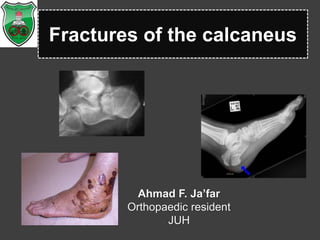
Fractures of the calcaneus
Ahmad F. Ja’far
Orthopaedic resident
JUH
Introduction
• Approximately 2% of all fractures.
• Most frequent tarsal bone fracture
• Challenging fracture for orthopedists
• 90% occur in males between 21-45 years of age.
• Although not all these fractures have bad results, the
results of treatment of calcaneus fractures over the
years have not been good.
Relevant Anatomy
• Largest tarsal bone.
• Dense cancellous bone
covered with a very thin
cortical bone.
• Articular surfaces-ant half
• Post half/ tuberosity
• Plantar fascia
Functions:
• Lever arm powered by
gastrocnemius
• Foundation for body wt.
• Supports/ maintains lat.
column of foot
• Articular surface for cuboid
• Ant./middle/post articular
facet for talus
• Post articular facet
– Is the calcaneal portion of
the subtalar joint
– Is the largest and is convex
in shape
– Is separated by the tarsal
sinus and the tarsal
ligament from the middle
and anterior facets
• Interosseous ligament
• Sinus tarsi
Post.
Middle
Ant.
Ant.
Post.
Middle
CC
Sustentaculum tali:
• Projects medially and supports
the neck of talus.
• FHL passes beneath it .
• Deltoid and talocalcaneal
ligament connect it to the talus
• Clinical significance :
contained in the
anteromedial
fragment, which remains
"constant" due to medial
talocalcaneal and
interosseous ligaments
Ant.
process
Tuberosity
Sinus tarsi
Lateral Aspect
Classification
• Intra-articular fractures 60-75%
• Extra-articular fractures 25-30% and include :
Anterior process fractures.
Beak or avulsion fractures of the tuberosity.
Medial process fractures.
Sustentaculum tali and body fractures.
Anterior process fracture
• Inversion “sprain”
• Frequently missed
• Most are small: treat like
sprain
• Large/displaced: ORIF
Tuberosity body fracture
• Fall/MVA
• Usually non-
operative
─ Swelling control
─ Early ROM
─ PWB
Tuberosity avulsion fractures
• Achilles avulsion
• Wound problems
• Surgical urgency
─ Lag screws or
tension band
Sustentacular fracture
• May alter ST jt.
mechanics
• Most small/
nondisplaced:
─ Non-operative
• Large/ displaced
─ ORIF (med.
approach)
─ Buttress plate
“Intra-articular” fractures
Mechanism of injury
• High energy: Axial load
─ MVA, fall
 Lateral process of talus acts as
wedge
• Oblique shear
1ry # line  2 fragments:
-- Superomedial (constant)
fragment.
-- Superolateral fragment>(intra-
articular aspect through post
facet)
 2ry # line dectates whether
there is joint depression or tongue-
type fracture
z
Mechanism of injury
• Secondary fracture
line runs in one of
two planes
• beneath the facet
exiting posteriorly
in tongue-type
fracture
• behind the posterior
facet in joint
depression fractures
Mechanism of injury
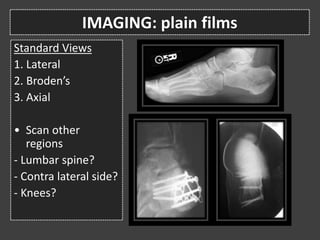
IMAGING: plain films
Standard Views
1. Lateral
2. Broden’s
3. Axial
• Scan other
regions
- Lumbar spine?
- Contra lateral side?
- Knees?
Lateral view
• Bohler’s angle
• 20-40
• Gissane’s angle
• 95-105
Broden’s view
• Positioning
– 20° IR view (mortise)
– 10°-40° plantar flex
Demonstrating the
articular surface of the
posterior facet.
Axial Harris view
• Very difficult to obtain in
the acute setting
• 45° axial of heel
• 2nd toe in line w/ tibia
• Assess varus/valgus
-- Normal »10° valgus --
• Joint displacement
• Tuberosity angulation
• Heel width.
Imaging: CT
Coronal Axial Sagittal
Classifications (intra-articular)
• Several used- None are
ideal
• Most commonly used
─ Essex-Lopresti
─ Sanders
Classifications
• Essex-Lopresti
• Sanders:
• Based on CT findings
• Coronal plane
• # joint fragments
• 2 = type II
• 3 = type III
• 4 or more = type IV
• Predictive of results
Sander’s
Sander’s
Associated injuries
– Extension into the calcaneocuboid joint occurs in
63%
– Vertebral injuries in 10%
– Contralateral calcaneus in 10%
– Compartment syndrome 2-10%
Principles of treatment
1) No reduction, with elevation of the foot, compression
dressing, and early ROM.
2) Closed reduction, with elevation of the foot,
compression dressing, and early ROM.
3) Percutaneous reduction (Essex-Lopresti) .
4) ORIF as popularized by Palmer and McReynolds .
5) Primary arthrodesis.
• Medial approaches, lateral approaches, or dual
approaches
TREATMENT: historical
• <1850: bandages/elevation
• 1850: Clark: traction
• 1931: Bohler: closed red./cast
• 1952: Essex-Lopresti: perQ fixation
• 1993+: Benirschke/Letournel/Sanders:
– Extensile lateral approach & plating
Management of intra-articular
calcaneal fractures
• Conservative
• Operative.
 Formal ORIF
 Minimally invasive techniques
 Ex. Fixation.
 Fusion
Conservative
• Admit to hospital
• Ice packs applied with or without compression
• Elevation.
• Below knee lightweight cast / functional brace for a 4–6
week period
• Non-weight bearing for a further 2 w
Operative treatment:
Rationale
• Restore anatomy
─ Shape and alignment of hindfoot
─ Articular congruency
• Return to function & prevent arthritis
• Typically, restoring articular anatomy gives
improved results if complications are avoided
• Prospective, randomized, controlled multicenter trial(level II)
• 82 patients …Follow-up at 1year and 8-12 years
• Primary out come at one 1 year no difference
• 8-12 years  Better VAS score for pain and function (p = 0.07)
and the physical component of the SF-36 (p = 0.06) in the
operative group.
• The prevalence of radiographically evident posttraumatic
subtalar arthritis was lower in the operative group (risk
reduction, 41%).
Canadian Calcaneus Registry, R. Buckley et al., JBJS, 2002
• The following did better with surgery:
• Women
• Age <29 years
• Non-Work-Comp
• Bohler angle <10˚
• Comminuted fracture
• Large initial joint step off
Difficulties with ORIF
 Difficult exposure
 Complex 3D-shape of the bone
 Ever-changing fixation devices
 Open fractures
 Osteopenic bone disease.
 Increased incidence of wound complications in patients
with DM, HTN, or PVD, and tobacco chewers and
smokers
Indications for ORIF
• Displaced intra-articular fractures involving the
posterior facet.
• Anterior process of the calcaneus fractures with
more than 25% involvement of the calcaneocuboid
articulation.
• Displaced fractures of the calcaneal tuberosity.
• Fracture-dislocations of the calcaneus.
• Selected open fractures of the calcaneus
Rel. Contraindications
• Diabetes
• Vascular insufficiency
• Smoker
• Severe swelling
• Open fractures
• Elderly
• Neuropathic
• Non-compliant pt.
• In-experienced surgeon
• Lymphedema.
• Immune compromise
Folk et al., JOT, 1999
• Diabetes
• Vascular insufficiency
• Smoker
• Wound problems: these factors have additive effects. If
all 3, >90%.
Operative treatment: contraindications
• Open Fractures
–Mostly medial wounds, varied severity
–All treated with I&D/ IV abx
–Grade II-III: 48% infections
–Grade IIIB: 77% infections & 46% BKAs
Heier KA, Infante AF, Walling AK, et al.
J Bone Joint Surg Am 2003, 85-A: 2276-82
Preparing Soft Tissues
• Elevation
• Compression stocking
• Cast boot
• Care of blisters
• ORIF @ 10-17 days
• + Wrinkle test
ORIF via Extensile Lateral Approach
Non touch technique
• Schanz pin to
manipulate tuberosity
• Clean out fracture
• Disimpact sustentacular
fragment
• Reduce tuberosity
(body) fragment to
sustentaculum
Tuberosity Reduction
Restore Joint Surface +/- graft
Lag screw below post facet
≥2 screws in each major fragment
Fixation Options
• Replace lateral wall
• Apply plate
• Recheck Xrays
Drain and deep closure
Post op care
• Elevate, splint
• Sutures out @ 3 wks.
• Fracture boot
• Early motion
• NWB for 8-12 weeks
• Improvement up to 2 yrs
Other Surgical Options
• Closed Reduction/ Int. Fixation
–Percutaneous
–Arthroscopic assisted
• Ilizarov
• Primary Fusion.
Surgery: percutaneous
• Fewer wound problems
• More difficult
reductions?
• Ex. Essex-Lopresti
maneuver (Tongue type)
Ilizarov
• Minimally invasive
• Indirect reduction
• Learning curve
• Immediate
weightbearing
Primary Fusion
• Sanders type IV or
severe cartilage injury
• ORIF calcaneus, debride
cartilage, and fuse ST
joint
• 69 patients(75 displaced intra-articular fractures)
• 36 fractures initial ORIF +fusion
• 39 fractures conservative –later fusion
• Follow-up 63 months
• First group : fewer postoperative wound complications and
had significantly higher Maryland Foot Scores (90.8
compared with 79.1; p < 0.0001) and American
Orthopaedic Foot and Ankle Society ankle-hindfoot scores
(87.1 compared with 73.8; p < 0.0001) than did Group B.
Complications
 Malunion
 Varus hindfoot
 Shortened foot = short
lever arm
 Peroneal
impingement/
dislocation
 Shoewear problems
 Valgus>varus with
surgical
Complications
• Stiffness
─ Prevention (early ROM)
• Subtalar arthritis
• 5-20% of calcaneal fractures may require
subtalar arthrodesis
─ NSAIDs
─ Subtalar fusion
Complications
• Peroneal tendon problems
─Tendonitis- NSAIDs, therapy
─Entrapped-release tendons,
exostectomy
─Dislocated-open reduction
Complications
Wound problems
•Apical wound necrosis
– Stop ROM
– Leave sutures in
•Infection
– Antibiotics
– I&D
– Soft tissue coverage?
Take home message
Thank you
• Complex injuries ,, patient education
• Don’t miss other injuries.
• Pay attention to soft tissue envelope.
• Functional impairment up to 5 years.
• Much controversies (classification, management, op
techniques…etc)
• ORIF is a good option for displaced intra-articular fractures
in selected group of pateints (on the long term)
Calcaneal fractures

Calcaneal fractures

  • 1.
    Fractures of thecalcaneus Ahmad F. Ja’far Orthopaedic resident JUH
  • 2.
    Introduction • Approximately 2%of all fractures. • Most frequent tarsal bone fracture • Challenging fracture for orthopedists • 90% occur in males between 21-45 years of age. • Although not all these fractures have bad results, the results of treatment of calcaneus fractures over the years have not been good.
  • 3.
    Relevant Anatomy • Largesttarsal bone. • Dense cancellous bone covered with a very thin cortical bone. • Articular surfaces-ant half • Post half/ tuberosity • Plantar fascia Functions: • Lever arm powered by gastrocnemius • Foundation for body wt. • Supports/ maintains lat. column of foot
  • 4.
    • Articular surfacefor cuboid • Ant./middle/post articular facet for talus • Post articular facet – Is the calcaneal portion of the subtalar joint – Is the largest and is convex in shape – Is separated by the tarsal sinus and the tarsal ligament from the middle and anterior facets • Interosseous ligament • Sinus tarsi Post. Middle Ant. Ant. Post. Middle CC
  • 5.
    Sustentaculum tali: • Projectsmedially and supports the neck of talus. • FHL passes beneath it . • Deltoid and talocalcaneal ligament connect it to the talus • Clinical significance : contained in the anteromedial fragment, which remains "constant" due to medial talocalcaneal and interosseous ligaments
  • 6.
  • 7.
    Classification • Intra-articular fractures60-75% • Extra-articular fractures 25-30% and include : Anterior process fractures. Beak or avulsion fractures of the tuberosity. Medial process fractures. Sustentaculum tali and body fractures.
  • 8.
    Anterior process fracture •Inversion “sprain” • Frequently missed • Most are small: treat like sprain • Large/displaced: ORIF
  • 9.
    Tuberosity body fracture •Fall/MVA • Usually non- operative ─ Swelling control ─ Early ROM ─ PWB
  • 10.
    Tuberosity avulsion fractures •Achilles avulsion • Wound problems • Surgical urgency ─ Lag screws or tension band
  • 11.
    Sustentacular fracture • Mayalter ST jt. mechanics • Most small/ nondisplaced: ─ Non-operative • Large/ displaced ─ ORIF (med. approach) ─ Buttress plate
  • 12.
  • 13.
    Mechanism of injury •High energy: Axial load ─ MVA, fall  Lateral process of talus acts as wedge • Oblique shear 1ry # line  2 fragments: -- Superomedial (constant) fragment. -- Superolateral fragment>(intra- articular aspect through post facet)  2ry # line dectates whether there is joint depression or tongue- type fracture
  • 14.
  • 15.
    • Secondary fracture lineruns in one of two planes • beneath the facet exiting posteriorly in tongue-type fracture • behind the posterior facet in joint depression fractures Mechanism of injury
  • 16.
    IMAGING: plain films StandardViews 1. Lateral 2. Broden’s 3. Axial • Scan other regions - Lumbar spine? - Contra lateral side? - Knees?
  • 17.
    Lateral view • Bohler’sangle • 20-40 • Gissane’s angle • 95-105
  • 19.
    Broden’s view • Positioning –20° IR view (mortise) – 10°-40° plantar flex Demonstrating the articular surface of the posterior facet.
  • 20.
    Axial Harris view •Very difficult to obtain in the acute setting • 45° axial of heel • 2nd toe in line w/ tibia • Assess varus/valgus -- Normal »10° valgus -- • Joint displacement • Tuberosity angulation • Heel width.
  • 21.
  • 22.
    Classifications (intra-articular) • Severalused- None are ideal • Most commonly used ─ Essex-Lopresti ─ Sanders
  • 23.
    Classifications • Essex-Lopresti • Sanders: •Based on CT findings • Coronal plane • # joint fragments • 2 = type II • 3 = type III • 4 or more = type IV • Predictive of results
  • 24.
  • 25.
  • 26.
    Associated injuries – Extensioninto the calcaneocuboid joint occurs in 63% – Vertebral injuries in 10% – Contralateral calcaneus in 10% – Compartment syndrome 2-10%
  • 27.
    Principles of treatment 1)No reduction, with elevation of the foot, compression dressing, and early ROM. 2) Closed reduction, with elevation of the foot, compression dressing, and early ROM. 3) Percutaneous reduction (Essex-Lopresti) . 4) ORIF as popularized by Palmer and McReynolds . 5) Primary arthrodesis. • Medial approaches, lateral approaches, or dual approaches
  • 28.
    TREATMENT: historical • <1850:bandages/elevation • 1850: Clark: traction • 1931: Bohler: closed red./cast • 1952: Essex-Lopresti: perQ fixation • 1993+: Benirschke/Letournel/Sanders: – Extensile lateral approach & plating
  • 29.
    Management of intra-articular calcanealfractures • Conservative • Operative.  Formal ORIF  Minimally invasive techniques  Ex. Fixation.  Fusion
  • 30.
    Conservative • Admit tohospital • Ice packs applied with or without compression • Elevation. • Below knee lightweight cast / functional brace for a 4–6 week period • Non-weight bearing for a further 2 w
  • 31.
    Operative treatment: Rationale • Restoreanatomy ─ Shape and alignment of hindfoot ─ Articular congruency • Return to function & prevent arthritis • Typically, restoring articular anatomy gives improved results if complications are avoided
  • 32.
    • Prospective, randomized,controlled multicenter trial(level II) • 82 patients …Follow-up at 1year and 8-12 years • Primary out come at one 1 year no difference • 8-12 years  Better VAS score for pain and function (p = 0.07) and the physical component of the SF-36 (p = 0.06) in the operative group. • The prevalence of radiographically evident posttraumatic subtalar arthritis was lower in the operative group (risk reduction, 41%).
  • 33.
    Canadian Calcaneus Registry,R. Buckley et al., JBJS, 2002 • The following did better with surgery: • Women • Age <29 years • Non-Work-Comp • Bohler angle <10˚ • Comminuted fracture • Large initial joint step off
  • 34.
    Difficulties with ORIF Difficult exposure  Complex 3D-shape of the bone  Ever-changing fixation devices  Open fractures  Osteopenic bone disease.  Increased incidence of wound complications in patients with DM, HTN, or PVD, and tobacco chewers and smokers
  • 35.
    Indications for ORIF •Displaced intra-articular fractures involving the posterior facet. • Anterior process of the calcaneus fractures with more than 25% involvement of the calcaneocuboid articulation. • Displaced fractures of the calcaneal tuberosity. • Fracture-dislocations of the calcaneus. • Selected open fractures of the calcaneus
  • 36.
    Rel. Contraindications • Diabetes •Vascular insufficiency • Smoker • Severe swelling • Open fractures • Elderly • Neuropathic • Non-compliant pt. • In-experienced surgeon • Lymphedema. • Immune compromise
  • 37.
    Folk et al.,JOT, 1999 • Diabetes • Vascular insufficiency • Smoker • Wound problems: these factors have additive effects. If all 3, >90%.
  • 38.
    Operative treatment: contraindications •Open Fractures –Mostly medial wounds, varied severity –All treated with I&D/ IV abx –Grade II-III: 48% infections –Grade IIIB: 77% infections & 46% BKAs Heier KA, Infante AF, Walling AK, et al. J Bone Joint Surg Am 2003, 85-A: 2276-82
  • 39.
    Preparing Soft Tissues •Elevation • Compression stocking • Cast boot • Care of blisters • ORIF @ 10-17 days • + Wrinkle test
  • 40.
    ORIF via ExtensileLateral Approach
  • 42.
  • 43.
    • Schanz pinto manipulate tuberosity • Clean out fracture • Disimpact sustentacular fragment • Reduce tuberosity (body) fragment to sustentaculum
  • 44.
  • 45.
  • 46.
    Lag screw belowpost facet ≥2 screws in each major fragment
  • 47.
  • 48.
    • Replace lateralwall • Apply plate • Recheck Xrays
  • 49.
  • 50.
    Post op care •Elevate, splint • Sutures out @ 3 wks. • Fracture boot • Early motion • NWB for 8-12 weeks • Improvement up to 2 yrs
  • 51.
    Other Surgical Options •Closed Reduction/ Int. Fixation –Percutaneous –Arthroscopic assisted • Ilizarov • Primary Fusion.
  • 52.
    Surgery: percutaneous • Fewerwound problems • More difficult reductions? • Ex. Essex-Lopresti maneuver (Tongue type)
  • 53.
    Ilizarov • Minimally invasive •Indirect reduction • Learning curve • Immediate weightbearing
  • 54.
    Primary Fusion • Sanderstype IV or severe cartilage injury • ORIF calcaneus, debride cartilage, and fuse ST joint
  • 55.
    • 69 patients(75displaced intra-articular fractures) • 36 fractures initial ORIF +fusion • 39 fractures conservative –later fusion • Follow-up 63 months • First group : fewer postoperative wound complications and had significantly higher Maryland Foot Scores (90.8 compared with 79.1; p < 0.0001) and American Orthopaedic Foot and Ankle Society ankle-hindfoot scores (87.1 compared with 73.8; p < 0.0001) than did Group B.
  • 56.
    Complications  Malunion  Varushindfoot  Shortened foot = short lever arm  Peroneal impingement/ dislocation  Shoewear problems  Valgus>varus with surgical
  • 57.
    Complications • Stiffness ─ Prevention(early ROM) • Subtalar arthritis • 5-20% of calcaneal fractures may require subtalar arthrodesis ─ NSAIDs ─ Subtalar fusion
  • 58.
    Complications • Peroneal tendonproblems ─Tendonitis- NSAIDs, therapy ─Entrapped-release tendons, exostectomy ─Dislocated-open reduction
  • 59.
    Complications Wound problems •Apical woundnecrosis – Stop ROM – Leave sutures in •Infection – Antibiotics – I&D – Soft tissue coverage?
  • 60.
    Take home message Thankyou • Complex injuries ,, patient education • Don’t miss other injuries. • Pay attention to soft tissue envelope. • Functional impairment up to 5 years. • Much controversies (classification, management, op techniques…etc) • ORIF is a good option for displaced intra-articular fractures in selected group of pateints (on the long term)

Editor's Notes

  • #4 articular surfaces are located on the dorsal aspect of its anterior half Post half –achilles The plantar fascia originates from the medial and lateral processes located on the plantar aspect of the tuberosity
  • #5 Sinus tarsi =interossseous sulcus(calcaneal sulcus)+talar sulcus
  • #7 Sinus tarsi =calcaneal interosseous sulcus+talar sulcus
  • #15 Iry # line 2 fragments
  • #16 2ry # line 3 fragments
  • #18 only if the entire facet is separated from the sustentaculum and depressed IA fractures show a loss in the height of the posterior facet a decrease in the angle of Bohler an increase in the angle of Gissane
  • #19 If only the lateral half of the posterior facet is fractured and displaced a split in the articular surface will be seen as a double density Bohler's and Gissane's angles may appear normal The articular surface can be found within the body of the calcaneus, usually rotated plantarly up to 90o in relation to the remainder of the subtalar joint.
  • #22 ====30o semi-coronal ST joint Heel width/ shortening Lateral wall “blowout” Peroneal impingement or dislocation Axial—CC joint Sagit---similar to lat
  • #25 3 frac lines devides the post facet into …..
  • #26 Type 1…any fract line non displaced < 2mm irrespective of the number of lines Type 2.. 2 part fract of post facet Tyoe 3.. 3 part fract with depression of central fragment
  • #28 === Can’t restore articular surface === joysticks, small elevators, cannulated screws === anatomic reduction of the articular facets; reconstitution of hindfoot height, width, and length realignment of the tuberosity to appropriate axial alignment.
  • #33 Swedish study JBJS 2013
  • #40 wrinkle test is done by bringing the foot from the plantarflexed position (A) into dorsiflexion and observing the wrinkles (B) that form on the lateral side of the ankle and foot.
  • #41 2 cm proximal to the tip of the lateral malleolus, at the lateral edge of the Achilles tendon, and is continued down toward the plantar surface of the heel then curved anteriorly toward the CC joint
  • #42 full thickness flap is then developed by raising the corner of the incision subperiosteally Avoid use of retractors earlier will tear the skin away from the periosteum, which could potentially cause late necrosis of the skin. With continued dissection, the calcaneofibular ligament is encountered and resected from the calcaneus; this will expose the peroneal tendons and their inferior sheath at the level of the peroneal tubercle
  • #43 Retract distal aspect of peroneal tendons and skin flab by 3 wires(fibula talar neck and cuboid).. Depressed lat fragment is visulaized
  • #44 The exposed corner of the calcaneal tuberosity is then predrilled and a short Schantz pin is screwed into place. Using the pin, the heel is manipulated and distracted into varus, which disimpacts the fracture and makes the edge of the fragment more visible
  • #56 Level III