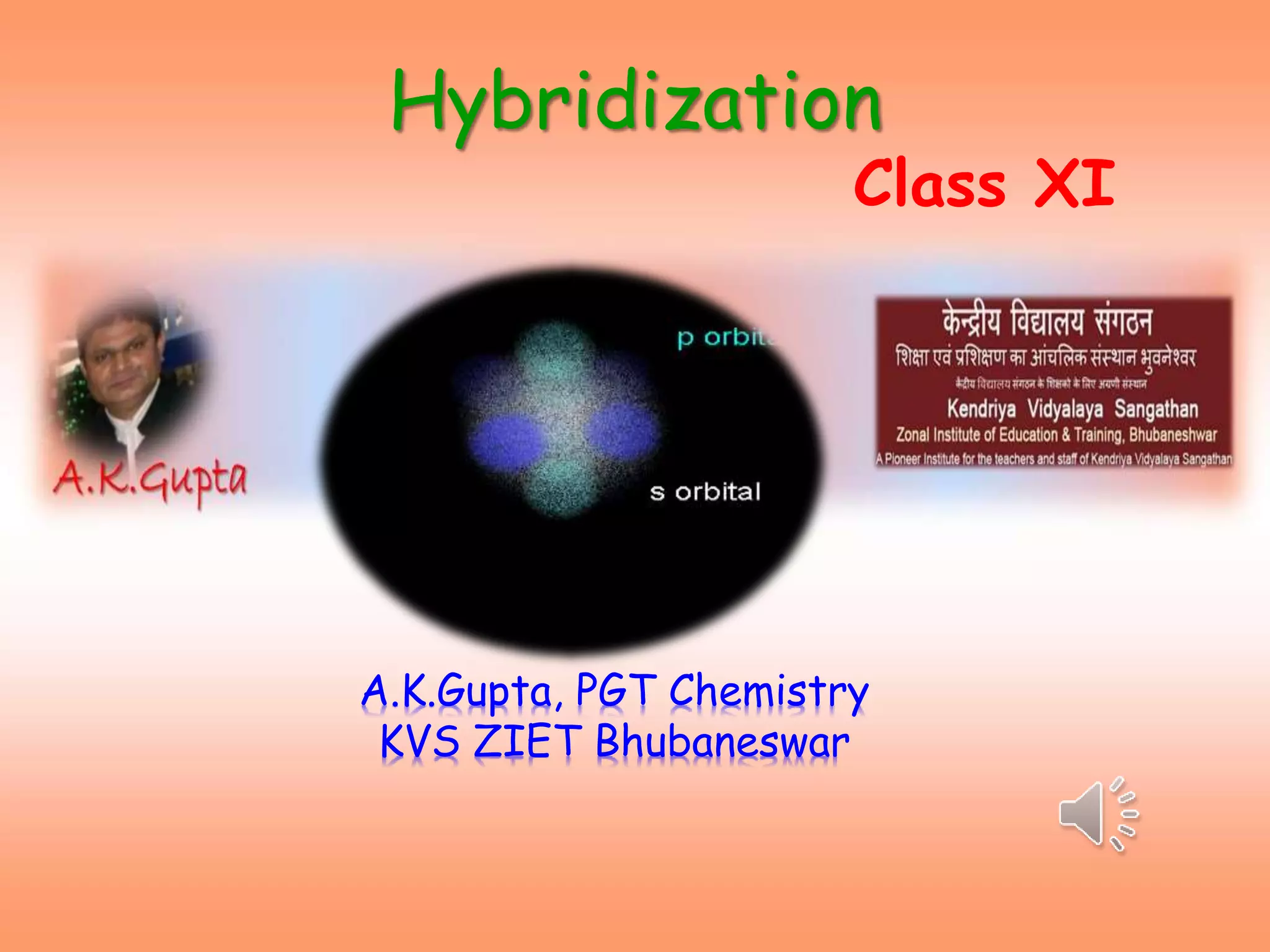
Hybridization
Class XI
A.K.Gupta, PGT Chemistry
KVS ZIET Bhubaneswar
What is hybridization?
Hybridisation (or hybridization) is the
concept of mixing atomic orbitals into
new hybrid orbitals (with different
energies, shapes, etc., than the
component atomic orbitals) suitable for
the pairing of electrons to form chemical
bonds in valence bond theory.
A.K.Gupta, PGT Chemistry, KVS ZIET BBSR
Types of hybridisation
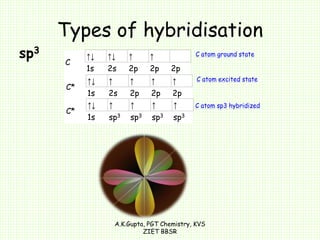
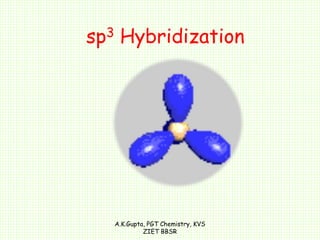
sp3
C
↑↓ ↑↓ ↑ ↑
1s 2s 2p 2p 2p
C*
↑↓ ↑ ↑ ↑ ↑
1s 2s 2p 2p 2p
C*
↑↓ ↑ ↑ ↑ ↑
1s sp3 sp3 sp3 sp3
C atom ground state
C atom excited state
C atom sp3 hybridized
A.K.Gupta, PGT Chemistry, KVS
ZIET BBSR
sp3 Hybridization
A.K.Gupta, PGT Chemistry, KVS
ZIET BBSR
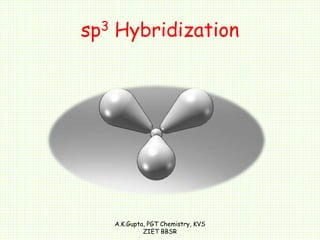
sp3 Hybridization
A.K.Gupta, PGT Chemistry, KVS
ZIET BBSR
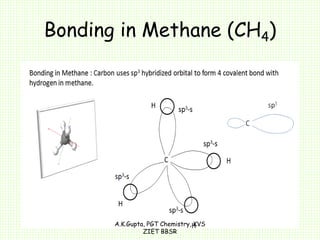
Bonding in Methane (CH4)
A.K.Gupta, PGT Chemistry, KVS
ZIET BBSR
Summary
 sp3 hybridization occurs when a C has 4
attached groups
sp3 hybrid orbital has 25% s and 75% p
character
the 4 sp3 hybrids point towards the corners
of a tetrahedron at 109.28o to each other
each sp3 hybrid orbital is involved in σ bond
foprmation.
A.K.Gupta, PGT Chemistry, KVS
ZIET BBSR
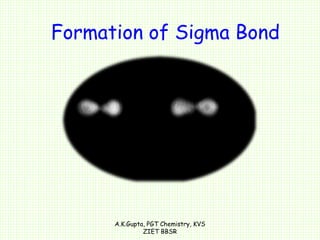
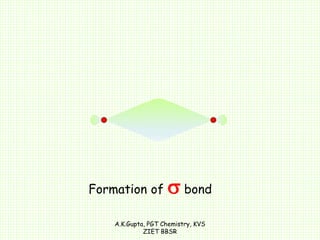
Formation of Sigma Bond
A.K.Gupta, PGT Chemistry, KVS
ZIET BBSR
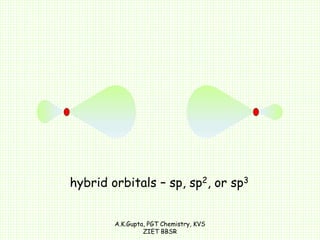
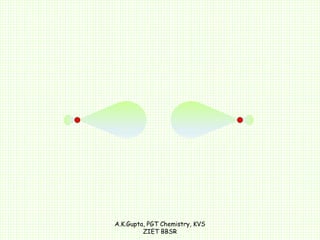
hybrid orbitals – sp, sp2, or sp3
A.K.Gupta, PGT Chemistry, KVS
ZIET BBSR
A.K.Gupta, PGT Chemistry, KVS
ZIET BBSR
A.K.Gupta, PGT Chemistry, KVS
ZIET BBSR
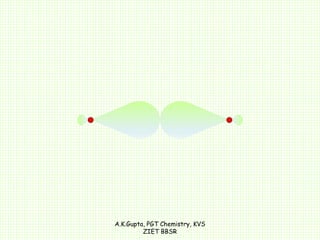
Formation of s bond
A.K.Gupta, PGT Chemistry, KVS
ZIET BBSR
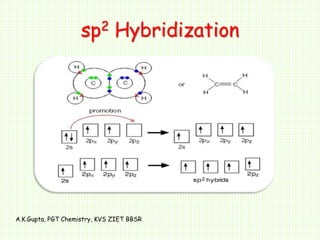
sp2 Hybridization
A.K.Gupta, PGT Chemistry, KVS ZIET BBSR
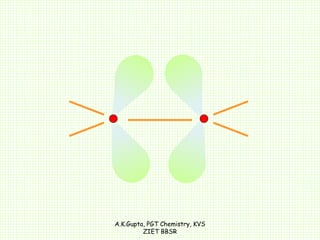
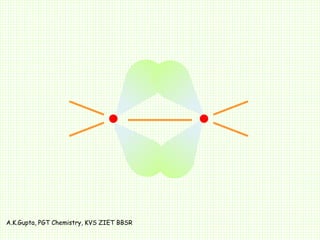
Formation of  bond
A.K.Gupta, PGT Chemistry, KVS
ZIET BBSR
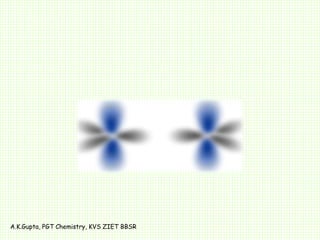
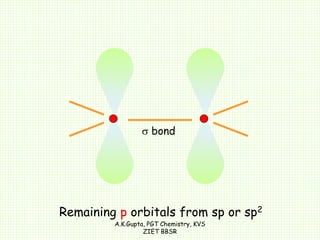
Remaining p orbitals from sp or sp2
s bond
A.K.Gupta, PGT Chemistry, KVS
ZIET BBSR
A.K.Gupta, PGT Chemistry, KVS
ZIET BBSR
A.K.Gupta, PGT Chemistry, KVS ZIET BBSR
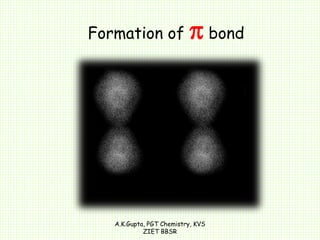
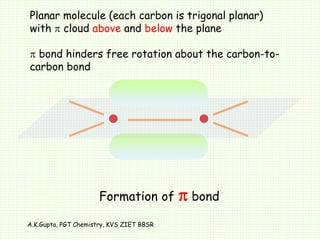
Formation of  bond
Planar molecule (each carbon is trigonal planar)
with  cloud above and below the plane
 bond hinders free rotation about the carbon-to-
carbon bond
A.K.Gupta, PGT Chemistry, KVS ZIET BBSR
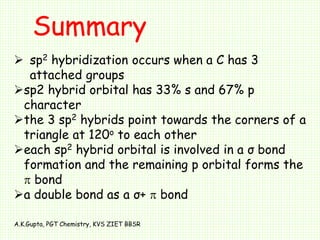
 sp2 hybridization occurs when a C has 3
attached groups
sp2 hybrid orbital has 33% s and 67% p
character
the 3 sp2 hybrids point towards the corners of a
triangle at 120o to each other
each sp2 hybrid orbital is involved in a σ bond
formation and the remaining p orbital forms the
 bond
a double bond as a σ+  bond
Summary
A.K.Gupta, PGT Chemistry, KVS ZIET BBSR
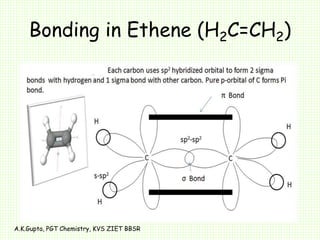
Bonding in Ethene (H2C=CH2)
A.K.Gupta, PGT Chemistry, KVS ZIET BBSR
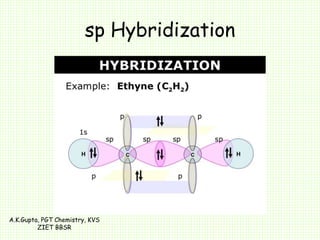
sp Hybridization
A.K.Gupta, PGT Chemistry, KVS
ZIET BBSR
Pure p
orbital
Sp hybrid
orbital
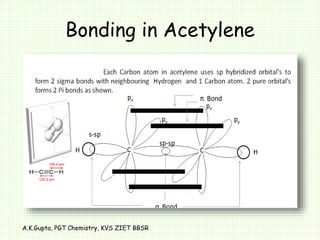
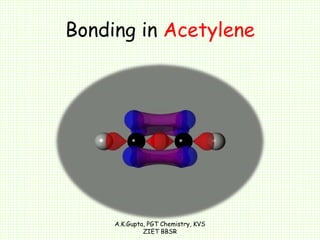
Bonding in Acetylene
A.K.Gupta, PGT Chemistry, KVS ZIET BBSR
sp Hybridization
A.K.Gupta, PGT Chemistry, KVS
ZIET BBSR
Bonding in Acetylene
A.K.Gupta, PGT Chemistry, KVS
ZIET BBSR
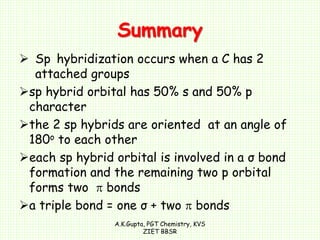
Summary
 Sp hybridization occurs when a C has 2
attached groups
sp hybrid orbital has 50% s and 50% p
character
the 2 sp hybrids are oriented at an angle of
180o to each other
each sp hybrid orbital is involved in a σ bond
formation and the remaining two p orbital
forms two  bonds
a triple bond = one σ + two  bonds
A.K.Gupta, PGT Chemistry, KVS
ZIET BBSR
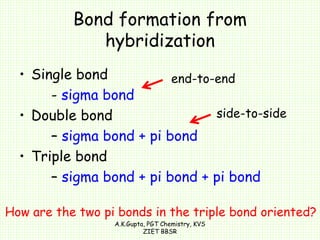
Bond formation from
hybridization
• Single bond
- sigma bond
• Double bond
– sigma bond + pi bond
• Triple bond
– sigma bond + pi bond + pi bond
How are the two pi bonds in the triple bond oriented?
end-to-end
side-to-side
A.K.Gupta, PGT Chemistry, KVS
ZIET BBSR
1
2
3
4
5
6
7
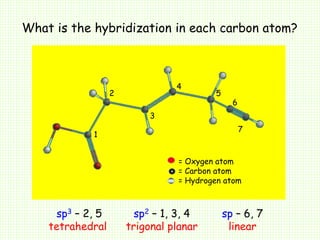
What is the hybridization in each carbon atom?
sp3 – 2, 5
tetrahedral
sp2 – 1, 3, 4
trigonal planar
sp – 6, 7
linear
= Oxygen atom
= Carbon atom
= Hydrogen atom
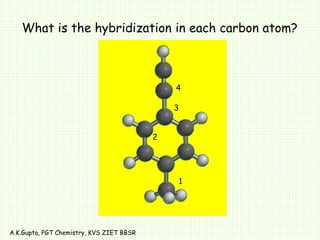
What is the hybridization in each carbon atom?
1
2
3
4
A.K.Gupta, PGT Chemistry, KVS ZIET BBSR
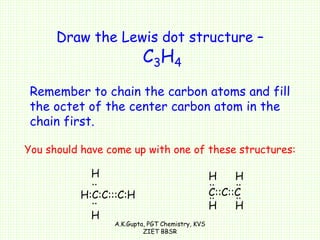
Draw the Lewis dot structure –
C3H4
Remember to chain the carbon atoms and fill
the octet of the center carbon atom in the
chain first.
You should have come up with one of these structures:
H:C:C:::C:H
H
H
..
..
C::C::C
H
H
..
..
H
H
..
..
A.K.Gupta, PGT Chemistry, KVS
ZIET BBSR
Thanks

Hybridization- sp, sp2 and sp3

  • 1.
    Hybridization Class XI A.K.Gupta, PGTChemistry KVS ZIET Bhubaneswar
  • 2.
    What is hybridization? Hybridisation(or hybridization) is the concept of mixing atomic orbitals into new hybrid orbitals (with different energies, shapes, etc., than the component atomic orbitals) suitable for the pairing of electrons to form chemical bonds in valence bond theory. A.K.Gupta, PGT Chemistry, KVS ZIET BBSR
  • 3.
    Types of hybridisation sp3 C ↑↓↑↓ ↑ ↑ 1s 2s 2p 2p 2p C* ↑↓ ↑ ↑ ↑ ↑ 1s 2s 2p 2p 2p C* ↑↓ ↑ ↑ ↑ ↑ 1s sp3 sp3 sp3 sp3 C atom ground state C atom excited state C atom sp3 hybridized A.K.Gupta, PGT Chemistry, KVS ZIET BBSR
  • 4.
    sp3 Hybridization A.K.Gupta, PGTChemistry, KVS ZIET BBSR
  • 5.
    sp3 Hybridization A.K.Gupta, PGTChemistry, KVS ZIET BBSR
  • 6.
    Bonding in Methane(CH4) A.K.Gupta, PGT Chemistry, KVS ZIET BBSR
  • 7.
    Summary  sp3 hybridizationoccurs when a C has 4 attached groups sp3 hybrid orbital has 25% s and 75% p character the 4 sp3 hybrids point towards the corners of a tetrahedron at 109.28o to each other each sp3 hybrid orbital is involved in σ bond foprmation. A.K.Gupta, PGT Chemistry, KVS ZIET BBSR
  • 8.
    Formation of SigmaBond A.K.Gupta, PGT Chemistry, KVS ZIET BBSR
  • 9.
    hybrid orbitals –sp, sp2, or sp3 A.K.Gupta, PGT Chemistry, KVS ZIET BBSR
  • 10.
  • 11.
  • 12.
    Formation of sbond A.K.Gupta, PGT Chemistry, KVS ZIET BBSR
  • 13.
    sp2 Hybridization A.K.Gupta, PGTChemistry, KVS ZIET BBSR
  • 14.
  • 15.
    Formation of bond A.K.Gupta, PGT Chemistry, KVS ZIET BBSR
  • 16.
    Remaining p orbitalsfrom sp or sp2 s bond A.K.Gupta, PGT Chemistry, KVS ZIET BBSR
  • 17.
  • 18.
  • 19.
    Formation of bond Planar molecule (each carbon is trigonal planar) with  cloud above and below the plane  bond hinders free rotation about the carbon-to- carbon bond A.K.Gupta, PGT Chemistry, KVS ZIET BBSR
  • 20.
     sp2 hybridizationoccurs when a C has 3 attached groups sp2 hybrid orbital has 33% s and 67% p character the 3 sp2 hybrids point towards the corners of a triangle at 120o to each other each sp2 hybrid orbital is involved in a σ bond formation and the remaining p orbital forms the  bond a double bond as a σ+  bond Summary A.K.Gupta, PGT Chemistry, KVS ZIET BBSR
  • 21.
    Bonding in Ethene(H2C=CH2) A.K.Gupta, PGT Chemistry, KVS ZIET BBSR
  • 22.
    sp Hybridization A.K.Gupta, PGTChemistry, KVS ZIET BBSR Pure p orbital Sp hybrid orbital
  • 23.
    Bonding in Acetylene A.K.Gupta,PGT Chemistry, KVS ZIET BBSR
  • 24.
    sp Hybridization A.K.Gupta, PGTChemistry, KVS ZIET BBSR
  • 25.
    Bonding in Acetylene A.K.Gupta,PGT Chemistry, KVS ZIET BBSR
  • 26.
    Summary  Sp hybridizationoccurs when a C has 2 attached groups sp hybrid orbital has 50% s and 50% p character the 2 sp hybrids are oriented at an angle of 180o to each other each sp hybrid orbital is involved in a σ bond formation and the remaining two p orbital forms two  bonds a triple bond = one σ + two  bonds A.K.Gupta, PGT Chemistry, KVS ZIET BBSR
  • 27.
    Bond formation from hybridization •Single bond - sigma bond • Double bond – sigma bond + pi bond • Triple bond – sigma bond + pi bond + pi bond How are the two pi bonds in the triple bond oriented? end-to-end side-to-side A.K.Gupta, PGT Chemistry, KVS ZIET BBSR
  • 28.
    1 2 3 4 5 6 7 What is thehybridization in each carbon atom? sp3 – 2, 5 tetrahedral sp2 – 1, 3, 4 trigonal planar sp – 6, 7 linear = Oxygen atom = Carbon atom = Hydrogen atom
  • 29.
    What is thehybridization in each carbon atom? 1 2 3 4 A.K.Gupta, PGT Chemistry, KVS ZIET BBSR
  • 30.
    Draw the Lewisdot structure – C3H4 Remember to chain the carbon atoms and fill the octet of the center carbon atom in the chain first. You should have come up with one of these structures: H:C:C:::C:H H H .. .. C::C::C H H .. .. H H .. .. A.K.Gupta, PGT Chemistry, KVS ZIET BBSR
  • 31.

Editor's Notes