PRESENTASION ON HYBRIDIZATION
Submitted To:
Dr.Mohammed Shafikur Rahman
Associate Professor
Department of Pharmacy
Faculty of Allied Health Science
Daffodil International University
Submitted By:
Apurba Bokshe (1062)
Department of Pharmacy
Daffodil International University
Hybridization
Hybridization is defined as the intermixing of atomic orbitals with
the same energy levels to give the same number of a new type of
hybrid orbitals. This intermixing usually results in the formation
of hybrid orbitals having entirely different energies, shapes, etc.
The atomic orbitals of the same energy level mainly take part in
hybridization.
Hybridization can be classified as sp, sp2, sp3, sp3d, sp3d2, or sp3d3
based on the types of orbitals involved in mixing.
Theories of covalent bonding and
• Theories of Covalent Bonding – Explain the observed shapes, polarities,
magnetic and spectroscopic properties of molecules by using quantum
mechanics – atomic and molecular orbitals – The application of quantum
mechanics to chemical bonding has led to two bonding theories .
Valence Bond (VB) Theory
• A covalent bonds results from the overlap of valence atomic orbitals on
neighboring atoms occupied by unpaired electrons and the formation of
an electron pair which has highest probability to be between the nuclei
• The two electrons in the pair must have opposite spins – Pauli exclusion
principle
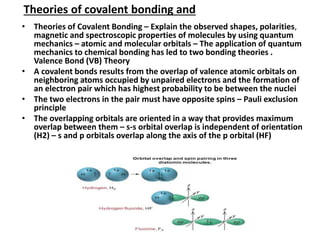
• The overlapping orbitals are oriented in a way that provides maximum
overlap between them – s-s orbital overlap is independent of orientation
(H2) – s and p orbitals overlap along the axis of the p orbital (HF)
Types of Hybridization
Hybridization can be classified as sp, sp2, sp3, sp3d, sp3d2, or sp3d3 based on the types of orbitals involved
in mixing.
sp Hybridization
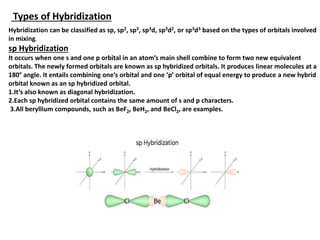
It occurs when one s and one p orbital in an atom’s main shell combine to form two new equivalent
orbitals. The newly formed orbitals are known as sp hybridized orbitals. It produces linear molecules at a
180° angle. It entails combining one’s orbital and one ‘p’ orbital of equal energy to produce a new hybrid
orbital known as an sp hybridized orbital.
1.It’s also known as diagonal hybridization.
2.Each sp hybridized orbital contains the same amount of s and p characters.
3.All beryllium compounds, such as BeF2, BeH2, and BeCl2, are examples.
sp2 Hybridization
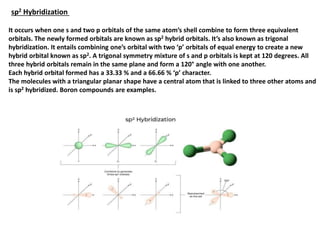
It occurs when one s and two p orbitals of the same atom’s shell combine to form three equivalent
orbitals. The newly formed orbitals are known as sp2 hybrid orbitals. It’s also known as trigonal
hybridization. It entails combining one’s orbital with two ‘p’ orbitals of equal energy to create a new
hybrid orbital known as sp2. A trigonal symmetry mixture of s and p orbitals is kept at 120 degrees. All
three hybrid orbitals remain in the same plane and form a 120° angle with one another.
Each hybrid orbital formed has a 33.33 % and a 66.66 % ‘p’ character.
The molecules with a triangular planar shape have a central atom that is linked to three other atoms and
is sp2 hybridized. Boron compounds are examples.
sp3 Hybridization
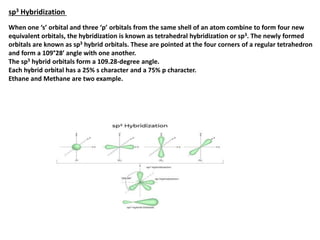
When one ‘s’ orbital and three ‘p’ orbitals from the same shell of an atom combine to form four new
equivalent orbitals, the hybridization is known as tetrahedral hybridization or sp3. The newly formed
orbitals are known as sp3 hybrid orbitals. These are pointed at the four corners of a regular tetrahedron
and form a 109°28′ angle with one another.
The sp3 hybrid orbitals form a 109.28-degree angle.
Each hybrid orbital has a 25% s character and a 75% p character.
Ethane and Methane are two example.
sp3d Hybridization
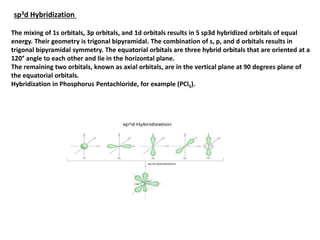
The mixing of 1s orbitals, 3p orbitals, and 1d orbitals results in 5 sp3d hybridized orbitals of equal
energy. Their geometry is trigonal bipyramidal. The combination of s, p, and d orbitals results in
trigonal bipyramidal symmetry. The equatorial orbitals are three hybrid orbitals that are oriented at a
120° angle to each other and lie in the horizontal plane.
The remaining two orbitals, known as axial orbitals, are in the vertical plane at 90 degrees plane of
the equatorial orbitals.
Hybridization in Phosphorus Pentachloride, for example (PCl5).
sp3d2 Hybridization
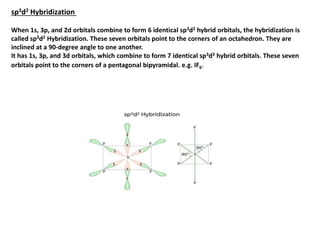
When 1s, 3p, and 2d orbitals combine to form 6 identical sp3d2 hybrid orbitals, the hybridization is
called sp3d2 Hybridization. These seven orbitals point to the corners of an octahedron. They are
inclined at a 90-degree angle to one another.
It has 1s, 3p, and 3d orbitals, which combine to form 7 identical sp3d3 hybrid orbitals. These seven
orbitals point to the corners of a pentagonal bipyramidal. e.g. IF6.
Shapes of Hybridization
Linear: The sp hybridization is caused by the interaction of two-electron groups; the orbital angle is
180°.
Trigonal planar: Three electron groups are involved, resulting in sp2 hybridization; the orbitals are
120° apart.
Tetrahedral: Four electron groups are involved, resulting in sp3 hybridization; the orbital angle is
109.5°.
Trigonal bipyramidal: Five electron groups are involved, resulting in sp3d hybridization; the orbital
angles are 90° and 120°.
Octahedral: Six electro
THANK YOU

Presentation on Hybridization

  • 1.
    PRESENTASION ON HYBRIDIZATION SubmittedTo: Dr.Mohammed Shafikur Rahman Associate Professor Department of Pharmacy Faculty of Allied Health Science Daffodil International University Submitted By: Apurba Bokshe (1062) Department of Pharmacy Daffodil International University
  • 2.
    Hybridization Hybridization is definedas the intermixing of atomic orbitals with the same energy levels to give the same number of a new type of hybrid orbitals. This intermixing usually results in the formation of hybrid orbitals having entirely different energies, shapes, etc. The atomic orbitals of the same energy level mainly take part in hybridization. Hybridization can be classified as sp, sp2, sp3, sp3d, sp3d2, or sp3d3 based on the types of orbitals involved in mixing.
  • 3.
    Theories of covalentbonding and • Theories of Covalent Bonding – Explain the observed shapes, polarities, magnetic and spectroscopic properties of molecules by using quantum mechanics – atomic and molecular orbitals – The application of quantum mechanics to chemical bonding has led to two bonding theories . Valence Bond (VB) Theory • A covalent bonds results from the overlap of valence atomic orbitals on neighboring atoms occupied by unpaired electrons and the formation of an electron pair which has highest probability to be between the nuclei • The two electrons in the pair must have opposite spins – Pauli exclusion principle • The overlapping orbitals are oriented in a way that provides maximum overlap between them – s-s orbital overlap is independent of orientation (H2) – s and p orbitals overlap along the axis of the p orbital (HF)
  • 4.
    Types of Hybridization Hybridizationcan be classified as sp, sp2, sp3, sp3d, sp3d2, or sp3d3 based on the types of orbitals involved in mixing. sp Hybridization It occurs when one s and one p orbital in an atom’s main shell combine to form two new equivalent orbitals. The newly formed orbitals are known as sp hybridized orbitals. It produces linear molecules at a 180° angle. It entails combining one’s orbital and one ‘p’ orbital of equal energy to produce a new hybrid orbital known as an sp hybridized orbital. 1.It’s also known as diagonal hybridization. 2.Each sp hybridized orbital contains the same amount of s and p characters. 3.All beryllium compounds, such as BeF2, BeH2, and BeCl2, are examples.
  • 5.
    sp2 Hybridization It occurswhen one s and two p orbitals of the same atom’s shell combine to form three equivalent orbitals. The newly formed orbitals are known as sp2 hybrid orbitals. It’s also known as trigonal hybridization. It entails combining one’s orbital with two ‘p’ orbitals of equal energy to create a new hybrid orbital known as sp2. A trigonal symmetry mixture of s and p orbitals is kept at 120 degrees. All three hybrid orbitals remain in the same plane and form a 120° angle with one another. Each hybrid orbital formed has a 33.33 % and a 66.66 % ‘p’ character. The molecules with a triangular planar shape have a central atom that is linked to three other atoms and is sp2 hybridized. Boron compounds are examples.
  • 6.
    sp3 Hybridization When one‘s’ orbital and three ‘p’ orbitals from the same shell of an atom combine to form four new equivalent orbitals, the hybridization is known as tetrahedral hybridization or sp3. The newly formed orbitals are known as sp3 hybrid orbitals. These are pointed at the four corners of a regular tetrahedron and form a 109°28′ angle with one another. The sp3 hybrid orbitals form a 109.28-degree angle. Each hybrid orbital has a 25% s character and a 75% p character. Ethane and Methane are two example.
  • 7.
    sp3d Hybridization The mixingof 1s orbitals, 3p orbitals, and 1d orbitals results in 5 sp3d hybridized orbitals of equal energy. Their geometry is trigonal bipyramidal. The combination of s, p, and d orbitals results in trigonal bipyramidal symmetry. The equatorial orbitals are three hybrid orbitals that are oriented at a 120° angle to each other and lie in the horizontal plane. The remaining two orbitals, known as axial orbitals, are in the vertical plane at 90 degrees plane of the equatorial orbitals. Hybridization in Phosphorus Pentachloride, for example (PCl5).
  • 8.
    sp3d2 Hybridization When 1s,3p, and 2d orbitals combine to form 6 identical sp3d2 hybrid orbitals, the hybridization is called sp3d2 Hybridization. These seven orbitals point to the corners of an octahedron. They are inclined at a 90-degree angle to one another. It has 1s, 3p, and 3d orbitals, which combine to form 7 identical sp3d3 hybrid orbitals. These seven orbitals point to the corners of a pentagonal bipyramidal. e.g. IF6.
  • 9.
    Shapes of Hybridization Linear:The sp hybridization is caused by the interaction of two-electron groups; the orbital angle is 180°. Trigonal planar: Three electron groups are involved, resulting in sp2 hybridization; the orbitals are 120° apart. Tetrahedral: Four electron groups are involved, resulting in sp3 hybridization; the orbital angle is 109.5°. Trigonal bipyramidal: Five electron groups are involved, resulting in sp3d hybridization; the orbital angles are 90° and 120°. Octahedral: Six electro
  • 10.