Gurumeet C Wadhawa
Karmaveer Bhaurao Patil College Vashi
Structural Theory in Organic Chemistry
Contents…
 BOND FISSION AND ITS TYPES
 ORGANIC REAGENTS
 TYPES OF ORGANIC REACTIONS
 INDUCTIVE EFFECT AND ITS
APPLICATIONS
 MESOMERIC EFFECT AND ITS
APPLICATIONS
Bond fission
A covalent bond is formed when two electrons
are shared between two atoms.
Now a chemical reaction takes place when old
bonds are broken and new ones are formed.
Bond making and breaking is takes place by
two ways,
Homolysis and Heterolysis
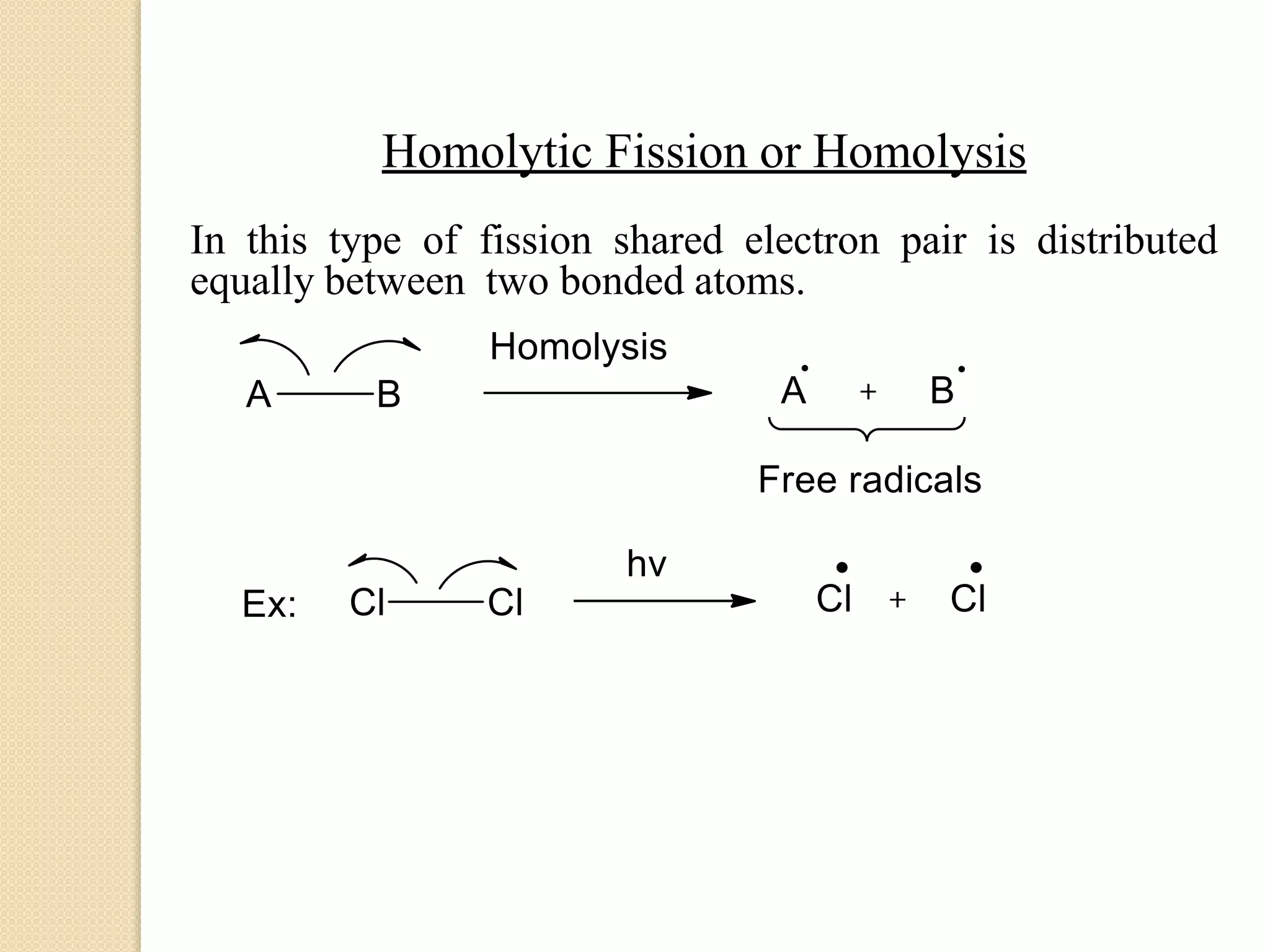
Homolytic Fission or Homolysis
In this type of fission shared electron pair is distributed
equally between two bonded atoms.
It is shown by half headed arrow
The two fragments formed in this cleavage are neutral species and each one
has one unpaired electron. These species are called as free radicals.
High temperature, Light (hv) and peroxides are used in Homolytic
fission for the production of free radicals.
The reactions involved in free radicals as intermediates are called free radical
reactions and are proceed through free radical mechanism.
Homolytic Fission Characteristics
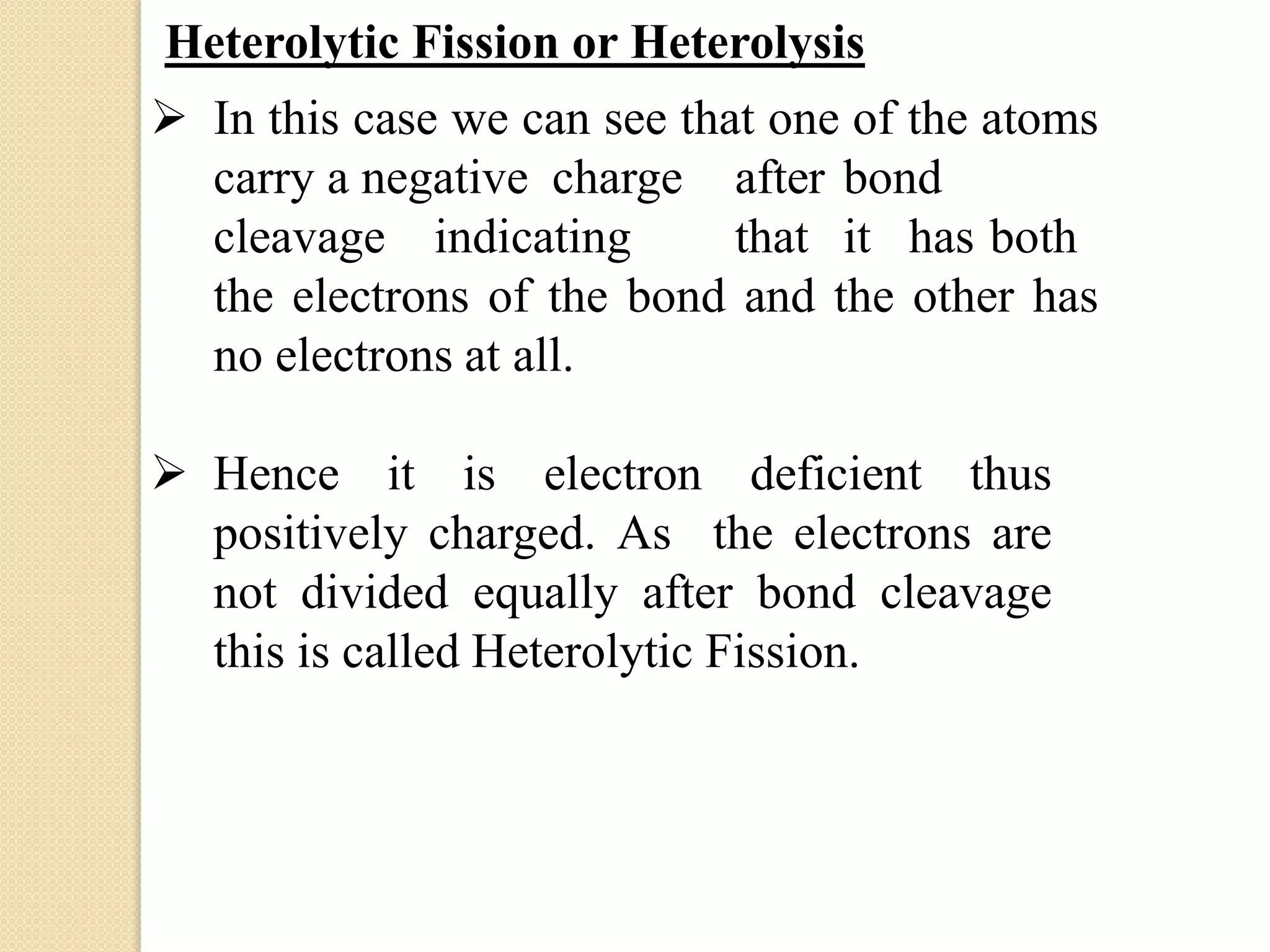
 In this case we can see that one of the atoms
carry a negative charge after bond
cleavage indicating that it has both
the electrons of the bond and the other has
no electrons at all.
 Hence it is electron deficient thus
positively charged. As the electrons are
not divided equally after bond cleavage
this is called Heterolytic Fission.
Heterolytic Fission or Heterolysis
 In a case the C atom carries a positive charge it is
called a carbocation and in the case it carries
both the electrons of the broken bond and is
negatively charged, it is called a Carbanion.
 Carbocation and Carbanionsare the most
important carbon intermediates in organic
chemistry .
Heterolytic Fission
This Heterolytic fission takes
place in two ways based on the
electro negativity difference of
the two atoms in the compound
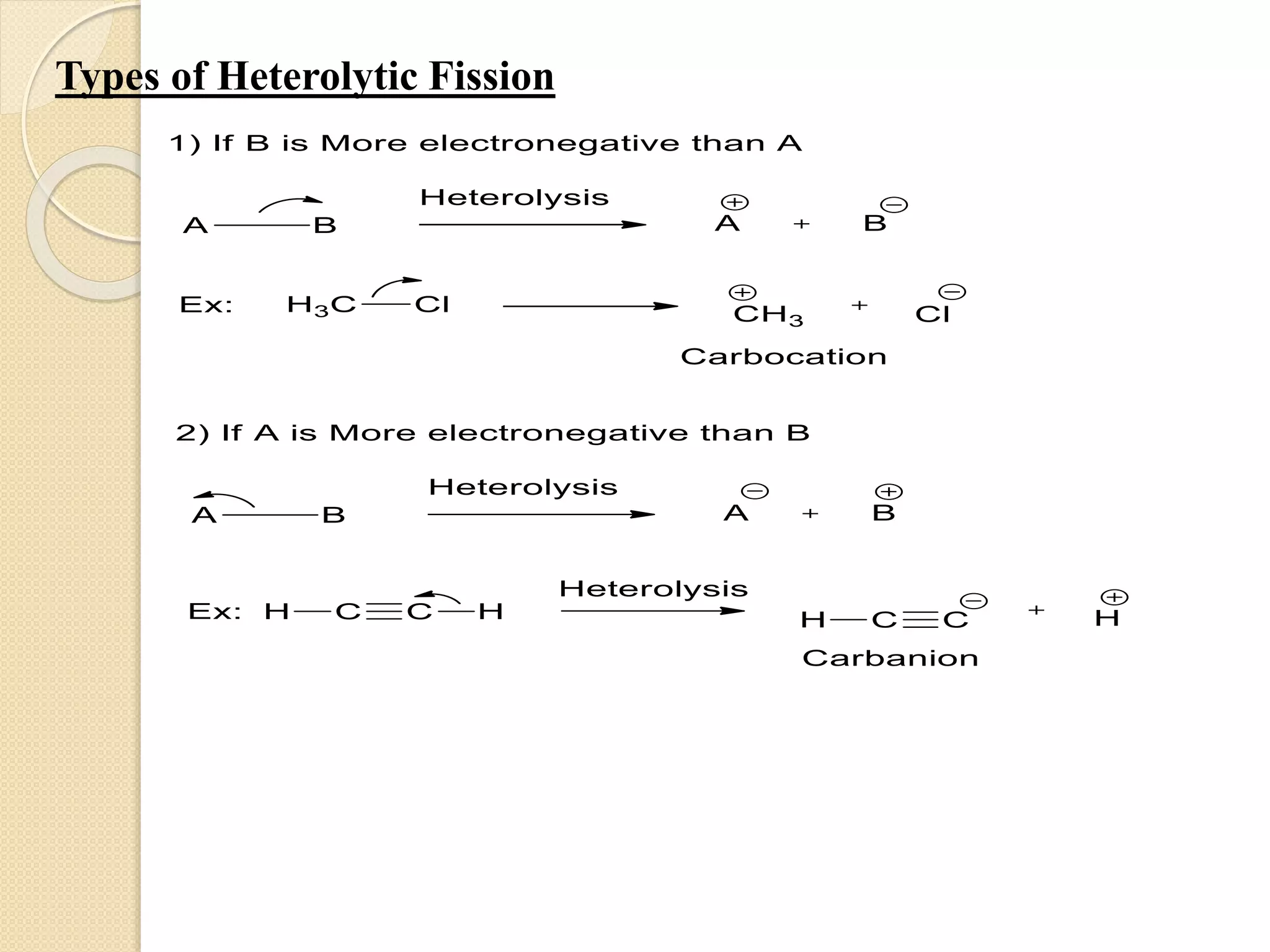
Types of Heterolytic Fission
There are three types of organic reagents
Electrophiles: These are electron deficient species and attacks at
centre of maximum electron density or at negatively charged
centre of the molecules. These are act as Lewis Acids.
Electrophiles are of two types ,
a) Positive Electrophiles: these are carrying positivecharge
2
Ex: All carbocations, H+
, H3O+
, Cl+
, NO +
etc.
Organic Reagents
b) Neutral Electrophiles:
These are neutral species
Ex: AlCl3, BF3, SO3 etc.
2
Nucleophiles: These are electron rich in species and attack
at the centre of minimum electron density or at
positively charged centre of the molecules. These are act
as Lewis Bases. Nucleophiles are two types,
a)Negative Nucleophiles: these are carrying Negative charge
Ex: All Carbanions, H-
, OH-
, Cl-
, RCOO-
etc.
b)Neutral Nucleophiles: these are
Neutral species Ex: H2O, NH3.
Free Radicals: These are Neutral species and contains an
unpaired or odd number of electrons
Ex: Cl.
, CH .
etc.
a)These are produced by homolysis of covalent bond
b) Free radicals are paramagnetic in nature due to presence of
odd electron
.
Free radicals
These are neutral intermediates,
formed due to homolytic
cleavage of a single bond.
Some common bonds which
cleave to give free radicals in
organic chemistry are shown: C-O,
C-Cl, C-Br, C-I, C-C, C-H.
Carbocations are formed from the heterolytic cleavage of a
carbon- heteroatom bond where the other atom is more
electronegative
than carbon like a C-O, C-N, C-X (X can be Cl, Br, I, etc) bond.
After the cleavage if a carbocation is to be formed the two
electrons of the bond must go to the other atom. And this is
favoured if that other atom is electronegative. Formation of
carbocations can be assisted by using cations
Carbocations
Carbanions
These are intermediates formed as a result of heterolysis, but
here the electron pair from the bond is kept by the carbon
atom.
From what we saw earlier the more electronegative atom
keeps the electrons, so in this case carbon must the more
electronegative of the two atoms making up the bond.
Organic reactions
There are four types of organic
reactions
1.Substitution reaction
2.Elimination reaction
3.Addition reaction
4.Rearrangement reaction
Substitution reaction
 In a substitution reaction one atom or a group of atoms is substituted by
another atom or a group of atoms to form a new substance. Example C-Cl
bond, in which the carbon atom has partial positive charge due to the
presence of highly electronegative chlorine atom.
 In a nucleophilic substitution reaction the nucleophile must have a
pair of electrons and also should have high affinity for the
electropositive species as compared to the substituent which was
originally present.
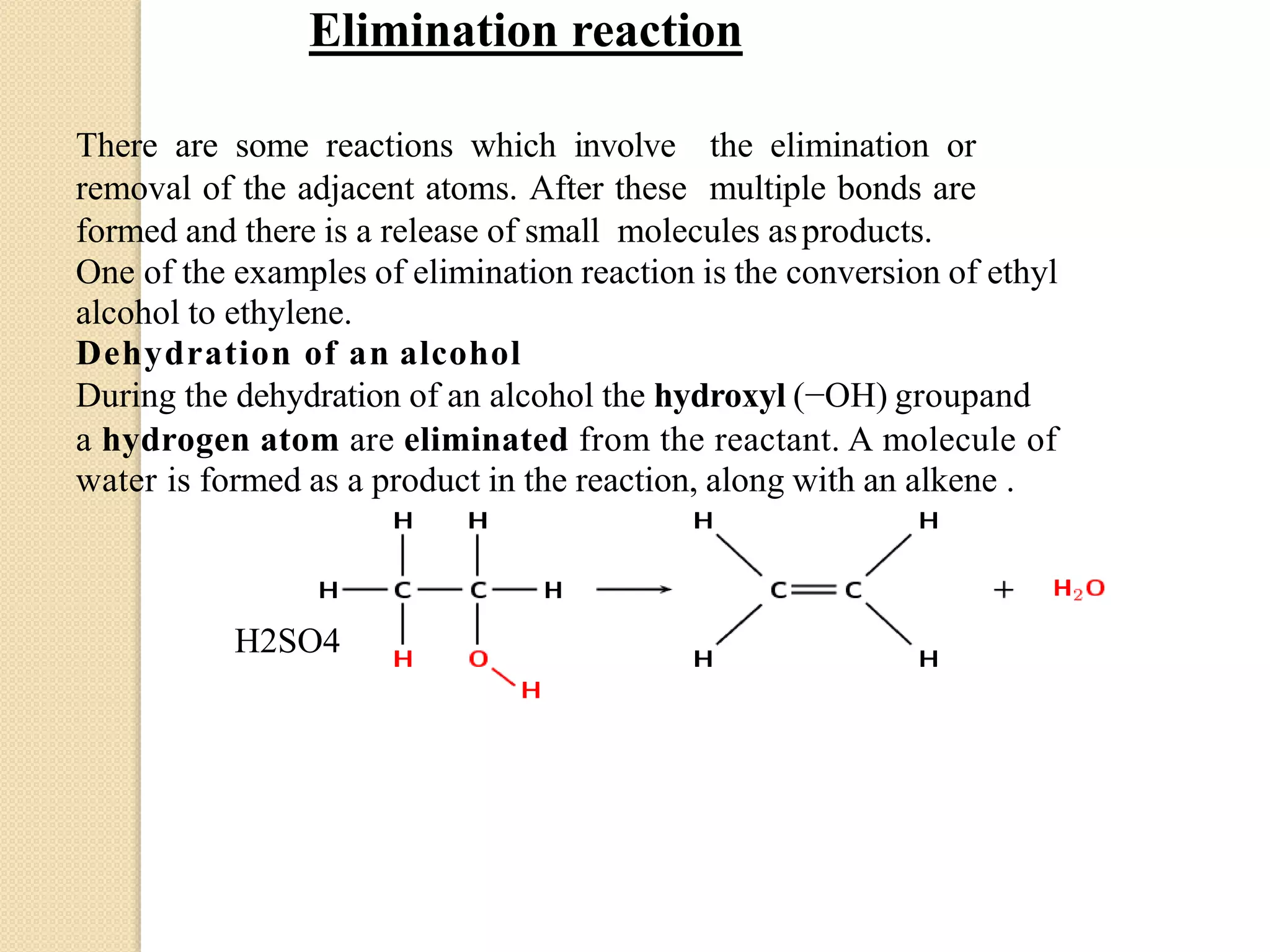
Elimination reaction
There are some reactions which involve the elimination or
removal of the adjacent atoms. After these multiple bonds are
formed and there is a release of small molecules asproducts.
One of the examples of elimination reaction is the conversion of ethyl
alcohol to ethylene.
Dehydration of an alcohol
During the dehydration of an alcohol the hydroxyl (−OH) groupand
a hydrogen atom are eliminated from the reactant. A molecule of
water is formed as a product in the reaction, along with an alkene .
H2SO4
Addition reaction
Addition reaction is nothing but just the opposite of elimination
reaction.
An addition reaction occurs when two or more reactants
combine to form a single product. During addition reaction
unsaturated molecules will become saturated.
In the reaction given below when HOH is added to ethylene it will
give us ethylalcohol.
Rearrangement Reactions
In these reactions migration of group or atom takes place at
intermediate stage as a result rearranged carbon skeleton
products are formed.
Ex: Pinacol – Pinacolone rearrangement
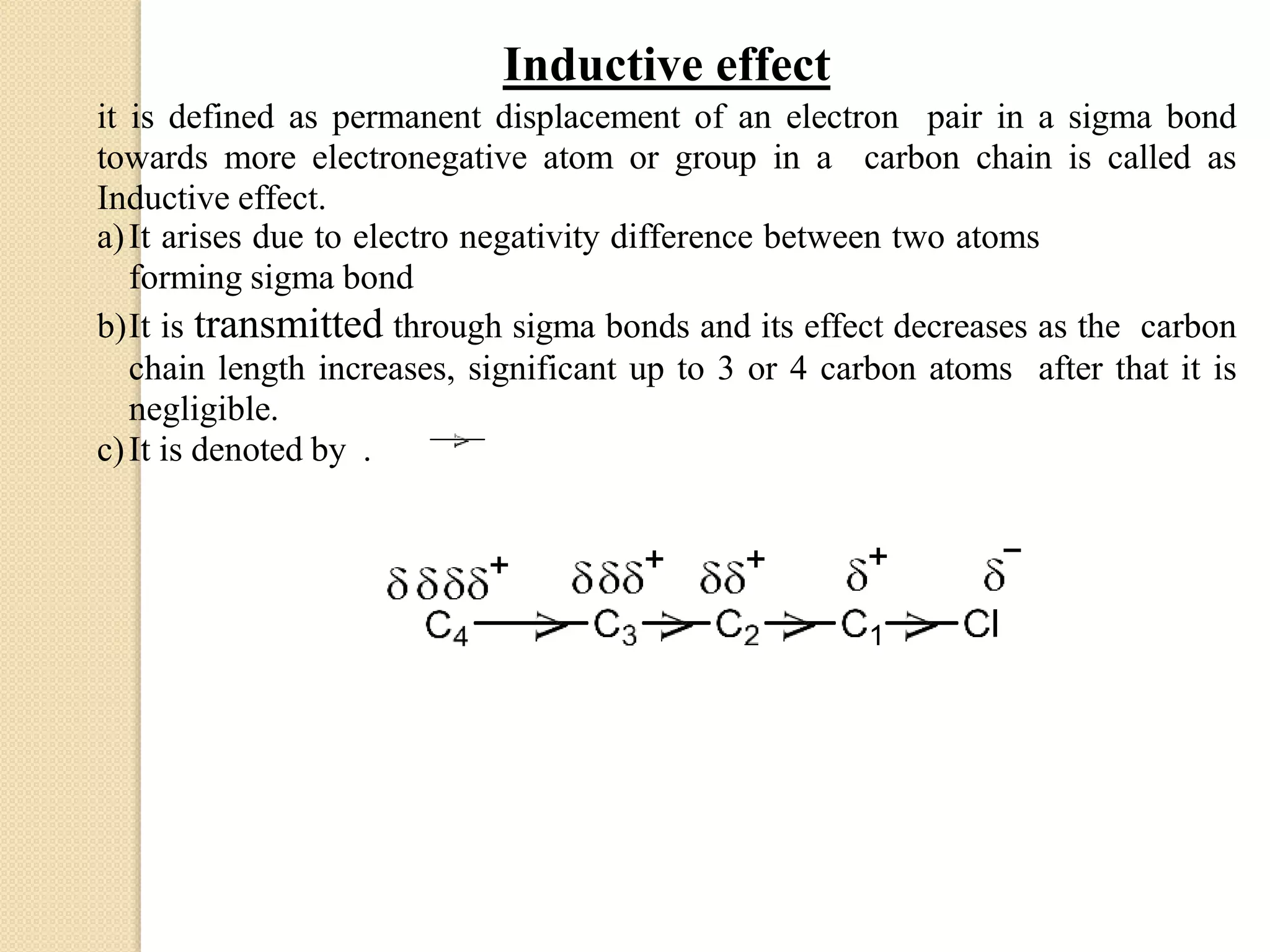
Inductive effect
it is defined as permanent displacement of an electron pair in a sigma bond
towards more electronegative atom or group in a carbon chain is called as
Inductive effect.
a)It arises due to electro negativity difference between two atoms
forming sigma bond
b)It is transmitted through sigma bonds and its effect decreases as the carbon
chain length increases, significant up to 3 or 4 carbon atoms after that it is
negligible.
c)It is denoted by .
Mesomeric or
Resonance Effect
The flow of electrons from one part of a conjugated
system to the other caused by phenomenon of
resonance is called resonance effect or mesomeric
effect.
-M or -R effect :
When the electron displacement is towards the group.
e.g :-NO2 , -CHO,
+M or +R effect :
When the electron displacement is away from the
group.
e.g :-OH , -OR,-Cl
Essay Questions:
1. Define Inductive Effect. Write Two Applications Of Inductive Effect.
2. Explain Mesomeric Effect With Two Applications.
3. Explain Hyper conjugation With Two Applications.
4. Explain types of organic relations with examples
Short Answer Questions:
1. Write about types of bond fission with examples.
2. Explain the following a) Electrophilic b) Nucleophilic c) free radical.
Reagents with examples.
3. Explain the stability of carbenes based on hyper conjugation.

Reaction.pptx

  • 1.
    Gurumeet C Wadhawa KarmaveerBhaurao Patil College Vashi Structural Theory in Organic Chemistry
  • 2.
    Contents…  BOND FISSIONAND ITS TYPES  ORGANIC REAGENTS  TYPES OF ORGANIC REACTIONS  INDUCTIVE EFFECT AND ITS APPLICATIONS  MESOMERIC EFFECT AND ITS APPLICATIONS
  • 3.
    Bond fission A covalentbond is formed when two electrons are shared between two atoms. Now a chemical reaction takes place when old bonds are broken and new ones are formed. Bond making and breaking is takes place by two ways, Homolysis and Heterolysis
  • 4.
    Homolytic Fission orHomolysis In this type of fission shared electron pair is distributed equally between two bonded atoms.
  • 5.
    It is shownby half headed arrow The two fragments formed in this cleavage are neutral species and each one has one unpaired electron. These species are called as free radicals. High temperature, Light (hv) and peroxides are used in Homolytic fission for the production of free radicals. The reactions involved in free radicals as intermediates are called free radical reactions and are proceed through free radical mechanism. Homolytic Fission Characteristics
  • 6.
     In thiscase we can see that one of the atoms carry a negative charge after bond cleavage indicating that it has both the electrons of the bond and the other has no electrons at all.  Hence it is electron deficient thus positively charged. As the electrons are not divided equally after bond cleavage this is called Heterolytic Fission. Heterolytic Fission or Heterolysis
  • 7.
     In acase the C atom carries a positive charge it is called a carbocation and in the case it carries both the electrons of the broken bond and is negatively charged, it is called a Carbanion.  Carbocation and Carbanionsare the most important carbon intermediates in organic chemistry . Heterolytic Fission
  • 8.
    This Heterolytic fissiontakes place in two ways based on the electro negativity difference of the two atoms in the compound Types of Heterolytic Fission
  • 9.
  • 10.
    There are threetypes of organic reagents Electrophiles: These are electron deficient species and attacks at centre of maximum electron density or at negatively charged centre of the molecules. These are act as Lewis Acids. Electrophiles are of two types , a) Positive Electrophiles: these are carrying positivecharge 2 Ex: All carbocations, H+ , H3O+ , Cl+ , NO + etc. Organic Reagents b) Neutral Electrophiles: These are neutral species Ex: AlCl3, BF3, SO3 etc.
  • 11.
    2 Nucleophiles: These areelectron rich in species and attack at the centre of minimum electron density or at positively charged centre of the molecules. These are act as Lewis Bases. Nucleophiles are two types, a)Negative Nucleophiles: these are carrying Negative charge Ex: All Carbanions, H- , OH- , Cl- , RCOO- etc. b)Neutral Nucleophiles: these are Neutral species Ex: H2O, NH3.
  • 12.
    Free Radicals: Theseare Neutral species and contains an unpaired or odd number of electrons Ex: Cl. , CH . etc. a)These are produced by homolysis of covalent bond b) Free radicals are paramagnetic in nature due to presence of odd electron .
  • 13.
    Free radicals These areneutral intermediates, formed due to homolytic cleavage of a single bond. Some common bonds which cleave to give free radicals in organic chemistry are shown: C-O, C-Cl, C-Br, C-I, C-C, C-H.
  • 14.
    Carbocations are formedfrom the heterolytic cleavage of a carbon- heteroatom bond where the other atom is more electronegative than carbon like a C-O, C-N, C-X (X can be Cl, Br, I, etc) bond. After the cleavage if a carbocation is to be formed the two electrons of the bond must go to the other atom. And this is favoured if that other atom is electronegative. Formation of carbocations can be assisted by using cations Carbocations
  • 15.
    Carbanions These are intermediatesformed as a result of heterolysis, but here the electron pair from the bond is kept by the carbon atom. From what we saw earlier the more electronegative atom keeps the electrons, so in this case carbon must the more electronegative of the two atoms making up the bond.
  • 16.
    Organic reactions There arefour types of organic reactions 1.Substitution reaction 2.Elimination reaction 3.Addition reaction 4.Rearrangement reaction
  • 17.
    Substitution reaction  Ina substitution reaction one atom or a group of atoms is substituted by another atom or a group of atoms to form a new substance. Example C-Cl bond, in which the carbon atom has partial positive charge due to the presence of highly electronegative chlorine atom.  In a nucleophilic substitution reaction the nucleophile must have a pair of electrons and also should have high affinity for the electropositive species as compared to the substituent which was originally present.
  • 18.
    Elimination reaction There aresome reactions which involve the elimination or removal of the adjacent atoms. After these multiple bonds are formed and there is a release of small molecules asproducts. One of the examples of elimination reaction is the conversion of ethyl alcohol to ethylene. Dehydration of an alcohol During the dehydration of an alcohol the hydroxyl (−OH) groupand a hydrogen atom are eliminated from the reactant. A molecule of water is formed as a product in the reaction, along with an alkene . H2SO4
  • 19.
    Addition reaction Addition reactionis nothing but just the opposite of elimination reaction. An addition reaction occurs when two or more reactants combine to form a single product. During addition reaction unsaturated molecules will become saturated. In the reaction given below when HOH is added to ethylene it will give us ethylalcohol.
  • 20.
    Rearrangement Reactions In thesereactions migration of group or atom takes place at intermediate stage as a result rearranged carbon skeleton products are formed. Ex: Pinacol – Pinacolone rearrangement
  • 21.
    Inductive effect it isdefined as permanent displacement of an electron pair in a sigma bond towards more electronegative atom or group in a carbon chain is called as Inductive effect. a)It arises due to electro negativity difference between two atoms forming sigma bond b)It is transmitted through sigma bonds and its effect decreases as the carbon chain length increases, significant up to 3 or 4 carbon atoms after that it is negligible. c)It is denoted by .
  • 30.
    Mesomeric or Resonance Effect Theflow of electrons from one part of a conjugated system to the other caused by phenomenon of resonance is called resonance effect or mesomeric effect. -M or -R effect : When the electron displacement is towards the group. e.g :-NO2 , -CHO, +M or +R effect : When the electron displacement is away from the group. e.g :-OH , -OR,-Cl
  • 33.
    Essay Questions: 1. DefineInductive Effect. Write Two Applications Of Inductive Effect. 2. Explain Mesomeric Effect With Two Applications. 3. Explain Hyper conjugation With Two Applications. 4. Explain types of organic relations with examples Short Answer Questions: 1. Write about types of bond fission with examples. 2. Explain the following a) Electrophilic b) Nucleophilic c) free radical. Reagents with examples. 3. Explain the stability of carbenes based on hyper conjugation.