Chlamydia
ConjunCtivitis
presentation by:
yassmeen Zein al-abdien Khalil
supervised by:
dr. amr mounir
sohag ophthalmology department
What is Chlamydia?
Chlamydia infection is a common sexually
transmitted disease. It is caused by bacteria
called Chlamydia trachomatis.
 Chlamydia is one of the most common sexually
transmitted infections worldwide affecting
about 4.2% of women and 2.7% of men.
Chlamydia can be spread during vaginal, anal,
ororal sex, and can be passed from an infected
motherto herbaby during childbirth.
Chlamydia the Bacteria
C. trachomatis is responsible forthe human
forms of chlamydial ocularinfections inclusion
conjunctivitis and trachoma.
Testing of polyclonal and monoclonal
antibodies with majorouter-membrane protein
has identified 19 different human serotypes
and several variants of C. trachomatis.
Serotypes D, Da, E, F, G, H, I, Ia, J, and Kare
associated with inclusion conjunctivitis (as well
as genital infections), while serotypes A, B, Ba,
and C are usually isolated from trachoma.
Chlamydia trachomatis
Obligate
intracellularhuman
pathogen.
gram-negative
coccied bacterium
that typically
infects columnar
epithelial cells.
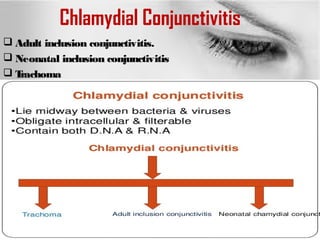
Chlamydial Conjunctivitis
 Adult inclusion conjunctivitis.
 Neonatal inclusion conjunctivitis
 Trachoma
Adult inclusion conjunctivitis
Adult chlamydial conjunctivitis is an
oculogenital infection usually caused by
serovars D–Kof C. trachomatis.
Affects 5–20% of sexually active young
adults in Western countries.
Transmission is by autoinoculation from
genital secretions,although eye-to-eye
spread probably accounts forabout 10%.
The incubation period is about a week.
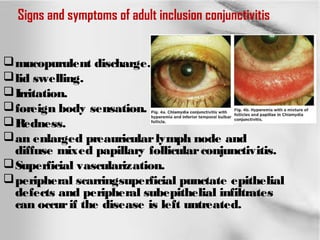
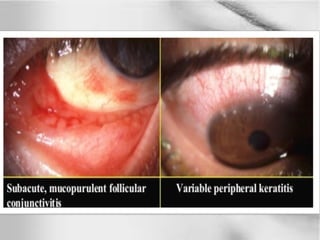
Signs and symptoms of adult inclusion conjunctivitis
mucopurulent discharge.
lid swelling.
Irritation.
foreign body sensation.
Redness.
an enlarged preauricularlymph node and
diffuse mixed papillary follicularconjunctivitis.
Superficial vascularization.
peripheral scarringsuperficial punctate epithelial
defects and peripheral subepithelial infiltrates
can occurif the disease is left untreated.
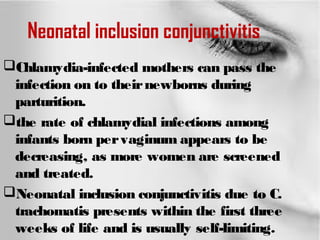
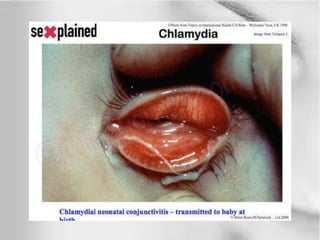
Neonatal inclusion conjunctivitis
Chlamydia-infected mothers can pass the
infection on to theirnewborns during
parturition.
the rate of chlamydial infections among
infants born pervaginum appears to be
decreasing, as more women are screened
and treated.
Neonatal inclusion conjunctivitis due to C.
trachomatis presents within the first three
weeks of life and is usually self-limiting.
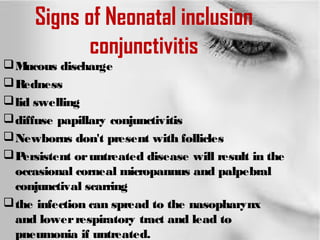
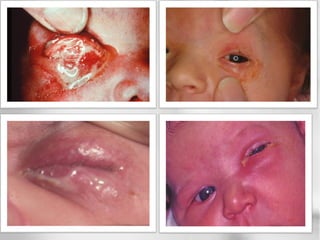
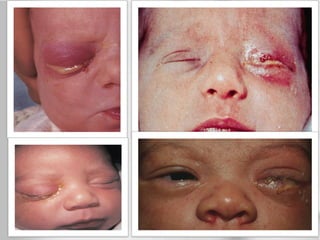
Signs of Neonatal inclusion
conjunctivitis
Mucous discharge
Redness
lid swelling
diffuse papillary conjunctivitis
Newborns don't present with follicles
Persistent oruntreated disease will result in the
occasional corneal micropannus and palpebral
conjunctival scarring
the infection can spread to the nasopharynx
and lowerrespiratory tract and lead to
pneumonia if untreated.
Diagnosis and treatment of inclusion conjunctivitis
Chlamydial conjunctivitis is detectable by a
cytological examination of stained smears
from tissue.
Trachoma and acute chlamydial conjunctivitis
can be detected by Giemsa staining of
conjunctival cells, which also reveals
intracellularinclusion bodies.
Immunofluorescent antibody staining of
chlamydial antigen and nucleic acid
amplification of conjunctival smears are
newerand more accurate techniques.
Recommended treatment forinclusion
conjunctivitis includes both topical and
systemic antibiotics.
A two-to-three week regimen of
erythromycin ortetracycline ointment with
systemic tetracycline, doxycycline or
erythromycin is the usual treatment foradult
chlamydial conjunctivitis.
Infected mothers and theirpartners should
take systemic tetracyclines, macrolides or
azolides.
Infants are usually treated with
erythromycin ophthalmic ointment forone
week and erythromycin orazithromycin
elixirfortwo to three weeks.
Trachoma
Definition:
Repeated infection with gram negative C.
trachomatis results in trachoma, a chronic,
inflammatory, follicularform of
keratoconjunctivitis.
Aetiology:
Caused by A, B, Ba and C of Chlamydia
trachomatis.
Any age but mainly affects children at early
age.
Bad environment,flies&bad general health.
Endemic in Egypt 80%-90%of
Life cycle of Trachoma
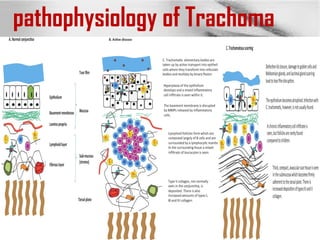
pathophysiology of Trachoma
Clinical features of Trachoma
Incubation period 5 to 21days.
Onset –subacute
Symptoms:
 F.b senseation(gritty senseation of sand)
 mucopurulent discharge.
 Watering .
 Redness.
 Photophobia.
 Blurring.
 Mild pain
Signs:
I. Conjunctival signs:
According to Mac Callen’s Classification, there
are 4 stages:
WHO classification:
II. corneal signs:
(1)Superficial punctuate keratitis:
)2(Corneal follicles:
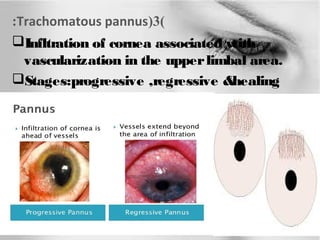
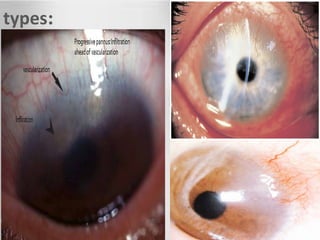
)3(Trachomatous pannus:
Infltration of cornea associated with
vascularization in the upperlimbal area.
Stages:progressive ,regressive &healing
stage.
:types
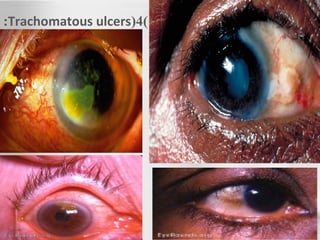
)4(Trachomatous ulcers:
Complication of trachoma
Lid:
trichiasis,entropion,tylois,ptosis&madarosis
Conjunctiva:
Concretions,pseudocyst,xerosis&symblephar
on.
Cornea:
Opacity,ectasia,xerosis,total corneal
pannus.
Lacrimal:
Management of Trachoma
Prevention of Trachoma
WHO’s SAFE stategy for the globtal elimination of
Trachoma:
Treatment of Trachoma
(1)Medical:
Systemic:A single dose of azithromycin (20 mg/kg up to 1 g)-
Erythromycin 500 mg twice daily for14 days-doxycycline 100
mg twice daily for10 days.
Local: sulphacetamide drops 10-30%5times/day for2 months-
Topical 1% tetracycline ointment.
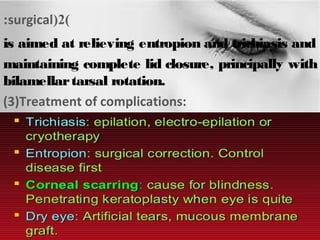
)2(surgical:
is aimed at relieving entropion and trichiasis and
maintaining complete lid closure, principally with
bilamellartarsal rotation.
(3)Treatment of complications:
Differential diagnosis of Trachoma
Thank you
Chlamydia Conjunctivitis

Chlamydia Conjunctivitis

  • 1.
    Chlamydia ConjunCtivitis presentation by: yassmeen Zeinal-abdien Khalil supervised by: dr. amr mounir sohag ophthalmology department
  • 2.
    What is Chlamydia? Chlamydiainfection is a common sexually transmitted disease. It is caused by bacteria called Chlamydia trachomatis.  Chlamydia is one of the most common sexually transmitted infections worldwide affecting about 4.2% of women and 2.7% of men. Chlamydia can be spread during vaginal, anal, ororal sex, and can be passed from an infected motherto herbaby during childbirth.
  • 3.
    Chlamydia the Bacteria C.trachomatis is responsible forthe human forms of chlamydial ocularinfections inclusion conjunctivitis and trachoma. Testing of polyclonal and monoclonal antibodies with majorouter-membrane protein has identified 19 different human serotypes and several variants of C. trachomatis. Serotypes D, Da, E, F, G, H, I, Ia, J, and Kare associated with inclusion conjunctivitis (as well as genital infections), while serotypes A, B, Ba, and C are usually isolated from trachoma.
  • 4.
  • 5.
    Chlamydial Conjunctivitis  Adultinclusion conjunctivitis.  Neonatal inclusion conjunctivitis  Trachoma
  • 6.
    Adult inclusion conjunctivitis Adultchlamydial conjunctivitis is an oculogenital infection usually caused by serovars D–Kof C. trachomatis. Affects 5–20% of sexually active young adults in Western countries. Transmission is by autoinoculation from genital secretions,although eye-to-eye spread probably accounts forabout 10%. The incubation period is about a week.
  • 7.
    Signs and symptomsof adult inclusion conjunctivitis mucopurulent discharge. lid swelling. Irritation. foreign body sensation. Redness. an enlarged preauricularlymph node and diffuse mixed papillary follicularconjunctivitis. Superficial vascularization. peripheral scarringsuperficial punctate epithelial defects and peripheral subepithelial infiltrates can occurif the disease is left untreated.
  • 12.
    Neonatal inclusion conjunctivitis Chlamydia-infectedmothers can pass the infection on to theirnewborns during parturition. the rate of chlamydial infections among infants born pervaginum appears to be decreasing, as more women are screened and treated. Neonatal inclusion conjunctivitis due to C. trachomatis presents within the first three weeks of life and is usually self-limiting.
  • 13.
    Signs of Neonatalinclusion conjunctivitis Mucous discharge Redness lid swelling diffuse papillary conjunctivitis Newborns don't present with follicles Persistent oruntreated disease will result in the occasional corneal micropannus and palpebral conjunctival scarring the infection can spread to the nasopharynx and lowerrespiratory tract and lead to pneumonia if untreated.
  • 17.
    Diagnosis and treatmentof inclusion conjunctivitis Chlamydial conjunctivitis is detectable by a cytological examination of stained smears from tissue. Trachoma and acute chlamydial conjunctivitis can be detected by Giemsa staining of conjunctival cells, which also reveals intracellularinclusion bodies. Immunofluorescent antibody staining of chlamydial antigen and nucleic acid amplification of conjunctival smears are newerand more accurate techniques.
  • 18.
    Recommended treatment forinclusion conjunctivitisincludes both topical and systemic antibiotics. A two-to-three week regimen of erythromycin ortetracycline ointment with systemic tetracycline, doxycycline or erythromycin is the usual treatment foradult chlamydial conjunctivitis. Infected mothers and theirpartners should take systemic tetracyclines, macrolides or azolides. Infants are usually treated with erythromycin ophthalmic ointment forone week and erythromycin orazithromycin elixirfortwo to three weeks.
  • 19.
    Trachoma Definition: Repeated infection withgram negative C. trachomatis results in trachoma, a chronic, inflammatory, follicularform of keratoconjunctivitis. Aetiology: Caused by A, B, Ba and C of Chlamydia trachomatis. Any age but mainly affects children at early age. Bad environment,flies&bad general health. Endemic in Egypt 80%-90%of
  • 21.
    Life cycle ofTrachoma
  • 22.
  • 24.
    Clinical features ofTrachoma Incubation period 5 to 21days. Onset –subacute Symptoms:  F.b senseation(gritty senseation of sand)  mucopurulent discharge.  Watering .  Redness.  Photophobia.  Blurring.  Mild pain
  • 25.
    Signs: I. Conjunctival signs: Accordingto Mac Callen’s Classification, there are 4 stages:
  • 27.
  • 29.
  • 30.
  • 31.
    )3(Trachomatous pannus: Infltration ofcornea associated with vascularization in the upperlimbal area. Stages:progressive ,regressive &healing stage.
  • 32.
  • 33.
  • 34.
  • 35.
  • 36.
    Prevention of Trachoma WHO’sSAFE stategy for the globtal elimination of Trachoma:
  • 38.
    Treatment of Trachoma (1)Medical: Systemic:Asingle dose of azithromycin (20 mg/kg up to 1 g)- Erythromycin 500 mg twice daily for14 days-doxycycline 100 mg twice daily for10 days. Local: sulphacetamide drops 10-30%5times/day for2 months- Topical 1% tetracycline ointment.
  • 39.
    )2(surgical: is aimed atrelieving entropion and trichiasis and maintaining complete lid closure, principally with bilamellartarsal rotation. (3)Treatment of complications:
  • 40.
  • 41.