VIRAL CONJUCTIVITIS
SITI MARIAM BINTI MOHD HAMZAH
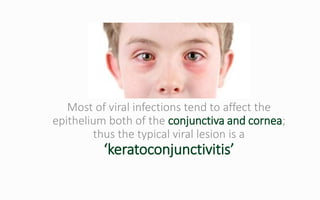
Most of viral infections tend to affect the
epithelium both of the conjunctiva and cornea;
thus the typical viral lesion is a
‘keratoconjunctivitis’
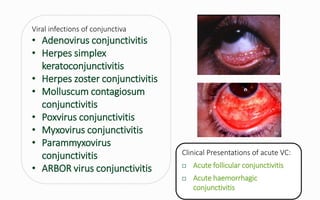
Viral infections of conjunctiva
• Adenovirus conjunctivitis
• Herpes simplex
keratoconjunctivitis
• Herpes zoster conjunctivitis
• Molluscum contagiosum
conjunctivitis
• Poxvirus conjunctivitis
• Myxovirus conjunctivitis
• Parammyxovirus
conjunctivitis
• ARBOR virus conjunctivitis
Clinical Presentations of acute VC:
 Acute follicular conjunctivitis
 Acute haemorrhagic
conjunctivitis
Adenoviral Conjunctivitis
• Adenoviruses are the commonest causes of viral conjunctivitis
• Non-enveloped, double stranded DNA viruses, which replicate within the
nucleus of host cells. General reservoir is only human.
Type of adenoviral conjunctivitis
• Epidemic keratoconjunctivitis (EKC)
• Nonspecific acute follicular conjunctivitis
• Pharyngoconjunctival fever (PCF)
• Chronic relapsing adenoviral conjunctivitis
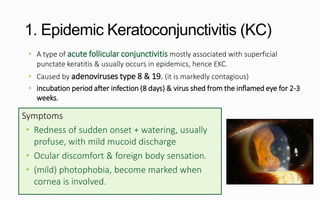
1. Epidemic Keratoconjunctivitis (KC)
• A type of acute follicular conjunctivitis mostly associated with superficial
punctate keratitis & usually occurs in epidemics, hence EKC.
• Caused by adenoviruses type 8 & 19. (it is markedly contagious)
• incubation period after infection (8 days) & virus shed from the inflamed eye for 2-3
weeks.
Symptoms
• Redness of sudden onset + watering, usually
profuse, with mild mucoid discharge
• Ocular discomfort & foreign body sensation.
• (mild) photophobia, become marked when
cornea is involved.
Signs
• Conjunctiva:
• Hyperaemia prominent
• Chemosis is present
• Follicles (lower fornix & palpebral conjunctiva)
• Papillary reaction
• Petechial subconjunctival haemorrhages (severe
adenoviral conjunctivitis)
• Pseudomembrane lining (lower fornix & palpebral
conjunctiva)
• Cornea:
• Epithelial microcystic diffuse fine non-staining
lesions
• Superficial punctate keratitis (SPK)
• Pre-auricular lymphadenopathy.
Treatment
I. Supportive treatment for amelioration of symptoms is the
only treatment required and includes:
• Cold compresses, and sun glasses to decrease glare,
• Decongestant and lubricant tear drops to decrease discomfort
II. Topical antibiotics; to prevent superadded bacterial infections
Prevention of spread of infection to the contacts
- Highly contagious and patients may be infectious for up to 11
days after onset
Transmission usually occurs
• From eyes to fingers to eyes
• Tonometers, contact lenses and eye drops
2. Nonspecific Acute Follicular
Conjunctivitis
• Most common form of acute follicular conjunctivitis
• Caused by adenovirus serotypes 1 to 11 & 19
• Milder form of acute follicular conjunctivitis.
• Treatment similar as EKC
3.Pharyngoconjunctival Fever (PCF)
• adenoviral infection commonly associated with subtypes 3 & 7.
• PCF primarily affect children & appears in epidemic form
• Treatment is similar as EKC
Clinical features
• Acute follicular conjunctivitis, associated
with pharyngitis.
• Fever & pre-auricular lymphadenopathy.
• Cornea : superficial punctate keratitis. (30%)
Acute Herpetic Conjunctivitis
• Always an accompaniment of the ‘primary herpetic infection’, mainly
occur in children and adolescents.
• Commonly caused by herpes simplex virus type 1 and spreads by kissing or
other close personal contacts.
• HSV type 2 associated with genital infections, may also involve the eyes
in adults as well as children, though rarely.
• Treatment
• Usually self limiting
• Topical antiviral drugs control the infection effectively and prevent
recurrences
• Supportive measures are similar with EKC
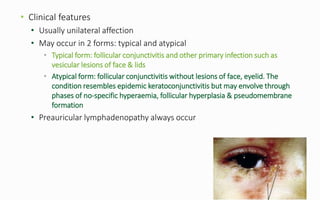
• Clinical features
• Usually unilateral affection
• May occur in 2 forms: typical and atypical
• Typical form: follicular conjunctivitis and other primary infection such as
vesicular lesions of face & lids
• Atypical form: follicular conjunctivitis without lesions of face, eyelid. The
condition resembles epidemic keratoconjunctivitis but may envolve through
phases of no-specific hyperaemia, follicular hyperplasia & pseudomembrane
formation
• Preauricular lymphadenopathy always occur
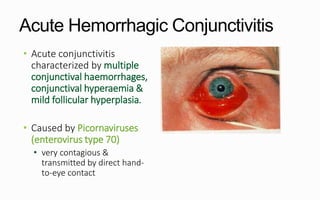
Acute Hemorrhagic Conjunctivitis
• Acute conjunctivitis
characterized by multiple
conjunctival haemorrhages,
conjunctival hyperaemia &
mild follicular hyperplasia.
• Caused by Picornaviruses
(enterovirus type 70)
• very contagious &
transmitted by direct hand-
to-eye contact
• Incubation period : 1-2 days
• Symptoms
• Pain
• Redness
• Watering
• Mild photophobia
• Transient blur of vision
• Lid swelling
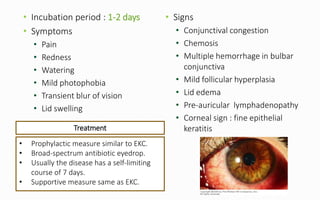
• Signs
• Conjunctival congestion
• Chemosis
• Multiple hemorrhage in bulbar
conjunctiva
• Mild follicular hyperplasia
• Lid edema
• Pre-auricular lymphadenopathy
• Corneal sign : fine epithelial
keratitis
• Prophylactic measure similar to EKC.
• Broad-spectrum antibiotic eyedrop.
• Usually the disease has a self-limiting
course of 7 days.
• Supportive measure same as EKC.
Treatment
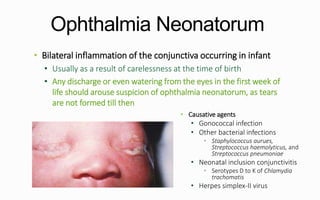
Ophthalmia Neonatorum
• Bilateral inflammation of the conjunctiva occurring in infant
• Usually as a result of carelessness at the time of birth
• Any discharge or even watering from the eyes in the first week of
life should arouse suspicion of ophthalmia neonatorum, as tears
are not formed till then
• Causative agents
• Gonococcal infection
• Other bacterial infections
• Staphylococcus aurues,
Streptococcus haemolyticus, and
Streptococcus pneumoniae
• Neonatal inclusion conjunctivitis
• Serotypes D to K of Chlamydia
trachomatis
• Herpes simplex-II virus
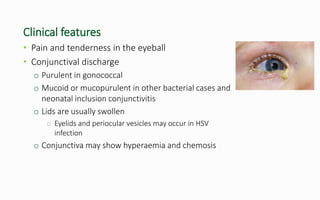
Clinical features
• Pain and tenderness in the eyeball
• Conjunctival discharge
o Purulent in gonococcal
o Mucoid or mucopurulent in other bacterial cases and
neonatal inclusion conjunctivitis
o Lids are usually swollen
o Eyelids and periocular vesicles may occur in HSV
infection
o Conjunctiva may show hyperaemia and chemosis
Treatment
• Prophylaxis needs antenatal, natal and postnatal care.
o Use either 1% tetracycline ointment or 0.5% erythromycin ointment into the eyes of babies
immediately after birth are useful for preventing bacterial and chlamydial ophthalmia
neonatorum.
• Curative treatment
Causative agents Treatment
Gonococcal Needs prompt treatment to prevent complications
1. Topical therapy
• Saline lavage hourly till discharge is eliminated
• Bacitracin eye ointment 4 times/day
• If cornea is involved, atropine sulphate ointment can be applied.
2. Systemic therapy
• Ceftriaxone, cefotaxime, ciprofloxacin
Other bacterial Treat with broad-spectrum antibiotics drops and ointment for 2 weeks
• Neomycin-bacitracin, tobramycin
Neonatal inclusion
conjunctivitis
Topical 1% tetracycline ointment or 0.5% erythromycin ointment qid for 3 weeks
Systemic erythromycin (125 mg orally, qid for 3 weeks); presence of chlamydia agents in the
conjunctiva implies colonization of URT as well.
Herpes simplex Self-limiting
However, antiviral drugs may control the infections and prevent the recurrence.

viral conjuctivitis

  • 1.
  • 2.
    Most of viralinfections tend to affect the epithelium both of the conjunctiva and cornea; thus the typical viral lesion is a ‘keratoconjunctivitis’
  • 3.
    Viral infections ofconjunctiva • Adenovirus conjunctivitis • Herpes simplex keratoconjunctivitis • Herpes zoster conjunctivitis • Molluscum contagiosum conjunctivitis • Poxvirus conjunctivitis • Myxovirus conjunctivitis • Parammyxovirus conjunctivitis • ARBOR virus conjunctivitis Clinical Presentations of acute VC:  Acute follicular conjunctivitis  Acute haemorrhagic conjunctivitis
  • 4.
    Adenoviral Conjunctivitis • Adenovirusesare the commonest causes of viral conjunctivitis • Non-enveloped, double stranded DNA viruses, which replicate within the nucleus of host cells. General reservoir is only human. Type of adenoviral conjunctivitis • Epidemic keratoconjunctivitis (EKC) • Nonspecific acute follicular conjunctivitis • Pharyngoconjunctival fever (PCF) • Chronic relapsing adenoviral conjunctivitis
  • 5.
    1. Epidemic Keratoconjunctivitis(KC) • A type of acute follicular conjunctivitis mostly associated with superficial punctate keratitis & usually occurs in epidemics, hence EKC. • Caused by adenoviruses type 8 & 19. (it is markedly contagious) • incubation period after infection (8 days) & virus shed from the inflamed eye for 2-3 weeks. Symptoms • Redness of sudden onset + watering, usually profuse, with mild mucoid discharge • Ocular discomfort & foreign body sensation. • (mild) photophobia, become marked when cornea is involved.
  • 6.
    Signs • Conjunctiva: • Hyperaemiaprominent • Chemosis is present • Follicles (lower fornix & palpebral conjunctiva) • Papillary reaction • Petechial subconjunctival haemorrhages (severe adenoviral conjunctivitis) • Pseudomembrane lining (lower fornix & palpebral conjunctiva) • Cornea: • Epithelial microcystic diffuse fine non-staining lesions • Superficial punctate keratitis (SPK) • Pre-auricular lymphadenopathy.
  • 7.
    Treatment I. Supportive treatmentfor amelioration of symptoms is the only treatment required and includes: • Cold compresses, and sun glasses to decrease glare, • Decongestant and lubricant tear drops to decrease discomfort II. Topical antibiotics; to prevent superadded bacterial infections Prevention of spread of infection to the contacts - Highly contagious and patients may be infectious for up to 11 days after onset Transmission usually occurs • From eyes to fingers to eyes • Tonometers, contact lenses and eye drops
  • 8.
    2. Nonspecific AcuteFollicular Conjunctivitis • Most common form of acute follicular conjunctivitis • Caused by adenovirus serotypes 1 to 11 & 19 • Milder form of acute follicular conjunctivitis. • Treatment similar as EKC
  • 9.
    3.Pharyngoconjunctival Fever (PCF) •adenoviral infection commonly associated with subtypes 3 & 7. • PCF primarily affect children & appears in epidemic form • Treatment is similar as EKC Clinical features • Acute follicular conjunctivitis, associated with pharyngitis. • Fever & pre-auricular lymphadenopathy. • Cornea : superficial punctate keratitis. (30%)
  • 10.
    Acute Herpetic Conjunctivitis •Always an accompaniment of the ‘primary herpetic infection’, mainly occur in children and adolescents. • Commonly caused by herpes simplex virus type 1 and spreads by kissing or other close personal contacts. • HSV type 2 associated with genital infections, may also involve the eyes in adults as well as children, though rarely. • Treatment • Usually self limiting • Topical antiviral drugs control the infection effectively and prevent recurrences • Supportive measures are similar with EKC
  • 11.
    • Clinical features •Usually unilateral affection • May occur in 2 forms: typical and atypical • Typical form: follicular conjunctivitis and other primary infection such as vesicular lesions of face & lids • Atypical form: follicular conjunctivitis without lesions of face, eyelid. The condition resembles epidemic keratoconjunctivitis but may envolve through phases of no-specific hyperaemia, follicular hyperplasia & pseudomembrane formation • Preauricular lymphadenopathy always occur
  • 12.
    Acute Hemorrhagic Conjunctivitis •Acute conjunctivitis characterized by multiple conjunctival haemorrhages, conjunctival hyperaemia & mild follicular hyperplasia. • Caused by Picornaviruses (enterovirus type 70) • very contagious & transmitted by direct hand- to-eye contact
  • 13.
    • Incubation period: 1-2 days • Symptoms • Pain • Redness • Watering • Mild photophobia • Transient blur of vision • Lid swelling • Signs • Conjunctival congestion • Chemosis • Multiple hemorrhage in bulbar conjunctiva • Mild follicular hyperplasia • Lid edema • Pre-auricular lymphadenopathy • Corneal sign : fine epithelial keratitis • Prophylactic measure similar to EKC. • Broad-spectrum antibiotic eyedrop. • Usually the disease has a self-limiting course of 7 days. • Supportive measure same as EKC. Treatment
  • 14.
    Ophthalmia Neonatorum • Bilateralinflammation of the conjunctiva occurring in infant • Usually as a result of carelessness at the time of birth • Any discharge or even watering from the eyes in the first week of life should arouse suspicion of ophthalmia neonatorum, as tears are not formed till then • Causative agents • Gonococcal infection • Other bacterial infections • Staphylococcus aurues, Streptococcus haemolyticus, and Streptococcus pneumoniae • Neonatal inclusion conjunctivitis • Serotypes D to K of Chlamydia trachomatis • Herpes simplex-II virus
  • 15.
    Clinical features • Painand tenderness in the eyeball • Conjunctival discharge o Purulent in gonococcal o Mucoid or mucopurulent in other bacterial cases and neonatal inclusion conjunctivitis o Lids are usually swollen o Eyelids and periocular vesicles may occur in HSV infection o Conjunctiva may show hyperaemia and chemosis
  • 16.
    Treatment • Prophylaxis needsantenatal, natal and postnatal care. o Use either 1% tetracycline ointment or 0.5% erythromycin ointment into the eyes of babies immediately after birth are useful for preventing bacterial and chlamydial ophthalmia neonatorum. • Curative treatment Causative agents Treatment Gonococcal Needs prompt treatment to prevent complications 1. Topical therapy • Saline lavage hourly till discharge is eliminated • Bacitracin eye ointment 4 times/day • If cornea is involved, atropine sulphate ointment can be applied. 2. Systemic therapy • Ceftriaxone, cefotaxime, ciprofloxacin Other bacterial Treat with broad-spectrum antibiotics drops and ointment for 2 weeks • Neomycin-bacitracin, tobramycin Neonatal inclusion conjunctivitis Topical 1% tetracycline ointment or 0.5% erythromycin ointment qid for 3 weeks Systemic erythromycin (125 mg orally, qid for 3 weeks); presence of chlamydia agents in the conjunctiva implies colonization of URT as well. Herpes simplex Self-limiting However, antiviral drugs may control the infections and prevent the recurrence.

Editor's Notes

  • #6 Superficial punctate keratitis is death of small groups of cells on the surface of the cornea
  • #7 Chemosis is the swelling (or edema) of the conjunctiva. It is due to exudation from abnormally permeable capillaries.