
DOCTOR OF PHARMACY
II YEAR
CONJUCTIVITIS
170101
CHAPTER-6
Opthomology
Dr. V. Chanukya (Pharm D)
• Definition
• Types
• Clinical features
• Treatment
Student Learning Outcomes
Upon completion of the chapter, the student will be able to:
• The conjunctiva is a translucent mucous membrane which lines the
posterior surface of the eyelids and anterior aspect of eyeball.
• The name conjunctiva (conjoin: to join) has been given to this
mucous membrane owing to the fact that it joins the eyeball to the
lids.
• It stretches from the lid margin to the limbus, and encloses a complex
space called conjunctival sac which is open in front at the palpebral
fissure.
ANATOMY
• Conjunctiva can be divided into three parts
– Palpebral conjunctiva
– Bulbar conjunctiva
– Conjunctival fornix
• PALPEBRAL CONJUNCTIVA
It lines the lids and can be subdivided into marginal, tarsal and orbital
conjunctiva.
1. Marginal conjunctiva extends from the lid margin to about 2 mm on
the back of lid up to a shallow groove, the sulcus subtarsalis. It is actually
a transitional zone between skin and the conjunctiva proper.
2. Tarsal conjunctiva is thin, transparent and highly vascular. It is firmly
adherent to the whole tarsal plate in the upper lid. In the lower lid, it is
adherent only to half width of the tarsus.
3. Orbital conjunctiva lies loose between the tarsal plate and fornix.
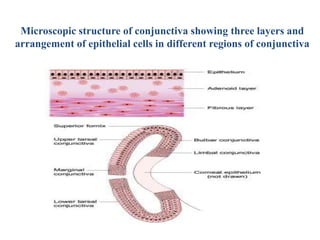
Microscopic structure of conjunctiva showing three layers and
arrangement of epithelial cells in different regions of conjunctiva
MARCH -2019 170101 /Chapter-3 /S7
EDUCATION FOR PEACE & PROGRESS
COPY RIGHTS RESERVED
Santhiram College of Pharmacy, Nandyal
• Bulbar conjunctiva
It is thin, transparent and
lies loose over the
underlying structures and
thus can be moved easily.
• Conjunctival fornix
It is a continuous circular cul-
de-sac which joins the bulbar
conjunctiva with the palpebral
conjunctiva.
Conjunctivitis
Conjunctivitis
DEFINITION
• Inflammation of the conjunctiva (conjunctivitis) is classically
defined as conjunctival hyperaemia associated with a discharge
which may be watery, mucoid, mucopurulent or purulent.
TYPES
• Based on aetiology and clinical presentations conjunctivitis is
divided into various types.
Etiological classification
1. Infective conjunctivitis: bacterial, chlamydial, viral, fungal,
rickettsial, spirochaetal, protozoal, parasitic etc.
2. Allergic conjunctivitis.
3. Irritative conjunctivitis.
4. Keratoconjunctivitis associated with diseases of skin and mucous
membrane.
5. Traumatic conjunctivitis.
6. Keratoconjunctivitis of unknown etiology
MARCH -2019 170101 /Chapter-3 /S11
EDUCATION FOR PEACE & PROGRESS
COPY RIGHTS RESERVED
Santhiram College of Pharmacy, Nandyal
Depending upon clinical presentation, conjunctivitis
can be classified as follows:
1. Acute catarrhal or
mucopurulent conjunctivitis.
2. Acute purulent conjunctivitis
3. Serous conjunctivitis
4. Chronic simple conjunctivitis
5. Angular conjunctivitis
6. Membranous conjunctivitis
7. Pseudomembranous conjunctivitis
8. Papillary conjunctivitis
9. Follicular conjunctivitis
10. Ophthalmia neonatorum
11. Granulomatous conjunctivitis
12. Ulcerative conjunctivitis
13. Cicatrising conjunctivitis
MARCH -2019 170101 /Chapter-3 /S12
EDUCATION FOR PEACE & PROGRESS
COPY RIGHTS RESERVED
Santhiram College of Pharmacy, Nandyal
acute mucopurulent
conjunctivitis
acute purulent
conjunctivitis
acute pseudo membranous
conjunctivitis
acute membranous
conjunctivitis
angular conjunctivitis Folicular conjunctivitis Ophthalmia neonatorum vernal
keratoconjunctivitis
Papillary conjunctivitis
INFECTIVE CONJUNCTIVITIS
Inflammation of the conjunctiva caused by microorganisms is the
commonest variety.
• This is in spite of the fact that the conjunctiva has been provided
with natural protective mechanisms in the form of :
– Low temperature due to exposure to air,
– Physical protection by lids,
– Flushing action of tears,
– Antibacterial activity of lysozymes and
– Humoral protection by the tear immunoglobulins
BACTERIAL CONJUNCTIVITIS
• In developing countries bacterial conjunctivitis continues to be the
commonest type of conjunctivitis.
• It can occur as sporadic cases and as epidemics.
• Outbreaks of bacterial conjunctivitis epidemics are quite frequent
during monsoon season.
Etiology
A. Predisposing factors for bacterial conjunctivitis, especially
epidemic forms, are flies, poor hygienic conditions, hot dry
climate, poor sanitation and dirty habits.
• These factors help the infection to establish, as the disease is
highly contagious.
B. Causative organisms
• It may be caused by a wide range of organisms in the following
approximate order of frequency :
• Staphylococcus aureus is the most common cause of bacterial
conjunctivitis and blepharoconjunctivitis.
• Staphylococcus epidermidis is an innocuous flora of lid and
conjunctiva. It can also produce blepharoconjunctivitis.
• Streptococcus pneumoniae (pneumococcus) produces acute
conjunctivitis usually associated with petechial subconjunctival
haemorrhages. The disease has a self-limiting course of 9-10 days.
• Streptococcus pyogenes (haemolyticus) is virulent and usually
produces pseudomembranous conjunctivitis..
• Haemophilus influenzae (aegyptius, Koch- Weeks bacillus). It
classically causes epidemics of mucopurulent conjunctivitis, known
as ‘red-eye’ especially in semitropical countries
• Moraxella lacunate (Moraxella Axenfeld bacillus) is most
common cause of angular conjunctivitis and angular
blepharoconjunctivitis.
• Pseudomonas pyocyanea is a virulent organism. It readily invades
the cornea.
• Neisseria gonorrhoeae typically produces acute purulent
conjunctivitis in adults and ophthalmia neonatorum in new born. It
is capable of invading intact corneal epithelium.
• Neisseria meningitidis (meningococcus) may produce
mucopurulent conjunctivitis.
• Corynebacterium diphtheriae causes acute membranous
conjunctivitis. Such infections are rare now-a-days.
Mode of infection
Conjunctiva may get infected from three sources, viz, exogenous, local
surrounding structures and endogenous, by following modes :
1. Exogenous infections may spread:
I. Directly through close contact, as air-borne infections or as
water-borne infections
II. Through vector transmission (e.g., flies)
III. Through material transfer such as infected fingers of doctors,
nurses, common towels, handkerchiefs, and infected
tonometers.
2. Local spread may occur from neighboring structures such as
infected lacrimal sac, lids, and nasopharynx. In addition to these, a
change in the character of relatively innocuous organisms present in
the conjunctival sac itself may cause infections.
3. Endogenous infections may occur very rarely through blood e.g.,
gonococcal and meningococcal infections.
Pathology
• Pathological changes of bacterial conjunctivitis consist of :
1. Vascular response.
It is characterised by congestion and increased permeability of the
conjunctival vessels associated with proliferation of capillaries.
2. Cellular response
It is in the form of exudation of polymorphonuclear cells and other
inflammatory cells into the conjunctiva as well as in the conjunctival
sac.
3. Conjunctival tissue response
• Conjunctiva becomes edematous. The superficial epithelial cells
degenerate, become loose and even desquamate.
• There occurs proliferation of basal layers of conjunctival epithelium
and increase in the number of mucin secreting goblet cells.
4. Conjunctival discharge
It consists of tears, mucus, inflammatory cells, desquamated epithelial
cells, fibrin and bacteria.
• If the inflammation is very severe, diapedesis of red blood cells may
occur and discharge may become blood stained.
• Severity of pathological changes varies depending upon the
severity of inflammation and the causative organism.
• The changes are thus more marked in purulent conjunctivitis than
mucopurulent conjunctivitis.
CLINICAL TYPES OF BACTERIAL CONJUNCTIVITIS
Depending upon the causative bacteria and the severity of infection,
bacterial conjunctivitis may present in following clinical forms:
1. Acute catarrhal or mucopurulent conjunctivitis.
2. Acute purulent conjunctivitis
3. Acute membranous conjunctivitis
4. Acute pseudomembranous conjunctivitis
5. Chronic angular conjunctivitis
Acute catarrhal or mucopurulent conjunctivitis
• Acute mucopurulent conjunctivitis is the most common type of acute
bacterial conjunctivitis. It is characterised by marked conjunctival
hyperaemia and mucopurulent discharge from the eye.
Common causative bacteria
• Staphylococcus aureus,
• Koch-Weeks bacillus
• Pneumococcus
• Streptococcus. Mucopurulent conjunctivitis generally accompanies
exanthemata such as measles and scarlet fever.
Clinical picture
Symptoms
• Discomfort and foreign body sensation due to engorgement of
vessels.
• Mild photophobia, i.e., difficulty to tolerate light.
• Mucopurulent discharge from the eyes.
• Sticking together of lid margins with discharge during sleep.
• Slight blurring of vision due to mucous flakes in front of cornea.
• Sometimes patient may complain of coloured halos due to prismatic
effect of mucus present on cornea.
Signs
• Conjunctival congestion, which is more marked in palpebral
conjunctiva, fornices and peripheral part of bulbar conjunctiva,
giving the appearance of ‘fiery red eye’. The congestion is
typically less marked in circumcorneal zone.
• Petechial haemorrhages are seen when the causative organism is
pneumococcus.
• Chemosis i.e., swelling of conjunctiva.
• Flakes of mucopus are seen in the fornices, canthi and lid
margins.
• Cilia are usually matted together with yellow crusts.
Clinical course.
• Mucopurulent conjunctivitis reaches its height in three to four
days. If untreated, in mild cases the infection may be overcome
and the condition is cured in 10-15 days; or it may pass to less
intense form, the ‘chronic catarrhal conjunctivitis’.
• Complications.
Occasionally the disease may be complicated by marginal corneal
ulcer, superficial keratitis, blepharitis or dacryocystitis.
• Differential diagnosis
1. From other causes of acute red eye .
2. From other types of conjunctivitis. It is made out from the
typical clinical picture of disease and is confirmed by
conjunctival cytology and bacteriological examination of
secretions and scrapings .
Treatment
1. Topical antibiotics
• To control the infection constitute the main treatment of acute
mucopurulent conjunctivitis.
• Ideally, the antibiotic should be selected after culture and sensitivity
tests but in practice, it is difficult.
• However, in routine, most of the patients respond well to broad
specturm antibiotics.
• Therefore, treatment may be started with chloramphenicol (1%)
gentamycin (0.3%) or framycetin eye drops 3-4 hourly in day and
ointment used at night will not only provide antibiotic cover but also
help to reduce the early morning stickiness.
• If the patient does not respond to these antibiotics, then the newer
antibiotic drops such as ciprofloxacin (0.3%), ofloxacin (0.3%) or
gatifloxacin (0.3%) may be used.
2. Irrigation of conjunctival sac with sterile warm saline once or twice
a day will help by removing the deleterious material. Frequent eyewash
is however contraindicated as it will wash away the lysozyme and other
protective proteins present in tears.
3. Dark goggles may be used to prevent photophobia.
4. No bandage should be applied in patients with mucopurulent
conjunctivitis. Exposure to air keeps the temperature of
conjunctival cul-de-sac low which inhibits the bacterial growth;
while after bandaging, conjunctival sac is converted into an
incubator, and thus infection flares to a severe degree within 24
hours. Further, bandaging of eye will also prevent the escape of
discharge.
5. No steroids should be applied, otherwise infection will flare up and
bacterial corneal ulcer may develop.
6. Anti-inflammatory and analgesic drugs (e.g. ibuprofen and
paracetamol) may be given orally for 2-3 days to provide symptomatic
relief from mild pain especially in sensitive patients.
ACUTE PURULENT CONJUNCTIVITIS
Acute purulent conjunctivitis also known as hyperacute conjunctivitis is
characterised by a violent inflammatory response. It occurs in two
forms:
• Adult purulent conjunctivitis
• Ophthalmia neonatorum in newborn
ACUTE PURULENT CONJUNCTIVITIS OF
ADULTS
Etiology
The disease affects adults, predominantly males.
• Commonest causative organism is Gonococcus; but rarely it may be
Staphylococcus aureus or Pneumococcus.
• Gonococcal infection directly spreads from genitals to eye.
Presently incidence of gonococcal conjunctivitis has markedly
decreased
Clinical picture
It can be divided into three stages:
1. Stage of infiltraton.
It lasts for 4-5 days and is characterised by:
• Considerably painful and tender eyeball.
• Bright red velvety chemosed conjunctiva.
• Lids are tense and swollen.
• Discharge is watery or sanguinous.
• Pre-auricular lymph nodes are enlarged
2. Stage of blenorrhoea.
It starts at about fifth day, lasts for several days and is characterised by:
• Frankly purulent, copious, thick discharge trickling down the cheeks.
• Other symptoms are increased but tension in the lids is decreased.
3. Stage of slow healing.
• During this stage, pain is decreased and swelling of the lids subsides.
• Conjunctiva remains red, thickened and velvety.
• Discharge diminishes slowly and in the end resolution is complete.
Acute purulent conjunctivitis
Treatment
1. Systemic therapy is far more critical than the topical therapy for
the infections caused by N. gonorrhoeae and N. meningitidis.
Because of the resistant strains penicillin and tetracyline are no longer
adequate as first-line treatment.
• Any of the following regimes can be adopted :
• Norfloxacin 1.2 gm orally qid for 5 days
• Cefoxitim 1.0 gm or cefotaxime 500 mg IV qid or ceftriaxone 1.0
gm IM qid, all for 5 days; or Spectinomycin 2.0 gm IM for 3 days.
• All of the above regimes should then be followed by a one week
course of either doxycycline 100 mg bid or erythromycin 250-
500 mg orally qid.
2. Topical antibiotic therapy presently recommended includes
ofloxacin, ciprofloxacin or tobramycin eye drops or bacitracin or
erythromycin eye ointment every 2 hours for the first 2-3 days and
then 5 times daily for 7 days. Because of the resistant strains,
intensive therapy with penicillin drops is not reliable.
3. Irrigation of the eyes frequently with sterile saline is very
therapeutic in washing away infected debris
4. Other general measures are similar to acute mucopurulent
conjunctivitis.
5. Topical atropine 1 per cent eye drops should be instilled once or
twice a day if cornea is involved.
6.Patient and the sexual partner should be referred for evaluation
of other sexually transmitted disease.
ACUTE MEMBRANOUS CONJUNCTIVITIS
• It is an acute inflammation of the conjunctiva, characterized by
formation of a true membrane on the conjunctiva.
• Now-a-days it is of very-very rare occurrence, because of markedly
decreased incidence of diphtheria.
• It is because of the fact that immunization against diphtheria is very
effective.
Etiology
• The disease is typically caused by Corynebacterium diphtheriae and
occasionally by virulent type of Streptococcus haemolyticus.
Pathology
• Corynebacterium diphtheriae produces a violent inflammation of
the conjunctiva, associated with deposition of fibrinous exudate on
the surface as well as in the substance of the conjunctiva resulting
in formation of a membrane.
• Usually membrane is formed in the palpebral conjunctiva.
• There is associated coagulative necrosis, resulting in sloughing of
membrane.
• Ultimately healing takes place by granulation tissue.
Clinical features
• The disease usually affects children between 2-8 years of age who are
not immunised against diphtheria.
• The disease may have a mild or very severe course. The child is toxic
and febrile.
• The clinical picture of the disease can be divided into three stages:
1. Stage of infiltration is characterised by:
Scanty conjunctival discharge and severe pain in the eye.
• Lids are swollen and hard.
• Conjunctiva is red, swollen and covered with a thick grey-yellow
membrane.
• The membrane is tough and firmly adherent to the conjunctiva,
which on removing bleeds and leaves behind a raw area.
• Pre-auricular lymph nodes are enlarged.
2. Stage of suppuration.
In this stage, pain decreases and the lids become soft.
The membrane is sloughed off leaving a raw surface. There is copious
outpouring of purulent discharge.
3. Stage of cicatrisation.
• In this stage, the raw surface covered with granulation tissue is
epithelised. Healing occurs by cicatrisation.
Complications
1. Corneal ulceration is a frequent complication in acute stage. The
bacteria may even involve the intact corneal epithelium.
2. Delayed complications due to cicatrization it may lead to
conjunctival xerosis.
Diagnosis
• Diagnosis is made from typical clinica features and confirmed by
bacteriological examination.
Treatment
A. Topical therapy
1. Penicillin eye drops (1:10000 units per ml) should be instilled every
half hourly.
2. Antidiphtheric serum (ADS) should be instilled every one hour.
3. Atropine sulfate 1 percent ointment should be added if cornea is
ulcerated.
4. Broad spectrum antibiotic ointment should be applied at bed time.
B. Systemic therapy
1. Crystalline penicillin 5 lac units (1mg = 1667 units) should be
injected intramuscularly twice a day for 10 days.
2. Antidiphtheric serum (ADS) (50 thousand units) should be
given intramuscularly stat.
Prophylaxis
1. Isolation of patient will prevent family members from being
infected.
2. Proper immunization against diphtheria is very effective and
provides protection to the community.
PSEUDOMEMBRANOUS CONJUNCTIVITIS
• It is a type of acute conjunctivitis, characterised by formation of a
pseudomembrane (which can be easily peeled off leaving behind
intact conjunctival epithelium) on the conjunctiva.
Etiology
It may be caused by following varied factors:
1. Bacterial infection. Common causative organisms are
Corynebacterium diphtheriae of low virulence, staphylococci,
streptococci, H. influenzae and N. gonorrhoea.
2. Viral infections such as herpes simplex and adenoviral epidemic
keratoconjunctivitis may also be sometimes associated with
pseudomembrane formation.
3. Chemical irritants such as acids, ammonia, lime, silver nitrate and
copper sulfate are also known to cause formation of such membrane.
Pathology
• The above agents produce inflammation of conjunctiva associated
with pouring of fibrinous exudate on its surface which coagulates
and leads to formation of a pseudomembrane.
Clinical features
• Pseudomembranous conjunctivitis is characterized by:
Acute mucopurulent conjunctivitis, like features associated with
Pseudomembrane formation which is thin yellowish-white membrane
seen in the fornices and on the palpebral conjunctiva.
• Pseudomembrane can be peeled off easily and does not bleed.
Treatment
• It is similar to that of mucopurulent conjunctivitis.
ANGULAR CONJUNCTIVITIS
• It is a type of chronic conjunctivitis characterised by mild grade
inflammation confined to the conjunctiva and lid margins near the
angles (hence the name).
Etiology
Causative organisms.
• Moraxella Axenfeld is the commones causative organism.
• Rarely, staphylococci may also cause angular conjunctivitis.
Pathology
• The causative organism, i.e., MA bacillus produces a proteolytic
enzyme which acts by macerating the epithelium.
• This proteolytic enzyme collects at the angles by the action of tears
and thus macerates the epithelium of the conjunctiva, lid margin and
the skin the surrounding angles of eye.
• The maceration is followed by vascular and cellular responses in the
form of mild grade chronic inflammation.
Clinical picture
Symptoms
• Irritation and feeling of discomfort in the eyes.
• History of collection of dirty-white foamy discharge at the angles.
• Redness in the angles of eyes.
Signs :
• Hyperaemia of bulbar conjunctiv.
• Hyperaemia of lid margins near the angles.
• Excoriation of the skin around the angles.
• Presence of foamy mucopurulent discharge at the angles.
Complications
• Includes blepharitis and shallow marginal catarrhal corneal
ulceration.
Treatment
A. Prophylaxis includes treatment of associated nasal infection and good
personal hygiene.
B. Curative treatment consists of :
1. Oxytetracycline (1%) eye ointment 2-3 times a day for 9-14 days will
eradicate the infection.
2. Zinc lotion instilled in day time and zinc oxide ointment at bed time
inhibits the proteolytic ferment and thus helps in reducing the
maceration.
Chlamydial conjunctivitis
• This is a sexually transmitted infection and is most prevalent in
sexually active adolescents and young adults.
• Direct or indirect contact with genital secretions is the usual route of
infections but shared eye cosmetics can also be involved.
• It is caused by Chlamydia trachomatis.
• Neonatal chlamydial conjunctivitis is a notifiable disease and should
be suspected in newborns with a red eye.
• Mothers should be asked about sexually transmitted infections.
• Trachoma caused by the same organism is found mainly in the
tropics and the Middle East and is a very common cause of blindness
in the world.
Clinical features
• The onset of symptoms is slow, and patients may complain of mild
discomfort for weeks.
• In these cases the red eye is associated with a scanty mucopurulent
discharge and a palpable preauricular lymph node. In chronic cases it
is not unusual to see superior corneal vascularization.
• In neonates the onset of the red eye is typically around 2 weeks after
birth, whereas gonococcal conjunctivitis occurs within days of birth.
• Conjunctival swabs should be taken prior to commencement of
treatment.
Treatment
• Topical erythromycin twice daily is commenced and patients referred
to the genitourinary physician.
• Neonates should be started on topical erythromycin and referred to
the paediatrician as there may be associated otitis media or
pneumonitis.
VIRAL CONJUNCTIVITIS
• Most of the viral infections tend to affect the epithelium, both of
the conjunctiva and cornea so, the typical viral lesion is a
'keratoconjunctivitis'.
• In some viral infections, conjunctival involvement is more
prominent (e.g., pharyngo-conjunctival fever), while in others
cornea is more involved (e.g., herpes simplex).
Viral infections of conjunctiva include:
• Adenovirus conjunctivitis
• Herpes simplex keratoconjunctivitis
• Herpes zoster conjunctivitis
• Pox virus conjunctivitis
• Myxovirus conjunctivitis
• Paramyxovirus conjunctivitis
• ARBOR virus conjunctivitis
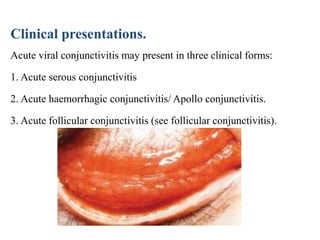
Clinical presentations.
Acute viral conjunctivitis may present in three clinical forms:
1. Acute serous conjunctivitis
2. Acute haemorrhagic conjunctivitis/ Apollo conjunctivitis.
3. Acute follicular conjunctivitis (see follicular conjunctivitis).
Adenoviral conjunctivitis
• This is highly contagious and can cause epidemics in communities.
• Transmission is through direct or indirect contact with infected
individuals.
Clinical features
• The onset of symptoms may be preceded by a cold or flu-like
symptoms.
• The eye becomes inflamed and this is commonly associated with
chemosis, lid oedema and a palpable preauricular lymph node.
• Some patients may develop a membrane on the tarsal conjunctiva and
haemorrhage on the bulbar conjunctiva.
• Viral conjunctivitis can cause deterioration in visual acuity owing to
corneal involvement (focal areas of inflammation).
• In 50% of the patients the conjunctivitis is unilateral.
Treatment
• The condition is largely self-limiting in the majority of cases.
• Lubricants together with a cold compress can be soothing for patients.
• Strict hygiene and keeping towels separate from the rest of the
household goes a long way towards reducing the spread of the
infection.
• Clinicians also need to ensure good hygiene practice to reduce cross-
infection and infecting themselves.
• In patients with corneal involvement or intense conjunctival
inflammation, topical steroids are indicated.
Herpes simplex conjunctivitis
• Primary ocular herpes simplex conjunctivitis is typically
unilateral.
• It usually causes a palpable preauricular lymph node and
cutaneous vesicles develop on the eyelids and the skin around the
eyes in the majority of patients.
• Over 50% of these patients may develop a dendritic corneal ulcer.
• The organism responsible for this condition is the herpes simplex
virus (HSV), which is usually HSV-1 but HSV-2 can give rise to
ocular infection.
Treatment
• Primary ocular HSV infection is a self-limiting condition but most
clinicians choose to treat it with topical aciclovir in order to limit the
risk of corneal epithelial involvement.
Others
• Treatment is usually supportive.
• Usually it is self-limiting and does not need any treatment.
• But to avoid secondary bacterial infection, broad spectrum antibiotic
eye drops may be used three times a day for about 7 days.
References
• A.k khurana Comprehensive OPHTHALMOLOGY, edition 4,
pgno:54-80
• Kumar and clark’s clinical medicine, 7 th edition, pgno 1088-1089.

Conjunctivitis

  • 1.
    DOCTOR OF PHARMACY IIYEAR CONJUCTIVITIS 170101 CHAPTER-6 Opthomology Dr. V. Chanukya (Pharm D)
  • 2.
    • Definition • Types •Clinical features • Treatment Student Learning Outcomes Upon completion of the chapter, the student will be able to:
  • 3.
    • The conjunctivais a translucent mucous membrane which lines the posterior surface of the eyelids and anterior aspect of eyeball. • The name conjunctiva (conjoin: to join) has been given to this mucous membrane owing to the fact that it joins the eyeball to the lids. • It stretches from the lid margin to the limbus, and encloses a complex space called conjunctival sac which is open in front at the palpebral fissure. ANATOMY
  • 4.
    • Conjunctiva canbe divided into three parts – Palpebral conjunctiva – Bulbar conjunctiva – Conjunctival fornix
  • 5.
    • PALPEBRAL CONJUNCTIVA Itlines the lids and can be subdivided into marginal, tarsal and orbital conjunctiva. 1. Marginal conjunctiva extends from the lid margin to about 2 mm on the back of lid up to a shallow groove, the sulcus subtarsalis. It is actually a transitional zone between skin and the conjunctiva proper. 2. Tarsal conjunctiva is thin, transparent and highly vascular. It is firmly adherent to the whole tarsal plate in the upper lid. In the lower lid, it is adherent only to half width of the tarsus. 3. Orbital conjunctiva lies loose between the tarsal plate and fornix.
  • 6.
    Microscopic structure ofconjunctiva showing three layers and arrangement of epithelial cells in different regions of conjunctiva
  • 7.
    MARCH -2019 170101/Chapter-3 /S7 EDUCATION FOR PEACE & PROGRESS COPY RIGHTS RESERVED Santhiram College of Pharmacy, Nandyal • Bulbar conjunctiva It is thin, transparent and lies loose over the underlying structures and thus can be moved easily. • Conjunctival fornix It is a continuous circular cul- de-sac which joins the bulbar conjunctiva with the palpebral conjunctiva.
  • 8.
  • 9.
    Conjunctivitis DEFINITION • Inflammation ofthe conjunctiva (conjunctivitis) is classically defined as conjunctival hyperaemia associated with a discharge which may be watery, mucoid, mucopurulent or purulent. TYPES • Based on aetiology and clinical presentations conjunctivitis is divided into various types.
  • 10.
    Etiological classification 1. Infectiveconjunctivitis: bacterial, chlamydial, viral, fungal, rickettsial, spirochaetal, protozoal, parasitic etc. 2. Allergic conjunctivitis. 3. Irritative conjunctivitis. 4. Keratoconjunctivitis associated with diseases of skin and mucous membrane. 5. Traumatic conjunctivitis. 6. Keratoconjunctivitis of unknown etiology
  • 11.
    MARCH -2019 170101/Chapter-3 /S11 EDUCATION FOR PEACE & PROGRESS COPY RIGHTS RESERVED Santhiram College of Pharmacy, Nandyal Depending upon clinical presentation, conjunctivitis can be classified as follows: 1. Acute catarrhal or mucopurulent conjunctivitis. 2. Acute purulent conjunctivitis 3. Serous conjunctivitis 4. Chronic simple conjunctivitis 5. Angular conjunctivitis 6. Membranous conjunctivitis 7. Pseudomembranous conjunctivitis 8. Papillary conjunctivitis 9. Follicular conjunctivitis 10. Ophthalmia neonatorum 11. Granulomatous conjunctivitis 12. Ulcerative conjunctivitis 13. Cicatrising conjunctivitis
  • 12.
    MARCH -2019 170101/Chapter-3 /S12 EDUCATION FOR PEACE & PROGRESS COPY RIGHTS RESERVED Santhiram College of Pharmacy, Nandyal acute mucopurulent conjunctivitis acute purulent conjunctivitis acute pseudo membranous conjunctivitis acute membranous conjunctivitis angular conjunctivitis Folicular conjunctivitis Ophthalmia neonatorum vernal keratoconjunctivitis Papillary conjunctivitis
  • 13.
    INFECTIVE CONJUNCTIVITIS Inflammation ofthe conjunctiva caused by microorganisms is the commonest variety. • This is in spite of the fact that the conjunctiva has been provided with natural protective mechanisms in the form of : – Low temperature due to exposure to air, – Physical protection by lids, – Flushing action of tears, – Antibacterial activity of lysozymes and – Humoral protection by the tear immunoglobulins
  • 14.
    BACTERIAL CONJUNCTIVITIS • Indeveloping countries bacterial conjunctivitis continues to be the commonest type of conjunctivitis. • It can occur as sporadic cases and as epidemics. • Outbreaks of bacterial conjunctivitis epidemics are quite frequent during monsoon season.
  • 15.
    Etiology A. Predisposing factorsfor bacterial conjunctivitis, especially epidemic forms, are flies, poor hygienic conditions, hot dry climate, poor sanitation and dirty habits. • These factors help the infection to establish, as the disease is highly contagious. B. Causative organisms • It may be caused by a wide range of organisms in the following approximate order of frequency :
  • 16.
    • Staphylococcus aureusis the most common cause of bacterial conjunctivitis and blepharoconjunctivitis. • Staphylococcus epidermidis is an innocuous flora of lid and conjunctiva. It can also produce blepharoconjunctivitis. • Streptococcus pneumoniae (pneumococcus) produces acute conjunctivitis usually associated with petechial subconjunctival haemorrhages. The disease has a self-limiting course of 9-10 days. • Streptococcus pyogenes (haemolyticus) is virulent and usually produces pseudomembranous conjunctivitis..
  • 17.
    • Haemophilus influenzae(aegyptius, Koch- Weeks bacillus). It classically causes epidemics of mucopurulent conjunctivitis, known as ‘red-eye’ especially in semitropical countries • Moraxella lacunate (Moraxella Axenfeld bacillus) is most common cause of angular conjunctivitis and angular blepharoconjunctivitis. • Pseudomonas pyocyanea is a virulent organism. It readily invades the cornea. • Neisseria gonorrhoeae typically produces acute purulent conjunctivitis in adults and ophthalmia neonatorum in new born. It is capable of invading intact corneal epithelium.
  • 18.
    • Neisseria meningitidis(meningococcus) may produce mucopurulent conjunctivitis. • Corynebacterium diphtheriae causes acute membranous conjunctivitis. Such infections are rare now-a-days.
  • 19.
    Mode of infection Conjunctivamay get infected from three sources, viz, exogenous, local surrounding structures and endogenous, by following modes : 1. Exogenous infections may spread: I. Directly through close contact, as air-borne infections or as water-borne infections II. Through vector transmission (e.g., flies) III. Through material transfer such as infected fingers of doctors, nurses, common towels, handkerchiefs, and infected tonometers.
  • 20.
    2. Local spreadmay occur from neighboring structures such as infected lacrimal sac, lids, and nasopharynx. In addition to these, a change in the character of relatively innocuous organisms present in the conjunctival sac itself may cause infections. 3. Endogenous infections may occur very rarely through blood e.g., gonococcal and meningococcal infections.
  • 21.
    Pathology • Pathological changesof bacterial conjunctivitis consist of : 1. Vascular response. It is characterised by congestion and increased permeability of the conjunctival vessels associated with proliferation of capillaries. 2. Cellular response It is in the form of exudation of polymorphonuclear cells and other inflammatory cells into the conjunctiva as well as in the conjunctival sac.
  • 22.
    3. Conjunctival tissueresponse • Conjunctiva becomes edematous. The superficial epithelial cells degenerate, become loose and even desquamate. • There occurs proliferation of basal layers of conjunctival epithelium and increase in the number of mucin secreting goblet cells. 4. Conjunctival discharge It consists of tears, mucus, inflammatory cells, desquamated epithelial cells, fibrin and bacteria. • If the inflammation is very severe, diapedesis of red blood cells may occur and discharge may become blood stained.
  • 23.
    • Severity ofpathological changes varies depending upon the severity of inflammation and the causative organism. • The changes are thus more marked in purulent conjunctivitis than mucopurulent conjunctivitis.
  • 24.
    CLINICAL TYPES OFBACTERIAL CONJUNCTIVITIS Depending upon the causative bacteria and the severity of infection, bacterial conjunctivitis may present in following clinical forms: 1. Acute catarrhal or mucopurulent conjunctivitis. 2. Acute purulent conjunctivitis 3. Acute membranous conjunctivitis 4. Acute pseudomembranous conjunctivitis 5. Chronic angular conjunctivitis
  • 25.
    Acute catarrhal ormucopurulent conjunctivitis • Acute mucopurulent conjunctivitis is the most common type of acute bacterial conjunctivitis. It is characterised by marked conjunctival hyperaemia and mucopurulent discharge from the eye. Common causative bacteria • Staphylococcus aureus, • Koch-Weeks bacillus • Pneumococcus • Streptococcus. Mucopurulent conjunctivitis generally accompanies exanthemata such as measles and scarlet fever.
  • 26.
    Clinical picture Symptoms • Discomfortand foreign body sensation due to engorgement of vessels. • Mild photophobia, i.e., difficulty to tolerate light. • Mucopurulent discharge from the eyes. • Sticking together of lid margins with discharge during sleep. • Slight blurring of vision due to mucous flakes in front of cornea. • Sometimes patient may complain of coloured halos due to prismatic effect of mucus present on cornea.
  • 27.
    Signs • Conjunctival congestion,which is more marked in palpebral conjunctiva, fornices and peripheral part of bulbar conjunctiva, giving the appearance of ‘fiery red eye’. The congestion is typically less marked in circumcorneal zone. • Petechial haemorrhages are seen when the causative organism is pneumococcus. • Chemosis i.e., swelling of conjunctiva. • Flakes of mucopus are seen in the fornices, canthi and lid margins.
  • 28.
    • Cilia areusually matted together with yellow crusts. Clinical course. • Mucopurulent conjunctivitis reaches its height in three to four days. If untreated, in mild cases the infection may be overcome and the condition is cured in 10-15 days; or it may pass to less intense form, the ‘chronic catarrhal conjunctivitis’.
  • 29.
    • Complications. Occasionally thedisease may be complicated by marginal corneal ulcer, superficial keratitis, blepharitis or dacryocystitis. • Differential diagnosis 1. From other causes of acute red eye . 2. From other types of conjunctivitis. It is made out from the typical clinical picture of disease and is confirmed by conjunctival cytology and bacteriological examination of secretions and scrapings .
  • 30.
    Treatment 1. Topical antibiotics •To control the infection constitute the main treatment of acute mucopurulent conjunctivitis. • Ideally, the antibiotic should be selected after culture and sensitivity tests but in practice, it is difficult. • However, in routine, most of the patients respond well to broad specturm antibiotics.
  • 31.
    • Therefore, treatmentmay be started with chloramphenicol (1%) gentamycin (0.3%) or framycetin eye drops 3-4 hourly in day and ointment used at night will not only provide antibiotic cover but also help to reduce the early morning stickiness. • If the patient does not respond to these antibiotics, then the newer antibiotic drops such as ciprofloxacin (0.3%), ofloxacin (0.3%) or gatifloxacin (0.3%) may be used. 2. Irrigation of conjunctival sac with sterile warm saline once or twice a day will help by removing the deleterious material. Frequent eyewash is however contraindicated as it will wash away the lysozyme and other protective proteins present in tears.
  • 32.
    3. Dark gogglesmay be used to prevent photophobia. 4. No bandage should be applied in patients with mucopurulent conjunctivitis. Exposure to air keeps the temperature of conjunctival cul-de-sac low which inhibits the bacterial growth; while after bandaging, conjunctival sac is converted into an incubator, and thus infection flares to a severe degree within 24 hours. Further, bandaging of eye will also prevent the escape of discharge.
  • 33.
    5. No steroidsshould be applied, otherwise infection will flare up and bacterial corneal ulcer may develop. 6. Anti-inflammatory and analgesic drugs (e.g. ibuprofen and paracetamol) may be given orally for 2-3 days to provide symptomatic relief from mild pain especially in sensitive patients.
  • 34.
    ACUTE PURULENT CONJUNCTIVITIS Acutepurulent conjunctivitis also known as hyperacute conjunctivitis is characterised by a violent inflammatory response. It occurs in two forms: • Adult purulent conjunctivitis • Ophthalmia neonatorum in newborn
  • 35.
    ACUTE PURULENT CONJUNCTIVITISOF ADULTS Etiology The disease affects adults, predominantly males. • Commonest causative organism is Gonococcus; but rarely it may be Staphylococcus aureus or Pneumococcus. • Gonococcal infection directly spreads from genitals to eye. Presently incidence of gonococcal conjunctivitis has markedly decreased
  • 36.
    Clinical picture It canbe divided into three stages: 1. Stage of infiltraton. It lasts for 4-5 days and is characterised by: • Considerably painful and tender eyeball. • Bright red velvety chemosed conjunctiva. • Lids are tense and swollen. • Discharge is watery or sanguinous. • Pre-auricular lymph nodes are enlarged
  • 37.
    2. Stage ofblenorrhoea. It starts at about fifth day, lasts for several days and is characterised by: • Frankly purulent, copious, thick discharge trickling down the cheeks. • Other symptoms are increased but tension in the lids is decreased. 3. Stage of slow healing. • During this stage, pain is decreased and swelling of the lids subsides. • Conjunctiva remains red, thickened and velvety. • Discharge diminishes slowly and in the end resolution is complete.
  • 38.
  • 39.
    Treatment 1. Systemic therapyis far more critical than the topical therapy for the infections caused by N. gonorrhoeae and N. meningitidis. Because of the resistant strains penicillin and tetracyline are no longer adequate as first-line treatment. • Any of the following regimes can be adopted : • Norfloxacin 1.2 gm orally qid for 5 days • Cefoxitim 1.0 gm or cefotaxime 500 mg IV qid or ceftriaxone 1.0 gm IM qid, all for 5 days; or Spectinomycin 2.0 gm IM for 3 days.
  • 40.
    • All ofthe above regimes should then be followed by a one week course of either doxycycline 100 mg bid or erythromycin 250- 500 mg orally qid. 2. Topical antibiotic therapy presently recommended includes ofloxacin, ciprofloxacin or tobramycin eye drops or bacitracin or erythromycin eye ointment every 2 hours for the first 2-3 days and then 5 times daily for 7 days. Because of the resistant strains, intensive therapy with penicillin drops is not reliable. 3. Irrigation of the eyes frequently with sterile saline is very therapeutic in washing away infected debris
  • 41.
    4. Other generalmeasures are similar to acute mucopurulent conjunctivitis. 5. Topical atropine 1 per cent eye drops should be instilled once or twice a day if cornea is involved. 6.Patient and the sexual partner should be referred for evaluation of other sexually transmitted disease.
  • 42.
    ACUTE MEMBRANOUS CONJUNCTIVITIS •It is an acute inflammation of the conjunctiva, characterized by formation of a true membrane on the conjunctiva. • Now-a-days it is of very-very rare occurrence, because of markedly decreased incidence of diphtheria. • It is because of the fact that immunization against diphtheria is very effective. Etiology • The disease is typically caused by Corynebacterium diphtheriae and occasionally by virulent type of Streptococcus haemolyticus.
  • 43.
    Pathology • Corynebacterium diphtheriaeproduces a violent inflammation of the conjunctiva, associated with deposition of fibrinous exudate on the surface as well as in the substance of the conjunctiva resulting in formation of a membrane. • Usually membrane is formed in the palpebral conjunctiva. • There is associated coagulative necrosis, resulting in sloughing of membrane. • Ultimately healing takes place by granulation tissue.
  • 44.
    Clinical features • Thedisease usually affects children between 2-8 years of age who are not immunised against diphtheria. • The disease may have a mild or very severe course. The child is toxic and febrile. • The clinical picture of the disease can be divided into three stages: 1. Stage of infiltration is characterised by: Scanty conjunctival discharge and severe pain in the eye.
  • 45.
    • Lids areswollen and hard. • Conjunctiva is red, swollen and covered with a thick grey-yellow membrane. • The membrane is tough and firmly adherent to the conjunctiva, which on removing bleeds and leaves behind a raw area. • Pre-auricular lymph nodes are enlarged. 2. Stage of suppuration. In this stage, pain decreases and the lids become soft. The membrane is sloughed off leaving a raw surface. There is copious outpouring of purulent discharge.
  • 46.
    3. Stage ofcicatrisation. • In this stage, the raw surface covered with granulation tissue is epithelised. Healing occurs by cicatrisation.
  • 47.
    Complications 1. Corneal ulcerationis a frequent complication in acute stage. The bacteria may even involve the intact corneal epithelium. 2. Delayed complications due to cicatrization it may lead to conjunctival xerosis. Diagnosis • Diagnosis is made from typical clinica features and confirmed by bacteriological examination.
  • 48.
    Treatment A. Topical therapy 1.Penicillin eye drops (1:10000 units per ml) should be instilled every half hourly. 2. Antidiphtheric serum (ADS) should be instilled every one hour. 3. Atropine sulfate 1 percent ointment should be added if cornea is ulcerated. 4. Broad spectrum antibiotic ointment should be applied at bed time.
  • 49.
    B. Systemic therapy 1.Crystalline penicillin 5 lac units (1mg = 1667 units) should be injected intramuscularly twice a day for 10 days. 2. Antidiphtheric serum (ADS) (50 thousand units) should be given intramuscularly stat. Prophylaxis 1. Isolation of patient will prevent family members from being infected. 2. Proper immunization against diphtheria is very effective and provides protection to the community.
  • 50.
    PSEUDOMEMBRANOUS CONJUNCTIVITIS • Itis a type of acute conjunctivitis, characterised by formation of a pseudomembrane (which can be easily peeled off leaving behind intact conjunctival epithelium) on the conjunctiva. Etiology It may be caused by following varied factors: 1. Bacterial infection. Common causative organisms are Corynebacterium diphtheriae of low virulence, staphylococci, streptococci, H. influenzae and N. gonorrhoea.
  • 51.
    2. Viral infectionssuch as herpes simplex and adenoviral epidemic keratoconjunctivitis may also be sometimes associated with pseudomembrane formation. 3. Chemical irritants such as acids, ammonia, lime, silver nitrate and copper sulfate are also known to cause formation of such membrane. Pathology • The above agents produce inflammation of conjunctiva associated with pouring of fibrinous exudate on its surface which coagulates and leads to formation of a pseudomembrane.
  • 52.
    Clinical features • Pseudomembranousconjunctivitis is characterized by: Acute mucopurulent conjunctivitis, like features associated with Pseudomembrane formation which is thin yellowish-white membrane seen in the fornices and on the palpebral conjunctiva. • Pseudomembrane can be peeled off easily and does not bleed. Treatment • It is similar to that of mucopurulent conjunctivitis.
  • 53.
    ANGULAR CONJUNCTIVITIS • Itis a type of chronic conjunctivitis characterised by mild grade inflammation confined to the conjunctiva and lid margins near the angles (hence the name). Etiology Causative organisms. • Moraxella Axenfeld is the commones causative organism. • Rarely, staphylococci may also cause angular conjunctivitis.
  • 54.
    Pathology • The causativeorganism, i.e., MA bacillus produces a proteolytic enzyme which acts by macerating the epithelium. • This proteolytic enzyme collects at the angles by the action of tears and thus macerates the epithelium of the conjunctiva, lid margin and the skin the surrounding angles of eye. • The maceration is followed by vascular and cellular responses in the form of mild grade chronic inflammation.
  • 55.
    Clinical picture Symptoms • Irritationand feeling of discomfort in the eyes. • History of collection of dirty-white foamy discharge at the angles. • Redness in the angles of eyes. Signs : • Hyperaemia of bulbar conjunctiv. • Hyperaemia of lid margins near the angles. • Excoriation of the skin around the angles. • Presence of foamy mucopurulent discharge at the angles.
  • 56.
    Complications • Includes blepharitisand shallow marginal catarrhal corneal ulceration.
  • 57.
    Treatment A. Prophylaxis includestreatment of associated nasal infection and good personal hygiene. B. Curative treatment consists of : 1. Oxytetracycline (1%) eye ointment 2-3 times a day for 9-14 days will eradicate the infection. 2. Zinc lotion instilled in day time and zinc oxide ointment at bed time inhibits the proteolytic ferment and thus helps in reducing the maceration.
  • 58.
    Chlamydial conjunctivitis • Thisis a sexually transmitted infection and is most prevalent in sexually active adolescents and young adults. • Direct or indirect contact with genital secretions is the usual route of infections but shared eye cosmetics can also be involved. • It is caused by Chlamydia trachomatis. • Neonatal chlamydial conjunctivitis is a notifiable disease and should be suspected in newborns with a red eye.
  • 59.
    • Mothers shouldbe asked about sexually transmitted infections. • Trachoma caused by the same organism is found mainly in the tropics and the Middle East and is a very common cause of blindness in the world. Clinical features • The onset of symptoms is slow, and patients may complain of mild discomfort for weeks. • In these cases the red eye is associated with a scanty mucopurulent discharge and a palpable preauricular lymph node. In chronic cases it is not unusual to see superior corneal vascularization.
  • 60.
    • In neonatesthe onset of the red eye is typically around 2 weeks after birth, whereas gonococcal conjunctivitis occurs within days of birth. • Conjunctival swabs should be taken prior to commencement of treatment. Treatment • Topical erythromycin twice daily is commenced and patients referred to the genitourinary physician. • Neonates should be started on topical erythromycin and referred to the paediatrician as there may be associated otitis media or pneumonitis.
  • 61.
    VIRAL CONJUNCTIVITIS • Mostof the viral infections tend to affect the epithelium, both of the conjunctiva and cornea so, the typical viral lesion is a 'keratoconjunctivitis'. • In some viral infections, conjunctival involvement is more prominent (e.g., pharyngo-conjunctival fever), while in others cornea is more involved (e.g., herpes simplex).
  • 62.
    Viral infections ofconjunctiva include: • Adenovirus conjunctivitis • Herpes simplex keratoconjunctivitis • Herpes zoster conjunctivitis • Pox virus conjunctivitis • Myxovirus conjunctivitis • Paramyxovirus conjunctivitis • ARBOR virus conjunctivitis
  • 63.
    Clinical presentations. Acute viralconjunctivitis may present in three clinical forms: 1. Acute serous conjunctivitis 2. Acute haemorrhagic conjunctivitis/ Apollo conjunctivitis. 3. Acute follicular conjunctivitis (see follicular conjunctivitis).
  • 64.
    Adenoviral conjunctivitis • Thisis highly contagious and can cause epidemics in communities. • Transmission is through direct or indirect contact with infected individuals. Clinical features • The onset of symptoms may be preceded by a cold or flu-like symptoms. • The eye becomes inflamed and this is commonly associated with chemosis, lid oedema and a palpable preauricular lymph node.
  • 65.
    • Some patientsmay develop a membrane on the tarsal conjunctiva and haemorrhage on the bulbar conjunctiva. • Viral conjunctivitis can cause deterioration in visual acuity owing to corneal involvement (focal areas of inflammation). • In 50% of the patients the conjunctivitis is unilateral. Treatment • The condition is largely self-limiting in the majority of cases. • Lubricants together with a cold compress can be soothing for patients.
  • 66.
    • Strict hygieneand keeping towels separate from the rest of the household goes a long way towards reducing the spread of the infection. • Clinicians also need to ensure good hygiene practice to reduce cross- infection and infecting themselves. • In patients with corneal involvement or intense conjunctival inflammation, topical steroids are indicated.
  • 67.
    Herpes simplex conjunctivitis •Primary ocular herpes simplex conjunctivitis is typically unilateral. • It usually causes a palpable preauricular lymph node and cutaneous vesicles develop on the eyelids and the skin around the eyes in the majority of patients. • Over 50% of these patients may develop a dendritic corneal ulcer. • The organism responsible for this condition is the herpes simplex virus (HSV), which is usually HSV-1 but HSV-2 can give rise to ocular infection.
  • 68.
    Treatment • Primary ocularHSV infection is a self-limiting condition but most clinicians choose to treat it with topical aciclovir in order to limit the risk of corneal epithelial involvement. Others • Treatment is usually supportive. • Usually it is self-limiting and does not need any treatment. • But to avoid secondary bacterial infection, broad spectrum antibiotic eye drops may be used three times a day for about 7 days.
  • 69.
    References • A.k khuranaComprehensive OPHTHALMOLOGY, edition 4, pgno:54-80 • Kumar and clark’s clinical medicine, 7 th edition, pgno 1088-1089.