Enterprise-architecture and the service-oriented enterprise Tom Graves, Tetradian Consulting TOGAF Glasgow, April 2008 info@tetradian.com / www.tetradian.com
SOA and SOE Service-oriented architecture (SOA) SOA still viewed primarily in terms of IT common interfaces for heterogeneous systems The service-oriented enterprise (SOE) extends SOA metaphor to  all  aspects of the enterprise TOGAF and SOA IT-architecture underpins IT-service architecture Adapt TOGAF ADM for use with SOE extend IT-centric methodology to whole-of-enterprise
The service-oriented enterprise ‘ Service’ concept as unifying theme SOE analogy with UNIX in UNIX, every device is treated as a file In SOE,  everything  delivers a service use SOA for architecture of entire enterprise Products are ‘services’ too deliver capability for client ‘self-service’ vacuum-cleaner  -> self-service of ‘cleaned floors’ computer  -> self-service ‘access to applications’
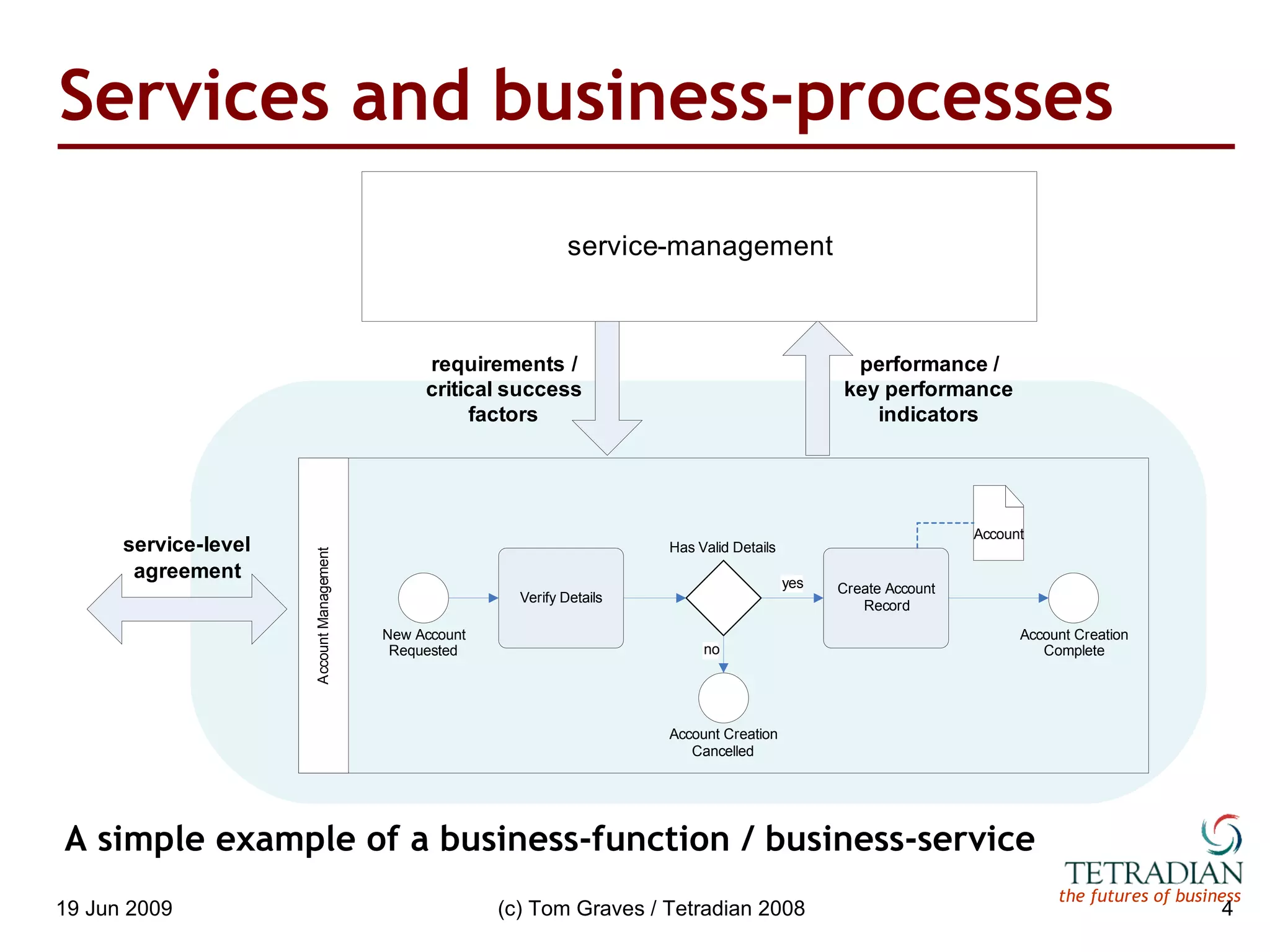
Services and business-processes A simple example of a business-function / business-service
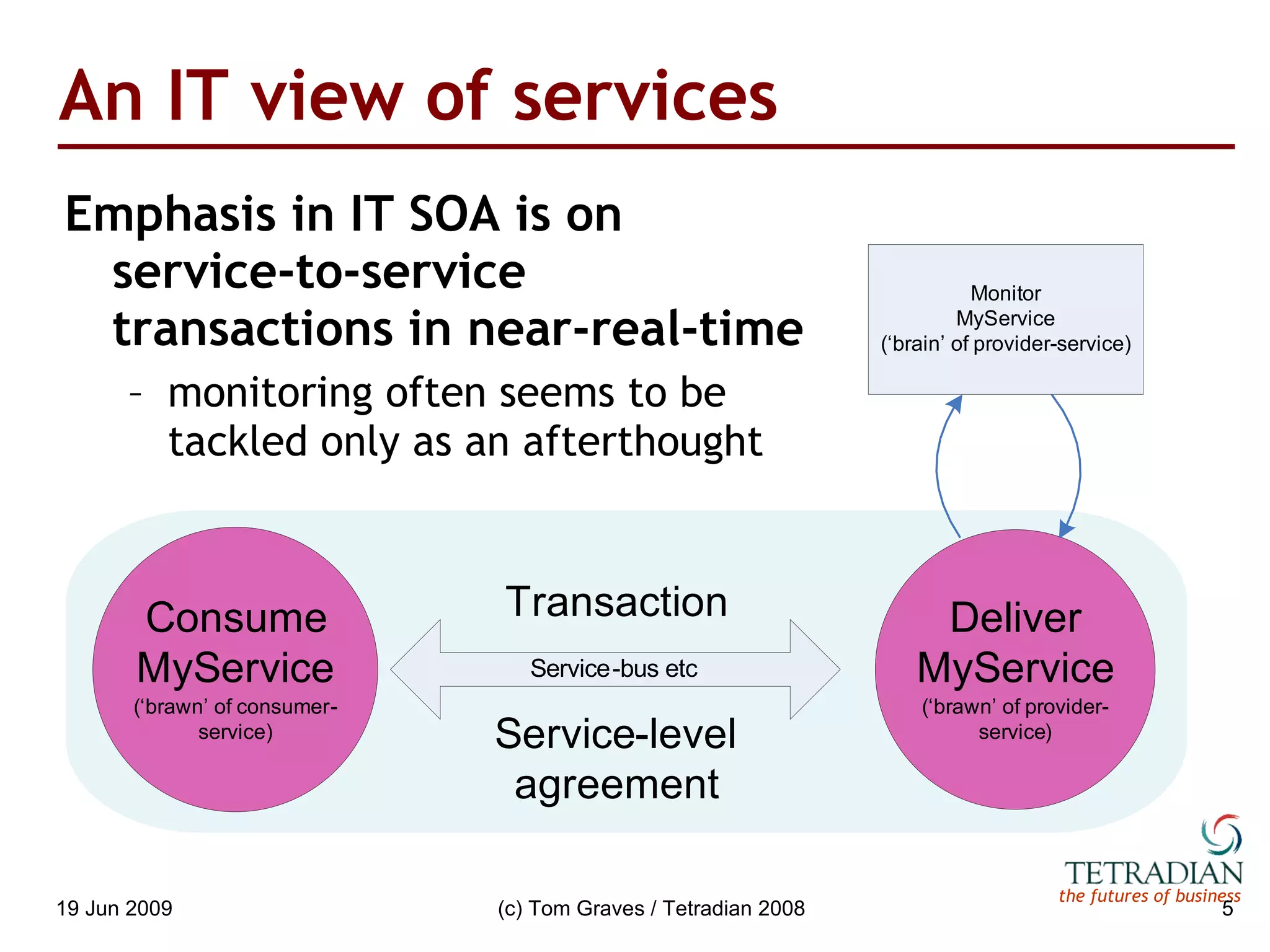
An IT view of services Emphasis in IT SOA is on service-to-service transactions in near-real-time monitoring often seems to be tackled only as an afterthought
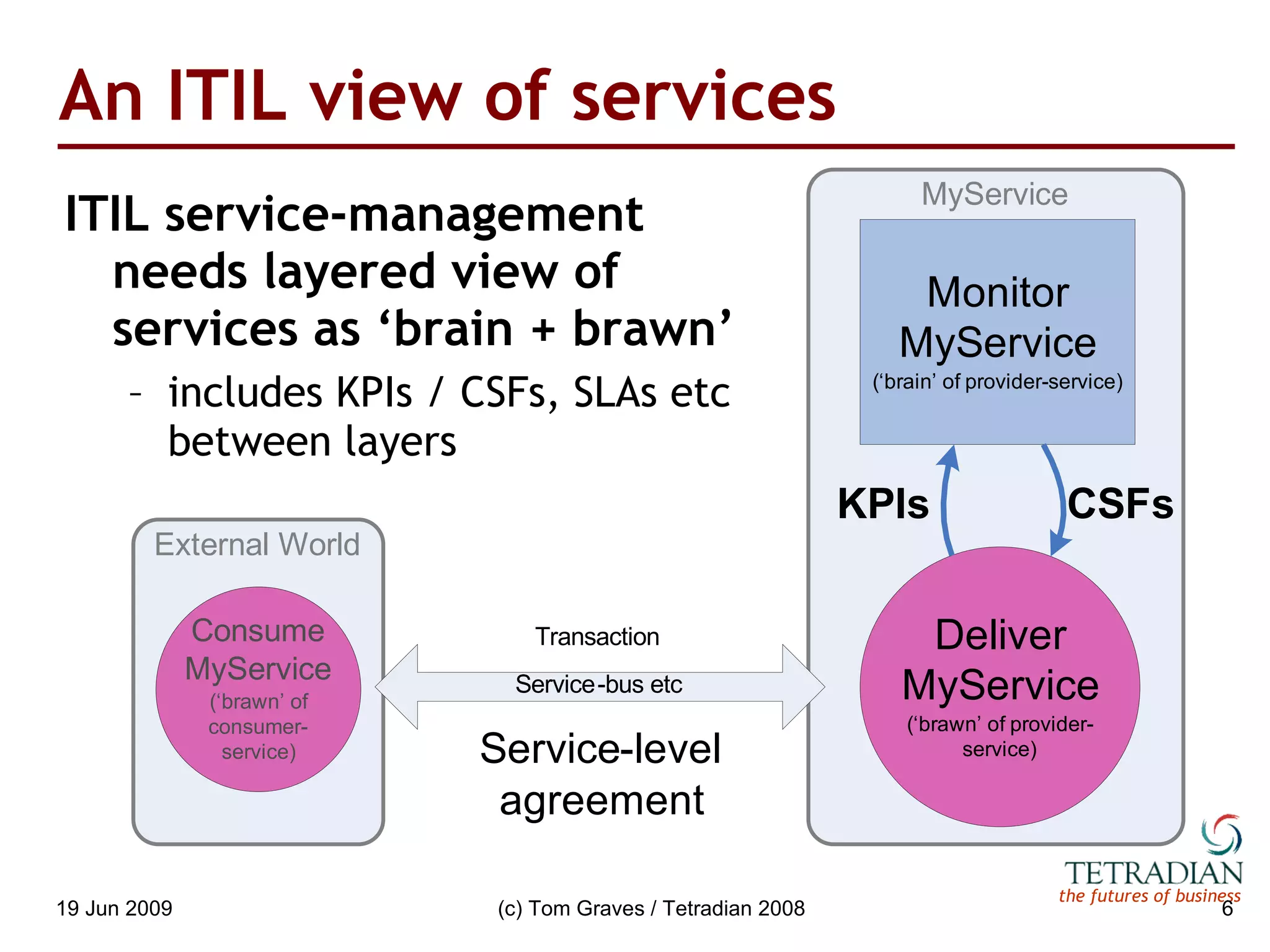
An ITIL view of services ITIL service-management needs layered view of services as ‘brain + brawn’ includes KPIs / CSFs, SLAs etc between layers
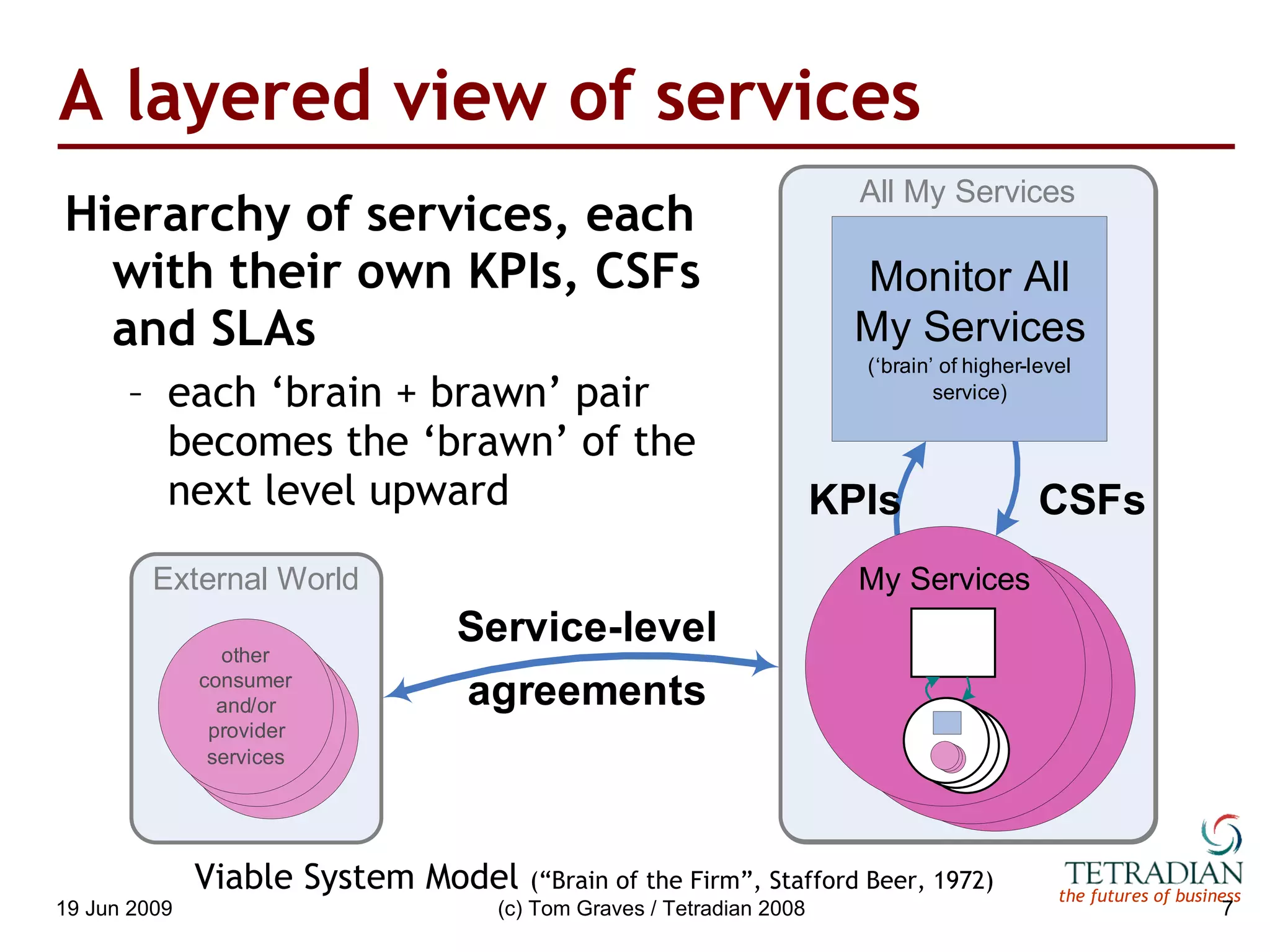
A layered view of services Hierarchy of services, each with their own KPIs, CSFs and SLAs each ‘brain + brawn’ pair becomes the ‘brawn’ of the next level upward Viable System Model  (“Brain of the Firm”, Stafford Beer, 1972)
Viable System Model (VSM) In the Viable System Model, every service contains a set of specialised sub-systems These interact with each other to act on and with the external world 1 – process  operations 2 – sub-process  coordination 3* –  sporadic audit / review 3 –  ‘inside / now’  [management] 4 –  ‘outside / future’  [+ strategy] 5 –  policy / purpose
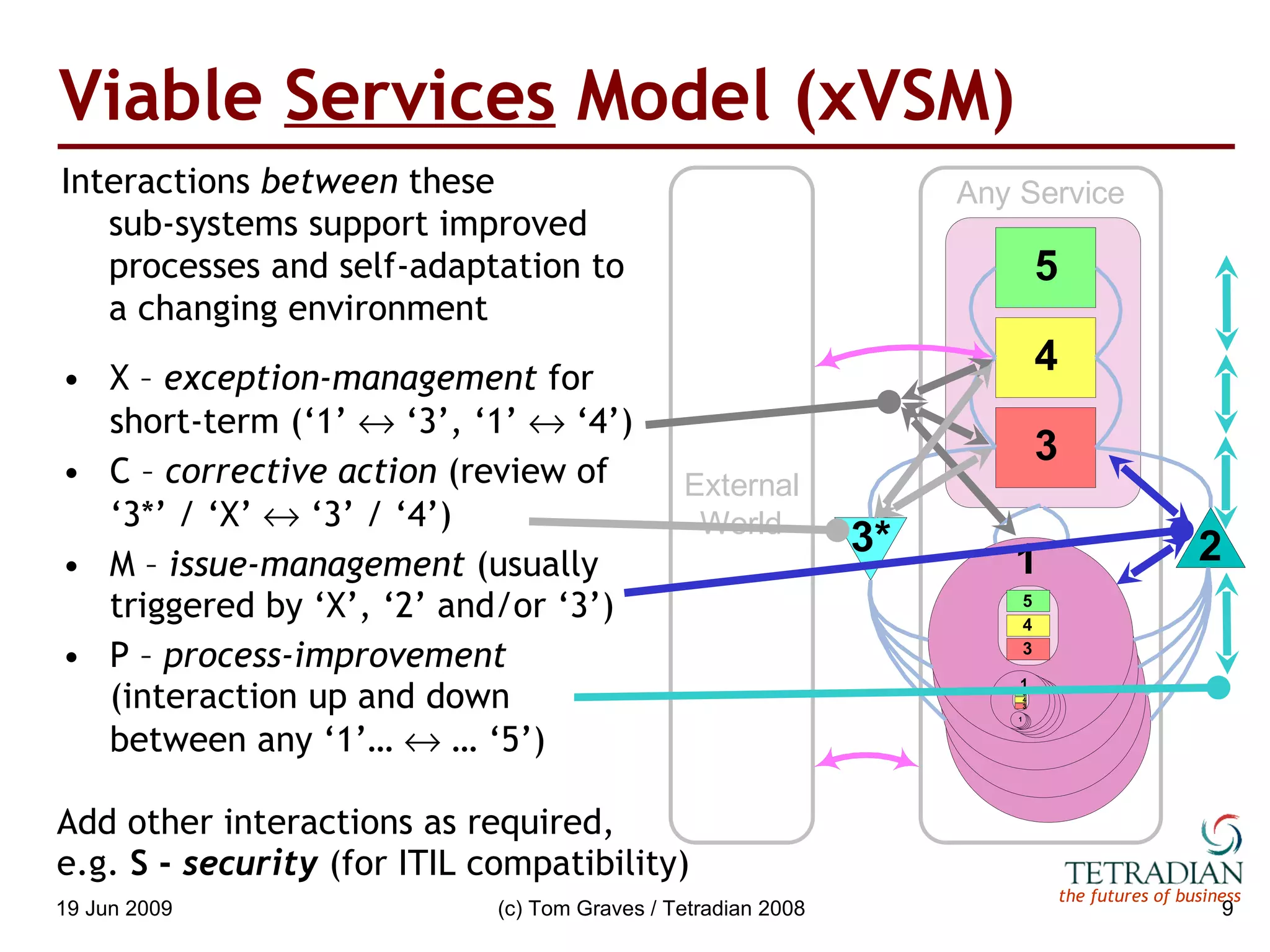
Viable  Services  Model (xVSM) Add other interactions as required, e.g.  S -  security  (for ITIL compatibility) X –  exception-management  for short-term (‘1’    ‘3’, ‘1’    ‘4’) C –  corrective action  (review of ‘3*’ / ‘X’    ‘3’ / ‘4’) M –  issue-management  (usually triggered by ‘X’, ‘2’ and/or ‘3’) P –  process-improvement  (interaction up and down between any ‘1’…    … ‘5’) Interactions  between  these  sub-systems support improved processes and self-adaptation to a changing environment
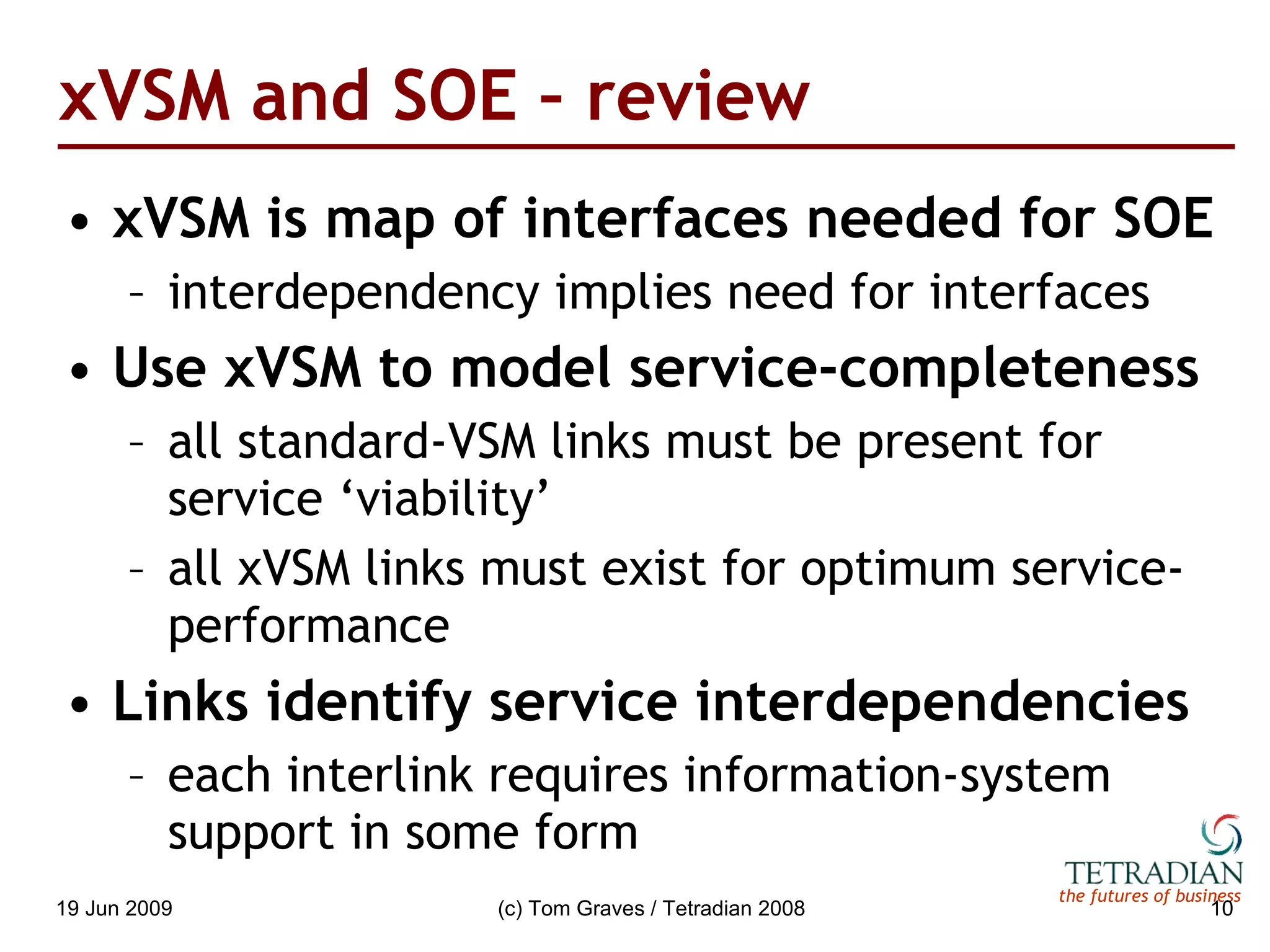
xVSM and SOE – review xVSM is map of interfaces needed for SOE interdependency implies need for interfaces Use xVSM to model service-completeness all standard-VSM links must be present for service ‘viability’ all xVSM links must exist for optimum service-performance Links identify service interdependencies each interlink requires information-system support in some form
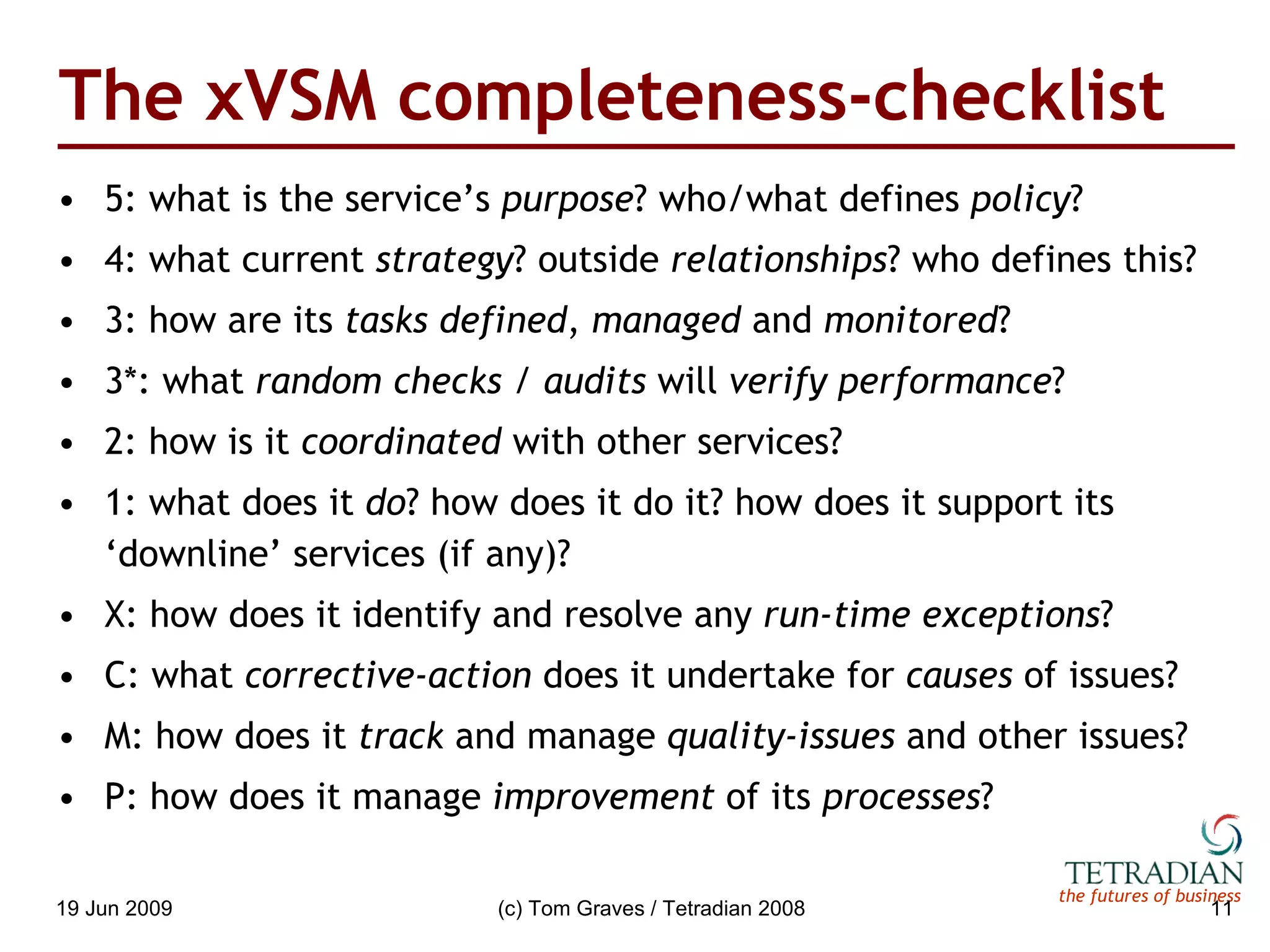
The xVSM completeness-checklist 5: what is the service’s  purpose ? who/what defines  policy ? 4: what current  strategy ? outside  relationships ? who defines this? 3: how are its  tasks defined ,  managed  and  monitored ? 3*: what  random checks /   audits  will  verify performance ? 2: how is it  coordinated  with other services? 1: what does it  do ? how does it do it? how does it support its ‘downline’ services (if any)? X: how does it identify and resolve any  run-time exceptions ? C: what  corrective-action  does it undertake for  causes  of issues? M: how does it  track  and manage  quality-issues  and other issues? P: how does it manage  improvement  of its  processes ?
xVSM analysis: logistics [1] Logistics organisation: mid-level function-model with  example xVSM mappings
xVSM analysis: logistics [2] Number of Business Systems containing activities for each VSM system (‘5’-’1’) or their interactions (‘X’-’P’) represents untraceable costs? represents untraced  opportunities for improvement?
xVSM analysis: human services [1] Government human-services department: initial high-level function-map, based on existing organisation structure
xVSM analysis: human services [2] Same department: revised high-level function-map as matrix against on two-tier xVSM categories
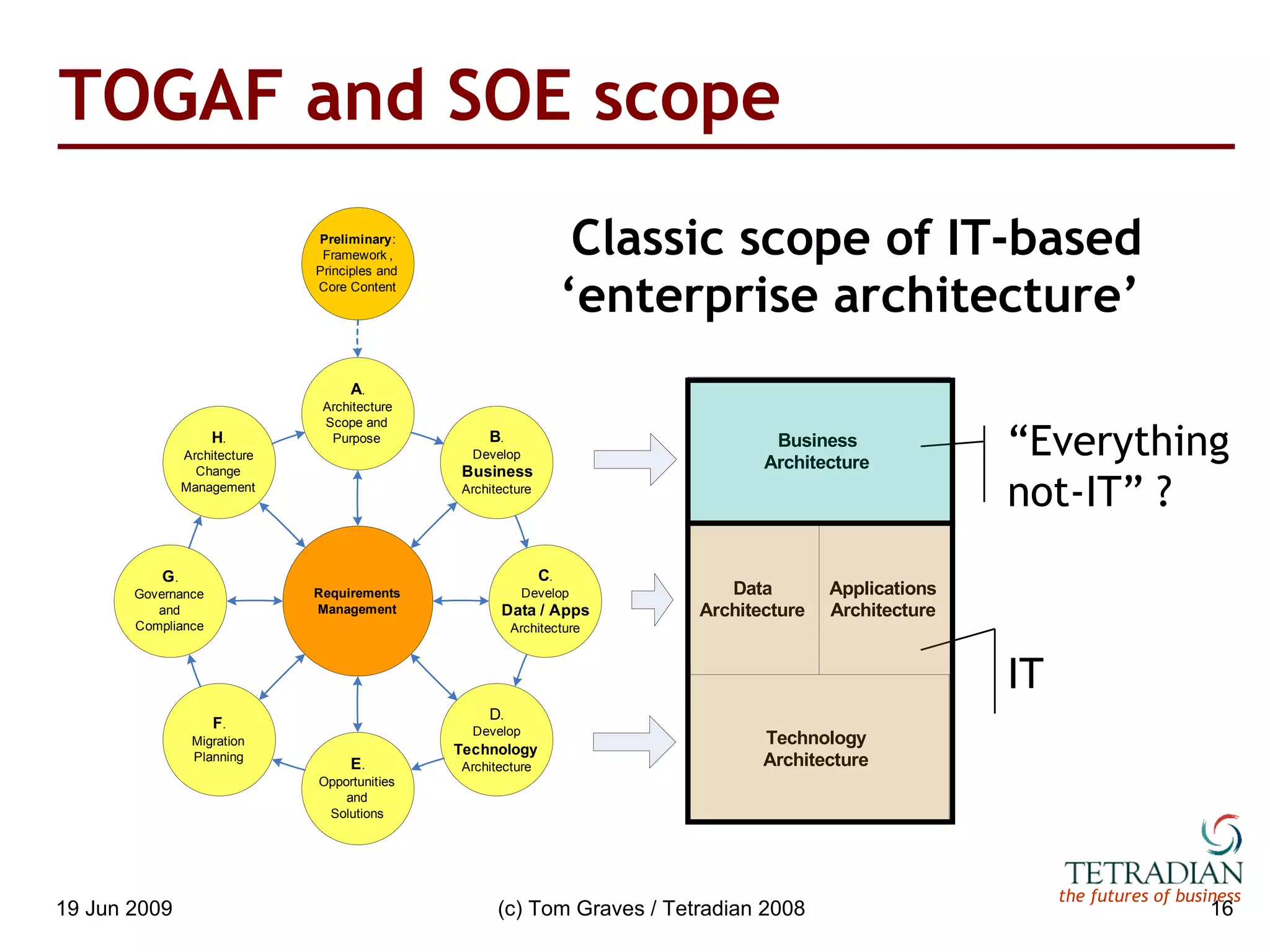
TOGAF and SOE scope Classic scope of IT-based ‘enterprise architecture’ IT “ Everything not-IT” ?
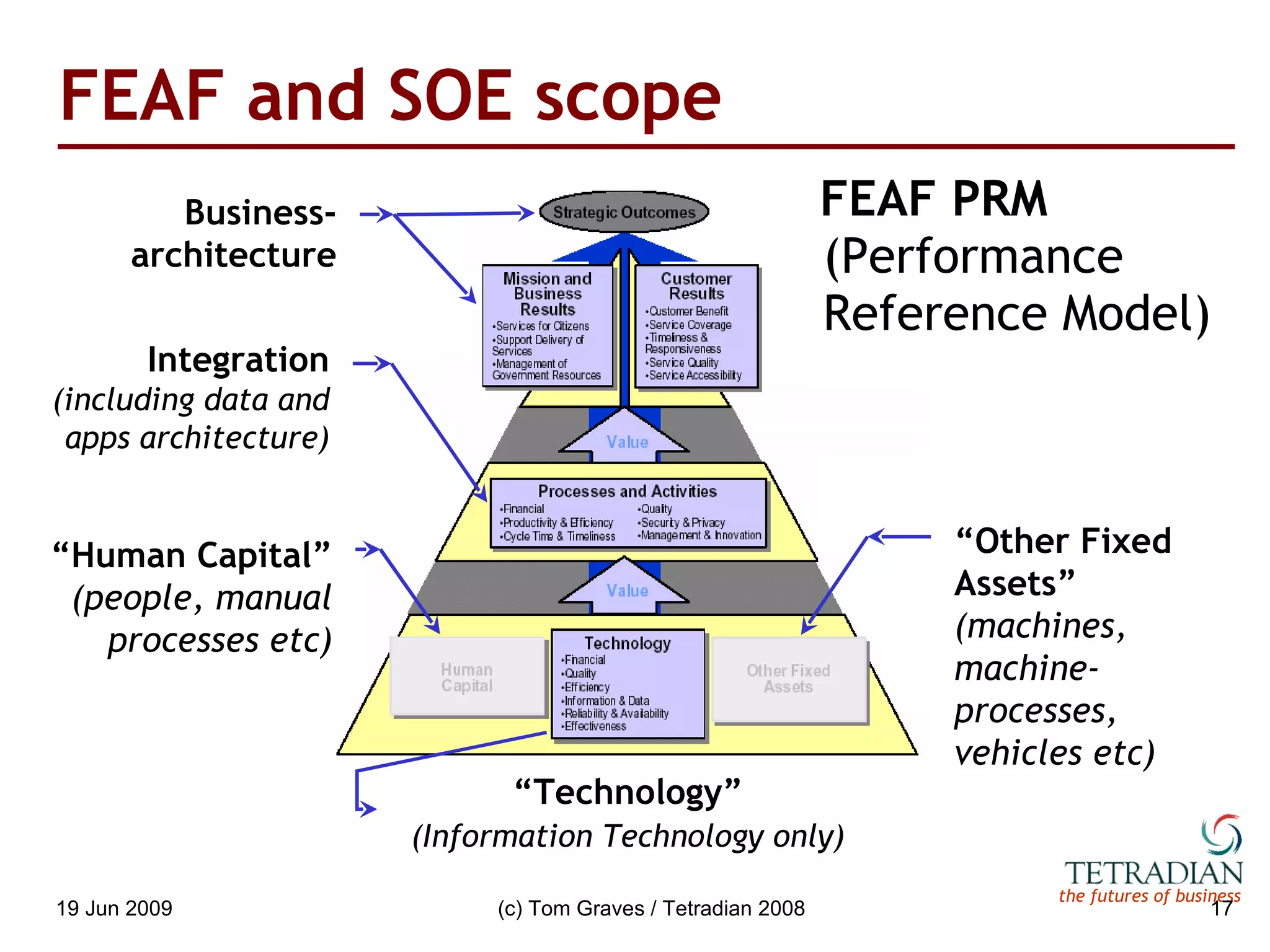
FEAF and SOE scope FEAF PRM  (Performance Reference Model) “ Technology” (Information Technology only) Integration (including data and apps architecture) “ Other Fixed Assets” (machines, machine-processes, vehicles etc) “ Human Capital” (people, manual processes etc) Business-architecture
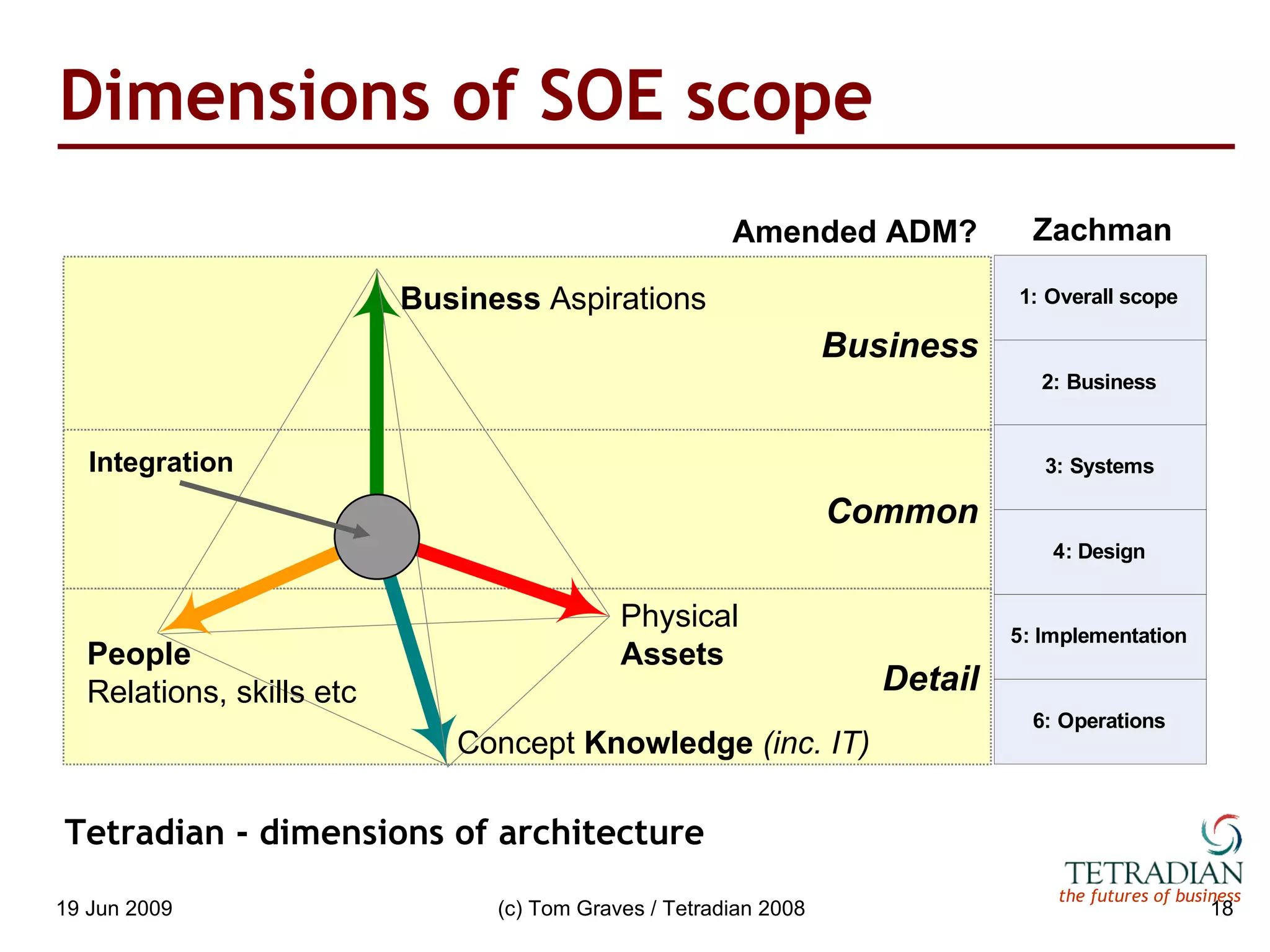
Dimensions of SOE scope Tetradian - dimensions of architecture Detail Common Business Business  Aspirations Amended ADM? Physical Assets Concept  Knowledge  (inc. IT) People Relations, skills etc Zachman Integration
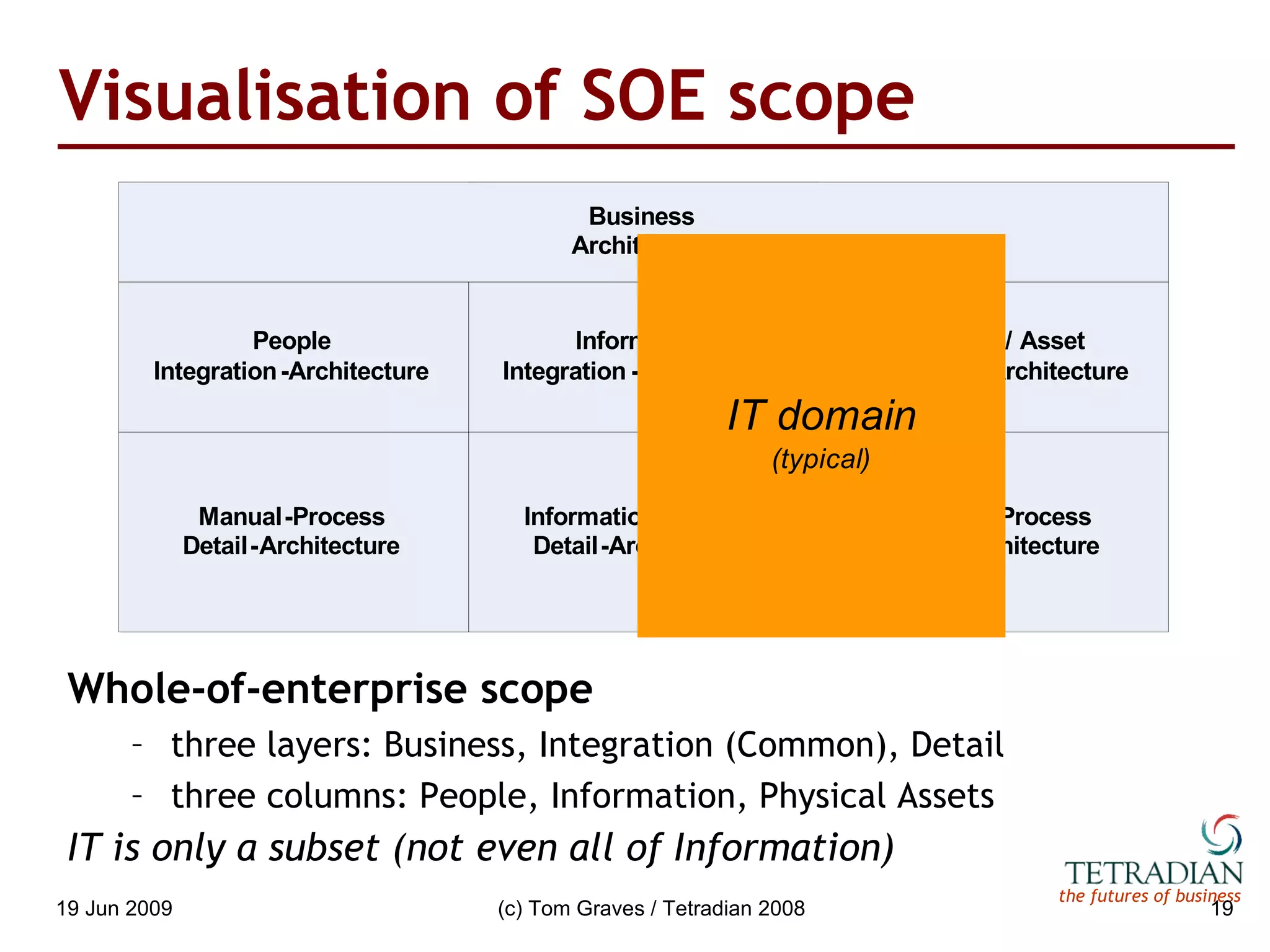
Visualisation of SOE scope Whole-of-enterprise scope IT is only a subset (not even all of Information) three layers: Business, Integration (Common), Detail three columns: People, Information, Physical Assets
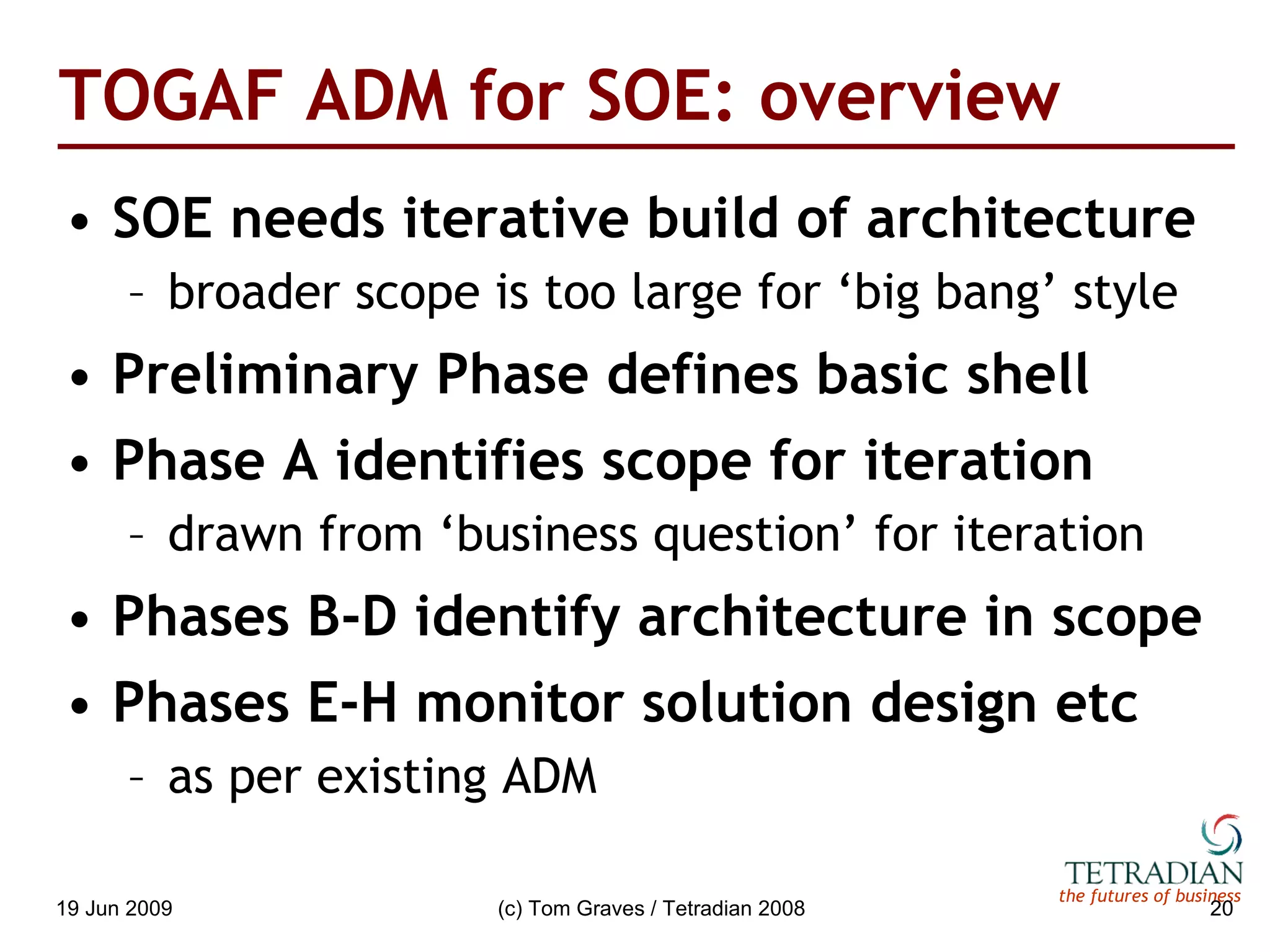
TOGAF ADM for SOE: overview SOE needs iterative build of architecture broader scope is too large for ‘big bang’ style Preliminary Phase defines basic shell Phase A identifies scope for iteration drawn from ‘business question’ for iteration Phases B-D identify architecture in scope Phases E-H monitor solution design etc as per existing ADM
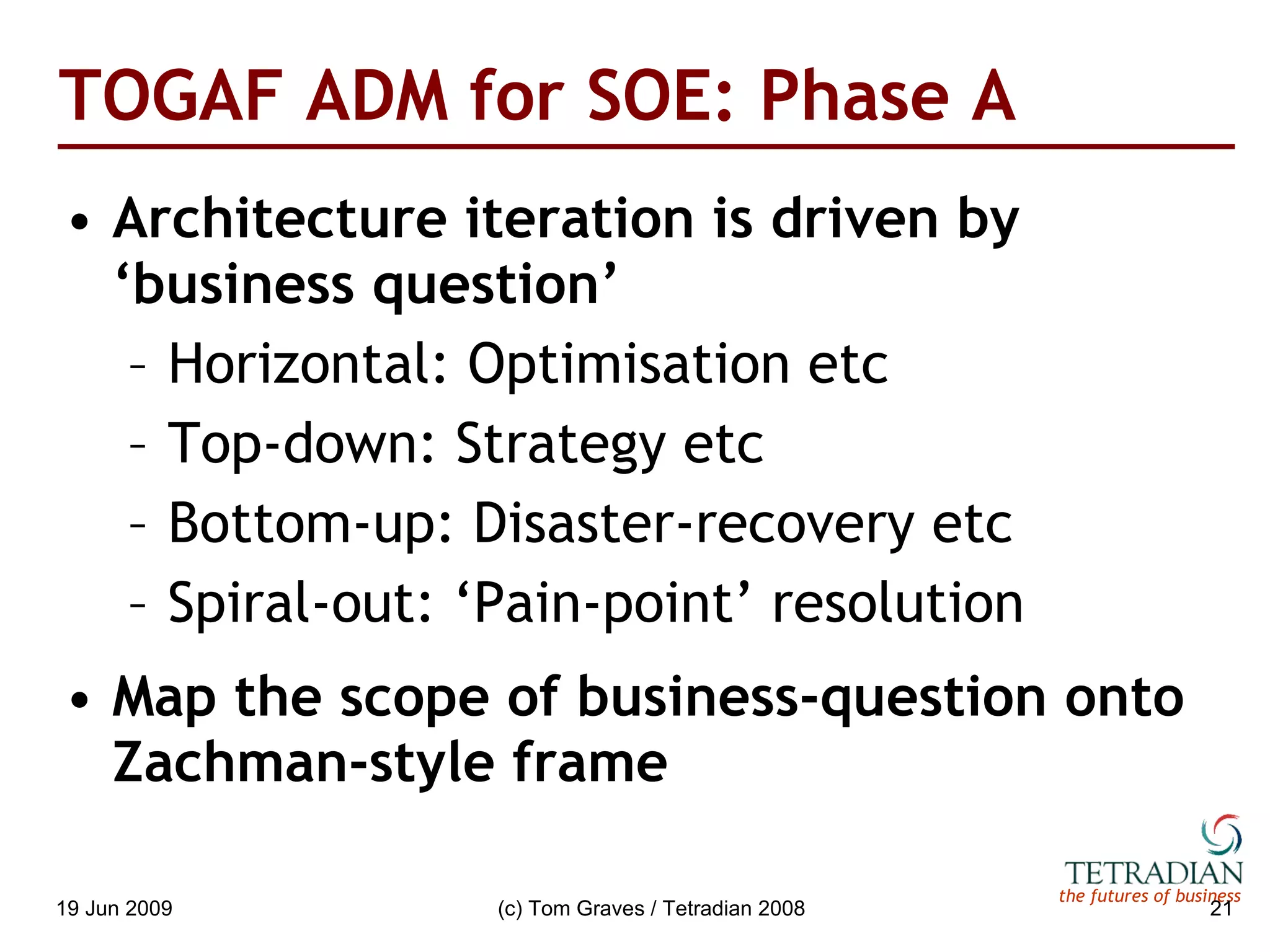
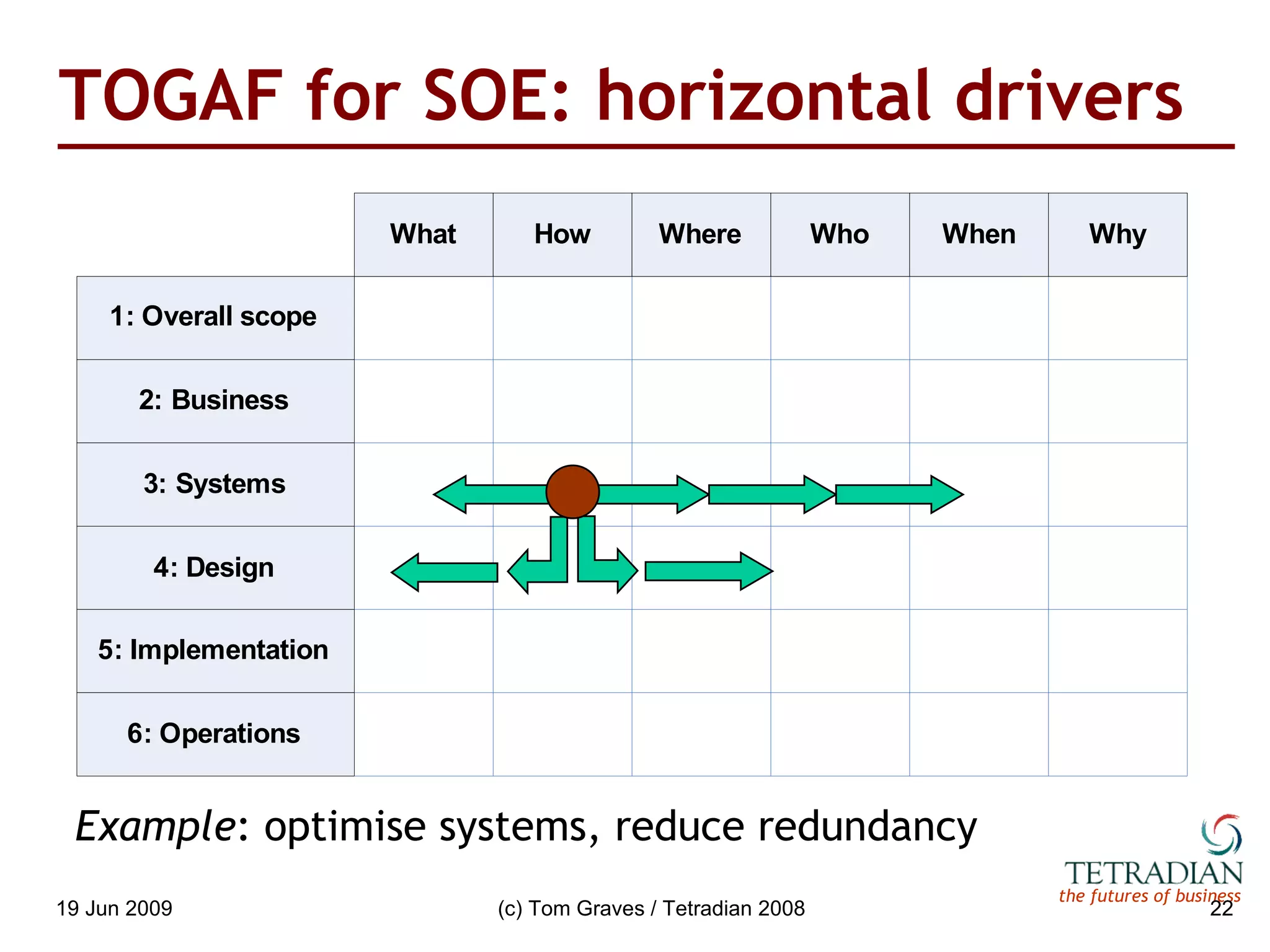
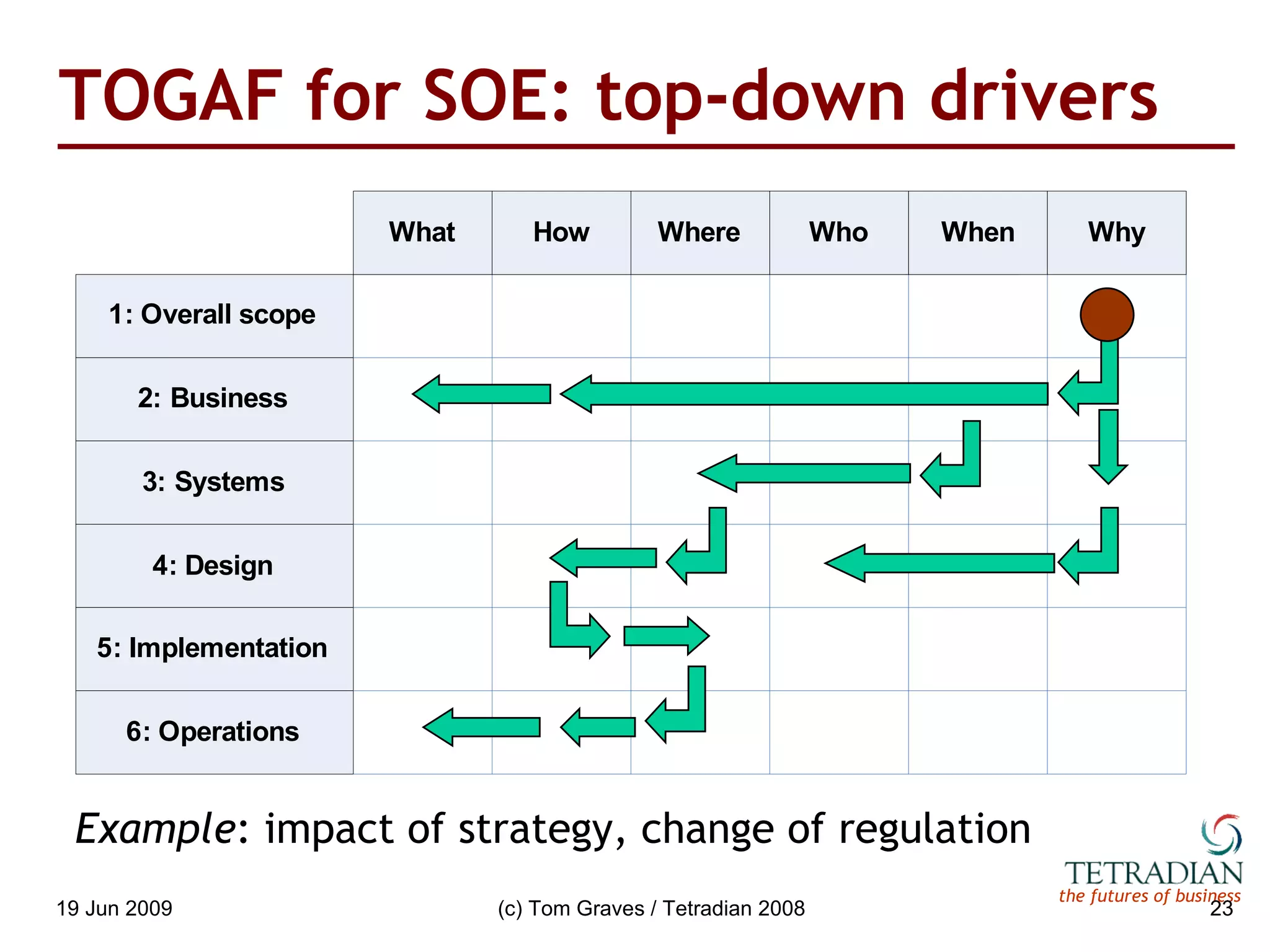
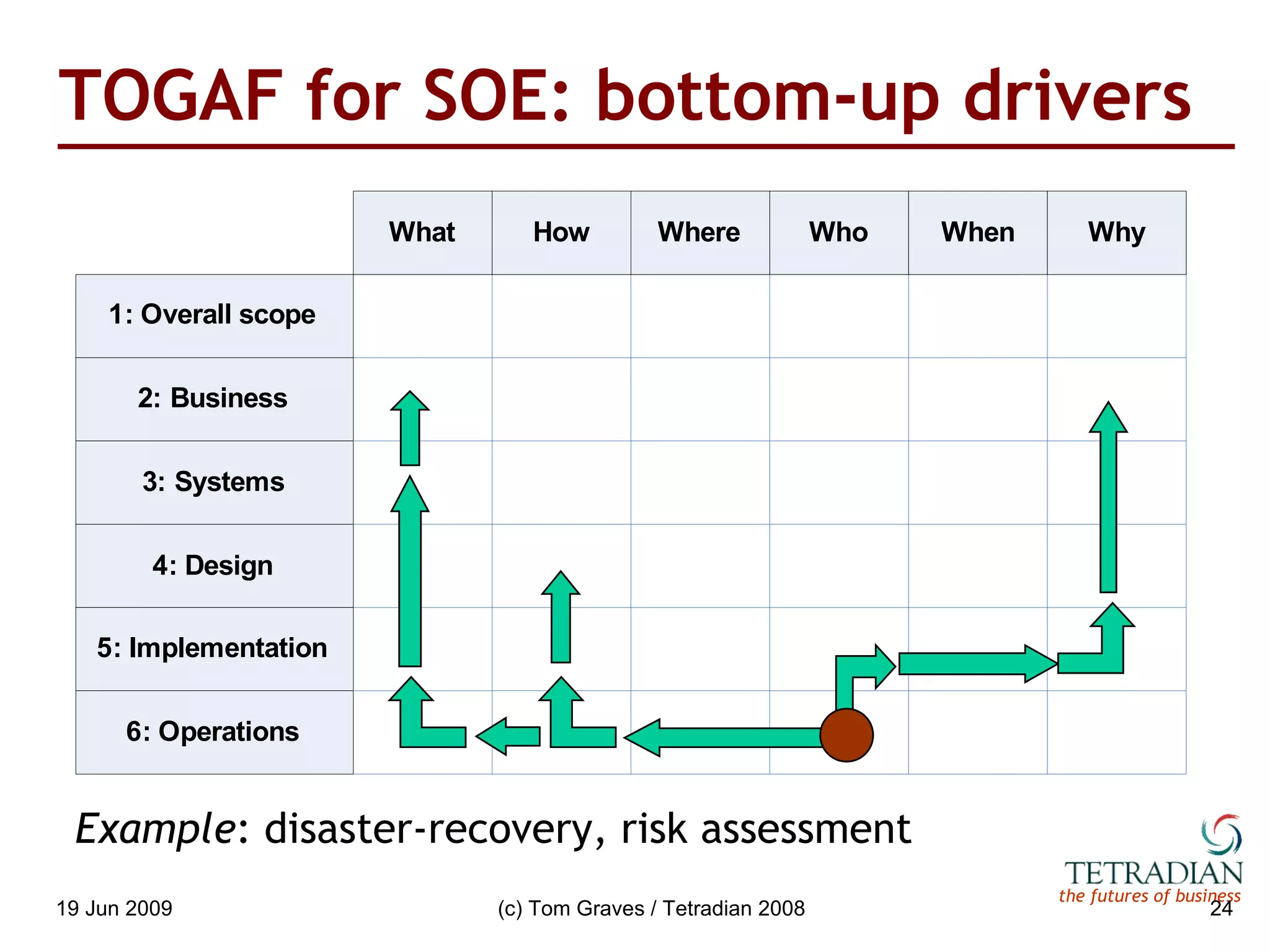
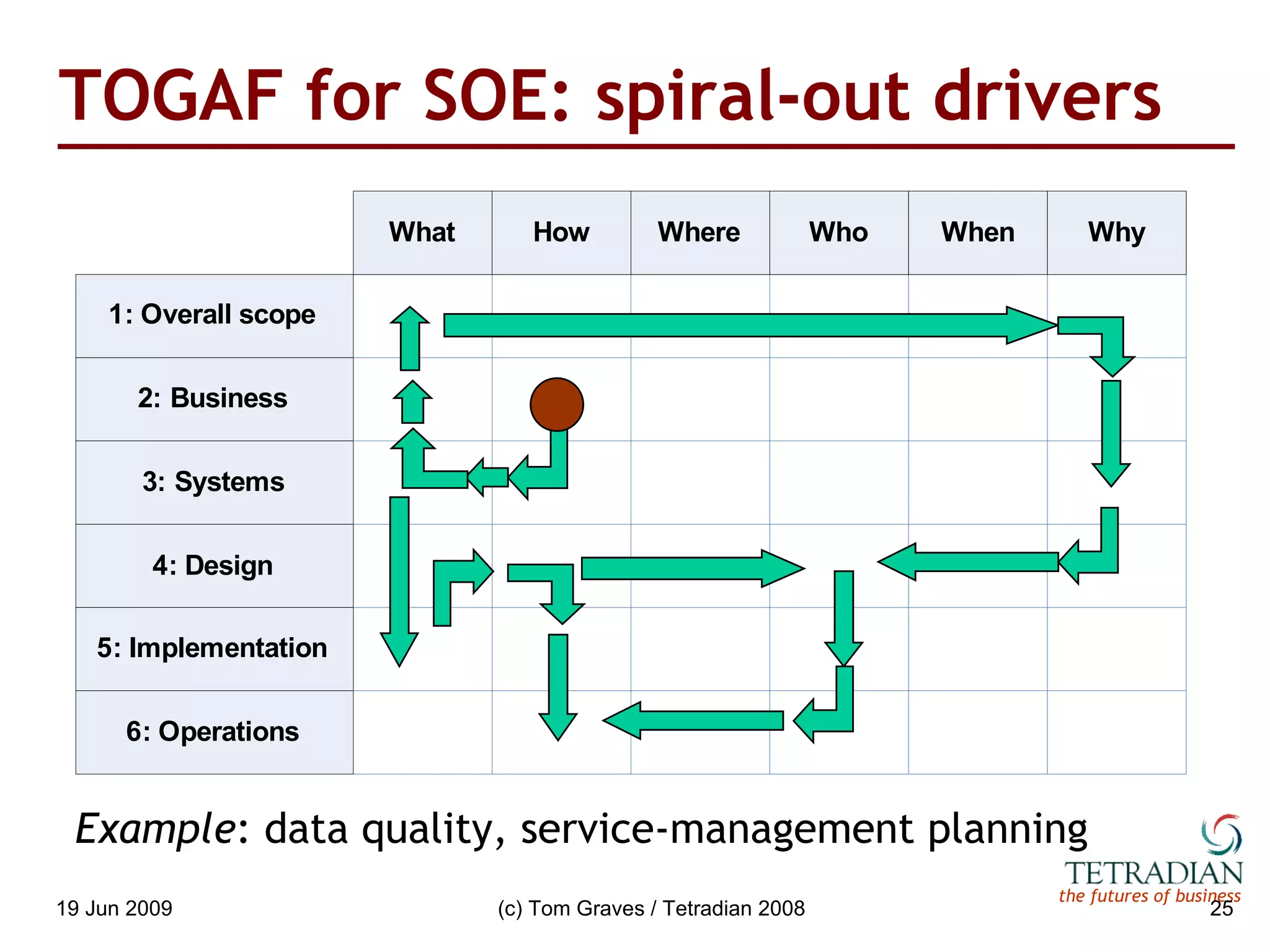
TOGAF ADM for SOE: Phase A Architecture iteration is driven by ‘business question’ Horizontal: Optimisation etc Top-down: Strategy etc Bottom-up: Disaster-recovery etc Spiral-out: ‘Pain-point’ resolution Map the scope of business-question onto Zachman-style frame
TOGAF for SOE: horizontal drivers Example : optimise systems, reduce redundancy
TOGAF for SOE: top-down drivers Example : impact of strategy, change of regulation
TOGAF for SOE: bottom-up drivers Example : disaster-recovery, risk assessment
TOGAF for SOE: spiral-out drivers Example : data quality, service-management planning
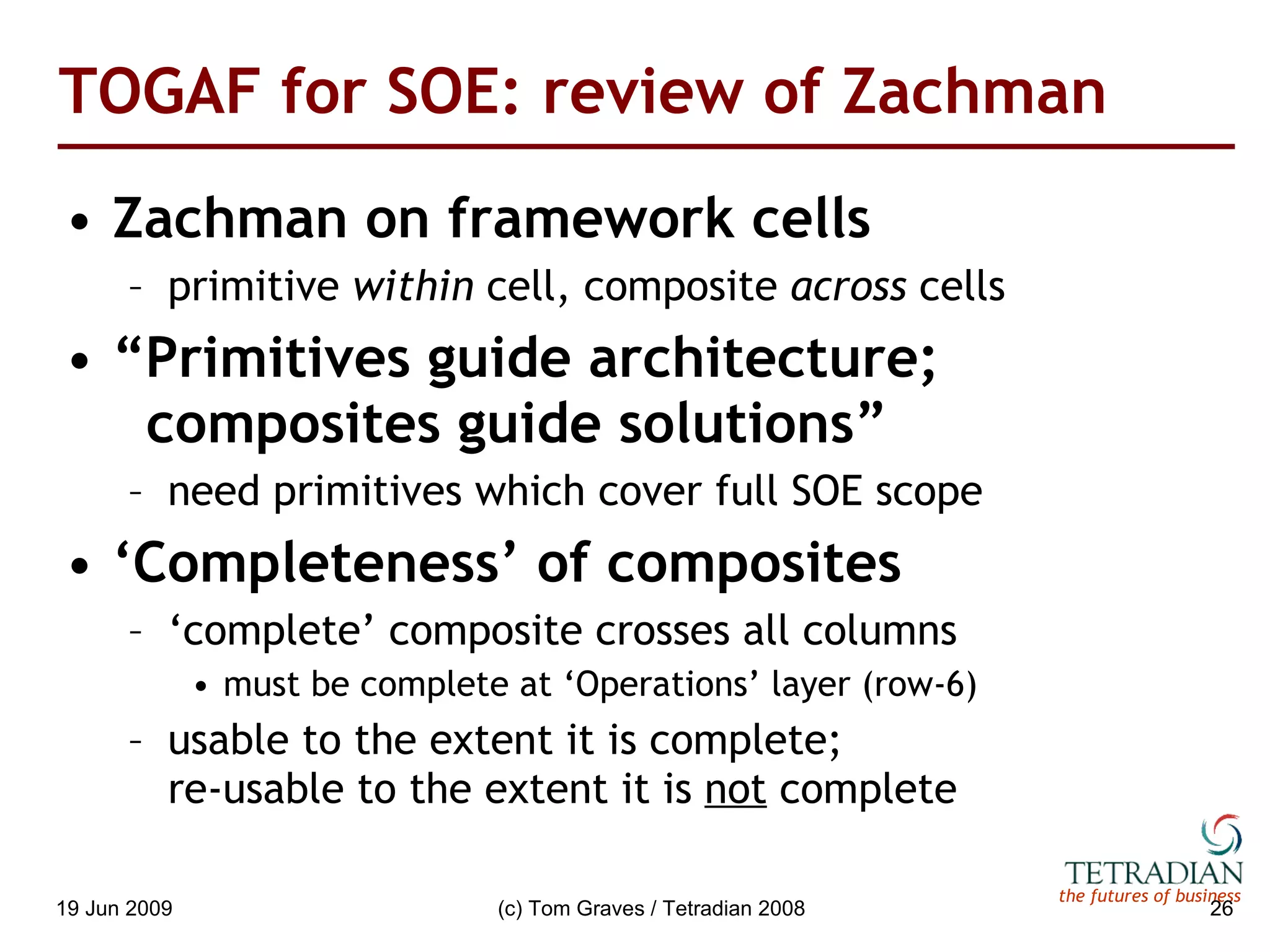
TOGAF for SOE: review of Zachman Zachman on framework cells primitive  within  cell, composite  across  cells “ Primitives guide architecture;    composites guide solutions” need primitives which cover full SOE scope ‘ Completeness’ of composites ‘ complete’ composite crosses all columns must be complete at ‘Operations’ layer (row-6) usable to the extent it is complete;  re-usable to the extent it is  not  complete
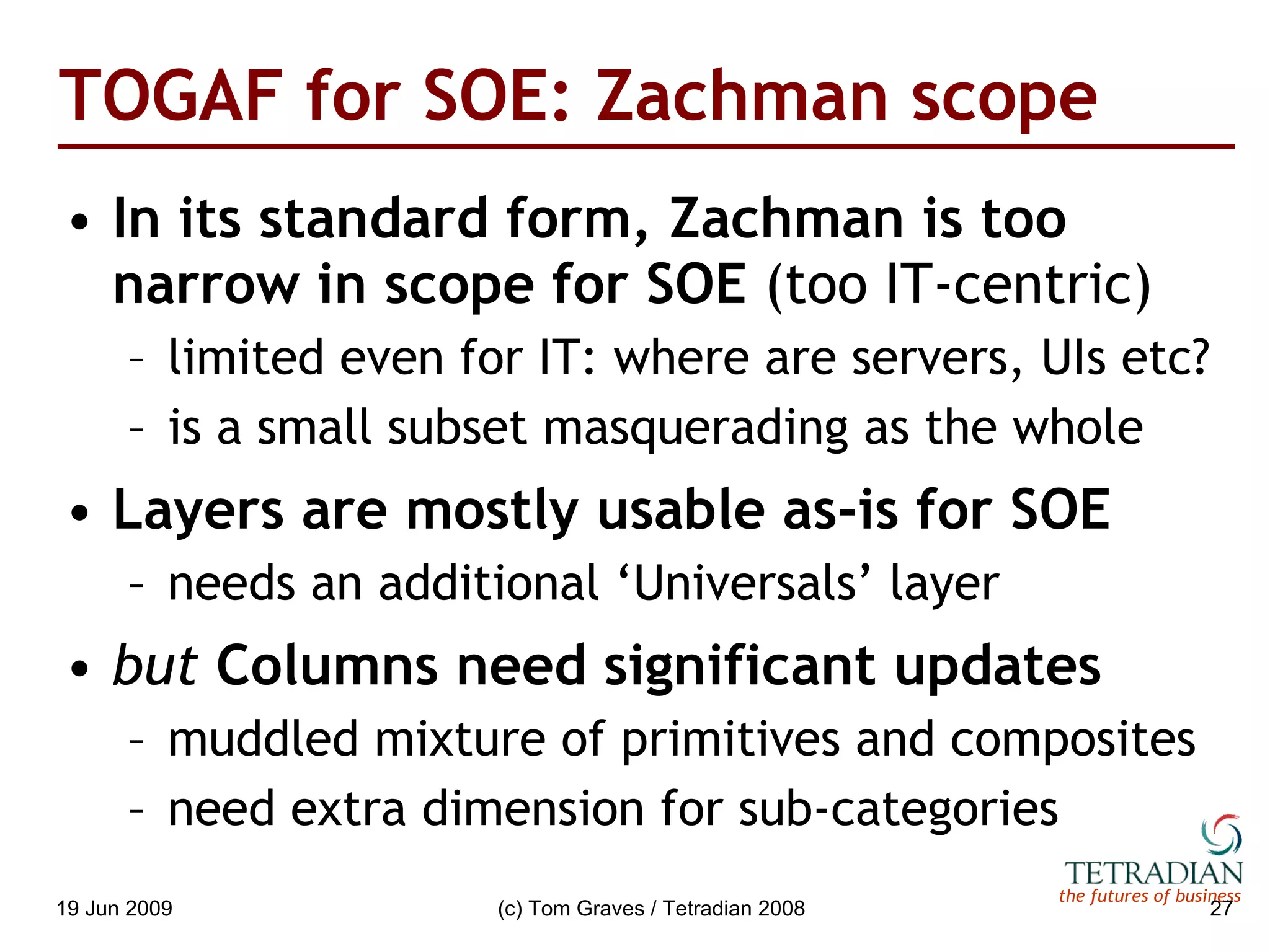
TOGAF for SOE: Zachman scope In its standard form, Zachman is too narrow in scope for SOE  (too IT-centric) limited even for IT: where are servers, UIs etc? is a small subset masquerading as the whole Layers are mostly usable as-is for SOE needs an additional ‘Universals’ layer but  Columns need significant updates muddled mixture of primitives and composites need extra dimension for sub-categories
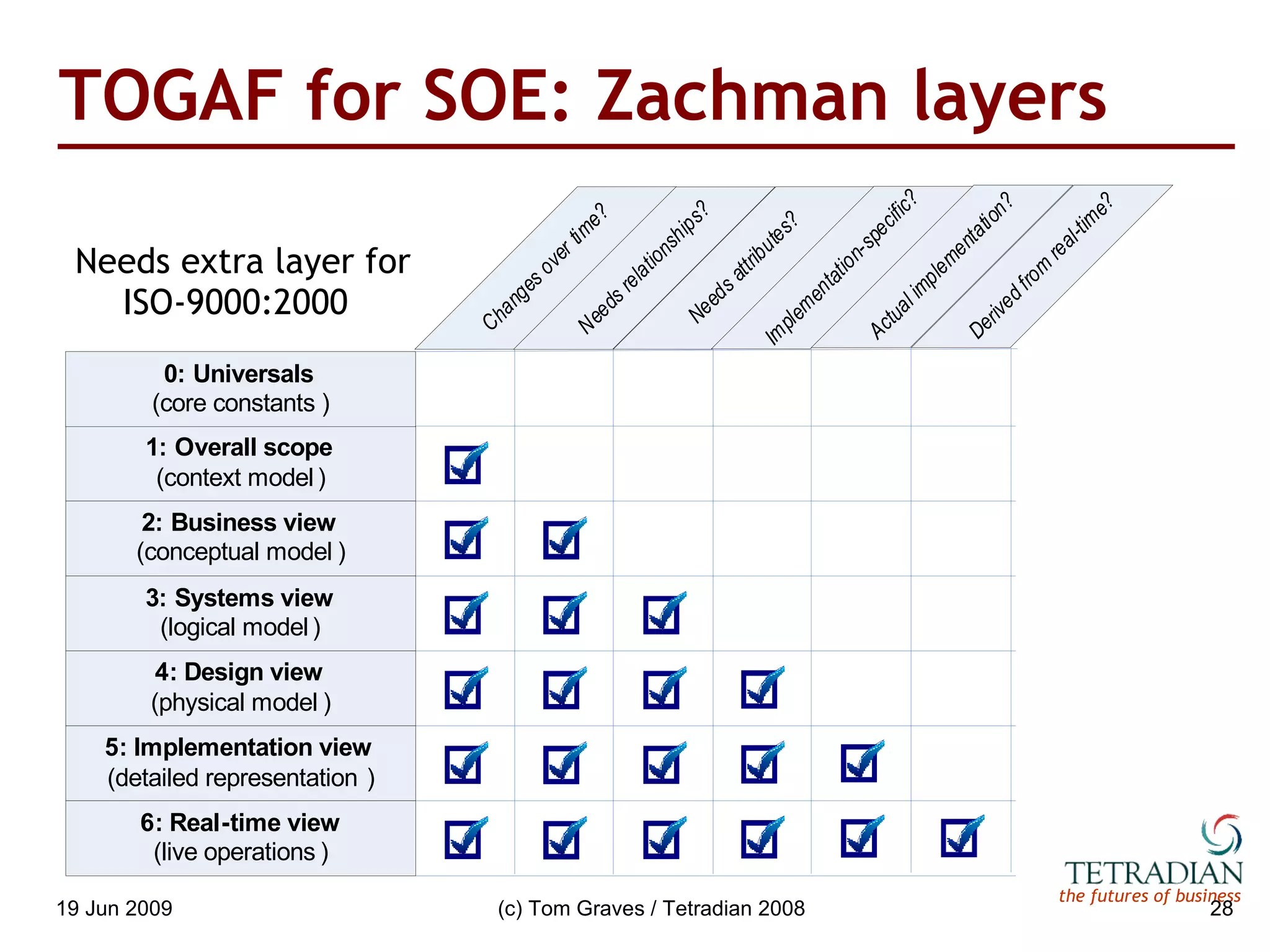
TOGAF for SOE: Zachman layers Needs extra layer for  ISO-9000:2000
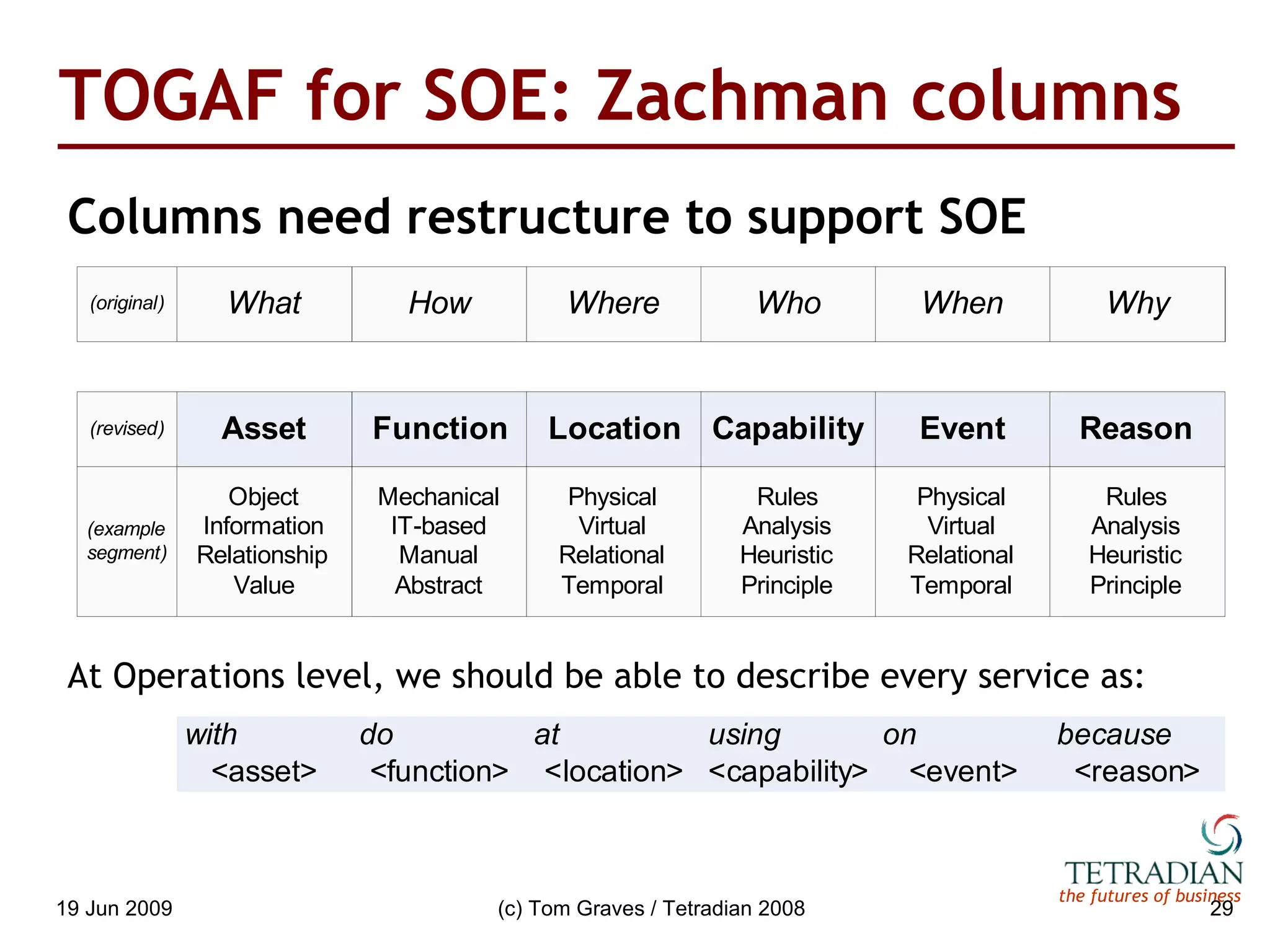
TOGAF for SOE: Zachman columns Columns need restructure to support SOE At Operations level, we should be able to describe every service as:
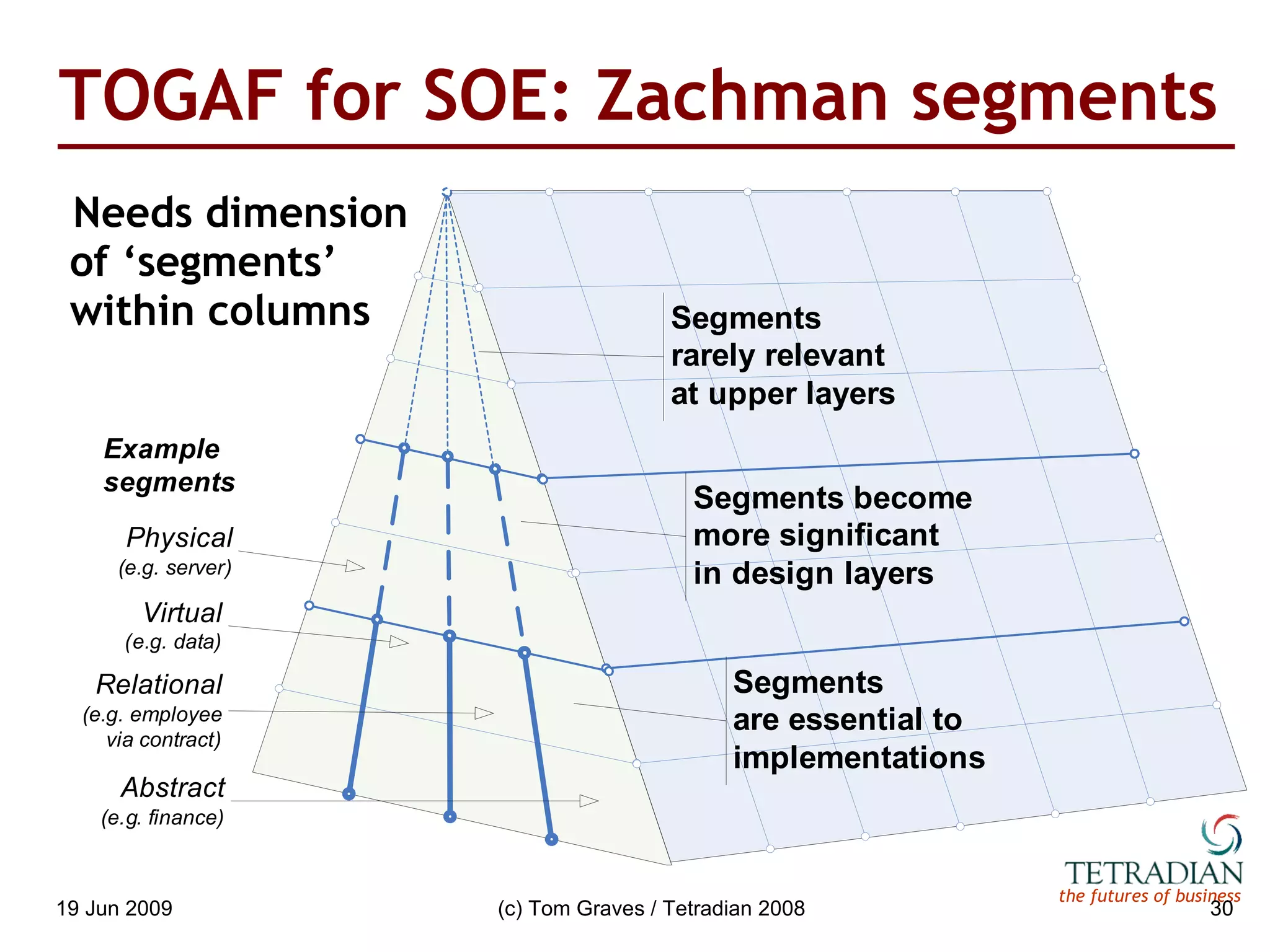
TOGAF for SOE: Zachman segments Needs dimension of ‘segments’ within columns
TOGAF ADM for SOE: Phase B-D [1] If we retain existing Phase B-D focus – extended as  Business, Common/Shared, Detail-level  – we will have a governance problem of endless review-meetings We can resolve the governance problem by changing the focus of Phases B-D: Develop ‘ As-Is’  Architecture Develop ‘ To-Be’  Architecture Conduct Gap-Analysis
TOGAF ADM for SOE: Phase B-D [2] Statement of Architecture Work (for iteration) Stakeholder review for ‘current state’ Stakeholder review for ‘future state’ Gap-analysis / requirements review Solution design review Project plan review Project architecture compliance review Benefits realisation (‘lessons learned’ etc) Architecture Charter Governance-artefacts define methodology’s phase-boundaries
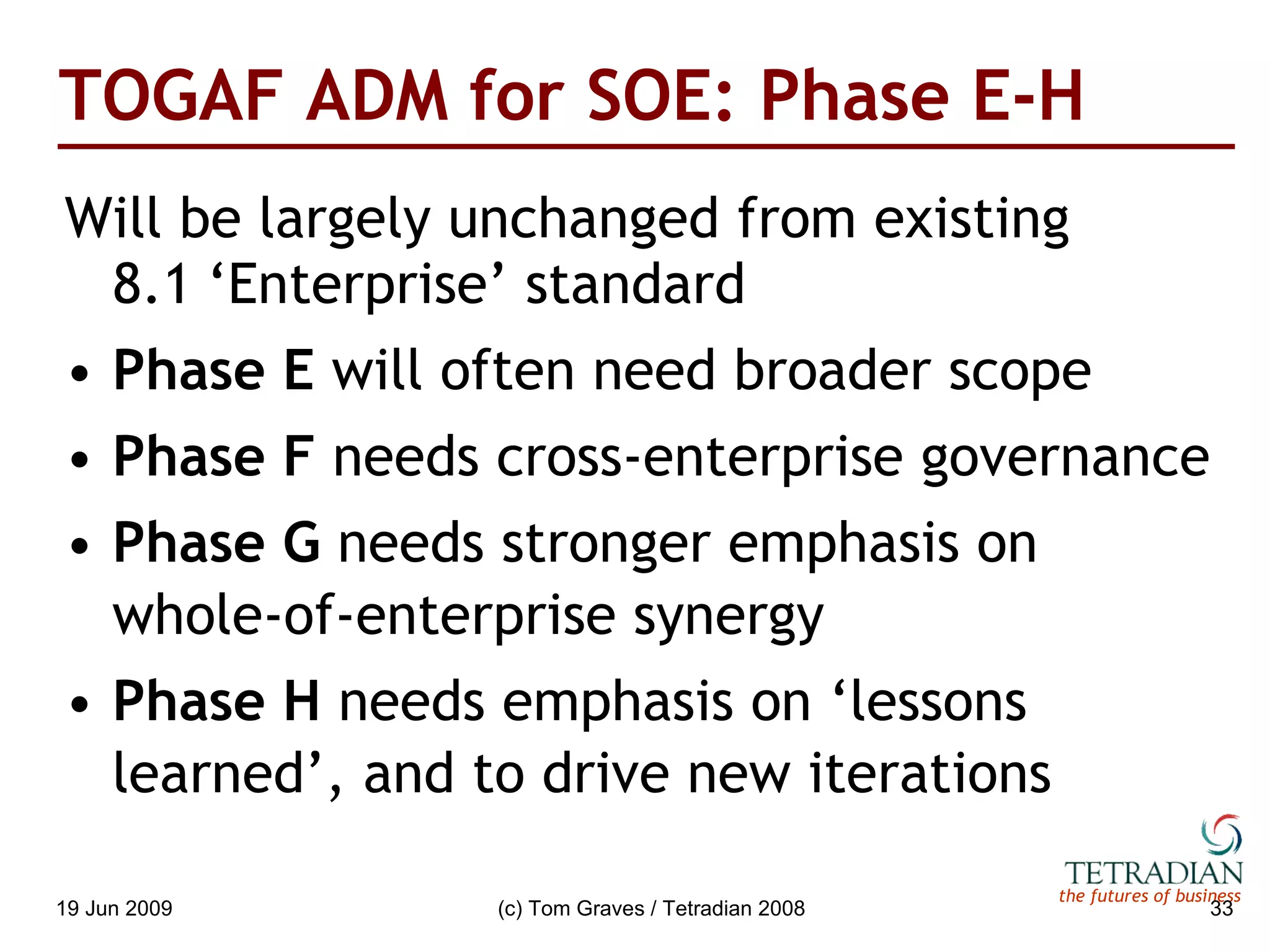
TOGAF ADM for SOE: Phase E-H Will be largely unchanged from existing  8.1   ‘Enterprise’ standard Phase E  will often need broader scope Phase F  needs cross-enterprise governance Phase G  needs stronger emphasis on whole-of-enterprise synergy Phase H  needs emphasis on ‘lessons learned’, and to drive new iterations
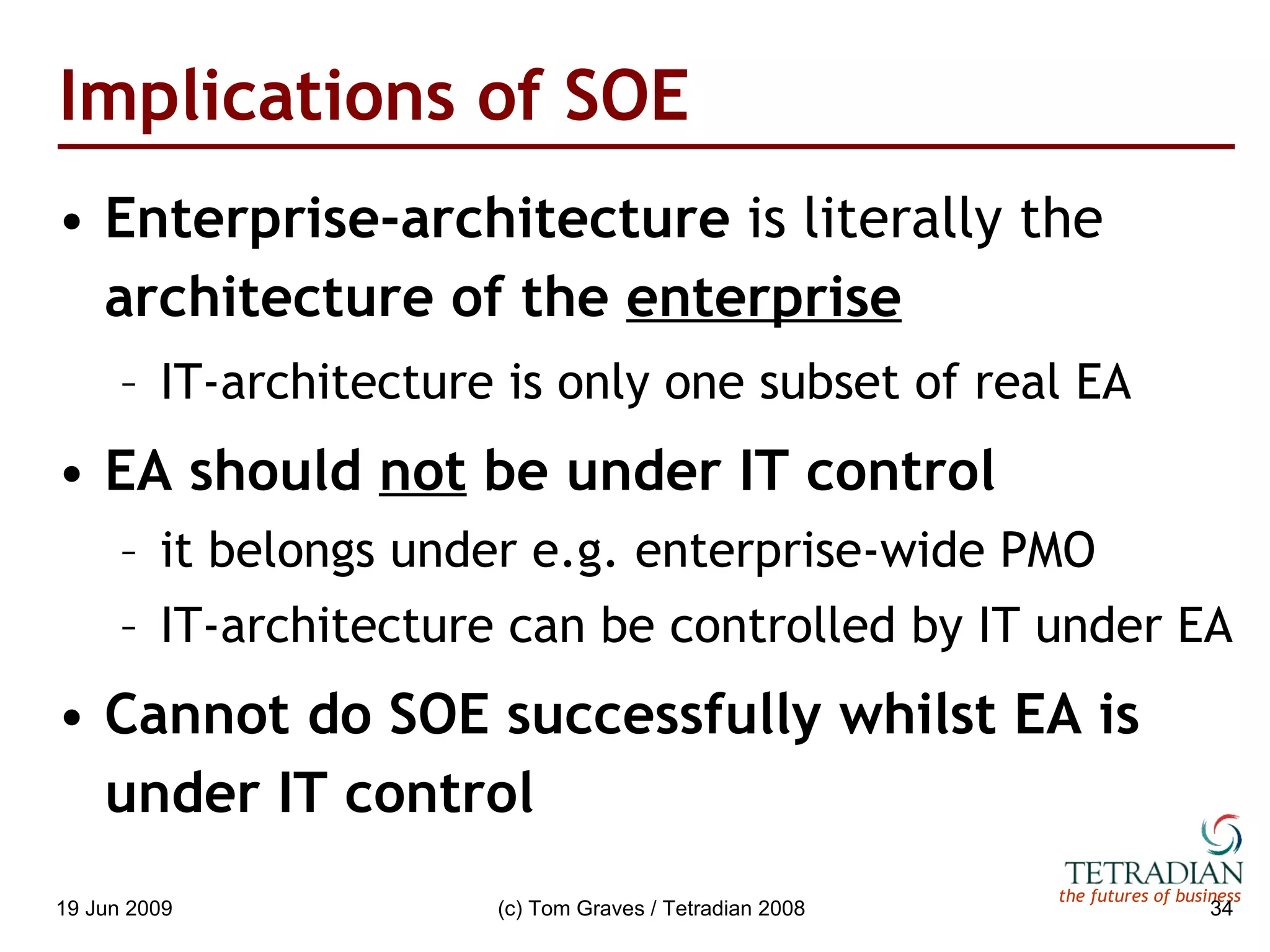
Implications of SOE Enterprise-architecture  is literally the  architecture of the  enterprise IT-architecture is only one subset of real EA  EA should  not  be under IT control it belongs under e.g. enterprise-wide PMO IT-architecture can be controlled by IT under EA Cannot do SOE successfully whilst EA is under IT control
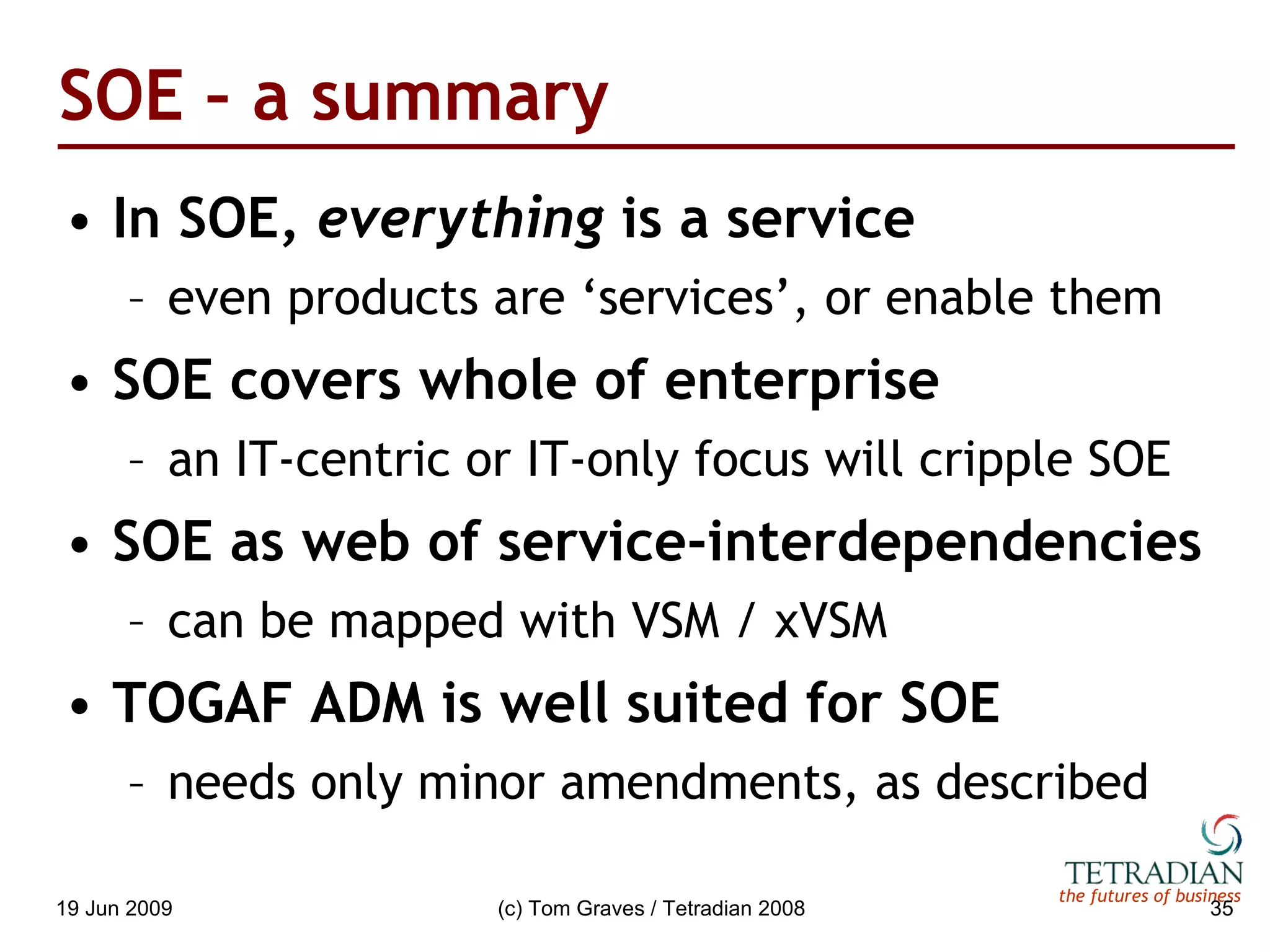
SOE – a summary In SOE,  everything  is a service even products are ‘services’, or enable them SOE covers whole of enterprise an IT-centric or IT-only focus will cripple SOE SOE as web of service-interdependencies can be mapped with VSM / xVSM TOGAF ADM is well suited for SOE needs only minor amendments, as described
Further information Viable System Model  (Wikipedia article and links) http://en.wikipedia.org/wiki/Viable_System_Model Brain of the Firm , 2nd Ed. (Viable System Model) author : Stafford Beer;  publisher : Wiley, 1994; ISBN 978-0-471-94839-1 “ The Viable Services Model : service quality, service interdependence and service completeness ” in ITSMF  IT Service Management Global Best Practices 1 chapter:  Tom Graves;  publisher:  Van Haren, 2008; ISBN 978-90-8753-100-3   Real Enterprise-Architecture : beyond IT to the whole enterprise author:  Tom Graves;  publisher:  Tetradian, 2008; ISBN 978-1-906681-00-5 Bridging the Silos : enterprise-architecture for IT architects author:  Tom Graves;  publisher:  Tetradian, 2008; ISBN 978-906681-02-9 See  tetradianbooks.com  for more details.

Enterprise-architecture and the service-oriented enterprise

  • 1.
    Enterprise-architecture and theservice-oriented enterprise Tom Graves, Tetradian Consulting TOGAF Glasgow, April 2008 info@tetradian.com / www.tetradian.com
  • 2.
    SOA and SOEService-oriented architecture (SOA) SOA still viewed primarily in terms of IT common interfaces for heterogeneous systems The service-oriented enterprise (SOE) extends SOA metaphor to all aspects of the enterprise TOGAF and SOA IT-architecture underpins IT-service architecture Adapt TOGAF ADM for use with SOE extend IT-centric methodology to whole-of-enterprise
  • 3.
    The service-oriented enterprise‘ Service’ concept as unifying theme SOE analogy with UNIX in UNIX, every device is treated as a file In SOE, everything delivers a service use SOA for architecture of entire enterprise Products are ‘services’ too deliver capability for client ‘self-service’ vacuum-cleaner -> self-service of ‘cleaned floors’ computer -> self-service ‘access to applications’
  • 4.
    Services and business-processesA simple example of a business-function / business-service
  • 5.
    An IT viewof services Emphasis in IT SOA is on service-to-service transactions in near-real-time monitoring often seems to be tackled only as an afterthought
  • 6.
    An ITIL viewof services ITIL service-management needs layered view of services as ‘brain + brawn’ includes KPIs / CSFs, SLAs etc between layers
  • 7.
    A layered viewof services Hierarchy of services, each with their own KPIs, CSFs and SLAs each ‘brain + brawn’ pair becomes the ‘brawn’ of the next level upward Viable System Model (“Brain of the Firm”, Stafford Beer, 1972)
  • 8.
    Viable System Model(VSM) In the Viable System Model, every service contains a set of specialised sub-systems These interact with each other to act on and with the external world 1 – process operations 2 – sub-process coordination 3* – sporadic audit / review 3 – ‘inside / now’ [management] 4 – ‘outside / future’ [+ strategy] 5 – policy / purpose
  • 9.
    Viable Services Model (xVSM) Add other interactions as required, e.g. S - security (for ITIL compatibility) X – exception-management for short-term (‘1’  ‘3’, ‘1’  ‘4’) C – corrective action (review of ‘3*’ / ‘X’  ‘3’ / ‘4’) M – issue-management (usually triggered by ‘X’, ‘2’ and/or ‘3’) P – process-improvement (interaction up and down between any ‘1’…  … ‘5’) Interactions between these sub-systems support improved processes and self-adaptation to a changing environment
  • 10.
    xVSM and SOE– review xVSM is map of interfaces needed for SOE interdependency implies need for interfaces Use xVSM to model service-completeness all standard-VSM links must be present for service ‘viability’ all xVSM links must exist for optimum service-performance Links identify service interdependencies each interlink requires information-system support in some form
  • 11.
    The xVSM completeness-checklist5: what is the service’s purpose ? who/what defines policy ? 4: what current strategy ? outside relationships ? who defines this? 3: how are its tasks defined , managed and monitored ? 3*: what random checks / audits will verify performance ? 2: how is it coordinated with other services? 1: what does it do ? how does it do it? how does it support its ‘downline’ services (if any)? X: how does it identify and resolve any run-time exceptions ? C: what corrective-action does it undertake for causes of issues? M: how does it track and manage quality-issues and other issues? P: how does it manage improvement of its processes ?
  • 12.
    xVSM analysis: logistics[1] Logistics organisation: mid-level function-model with example xVSM mappings
  • 13.
    xVSM analysis: logistics[2] Number of Business Systems containing activities for each VSM system (‘5’-’1’) or their interactions (‘X’-’P’) represents untraceable costs? represents untraced opportunities for improvement?
  • 14.
    xVSM analysis: humanservices [1] Government human-services department: initial high-level function-map, based on existing organisation structure
  • 15.
    xVSM analysis: humanservices [2] Same department: revised high-level function-map as matrix against on two-tier xVSM categories
  • 16.
    TOGAF and SOEscope Classic scope of IT-based ‘enterprise architecture’ IT “ Everything not-IT” ?
  • 17.
    FEAF and SOEscope FEAF PRM (Performance Reference Model) “ Technology” (Information Technology only) Integration (including data and apps architecture) “ Other Fixed Assets” (machines, machine-processes, vehicles etc) “ Human Capital” (people, manual processes etc) Business-architecture
  • 18.
    Dimensions of SOEscope Tetradian - dimensions of architecture Detail Common Business Business Aspirations Amended ADM? Physical Assets Concept Knowledge (inc. IT) People Relations, skills etc Zachman Integration
  • 19.
    Visualisation of SOEscope Whole-of-enterprise scope IT is only a subset (not even all of Information) three layers: Business, Integration (Common), Detail three columns: People, Information, Physical Assets
  • 20.
    TOGAF ADM forSOE: overview SOE needs iterative build of architecture broader scope is too large for ‘big bang’ style Preliminary Phase defines basic shell Phase A identifies scope for iteration drawn from ‘business question’ for iteration Phases B-D identify architecture in scope Phases E-H monitor solution design etc as per existing ADM
  • 21.
    TOGAF ADM forSOE: Phase A Architecture iteration is driven by ‘business question’ Horizontal: Optimisation etc Top-down: Strategy etc Bottom-up: Disaster-recovery etc Spiral-out: ‘Pain-point’ resolution Map the scope of business-question onto Zachman-style frame
  • 22.
    TOGAF for SOE:horizontal drivers Example : optimise systems, reduce redundancy
  • 23.
    TOGAF for SOE:top-down drivers Example : impact of strategy, change of regulation
  • 24.
    TOGAF for SOE:bottom-up drivers Example : disaster-recovery, risk assessment
  • 25.
    TOGAF for SOE:spiral-out drivers Example : data quality, service-management planning
  • 26.
    TOGAF for SOE:review of Zachman Zachman on framework cells primitive within cell, composite across cells “ Primitives guide architecture; composites guide solutions” need primitives which cover full SOE scope ‘ Completeness’ of composites ‘ complete’ composite crosses all columns must be complete at ‘Operations’ layer (row-6) usable to the extent it is complete; re-usable to the extent it is not complete
  • 27.
    TOGAF for SOE:Zachman scope In its standard form, Zachman is too narrow in scope for SOE (too IT-centric) limited even for IT: where are servers, UIs etc? is a small subset masquerading as the whole Layers are mostly usable as-is for SOE needs an additional ‘Universals’ layer but Columns need significant updates muddled mixture of primitives and composites need extra dimension for sub-categories
  • 28.
    TOGAF for SOE:Zachman layers Needs extra layer for ISO-9000:2000
  • 29.
    TOGAF for SOE:Zachman columns Columns need restructure to support SOE At Operations level, we should be able to describe every service as:
  • 30.
    TOGAF for SOE:Zachman segments Needs dimension of ‘segments’ within columns
  • 31.
    TOGAF ADM forSOE: Phase B-D [1] If we retain existing Phase B-D focus – extended as Business, Common/Shared, Detail-level – we will have a governance problem of endless review-meetings We can resolve the governance problem by changing the focus of Phases B-D: Develop ‘ As-Is’ Architecture Develop ‘ To-Be’ Architecture Conduct Gap-Analysis
  • 32.
    TOGAF ADM forSOE: Phase B-D [2] Statement of Architecture Work (for iteration) Stakeholder review for ‘current state’ Stakeholder review for ‘future state’ Gap-analysis / requirements review Solution design review Project plan review Project architecture compliance review Benefits realisation (‘lessons learned’ etc) Architecture Charter Governance-artefacts define methodology’s phase-boundaries
  • 33.
    TOGAF ADM forSOE: Phase E-H Will be largely unchanged from existing 8.1 ‘Enterprise’ standard Phase E will often need broader scope Phase F needs cross-enterprise governance Phase G needs stronger emphasis on whole-of-enterprise synergy Phase H needs emphasis on ‘lessons learned’, and to drive new iterations
  • 34.
    Implications of SOEEnterprise-architecture is literally the architecture of the enterprise IT-architecture is only one subset of real EA EA should not be under IT control it belongs under e.g. enterprise-wide PMO IT-architecture can be controlled by IT under EA Cannot do SOE successfully whilst EA is under IT control
  • 35.
    SOE – asummary In SOE, everything is a service even products are ‘services’, or enable them SOE covers whole of enterprise an IT-centric or IT-only focus will cripple SOE SOE as web of service-interdependencies can be mapped with VSM / xVSM TOGAF ADM is well suited for SOE needs only minor amendments, as described
  • 36.
    Further information ViableSystem Model (Wikipedia article and links) http://en.wikipedia.org/wiki/Viable_System_Model Brain of the Firm , 2nd Ed. (Viable System Model) author : Stafford Beer; publisher : Wiley, 1994; ISBN 978-0-471-94839-1 “ The Viable Services Model : service quality, service interdependence and service completeness ” in ITSMF IT Service Management Global Best Practices 1 chapter: Tom Graves; publisher: Van Haren, 2008; ISBN 978-90-8753-100-3 Real Enterprise-Architecture : beyond IT to the whole enterprise author: Tom Graves; publisher: Tetradian, 2008; ISBN 978-1-906681-00-5 Bridging the Silos : enterprise-architecture for IT architects author: Tom Graves; publisher: Tetradian, 2008; ISBN 978-906681-02-9 See tetradianbooks.com for more details.

Editor's Notes

  • #2 Tetradian Consulting Unit 215, Communications House 9 St Johns Street Colchester Essex CO2 7NN England www.tetradian.com [email_address] © Tom Graves / Tetradian 2008
  • #3 Service-oriented architecture, or SOA, is well-known as a way to structure the links between different IT systems. So it has obvious connections with enterprise-architecture. A main theme of TOGAF conferences has been about how IT-architecture underpins the IT aspects of SOA. Yet SOA can – or must – be about more than just IT. So the aim here is to extend SOA ideas to the whole of the enterprise – in other words, the service-oriented enterprise – and adapt the TOGAF ADM to suit.
  • #4 There’s an analogy here with the Unix principle that every device is treated as a file. In the service-oriented enterprise, we gain unity and consistency by treating every activity as a service. From IT-interfaces to board-level strategic assessments, and everywhere in between, everything is a service. In a sense, even products are services – they give the customer a capability to deliver self-service via the product.
  • #5 A business process is a network of transactions between services. IT-based SOA is concerned mostly with the low-level choreography and underlying mechanisms. But there are also transactions that deal with service performance – monitoring service-level agreements (SLAs) between services; key performance-indicators (KPIs) that report on service performance; and critical success-factors (CSFs) that guide interpretation of KPIs. This information passes up and down through a web of other inter-linked services.
  • #6 In abstract terms, each service has two layers: service-delivery; and sub-systems to guide and monitor service-delivery. We could call these the ‘brawn’ and ‘brain’ of the service. In most IT-centric SOA, the emphasis is on ‘brawn to brawn’ – the service transactions, and conditions and metrics to monitor the SLAs. In terms of time, this all happens in the ‘now’. KPIs and CSFs are almost invisible at this level.
  • #7 But in service-management we want to know about the service’s ‘brain’ as much as its ‘brawn’. We need to keep track of what’s going on, through all the KPIs and CSFs and so on. And we need a broader sense of time than just the ‘now’. We need a picture of what’s happened in the past, and prepare and plan for the future. Even in IT service-management, many of these ‘brain’ services can be done only by people, not by machines. To make this work, we must expand our view of SOA beyond the ‘IT-only’ box.
  • #8 The ‘brawn / brain’ pairs don’t exist in isolation. It’s useful to think of them as stacked in layers, services ‘enclosed’ within more abstract business-services and functions. KPIs and so on migrate upward for a business view of service-delivery; we’ll also want to ‘drill down’ to see the detail. We could map this to Zachman, for example. Or the way that transaction-data becomes information, and then knowledge; we hope somewhere it becomes wisdom! This structure is recursive : each ‘brawn / brain’ pair becomes a ‘brawn’ at the next layer. This is a core principle of a long-proven structure called the Viable System Model (VSM).
  • #9 VSM focuses on management and management-support – on guiding principles and the future view as well as day-to-day management. Each service has sub-systems to do specific tasks. Note that choreography (system-2) and quality-audit (system-3*) exist partly outside of the main management hierarchy. If the overall enterprise is to be ‘viable’ - especially in the longer term - all these sub-systems need to exist in every layer and every service .
  • #10 For service-management, we’ll also want to know about interactions between ‘systems’. This extends the VSM to a ‘viable services model’ (xVSM). These ‘X’. ‘C’, ‘M’ and ‘P’ interactions are the set we used for quality-systems review, in business-transformation for a large Australian logistics enterprise. For ITIL we should also map links to manage security (‘S’), whilst legislation compliance suggests others such as health-and-safety (‘H’) and environment (‘E’).
  • #11 Here’s a quick summary so far of how the viable services model can support structure and ‘completeness’ for the service-oriented enterprise. Every path between ‘systems’ also needs information exchange – relevant for whole-of-enterprise IT design.
  • #12 This is the xVSM checklist we used to review ‘viability’ and quality-management in that transformation project. We used the project’s existing four-tier business-function model as the information-source for the review.
  • #13 This is a graphic version of the function model, with an example set of viable-services mappings. Service-support escalates upward into management and strategy layers. (For confidentiality, I’ve changed the detail, to look like a plastics factory. The point is that the same principles apply to every enterprise.)
  • #14 Since every VSM ‘system’ must exist for viability, untraceable VSM links represent untraceable costs; untraceable xVSM links represent potential problems in quality- and service-management. This was the result of cost-tracing for the transformation-project, mapping xVSM links for twenty business-systems. Barely half the costs could be traced to the respective system. Barely a sixth of the needed quality-management links could be identified. Scary – but also a valuable call to action. Some of the problems were already known, but this made the reasons visible – and what to do about them.
  • #15 Another Australian example, a large government department in the human-services sector. This was the first cut for a high-level, whole-of-enterprise view of its business functions and services. Although IT is very important here, it’s not an IT-centric organisation – it’s not a bank, or insurance. The real complexity is between IT-based and people-based parts of business-processes. For this it’s essential to break out of the ‘IT-only’ mindset of most ‘enterprise-architecture’.
  • #16 This is a later version of the same high-level business-function model, restructured as a two-layer matrix between high-level functions and the extended VSM. This grid-layout makes it much easier to see the probable dependencies – and information-needs – as we drill downward into the lower-level detail.
  • #17 So where does TOGAF come into this? The TOGAF ADM should be the best methodology and discipline for developing architecture for the service-oriented enterprise. But at present the ADM is too IT-centric. So IT-centric that, in TOGAF 8.1, ‘business architecture’ is just a grab-bag for ‘everything not-IT’. To make TOGAF usable for SOE, we must adapt the ADM for a much broader scope.
  • #18 Compare the Federal Enterprise Architecture Framework’s ‘Performance Reference Model’. At first glance it’s much the same as TOGAF. But notice the two greyed-out boxes on either side of Information-Technology – placeholders for future work, labelled ‘Human Capital’ and ‘Other Fixed Assets’. They’re distinct domains, separate from business-architecture proper. Rather than bundling everything non-IT into ‘business architecture’, the ADM does need to treat these as separate domains.
  • #19 So we need to deal with not just two dimensions, but at least four, plus their integration. It’s useful to visualise this as a ‘tetradian’, a four-axis tetrahedron. We can also see how these dimensions map loosely to Zachman, and to a broader view for the ADM.
  • #20 From there, this gives us a simple flattened view of the scope for the service-oriented enterprise. This shows us why IT-centric architecture can be such a problem: it only covers a small part of what’s really needed. IT doesn’t even cover the whole of information, because there’s also all the people-based ‘tacit’ knowledge, central to knowledge-management.
  • #21 But it’s not hard to adapt the ADM to suit. The 8.1 ADM assumes a ‘big-bang’ approach: do all the architecture at once. But for whole-of-enterprise, there’s no way we can do that reliably, or in a realistic time-scale. We must revise the ADM to an iterative style. So we change the Preliminary Phase slightly, to define the main skeleton of the framework we’ll populate in later iterations. The rest of the ADM cycle needs only minor changes to handle iteration. Each iteration has its own scope, which or may not be centred on IT.
  • #22 Each architecture cycle begins with a business-driver, a business-question that needs to be resolved. This is the focus for Phase A in an iterative ADM. To understand the scope and interactions within SOE, it’s useful to map these drivers onto a Zachman-style frame.
  • #23 Much of early-maturity IT-architecture is focussed on optimisation, reducing system-redundancy, or improving standardisation. These are horizontal concerns. For example, in classic data-architecture, we optimise at the logical level, then move downward to physical designs.
  • #24 With better optimisation, we’re more able to tackle impacts of ‘business-level’ concerns such as changes to strategy, market or regulation. These are top-down drivers. Their impacts start at the top of Zachman, and may well ripple downward all the way to the real-time Operations layer.
  • #25 Bottom-up drivers start at the base of the Zachman frame, with impacts that can ripple upward all the way to the highest business-level metrics. This is the province of disaster-recovery planning and failure analysis. The service-oriented enterprise makes this easier by identifying beforehand the interdependencies between systems, services and levels. (It’s easier again if there are links between architecture models and real-time tracking – a difficult technical challenge, but some of the EA toolsets can already do this.)
  • #26 What business really wants is architecture help with the difficult ‘pain-points’. One we dealt with was a key business-metric they couldn’t trusted because of unreliable sources or transforms. Two other IT examples are ‘single sign-on’ and ‘single source of truth’ - both simple in theory, anything but simple in practice. In Zachman, the impact spirals-out in almost any direction – which we won’t know at the start. An iterative approach is essential for this kind of work.
  • #27 We also need to rethink Zachman itself for whole-of-enterprise architecture. Zachman talks about ‘primitives’ versus ‘composites’. - primitives sit within a single framework cell, as the root for architecture redesigns. - composites link across cells as re-usable ‘building blocks’ for solution design – such as patterns at the logical layer, or clusters of components at implementation. A composite can be used in a real solution to the extent it’s architecturally ‘complete’, linking across all columns. It’s re -usable to the extent it’s not ‘complete’ – such as a business-service to re-use for different events or in different locations.
  • #28 But standard Zachman doesn’t work well for SOE. It’s too narrow, far too IT-centric; and though his layers are almost right, his columns are not. His columns are a muddled mixture of misplaced primitives, and composites pretending to be primitives. Some toolset-vendors make things worse by trying to cram all models into single cells – missing Zachman’s own crucial distinction between primitives and composites. To make the ADM work well for SOE, we must resolve these.
  • #29 Zachman’s structure needs an extra ‘Universals’ layer at the top. We need this to match with quality-frameworks like ISO9000:2000. The new layer straddles all columns. Ultimately everything in the enterprise links back to entities in this layer – hence ‘universals’.
  • #30 We do need to rethink the columns, to resolve the ‘pseudo-primitives’ in Zachman’s original, and to give flexibility for a broader scope. The architecture must be able to handle a human-services context or a chemical-plant as much as for IT. This is a summary of the columns I use in my own work. (There’s more detail on this in my Bridging the Silos book.) At the Operations layer, we must be able to describe every ‘complete’ service in terms of that phrase in the slide: “with <asset> do <function>...” and so on.
  • #31 Standard Zachman is missing an entire dimension . Especially at the lower levels, we need to split the columns into distinct segments . There are several variations for segments. The simplest is to split into segments on the same boundaries as in FEAF: physical (‘Fixed Assets’), information, people-based (‘Human Capital’) and abstract (‘Business’). (Again, there’s more detail on this in the Silos book.) We can often ignore segments at the higher framework layers, but we’ll need them at design-levels. At the base, the split is essential – in the real world we need to know if a service is provided by a machine, a person or an IT-box.
  • #32 We define Phase A scope in terms of layers, columns, and segments. We also need to rethink ADM Phases B to D, because at present they assume a fixed IT-centric scope. We could do it as in the existing ADM, with phase-boundaries on Zachman-type layers: business or strategy, logical shared-interfaces, and implementation-detail. This needs as-is, to-be and gap-analysis in each layer. But like the ADM, that means endless stakeholder-reviews. Which means trouble in a real business context. A better split is to set Phase B as the whole of the ‘as-is’; Phase C as the ‘to-be’; and Phase D as the gap-analysis for later solution-design.
  • #33 In this split, the stakeholder-reviews occur only at phase-boundaries – in fact they are the phase-boundaries. It’s simpler than the existing ADM; it fits well with an iterative approach; and also fits well with the ‘product’-based governance in PRINCE2 and ITIL.
  • #34 The solution-design phases in the ADM - Phases E to H - need only minor adjustments to work well for iterative SOE. (Again, I can only do a summary here, but the detail is in the Silos book.)
  • #35 A final problem is that we need to rethink the role and governance of architecture itself. Enterprise-architecture means enterprise -architecture – not just IT-architecture. It needs to operate with a true enterprise -wide scope. So the challenge is that though EA started out in IT, and right now is usually under IT control, it does not belong there. Unfortunately, our experience in practice is that getting IT to let go of EA can be the hardest task of all. But this has to change for EA to move up to the next level of maturity, in support of the service-oriented enterprise.
  • #36 So, to recap, the basic principle of the service-oriented enterprise is that everything is a service. This means that service-oriented architecture covers every aspect of the enterprise, not just its IT. Systems-theory gives a useful tool to map service interdependencies, in the Viable System Model and the extended Viable Services Model. And the TOGAF ADM, with only minor changes, is well suited to the iterative architecture that the service-oriented enterprise will need.