SOA Methodologies in Practice Sandeep Purao , Ph.D. Associate Professor of IST  Enterprise Informatics and Integration Center Standards Interest Group, Socio-technical Systems Lab
We Are.. College of Information  Sciences and Technology
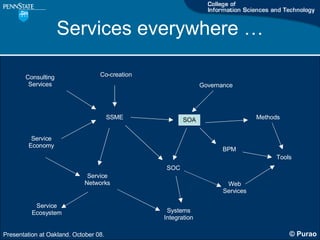
Services everywhere … SSME SOA SOC Web Services Methods Tools Co-creation Governance Systems Integration Service Economy Consulting Services Service Networks BPM Service Ecosystem
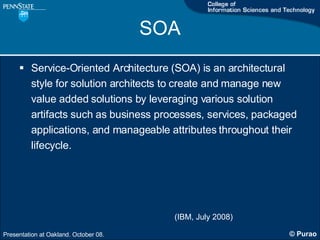
SOA Service-Oriented Architecture (SOA) is an architectural style for solution architects to create and manage new value added solutions by leveraging various solution artifacts such as business processes, services, packaged applications, and manageable attributes throughout their lifecycle.  (IBM, July 2008)
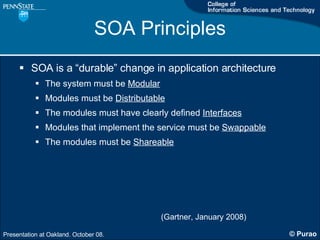
SOA Principles SOA is a “durable” change in application architecture The system must be  Modular Modules must be  Distributable The modules must have clearly defined  Interfaces Modules that implement the service must be  Swappable The modules must be  Shareable (Gartner, January 2008)
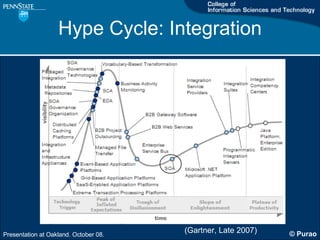
Hype Cycle: Integration (Gartner, Late 2007)
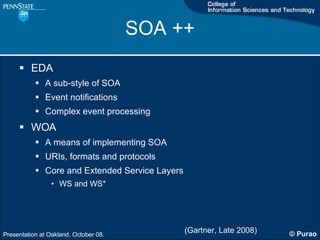
SOA ++ EDA A sub-style of SOA Event notifications Complex event processing WOA A means of implementing SOA URIs, formats and protocols Core and Extended Service Layers WS and WS* (Gartner, Late 2008)
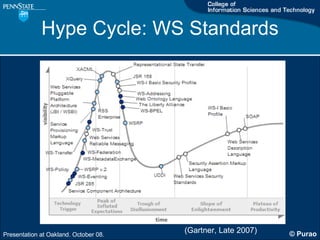
Hype Cycle: WS Standards (Gartner, Late 2007)
An Example Alter’s Service System Fundamentals Argues for a unified view: “service systems are work systems” Suggested ‘representation styles’ for services, e.g.  Work system snapshot consisting of Customer, Services, Processes, Participants, Information and Technologies Contrasting WSLC against SDLC emphasizing reuse yet several unanticipated interventions (Alter 2008)
Another example Rouse’s Service Value Networks Actors: consumers, service providers, enablers and auxiliary enablers Applications in several domains including healthcare  Complexity computations extending Shannon’s entropy Analytical possibilities following economic and industrial engineering perspectives (Basole and Rouse 2008)
Our own ongoing work Designing and Monitoring With Robinson and Jain Harvesting services from legacy applications Capturing service interaction protocols Goal-based monitoring Feedback to suggest evolution possibilities
A few problems A selective list based on anecdotal data / observations Focus on technology Business-IT relationship A problem of scale An ‘all-or-nothing’ proposition Do we know ‘how-to’ Transition plan Governance concerns Three Vendors  ->
The IBM View UML-based  Meta-model Meta-model includes  KPI, NFR, Goals, Processes © IBM
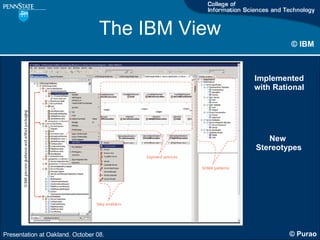
The IBM View Implemented with Rational New  Stereotypes © IBM
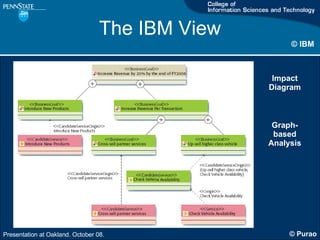
The IBM View Impact Diagram Graph- based Analysis © IBM
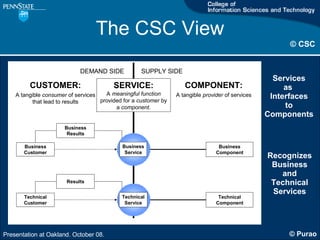
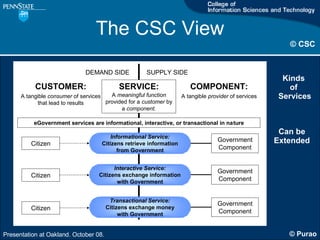
The CSC View Services as  Interfaces to Components Recognizes Business and Technical Services © CSC
The CSC View Kinds  of  Services Recognizes Manual and Automated Components and Services © CSC
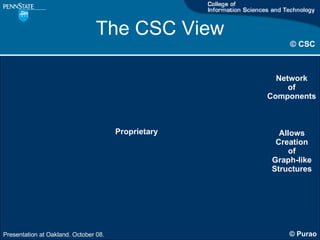
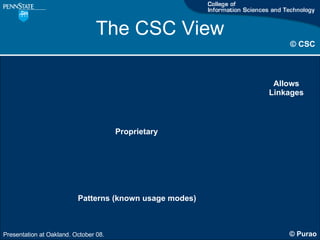
The CSC View Network of Components Allows Creation of Graph-like Structures © CSC Proprietary
The CSC View Kinds  of  Services Can be Extended © CSC
The CSC View Patterns (known usage modes) Allows Linkages © CSC Proprietary
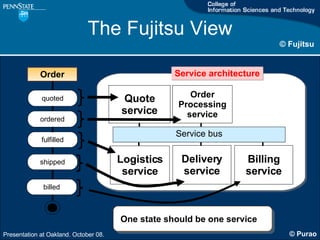
The Fujitsu View One state should be one service Service architecture quoted Service bus ordered fulfilled shipped Order billed © Fujitsu Quote service Order Processing service Logistics service Delivery service Billing service
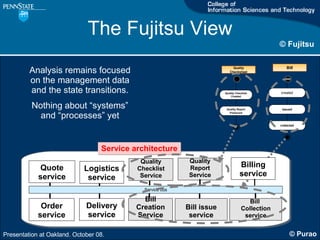
The Fujitsu View Quality Checksheet Bill Order service Quote service Logistics service Delivery service Service architecture Service bus Quality Checklist Created Quality Report Produced issued collected created Billing service Analysis remains focused on the management data and the state transitions. Nothing about “systems” and “processes” yet © Fujitsu Quality Checklist Service Bill Creation Service Quality Report Service Bill issue service Bill  Collection service
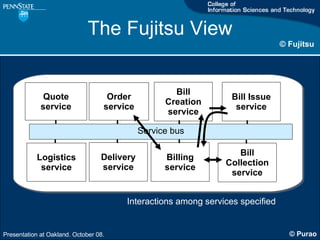
The Fujitsu View © Fujitsu Interactions among services specified Service bus Quote service Order service Logistics service Delivery service Billing service Bill Collection service Bill Creation service Bill Issue service
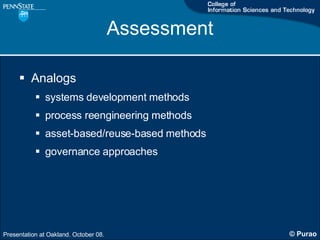
Assessment Analogs  systems development methods process reengineering methods asset-based/reuse-based methods governance approaches
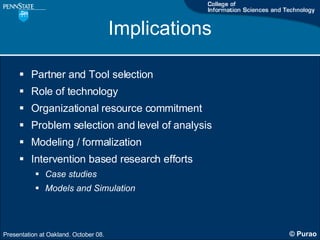
Implications Partner and Tool selection Role of technology Organizational resource commitment Problem selection and level of analysis Modeling / formalization Intervention based research efforts Case studies Models and Simulation
Q+A This Presentation College of IST + EI 2  Center  Collaborations Penn State Football  [email_address]

SOA Methodologies in Practice

  • 1.
    SOA Methodologies inPractice Sandeep Purao , Ph.D. Associate Professor of IST Enterprise Informatics and Integration Center Standards Interest Group, Socio-technical Systems Lab
  • 2.
    We Are.. Collegeof Information Sciences and Technology
  • 3.
    Services everywhere …SSME SOA SOC Web Services Methods Tools Co-creation Governance Systems Integration Service Economy Consulting Services Service Networks BPM Service Ecosystem
  • 4.
    SOA Service-Oriented Architecture(SOA) is an architectural style for solution architects to create and manage new value added solutions by leveraging various solution artifacts such as business processes, services, packaged applications, and manageable attributes throughout their lifecycle. (IBM, July 2008)
  • 5.
    SOA Principles SOAis a “durable” change in application architecture The system must be Modular Modules must be Distributable The modules must have clearly defined Interfaces Modules that implement the service must be Swappable The modules must be Shareable (Gartner, January 2008)
  • 6.
    Hype Cycle: Integration(Gartner, Late 2007)
  • 7.
    SOA ++ EDAA sub-style of SOA Event notifications Complex event processing WOA A means of implementing SOA URIs, formats and protocols Core and Extended Service Layers WS and WS* (Gartner, Late 2008)
  • 8.
    Hype Cycle: WSStandards (Gartner, Late 2007)
  • 9.
    An Example Alter’sService System Fundamentals Argues for a unified view: “service systems are work systems” Suggested ‘representation styles’ for services, e.g. Work system snapshot consisting of Customer, Services, Processes, Participants, Information and Technologies Contrasting WSLC against SDLC emphasizing reuse yet several unanticipated interventions (Alter 2008)
  • 10.
    Another example Rouse’sService Value Networks Actors: consumers, service providers, enablers and auxiliary enablers Applications in several domains including healthcare Complexity computations extending Shannon’s entropy Analytical possibilities following economic and industrial engineering perspectives (Basole and Rouse 2008)
  • 11.
    Our own ongoingwork Designing and Monitoring With Robinson and Jain Harvesting services from legacy applications Capturing service interaction protocols Goal-based monitoring Feedback to suggest evolution possibilities
  • 12.
    A few problemsA selective list based on anecdotal data / observations Focus on technology Business-IT relationship A problem of scale An ‘all-or-nothing’ proposition Do we know ‘how-to’ Transition plan Governance concerns Three Vendors ->
  • 13.
    The IBM ViewUML-based Meta-model Meta-model includes KPI, NFR, Goals, Processes © IBM
  • 14.
    The IBM ViewImplemented with Rational New Stereotypes © IBM
  • 15.
    The IBM ViewImpact Diagram Graph- based Analysis © IBM
  • 16.
    The CSC ViewServices as Interfaces to Components Recognizes Business and Technical Services © CSC
  • 17.
    The CSC ViewKinds of Services Recognizes Manual and Automated Components and Services © CSC
  • 18.
    The CSC ViewNetwork of Components Allows Creation of Graph-like Structures © CSC Proprietary
  • 19.
    The CSC ViewKinds of Services Can be Extended © CSC
  • 20.
    The CSC ViewPatterns (known usage modes) Allows Linkages © CSC Proprietary
  • 21.
    The Fujitsu ViewOne state should be one service Service architecture quoted Service bus ordered fulfilled shipped Order billed © Fujitsu Quote service Order Processing service Logistics service Delivery service Billing service
  • 22.
    The Fujitsu ViewQuality Checksheet Bill Order service Quote service Logistics service Delivery service Service architecture Service bus Quality Checklist Created Quality Report Produced issued collected created Billing service Analysis remains focused on the management data and the state transitions. Nothing about “systems” and “processes” yet © Fujitsu Quality Checklist Service Bill Creation Service Quality Report Service Bill issue service Bill Collection service
  • 23.
    The Fujitsu View© Fujitsu Interactions among services specified Service bus Quote service Order service Logistics service Delivery service Billing service Bill Collection service Bill Creation service Bill Issue service
  • 24.
    Assessment Analogs systems development methods process reengineering methods asset-based/reuse-based methods governance approaches
  • 25.
    Implications Partner andTool selection Role of technology Organizational resource commitment Problem selection and level of analysis Modeling / formalization Intervention based research efforts Case studies Models and Simulation
  • 26.
    Q+A This PresentationCollege of IST + EI 2 Center Collaborations Penn State Football [email_address]