E nterprise  A rchitecture as a Corporate Competency for Competitive Advantage
Enterprise Architecture Services in a Nutshell “ WHAT” is Architecture Goals  Scope Operations Deliverables Roles Shared Services (products and support) “ WHY” the "Convergence Imperative" Value SOA Enabler SOA Framework “ WHEN” Are Projects Engaged by EAS “ HOW” to Maintain Convergence Heading Agenda
Enterprise Architecture in a Nutshell   Convergence of Technology and Business Mission: Pre-project “ initiation”  build of prelim. solution map Develop, maintain and support “EAI Services”. Extend the useful life of system components. Manage and mentor  Enterprise Architecture Tenets; Tool standards and usage; Facilitate Architecture Steering Committee. Maintain “ convergence”  heading towards a  consistent and agile Enterprise Architecture. !
Enterprise Architecture in a Nutshell   Convergence of Technology and Business Increase quality of data; Improve agility of processing systems; Convergence = Consistency + Reliability + Agility; Ability to create shared services which can be used across multiple systems and lines of business. Outcomes:
Agenda Enterprise Architecture Services in a Nutshell “ WHAT” is Architecture Goals  Scope Operations Deliverables Roles Shared Services (products and support) “ WHY” the "Convergence Imperative" Value SOA Enabler SOA Framework “ WHEN” Are Projects Engaged by EAS “ HOW” to Maintain Convergence Heading
“ What” is Architecture A set of conceptual patterns that: Guide the design and integration of each major system; Defines a roadmap for integration across environments; Facilitate the realization of improved IT “PARTS”:  P erformance; A vailability; R eliability; T estability; S calability
Convergence of tools, techniques and solutions to gain efficiencies across multiple lines of business operations; Bridge the knowledge gap across the organization; Simplify complexity; Isolate dependencies; Better resource utilization; Less redundancy across all technology areas. “ What” is Architecture  (Goals)
“ What” is Architecture  (Scope)   Similar to blueprints for a  bridge architecture   defining the: Themes;  Materials, and;  Inter-connections  guiding construction of a “span” between two points… … Enterprise Architecture  defines the: Tenets; Tools and components, and;  Dependencies to shape convergence between multiple teams/systems. !
“ What” is Architecture  (Operations)   The enterprise architecture team develops blueprints to describe in explicit detail the: Solution boundaries;  Technical approach;  Tools and technologies; Raw components and interfaces.   The Project teams utilize these blueprints in the development of business solutions. The Architecture team rewards developers for Project components submitted and accepted for inclusion in the SOA Framework. The Architecture team extends and supports components harvested from Projects to be reused by the enterprise as “EAI Services”. !
Architecture Document  – Maps the problem space to the solution space and presents the solution in terms of the business, systems/applications, data and technical views (see Architecture Tenets).  Architecture Models and Tenets  – Define, own and maintain blueprints and associated principles and tenets that lead teams to convergence. EAI Services  – Identify, specify, design and mentor delivery of shared functionally autonomous “ E nterprise  A pplication  I ntegration Services” usable by multiple lines of operations. SOA Framework  – ID commonly needed EAI Services across the organization and assist Projects in their adoption and implementation. “ What” is Architecture  (Deliverables)   !
Just as a  Building Architect  defines principles and goals of a building project and incorporates them into blueprints… … an  Enterprise Architect  uses visual modeling to specify  convergence of the: Development; Application; Data, and; Technical architecture(s) as the basis for construction of physical systems/services for each Project. “ What” is Architecture  (Roles)
The  Enterprise Architect  develops: Plans software modularity and integration strategies; Business Objects (aka Services) and enterprise workflow. Interaction methods, particularly with external systems; General user interface dialog style; Design features, mechanisms and constraints. The  Enterprise & Lead Architects  consult with Managers and Tech. Leads regarding: Scope; Process, and; Design issues.   The  Enterprise & Lead Architects  consult with Developers on: Structural features; Implementation techniques; Appearance and style. “ What” is Architecture  (Roles continued)
The MarkITS Service Oriented Architecture (SOA) Framework consists of “EAI Services” used by two or more Projects.  Enterprise Service Bus (ESB) is the logical transport mechanism allowing the EAI Services to communicate across operating lines. “ EAI Services” provide common functionality across multiple  business lines of operations. Messaging Services; OTA Services; Monitoring Services; Security Services; Others to come… “ What” is Architecture  (Products)
EAS  core  team works with Project teams to conceive and design “EAI Services” needed by tactical Projects. EAS  virtual  team assists Projects in applying architecture tenets appropriate for Project size and complexity. EAS  virtual  team assists Projects in implementing EAI Services where appropriate. EAS generalizes reusable components into EAI Services that  unify ,  simplify  and  optimize  “convergence” by: Modeling current state enterprise  dependencies ; Constructing  blueprints  to assist analysis and “ convergence ”; Defining  EAI Services  foundation to jump-start implementations; Assisting Projects with refactoring of legacy designs. “ What” is Architecture  (Support)
Agenda Enterprise Architecture Services in a Nutshell “ WHAT” is Architecture Goals  Scope Operations Deliverables Roles Shared Services (products and support) “ WHY” the "Convergence Imperative" Value SOA Enabler SOA Framework “ WHEN” Are Projects Engaged by EAS “ HOW” to Maintain Convergence Heading
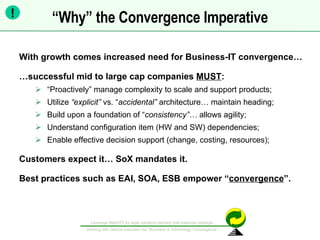
With growth comes increased need for Business-IT convergence…  … successful mid to large cap companies  MUST : “ Proactively” manage complexity to scale and support products; Utilize  “explicit”  vs. “ accidental”  architecture… maintain heading; Build upon a foundation of “ consistency”…  allows agility; Understand configuration item (HW and SW) dependencies; Enable effective decision support (change, costing, resources); Customers expect it… SoX mandates it. Best practices such as EAI, SOA, ESB empower “ convergence ”. “ Why” the Convergence Imperative !
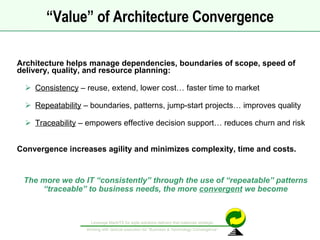
Architecture helps manage dependencies, boundaries of scope, speed of delivery, quality, and resource planning: Consistency  – reuse, extend, lower cost… faster time to market Repeatability  – boundaries, patterns, jump-start projects… improves quality Traceability  – empowers effective decision support… reduces churn and risk Convergence increases agility and minimizes complexity, time and costs. “ Value” of Architecture Convergence The more we do IT “consistently” through the use of “repeatable” patterns “traceable” to business needs, the more  convergent  we become
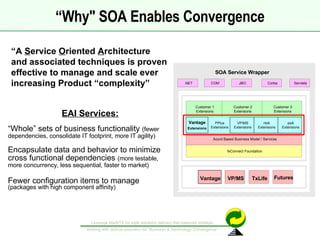
“ Whole” sets of business functionality  (fewer dependencies, consolidate IT footprint, more IT agility)   “ Why" SOA Enables Convergence EAI Services: Encapsulate data and behavior to minimize cross functional dependencies  (more testable, more concurrency, less sequential, faster to market) Fewer configuration items to manage  (packages with high component affinity) fsConnect Foundation Customer 1 Extensions Customer 3 Extensions Customer 2 Extensions Vantage VP/MS TxLife Futures Acord Based Business Model / Services JBO COM Corba Servlets .NET SOA Service Wrapper “ A  S ervice  O riented  A rchitecture and associated techniques is proven effective to manage and scale ever increasing Product “complexity” PPlus Extensions Vantage Extensions VP/MS Extensions nbA Extensions psA Extensions
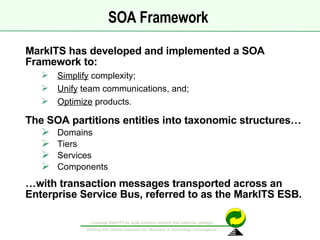
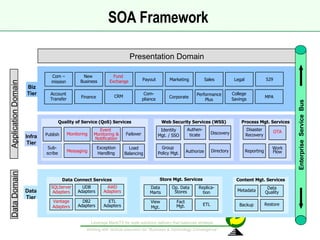
SOA Framework  MarkITS has developed and implemented a SOA Framework to: Simplify  complexity; Unify  team communications, and; Optimize  products.  The SOA partitions entities into taxonomic structures… Domains Tiers Services Components … with transaction messages transported across an  Enterprise Service Bus, referred to as the MarkITS ESB.
SOA Framework  Presentation Domain Application Domain Data Domain Biz Tier Account Transfer Finance CRM Com- pliance Performance Plus Corporate College Savings MPA Com – mission New  Business Fund  Exchange Payout Sales Marketing Legal 529 Infra Tier Process Mgt. Services Web Security Services (WSS) Quality of Service (QoS) Services Sub- scribe Exception Handling Publish Monitoring Event  Monitoring & Notification Messaging Failover Load Balancing Authen- ticate Directory Authorize Identity Mgt. / SSO Discovery Group  Policy Mgt. Reporting Disaster Recovery OTA Work Flow Data Tier Store Mgt. Services Data Connect Services SQLServer Adapters Vantage Adapters UDB Adapters DB2 Adapters Data Marts View Mgt. Op. Data Stores Fact Mgt. Replica- tion ETL Content Mgt. Services Metadata Backup Data Quality Restore AWD Adapters ETL Adapters Enterprise  Service  Bus
Agenda Enterprise Architecture Services in a Nutshell “ WHAT” is Architecture Goals  Scope Operations Deliverables Roles Shared Services (products and support) “ WHY” the "Convergence Imperative" Value SOA Enabler SOA Framework “ WHEN” Are Projects Engaged by EAS “ HOW” to Stay Headed Towards Convergence
“ WHEN” Are Projects Are Engaged by EAS Begin during  project proposal assessment   Map problem space to potential inventory of existing solutions EAS listens to key business requirements discussions to concurrently identify technical requirements. EAS helps structure the requirements as they are being identified: Business Requirements – inclusion in key Business-IT discussions; Functional Requirements – testable details of business requirements; Non-functional Requirements – supplemental needs (PARTS); Data – persistence needs; Technical – integration, sizing, hardware, environments, tools, COTS. EAS assists analysis to ID logical packages and raw components. EAS provides patterns mentoring during high level and detail design. EAS supports EAI Services  through implementation warranty . EAS provides long term EAI Services stewardship of PVCS baseline !
Agenda Enterprise Architecture Services in a Nutshell “ WHAT” is Architecture Goals  Scope Operations Deliverables Roles Shared Services (products and support) “ WHY” the "Convergence Imperative" Value SOA Enabler SOA Framework “ WHEN” Are Projects Engaged by EAS “ HOW” to Maintain Convergence Heading
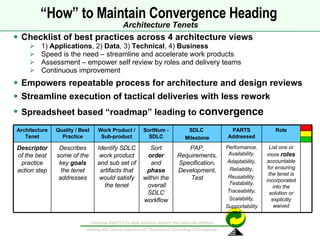
Checklist of best practices across 4 architecture views 1)  Applications , 2)  Data , 3)  Technical , 4)  Business   Speed is the need – streamline and accelerate work products Assessment – empower self review by roles and delivery teams Continuous improvement Empowers repeatable process for architecture and design reviews Streamline execution of tactical deliveries with less rework Spreadsheet based “roadmap” leading to  convergence “ How” to Maintain Convergence Heading  Architecture Tenets List one or more  roles  accountable for ensuring the tenet is incorporated into the solution or explicitly waived Performance, Availability, Adaptability, Reliability, Reusability, Testability, Traceability, Scalability, Supportability PAP, Requirements, Specification, Development, Test Sort  order  and  phase  within the  overall SDLC workflow Identify SDLC work product and sub set of artifacts that would satisfy the tenet Describes some of the key  goals  the tenet addresses Descriptor  of the best practice action step Role PARTS Addressed SDLC  Milestone SortNum -SDLC Work Product / Sub-product Quality / Best Practice Architecture Tenet
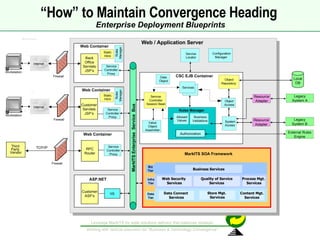
Web Container Web Container CSC EJB Container Services Allowed  Values  Business Validations Authorization Rules Manager System  Access Configuration  Manager Data  Object Web / Application Server Static  Html Static  Html Service  Controller  Proxy Service  Controller  Proxy Service  Controller  Session Bean Legacy System B R u l e s M a n a g e r R u l e s M a n a g e r Value  Object  Assembler Legacy System A Resource Adapter Resource Adapter Third  Party  Vendor Web Container TCP/IP External Rules Engine ASP.NET Customer ASP’s RPC Router Customer Servlets JSP’s Back Office Servlets JSP’s IIS Local DB MarkITS Enterprise  Service  Bus Store Mgt.  Services Process Mgt.  Services Web Security  Services Quality of Service Services Data Connect  Services Content Mgt. Services Business Services Data Tier Infra Tier Biz Tier MarkITS SOA Framework “ How” to Maintain Convergence Heading  Enterprise Deployment Blueprints Internet Workstation Object  Access Service  Locator Service  Controller  Proxy Object Repository  Internet Workstation Firewall Firewall Firewall
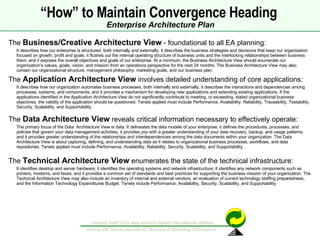
The  Business/Creative Architecture View  - foundational to all EA planning:   It describes how our enterprise is structured, both internally and externally; it describes the business strategies and decisions that keep our organization focused on growth, profit and goals; it flushes out the internal operating structure of business units and the interlocking relationships between business them; and it exposes the overall objectives and goals of our enterprise. At a minimum, the Business Architecture View should enumerate our organization's values, goals, vision, and mission from an operations perspective for the next 24 months. The Business Architecture View may also contain our organizational structure, management philosophy, marketing goals, and our business plan. The  Application Architecture View  involves detailed understanding of core applications: It describes how our organization automates business processes, both internally and externally; it describes the interactions and dependencies among processes, systems, and components; and it provides a mechanism for developing new applications and extending existing applications. If the applications identified in the Application Architecture View do not significantly contribute to meeting, or exceeding, stated organizational business objectives, the validity of the application should be questioned. Tenets applied must include Performance, Availability, Reliability, Traceability, Testability, Security, Scalability, and Supportability. The  Data Architecture View  reveals critical information necessary to effectively operate:   The primary focus of the Data  Architecture View is data. It delineates the data models of your enterprise; it defines the procedures, processes, and policies that govern your data management activities; it provides you with a greater understanding of your data recovery, backup, and usage patterns; and it provides greater understanding of the relationships and interdependencies among the data documents within your organization. The Data  Architecture View is about capturing, defining, and understanding data as it relates to organizational business processes, workflows, and data repositories. Tenets applied must include Performance, Availability, Reliability, Security, Scalability, and Supportability. The  Technical Architecture View  enumerates the state of the technical infrastructure:  It identifies desktop and server hardware; it identifies the operating systems and network infrastructure; it identifies any network components such as printers, modems, and faxes; and it provides a common set of standards and best practices for supporting the business mission of your organization. The Technical Architecture View may also include an inventory of internal and external vendors, an evaluation of current technology staffing preparedness, and the Information Technology Expenditures Budget. Tenets include Performance, Availability, Security, Scalability, and Supportability. “ How” to Maintain Convergence Heading  Enterprise Architecture Plan
Thank You  For Your  Participation! [email_address] www.MarkITS.us   Discussion – Q & A

Enterprise Architecture as a Competitive Advantage in the MarkITS

  • 1.
    E nterprise A rchitecture as a Corporate Competency for Competitive Advantage
  • 2.
    Enterprise Architecture Servicesin a Nutshell “ WHAT” is Architecture Goals Scope Operations Deliverables Roles Shared Services (products and support) “ WHY” the "Convergence Imperative" Value SOA Enabler SOA Framework “ WHEN” Are Projects Engaged by EAS “ HOW” to Maintain Convergence Heading Agenda
  • 3.
    Enterprise Architecture ina Nutshell Convergence of Technology and Business Mission: Pre-project “ initiation” build of prelim. solution map Develop, maintain and support “EAI Services”. Extend the useful life of system components. Manage and mentor Enterprise Architecture Tenets; Tool standards and usage; Facilitate Architecture Steering Committee. Maintain “ convergence” heading towards a consistent and agile Enterprise Architecture. !
  • 4.
    Enterprise Architecture ina Nutshell Convergence of Technology and Business Increase quality of data; Improve agility of processing systems; Convergence = Consistency + Reliability + Agility; Ability to create shared services which can be used across multiple systems and lines of business. Outcomes:
  • 5.
    Agenda Enterprise ArchitectureServices in a Nutshell “ WHAT” is Architecture Goals Scope Operations Deliverables Roles Shared Services (products and support) “ WHY” the "Convergence Imperative" Value SOA Enabler SOA Framework “ WHEN” Are Projects Engaged by EAS “ HOW” to Maintain Convergence Heading
  • 6.
    “ What” isArchitecture A set of conceptual patterns that: Guide the design and integration of each major system; Defines a roadmap for integration across environments; Facilitate the realization of improved IT “PARTS”: P erformance; A vailability; R eliability; T estability; S calability
  • 7.
    Convergence of tools,techniques and solutions to gain efficiencies across multiple lines of business operations; Bridge the knowledge gap across the organization; Simplify complexity; Isolate dependencies; Better resource utilization; Less redundancy across all technology areas. “ What” is Architecture (Goals)
  • 8.
    “ What” isArchitecture (Scope) Similar to blueprints for a bridge architecture defining the: Themes; Materials, and; Inter-connections guiding construction of a “span” between two points… … Enterprise Architecture defines the: Tenets; Tools and components, and; Dependencies to shape convergence between multiple teams/systems. !
  • 9.
    “ What” isArchitecture (Operations) The enterprise architecture team develops blueprints to describe in explicit detail the: Solution boundaries; Technical approach; Tools and technologies; Raw components and interfaces. The Project teams utilize these blueprints in the development of business solutions. The Architecture team rewards developers for Project components submitted and accepted for inclusion in the SOA Framework. The Architecture team extends and supports components harvested from Projects to be reused by the enterprise as “EAI Services”. !
  • 10.
    Architecture Document – Maps the problem space to the solution space and presents the solution in terms of the business, systems/applications, data and technical views (see Architecture Tenets). Architecture Models and Tenets – Define, own and maintain blueprints and associated principles and tenets that lead teams to convergence. EAI Services – Identify, specify, design and mentor delivery of shared functionally autonomous “ E nterprise A pplication I ntegration Services” usable by multiple lines of operations. SOA Framework – ID commonly needed EAI Services across the organization and assist Projects in their adoption and implementation. “ What” is Architecture (Deliverables) !
  • 11.
    Just as a Building Architect defines principles and goals of a building project and incorporates them into blueprints… … an Enterprise Architect uses visual modeling to specify convergence of the: Development; Application; Data, and; Technical architecture(s) as the basis for construction of physical systems/services for each Project. “ What” is Architecture (Roles)
  • 12.
    The EnterpriseArchitect develops: Plans software modularity and integration strategies; Business Objects (aka Services) and enterprise workflow. Interaction methods, particularly with external systems; General user interface dialog style; Design features, mechanisms and constraints. The Enterprise & Lead Architects consult with Managers and Tech. Leads regarding: Scope; Process, and; Design issues. The Enterprise & Lead Architects consult with Developers on: Structural features; Implementation techniques; Appearance and style. “ What” is Architecture (Roles continued)
  • 13.
    The MarkITS ServiceOriented Architecture (SOA) Framework consists of “EAI Services” used by two or more Projects. Enterprise Service Bus (ESB) is the logical transport mechanism allowing the EAI Services to communicate across operating lines. “ EAI Services” provide common functionality across multiple business lines of operations. Messaging Services; OTA Services; Monitoring Services; Security Services; Others to come… “ What” is Architecture (Products)
  • 14.
    EAS core team works with Project teams to conceive and design “EAI Services” needed by tactical Projects. EAS virtual team assists Projects in applying architecture tenets appropriate for Project size and complexity. EAS virtual team assists Projects in implementing EAI Services where appropriate. EAS generalizes reusable components into EAI Services that unify , simplify and optimize “convergence” by: Modeling current state enterprise dependencies ; Constructing blueprints to assist analysis and “ convergence ”; Defining EAI Services foundation to jump-start implementations; Assisting Projects with refactoring of legacy designs. “ What” is Architecture (Support)
  • 15.
    Agenda Enterprise ArchitectureServices in a Nutshell “ WHAT” is Architecture Goals Scope Operations Deliverables Roles Shared Services (products and support) “ WHY” the "Convergence Imperative" Value SOA Enabler SOA Framework “ WHEN” Are Projects Engaged by EAS “ HOW” to Maintain Convergence Heading
  • 16.
    With growth comesincreased need for Business-IT convergence… … successful mid to large cap companies MUST : “ Proactively” manage complexity to scale and support products; Utilize “explicit” vs. “ accidental” architecture… maintain heading; Build upon a foundation of “ consistency”… allows agility; Understand configuration item (HW and SW) dependencies; Enable effective decision support (change, costing, resources); Customers expect it… SoX mandates it. Best practices such as EAI, SOA, ESB empower “ convergence ”. “ Why” the Convergence Imperative !
  • 17.
    Architecture helps managedependencies, boundaries of scope, speed of delivery, quality, and resource planning: Consistency – reuse, extend, lower cost… faster time to market Repeatability – boundaries, patterns, jump-start projects… improves quality Traceability – empowers effective decision support… reduces churn and risk Convergence increases agility and minimizes complexity, time and costs. “ Value” of Architecture Convergence The more we do IT “consistently” through the use of “repeatable” patterns “traceable” to business needs, the more convergent we become
  • 18.
    “ Whole” setsof business functionality (fewer dependencies, consolidate IT footprint, more IT agility) “ Why" SOA Enables Convergence EAI Services: Encapsulate data and behavior to minimize cross functional dependencies (more testable, more concurrency, less sequential, faster to market) Fewer configuration items to manage (packages with high component affinity) fsConnect Foundation Customer 1 Extensions Customer 3 Extensions Customer 2 Extensions Vantage VP/MS TxLife Futures Acord Based Business Model / Services JBO COM Corba Servlets .NET SOA Service Wrapper “ A S ervice O riented A rchitecture and associated techniques is proven effective to manage and scale ever increasing Product “complexity” PPlus Extensions Vantage Extensions VP/MS Extensions nbA Extensions psA Extensions
  • 19.
    SOA Framework MarkITS has developed and implemented a SOA Framework to: Simplify complexity; Unify team communications, and; Optimize products. The SOA partitions entities into taxonomic structures… Domains Tiers Services Components … with transaction messages transported across an Enterprise Service Bus, referred to as the MarkITS ESB.
  • 20.
    SOA Framework Presentation Domain Application Domain Data Domain Biz Tier Account Transfer Finance CRM Com- pliance Performance Plus Corporate College Savings MPA Com – mission New Business Fund Exchange Payout Sales Marketing Legal 529 Infra Tier Process Mgt. Services Web Security Services (WSS) Quality of Service (QoS) Services Sub- scribe Exception Handling Publish Monitoring Event Monitoring & Notification Messaging Failover Load Balancing Authen- ticate Directory Authorize Identity Mgt. / SSO Discovery Group Policy Mgt. Reporting Disaster Recovery OTA Work Flow Data Tier Store Mgt. Services Data Connect Services SQLServer Adapters Vantage Adapters UDB Adapters DB2 Adapters Data Marts View Mgt. Op. Data Stores Fact Mgt. Replica- tion ETL Content Mgt. Services Metadata Backup Data Quality Restore AWD Adapters ETL Adapters Enterprise Service Bus
  • 21.
    Agenda Enterprise ArchitectureServices in a Nutshell “ WHAT” is Architecture Goals Scope Operations Deliverables Roles Shared Services (products and support) “ WHY” the "Convergence Imperative" Value SOA Enabler SOA Framework “ WHEN” Are Projects Engaged by EAS “ HOW” to Stay Headed Towards Convergence
  • 22.
    “ WHEN” AreProjects Are Engaged by EAS Begin during project proposal assessment Map problem space to potential inventory of existing solutions EAS listens to key business requirements discussions to concurrently identify technical requirements. EAS helps structure the requirements as they are being identified: Business Requirements – inclusion in key Business-IT discussions; Functional Requirements – testable details of business requirements; Non-functional Requirements – supplemental needs (PARTS); Data – persistence needs; Technical – integration, sizing, hardware, environments, tools, COTS. EAS assists analysis to ID logical packages and raw components. EAS provides patterns mentoring during high level and detail design. EAS supports EAI Services through implementation warranty . EAS provides long term EAI Services stewardship of PVCS baseline !
  • 23.
    Agenda Enterprise ArchitectureServices in a Nutshell “ WHAT” is Architecture Goals Scope Operations Deliverables Roles Shared Services (products and support) “ WHY” the "Convergence Imperative" Value SOA Enabler SOA Framework “ WHEN” Are Projects Engaged by EAS “ HOW” to Maintain Convergence Heading
  • 24.
    Checklist of bestpractices across 4 architecture views 1) Applications , 2) Data , 3) Technical , 4) Business Speed is the need – streamline and accelerate work products Assessment – empower self review by roles and delivery teams Continuous improvement Empowers repeatable process for architecture and design reviews Streamline execution of tactical deliveries with less rework Spreadsheet based “roadmap” leading to convergence “ How” to Maintain Convergence Heading Architecture Tenets List one or more roles accountable for ensuring the tenet is incorporated into the solution or explicitly waived Performance, Availability, Adaptability, Reliability, Reusability, Testability, Traceability, Scalability, Supportability PAP, Requirements, Specification, Development, Test Sort order and phase within the overall SDLC workflow Identify SDLC work product and sub set of artifacts that would satisfy the tenet Describes some of the key goals the tenet addresses Descriptor of the best practice action step Role PARTS Addressed SDLC Milestone SortNum -SDLC Work Product / Sub-product Quality / Best Practice Architecture Tenet
  • 25.
    Web Container WebContainer CSC EJB Container Services Allowed Values Business Validations Authorization Rules Manager System Access Configuration Manager Data Object Web / Application Server Static Html Static Html Service Controller Proxy Service Controller Proxy Service Controller Session Bean Legacy System B R u l e s M a n a g e r R u l e s M a n a g e r Value Object Assembler Legacy System A Resource Adapter Resource Adapter Third Party Vendor Web Container TCP/IP External Rules Engine ASP.NET Customer ASP’s RPC Router Customer Servlets JSP’s Back Office Servlets JSP’s IIS Local DB MarkITS Enterprise Service Bus Store Mgt. Services Process Mgt. Services Web Security Services Quality of Service Services Data Connect Services Content Mgt. Services Business Services Data Tier Infra Tier Biz Tier MarkITS SOA Framework “ How” to Maintain Convergence Heading Enterprise Deployment Blueprints Internet Workstation Object Access Service Locator Service Controller Proxy Object Repository Internet Workstation Firewall Firewall Firewall
  • 26.
    The Business/CreativeArchitecture View - foundational to all EA planning: It describes how our enterprise is structured, both internally and externally; it describes the business strategies and decisions that keep our organization focused on growth, profit and goals; it flushes out the internal operating structure of business units and the interlocking relationships between business them; and it exposes the overall objectives and goals of our enterprise. At a minimum, the Business Architecture View should enumerate our organization's values, goals, vision, and mission from an operations perspective for the next 24 months. The Business Architecture View may also contain our organizational structure, management philosophy, marketing goals, and our business plan. The Application Architecture View involves detailed understanding of core applications: It describes how our organization automates business processes, both internally and externally; it describes the interactions and dependencies among processes, systems, and components; and it provides a mechanism for developing new applications and extending existing applications. If the applications identified in the Application Architecture View do not significantly contribute to meeting, or exceeding, stated organizational business objectives, the validity of the application should be questioned. Tenets applied must include Performance, Availability, Reliability, Traceability, Testability, Security, Scalability, and Supportability. The Data Architecture View reveals critical information necessary to effectively operate: The primary focus of the Data Architecture View is data. It delineates the data models of your enterprise; it defines the procedures, processes, and policies that govern your data management activities; it provides you with a greater understanding of your data recovery, backup, and usage patterns; and it provides greater understanding of the relationships and interdependencies among the data documents within your organization. The Data Architecture View is about capturing, defining, and understanding data as it relates to organizational business processes, workflows, and data repositories. Tenets applied must include Performance, Availability, Reliability, Security, Scalability, and Supportability. The Technical Architecture View enumerates the state of the technical infrastructure: It identifies desktop and server hardware; it identifies the operating systems and network infrastructure; it identifies any network components such as printers, modems, and faxes; and it provides a common set of standards and best practices for supporting the business mission of your organization. The Technical Architecture View may also include an inventory of internal and external vendors, an evaluation of current technology staffing preparedness, and the Information Technology Expenditures Budget. Tenets include Performance, Availability, Security, Scalability, and Supportability. “ How” to Maintain Convergence Heading Enterprise Architecture Plan
  • 27.
    Thank You For Your Participation! [email_address] www.MarkITS.us Discussion – Q & A