P4.1 Reference Architectures for Enterprise Big Data Use Cases
Romeo Kienzler, Data Scientist, Advisory Architect, IBM Germany, Austria, Switzerland
IBM Center of Excellence for Data Science, Cognitive Systems and BigData
(A joint-venture between IBM Research Zurich and IBM Innovation Center DACH)
● Motivation
● Use Cases
● How Databases scale
● Evolution of Large Scale Data Processing
● Requirements and Ingredients
● Architectural Proposal
Agenda
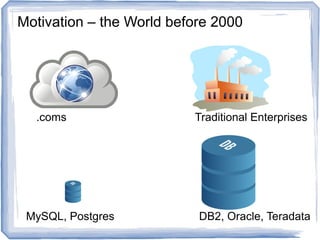
Motivation – the World before 2000
.coms Traditional Enterprises
MySQL, Postgres DB2, Oracle, Teradata
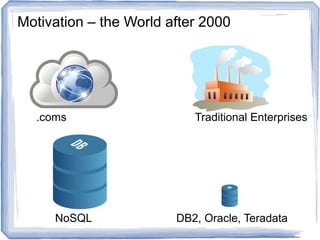
Motivation – the World after 2000
.coms Traditional Enterprises
NoSQL DB2, Oracle, Teradata
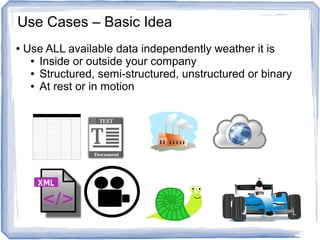
● Use ALL available data independently weather it is
Use Cases – Basic Idea
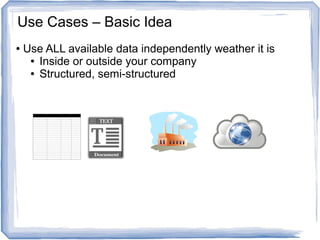
● Use ALL available data independently weather it is
● Inside
Use Cases – Basic Idea
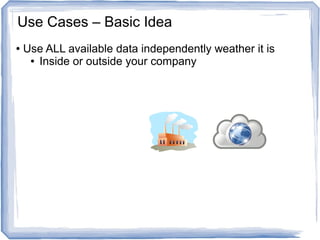
● Use ALL available data independently weather it is
● Inside or outside your company
Use Cases – Basic Idea
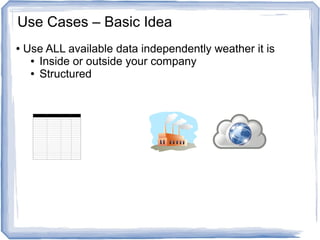
● Use ALL available data independently weather it is
● Inside or outside your company
● Structured
Use Cases – Basic Idea
● Use ALL available data independently weather it is
● Inside or outside your company
● Structured, semi-structured
Use Cases – Basic Idea
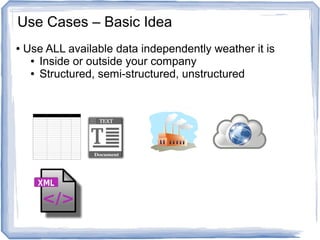
● Use ALL available data independently weather it is
● Inside or outside your company
● Structured, semi-structured, unstructured
Use Cases – Basic Idea
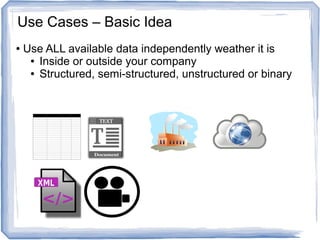
● Use ALL available data independently weather it is
● Inside or outside your company
● Structured, semi-structured, unstructured or binary
Use Cases – Basic Idea
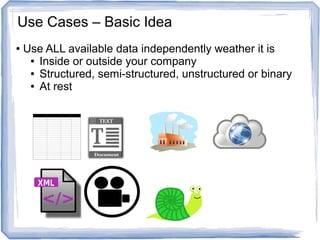
● Use ALL available data independently weather it is
● Inside or outside your company
● Structured, semi-structured, unstructured or binary
● At rest
Use Cases – Basic Idea
● Use ALL available data independently weather it is
● Inside or outside your company
● Structured, semi-structured, unstructured or binary
● At rest or in motion
Use Cases – Basic Idea
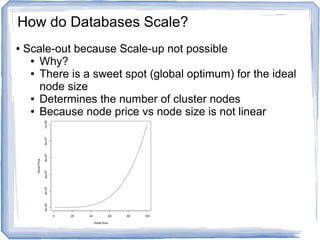
● Scale-out because Scale-up not possible
● Why?
● There is a sweet spot (global optimum) for the ideal
node size
● Determines the number of cluster nodes
● Because node price vs node size is not linear
How do Databases Scale?
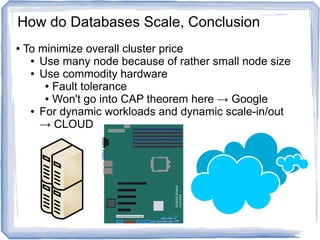
● To minimize overall cluster price
● Use many node because of rather small node size
● Use commodity hardware
● Fault tolerance
● Won't go into CAP theorem here → Google
● For dynamic workloads and dynamic scale-in/out
→ CLOUD
How do Databases Scale, Conclusion
● Current situation in Enterprises
● BI Tools
● SQL (42%)
● R (33%)
● Python (26%)
● Excel (25%)
● Java, Ruby, C++ (17%)
● SPSS, SAS (9%)
● Current situation in .coms
● Writing MapReduce Jobs
● Using proprietary query languages
● Code everything from scratch
Current situation
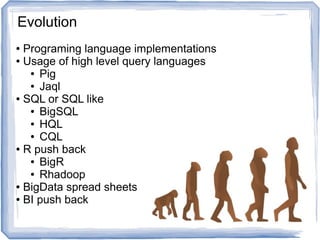
● Programing language implementations
● Usage of high level query languages
● Pig
● Jaql
● SQL or SQL like
● BigSQL
● HQL
● CQL
● R push back
● BigR
● Rhadoop
● BigData spread sheets
● BI push back
● SPSS push back
Evolution
Pig(Latin) / JAQL
BigSQL
Big Spreadsheets
BigR
SPSS
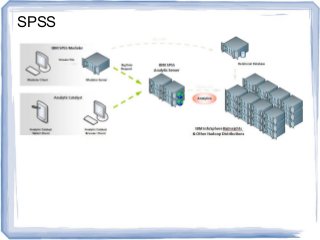
SPSS
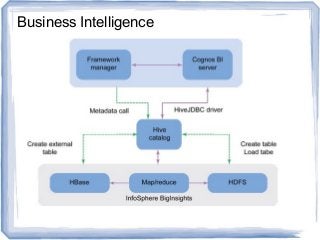
Business Intelligence
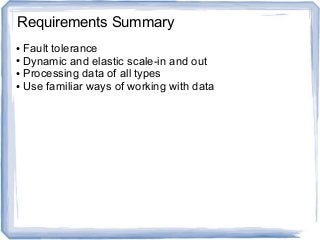
● Fault tolerance
● Dynamic and elastic scale-in and out
● Processing data of all types
● Use familiar ways of working with data
Requirements Summary
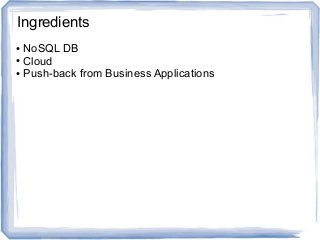
● NoSQL DB
● Cloud
● Push-back from Business Applications
Ingredients
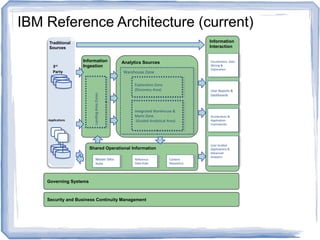
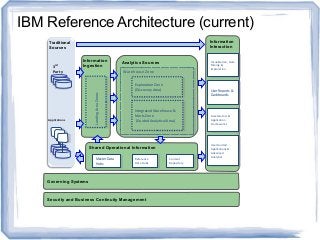
IBM Reference Architecture (current)
Information
Ingestion
Security and Business Continuity Management
Information
Interaction
Analytics Sources
Shared Operational Information
Traditional
Sources
3rd
Party
Applications
Governing Systems
Visualization, Data
Mining &
Exploration
Visualization, Data
Mining &
Exploration
User Reports &
Dashboards
User Reports &
Dashboards
Accelerators &
Application
Frameworks
Accelerators &
Application
Frameworks
User Guided
Applications &
Advanced
Analytics
User Guided
Applications &
Advanced
Analytics
Content
Repository
Content
Repository
Master Data
Hubs
Master Data
Hubs
Reference
Data Hubs
Reference
Data Hubs
Warehouse ZoneWarehouse Zone
Integrated Warehouse &
Marts Zone
(Guided Analytical Area)
Integrated Warehouse &
Marts Zone
(Guided Analytical Area)
Exploration Zone
(Discovery Area)
Exploration Zone
(Discovery Area)
LandingAreaZones
LandingAreaZones
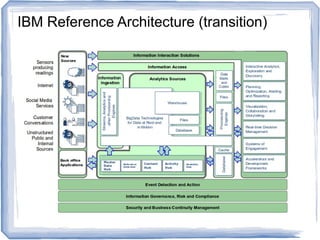
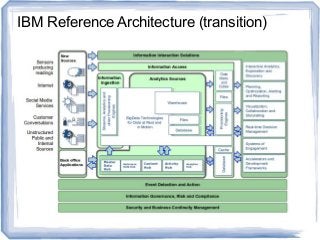
IBM Reference Architecture (transition)
15 minutes Discussion
Twitter: @romeokienzler
Email: romeo . Kienzler (at) ch.ibm.com

The European Conference on Software Architecture (ECSA) 14 - IBM BigData Reference Architecture

  • 1.
    P4.1 Reference Architecturesfor Enterprise Big Data Use Cases Romeo Kienzler, Data Scientist, Advisory Architect, IBM Germany, Austria, Switzerland IBM Center of Excellence for Data Science, Cognitive Systems and BigData (A joint-venture between IBM Research Zurich and IBM Innovation Center DACH)
  • 2.
    ● Motivation ● UseCases ● How Databases scale ● Evolution of Large Scale Data Processing ● Requirements and Ingredients ● Architectural Proposal Agenda
  • 3.
    Motivation – theWorld before 2000 .coms Traditional Enterprises MySQL, Postgres DB2, Oracle, Teradata
  • 4.
    Motivation – theWorld after 2000 .coms Traditional Enterprises NoSQL DB2, Oracle, Teradata
  • 5.
    ● Use ALLavailable data independently weather it is Use Cases – Basic Idea
  • 6.
    ● Use ALLavailable data independently weather it is ● Inside Use Cases – Basic Idea
  • 7.
    ● Use ALLavailable data independently weather it is ● Inside or outside your company Use Cases – Basic Idea
  • 8.
    ● Use ALLavailable data independently weather it is ● Inside or outside your company ● Structured Use Cases – Basic Idea
  • 9.
    ● Use ALLavailable data independently weather it is ● Inside or outside your company ● Structured, semi-structured Use Cases – Basic Idea
  • 10.
    ● Use ALLavailable data independently weather it is ● Inside or outside your company ● Structured, semi-structured, unstructured Use Cases – Basic Idea
  • 11.
    ● Use ALLavailable data independently weather it is ● Inside or outside your company ● Structured, semi-structured, unstructured or binary Use Cases – Basic Idea
  • 12.
    ● Use ALLavailable data independently weather it is ● Inside or outside your company ● Structured, semi-structured, unstructured or binary ● At rest Use Cases – Basic Idea
  • 13.
    ● Use ALLavailable data independently weather it is ● Inside or outside your company ● Structured, semi-structured, unstructured or binary ● At rest or in motion Use Cases – Basic Idea
  • 14.
    ● Scale-out becauseScale-up not possible ● Why? ● There is a sweet spot (global optimum) for the ideal node size ● Determines the number of cluster nodes ● Because node price vs node size is not linear How do Databases Scale?
  • 15.
    ● To minimizeoverall cluster price ● Use many node because of rather small node size ● Use commodity hardware ● Fault tolerance ● Won't go into CAP theorem here → Google ● For dynamic workloads and dynamic scale-in/out → CLOUD How do Databases Scale, Conclusion
  • 16.
    ● Current situationin Enterprises ● BI Tools ● SQL (42%) ● R (33%) ● Python (26%) ● Excel (25%) ● Java, Ruby, C++ (17%) ● SPSS, SAS (9%) ● Current situation in .coms ● Writing MapReduce Jobs ● Using proprietary query languages ● Code everything from scratch Current situation
  • 17.
    ● Programing languageimplementations ● Usage of high level query languages ● Pig ● Jaql ● SQL or SQL like ● BigSQL ● HQL ● CQL ● R push back ● BigR ● Rhadoop ● BigData spread sheets ● BI push back ● SPSS push back Evolution
  • 18.
  • 19.
  • 20.
  • 21.
  • 22.
  • 23.
  • 24.
  • 25.
    ● Fault tolerance ●Dynamic and elastic scale-in and out ● Processing data of all types ● Use familiar ways of working with data Requirements Summary
  • 26.
    ● NoSQL DB ●Cloud ● Push-back from Business Applications Ingredients
  • 27.
    IBM Reference Architecture(current) Information Ingestion Security and Business Continuity Management Information Interaction Analytics Sources Shared Operational Information Traditional Sources 3rd Party Applications Governing Systems Visualization, Data Mining & Exploration Visualization, Data Mining & Exploration User Reports & Dashboards User Reports & Dashboards Accelerators & Application Frameworks Accelerators & Application Frameworks User Guided Applications & Advanced Analytics User Guided Applications & Advanced Analytics Content Repository Content Repository Master Data Hubs Master Data Hubs Reference Data Hubs Reference Data Hubs Warehouse ZoneWarehouse Zone Integrated Warehouse & Marts Zone (Guided Analytical Area) Integrated Warehouse & Marts Zone (Guided Analytical Area) Exploration Zone (Discovery Area) Exploration Zone (Discovery Area) LandingAreaZones LandingAreaZones
  • 28.
  • 29.
    15 minutes Discussion Twitter:@romeokienzler Email: romeo . Kienzler (at) ch.ibm.com