

Enterprise / Solution
Architecture Revisited
( webinar from London )
Daljit Roy Banger MSc FBCS1st June 2017
EA SIG
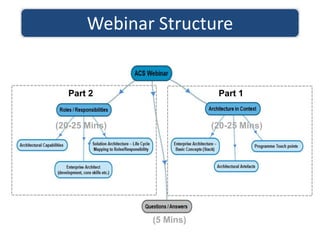
Webinar Structure
(20-25 Mins)(20-25 Mins)
(5 Mins)
Part 1Part 2
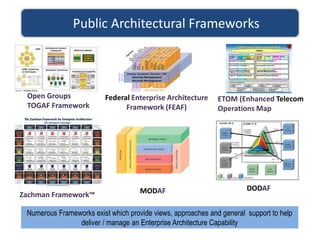
Open Groups
TOGAF Framework
Zachman Framework™ MODAF
Federal Enterprise Architecture
Framework (FEAF)
DODAF
Public Architectural Frameworks
ETOM (Enhanced Telecom
Operations Map
Numerous Frameworks exist which provide views, approaches and general support to help
deliver / manage an Enterprise Architecture Capability
 Enterprise Architecture supports how one builds a reusable Unified
Information Systems/Management capability that supports and meets
Organisational needs.
 The EA Goal is to Align and Manage the Technology landscape of an
Organisation with its Strategic / Operational Goals/Objectives for both
today and tomorrow.
Something to Consider…
 Enterprise Architecture is NOT Enterprise Systems Architecture and this
difference often results in opposing views in terms of capabilities and
outcomes.
These can be expressed as:
 A view towards how we construct / reconstruct the Organisation to
deliver specific Enterprise outcomes.
 A view with a strong bias towards Technology and how it can be
best provisioned to meet outcomes.
A Quick Introduction
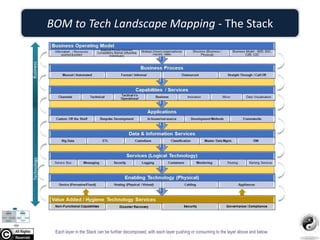
BOM to Tech Landscape Mapping - The Stack
Each layer in the Stack can be further decomposed, with each layer pushing or consuming to the layer above and below.
BusinessTechnology
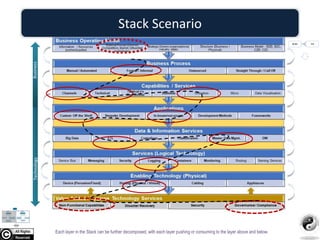
Stack Scenario
Each layer in the Stack can be further decomposed, with each layer pushing or consuming to the layer above and below.
BusinessTechnology
BOM BM
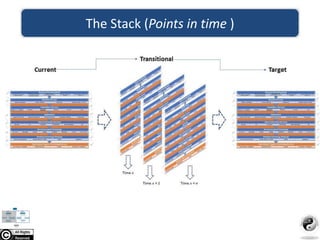
The Stack (Points in time )
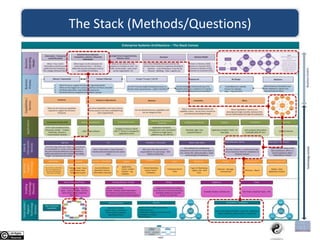
The Stack (Methods/Questions)
Products of Enterprise Architecture
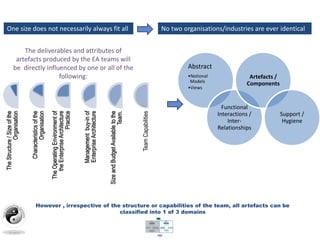
The deliverables and attributes of
artefacts produced by the EA teams will
be directly influenced by one or all of the
following:
TheStructure/Sizeofthe
Organisation
Characteristicsofthe
Organisation
TheOperatingEnvironmentof
theEnterpriseArchitecture
Practice
Managementbuy-inof
EnterpriseArchitecture
SizeandBudgetAvailabletothe
Team.
TeamCapabilities
However , irrespective of the structure or capabilities of the team, all artefacts can be
classified into 1 of 3 domains
One size does not necessarily always fit all No two organisations/industries are ever identical
Abstract
•Notional
Models
•Views
Functional
Interactions /
Inter-
Relationships
Artefacts /
Components
Support /
Hygiene
Control
Governance –
Process
Boards –
Review,
Technical,
Business
Boards
Programme /
Project
Engagement
Business /
Partner
Engagements
Stakeholder
Management
Inform
Principles
Policies
Portfolio
Manageme
nt
Funding
Models
Reference
Models
• Technical
• ApplicationBest
Practices
Patterns
Impact
Assessmen
ts
Marketing
Plans
Standards /
Notations
Direct
Stakeholder
Engagement
Business
Architecture
Target
Definition
Application
Target
Architecture
Data &
Information
(Master Data
Management
Strategy)
Infrastructure
Target
Architecture –
Enabling
Technology &
Platforms
Roadmaps
(Product /
Technology)
Gap Analysis –
Transitional
States
Impact
Assessments
Service
promotion,
catalogue
etc…
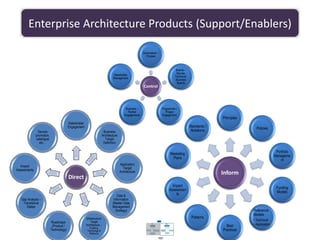
Enterprise Architecture Products (Support/Enablers)
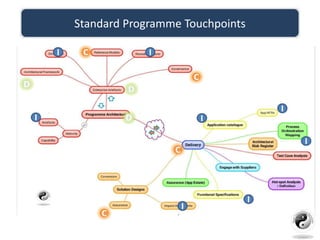
Standard Programme Touchpoints
Context
Define
Measure
Analyze
Improve
control
EA/SCRUM Touchpoints
Six Sigma’s
DMAIC
D
I
I
C
C
If, like me, you are a fan of the US HBO “Silicon Valley” TV show, you will have laughed at the guys in
episode 5 discussing SCRUM – if you have not , here’s a link to exert http://youtu.be/oyVksFviJVE .
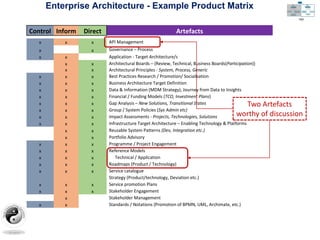
Enterprise Architecture - Example Product Matrix
Control Inform Direct Artefacts
x x x API Management
x x Governance – Process
x x Application - Target Architecture/s
x x Architectural Boards – (Review, Technical, Business Boards(Participation))
x x Architectural Principles - System, Process, Generic
x x x Best Practices Research / Promotion/ Socialisation
x x x Business Architecture Target Definition
x x x Data & Information (MDM Strategy), Journey from Data to Insights
x x x Financial / Funding Models (TCO, Investment Plans)
x x x Gap Analysis – New Solutions, Transitional States
x x x Group / System Policies (Sys Admin etc)
x x x Impact Assessments - Projects, Technologies, Solutions
x x x Infrastructure Target Architecture – Enabling Technology & Platforms
x x Reusable System Patterns (Dev, Integration etc.)
x x Portfolio Advisory
x x x Programme / Project Engagement
x x x Reference Models
x x x Technical / Application
x x x Roadmaps (Product / Technology)
x x x Service catalogue
Strategy (Product/technology, Deviation etc.)
x x x Service promotion Plans
x x x Stakeholder Engagement
x Stakeholder Management
x x Standards / Notations (Promotion of BPMN, UML, Archimate, etc.)
Two Artefacts
worthy of discussion
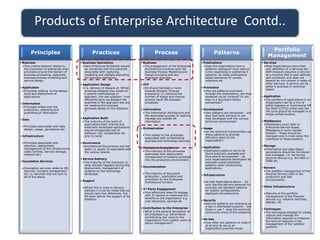
Principles
• Business
• This criteria element relates to
the promotion of enterprise wide
principles around the domain of
business processing, especially
business process modelling and
service design.
• Application
• Principles relating to the design,
build and deployment of
applications
• Information
• Principles linked with the
production, cleansing and
publishing of information
• Data
• Principles associated with data
design, usage, persistence etc.
• Infrastructure
• Principles associated with
selection, deployment,
management of the infrastructure
(data Centres, Servers storage,
network etc)
• Foundation Services.
• Foundation services relate to DR,
Security, Incident management
etc i.e. services that are core to
all of the above
Practices
• Business Operations
• Here Enterprise Architects should
be concerned with the practices
associated with capturing,
modelling and digitally executing
the business operations.
• Application Design
• I.e. delivery of designs of. Whilst,
practices adopted may based on
a specific methodology or
approach, the real question ‘ how
efficiently have we adopted the
practices of the approach and are
we meeting the business
demands based on this adoption
?’
• Application Build
• The maturity of the build of
applications both internal and
externally developed applications
should encapsulate test of
software unit, components etc
prior to build
• Governance
• Architectural Governance and the
teeth i.e. power of associated with
the various boards.
• Service Delivery
• The maturity of the practices i.e.
what actually happens during the
deployment, management of
systems on the technology
landscape.
• Support
• Whilst this is close to Service
Delivery it must be noted that we
should rank how effectively the
EA team deliver the support of its
artefacts
Process
• Business
• The engagement of the Enterprise
Architecture functions with the
Business Process Modelling and
Design functions and any
alignment activities.
• STP
• EA should facilitate a move
towards Straight Through
processing i.e. reducing the
number of digital and manual
process hand offs between
processes.
• Information
• The Information Architecture and
the associated process to capture,
manage and publish EA
information.
• Orchestration
• This relates to the processes
associated with orchestrating
business and technology services
• Production Acceptance
• The maturity of the processes
associated with deployment,
management of systems accepted
into the production environment.
• Documentation
• The maturity of document
production , publication and
promotion by the Enterprise
Architecture function
• 3rd Party Engagement
• How effectively does EA engage
with 3rd parties to maximise the
benefits to the organisation e.g.
cost reductions, savings etc
• Contribution to the Enterprise
• What is the general perception of
EA processes e.g. Governance
contributing real value to the
organisation from system users to
senior management?
Patterns
• Publications
• Does the organisation have a
patterns catalogue? How mature
is the organising in publishing it
patterns, do these publications
adopt standards for syntax,
notations etc
• Promotion
• How are patterns promoted
through the organisation, are they
rendered via an intranet? Or are
they in a document library
somewhere?
• Development
• How patterns are developed – are
they text book extracts or are
they developed with the various
technical communities?
• Usage
• Do the technical Communities use
these patterns to provide
efficiency gains to the
organisation?
• Application
• Application patterns are to be
found publically available and
thus should be exploited – do
your organisational developers for
example exploit published
patterns when constructing
applications.
• Infrastructure
• As with Applications above – Do
your Service delivery personal for
example use standard patterns
for system configurations
deployed into production.
• Security
• Security patterns are emerging as
a key in distributed systems – are
these in use ?, does the technical
community know of the existence
• Re-Use
• How often are patterns re-used if
at all and do we as an
organisation promote reuse.
Portfolio
Management
• Services
• Most Organisations have their
own definition of a Services the
EAM measure assumes a service
as a function that is well-defined,
self-contained, and does not
depend on the context or state of
other services. A service can be
either a business or technical
object.
• Application
• The portfolio of applications in an
Organisation can be a mix of
either bespoke or Commercial Off
the Shelf (COTS) either way the
life cycle should be managed in a
single unified location.
• Middleware
• Middleware could refer to
Enterprise Service Buses,
Messaging or even request
brokers – these should be
managed and in most cases the
interfaces to these systems.
• Storage
• Information and data object
persistence should be monitored
and managed, i.e. not be the
physical devices e.g. the NAS or
SANs etc.
• Servers
• The portfolio management of the
Physical Servers both in the
production and test
environments.
• Other Infrastructure
• Maturity of the portfolio
management of the Physical
devices e.g. network Switches,
laptops, etc.
• Techniques
• The techniques adopted to create,
capture and manage the
information required to measure
the level of maturity in the
management of the ‘artefact’
portfolio.
Products of Enterprise Architecture Contd..
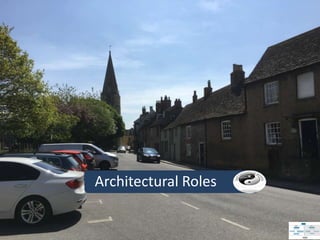
Architectural Roles
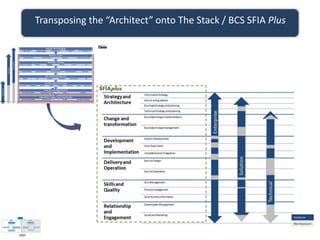
Transposing the “Architect” onto The Stack / BCS SFIA Plus
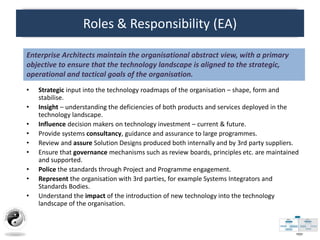
Roles & Responsibility (EA)
• Strategic input into the technology roadmaps of the organisation – shape, form and
stabilise.
• Insight – understanding the deficiencies of both products and services deployed in the
technology landscape.
• Influence decision makers on technology investment – current & future.
• Provide systems consultancy, guidance and assurance to large programmes.
• Review and assure Solution Designs produced both internally and by 3rd party suppliers.
• Ensure that governance mechanisms such as review boards, principles etc. are maintained
and supported.
• Police the standards through Project and Programme engagement.
• Represent the organisation with 3rd parties, for example Systems Integrators and
Standards Bodies.
• Understand the impact of the introduction of new technology into the technology
landscape of the organisation.
Enterprise Architects maintain the organisational abstract view, with a primary
objective to ensure that the technology landscape is aligned to the strategic,
operational and tactical goals of the organisation.
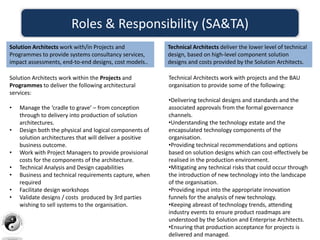
Roles & Responsibility (SA&TA)
Solution Architects work with/in Projects and
Programmes to provide systems consultancy services,
impact assessments, end-to-end designs, cost models..
Solution Architects work within the Projects and
Programmes to deliver the following architectural
services:
• Manage the ‘cradle to grave’ – from conception
through to delivery into production of solution
architectures.
• Design both the physical and logical components of
solution architectures that will deliver a positive
business outcome.
• Work with Project Managers to provide provisional
costs for the components of the architecture.
• Technical Analysis and Design capabilities
• Business and technical requirements capture, when
required
• Facilitate design workshops
• Validate designs / costs produced by 3rd parties
wishing to sell systems to the organisation.
Technical Architects deliver the lower level of technical
design, based on high-level component solution
designs and costs provided by the Solution Architects.
Technical Architects work with projects and the BAU
organisation to provide some of the following:
•Delivering technical designs and standards and the
associated approvals from the formal governance
channels.
•Understanding the technology estate and the
encapsulated technology components of the
organisation.
•Providing technical recommendations and options
based on solution designs which can cost-effectively be
realised in the production environment.
•Mitigating any technical risks that could occur through
the introduction of new technology into the landscape
of the organisation.
•Providing input into the appropriate innovation
funnels for the analysis of new technology.
•Keeping abreast of technology trends, attending
industry events to ensure product roadmaps are
understood by the Solution and Enterprise Architects.
•Ensuring that production acceptance for projects is
delivered and managed.
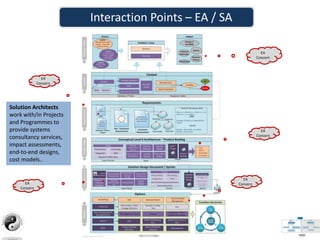
Solution Architects
work with/in Projects
and Programmes to
provide systems
consultancy services,
impact assessments,
end-to-end designs,
cost models..
EA
Concern
EA
Concern
Interaction Points – EA / SA
EA
Concern
EA
Concern
EA
Concern
Final Note
• Enterprise Architecture is delivered in the context of the
Organisation – true value can not be realised by simply following
a single framework approach.
• Architectural Realisation is a way of thinking and not a concrete
technological implementation. It is however supported by
frameworks, patterns & best practices that complement the
mindset.
• As an Enterprise Architect you must be aware of both the
technology landscape of your organisation and external factors
that can impact the landscape.
• EA’s can not work in isolation – programme / project engagement
is essential as it allows a deeper understanding of the estate.
“In the struggle for survival, the fittest win out at the expense of their
rivals because they succeed in adapting themselves best to their
environment” Charles Darwin
Website : www.s-ea-t.com (Tools, Papers Downloads)
Blog : https://dalbanger.wordpress.com/
Email : dal@s-ea-t.com
Thank You

Supporting material for my Webinar to the ACS - June2017

  • 1.
    Enterprise / Solution ArchitectureRevisited ( webinar from London ) Daljit Roy Banger MSc FBCS1st June 2017 EA SIG
  • 2.
    Webinar Structure (20-25 Mins)(20-25Mins) (5 Mins) Part 1Part 2
  • 3.
    Open Groups TOGAF Framework ZachmanFramework™ MODAF Federal Enterprise Architecture Framework (FEAF) DODAF Public Architectural Frameworks ETOM (Enhanced Telecom Operations Map Numerous Frameworks exist which provide views, approaches and general support to help deliver / manage an Enterprise Architecture Capability
  • 4.
     Enterprise Architecturesupports how one builds a reusable Unified Information Systems/Management capability that supports and meets Organisational needs.  The EA Goal is to Align and Manage the Technology landscape of an Organisation with its Strategic / Operational Goals/Objectives for both today and tomorrow. Something to Consider…  Enterprise Architecture is NOT Enterprise Systems Architecture and this difference often results in opposing views in terms of capabilities and outcomes. These can be expressed as:  A view towards how we construct / reconstruct the Organisation to deliver specific Enterprise outcomes.  A view with a strong bias towards Technology and how it can be best provisioned to meet outcomes.
  • 5.
  • 6.
    BOM to TechLandscape Mapping - The Stack Each layer in the Stack can be further decomposed, with each layer pushing or consuming to the layer above and below. BusinessTechnology
  • 7.
    Stack Scenario Each layerin the Stack can be further decomposed, with each layer pushing or consuming to the layer above and below. BusinessTechnology BOM BM
  • 8.
  • 9.
  • 10.
  • 11.
    The deliverables andattributes of artefacts produced by the EA teams will be directly influenced by one or all of the following: TheStructure/Sizeofthe Organisation Characteristicsofthe Organisation TheOperatingEnvironmentof theEnterpriseArchitecture Practice Managementbuy-inof EnterpriseArchitecture SizeandBudgetAvailabletothe Team. TeamCapabilities However , irrespective of the structure or capabilities of the team, all artefacts can be classified into 1 of 3 domains One size does not necessarily always fit all No two organisations/industries are ever identical Abstract •Notional Models •Views Functional Interactions / Inter- Relationships Artefacts / Components Support / Hygiene
  • 12.
    Control Governance – Process Boards – Review, Technical, Business Boards Programme/ Project Engagement Business / Partner Engagements Stakeholder Management Inform Principles Policies Portfolio Manageme nt Funding Models Reference Models • Technical • ApplicationBest Practices Patterns Impact Assessmen ts Marketing Plans Standards / Notations Direct Stakeholder Engagement Business Architecture Target Definition Application Target Architecture Data & Information (Master Data Management Strategy) Infrastructure Target Architecture – Enabling Technology & Platforms Roadmaps (Product / Technology) Gap Analysis – Transitional States Impact Assessments Service promotion, catalogue etc… Enterprise Architecture Products (Support/Enablers)
  • 13.
  • 14.
    Context Define Measure Analyze Improve control EA/SCRUM Touchpoints Six Sigma’s DMAIC D I I C C If,like me, you are a fan of the US HBO “Silicon Valley” TV show, you will have laughed at the guys in episode 5 discussing SCRUM – if you have not , here’s a link to exert http://youtu.be/oyVksFviJVE .
  • 15.
    Enterprise Architecture -Example Product Matrix Control Inform Direct Artefacts x x x API Management x x Governance – Process x x Application - Target Architecture/s x x Architectural Boards – (Review, Technical, Business Boards(Participation)) x x Architectural Principles - System, Process, Generic x x x Best Practices Research / Promotion/ Socialisation x x x Business Architecture Target Definition x x x Data & Information (MDM Strategy), Journey from Data to Insights x x x Financial / Funding Models (TCO, Investment Plans) x x x Gap Analysis – New Solutions, Transitional States x x x Group / System Policies (Sys Admin etc) x x x Impact Assessments - Projects, Technologies, Solutions x x x Infrastructure Target Architecture – Enabling Technology & Platforms x x Reusable System Patterns (Dev, Integration etc.) x x Portfolio Advisory x x x Programme / Project Engagement x x x Reference Models x x x Technical / Application x x x Roadmaps (Product / Technology) x x x Service catalogue Strategy (Product/technology, Deviation etc.) x x x Service promotion Plans x x x Stakeholder Engagement x Stakeholder Management x x Standards / Notations (Promotion of BPMN, UML, Archimate, etc.) Two Artefacts worthy of discussion
  • 16.
    Principles • Business • Thiscriteria element relates to the promotion of enterprise wide principles around the domain of business processing, especially business process modelling and service design. • Application • Principles relating to the design, build and deployment of applications • Information • Principles linked with the production, cleansing and publishing of information • Data • Principles associated with data design, usage, persistence etc. • Infrastructure • Principles associated with selection, deployment, management of the infrastructure (data Centres, Servers storage, network etc) • Foundation Services. • Foundation services relate to DR, Security, Incident management etc i.e. services that are core to all of the above Practices • Business Operations • Here Enterprise Architects should be concerned with the practices associated with capturing, modelling and digitally executing the business operations. • Application Design • I.e. delivery of designs of. Whilst, practices adopted may based on a specific methodology or approach, the real question ‘ how efficiently have we adopted the practices of the approach and are we meeting the business demands based on this adoption ?’ • Application Build • The maturity of the build of applications both internal and externally developed applications should encapsulate test of software unit, components etc prior to build • Governance • Architectural Governance and the teeth i.e. power of associated with the various boards. • Service Delivery • The maturity of the practices i.e. what actually happens during the deployment, management of systems on the technology landscape. • Support • Whilst this is close to Service Delivery it must be noted that we should rank how effectively the EA team deliver the support of its artefacts Process • Business • The engagement of the Enterprise Architecture functions with the Business Process Modelling and Design functions and any alignment activities. • STP • EA should facilitate a move towards Straight Through processing i.e. reducing the number of digital and manual process hand offs between processes. • Information • The Information Architecture and the associated process to capture, manage and publish EA information. • Orchestration • This relates to the processes associated with orchestrating business and technology services • Production Acceptance • The maturity of the processes associated with deployment, management of systems accepted into the production environment. • Documentation • The maturity of document production , publication and promotion by the Enterprise Architecture function • 3rd Party Engagement • How effectively does EA engage with 3rd parties to maximise the benefits to the organisation e.g. cost reductions, savings etc • Contribution to the Enterprise • What is the general perception of EA processes e.g. Governance contributing real value to the organisation from system users to senior management? Patterns • Publications • Does the organisation have a patterns catalogue? How mature is the organising in publishing it patterns, do these publications adopt standards for syntax, notations etc • Promotion • How are patterns promoted through the organisation, are they rendered via an intranet? Or are they in a document library somewhere? • Development • How patterns are developed – are they text book extracts or are they developed with the various technical communities? • Usage • Do the technical Communities use these patterns to provide efficiency gains to the organisation? • Application • Application patterns are to be found publically available and thus should be exploited – do your organisational developers for example exploit published patterns when constructing applications. • Infrastructure • As with Applications above – Do your Service delivery personal for example use standard patterns for system configurations deployed into production. • Security • Security patterns are emerging as a key in distributed systems – are these in use ?, does the technical community know of the existence • Re-Use • How often are patterns re-used if at all and do we as an organisation promote reuse. Portfolio Management • Services • Most Organisations have their own definition of a Services the EAM measure assumes a service as a function that is well-defined, self-contained, and does not depend on the context or state of other services. A service can be either a business or technical object. • Application • The portfolio of applications in an Organisation can be a mix of either bespoke or Commercial Off the Shelf (COTS) either way the life cycle should be managed in a single unified location. • Middleware • Middleware could refer to Enterprise Service Buses, Messaging or even request brokers – these should be managed and in most cases the interfaces to these systems. • Storage • Information and data object persistence should be monitored and managed, i.e. not be the physical devices e.g. the NAS or SANs etc. • Servers • The portfolio management of the Physical Servers both in the production and test environments. • Other Infrastructure • Maturity of the portfolio management of the Physical devices e.g. network Switches, laptops, etc. • Techniques • The techniques adopted to create, capture and manage the information required to measure the level of maturity in the management of the ‘artefact’ portfolio. Products of Enterprise Architecture Contd..
  • 17.
  • 18.
    Transposing the “Architect”onto The Stack / BCS SFIA Plus
  • 19.
    Roles & Responsibility(EA) • Strategic input into the technology roadmaps of the organisation – shape, form and stabilise. • Insight – understanding the deficiencies of both products and services deployed in the technology landscape. • Influence decision makers on technology investment – current & future. • Provide systems consultancy, guidance and assurance to large programmes. • Review and assure Solution Designs produced both internally and by 3rd party suppliers. • Ensure that governance mechanisms such as review boards, principles etc. are maintained and supported. • Police the standards through Project and Programme engagement. • Represent the organisation with 3rd parties, for example Systems Integrators and Standards Bodies. • Understand the impact of the introduction of new technology into the technology landscape of the organisation. Enterprise Architects maintain the organisational abstract view, with a primary objective to ensure that the technology landscape is aligned to the strategic, operational and tactical goals of the organisation.
  • 20.
    Roles & Responsibility(SA&TA) Solution Architects work with/in Projects and Programmes to provide systems consultancy services, impact assessments, end-to-end designs, cost models.. Solution Architects work within the Projects and Programmes to deliver the following architectural services: • Manage the ‘cradle to grave’ – from conception through to delivery into production of solution architectures. • Design both the physical and logical components of solution architectures that will deliver a positive business outcome. • Work with Project Managers to provide provisional costs for the components of the architecture. • Technical Analysis and Design capabilities • Business and technical requirements capture, when required • Facilitate design workshops • Validate designs / costs produced by 3rd parties wishing to sell systems to the organisation. Technical Architects deliver the lower level of technical design, based on high-level component solution designs and costs provided by the Solution Architects. Technical Architects work with projects and the BAU organisation to provide some of the following: •Delivering technical designs and standards and the associated approvals from the formal governance channels. •Understanding the technology estate and the encapsulated technology components of the organisation. •Providing technical recommendations and options based on solution designs which can cost-effectively be realised in the production environment. •Mitigating any technical risks that could occur through the introduction of new technology into the landscape of the organisation. •Providing input into the appropriate innovation funnels for the analysis of new technology. •Keeping abreast of technology trends, attending industry events to ensure product roadmaps are understood by the Solution and Enterprise Architects. •Ensuring that production acceptance for projects is delivered and managed.
  • 21.
    Solution Architects work with/inProjects and Programmes to provide systems consultancy services, impact assessments, end-to-end designs, cost models.. EA Concern EA Concern Interaction Points – EA / SA EA Concern EA Concern EA Concern
  • 22.
    Final Note • EnterpriseArchitecture is delivered in the context of the Organisation – true value can not be realised by simply following a single framework approach. • Architectural Realisation is a way of thinking and not a concrete technological implementation. It is however supported by frameworks, patterns & best practices that complement the mindset. • As an Enterprise Architect you must be aware of both the technology landscape of your organisation and external factors that can impact the landscape. • EA’s can not work in isolation – programme / project engagement is essential as it allows a deeper understanding of the estate. “In the struggle for survival, the fittest win out at the expense of their rivals because they succeed in adapting themselves best to their environment” Charles Darwin
  • 23.
    Website : www.s-ea-t.com(Tools, Papers Downloads) Blog : https://dalbanger.wordpress.com/ Email : dal@s-ea-t.com Thank You

Editor's Notes

  • #3 The purpose of today's session is to introduce core basic concepts around Enterprise Architecture and discuss the role of the Architect . We shall Discuss the Architectural Stack and the areas it covers Use a Simple Example of an impending Law which will modify some elements of the Stack Discuss Some of the Products that are produced to Control, Inform and Direct the ICT Function to ensure it aligns with Business Goals We will Discuss the Role/Responsibility of the Enterprise Architect Then we will take questions
  • #4 On the Zachman website – it states The Zachman Framework™ IS NOT a methodology for creating the implementation (an instantiation) of the objects – We can use this as a ‘tick list’ to support the EA