Enterprise
architecture
Samah Safi
Legend


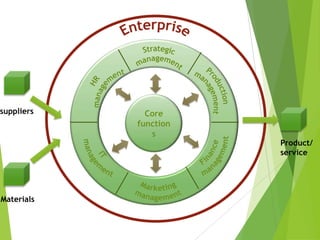
Enterprise



Enterprise Architecture



EA frameworks
suppliers

Materials

Core
function
s

Product/
service
From stability to agility


new competitive dynamics



more demanding customers



market volatility



globalization
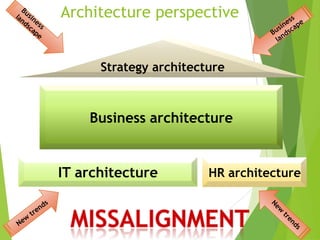
Architecture perspective
Strategy architecture

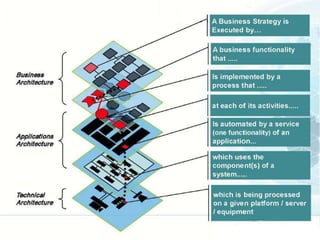
Business architecture

IT architecture

HR architecture
Technology Role


Empowerment of organization



Increase competitive advantage



Drive growth and innovation



Ameliorate services and products



strategies, goals, and operations change much more
quickly than IT systems could once they are implemented
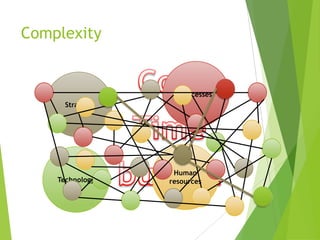
Complexity

Processes
Strategy

Technology

Human
resources
Enterprise architecture


EA is a discipline that helps the Enterprise define ,
develop and exploit the boundary less information flow
(BIF*) capabilities in order to achieve the Enterprise’s
Strategic Intent. ”OMG”



EA is the process of translating business vision and
strategy into effective enterprise change by creating,
communicating, and improving the key principles and
models that describe the enterprise’s future state and
enable its evolution. “Gartner”
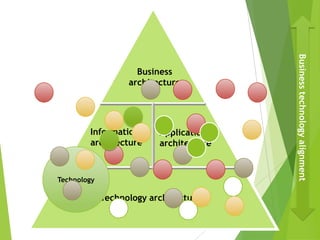
Information
architecture

Application
architecture

Technology

Technology architecture

Business technology alignment

Business
architecture
Enterprise architecture


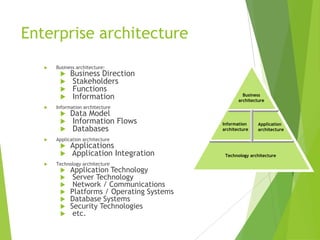
Business architecture:







Data Model
Information Flows
Databases

Information
architecture

Application
architecture

Application architecture






Business
architecture

Information architecture






Business Direction
Stakeholders
Functions
Information

Applications
Application Integration

Technology architecture









Application Technology
Server Technology
Network / Communications
Platforms / Operating Systems
Database Systems
Security Technologies
etc.

Technology architecture
Why Enterprise architecture?


Provides a clear view of how the business and technology
resources will support and achieve an organization’s business
goals and initiatives.



Understand the strategy, the business, the systems and the
infrastructure and how they interrelate.



Moving "need to know" information to those that "know they
need" upstream and down stream and in both directions.



Helps us prioritize and decide which things to do and in
what order.




“Doing the Right Things”

Governs the change and building of things.


“Doing the Things Right”
Enterprise architecture
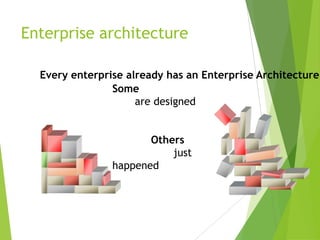
Every enterprise already has an Enterprise Architecture
Some
are designed
Others
just
happened
Benefits


Enhance decision making





Holistic view of the organization
Relational view of information entities

Enable rapid change



Targeted approach to change management





Visible impact scope
Reduced discovery and investigation

Improve business/IT alignment






IT initiatives are derived from business priorities

Business objectives are linked to projects

Improve inter-department cooperation





Enhance sharing of information
Align efforts

Reduce IT solution delivery time


Leverage reusable objects



Ensure methodology driven implementation approach
Architecture framework
A conceptual structure used to develop,
implement and sustain enterprise
architecture.
 It should describe a method for designing
target state of the enterprise in terms of a set
of building blocks fit together
 It should contain a set of tools and provide a
common vocabulary
 It should also include a list of recommended
standards and compliant products that can be
used to implement the building blocks

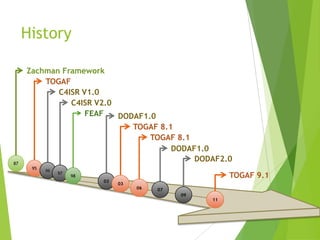
History

87

Zachman Framework
TOGAF
C4ISR V1.0
C4ISR V2.0
FEAF
DODAF1.0
TOGAF 8.1
TOGAF 8.1
DODAF1.0
DODAF2.0
95

96

97

TOGAF 9.1

98
03

03

06

07
09

11
Zachman framework


Draws upon the discipline of classical architecture to
establish a common vocabulary and set of perspectives, a
framework, for defining and describing today's complex
enterprise systems.



Need to classify the wide range of information that is
collected and developed as part of an enterprise
architecture.



The underlying concept of this framework was that the
vertical axis represents multiple aspects (dimensions) of
the overall architecture.



The horizontal axis provides a way of classifying the
various artifacts based on the interests of a particular
audience (perspectives).
FEAF


The federal enterprise architecture is a strategic
information asset base that defines the business,
information necessary to operate the business,
technologies necessary to support the business
operations, and transitional processes for implementing
new technologies in response to the changing of the
business.
DODAF


The Department of Defense Architecture
Framework (DoDAF) is an architecture framework for
the United States Department of Defense (DoD) that
provides visualization infrastructure for specific
stakeholders concerns through viewpoints organized by
various views. These views are artifacts for visualizing,
understanding, and assimilating the broad scope and
complexities of an architecture description
through tabular, structural, behavioral, ontological, picto
rial, temporal, graphical, probabilistic, or
alternative conceptual means.
TOGAF


The Open Group Architecture Framework (TOGAF) is a
framework and detailed method for building,
maintaining, and gaining value from an enterprise
architecture for an organization.



TOGAF 9 is the latest evolution of the framework, and its
accompanying Architecture Development Method (ADM)



The TOGAF specification is an open standard that has
been created and is maintained by The Open Group
Types of Architectures in
TOGAF


Business Architecture -- addresses the needs of users, planners,
and business management,



Data/Information Architecture -- addresses the needs of database
designers, database administrators, and system engineers,



Application (Systems) Architecture -- addresses the needs of
system and software engineers,



Information Technology (IT) Architecture -- addresses the needs of
acquirers, operators, administrators, and managers.
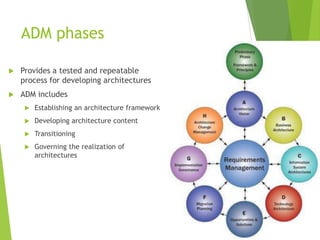
ADM phases


Provides a tested and repeatable
process for developing architectures



ADM includes


Establishing an architecture framework



Developing architecture content



Transitioning



Governing the realization of
architectures
ADM phases


The Preliminary Phase describes the preparation and initiation activities required to
prepare to meet the business directive for a new enterprise architecture, including the
definition of an Organization-Specific Architecture framework and the definition of
principles.



Phase A: Architecture Vision describes the initial phase of an architecture development
cycle. It includes information about defining the scope, identifying the stakeholders,
creating the Architecture Vision, and obtaining approvals.



Phase B: Business Architecture describes the development of a Business Architecture to
support an agreed Architecture Vision.



Phase C: Information Systems Architectures describes the development of Information
Systems Architectures for an architecture project, including the development of Data and
Application Architectures.



Phase D: Technology Architecture describes the development of the Technology
Architecture for an architecture project.



Phase E: Opportunities & Solutions conducts initial implementation planning and the
identification of delivery vehicles for the architecture defined in the previous phases.



Phase F: Migration Planning addresses the formulation of a set of detailed sequence of
transition architectures with a supporting Implementation and Migration Plan.



Phase G: Implementation Governance provides an architectural oversight of the
implementation.



Phase H: Architecture Change Management establishes procedures for managing change to
the new architecture.



Requirements Management examines the process of managing architecture requirements
throughout the ADM.
Content framework


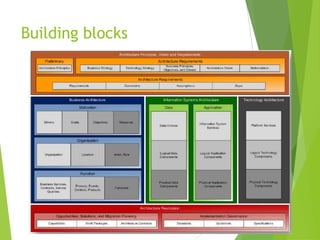
The content metamodel provides a definition of all the
types of building blocks that may exist within an
architecture, showing how these building blocks can be
described and related to one another. For example, when
creating an architecture, an architect will identify
applications, "data entities" held within applications, and
technologies that implement those applications. These
applications will in turn support particular groups of
business user or actor, and will be used to fulfill "business
services".



The content metamodel identifies all of these concerns
(i.e., application, data entity, technology, actor, and
business service), shows the relationships that are possible
between them (e.g., actors consume business services), and
finally identifies artifacts that can be used to represent
them.
Building blocks
Enterprise Continuum


A view of the Architecture Repository that provides
methods for classifying architecture and solution
artifacts as they evolve from generic Foundation
Architectures to Organization-Specific Architectures



Explains how generic solutions can be leveraged and
specialized in order to support the requirements of an
individual organization

Enterprise architecture

  • 1.
  • 2.
  • 3.
  • 4.
    From stability toagility  new competitive dynamics  more demanding customers  market volatility  globalization
  • 5.
    Architecture perspective Strategy architecture Businessarchitecture IT architecture HR architecture
  • 6.
    Technology Role  Empowerment oforganization  Increase competitive advantage  Drive growth and innovation  Ameliorate services and products  strategies, goals, and operations change much more quickly than IT systems could once they are implemented
  • 7.
  • 8.
    Enterprise architecture  EA isa discipline that helps the Enterprise define , develop and exploit the boundary less information flow (BIF*) capabilities in order to achieve the Enterprise’s Strategic Intent. ”OMG”  EA is the process of translating business vision and strategy into effective enterprise change by creating, communicating, and improving the key principles and models that describe the enterprise’s future state and enable its evolution. “Gartner”
  • 9.
  • 10.
    Enterprise architecture  Business architecture:      DataModel Information Flows Databases Information architecture Application architecture Application architecture    Business architecture Information architecture     Business Direction Stakeholders Functions Information Applications Application Integration Technology architecture        Application Technology Server Technology Network / Communications Platforms / Operating Systems Database Systems Security Technologies etc. Technology architecture
  • 12.
    Why Enterprise architecture?  Providesa clear view of how the business and technology resources will support and achieve an organization’s business goals and initiatives.  Understand the strategy, the business, the systems and the infrastructure and how they interrelate.  Moving "need to know" information to those that "know they need" upstream and down stream and in both directions.  Helps us prioritize and decide which things to do and in what order.   “Doing the Right Things” Governs the change and building of things.  “Doing the Things Right”
  • 13.
    Enterprise architecture Every enterprisealready has an Enterprise Architecture Some are designed Others just happened
  • 14.
    Benefits  Enhance decision making    Holisticview of the organization Relational view of information entities Enable rapid change   Targeted approach to change management   Visible impact scope Reduced discovery and investigation Improve business/IT alignment    IT initiatives are derived from business priorities Business objectives are linked to projects Improve inter-department cooperation    Enhance sharing of information Align efforts Reduce IT solution delivery time  Leverage reusable objects  Ensure methodology driven implementation approach
  • 15.
    Architecture framework A conceptualstructure used to develop, implement and sustain enterprise architecture.  It should describe a method for designing target state of the enterprise in terms of a set of building blocks fit together  It should contain a set of tools and provide a common vocabulary  It should also include a list of recommended standards and compliant products that can be used to implement the building blocks 
  • 16.
    History 87 Zachman Framework TOGAF C4ISR V1.0 C4ISRV2.0 FEAF DODAF1.0 TOGAF 8.1 TOGAF 8.1 DODAF1.0 DODAF2.0 95 96 97 TOGAF 9.1 98 03 03 06 07 09 11
  • 17.
    Zachman framework  Draws uponthe discipline of classical architecture to establish a common vocabulary and set of perspectives, a framework, for defining and describing today's complex enterprise systems.  Need to classify the wide range of information that is collected and developed as part of an enterprise architecture.  The underlying concept of this framework was that the vertical axis represents multiple aspects (dimensions) of the overall architecture.  The horizontal axis provides a way of classifying the various artifacts based on the interests of a particular audience (perspectives).
  • 18.
    FEAF  The federal enterprisearchitecture is a strategic information asset base that defines the business, information necessary to operate the business, technologies necessary to support the business operations, and transitional processes for implementing new technologies in response to the changing of the business.
  • 19.
    DODAF  The Department ofDefense Architecture Framework (DoDAF) is an architecture framework for the United States Department of Defense (DoD) that provides visualization infrastructure for specific stakeholders concerns through viewpoints organized by various views. These views are artifacts for visualizing, understanding, and assimilating the broad scope and complexities of an architecture description through tabular, structural, behavioral, ontological, picto rial, temporal, graphical, probabilistic, or alternative conceptual means.
  • 20.
    TOGAF  The Open GroupArchitecture Framework (TOGAF) is a framework and detailed method for building, maintaining, and gaining value from an enterprise architecture for an organization.  TOGAF 9 is the latest evolution of the framework, and its accompanying Architecture Development Method (ADM)  The TOGAF specification is an open standard that has been created and is maintained by The Open Group
  • 21.
    Types of Architecturesin TOGAF  Business Architecture -- addresses the needs of users, planners, and business management,  Data/Information Architecture -- addresses the needs of database designers, database administrators, and system engineers,  Application (Systems) Architecture -- addresses the needs of system and software engineers,  Information Technology (IT) Architecture -- addresses the needs of acquirers, operators, administrators, and managers.
  • 22.
    ADM phases  Provides atested and repeatable process for developing architectures  ADM includes  Establishing an architecture framework  Developing architecture content  Transitioning  Governing the realization of architectures
  • 23.
    ADM phases  The PreliminaryPhase describes the preparation and initiation activities required to prepare to meet the business directive for a new enterprise architecture, including the definition of an Organization-Specific Architecture framework and the definition of principles.  Phase A: Architecture Vision describes the initial phase of an architecture development cycle. It includes information about defining the scope, identifying the stakeholders, creating the Architecture Vision, and obtaining approvals.  Phase B: Business Architecture describes the development of a Business Architecture to support an agreed Architecture Vision.  Phase C: Information Systems Architectures describes the development of Information Systems Architectures for an architecture project, including the development of Data and Application Architectures.  Phase D: Technology Architecture describes the development of the Technology Architecture for an architecture project.  Phase E: Opportunities & Solutions conducts initial implementation planning and the identification of delivery vehicles for the architecture defined in the previous phases.  Phase F: Migration Planning addresses the formulation of a set of detailed sequence of transition architectures with a supporting Implementation and Migration Plan.  Phase G: Implementation Governance provides an architectural oversight of the implementation.  Phase H: Architecture Change Management establishes procedures for managing change to the new architecture.  Requirements Management examines the process of managing architecture requirements throughout the ADM.
  • 24.
    Content framework  The contentmetamodel provides a definition of all the types of building blocks that may exist within an architecture, showing how these building blocks can be described and related to one another. For example, when creating an architecture, an architect will identify applications, "data entities" held within applications, and technologies that implement those applications. These applications will in turn support particular groups of business user or actor, and will be used to fulfill "business services".  The content metamodel identifies all of these concerns (i.e., application, data entity, technology, actor, and business service), shows the relationships that are possible between them (e.g., actors consume business services), and finally identifies artifacts that can be used to represent them.
  • 25.
  • 26.
    Enterprise Continuum  A viewof the Architecture Repository that provides methods for classifying architecture and solution artifacts as they evolve from generic Foundation Architectures to Organization-Specific Architectures  Explains how generic solutions can be leveraged and specialized in order to support the requirements of an individual organization

Editor's Notes

  • #13 Markets change fast, business has to keep up. With frozen technology, company won't pace with customers. A good EA will design the business and the tech for quick adaptation1-the roads in company are paved with technology -- so the best way to ensure that they are straight is to build and control the tech.2- Markets change fast, your business has to keep up. If you've got frozen technology, your company won't pace with your customers. A good EA will design the business and the tech for quick adaptation.3-EAs know when and when not to use new technologyLinking and bridging the mission of the business to drive prudent deployment of Information TechnologyEnables agility of an organizationReduces costsImproves security and reducing risks