Energy Conversion Lab
POWER FLOW ANALYSIS
 Power flow analysis assumption
 steady-state
 balanced single-phase network
 network may contain hundreds of nodes and
branches with impedance X specified in per unit on
MVA base
 Power flow equations
 bus admittance matrix of node-voltage equation is
formulated
 currents can be expressed in terms of voltages
 resulting equation can be in terms of power in MW
Energy Conversion Lab
BUS ADMITTANCE MATRIX
 Nodal solution
 nodal solution is based on
the Kirchhoff’s current law
 impedance is converted to
admittance
 Bus admittance equations
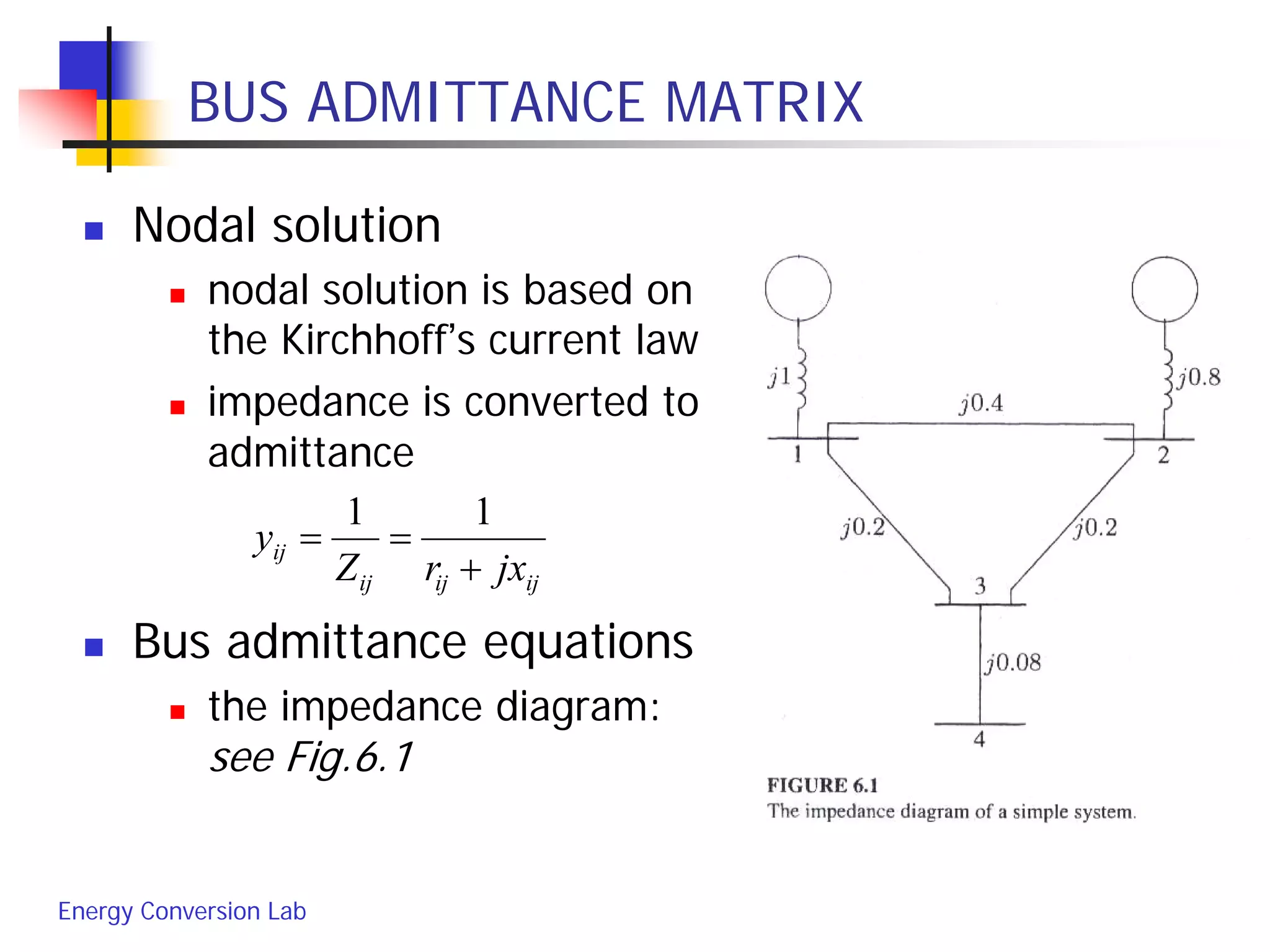
 the impedance diagram:
see Fig.6.1
ijijij
ij
jxrZ
y
+
==
11
Energy Conversion Lab
BUS ADMITTANCE MATRIX
 Bus admittance
equations
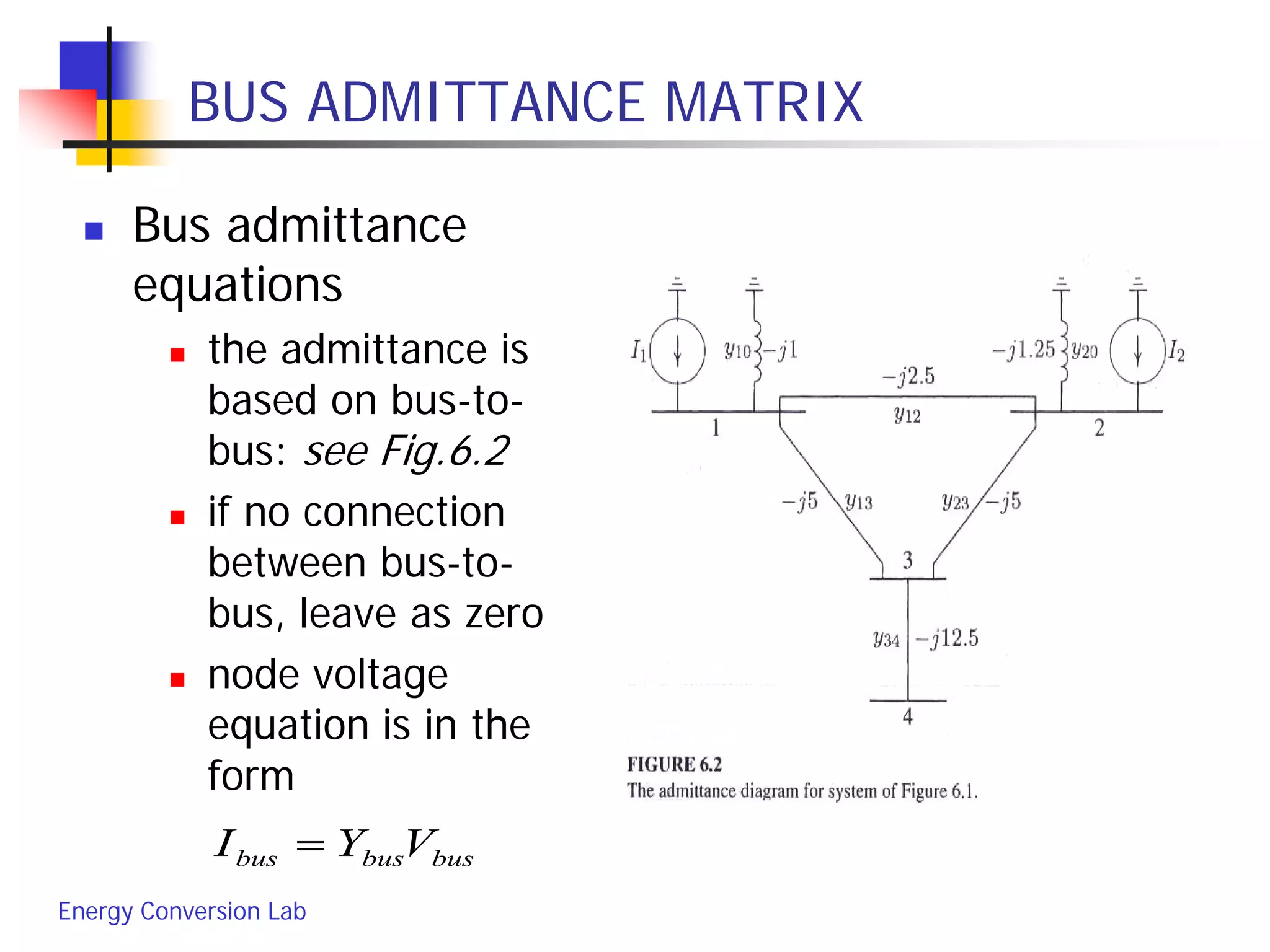
 the admittance is
based on bus-to-
bus: see Fig.6.2
 if no connection
between bus-to-
bus, leave as zero
 node voltage
equation is in the
form
busbusbus VYI =
Energy Conversion Lab
BUS ADMITTANCE MATRIX
 Node-voltage matrix
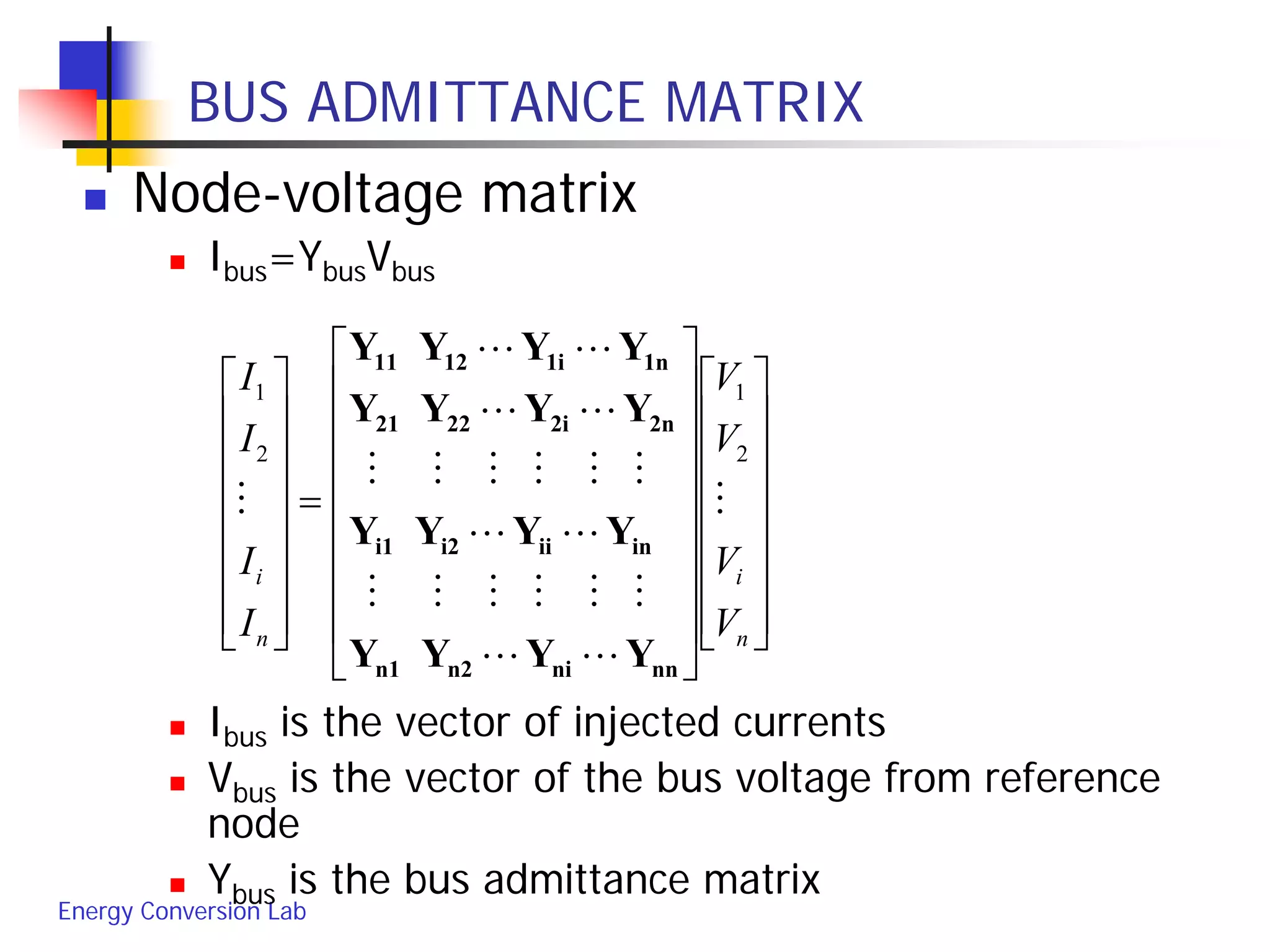
 Ibus=YbusVbus
 Ibus is the vector of injected currents
 Vbus is the vector of the bus voltage from reference
node
 Ybus is the bus admittance matrix


































=
















n
i
n
i
V
V
V
V
I
I
I
I








2
1
2
1
nnnin2n1
iniii2i1
2n2i2221
1n1i1211
YYYY
YYYY
YYYY
YYYY
Energy Conversion Lab
BUS ADMITTANCE MATRIX
 Node-voltage matrix
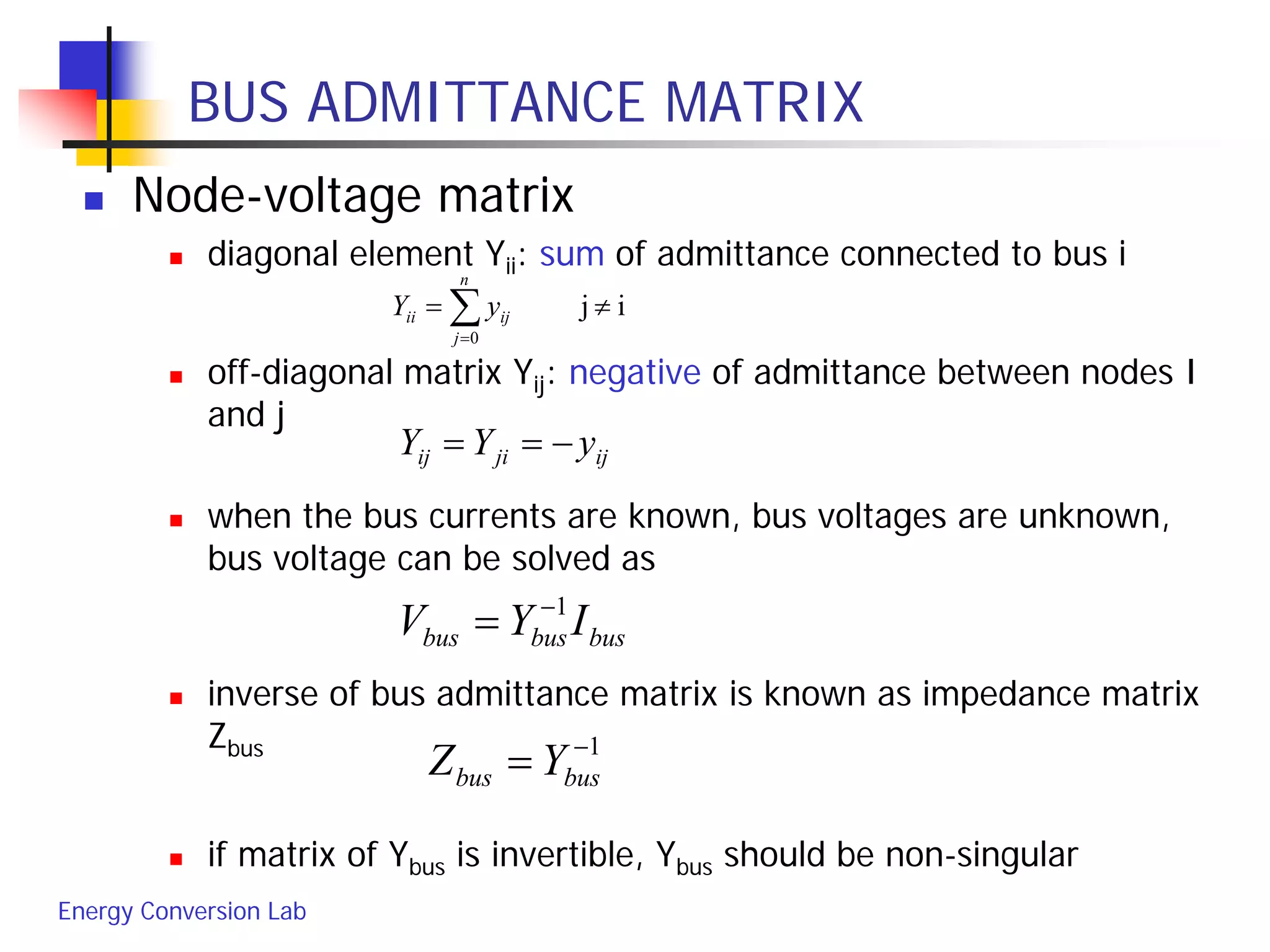
 diagonal element Yii: sum of admittance connected to bus i
 off-diagonal matrix Yij: negative of admittance between nodes I
and j
 when the bus currents are known, bus voltages are unknown,
bus voltage can be solved as
 inverse of bus admittance matrix is known as impedance matrix
Zbus
 if matrix of Ybus is invertible, Ybus should be non-singular
ij
0
≠= ∑=
n
j
ijii yY
ijjiij yYY −==
busbusbus IYV 1−
=
1−
= busbus YZ
Energy Conversion Lab
BUS ADMITTANCE MATRIX
 Node-voltage matrix
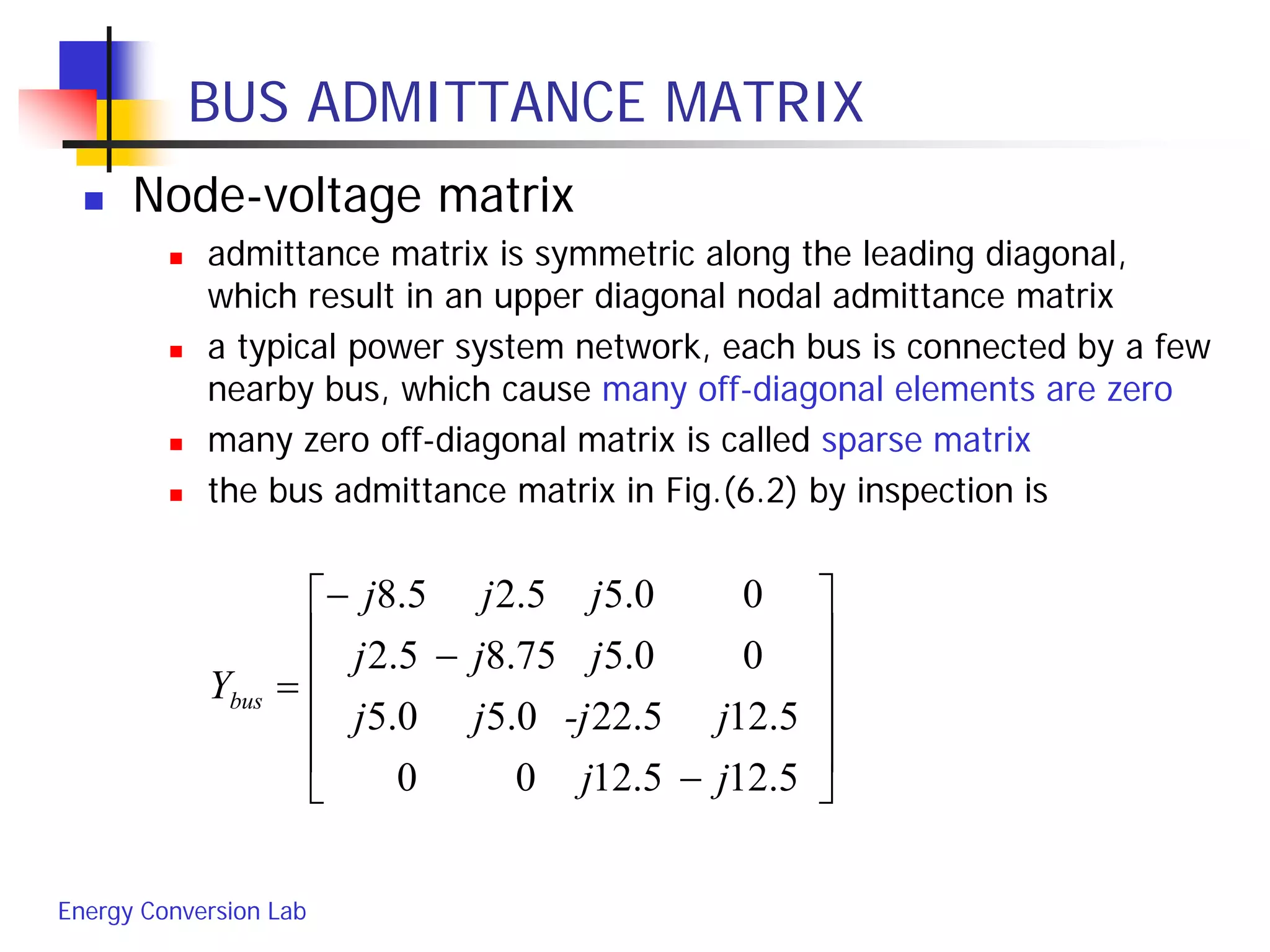
 admittance matrix is symmetric along the leading diagonal,
which result in an upper diagonal nodal admittance matrix
 a typical power system network, each bus is connected by a few
nearby bus, which cause many off-diagonal elements are zero
 many zero off-diagonal matrix is called sparse matrix
 the bus admittance matrix in Fig.(6.2) by inspection is












−
−
−
=
5.125.1200
5.125.220.50.5
00.575.85.2
00.55.25.8
jj
j-jjj
jjj
jjj
Ybus
Energy Conversion Lab
SOLUTION OF NONLINEAR ALGEBRA EQUATIONS
 Techniques for iterative solution of non-linear
equations
 Gauss-Seidal
 Newton-Raphson
 Quasi-Newton
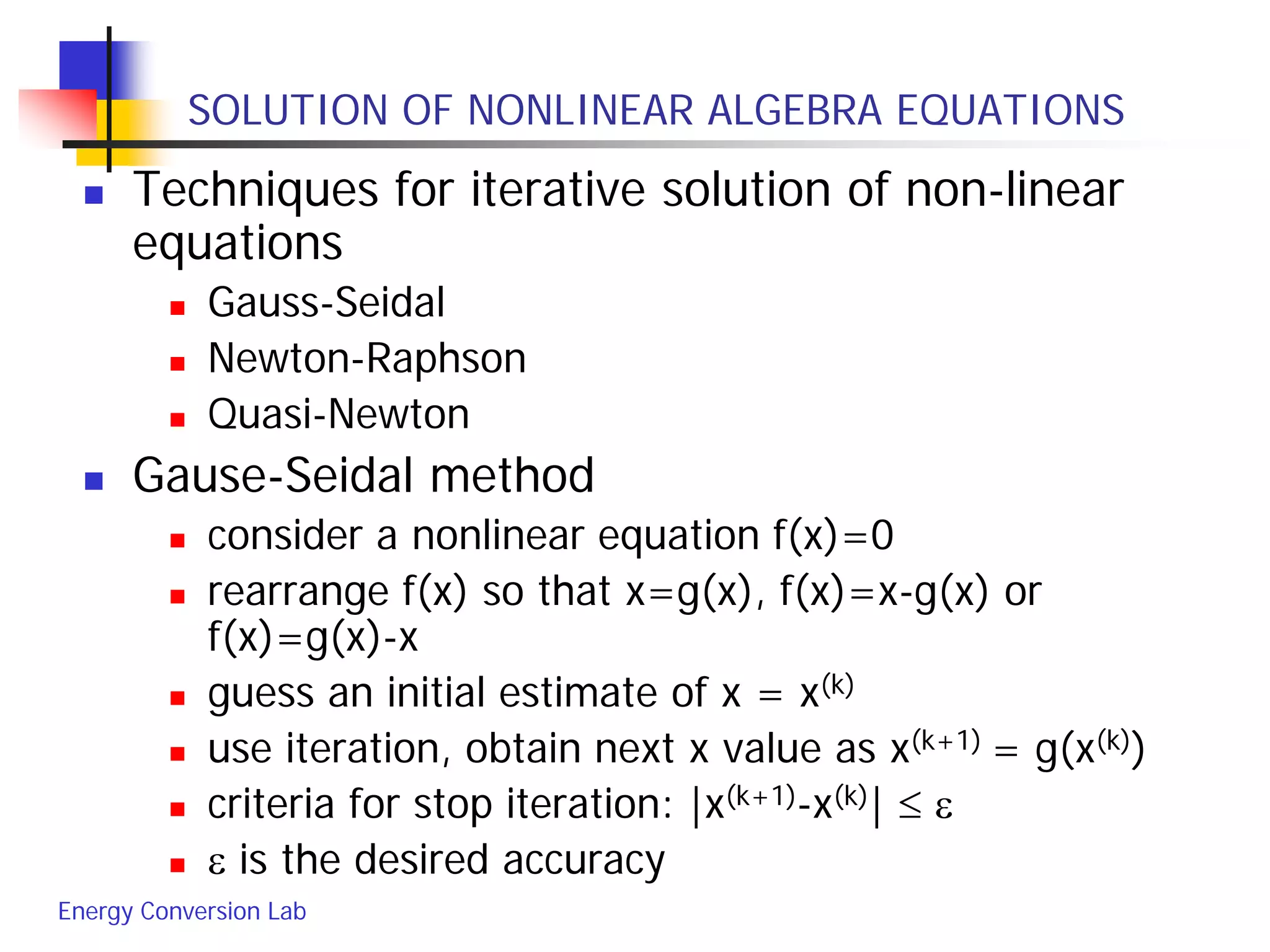
 Gause-Seidal method
 consider a nonlinear equation f(x)=0
 rearrange f(x) so that x=g(x), f(x)=x-g(x) or
f(x)=g(x)-x
 guess an initial estimate of x = x(k)
 use iteration, obtain next x value as x(k+1) = g(x(k))
 criteria for stop iteration: |x(k+1)-x(k)| ≤ ε
 ε is the desired accuracy
Energy Conversion Lab
GAUSE-SEIDAL METHOD
 Nature of Gause-Seidal method
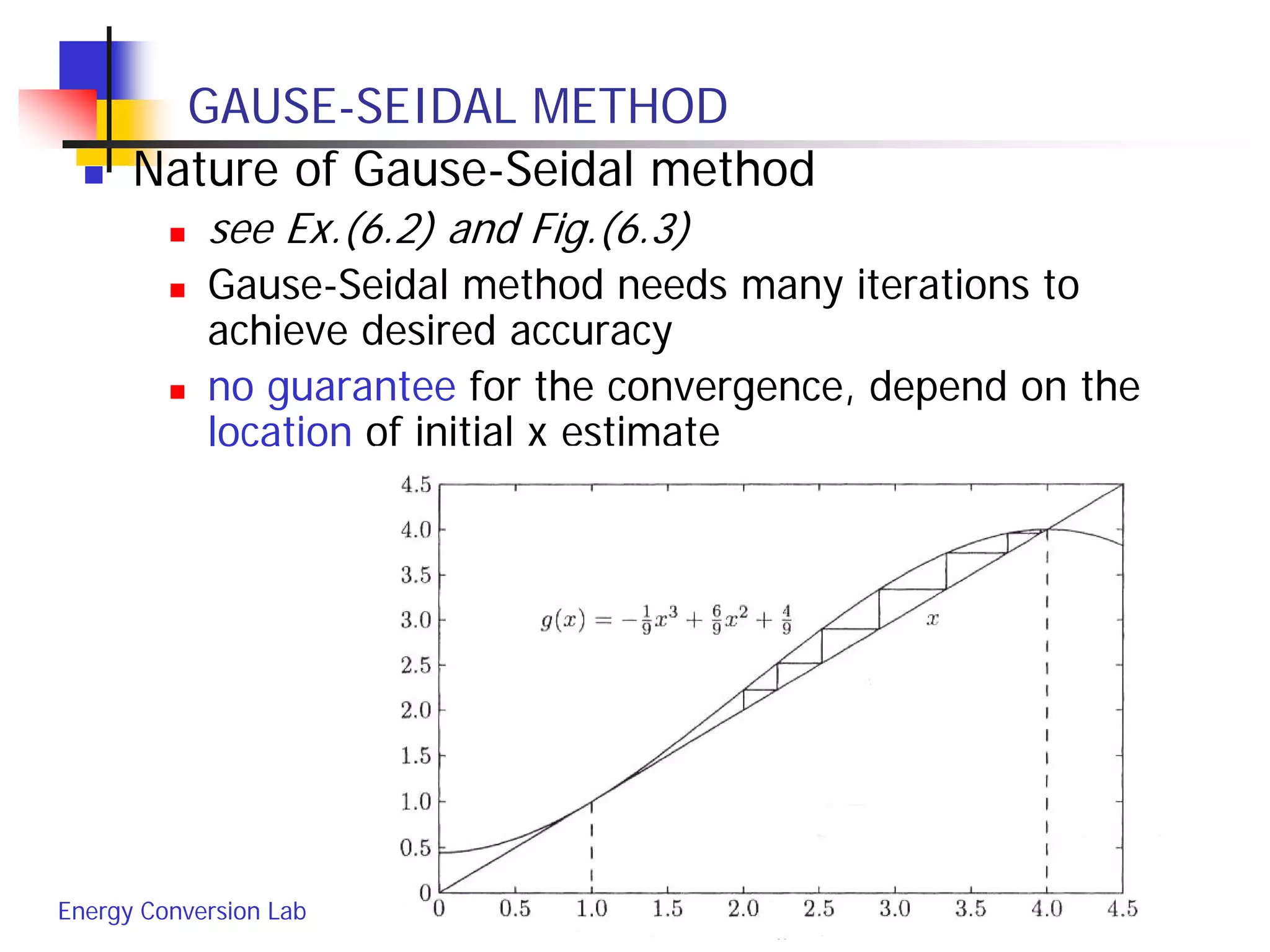
 see Ex.(6.2) and Fig.(6.3)
 Gause-Seidal method needs many iterations to
achieve desired accuracy
 no guarantee for the convergence, depend on the
location of initial x estimate
Energy Conversion Lab
GAUSE-SEIDAL METHOD
 Nature of Gause-Seidal method
 solution: if initial estimate x is within convergent
region, solution will converge in zigzag fashion to one
of the roots
 no solution: if initial estimate x is outside convergent
region, process will diverge, no solution found
 in some case, an acceleration factor α is added to
improve the rate of convergence:
 x(k+1) = x(k) +α[g(x(k))-x(k)], where α>1
 acceleration factor should not too large to produce
overshoot
 see Ex.(6.3) for the acceleration factor used
Energy Conversion Lab
GAUSE-SEIDAL METHOD
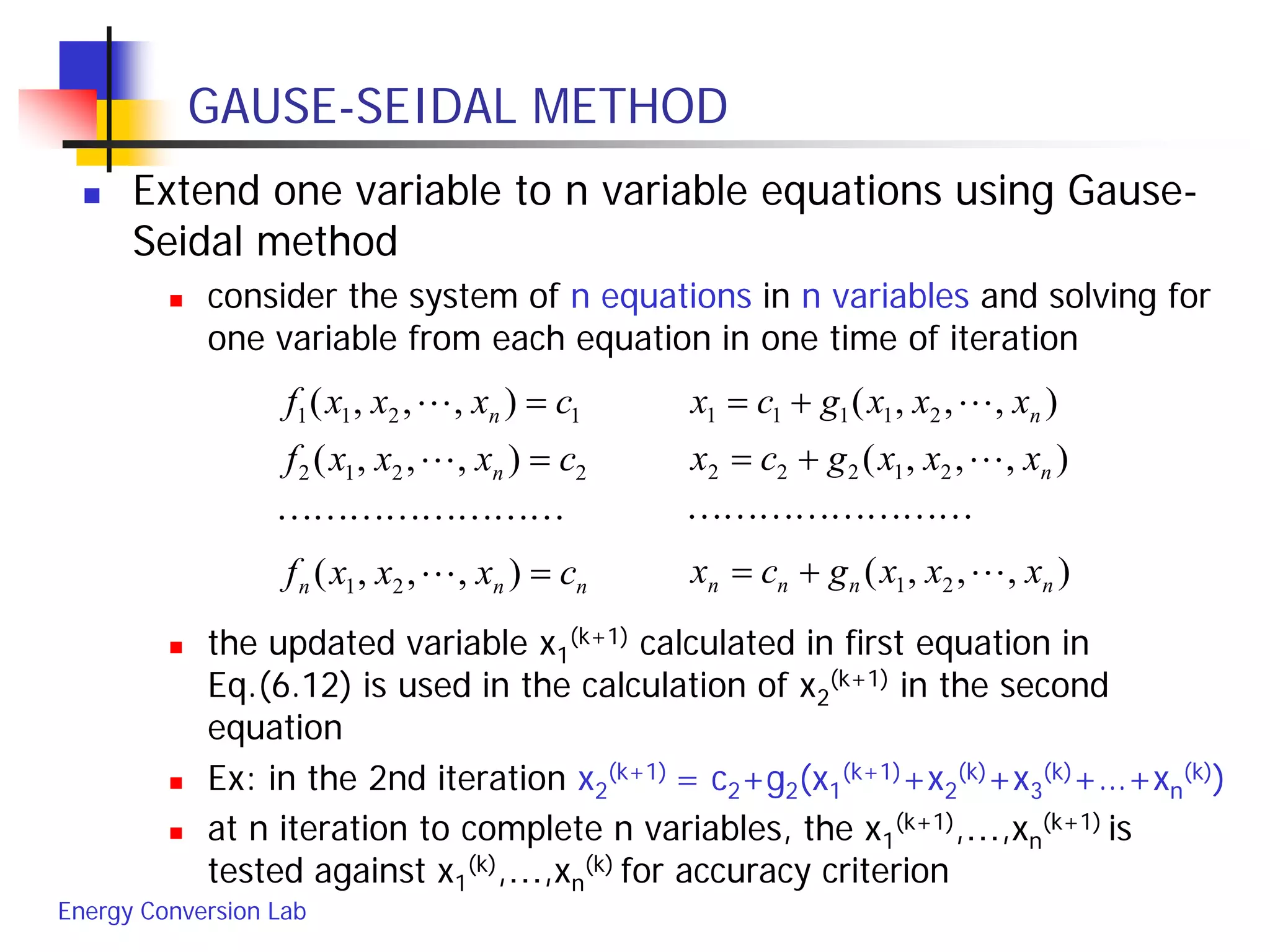
 Extend one variable to n variable equations using Gause-
Seidal method
 consider the system of n equations in n variables and solving for
one variable from each equation in one time of iteration
 the updated variable x1
(k+1) calculated in first equation in
Eq.(6.12) is used in the calculation of x2
(k+1) in the second
equation
 Ex: in the 2nd iteration x2
(k+1) = c2+g2(x1
(k+1)+x2
(k)+x3
(k)+…+xn
(k))
 at n iteration to complete n variables, the x1
(k+1),…,xn
(k+1) is
tested against x1
(k),…,xn
(k) for accuracy criterion
nnn
n
n
cxxxf
cxxxf
cxxxf
=
=
=
),,,(
),,,(
),,,(
21
2212
1211




),,,(
),,,(
),,,(
21
21222
21111
nnnn
n
n
xxxgcx
xxxgcx
xxxgcx




+=
+=
+=
Energy Conversion Lab
POWER FLOW SOLUTION
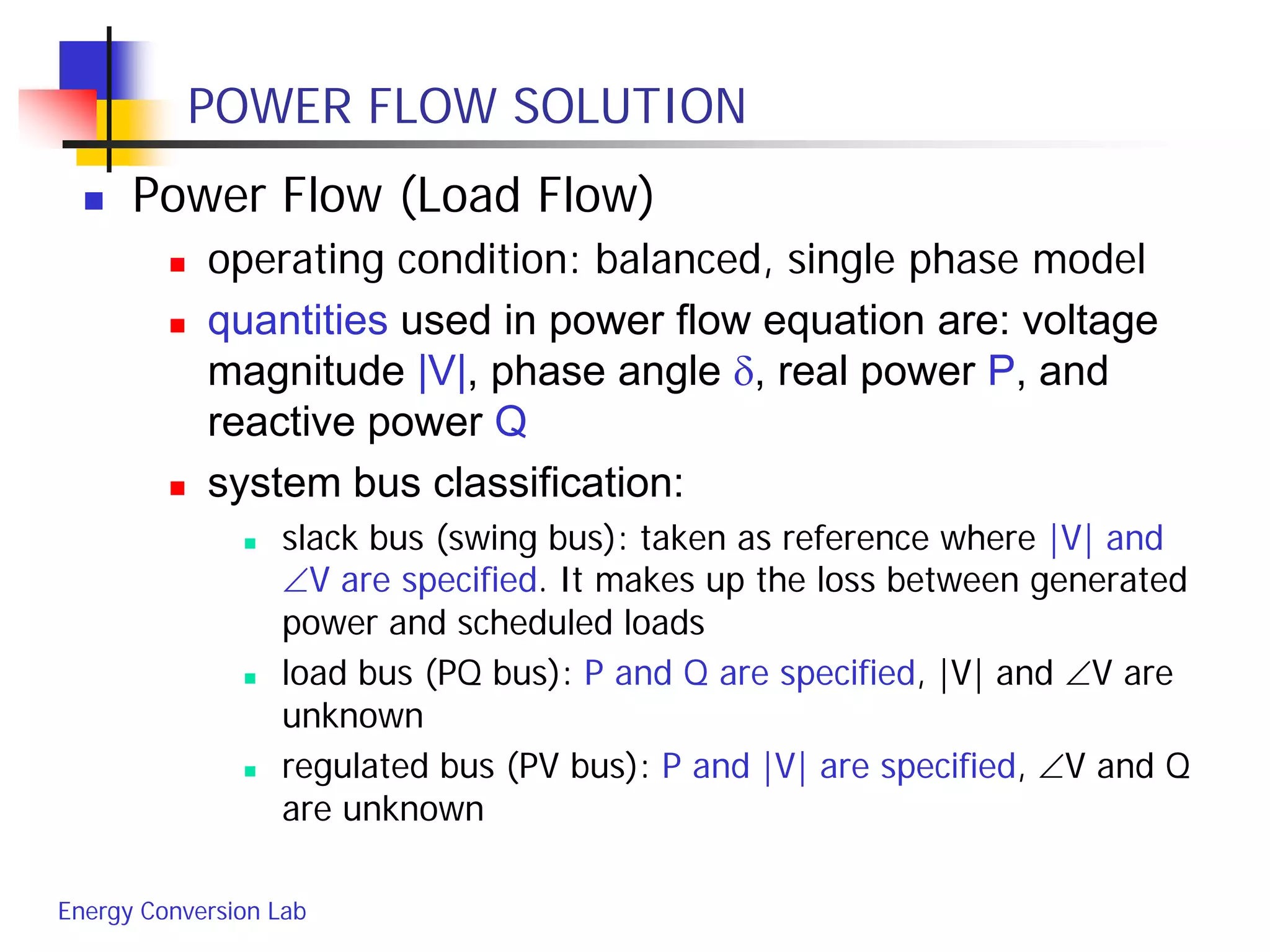
 Power Flow (Load Flow)
 operating condition: balanced, single phase model
 quantities used in power flow equation are: voltage
magnitude |V|, phase angle δ, real power P, and
reactive power Q
 system bus classification:
 slack bus (swing bus): taken as reference where |V| and
∠V are specified. It makes up the loss between generated
power and scheduled loads
 load bus (PQ bus): P and Q are specified, |V| and ∠V are
unknown
 regulated bus (PV bus): P and |V| are specified, ∠V and Q
are unknown
Energy Conversion Lab
POWER FLOW EQUATION
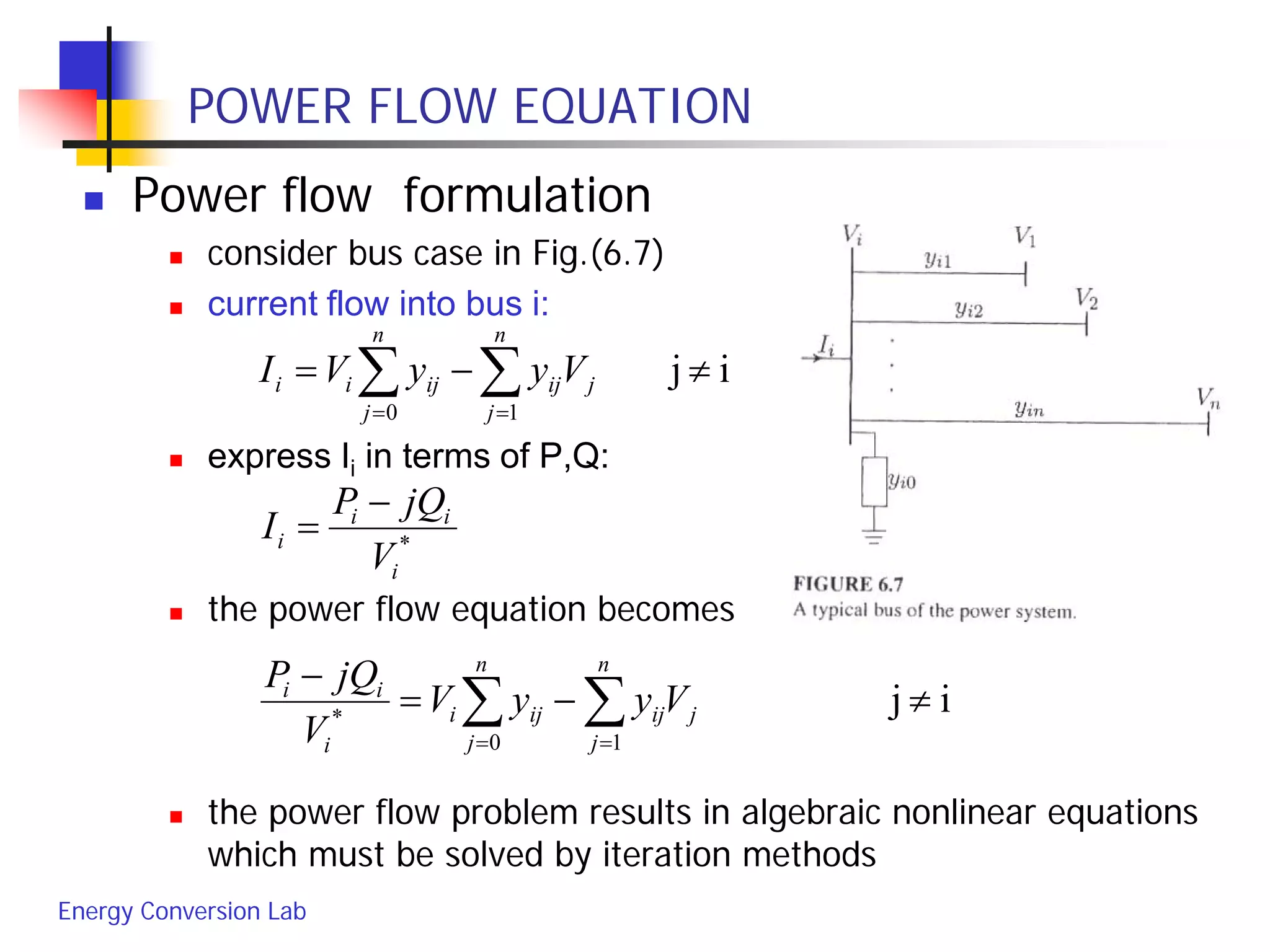
 Power flow formulation
 consider bus case in Fig.(6.7)
 current flow into bus i:
 express Ii in terms of P,Q:
 the power flow equation becomes
 the power flow problem results in algebraic nonlinear equations
which must be solved by iteration methods
ij
10
≠−= ∑∑ ==
j
n
j
ij
n
j
ijii VyyVI
*
i
ii
i
V
jQP
I
−
=
ij
10
*
≠−=
−
∑∑ ==
j
n
j
ij
n
j
iji
i
ii
VyyV
V
jQP
Energy Conversion Lab
GAUSS-SEIDEL POWER FLOW EQUATION
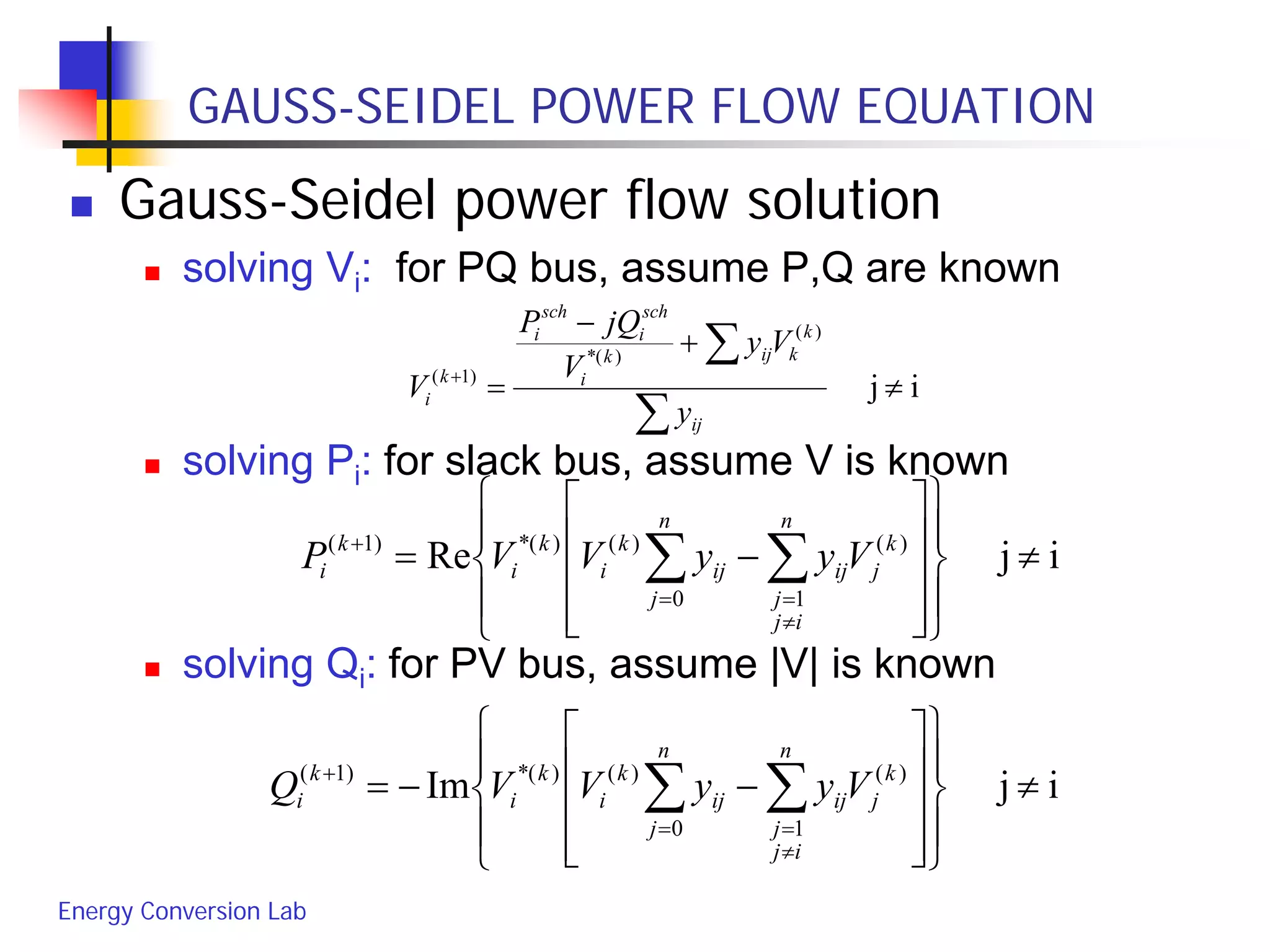
 Gauss-Seidel power flow solution
 solving Vi: for PQ bus, assume P,Q are known
 solving Pi: for slack bus, assume V is known
 solving Qi: for PV bus, assume |V| is known
ij
)(
)(*
)1(
≠
+
−
=
∑
∑+
ij
k
kijk
i
sch
i
sch
i
k
i
y
Vy
V
jQP
V
ijRe )(
10
)()(*)1(
≠




















−= ∑∑
≠
==
+ k
j
n
ij
j
ij
n
j
ij
k
i
k
i
k
i VyyVVP
ijIm )(
10
)()(*)1(
≠




















−−= ∑∑
≠
==
+ k
j
n
ij
j
ij
n
j
ij
k
i
k
i
k
i VyyVVQ
Energy Conversion Lab
GAUSS-SEIDEL POWER FLOW EQUATION
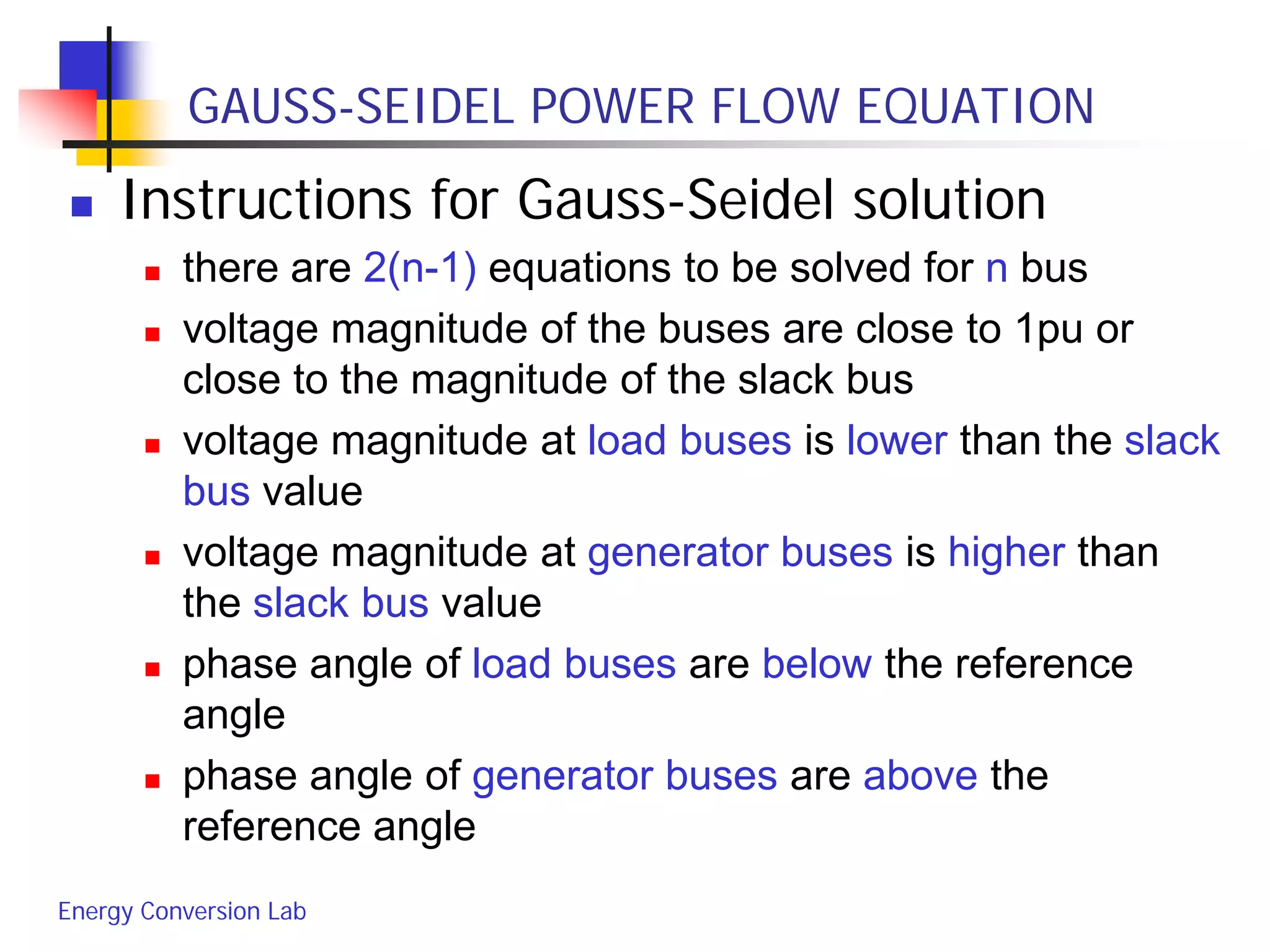
 Instructions for Gauss-Seidel solution
 there are 2(n-1) equations to be solved for n bus
 voltage magnitude of the buses are close to 1pu or
close to the magnitude of the slack bus
 voltage magnitude at load buses is lower than the slack
bus value
 voltage magnitude at generator buses is higher than
the slack bus value
 phase angle of load buses are below the reference
angle
 phase angle of generator buses are above the
reference angle
Energy Conversion Lab
INSTRUCTIONS FOR G-S SOLUTION
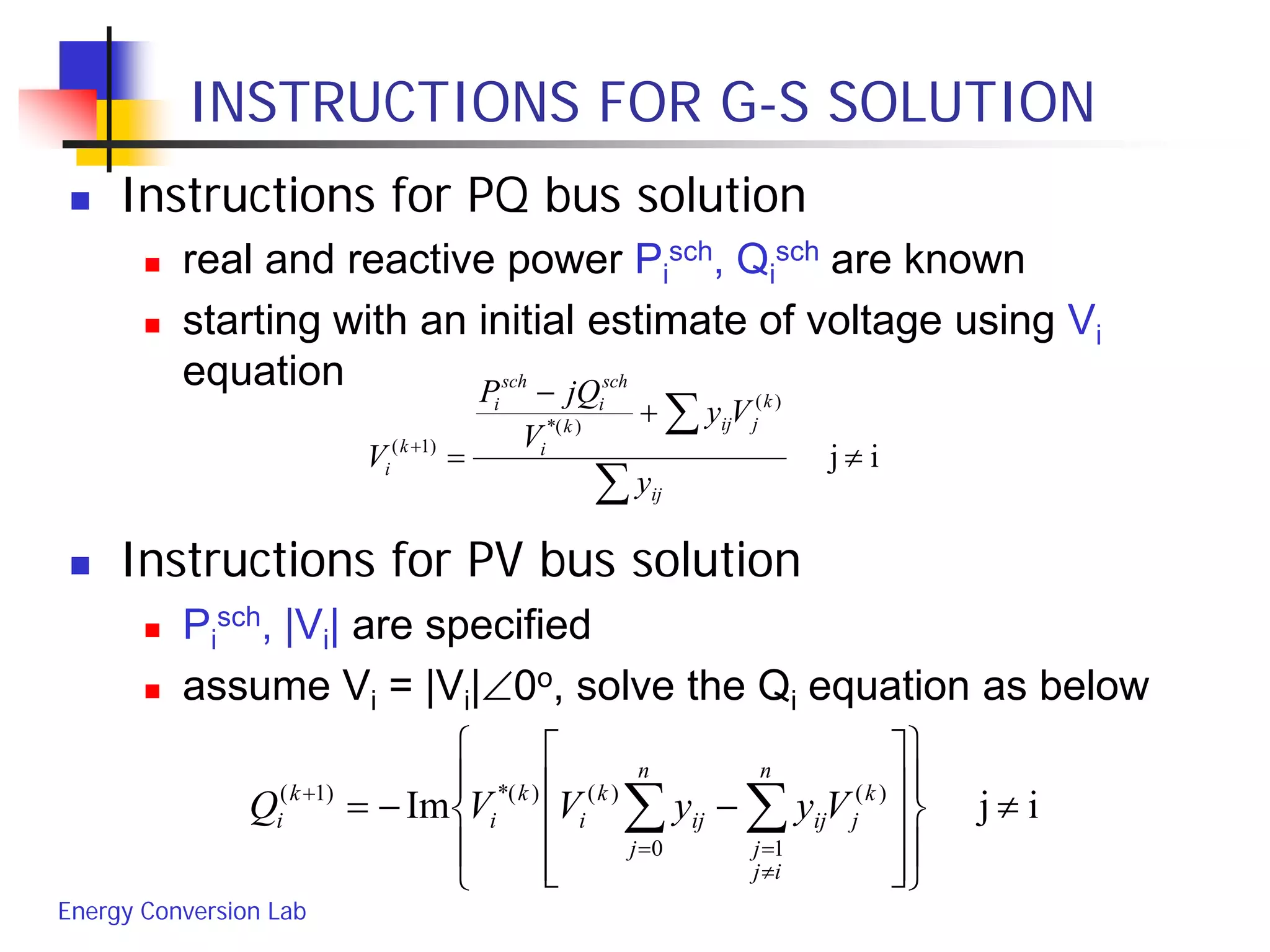
 Instructions for PQ bus solution
 real and reactive power Pi
sch, Qi
sch are known
 starting with an initial estimate of voltage using Vi
equation
 Instructions for PV bus solution
 Pi
sch, |Vi| are specified
 assume Vi = |Vi|∠0o, solve the Qi equation as below
ij
)(
)(*
)1(
≠
+
−
=
∑
∑+
ij
k
jijk
i
sch
i
sch
i
k
i
y
Vy
V
jQP
V
ijIm )(
10
)()(*)1(
≠




















−−= ∑∑
≠
==
+ k
j
n
ij
j
ij
n
j
ij
k
i
k
i
k
i VyyVVQ
Energy Conversion Lab
INSTRUCTIONS FOR G-S SOLUTION
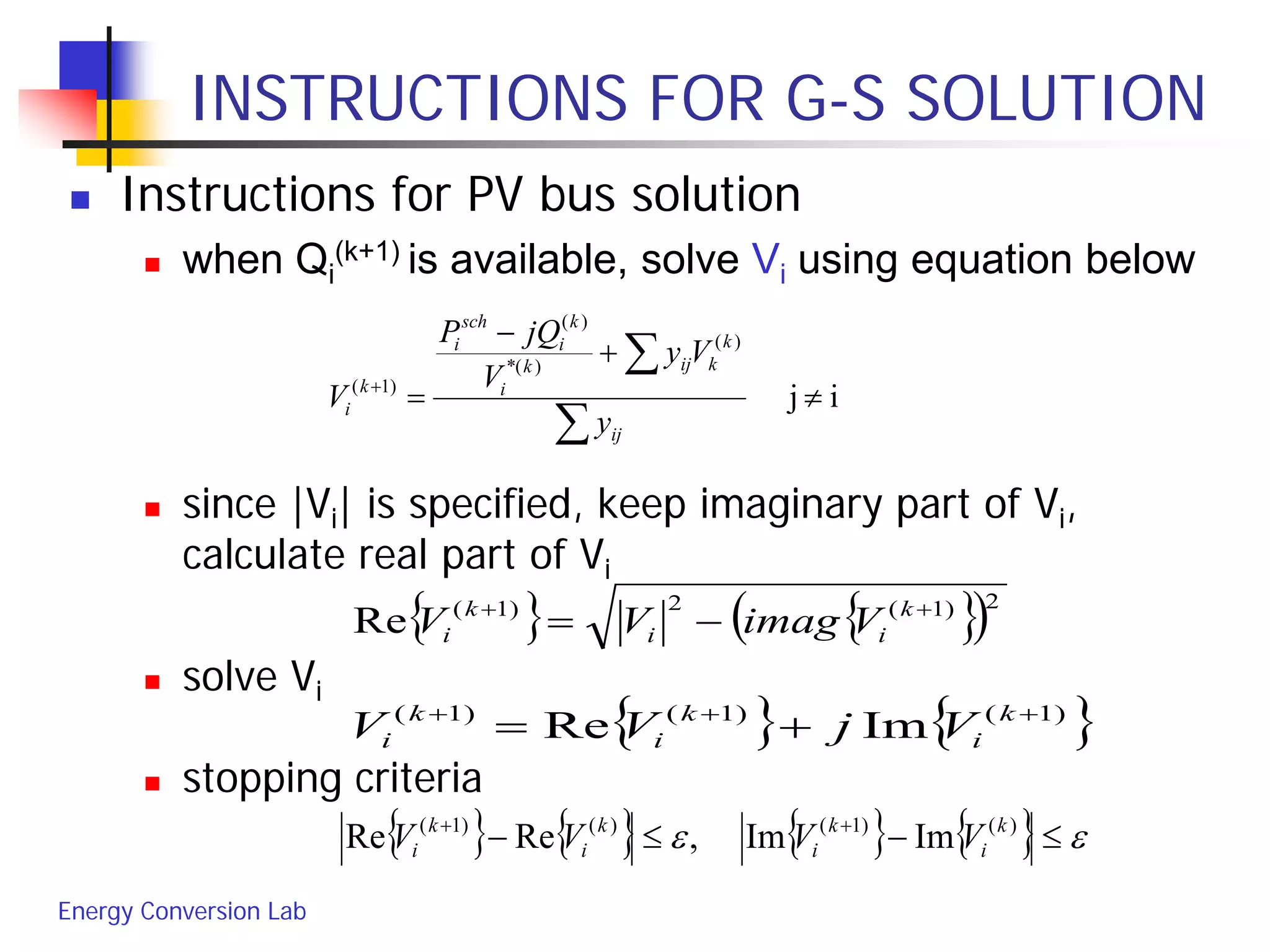
 Instructions for PV bus solution
 when Qi
(k+1) is available, solve Vi using equation below
 since |Vi| is specified, keep imaginary part of Vi,
calculate real part of Vi
 solve Vi
 stopping criteria
ij
)(
)(*
)(
)1(
≠
+
−
=
∑
∑+
ij
k
kijk
i
k
i
sch
i
k
i
y
Vy
V
jQP
V
{ } { }( )2)1(2)1(
Re ++
−= k
ii
k
i VimagVV
{ } { })1()1()1(
ImRe +++
+= k
i
k
i
k
i VjVV
{ } { } { } { } εε ≤−≤− ++ )()1()()1(
ImIm,ReRe k
i
k
i
k
i
k
i VVVV
Energy Conversion Lab
INSTRUCTIONS FOR G-S SOLUTION
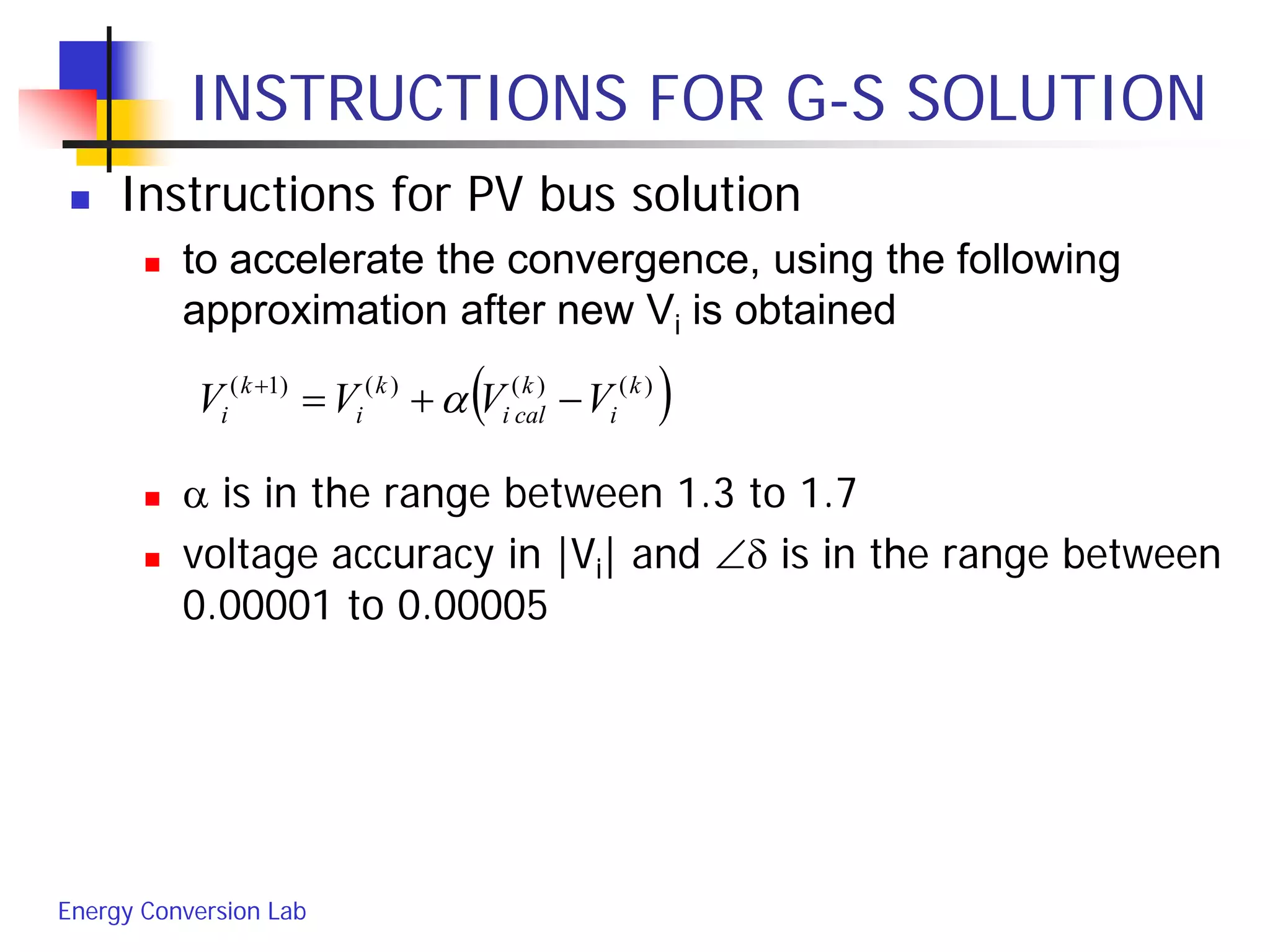
 Instructions for PV bus solution
 to accelerate the convergence, using the following
approximation after new Vi is obtained
 α is in the range between 1.3 to 1.7
 voltage accuracy in |Vi| and ∠δ is in the range between
0.00001 to 0.00005
( ))()()()1( k
i
k
cali
k
i
k
i VVVV −+=+
α
Energy Conversion Lab
INSTRUCTIONS FOR G-S SOLUTION
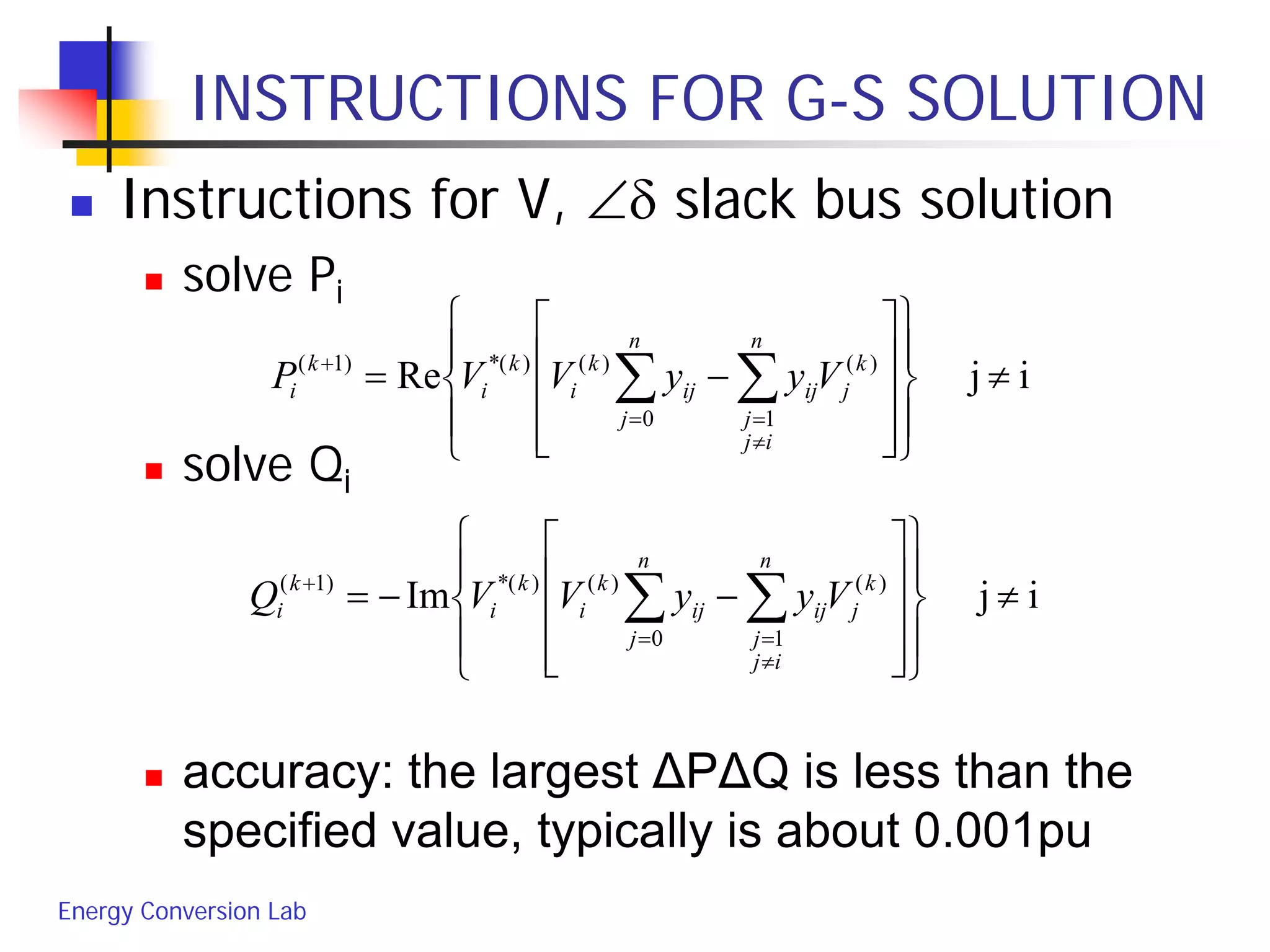
 Instructions for V, ∠δ slack bus solution
 solve Pi
 solve Qi
 accuracy: the largest ΔPΔQ is less than the
specified value, typically is about 0.001pu
ijRe )(
10
)()(*)1(
≠




















−= ∑∑
≠
==
+ k
j
n
ij
j
ij
n
j
ij
k
i
k
i
k
i VyyVVP
ijIm )(
10
)()(*)1(
≠




















−−= ∑∑
≠
==
+ k
j
n
ij
j
ij
n
j
ij
k
i
k
i
k
i VyyVVQ
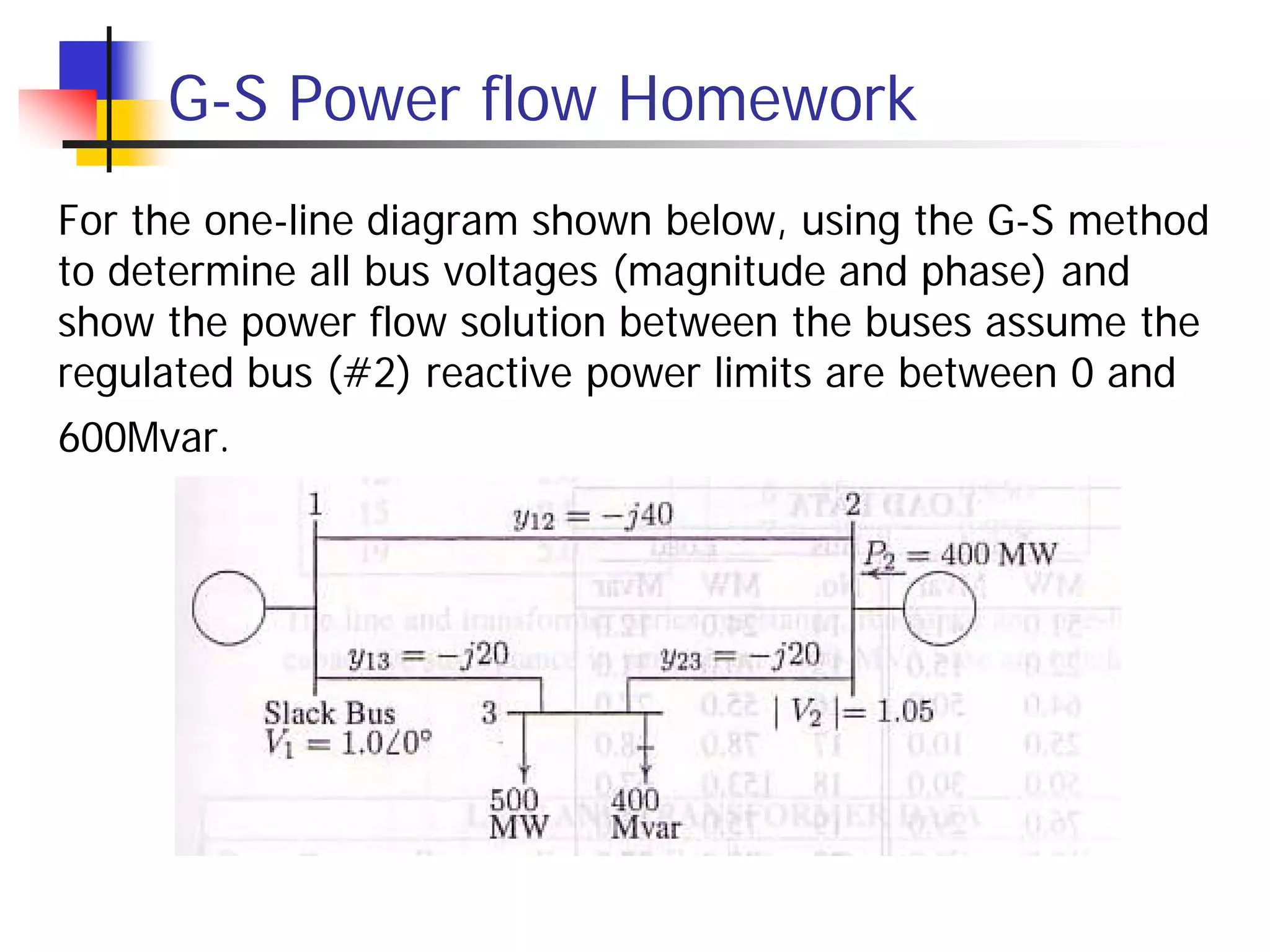
G-S Power flow Homework
For the one-line diagram shown below, using the G-S method
to determine all bus voltages (magnitude and phase) and
show the power flow solution between the buses assume the
regulated bus (#2) reactive power limits are between 0 and
600Mvar.
Energy Conversion Lab
NEWTON RAPHSON METHOD
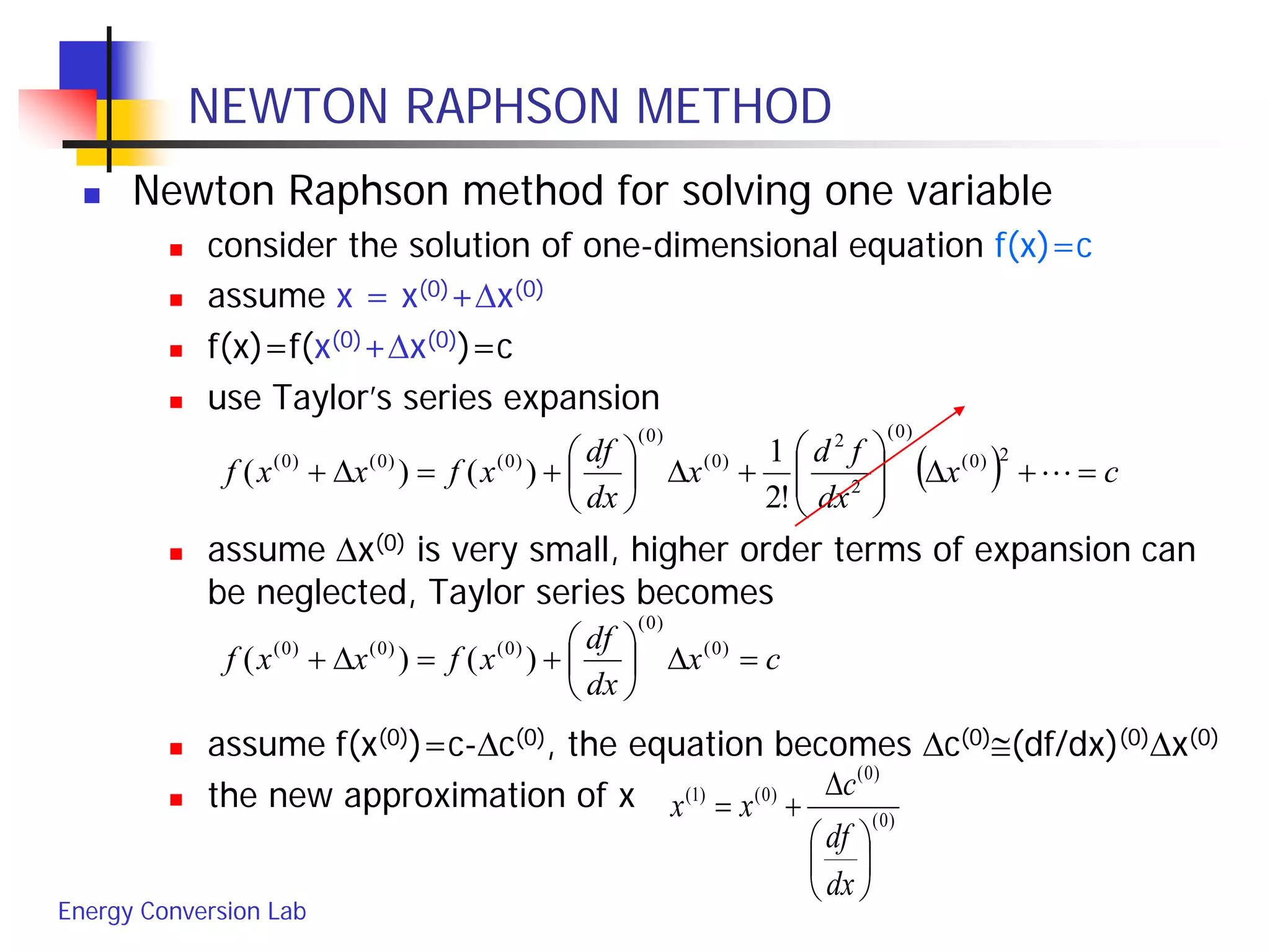
 Newton Raphson method for solving one variable
 consider the solution of one-dimensional equation f(x)=c
 assume x = x(0)+∆x(0)
 f(x)=f(x(0)+∆x(0))=c
 use Taylor’s series expansion
 assume ∆x(0) is very small, higher order terms of expansion can
be neglected, Taylor series becomes
 assume f(x(0))=c-∆c(0), the equation becomes ∆c(0)≅(df/dx)(0)∆x(0)
 the new approximation of x
( ) cx
dx
fd
x
dx
df
xfxxf =+∆





+∆





+=∆+ 
2)0(
)0(
2
2
)0(
)0(
)0()0()0(
!2
1
)()(
cx
dx
df
xfxxf =∆





+=∆+ )0(
)0(
)0()0()0(
)()(
)0(
)0(
)0()1(






∆
+=
dx
df
c
xx
Energy Conversion Lab
NEWTON RAPHSON METHOD
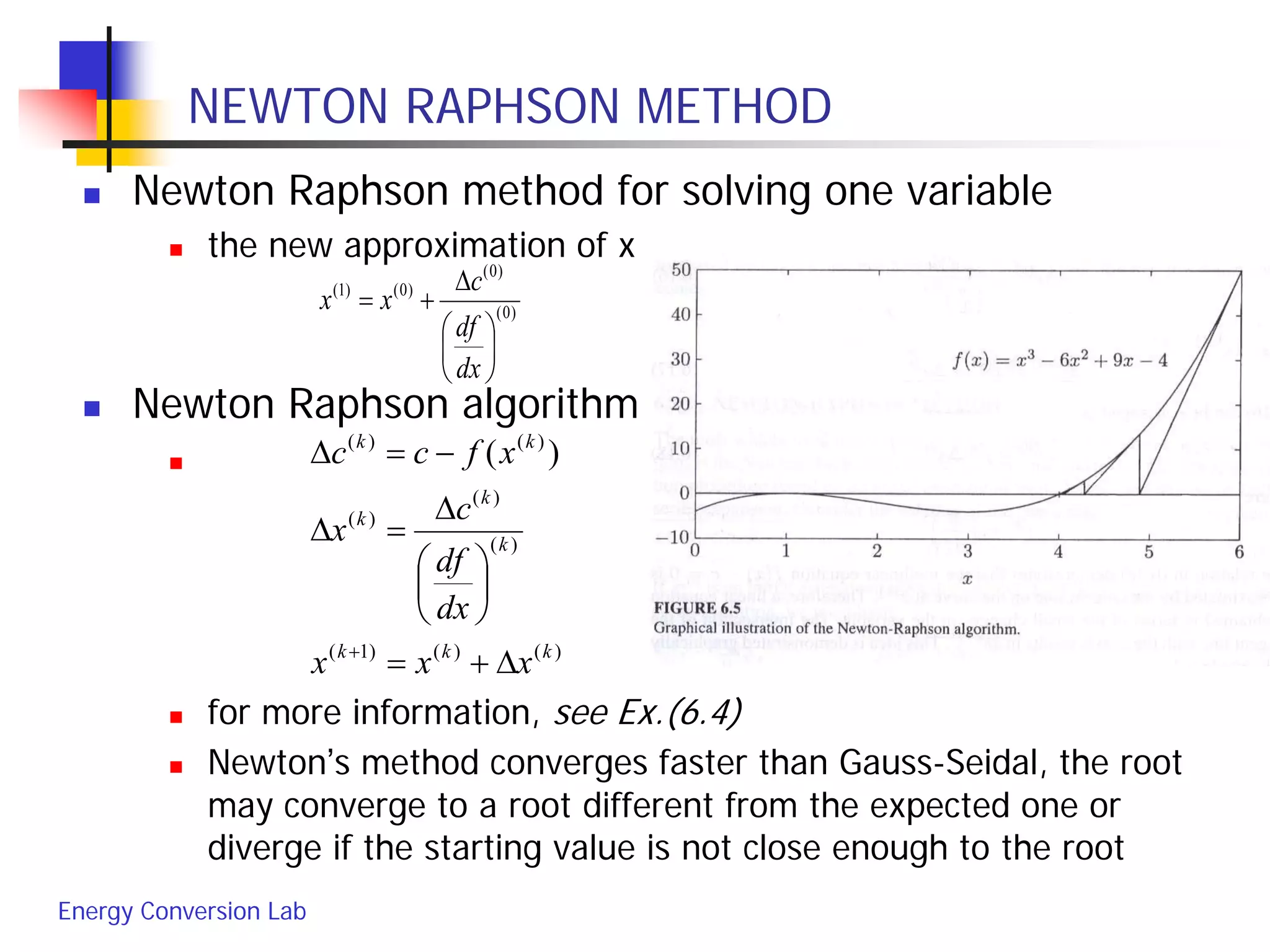
 Newton Raphson method for solving one variable
 the new approximation of x
 Newton Raphson algorithm

 for more information, see Ex.(6.4)
 Newton’s method converges faster than Gauss-Seidal, the root
may converge to a root different from the expected one or
diverge if the starting value is not close enough to the root
)0(
)0(
)0()1(






∆
+=
dx
df
c
xx
)()()1(
)(
)(
)(
)()(
)(
kkk
k
k
k
kk
xxx
dx
df
c
x
xfcc
∆+=






∆
=∆
−=∆
+
Energy Conversion Lab
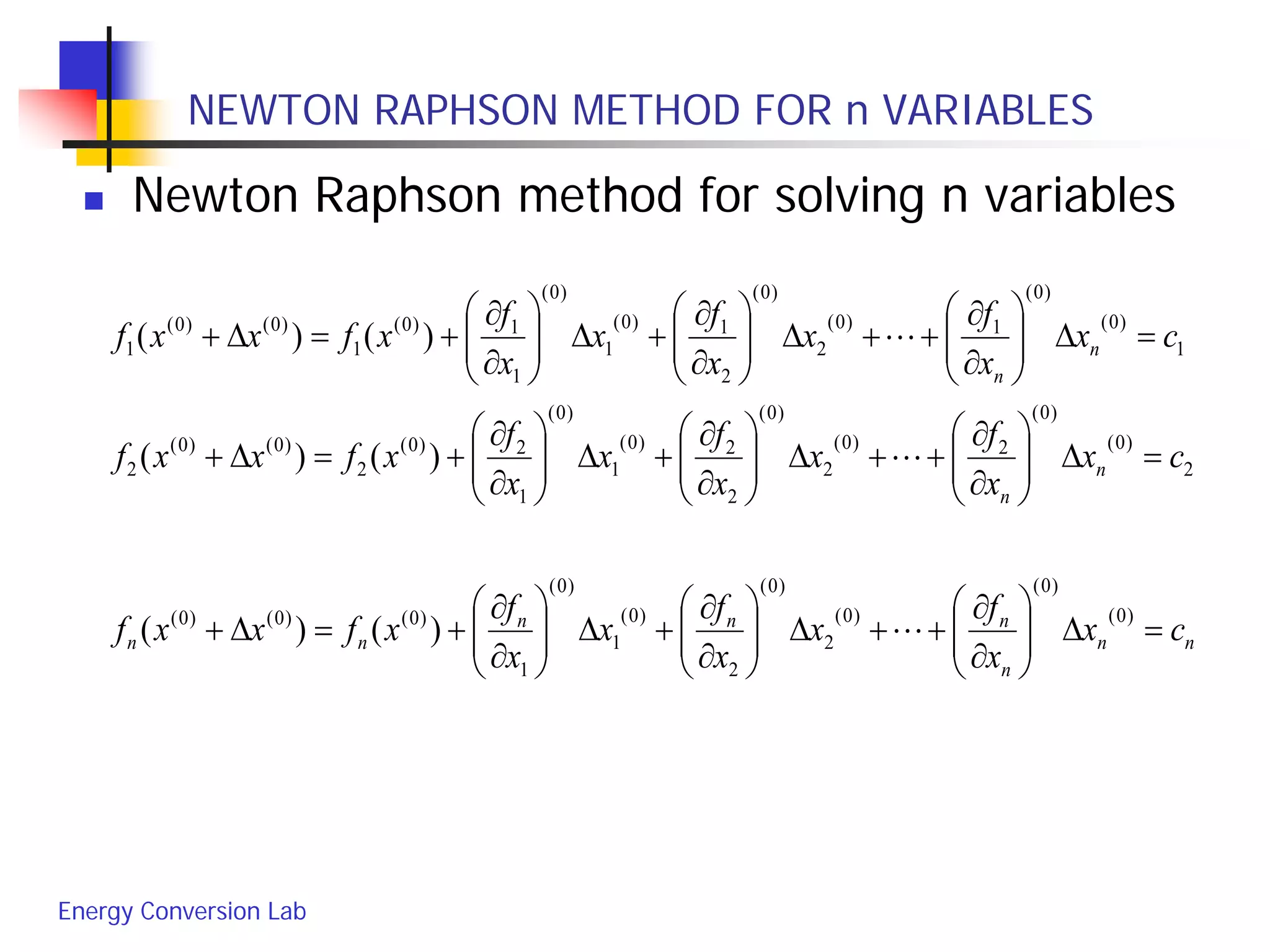
NEWTON RAPHSON METHOD FOR n VARIABLES
 Newton Raphson method for solving n variables
nn
n
nnn
nn
n
n
n
n
cx
x
f
x
x
f
x
x
f
xfxxf
cx
x
f
x
x
f
x
x
f
xfxxf
cx
x
f
x
x
f
x
x
f
xfxxf
=∆





∂
∂
++∆





∂
∂
+∆





∂
∂
+=∆+
=∆





∂
∂
++∆





∂
∂
+∆





∂
∂
+=∆+
=∆





∂
∂
++∆





∂
∂
+∆





∂
∂
+=∆+
)0(
)0(
)0(
2
)0(
2
)0(
1
)0(
1
)0()0()0(
2
)0(
)0(
2)0(
2
)0(
2
2)0(
1
)0(
1
2)0(
2
)0()0(
2
1
)0(
)0(
1)0(
2
)0(
2
1)0(
1
)0(
1
1)0(
1
)0()0(
1
)()(
)()(
)()(



Energy Conversion Lab
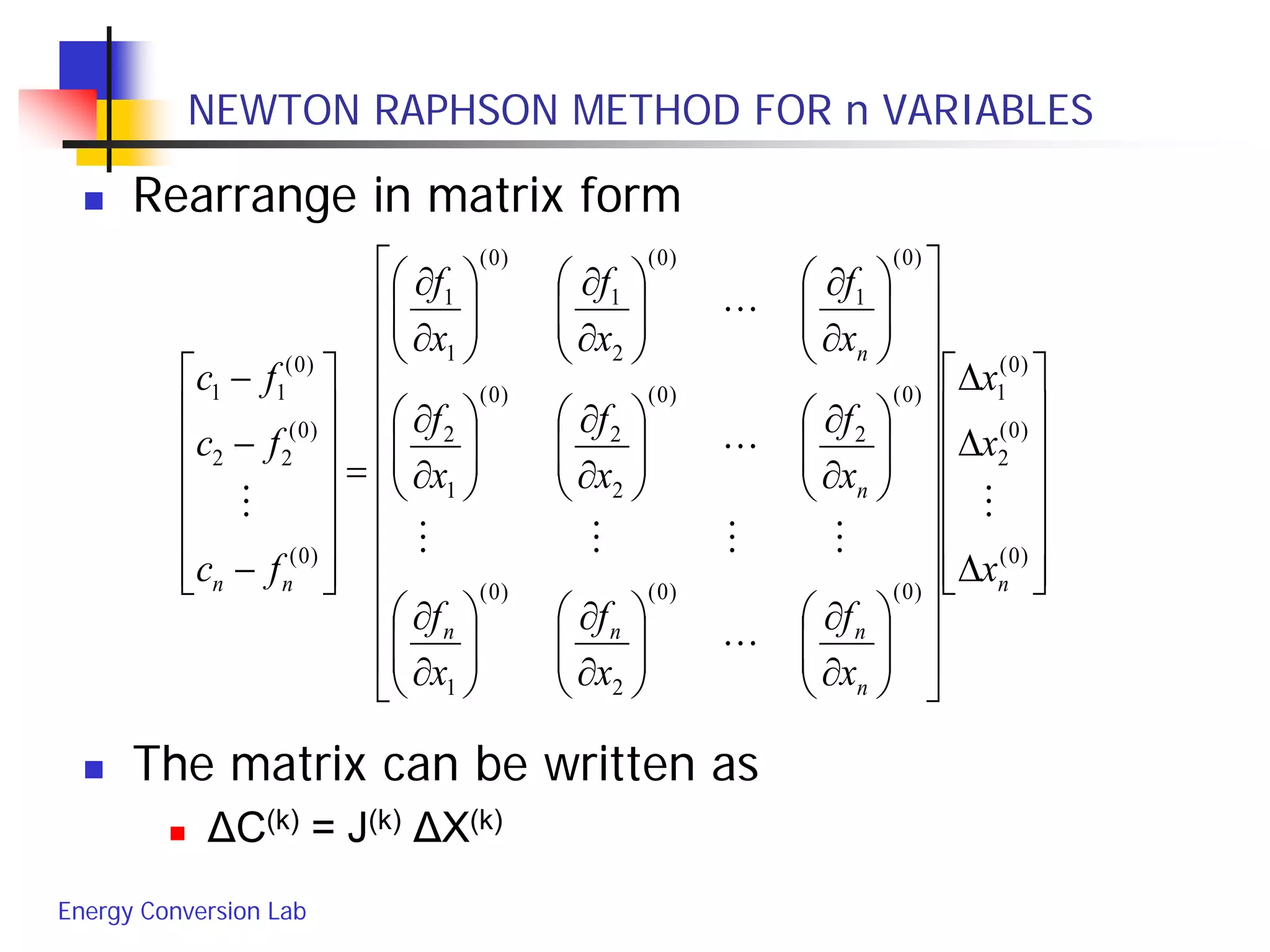
NEWTON RAPHSON METHOD FOR n VARIABLES
 Rearrange in matrix form
 The matrix can be written as
 ΔC(k) = J(k) ΔX(k)














∆
∆
∆






























∂
∂






∂
∂






∂
∂






∂
∂






∂
∂






∂
∂






∂
∂






∂
∂






∂
∂
=














−
−
−
)0(
)0(
2
)0(
1
)0()0(
2
)0(
1
)0(
2
)0(
2
2
)0(
1
2
)0(
1
)0(
2
1
)0(
1
1
)0(
)0(
22
)0(
11
n
n
nnn
n
n
nn x
x
x
x
f
x
f
x
f
x
f
x
f
x
f
x
f
x
f
x
f
fc
fc
fc






Energy Conversion Lab
NEWTON RAPHSON METHOD FOR n VARIABLES
 The Newton-Raphson algorithm for n-
dimensional case is
 X(k+1) = X(k) +ΔX(k) = X(k) + [J(k)]-1ΔC(k)
 where














−
−
−
=∆
)(
)(
22
)(
11
)(
k
nn
k
k
k
fc
fc
fc
C































∂
∂






∂
∂






∂
∂






∂
∂






∂
∂






∂
∂






∂
∂






∂
∂






∂
∂
=
)()(
2
)(
1
)(
2
)(
2
2
)(
1
2
)(
1
)(
2
1
)(
1
1
)(
k
n
n
k
n
k
n
k
n
kk
k
n
kk
k
x
f
x
f
x
f
x
f
x
f
x
f
x
f
x
f
x
f
J


















∆
∆
∆
=∆
)(
)(
2
)(
1
)(
k
n
k
k
k
x
x
x
X

Energy Conversion Lab
NEWTON RAPHSON METHOD FOR n VARIABLES
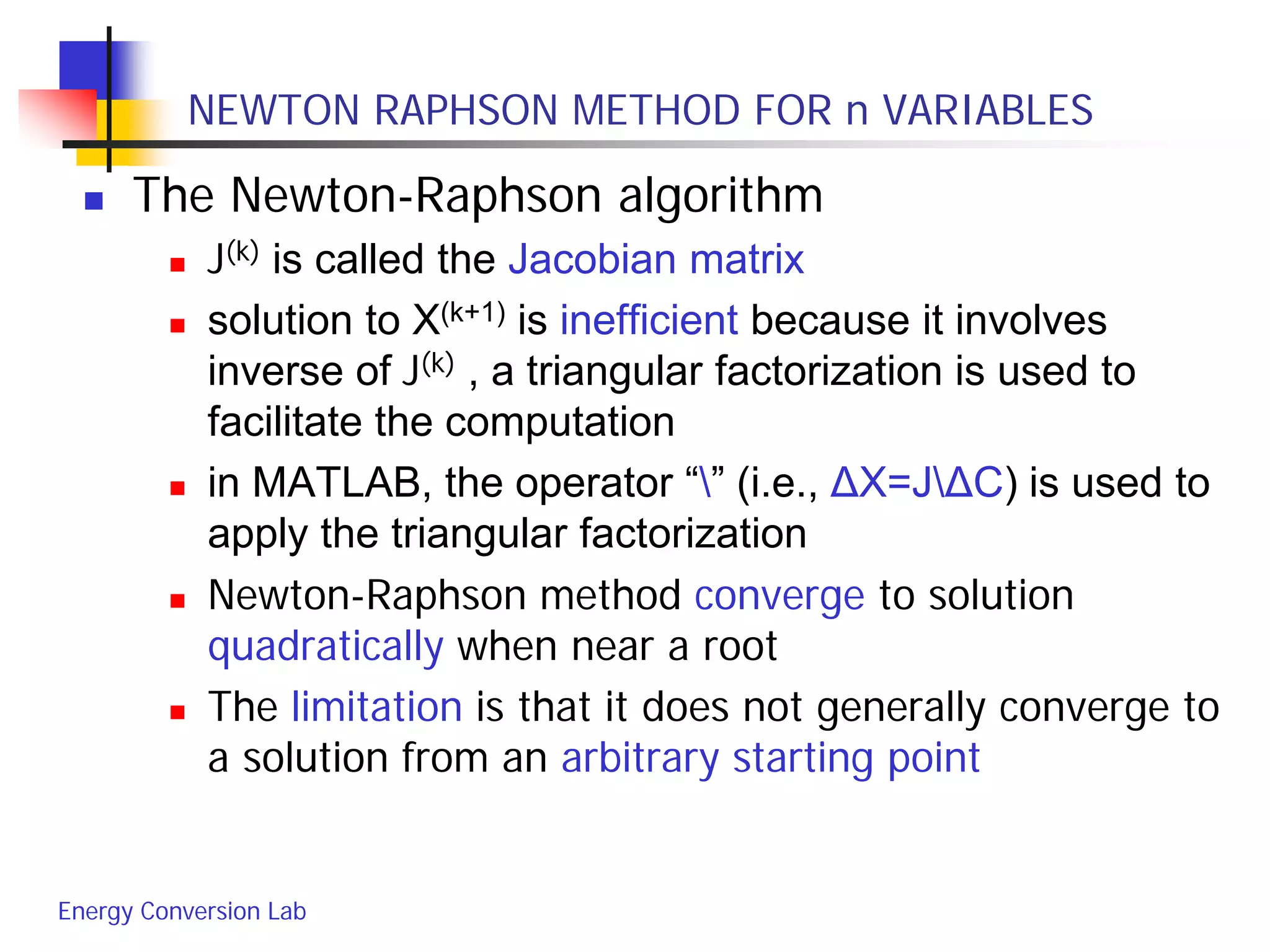
 The Newton-Raphson algorithm
 J(k) is called the Jacobian matrix
 solution to X(k+1) is inefficient because it involves
inverse of J(k) , a triangular factorization is used to
facilitate the computation
 in MATLAB, the operator “” (i.e., ΔX=JΔC) is used to
apply the triangular factorization
 Newton-Raphson method converge to solution
quadratically when near a root
 The limitation is that it does not generally converge to
a solution from an arbitrary starting point
Energy Conversion Lab
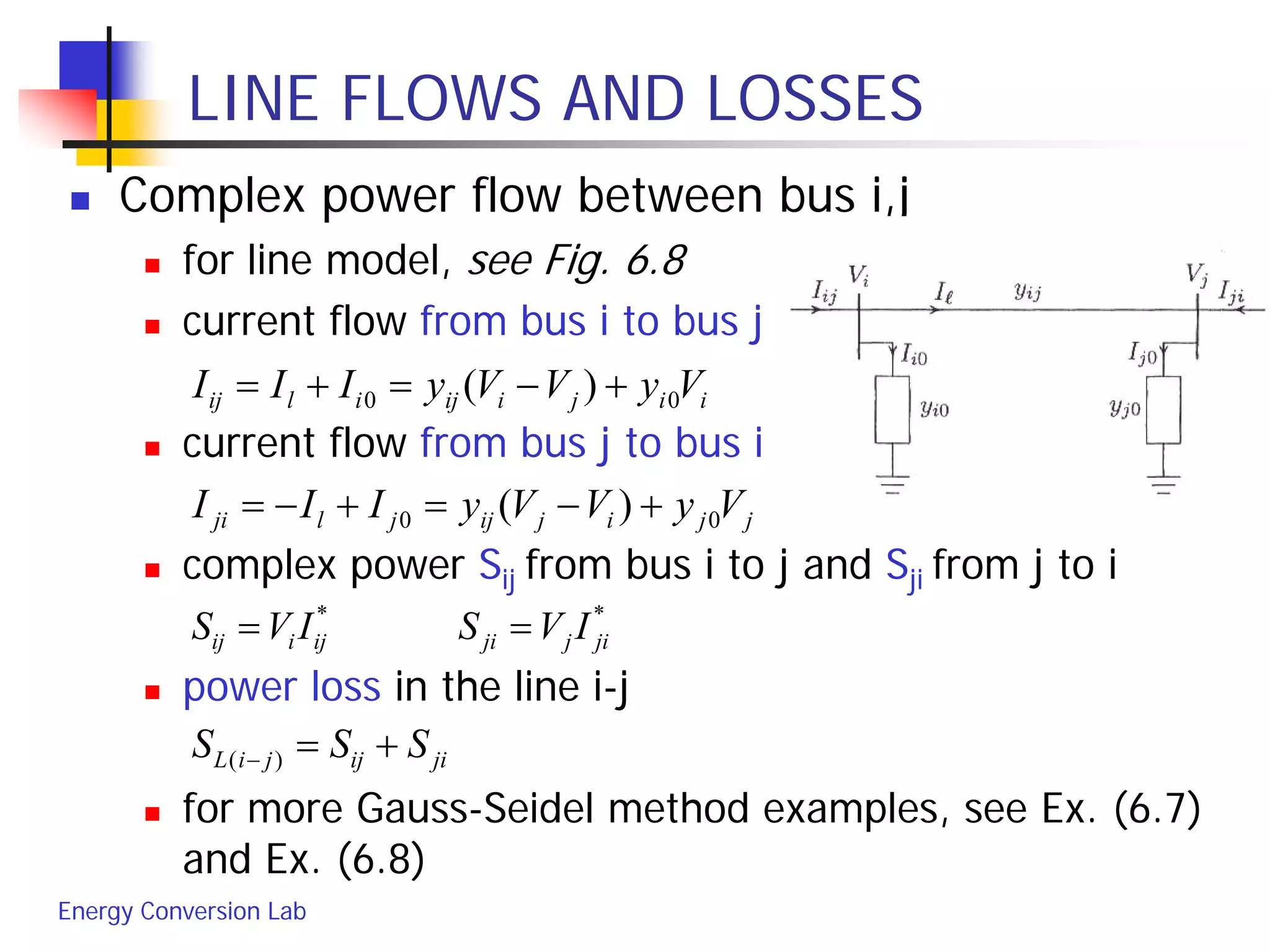
LINE FLOWS AND LOSSES
 Complex power flow between bus i,j
 for line model, see Fig. 6.8
 current flow from bus i to bus j
 current flow from bus j to bus i
 complex power Sij from bus i to j and Sji from j to i
 power loss in the line i-j
 for more Gauss-Seidel method examples, see Ex. (6.7)
and Ex. (6.8)
iijiijilij VyVVyIII 00 )( +−=+=
jjijijjlji VyVVyIII 00 )( +−=+−=
**
jijjiijiij IVSIVS ==
jiijjiL SSS +=− )(
Energy Conversion Lab
NEWTON-RAPHSON POWER FLOW
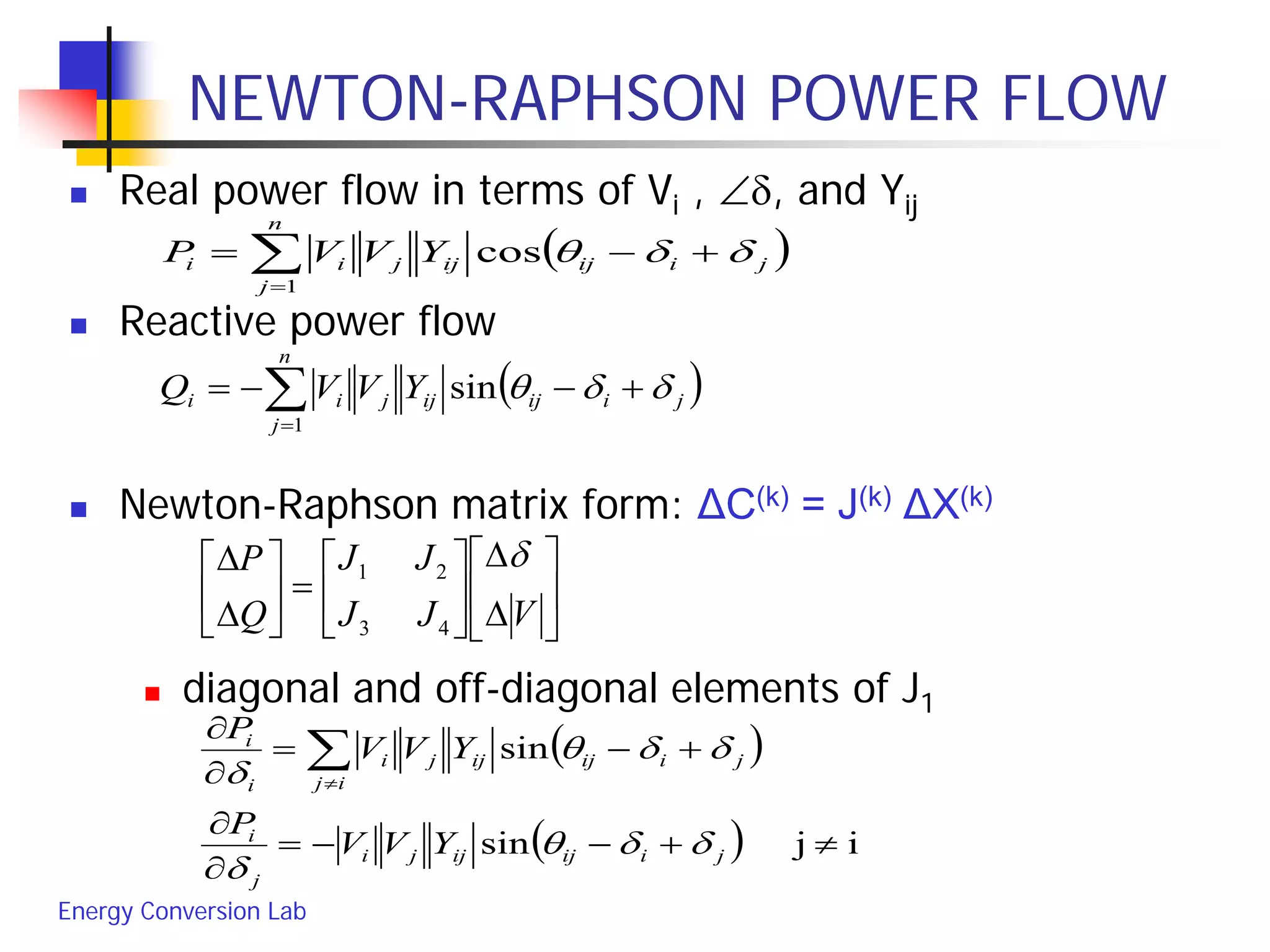
 Real power flow in terms of Vi , ∠δ, and Yij
 Reactive power flow
 Newton-Raphson matrix form: ΔC(k) = J(k) ΔX(k)
 diagonal and off-diagonal elements of J1
( )∑=
+−=
n
j
jiijijjii YVVP
1
cos δδθ
( )∑=
+−−=
n
j
jiijijjii YVVQ
1
sin δδθ






∆
∆






=





∆
∆
VJJ
JJ
Q
P δ
43
21
( )
( ) ijsin
sin
≠+−−=
∂
∂
+−=
∂
∂
∑≠
jiijijji
j
i
ij
jiijijji
i
i
YVV
P
YVV
P
δδθ
δ
δδθ
δ
Energy Conversion Lab
NEWTON-RAPHSON POWER FLOW
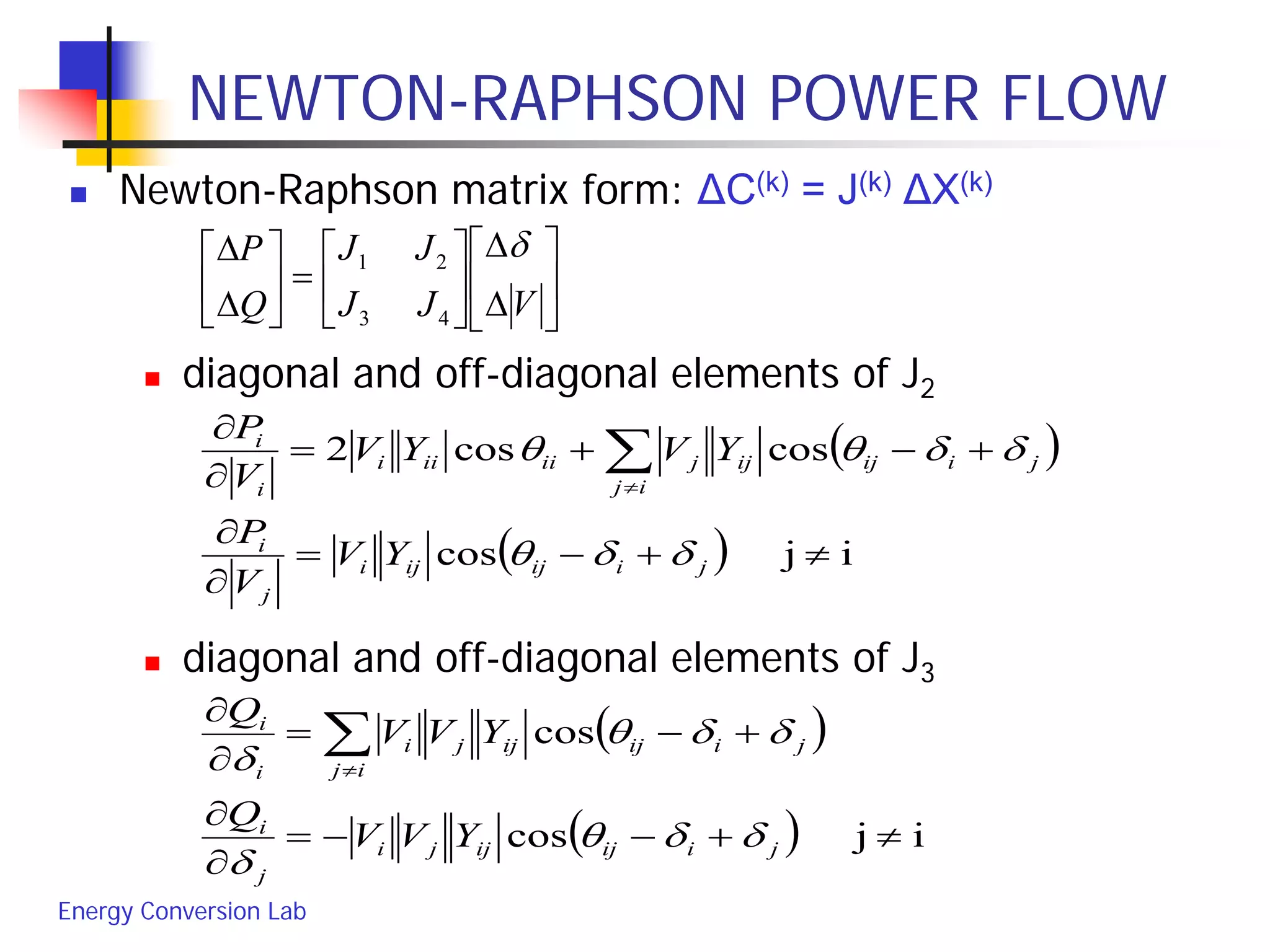
 Newton-Raphson matrix form: ΔC(k) = J(k) ΔX(k)
 diagonal and off-diagonal elements of J2
 diagonal and off-diagonal elements of J3






∆
∆






=





∆
∆
VJJ
JJ
Q
P δ
43
21
( )
( ) ijcos
coscos2
≠+−=
∂
∂
+−+=
∂
∂
∑≠
jiijiji
j
i
ij
jiijijjiiiii
i
i
YV
V
P
YVYV
V
P
δδθ
δδθθ
( )
( ) ijcos
cos
≠+−−=
∂
∂
+−=
∂
∂
∑≠
jiijijji
j
i
ij
jiijijji
i
i
YVV
Q
YVV
Q
δδθ
δ
δδθ
δ
Energy Conversion Lab
NEWTON-RAPHSON POWER FLOW
 Newton-Raphson matrix form: ΔC(k) = J(k) ΔX(k)
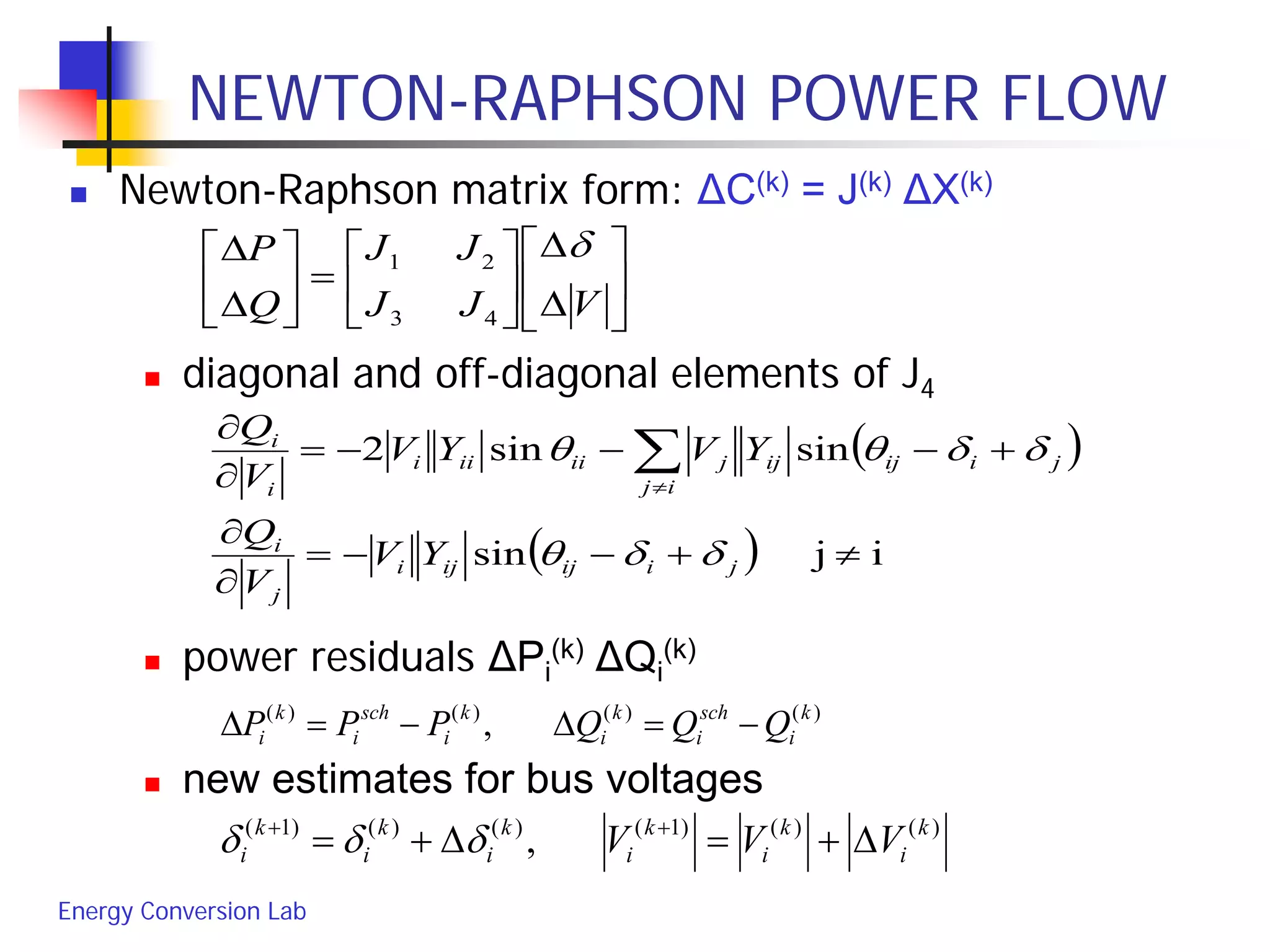
 diagonal and off-diagonal elements of J4
 power residuals ΔPi
(k) ΔQi
(k)
 new estimates for bus voltages






∆
∆






=





∆
∆
VJJ
JJ
Q
P δ
43
21
( )
( ) ijsin
sinsin2
≠+−−=
∂
∂
+−−−=
∂
∂
∑≠
jiijiji
j
i
ij
jiijijjiiiii
i
i
YV
V
Q
YVYV
V
Q
δδθ
δδθθ
)()()()(
, k
i
sch
i
k
i
k
i
sch
i
k
i QQQPPP −=∆−=∆
)()()1()()()1(
, k
i
k
i
k
i
k
i
k
i
k
i VVV ∆+=∆+= ++
δδδ
Energy Conversion Lab
NEWTON-RAPHSON POWER FLOW
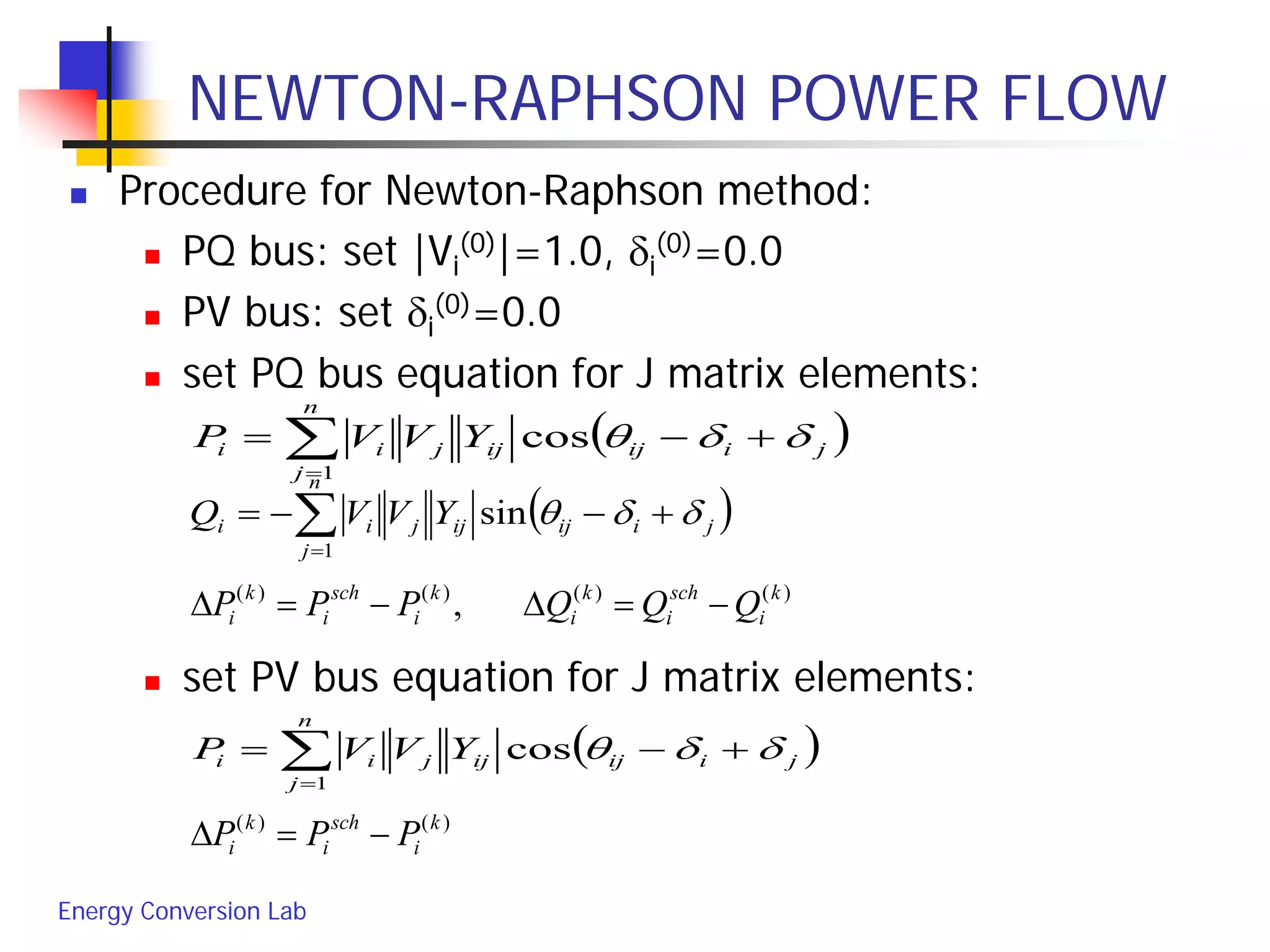
 Procedure for Newton-Raphson method:
 PQ bus: set |Vi
(0)|=1.0, δi
(0)=0.0
 PV bus: set δi
(0)=0.0
 set PQ bus equation for J matrix elements:
 set PV bus equation for J matrix elements:
)()()()(
, k
i
sch
i
k
i
k
i
sch
i
k
i QQQPPP −=∆−=∆
( )∑=
+−=
n
j
jiijijjii YVVP
1
cos δδθ
( )∑=
+−−=
n
j
jiijijjii YVVQ
1
sin δδθ
( )∑=
+−=
n
j
jiijijjii YVVP
1
cos δδθ
)()( k
i
sch
i
k
i PPP −=∆
Energy Conversion Lab
NEWTON-RAPHSON POWER FLOW
 Procedure for Newton-Raphson method:
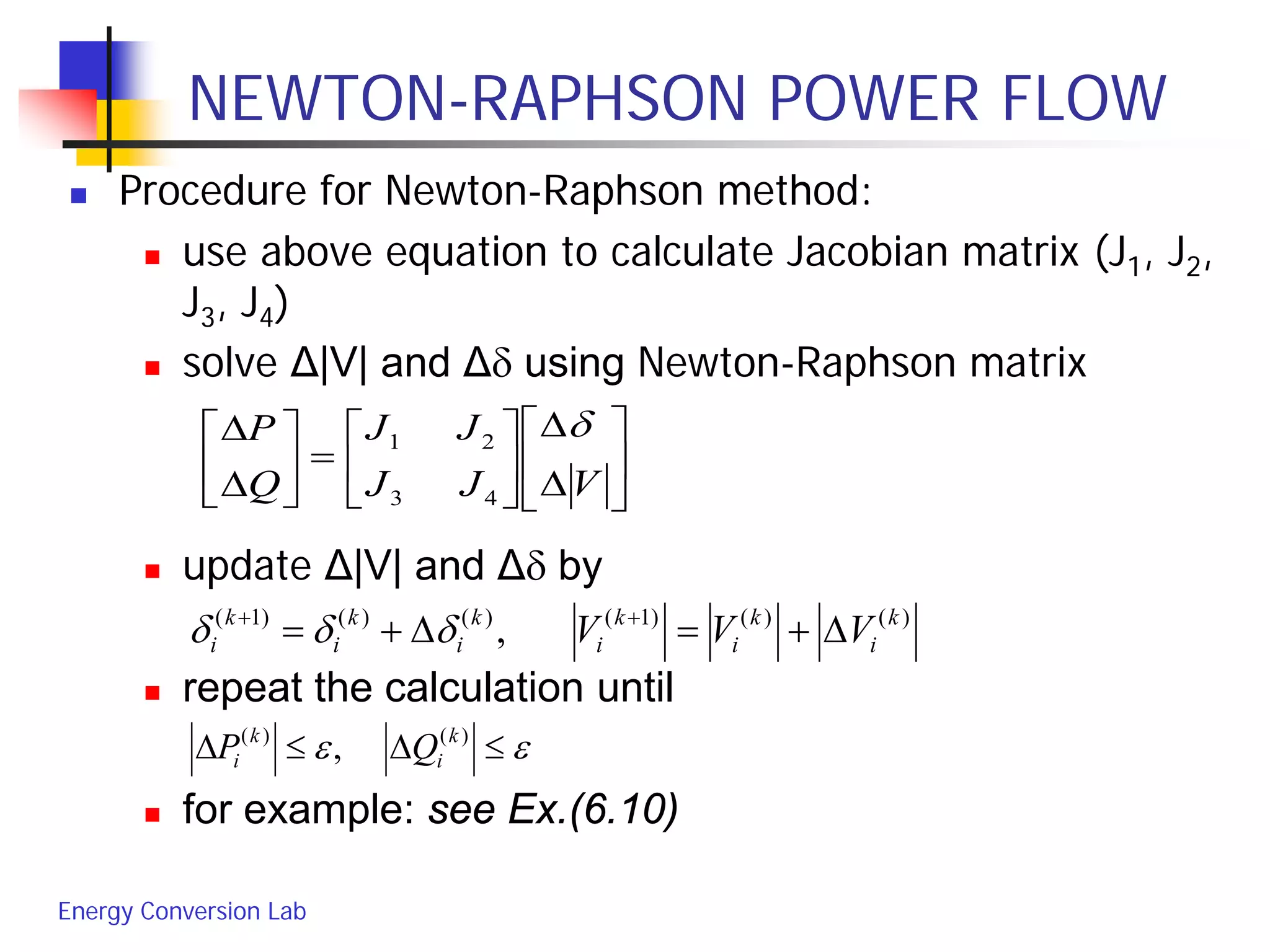
 use above equation to calculate Jacobian matrix (J1, J2,
J3, J4)
 solve Δ|V| and Δδ using Newton-Raphson matrix
 update Δ|V| and Δδ by
 repeat the calculation until
 for example: see Ex.(6.10)
εε ≤∆≤∆ )()(
, k
i
k
i QP






∆
∆






=





∆
∆
VJJ
JJ
Q
P δ
43
21
)()()1()()()1(
, k
i
k
i
k
i
k
i
k
i
k
i VVV ∆+=∆+= ++
δδδ
Energy Conversion Lab
FAST DECOUPLED POWER FLOW
 Fast decoupled power flow solution:
 the algorithm is based on Newton-Raphson method
 when transmission lines has a high X/R ratio, the
Newton-Raphson method could be further simplified
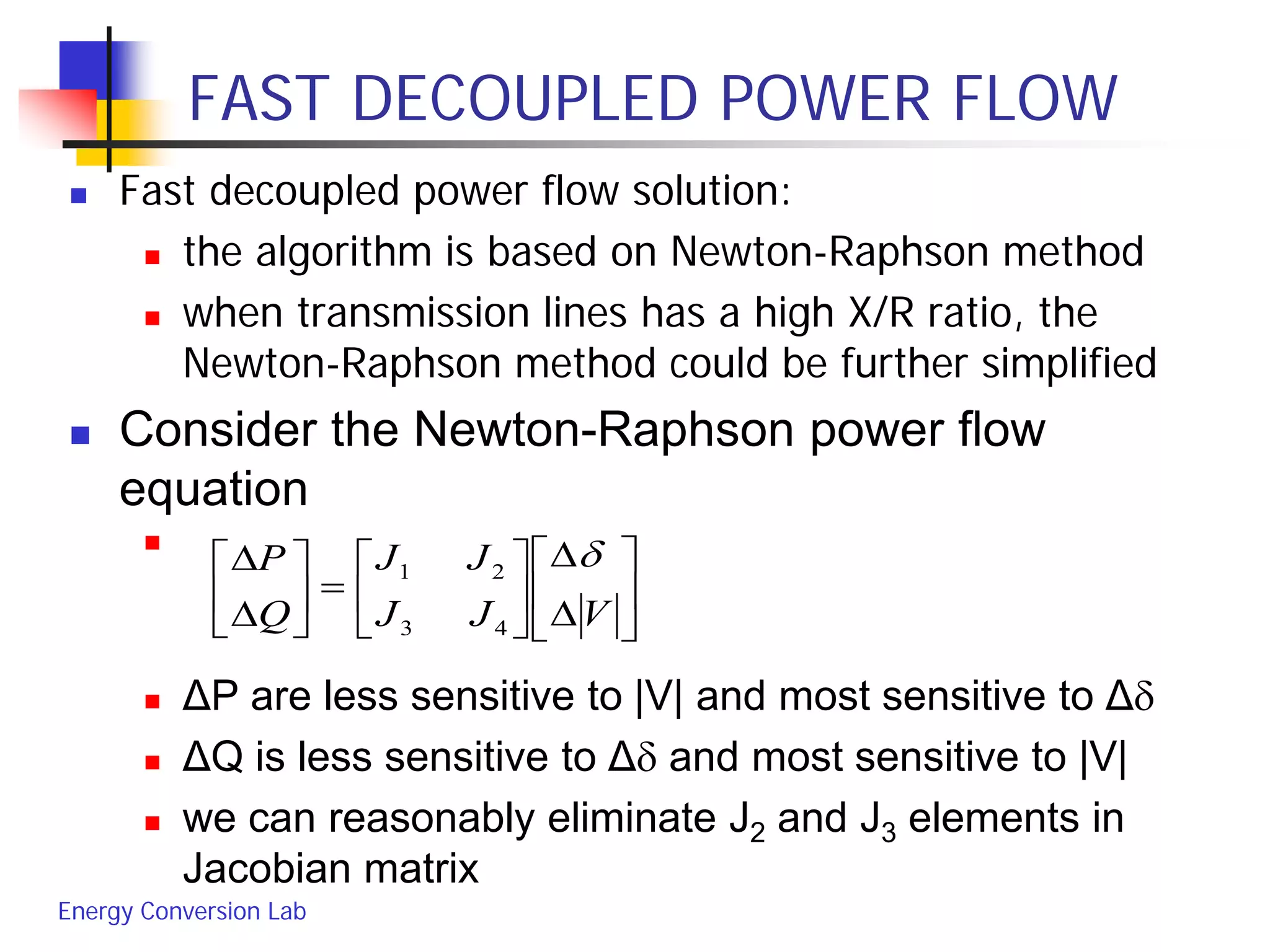
 Consider the Newton-Raphson power flow
equation

 ΔP are less sensitive to |V| and most sensitive to Δδ
 ΔQ is less sensitive to Δδ and most sensitive to |V|
 we can reasonably eliminate J2 and J3 elements in
Jacobian matrix






∆
∆






=





∆
∆
VJJ
JJ
Q
P δ
43
21
Energy Conversion Lab
FAST DECOUPLED POWER FLOW
 Consider the Newton-Raphson power flow equation
 the power flow equation reduces to
 ΔP = J1Δδ = [∂P/∂δ]Δδ, ΔQ = J4Δ|V| = [∂Q/∂|V|]Δ|V|
 ∂Pi/∂δi = -Qi - |Vi|2Bii, Bii = |Yii|sinθii is the imaginary part of the
diagonal elements
 since Bii >> Qi, ∂Pi/∂δi (diagonal elements of J1) can be further
reduced to ∂Pi/∂δi = - |Vi|Bii (|Vi|2 ≈|Vi| )
 off diagonal element of J1: ∂Pi/∂δi = - |Vi||Vj|Yijsin(θij-δi+δj), since δj-δi
is quite small, θij-δi+δj = θij, J1 = ∂Pi/∂δj = - |Vi||Vj|Bij
 since |Vj|≈1, off diagonal elements of J1 = ∂Pi/∂δj = - |Vi|Bij






∆
∆






=





∆
∆
VJ
J
Q
P δ
4
1
0
0
Energy Conversion Lab
FAST DECOUPLED POWER FLOW
 Consider the Newton-Raphson power flow
equation
 similarly, diagonal elements of J4: ∂Qi/∂|Vi| = - |Vi|Bii
 off diagonal elements of J4: ∂Qi/∂|Vj| = - |Vi|Bij
 therefore, ΔP and ΔQ has the following forms
 B’ and B” are the imaginary part of Ybus
 the updated Δδ and Δ|V| can be obtained from
 to calculate PQ bus, use simplified J1 and J4 to obtain
solution
 to calculate PV bus, J4 can be further eliminated, only
J1 is used to obtain solution
VB
V
Q
B
V
P
ii
∆−=
∆
∆−=
∆ '''
,δ
[ ] [ ]
V
Q
BV
V
P
B
∆
−=∆
∆
−=∆
−− 11
",'δ
Energy Conversion Lab
FAST DECOUPLED POWER FLOW
 Comparison between fast decouple power flow
solution and Newton Raphson power flow solution
 fast decoupled solution requires more iterations than
Newton Raphson solution
 fast decoupled solution requires less time per iteration
 since decoupled solution needs less time for iteration,
the overall computation time may be less than using
the Newton Raphson method
 fast decoupled solution often used in fast computation
of power flow, for example, contingency analysis or on-
line control of power flow
 see Ex. 6.12

APSA LEC 9

  • 1.
    Energy Conversion Lab POWERFLOW ANALYSIS  Power flow analysis assumption  steady-state  balanced single-phase network  network may contain hundreds of nodes and branches with impedance X specified in per unit on MVA base  Power flow equations  bus admittance matrix of node-voltage equation is formulated  currents can be expressed in terms of voltages  resulting equation can be in terms of power in MW
  • 2.
    Energy Conversion Lab BUSADMITTANCE MATRIX  Nodal solution  nodal solution is based on the Kirchhoff’s current law  impedance is converted to admittance  Bus admittance equations  the impedance diagram: see Fig.6.1 ijijij ij jxrZ y + == 11
  • 3.
    Energy Conversion Lab BUSADMITTANCE MATRIX  Bus admittance equations  the admittance is based on bus-to- bus: see Fig.6.2  if no connection between bus-to- bus, leave as zero  node voltage equation is in the form busbusbus VYI =
  • 4.
    Energy Conversion Lab BUSADMITTANCE MATRIX  Node-voltage matrix  Ibus=YbusVbus  Ibus is the vector of injected currents  Vbus is the vector of the bus voltage from reference node  Ybus is the bus admittance matrix                                   =                 n i n i V V V V I I I I         2 1 2 1 nnnin2n1 iniii2i1 2n2i2221 1n1i1211 YYYY YYYY YYYY YYYY
  • 5.
    Energy Conversion Lab BUSADMITTANCE MATRIX  Node-voltage matrix  diagonal element Yii: sum of admittance connected to bus i  off-diagonal matrix Yij: negative of admittance between nodes I and j  when the bus currents are known, bus voltages are unknown, bus voltage can be solved as  inverse of bus admittance matrix is known as impedance matrix Zbus  if matrix of Ybus is invertible, Ybus should be non-singular ij 0 ≠= ∑= n j ijii yY ijjiij yYY −== busbusbus IYV 1− = 1− = busbus YZ
  • 6.
    Energy Conversion Lab BUSADMITTANCE MATRIX  Node-voltage matrix  admittance matrix is symmetric along the leading diagonal, which result in an upper diagonal nodal admittance matrix  a typical power system network, each bus is connected by a few nearby bus, which cause many off-diagonal elements are zero  many zero off-diagonal matrix is called sparse matrix  the bus admittance matrix in Fig.(6.2) by inspection is             − − − = 5.125.1200 5.125.220.50.5 00.575.85.2 00.55.25.8 jj j-jjj jjj jjj Ybus
  • 7.
    Energy Conversion Lab SOLUTIONOF NONLINEAR ALGEBRA EQUATIONS  Techniques for iterative solution of non-linear equations  Gauss-Seidal  Newton-Raphson  Quasi-Newton  Gause-Seidal method  consider a nonlinear equation f(x)=0  rearrange f(x) so that x=g(x), f(x)=x-g(x) or f(x)=g(x)-x  guess an initial estimate of x = x(k)  use iteration, obtain next x value as x(k+1) = g(x(k))  criteria for stop iteration: |x(k+1)-x(k)| ≤ ε  ε is the desired accuracy
  • 8.
    Energy Conversion Lab GAUSE-SEIDALMETHOD  Nature of Gause-Seidal method  see Ex.(6.2) and Fig.(6.3)  Gause-Seidal method needs many iterations to achieve desired accuracy  no guarantee for the convergence, depend on the location of initial x estimate
  • 9.
    Energy Conversion Lab GAUSE-SEIDALMETHOD  Nature of Gause-Seidal method  solution: if initial estimate x is within convergent region, solution will converge in zigzag fashion to one of the roots  no solution: if initial estimate x is outside convergent region, process will diverge, no solution found  in some case, an acceleration factor α is added to improve the rate of convergence:  x(k+1) = x(k) +α[g(x(k))-x(k)], where α>1  acceleration factor should not too large to produce overshoot  see Ex.(6.3) for the acceleration factor used
  • 10.
    Energy Conversion Lab GAUSE-SEIDALMETHOD  Extend one variable to n variable equations using Gause- Seidal method  consider the system of n equations in n variables and solving for one variable from each equation in one time of iteration  the updated variable x1 (k+1) calculated in first equation in Eq.(6.12) is used in the calculation of x2 (k+1) in the second equation  Ex: in the 2nd iteration x2 (k+1) = c2+g2(x1 (k+1)+x2 (k)+x3 (k)+…+xn (k))  at n iteration to complete n variables, the x1 (k+1),…,xn (k+1) is tested against x1 (k),…,xn (k) for accuracy criterion nnn n n cxxxf cxxxf cxxxf = = = ),,,( ),,,( ),,,( 21 2212 1211     ),,,( ),,,( ),,,( 21 21222 21111 nnnn n n xxxgcx xxxgcx xxxgcx     += += +=
  • 11.
    Energy Conversion Lab POWERFLOW SOLUTION  Power Flow (Load Flow)  operating condition: balanced, single phase model  quantities used in power flow equation are: voltage magnitude |V|, phase angle δ, real power P, and reactive power Q  system bus classification:  slack bus (swing bus): taken as reference where |V| and ∠V are specified. It makes up the loss between generated power and scheduled loads  load bus (PQ bus): P and Q are specified, |V| and ∠V are unknown  regulated bus (PV bus): P and |V| are specified, ∠V and Q are unknown
  • 12.
    Energy Conversion Lab POWERFLOW EQUATION  Power flow formulation  consider bus case in Fig.(6.7)  current flow into bus i:  express Ii in terms of P,Q:  the power flow equation becomes  the power flow problem results in algebraic nonlinear equations which must be solved by iteration methods ij 10 ≠−= ∑∑ == j n j ij n j ijii VyyVI * i ii i V jQP I − = ij 10 * ≠−= − ∑∑ == j n j ij n j iji i ii VyyV V jQP
  • 13.
    Energy Conversion Lab GAUSS-SEIDELPOWER FLOW EQUATION  Gauss-Seidel power flow solution  solving Vi: for PQ bus, assume P,Q are known  solving Pi: for slack bus, assume V is known  solving Qi: for PV bus, assume |V| is known ij )( )(* )1( ≠ + − = ∑ ∑+ ij k kijk i sch i sch i k i y Vy V jQP V ijRe )( 10 )()(*)1( ≠                     −= ∑∑ ≠ == + k j n ij j ij n j ij k i k i k i VyyVVP ijIm )( 10 )()(*)1( ≠                     −−= ∑∑ ≠ == + k j n ij j ij n j ij k i k i k i VyyVVQ
  • 14.
    Energy Conversion Lab GAUSS-SEIDELPOWER FLOW EQUATION  Instructions for Gauss-Seidel solution  there are 2(n-1) equations to be solved for n bus  voltage magnitude of the buses are close to 1pu or close to the magnitude of the slack bus  voltage magnitude at load buses is lower than the slack bus value  voltage magnitude at generator buses is higher than the slack bus value  phase angle of load buses are below the reference angle  phase angle of generator buses are above the reference angle
  • 15.
    Energy Conversion Lab INSTRUCTIONSFOR G-S SOLUTION  Instructions for PQ bus solution  real and reactive power Pi sch, Qi sch are known  starting with an initial estimate of voltage using Vi equation  Instructions for PV bus solution  Pi sch, |Vi| are specified  assume Vi = |Vi|∠0o, solve the Qi equation as below ij )( )(* )1( ≠ + − = ∑ ∑+ ij k jijk i sch i sch i k i y Vy V jQP V ijIm )( 10 )()(*)1( ≠                     −−= ∑∑ ≠ == + k j n ij j ij n j ij k i k i k i VyyVVQ
  • 16.
    Energy Conversion Lab INSTRUCTIONSFOR G-S SOLUTION  Instructions for PV bus solution  when Qi (k+1) is available, solve Vi using equation below  since |Vi| is specified, keep imaginary part of Vi, calculate real part of Vi  solve Vi  stopping criteria ij )( )(* )( )1( ≠ + − = ∑ ∑+ ij k kijk i k i sch i k i y Vy V jQP V { } { }( )2)1(2)1( Re ++ −= k ii k i VimagVV { } { })1()1()1( ImRe +++ += k i k i k i VjVV { } { } { } { } εε ≤−≤− ++ )()1()()1( ImIm,ReRe k i k i k i k i VVVV
  • 17.
    Energy Conversion Lab INSTRUCTIONSFOR G-S SOLUTION  Instructions for PV bus solution  to accelerate the convergence, using the following approximation after new Vi is obtained  α is in the range between 1.3 to 1.7  voltage accuracy in |Vi| and ∠δ is in the range between 0.00001 to 0.00005 ( ))()()()1( k i k cali k i k i VVVV −+=+ α
  • 18.
    Energy Conversion Lab INSTRUCTIONSFOR G-S SOLUTION  Instructions for V, ∠δ slack bus solution  solve Pi  solve Qi  accuracy: the largest ΔPΔQ is less than the specified value, typically is about 0.001pu ijRe )( 10 )()(*)1( ≠                     −= ∑∑ ≠ == + k j n ij j ij n j ij k i k i k i VyyVVP ijIm )( 10 )()(*)1( ≠                     −−= ∑∑ ≠ == + k j n ij j ij n j ij k i k i k i VyyVVQ
  • 19.
    G-S Power flowHomework For the one-line diagram shown below, using the G-S method to determine all bus voltages (magnitude and phase) and show the power flow solution between the buses assume the regulated bus (#2) reactive power limits are between 0 and 600Mvar.
  • 20.
    Energy Conversion Lab NEWTONRAPHSON METHOD  Newton Raphson method for solving one variable  consider the solution of one-dimensional equation f(x)=c  assume x = x(0)+∆x(0)  f(x)=f(x(0)+∆x(0))=c  use Taylor’s series expansion  assume ∆x(0) is very small, higher order terms of expansion can be neglected, Taylor series becomes  assume f(x(0))=c-∆c(0), the equation becomes ∆c(0)≅(df/dx)(0)∆x(0)  the new approximation of x ( ) cx dx fd x dx df xfxxf =+∆      +∆      +=∆+  2)0( )0( 2 2 )0( )0( )0()0()0( !2 1 )()( cx dx df xfxxf =∆      +=∆+ )0( )0( )0()0()0( )()( )0( )0( )0()1(       ∆ += dx df c xx
  • 21.
    Energy Conversion Lab NEWTONRAPHSON METHOD  Newton Raphson method for solving one variable  the new approximation of x  Newton Raphson algorithm   for more information, see Ex.(6.4)  Newton’s method converges faster than Gauss-Seidal, the root may converge to a root different from the expected one or diverge if the starting value is not close enough to the root )0( )0( )0()1(       ∆ += dx df c xx )()()1( )( )( )( )()( )( kkk k k k kk xxx dx df c x xfcc ∆+=       ∆ =∆ −=∆ +
  • 22.
    Energy Conversion Lab NEWTONRAPHSON METHOD FOR n VARIABLES  Newton Raphson method for solving n variables nn n nnn nn n n n n cx x f x x f x x f xfxxf cx x f x x f x x f xfxxf cx x f x x f x x f xfxxf =∆      ∂ ∂ ++∆      ∂ ∂ +∆      ∂ ∂ +=∆+ =∆      ∂ ∂ ++∆      ∂ ∂ +∆      ∂ ∂ +=∆+ =∆      ∂ ∂ ++∆      ∂ ∂ +∆      ∂ ∂ +=∆+ )0( )0( )0( 2 )0( 2 )0( 1 )0( 1 )0()0()0( 2 )0( )0( 2)0( 2 )0( 2 2)0( 1 )0( 1 2)0( 2 )0()0( 2 1 )0( )0( 1)0( 2 )0( 2 1)0( 1 )0( 1 1)0( 1 )0()0( 1 )()( )()( )()(   
  • 23.
    Energy Conversion Lab NEWTONRAPHSON METHOD FOR n VARIABLES  Rearrange in matrix form  The matrix can be written as  ΔC(k) = J(k) ΔX(k)               ∆ ∆ ∆                               ∂ ∂       ∂ ∂       ∂ ∂       ∂ ∂       ∂ ∂       ∂ ∂       ∂ ∂       ∂ ∂       ∂ ∂ =               − − − )0( )0( 2 )0( 1 )0()0( 2 )0( 1 )0( 2 )0( 2 2 )0( 1 2 )0( 1 )0( 2 1 )0( 1 1 )0( )0( 22 )0( 11 n n nnn n n nn x x x x f x f x f x f x f x f x f x f x f fc fc fc      
  • 24.
    Energy Conversion Lab NEWTONRAPHSON METHOD FOR n VARIABLES  The Newton-Raphson algorithm for n- dimensional case is  X(k+1) = X(k) +ΔX(k) = X(k) + [J(k)]-1ΔC(k)  where               − − − =∆ )( )( 22 )( 11 )( k nn k k k fc fc fc C                                ∂ ∂       ∂ ∂       ∂ ∂       ∂ ∂       ∂ ∂       ∂ ∂       ∂ ∂       ∂ ∂       ∂ ∂ = )()( 2 )( 1 )( 2 )( 2 2 )( 1 2 )( 1 )( 2 1 )( 1 1 )( k n n k n k n k n kk k n kk k x f x f x f x f x f x f x f x f x f J                   ∆ ∆ ∆ =∆ )( )( 2 )( 1 )( k n k k k x x x X 
  • 25.
    Energy Conversion Lab NEWTONRAPHSON METHOD FOR n VARIABLES  The Newton-Raphson algorithm  J(k) is called the Jacobian matrix  solution to X(k+1) is inefficient because it involves inverse of J(k) , a triangular factorization is used to facilitate the computation  in MATLAB, the operator “” (i.e., ΔX=JΔC) is used to apply the triangular factorization  Newton-Raphson method converge to solution quadratically when near a root  The limitation is that it does not generally converge to a solution from an arbitrary starting point
  • 26.
    Energy Conversion Lab LINEFLOWS AND LOSSES  Complex power flow between bus i,j  for line model, see Fig. 6.8  current flow from bus i to bus j  current flow from bus j to bus i  complex power Sij from bus i to j and Sji from j to i  power loss in the line i-j  for more Gauss-Seidel method examples, see Ex. (6.7) and Ex. (6.8) iijiijilij VyVVyIII 00 )( +−=+= jjijijjlji VyVVyIII 00 )( +−=+−= ** jijjiijiij IVSIVS == jiijjiL SSS +=− )(
  • 27.
    Energy Conversion Lab NEWTON-RAPHSONPOWER FLOW  Real power flow in terms of Vi , ∠δ, and Yij  Reactive power flow  Newton-Raphson matrix form: ΔC(k) = J(k) ΔX(k)  diagonal and off-diagonal elements of J1 ( )∑= +−= n j jiijijjii YVVP 1 cos δδθ ( )∑= +−−= n j jiijijjii YVVQ 1 sin δδθ       ∆ ∆       =      ∆ ∆ VJJ JJ Q P δ 43 21 ( ) ( ) ijsin sin ≠+−−= ∂ ∂ +−= ∂ ∂ ∑≠ jiijijji j i ij jiijijji i i YVV P YVV P δδθ δ δδθ δ
  • 28.
    Energy Conversion Lab NEWTON-RAPHSONPOWER FLOW  Newton-Raphson matrix form: ΔC(k) = J(k) ΔX(k)  diagonal and off-diagonal elements of J2  diagonal and off-diagonal elements of J3       ∆ ∆       =      ∆ ∆ VJJ JJ Q P δ 43 21 ( ) ( ) ijcos coscos2 ≠+−= ∂ ∂ +−+= ∂ ∂ ∑≠ jiijiji j i ij jiijijjiiiii i i YV V P YVYV V P δδθ δδθθ ( ) ( ) ijcos cos ≠+−−= ∂ ∂ +−= ∂ ∂ ∑≠ jiijijji j i ij jiijijji i i YVV Q YVV Q δδθ δ δδθ δ
  • 29.
    Energy Conversion Lab NEWTON-RAPHSONPOWER FLOW  Newton-Raphson matrix form: ΔC(k) = J(k) ΔX(k)  diagonal and off-diagonal elements of J4  power residuals ΔPi (k) ΔQi (k)  new estimates for bus voltages       ∆ ∆       =      ∆ ∆ VJJ JJ Q P δ 43 21 ( ) ( ) ijsin sinsin2 ≠+−−= ∂ ∂ +−−−= ∂ ∂ ∑≠ jiijiji j i ij jiijijjiiiii i i YV V Q YVYV V Q δδθ δδθθ )()()()( , k i sch i k i k i sch i k i QQQPPP −=∆−=∆ )()()1()()()1( , k i k i k i k i k i k i VVV ∆+=∆+= ++ δδδ
  • 30.
    Energy Conversion Lab NEWTON-RAPHSONPOWER FLOW  Procedure for Newton-Raphson method:  PQ bus: set |Vi (0)|=1.0, δi (0)=0.0  PV bus: set δi (0)=0.0  set PQ bus equation for J matrix elements:  set PV bus equation for J matrix elements: )()()()( , k i sch i k i k i sch i k i QQQPPP −=∆−=∆ ( )∑= +−= n j jiijijjii YVVP 1 cos δδθ ( )∑= +−−= n j jiijijjii YVVQ 1 sin δδθ ( )∑= +−= n j jiijijjii YVVP 1 cos δδθ )()( k i sch i k i PPP −=∆
  • 31.
    Energy Conversion Lab NEWTON-RAPHSONPOWER FLOW  Procedure for Newton-Raphson method:  use above equation to calculate Jacobian matrix (J1, J2, J3, J4)  solve Δ|V| and Δδ using Newton-Raphson matrix  update Δ|V| and Δδ by  repeat the calculation until  for example: see Ex.(6.10) εε ≤∆≤∆ )()( , k i k i QP       ∆ ∆       =      ∆ ∆ VJJ JJ Q P δ 43 21 )()()1()()()1( , k i k i k i k i k i k i VVV ∆+=∆+= ++ δδδ
  • 32.
    Energy Conversion Lab FASTDECOUPLED POWER FLOW  Fast decoupled power flow solution:  the algorithm is based on Newton-Raphson method  when transmission lines has a high X/R ratio, the Newton-Raphson method could be further simplified  Consider the Newton-Raphson power flow equation   ΔP are less sensitive to |V| and most sensitive to Δδ  ΔQ is less sensitive to Δδ and most sensitive to |V|  we can reasonably eliminate J2 and J3 elements in Jacobian matrix       ∆ ∆       =      ∆ ∆ VJJ JJ Q P δ 43 21
  • 33.
    Energy Conversion Lab FASTDECOUPLED POWER FLOW  Consider the Newton-Raphson power flow equation  the power flow equation reduces to  ΔP = J1Δδ = [∂P/∂δ]Δδ, ΔQ = J4Δ|V| = [∂Q/∂|V|]Δ|V|  ∂Pi/∂δi = -Qi - |Vi|2Bii, Bii = |Yii|sinθii is the imaginary part of the diagonal elements  since Bii >> Qi, ∂Pi/∂δi (diagonal elements of J1) can be further reduced to ∂Pi/∂δi = - |Vi|Bii (|Vi|2 ≈|Vi| )  off diagonal element of J1: ∂Pi/∂δi = - |Vi||Vj|Yijsin(θij-δi+δj), since δj-δi is quite small, θij-δi+δj = θij, J1 = ∂Pi/∂δj = - |Vi||Vj|Bij  since |Vj|≈1, off diagonal elements of J1 = ∂Pi/∂δj = - |Vi|Bij       ∆ ∆       =      ∆ ∆ VJ J Q P δ 4 1 0 0
  • 34.
    Energy Conversion Lab FASTDECOUPLED POWER FLOW  Consider the Newton-Raphson power flow equation  similarly, diagonal elements of J4: ∂Qi/∂|Vi| = - |Vi|Bii  off diagonal elements of J4: ∂Qi/∂|Vj| = - |Vi|Bij  therefore, ΔP and ΔQ has the following forms  B’ and B” are the imaginary part of Ybus  the updated Δδ and Δ|V| can be obtained from  to calculate PQ bus, use simplified J1 and J4 to obtain solution  to calculate PV bus, J4 can be further eliminated, only J1 is used to obtain solution VB V Q B V P ii ∆−= ∆ ∆−= ∆ ''' ,δ [ ] [ ] V Q BV V P B ∆ −=∆ ∆ −=∆ −− 11 ",'δ
  • 35.
    Energy Conversion Lab FASTDECOUPLED POWER FLOW  Comparison between fast decouple power flow solution and Newton Raphson power flow solution  fast decoupled solution requires more iterations than Newton Raphson solution  fast decoupled solution requires less time per iteration  since decoupled solution needs less time for iteration, the overall computation time may be less than using the Newton Raphson method  fast decoupled solution often used in fast computation of power flow, for example, contingency analysis or on- line control of power flow  see Ex. 6.12