Lecture 21                      Power Engineering - Egill Benedikt Hreinsson   1


             Sparse Matrices in Power Flow
                   Calculations (2)
Lecture 21                                       Power Engineering - Egill Benedikt Hreinsson   2


               Network reduction and fill-ins
             Introduction of “Fill-ins” in the Gauss elimination
             process represents new branches in the network.
               So, by eliminating nodes in the
                 network we may create new
                               branches
Lecture 21                                                 Power Engineering - Egill Benedikt Hreinsson        3


                         Fill ins and Network reduction
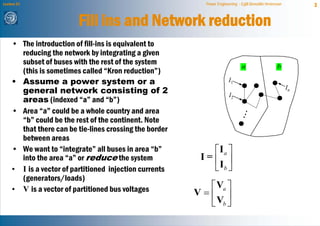
     • The introduction of fill-ins is equivalent to
       reducing the network by integrating a given
       subset of buses with the rest of the system                             a                    b
       (this is sometimes called “Kron reduction”)
     • Assume a power system or a                                       I1
       general network consisting of 2                                  I2
                                                                                                          In
       areas (indexed “a” and “b”)
     • Area “a” could be a whole country and area
       “b” could be the rest of the continent. Note
       that there can be tie-lines crossing the border
       between areas
     • We want to “integrate” all buses in area “b”         ⎡Ia ⎤
       into the area “a” or reduce the system             I=⎢ ⎥
     • I is a vector of partitioned injection currents      ⎣ Ib ⎦
       (generators/loads)
     • V is a vector of partitioned bus voltages           ⎡ Va ⎤
                                                         V=⎢ ⎥
                                                           ⎣ Vb ⎦
Lecture 21                                               Power Engineering - Egill Benedikt Hreinsson   4


                               The Kron Reduction
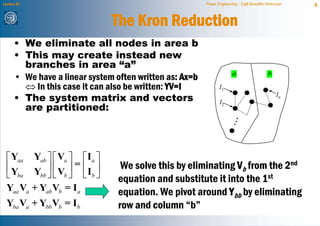
      • We eliminate all nodes in area b
      • This may create instead new
        branches in area “a”
      • We have a linear system often written as: Ax=b                  a                    b

        ⇔ In this case it can also be written: YV=I             I1
      • The system matrix and vectors                                                            In

        are partitioned:
                                                                I2


  ⎡ Yaa Yab ⎤ ⎡ Va ⎤ ⎡ I a ⎤
  ⎢Y         ⎥ ⎢ V ⎥ = ⎢I ⎥       We solve this by eliminating Vb from the 2nd
  ⎣ ba Ybb ⎦ ⎣ b ⎦ ⎣ b ⎦         equation and substitute it into the 1st
  Yaa Va + Yab Vb = I a          equation. We pivot around Ybb by eliminating
  Yba Va + Ybb Vb = I b          row and column “b”
Lecture 21                                                        Power Engineering - Egill Benedikt Hreinsson        5


                                 The Kron Reduction (2)
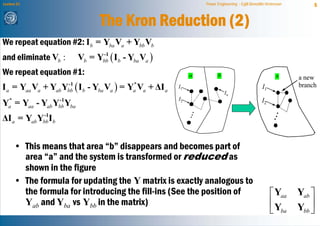
We repeat equation #2: Ib = Yba Va + Ybb Vb
and eliminate Vb :        Vb = Ybb ( Ib - Yba Va )
                                -1


We repeat equation #1:                                        a         b                                 a      a new
I a = Yaa Va + Yab Ybb ( Ib - Yba Va ) = Ya* Va + ΔI a
                    -1
                                                         I1                                       I1             branch
                                                                            In

Ya* = Yaa - Yab Ybb Yba
                 -1                                      I2                                       I2

            -1
ΔI a = Yab Ybb Ib


      • This means that area “b” disappears and becomes part of
        area “a” and the system is transformed or reduced as
        shown in the figure
      • The formula for updating the Y matrix is exactly analogous to
        the formula for introducing the fill-ins (See the position of                                  ⎡ Yaa     Yab ⎤
        Yab and Yba vs Ybb in the matrix)                                                              ⎢Y        Ybb ⎥
                                                                                                       ⎣ ba          ⎦
Lecture 21                                           Power Engineering - Egill Benedikt Hreinsson   6


                             The Kron Reduction (2)

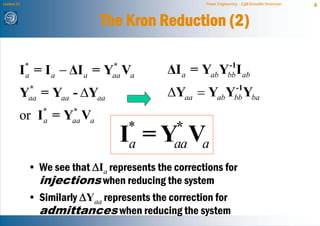
         I = I a − ΔI a = Y Va
             *
             a
                                *
                                aa
                                            ΔI a = Yab Y I       -1
                                                                 bb ab

         Y = Yaa - ΔYaa
             *
             aa
                                            ΔYaa = Yab Y Yba         -1
                                                                     bb
                       *
         or I = Y Va
                  *
                  a    aa
                                              *
                                  I = Y Va
                                     *
                                     a        aa
             • We see that ΔIa represents the corrections for
               injections when reducing the system
             • Similarly ΔYaa represents the correction for
               admittances when reducing the system
Lecture 21                                       Power Engineering - Egill Benedikt Hreinsson       7


                    Example of 3 bus Kron reduction

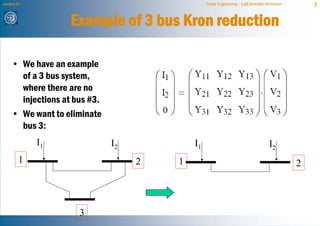
     • We have an example
       of a 3 bus system,
       where there are no
       injections at bus #3.
     • We want to eliminate
       bus 3:
             I1                I2           I1                                       I2
        1                           2   1                                                       2


                      3
Lecture 21                                 Power Engineering - Egill Benedikt Hreinsson       8


                    Example of 3 bus Kron reduction

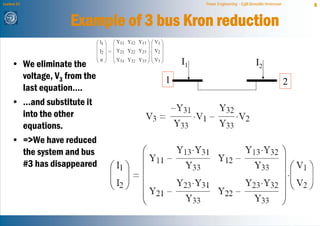
     • We eliminate the               I1                                I2
       voltage, V3 from the       1                                                       2
       last equation….
     • …and substitute it
       into the other
       equations.
     • =>We have reduced
       the system and bus
       #3 has disappeared
Lecture 21                               Power Engineering - Egill Benedikt Hreinsson   9


                       Network reduction
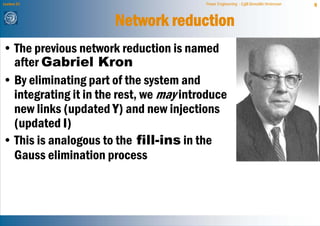
• The previous network reduction is named
  after Gabriel Kron
• By eliminating part of the system and
  integrating it in the rest, we may introduce
  new links (updated Y) and new injections
  (updated I)
• This is analogous to the fill-ins in the
  Gauss elimination process
Lecture 21                                              Power Engineering - Egill Benedikt Hreinsson   10


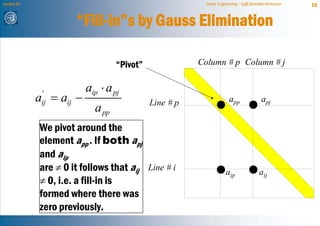
                      “Fill-in”s by Gauss Elimination

                                  “Pivot”              Column # p Column # j

                         aip ⋅ a pj
             a = aij −
              '
              ij                            Line # p                 app                apj
                           a pp
             We pivot around the
             element app . If both apj
             and aip
             are ≠ 0 it follows that aij Line # i                  aip                aij
             ≠ 0, i.e. a fill-in is
             formed where there was
             zero previously.
Lecture 21                                                                                  Power Engineering - Egill Benedikt Hreinsson               11


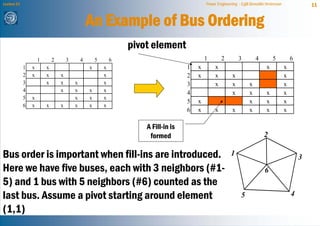
                                                 An Example of Bus Ordering
                                                                 pivot element
                     1       2       3       4       5       6                              1        2         3         4         5           6
             1   x       x                       x       x                          1   x        x                             x           x
             2   x       x       x                       x                          2   x        x         x                               x
             3           x       x       x               x                          3            x         x         x                     x
             4                   x       x       x       x                          4                      x         x         x           x
             5   x                       x       x       x
                                                                                    5   x                            x         x           x
             6   x       x       x       x       x       x
                                                                                    6   x        x         x         x         x           x

                                                                     A Fill-in is
                                                                      formed                                                 2

Bus order is important when fill-ins are introduced.                                                      1
                                                                                                                                                   3
Here we have five buses, each with 3 neighbors (#1-                                                                           6
5) and 1 bus with 5 neighbors (#6) counted as the
last bus. Assume a pivot starting around element                                                                5                              4

(1,1)
Lecture 21                                                                                    Power Engineering - Egill Benedikt Hreinsson           12


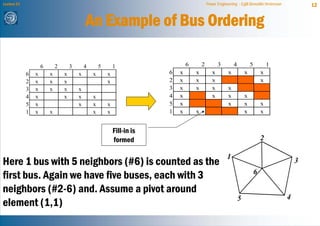
                                             An Example of Bus Ordering

                     6       2       3       4       5       1                    6       2          3        4           5           1
             6   x       x       x       x       x       x                6   x       x          x        x           x           x
             2   x       x       x                       x                2   x       x          x                                x
             3   x       x       x       x                                3   x       x          x        x
             4   x               x       x       x                        4   x                  x        x           x
             5   x                       x       x       x                5   x                           x           x           x
             1   x       x                       x       x                1   x       x                               x           x


                                                             Fill-in is
                                                             formed                                                               2

                                                                                                          1
Here 1 bus with 5 neighbors (#6) is counted as the                                                                                               3

first bus. Again we have five buses, each with 3                                                                              6

neighbors (#2-6) and. Assume a pivot around
                                                                                                                  5                          4
element (1,1)
Lecture 21                                  Power Engineering - Egill Benedikt Hreinsson   13


                  Optimal Ordering Method # 1
             Order the nodes by starting with the node
             which is initially connected to the
             fewest other nodes. Ties can be
             broken arbitrarily. (Parallel or shunt
             connections can be skipped)

             (This ordering rule is the simplest and has a
             great benefit as compared to no ordering)
Lecture 21                              Power Engineering - Egill Benedikt Hreinsson   14


             Optimal Ordering Method # 2
• Order the nodes in each step by selecting as the next node
  the one with the fewest connections to
  neighboring nodes (Including the effect of fill-
  ins). Ties can be broken arbitrarily
• (This ordering rule is probably the best when weighing the
  advantages and disadvantages)
Lecture 21                              Power Engineering - Egill Benedikt Hreinsson   15


               Optimal Ordering Method # 3
• Order the nodes by selecting as the next node the node
  which creates the fewest new branches. Ties can be
  broken arbitrarily

• (The increased calculation speed according to this rules will
  not outweigh the need for more memory and since all new
  nodes have to be considered in each step)
Lecture 21                           Power Engineering - Egill Benedikt Hreinsson   16


                Practical results how different
              ordering methods introduce fill-ins
             during the Gauss elimination process
Lecture 21                                           Power Engineering - Egill Benedikt Hreinsson   17
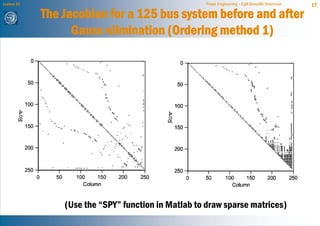
             The Jacobian for a 125 bus system before and after
                   Gauss elimination (Ordering method 1)


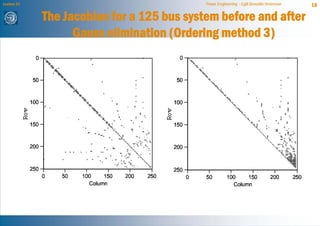
                 (Use the “SPY” function in Matlab to draw sparse matrices)
Lecture 21                                  Power Engineering - Egill Benedikt Hreinsson   18

             The Jacobian for a 125 bus system before and after
                   Gauss elimination (Ordering method 3)
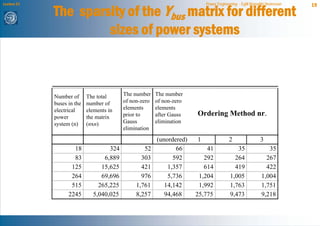
The sparsity of the Ybus matrix for different
Lecture 21                                                                Power Engineering - Egill Benedikt Hreinsson   19


                      sizes of power systems


             Number of      The total     The number    The number
             buses in the   number of     of non-zero   of non-zero
             electrical     elements in   elements      elements
             power          the matrix    prior to      after Gauss   Ordering Method nr.
             system (n)     (nxn)         Gauss         elimination
                                          elimination
                                                        (unordered)   1                2                 3
                     18             324           52           66         41              35                 35
                     83           6,889          303          592        292             264                267
                    125          15,625          421        1,357        614             419                422
                    264          69,696          976        5,736      1,204           1,005              1,004
                    515         265,225        1,761       14,142      1,992           1,763              1,751
                   2245       5,040,025        8,257       94,468     25,775           9,473              9,218
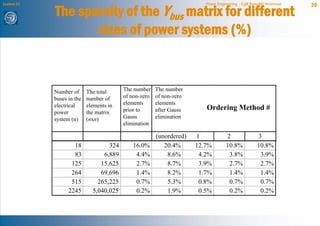
The sparsity of the Ybus matrix for different
Lecture 21                                                               Power Engineering - Egill Benedikt Hreinsson   20


                    sizes of power systems (%)


             Number of      The total     The number    The number
             buses in the   number of     of non-zero   of non-zero
                                          elements      elements
             electrical     elements in
                                          prior to      after Gauss      Ordering Method #
             power          the matrix
             system (n)     (nxn)         Gauss         elimination
                                          elimination

                                                        (unordered)   1             2                 3
                     18             324      16.0%         20.4%      12.7%         10.8%             10.8%
                     83           6,889       4.4%          8.6%       4.2%          3.8%              3.9%
                    125          15,625       2.7%          8.7%       3.9%          2.7%              2.7%
                    264          69,696       1.4%          8.2%       1.7%          1.4%              1.4%
                    515         265,225       0.7%          5.3%       0.8%          0.7%              0.7%
                   2245       5,040,025       0.2%          1.9%       0.5%          0.2%              0.2%
Lecture 21                                Power Engineering - Egill Benedikt Hreinsson   21


             Other methods of solving linear
                      equations
                Crout’s Method of LU Decomposition
Lecture 21                                           Power Engineering - Egill Benedikt Hreinsson   22


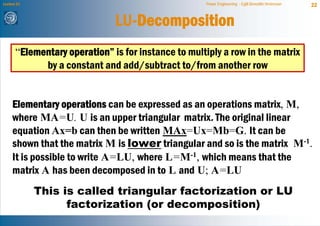
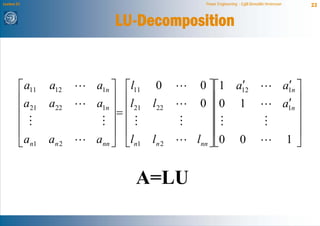
                               LU-Decomposition
       “Elementary operation” is for instance to multiply a row in the matrix
             by a constant and add/subtract to/from another row


     Elementary operations can be expressed as an operations matrix, M,
     where MA=U. U is an upper triangular matrix. The original linear
     equation Ax=b can then be written MAx=Ux=Mb=G. It can be
     shown that the matrix M is lower triangular and so is the matrix M-1.
     It is possible to write A=LU, where L=M-1, which means that the
     matrix A has been decomposed in to L and U; A=LU
             This is called triangular factorization or LU
                   factorization (or decomposition)
Lecture 21                                 Power Engineering - Egill Benedikt Hreinsson           23


                            LU-Decomposition


         ⎡ a11   a12    a1n ⎤ ⎡l11 0               ′
                                           0 ⎤⎡1 a12                                       ′
                                                                                          a1n ⎤
         ⎢a      a22        ⎥ ⎢l
                        a1n ⎥ ⎢ 21 l22     0⎥ ⎥ ⎢0 1                                       ′  ⎥
                                                                                          a1n ⎥
         ⎢ 21                =                  ⎢
         ⎢                  ⎥ ⎢               ⎥⎢                                              ⎥
         ⎢                  ⎥ ⎢               ⎥⎢                                              ⎥
         ⎣an1    an 2   ann ⎦ ⎣ln1 ln 2   lnn ⎦⎣0 0                                        1⎦


                                A=LU
Lecture 21                                                 Power Engineering - Egill Benedikt Hreinsson   24
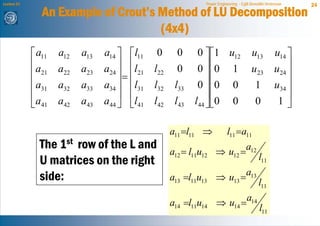
                An Example of Crout’s Method of LU Decomposition
                                      (4x4)
             ⎡ a11   a12   a13   a14 ⎤ ⎡l11 0      0      0 ⎤⎡1 u12                  u13          u14 ⎤
             ⎢a      a22   a23   a24 ⎥ ⎢l21 l22    0      0 ⎥ ⎢0 1                   u23          u24 ⎥
             ⎢ 21                    ⎥= ⎢                    ⎥⎢                                       ⎥
             ⎢ a31   a32   a33   a34 ⎥ ⎢l31 l32    l33    0 ⎥ ⎢0 0                    1           u34 ⎥
             ⎢                       ⎥ ⎢                     ⎥⎢                                       ⎥
             ⎣a41    a42   a43   a44 ⎦ ⎣l41 l42    l43   l44 ⎦⎣0 0                     0           1⎦

                                                  a11 =l11 ⇒           l11 =a11
               The 1st row of the L and           a12 = l11u12 ⇒ u12 =
                                                                                  a12
               U matrices on the right                                                   l11

               side:                              a13 =l11u13 ⇒ u13 =
                                                                                  a13
                                                                                         l11
                                                                                  a14
                                                  a14 =l11u14 ⇒ u14 =
                                                                                          l11
Lecture 21                                                   Power Engineering - Egill Benedikt Hreinsson         25


             An Example of Crout’s Method of LU Decomposition
                                 (4x4) (2)
             ⎡ a11   a12   a13   a14 ⎤ ⎡l11 0        0      0 ⎤⎡1 u12                  u13          u14 ⎤
             ⎢a      a22   a23   a24 ⎥ ⎢l21 l22       0     0 ⎥ ⎢0 1                   u23          u24 ⎥
             ⎢ 21                    ⎥= ⎢                      ⎥⎢                                       ⎥
             ⎢ a31   a32   a33   a34 ⎥ ⎢l31 l32      l33    0 ⎥ ⎢0 0                    1           u34 ⎥
             ⎢                       ⎥ ⎢                       ⎥⎢                                       ⎥
             ⎣a41    a42   a43   a44 ⎦ ⎣l41 l42      l43   l44 ⎦⎣0 0                    0            1⎦
                                          a21 =l21          ⇒          l21 =a21
                 2nd row of the L a22 =l21u12 +l22 ⇒ l22 =a22 −l21u12
                 and U matrices                                 [a23 −l21u13 ]
                 on the right side: a23 =l21u13 +l22 u23 ⇒ u23 =
                                                                               l22

                                          a24 =l21u14 +l22 u24 ⇒ u24             =
                                                                                  [a24 −l21u14 ]
                                                                                                            l22
Lecture 21                                                     Power Engineering - Egill Benedikt Hreinsson   26

             An Example of Crout’s Method of LU Decomposition (4x4)
                                       (3)

             ⎡ a11   a12   a13   a14 ⎤ ⎡l11 0         0 0 ⎤⎡1 u12                        u13 u14 ⎤
             ⎢a      a22   a23   a24 ⎥ ⎢l21 l22       0 0 ⎥ ⎢0 1                         u23 u24 ⎥
             ⎢ 21                    ⎥= ⎢                    ⎥⎢                                  ⎥
             ⎢ a31   a32   a33   a34 ⎥ ⎢l31 l32      l33 0 ⎥⎢0 0                          1 u34 ⎥
             ⎢                       ⎥ ⎢                     ⎥⎢                                  ⎥
             ⎣a41    a42   a43   a44 ⎦ ⎣l41 l42      l43 l44 ⎦⎣0 0                        0   1⎦

  The 3rd row of             a31 = l31   ⇒ l31 =a31
  the L and U                a32 = l31u12 +l32 ⇒ l32 =a32 −l31u12
  matrices on                a33 = l31u13 +l32 u23 +l33 ⇒ l33 = a33 −l31u13 −l32 u23
  the right side:            a34 = l31u14 +l32 u24 +l33u34   ⇒ u34 = [a34 −l31u14 −l32 u24 ]
                                                                     1
                                                                    l33
Lecture 21                                                 Power Engineering - Egill Benedikt Hreinsson   27
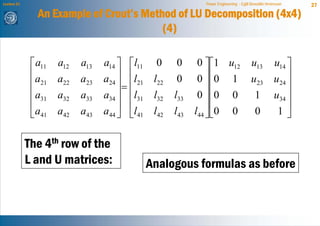
                An Example of Crout’s Method of LU Decomposition (4x4)
                                          (4)

              ⎡ a11   a12   a13   a14 ⎤ ⎡l11 0     0      0 ⎤⎡1 u12                  u13          u14 ⎤
              ⎢a      a22   a23       ⎥ ⎢l
                                  a24 ⎥ ⎢ 21 l22    0        ⎥ ⎢0 1
                                                          0 ⎥⎢                       u23              ⎥
                                                                                                  u24 ⎥
              ⎢ 21                     =
              ⎢ a31   a32   a33   a34 ⎥ ⎢l31 l32   l33    0 ⎥ ⎢0 0                    1           u34 ⎥
              ⎢                       ⎥ ⎢                    ⎥⎢                                       ⎥
              ⎣a41    a42   a43   a44 ⎦ ⎣l41 l42   l43   l44 ⎦⎣0 0                    0            1⎦


             The 4th row of the
             L and U matrices:             Analogous formulas as before
Lecture 21                                        Power Engineering - Egill Benedikt Hreinsson   28
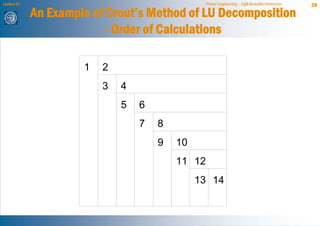
             An Example of Crout’s Method of LU Decomposition
                           - Order of Calculations

                      1   2
                          3   4
                              5   6
                                  7   8
                                      9   10
                                          11 12
                                               13 14
Lecture 21                                       Power Engineering - Egill Benedikt Hreinsson   29
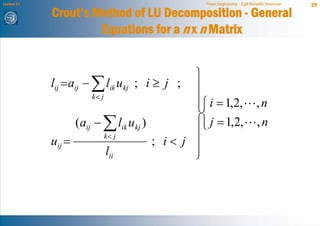
             Crout’s Method of LU Decomposition - General
                      Equations for a n x n Matrix


                                               ⎫
             lij = aij − ∑ lik ukj ; i ≥ j ; ⎪
                         k< j                  ⎪⎧ i = 1,2,
                                               ⎪                              ,n
                                               ⎬⎨
                     (aij − ∑ lik ukj )        ⎪⎩ j = 1,2,                    ,n
                                        ; i< j ⎪
                              k< j
             uij =
                              lii              ⎪
                                               ⎭
Lecture 21                                       Power Engineering - Egill Benedikt Hreinsson   30


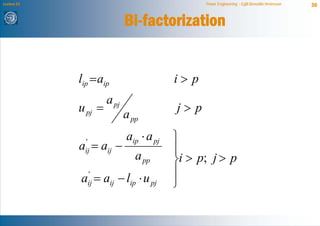
                             Bi-factorization


             lip = aip                    i> p
                      a pj
             u pj =                       j> p
                             a pp
                             aip ⋅ a pj   ⎫
             a = aij −
              '
              ij                          ⎪
                                a pp      ⎬i > p; j > p
             aij = aij − lip ⋅ u pj
              '                           ⎪
                                          ⎭
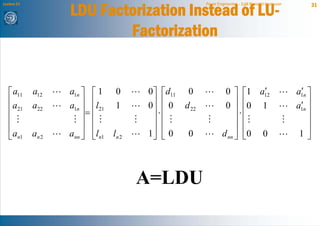
LDU Factorization Instead of LU-
Lecture 21                                             Power Engineering - Egill Benedikt Hreinsson           31


                            Factorization


   ⎡ a11     a12    a1n ⎤ ⎡ 1 0       0⎤ ⎡d11    0                        ′
                                                                 0 ⎤ ⎡1 a12                            ′
                                                                                                      a1n ⎤
   ⎢a        a22    a1n ⎥ ⎢l21 1      0⎥ ⎢ 0    d 22             0 ⎥ ⎢0 1                             a1n ⎥
                                                                                                       ′
   ⎢ 21                 ⎥= ⎢           ⎥⋅⎢                           ⎥⋅⎢                                  ⎥
   ⎢                    ⎥ ⎢            ⎥ ⎢                           ⎥ ⎢                                  ⎥
   ⎢                    ⎥ ⎢            ⎥ ⎢                           ⎥ ⎢                                  ⎥
   ⎣an1      an 2   ann ⎦ ⎣ln1 ln 2   1⎦ ⎣ 0     0              d nn ⎦ ⎣0 0                            1⎦


                                      A=LDU
Lecture 21                                                                    Power Engineering - Egill Benedikt Hreinsson   32


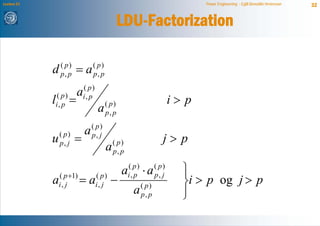
                                              LDU-Factorization

             d   ( p)
                 p, p   =a      ( p)
                                p, p

                        ai(,p )
             ( p)
             l
             i, p   =       p
                                       ( p)                            i> p
                                  a    p, p
                                ( p)
                            a
             u   ( p)
                 p, j   =       p, j
                                           ( p)                    j> p
                                       a   p, p


                 ( p +1)
                                              a   ( p)
                                                         ⋅a     ( p)
                                                                         ⎫
                                                                         ⎪
                           =a            −                               ⎬i > p og j > p
                                  ( p)            i, p          p, j
             a   i, j             i, j
                                                                         ⎪
                                                         ( p)
                                                   a     p, p            ⎭
Lecture 21                           Power Engineering - Egill Benedikt Hreinsson   33
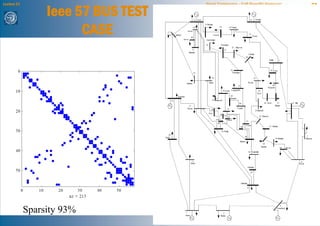
                  Ieee 57 BUS TEST
                        CASE


             Sparsity 93%
Lecture 21                                Power Engineering - Egill Benedikt Hreinsson   34
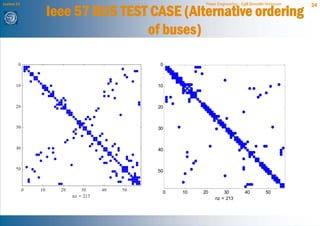
             Ieee 57 BUS TEST CASE (Alternative ordering
                             of buses)

                                0


                               10


                               20


                               30


                               40


                               50


                                0   10   20        30           40          50
                                               nz = 213
Lecture 21                                             Power Engineering - Egill Benedikt Hreinsson   35


                     Software for power system analysis
             • Powerworld (www.powerworld.com)
             • Matpower
                 – (http://www.pserc.cornell.edu/matpower/)
             •   Eurostag www.eurostag.be
             •   EDSA    www.edsa.com
             •   ETAP    www.etap.com
             •   CYME www.cyme.com
             •   ASPEN www.aspeninc.com
             •   NEPLAN www.neplan.ch
             •   PSS/E, PSS/O http://www.pti-us.com
             •   DIGSILENT www.digsilent.de
Lecture 21                           Power Engineering - Egill Benedikt Hreinsson   36


             Software for power system analysis (2)
• QuickStab® Professional    www.scscc-us.com
• CAPE     www.electrocon.com
• SKM Power* Tools www.skm.com
• DINIS www.dinis.com
• SPARD® www.energyco.com
• ESA Easy Power www.easypower.com
• DSA PowerTools www.powertechlabs.com
• SynerGEE www.advantica.biz
• SCOPE www.nexant.com
Lecture 21                           Power Engineering - Egill Benedikt Hreinsson   37


             Software for power system analysis (3)
• CDEGS www.sestech.com
• ATP/EMTP http://www.emtp.org
• EMTP-RV www.emtp.com
• PSCAD/EMTDC www.pscad.com
• IPSA www.ipsa-power.com
• MiPower www.mipowersoftware.com
• Distribution Management System
  (DMS)      http://www.dmsgroup.co.yu/
• Optimal Aempfast http://www.otii.com/aempfast.html
Lecture 21                            Power Engineering - Egill Benedikt Hreinsson   38


             Software for power system analysis (4)
• DEW         http://www.samsix.com/dew.htm
• Simpow www.stri.se
• PSAT (Power System Analysis Toolbox)
  http://thunderbox.uwaterloo.ca/~fmilano
• TRANSMISSION 2000 http://www.cai-
  engr.com/T2000.htm
• POM tools (POM, OPM, BOR,...) for contingency analysis,
  optimal mitigation measures, Boundary of operating
  regions, stability,...etc http://www.vrenergy.com/
• Fendi : (free) http://www.martinole.org/Fendi/
Lecture 21                                        Power Engineering - Egill Benedikt Hreinsson   39


                    Software for power system analysis (5)
             • Anarede - load flow, Anafas - short circuit, Anatem -
               electromechanical stability (Portúgalska)
               http://www.cepel.br
             • General Electric - PSLF,
               http://www.gepower.com/prod_serv/products/utility_so
               ftware/en/ge_pslf/index.htm
             • Intellicon's Voltage Collapse Diagnostic and Postured
               Control http://www.intellicon.biz
             • Kína: Power System Analysis Software Package (PSASP):
               http://www.psasp.com.cn
             • MicroTran is the electromagnetic transients program
               (EMTP) version of the University of British Columbia.
               http://www.microtran.com
Lecture 21                                   Power Engineering - Egill Benedikt Hreinsson   40


                         Heimildir/tilvísanir
  • W.F. Tinney, W.S. Meyer: “Solution of Large Sparse Systems by
    Ordered Triangular Factorization”, IEEE Transactions on Automatic
    control, Vol.AC-18, No 4, 1973, bls 333-346
  • California Energy Commission Report, “WECC CAISO Specific Needs
    for Loop Flow Monitoring, Management, Near Term Prediction and
    Probabilistic Assessment, and Prototype Monitoring System Design”
    Publication Number: CEC-500-2005-168, Publication Date:
    NOVEMBER 2005
    (http://www.energy.ca.gov/pier/final_project_reports/CEC-500-
    2005-168.html)
  • IEEE test systems:
    http://www.ee.washington.edu/research/pstca/

Rk21 power flow_sparse2

  • 1.
    Lecture 21 Power Engineering - Egill Benedikt Hreinsson 1 Sparse Matrices in Power Flow Calculations (2)
  • 2.
    Lecture 21 Power Engineering - Egill Benedikt Hreinsson 2 Network reduction and fill-ins Introduction of “Fill-ins” in the Gauss elimination process represents new branches in the network. So, by eliminating nodes in the network we may create new branches
  • 3.
    Lecture 21 Power Engineering - Egill Benedikt Hreinsson 3 Fill ins and Network reduction • The introduction of fill-ins is equivalent to reducing the network by integrating a given subset of buses with the rest of the system a b (this is sometimes called “Kron reduction”) • Assume a power system or a I1 general network consisting of 2 I2 In areas (indexed “a” and “b”) • Area “a” could be a whole country and area “b” could be the rest of the continent. Note that there can be tie-lines crossing the border between areas • We want to “integrate” all buses in area “b” ⎡Ia ⎤ into the area “a” or reduce the system I=⎢ ⎥ • I is a vector of partitioned injection currents ⎣ Ib ⎦ (generators/loads) • V is a vector of partitioned bus voltages ⎡ Va ⎤ V=⎢ ⎥ ⎣ Vb ⎦
  • 4.
    Lecture 21 Power Engineering - Egill Benedikt Hreinsson 4 The Kron Reduction • We eliminate all nodes in area b • This may create instead new branches in area “a” • We have a linear system often written as: Ax=b a b ⇔ In this case it can also be written: YV=I I1 • The system matrix and vectors In are partitioned: I2 ⎡ Yaa Yab ⎤ ⎡ Va ⎤ ⎡ I a ⎤ ⎢Y ⎥ ⎢ V ⎥ = ⎢I ⎥ We solve this by eliminating Vb from the 2nd ⎣ ba Ybb ⎦ ⎣ b ⎦ ⎣ b ⎦ equation and substitute it into the 1st Yaa Va + Yab Vb = I a equation. We pivot around Ybb by eliminating Yba Va + Ybb Vb = I b row and column “b”
  • 5.
    Lecture 21 Power Engineering - Egill Benedikt Hreinsson 5 The Kron Reduction (2) We repeat equation #2: Ib = Yba Va + Ybb Vb and eliminate Vb : Vb = Ybb ( Ib - Yba Va ) -1 We repeat equation #1: a b a a new I a = Yaa Va + Yab Ybb ( Ib - Yba Va ) = Ya* Va + ΔI a -1 I1 I1 branch In Ya* = Yaa - Yab Ybb Yba -1 I2 I2 -1 ΔI a = Yab Ybb Ib • This means that area “b” disappears and becomes part of area “a” and the system is transformed or reduced as shown in the figure • The formula for updating the Y matrix is exactly analogous to the formula for introducing the fill-ins (See the position of ⎡ Yaa Yab ⎤ Yab and Yba vs Ybb in the matrix) ⎢Y Ybb ⎥ ⎣ ba ⎦
  • 6.
    Lecture 21 Power Engineering - Egill Benedikt Hreinsson 6 The Kron Reduction (2) I = I a − ΔI a = Y Va * a * aa ΔI a = Yab Y I -1 bb ab Y = Yaa - ΔYaa * aa ΔYaa = Yab Y Yba -1 bb * or I = Y Va * a aa * I = Y Va * a aa • We see that ΔIa represents the corrections for injections when reducing the system • Similarly ΔYaa represents the correction for admittances when reducing the system
  • 7.
    Lecture 21 Power Engineering - Egill Benedikt Hreinsson 7 Example of 3 bus Kron reduction • We have an example of a 3 bus system, where there are no injections at bus #3. • We want to eliminate bus 3: I1 I2 I1 I2 1 2 1 2 3
  • 8.
    Lecture 21 Power Engineering - Egill Benedikt Hreinsson 8 Example of 3 bus Kron reduction • We eliminate the I1 I2 voltage, V3 from the 1 2 last equation…. • …and substitute it into the other equations. • =>We have reduced the system and bus #3 has disappeared
  • 9.
    Lecture 21 Power Engineering - Egill Benedikt Hreinsson 9 Network reduction • The previous network reduction is named after Gabriel Kron • By eliminating part of the system and integrating it in the rest, we may introduce new links (updated Y) and new injections (updated I) • This is analogous to the fill-ins in the Gauss elimination process
  • 10.
    Lecture 21 Power Engineering - Egill Benedikt Hreinsson 10 “Fill-in”s by Gauss Elimination “Pivot” Column # p Column # j aip ⋅ a pj a = aij − ' ij Line # p app apj a pp We pivot around the element app . If both apj and aip are ≠ 0 it follows that aij Line # i aip aij ≠ 0, i.e. a fill-in is formed where there was zero previously.
  • 11.
    Lecture 21 Power Engineering - Egill Benedikt Hreinsson 11 An Example of Bus Ordering pivot element 1 2 3 4 5 6 1 2 3 4 5 6 1 x x x x 1 x x x x 2 x x x x 2 x x x x 3 x x x x 3 x x x x 4 x x x x 4 x x x x 5 x x x x 5 x x x x 6 x x x x x x 6 x x x x x x A Fill-in is formed 2 Bus order is important when fill-ins are introduced. 1 3 Here we have five buses, each with 3 neighbors (#1- 6 5) and 1 bus with 5 neighbors (#6) counted as the last bus. Assume a pivot starting around element 5 4 (1,1)
  • 12.
    Lecture 21 Power Engineering - Egill Benedikt Hreinsson 12 An Example of Bus Ordering 6 2 3 4 5 1 6 2 3 4 5 1 6 x x x x x x 6 x x x x x x 2 x x x x 2 x x x x 3 x x x x 3 x x x x 4 x x x x 4 x x x x 5 x x x x 5 x x x x 1 x x x x 1 x x x x Fill-in is formed 2 1 Here 1 bus with 5 neighbors (#6) is counted as the 3 first bus. Again we have five buses, each with 3 6 neighbors (#2-6) and. Assume a pivot around 5 4 element (1,1)
  • 13.
    Lecture 21 Power Engineering - Egill Benedikt Hreinsson 13 Optimal Ordering Method # 1 Order the nodes by starting with the node which is initially connected to the fewest other nodes. Ties can be broken arbitrarily. (Parallel or shunt connections can be skipped) (This ordering rule is the simplest and has a great benefit as compared to no ordering)
  • 14.
    Lecture 21 Power Engineering - Egill Benedikt Hreinsson 14 Optimal Ordering Method # 2 • Order the nodes in each step by selecting as the next node the one with the fewest connections to neighboring nodes (Including the effect of fill- ins). Ties can be broken arbitrarily • (This ordering rule is probably the best when weighing the advantages and disadvantages)
  • 15.
    Lecture 21 Power Engineering - Egill Benedikt Hreinsson 15 Optimal Ordering Method # 3 • Order the nodes by selecting as the next node the node which creates the fewest new branches. Ties can be broken arbitrarily • (The increased calculation speed according to this rules will not outweigh the need for more memory and since all new nodes have to be considered in each step)
  • 16.
    Lecture 21 Power Engineering - Egill Benedikt Hreinsson 16 Practical results how different ordering methods introduce fill-ins during the Gauss elimination process
  • 17.
    Lecture 21 Power Engineering - Egill Benedikt Hreinsson 17 The Jacobian for a 125 bus system before and after Gauss elimination (Ordering method 1) (Use the “SPY” function in Matlab to draw sparse matrices)
  • 18.
    Lecture 21 Power Engineering - Egill Benedikt Hreinsson 18 The Jacobian for a 125 bus system before and after Gauss elimination (Ordering method 3)
  • 19.
    The sparsity ofthe Ybus matrix for different Lecture 21 Power Engineering - Egill Benedikt Hreinsson 19 sizes of power systems Number of The total The number The number buses in the number of of non-zero of non-zero electrical elements in elements elements power the matrix prior to after Gauss Ordering Method nr. system (n) (nxn) Gauss elimination elimination (unordered) 1 2 3 18 324 52 66 41 35 35 83 6,889 303 592 292 264 267 125 15,625 421 1,357 614 419 422 264 69,696 976 5,736 1,204 1,005 1,004 515 265,225 1,761 14,142 1,992 1,763 1,751 2245 5,040,025 8,257 94,468 25,775 9,473 9,218
  • 20.
    The sparsity ofthe Ybus matrix for different Lecture 21 Power Engineering - Egill Benedikt Hreinsson 20 sizes of power systems (%) Number of The total The number The number buses in the number of of non-zero of non-zero elements elements electrical elements in prior to after Gauss Ordering Method # power the matrix system (n) (nxn) Gauss elimination elimination (unordered) 1 2 3 18 324 16.0% 20.4% 12.7% 10.8% 10.8% 83 6,889 4.4% 8.6% 4.2% 3.8% 3.9% 125 15,625 2.7% 8.7% 3.9% 2.7% 2.7% 264 69,696 1.4% 8.2% 1.7% 1.4% 1.4% 515 265,225 0.7% 5.3% 0.8% 0.7% 0.7% 2245 5,040,025 0.2% 1.9% 0.5% 0.2% 0.2%
  • 21.
    Lecture 21 Power Engineering - Egill Benedikt Hreinsson 21 Other methods of solving linear equations Crout’s Method of LU Decomposition
  • 22.
    Lecture 21 Power Engineering - Egill Benedikt Hreinsson 22 LU-Decomposition “Elementary operation” is for instance to multiply a row in the matrix by a constant and add/subtract to/from another row Elementary operations can be expressed as an operations matrix, M, where MA=U. U is an upper triangular matrix. The original linear equation Ax=b can then be written MAx=Ux=Mb=G. It can be shown that the matrix M is lower triangular and so is the matrix M-1. It is possible to write A=LU, where L=M-1, which means that the matrix A has been decomposed in to L and U; A=LU This is called triangular factorization or LU factorization (or decomposition)
  • 23.
    Lecture 21 Power Engineering - Egill Benedikt Hreinsson 23 LU-Decomposition ⎡ a11 a12 a1n ⎤ ⎡l11 0 ′ 0 ⎤⎡1 a12 ′ a1n ⎤ ⎢a a22 ⎥ ⎢l a1n ⎥ ⎢ 21 l22 0⎥ ⎥ ⎢0 1 ′ ⎥ a1n ⎥ ⎢ 21 = ⎢ ⎢ ⎥ ⎢ ⎥⎢ ⎥ ⎢ ⎥ ⎢ ⎥⎢ ⎥ ⎣an1 an 2 ann ⎦ ⎣ln1 ln 2 lnn ⎦⎣0 0 1⎦ A=LU
  • 24.
    Lecture 21 Power Engineering - Egill Benedikt Hreinsson 24 An Example of Crout’s Method of LU Decomposition (4x4) ⎡ a11 a12 a13 a14 ⎤ ⎡l11 0 0 0 ⎤⎡1 u12 u13 u14 ⎤ ⎢a a22 a23 a24 ⎥ ⎢l21 l22 0 0 ⎥ ⎢0 1 u23 u24 ⎥ ⎢ 21 ⎥= ⎢ ⎥⎢ ⎥ ⎢ a31 a32 a33 a34 ⎥ ⎢l31 l32 l33 0 ⎥ ⎢0 0 1 u34 ⎥ ⎢ ⎥ ⎢ ⎥⎢ ⎥ ⎣a41 a42 a43 a44 ⎦ ⎣l41 l42 l43 l44 ⎦⎣0 0 0 1⎦ a11 =l11 ⇒ l11 =a11 The 1st row of the L and a12 = l11u12 ⇒ u12 = a12 U matrices on the right l11 side: a13 =l11u13 ⇒ u13 = a13 l11 a14 a14 =l11u14 ⇒ u14 = l11
  • 25.
    Lecture 21 Power Engineering - Egill Benedikt Hreinsson 25 An Example of Crout’s Method of LU Decomposition (4x4) (2) ⎡ a11 a12 a13 a14 ⎤ ⎡l11 0 0 0 ⎤⎡1 u12 u13 u14 ⎤ ⎢a a22 a23 a24 ⎥ ⎢l21 l22 0 0 ⎥ ⎢0 1 u23 u24 ⎥ ⎢ 21 ⎥= ⎢ ⎥⎢ ⎥ ⎢ a31 a32 a33 a34 ⎥ ⎢l31 l32 l33 0 ⎥ ⎢0 0 1 u34 ⎥ ⎢ ⎥ ⎢ ⎥⎢ ⎥ ⎣a41 a42 a43 a44 ⎦ ⎣l41 l42 l43 l44 ⎦⎣0 0 0 1⎦ a21 =l21 ⇒ l21 =a21 2nd row of the L a22 =l21u12 +l22 ⇒ l22 =a22 −l21u12 and U matrices [a23 −l21u13 ] on the right side: a23 =l21u13 +l22 u23 ⇒ u23 = l22 a24 =l21u14 +l22 u24 ⇒ u24 = [a24 −l21u14 ] l22
  • 26.
    Lecture 21 Power Engineering - Egill Benedikt Hreinsson 26 An Example of Crout’s Method of LU Decomposition (4x4) (3) ⎡ a11 a12 a13 a14 ⎤ ⎡l11 0 0 0 ⎤⎡1 u12 u13 u14 ⎤ ⎢a a22 a23 a24 ⎥ ⎢l21 l22 0 0 ⎥ ⎢0 1 u23 u24 ⎥ ⎢ 21 ⎥= ⎢ ⎥⎢ ⎥ ⎢ a31 a32 a33 a34 ⎥ ⎢l31 l32 l33 0 ⎥⎢0 0 1 u34 ⎥ ⎢ ⎥ ⎢ ⎥⎢ ⎥ ⎣a41 a42 a43 a44 ⎦ ⎣l41 l42 l43 l44 ⎦⎣0 0 0 1⎦ The 3rd row of a31 = l31 ⇒ l31 =a31 the L and U a32 = l31u12 +l32 ⇒ l32 =a32 −l31u12 matrices on a33 = l31u13 +l32 u23 +l33 ⇒ l33 = a33 −l31u13 −l32 u23 the right side: a34 = l31u14 +l32 u24 +l33u34 ⇒ u34 = [a34 −l31u14 −l32 u24 ] 1 l33
  • 27.
    Lecture 21 Power Engineering - Egill Benedikt Hreinsson 27 An Example of Crout’s Method of LU Decomposition (4x4) (4) ⎡ a11 a12 a13 a14 ⎤ ⎡l11 0 0 0 ⎤⎡1 u12 u13 u14 ⎤ ⎢a a22 a23 ⎥ ⎢l a24 ⎥ ⎢ 21 l22 0 ⎥ ⎢0 1 0 ⎥⎢ u23 ⎥ u24 ⎥ ⎢ 21 = ⎢ a31 a32 a33 a34 ⎥ ⎢l31 l32 l33 0 ⎥ ⎢0 0 1 u34 ⎥ ⎢ ⎥ ⎢ ⎥⎢ ⎥ ⎣a41 a42 a43 a44 ⎦ ⎣l41 l42 l43 l44 ⎦⎣0 0 0 1⎦ The 4th row of the L and U matrices: Analogous formulas as before
  • 28.
    Lecture 21 Power Engineering - Egill Benedikt Hreinsson 28 An Example of Crout’s Method of LU Decomposition - Order of Calculations 1 2 3 4 5 6 7 8 9 10 11 12 13 14
  • 29.
    Lecture 21 Power Engineering - Egill Benedikt Hreinsson 29 Crout’s Method of LU Decomposition - General Equations for a n x n Matrix ⎫ lij = aij − ∑ lik ukj ; i ≥ j ; ⎪ k< j ⎪⎧ i = 1,2, ⎪ ,n ⎬⎨ (aij − ∑ lik ukj ) ⎪⎩ j = 1,2, ,n ; i< j ⎪ k< j uij = lii ⎪ ⎭
  • 30.
    Lecture 21 Power Engineering - Egill Benedikt Hreinsson 30 Bi-factorization lip = aip i> p a pj u pj = j> p a pp aip ⋅ a pj ⎫ a = aij − ' ij ⎪ a pp ⎬i > p; j > p aij = aij − lip ⋅ u pj ' ⎪ ⎭
  • 31.
    LDU Factorization Insteadof LU- Lecture 21 Power Engineering - Egill Benedikt Hreinsson 31 Factorization ⎡ a11 a12 a1n ⎤ ⎡ 1 0 0⎤ ⎡d11 0 ′ 0 ⎤ ⎡1 a12 ′ a1n ⎤ ⎢a a22 a1n ⎥ ⎢l21 1 0⎥ ⎢ 0 d 22 0 ⎥ ⎢0 1 a1n ⎥ ′ ⎢ 21 ⎥= ⎢ ⎥⋅⎢ ⎥⋅⎢ ⎥ ⎢ ⎥ ⎢ ⎥ ⎢ ⎥ ⎢ ⎥ ⎢ ⎥ ⎢ ⎥ ⎢ ⎥ ⎢ ⎥ ⎣an1 an 2 ann ⎦ ⎣ln1 ln 2 1⎦ ⎣ 0 0 d nn ⎦ ⎣0 0 1⎦ A=LDU
  • 32.
    Lecture 21 Power Engineering - Egill Benedikt Hreinsson 32 LDU-Factorization d ( p) p, p =a ( p) p, p ai(,p ) ( p) l i, p = p ( p) i> p a p, p ( p) a u ( p) p, j = p, j ( p) j> p a p, p ( p +1) a ( p) ⋅a ( p) ⎫ ⎪ =a − ⎬i > p og j > p ( p) i, p p, j a i, j i, j ⎪ ( p) a p, p ⎭
  • 33.
    Lecture 21 Power Engineering - Egill Benedikt Hreinsson 33 Ieee 57 BUS TEST CASE Sparsity 93%
  • 34.
    Lecture 21 Power Engineering - Egill Benedikt Hreinsson 34 Ieee 57 BUS TEST CASE (Alternative ordering of buses) 0 10 20 30 40 50 0 10 20 30 40 50 nz = 213
  • 35.
    Lecture 21 Power Engineering - Egill Benedikt Hreinsson 35 Software for power system analysis • Powerworld (www.powerworld.com) • Matpower – (http://www.pserc.cornell.edu/matpower/) • Eurostag www.eurostag.be • EDSA www.edsa.com • ETAP www.etap.com • CYME www.cyme.com • ASPEN www.aspeninc.com • NEPLAN www.neplan.ch • PSS/E, PSS/O http://www.pti-us.com • DIGSILENT www.digsilent.de
  • 36.
    Lecture 21 Power Engineering - Egill Benedikt Hreinsson 36 Software for power system analysis (2) • QuickStab® Professional www.scscc-us.com • CAPE www.electrocon.com • SKM Power* Tools www.skm.com • DINIS www.dinis.com • SPARD® www.energyco.com • ESA Easy Power www.easypower.com • DSA PowerTools www.powertechlabs.com • SynerGEE www.advantica.biz • SCOPE www.nexant.com
  • 37.
    Lecture 21 Power Engineering - Egill Benedikt Hreinsson 37 Software for power system analysis (3) • CDEGS www.sestech.com • ATP/EMTP http://www.emtp.org • EMTP-RV www.emtp.com • PSCAD/EMTDC www.pscad.com • IPSA www.ipsa-power.com • MiPower www.mipowersoftware.com • Distribution Management System (DMS) http://www.dmsgroup.co.yu/ • Optimal Aempfast http://www.otii.com/aempfast.html
  • 38.
    Lecture 21 Power Engineering - Egill Benedikt Hreinsson 38 Software for power system analysis (4) • DEW http://www.samsix.com/dew.htm • Simpow www.stri.se • PSAT (Power System Analysis Toolbox) http://thunderbox.uwaterloo.ca/~fmilano • TRANSMISSION 2000 http://www.cai- engr.com/T2000.htm • POM tools (POM, OPM, BOR,...) for contingency analysis, optimal mitigation measures, Boundary of operating regions, stability,...etc http://www.vrenergy.com/ • Fendi : (free) http://www.martinole.org/Fendi/
  • 39.
    Lecture 21 Power Engineering - Egill Benedikt Hreinsson 39 Software for power system analysis (5) • Anarede - load flow, Anafas - short circuit, Anatem - electromechanical stability (Portúgalska) http://www.cepel.br • General Electric - PSLF, http://www.gepower.com/prod_serv/products/utility_so ftware/en/ge_pslf/index.htm • Intellicon's Voltage Collapse Diagnostic and Postured Control http://www.intellicon.biz • Kína: Power System Analysis Software Package (PSASP): http://www.psasp.com.cn • MicroTran is the electromagnetic transients program (EMTP) version of the University of British Columbia. http://www.microtran.com
  • 40.
    Lecture 21 Power Engineering - Egill Benedikt Hreinsson 40 Heimildir/tilvísanir • W.F. Tinney, W.S. Meyer: “Solution of Large Sparse Systems by Ordered Triangular Factorization”, IEEE Transactions on Automatic control, Vol.AC-18, No 4, 1973, bls 333-346 • California Energy Commission Report, “WECC CAISO Specific Needs for Loop Flow Monitoring, Management, Near Term Prediction and Probabilistic Assessment, and Prototype Monitoring System Design” Publication Number: CEC-500-2005-168, Publication Date: NOVEMBER 2005 (http://www.energy.ca.gov/pier/final_project_reports/CEC-500- 2005-168.html) • IEEE test systems: http://www.ee.washington.edu/research/pstca/