Application of Equal Area
Criterion (EAC)
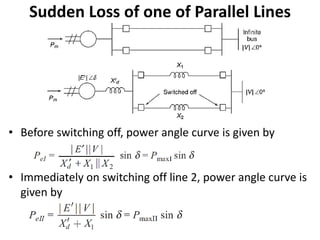
Sudden Loss of one of Parallel Lines
• Before switching off, power angle curve is given by
• Immediately on switching off line 2, power angle curve is
given by
Sudden Loss of one of Parallel Lines
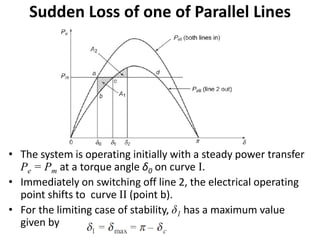
• The system is operating initially with a steady power transfer
Pe = Pm at a torque angle δ0 on curve I.
• Immediately on switching off line 2, the electrical operating
point shifts to curve II (point b).
• For the limiting case of stability, δ1 has a maximum value
given by
Sudden Short Circuit on One of Parallel Lines
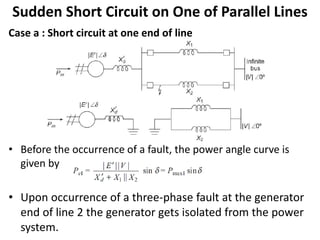
Case a : Short circuit at one end of line
• Before the occurrence of a fault, the power angle curve is
given by
• Upon occurrence of a three-phase fault at the generator
end of line 2 the generator gets isolated from the power
system.
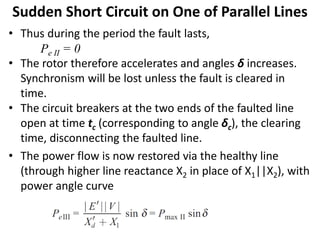
• Thus during the period the fault lasts,
Pe II = 0
• The rotor therefore accelerates and angles δ increases.
Synchronism will be lost unless the fault is cleared in
time.
• The circuit breakers at the two ends of the faulted line
open at time tc (corresponding to angle δc), the clearing
time, disconnecting the faulted line.
• The power flow is now restored via the healthy line
(through higher line reactance X2 in place of X1||X2), with
power angle curve
Sudden Short Circuit on One of Parallel Lines
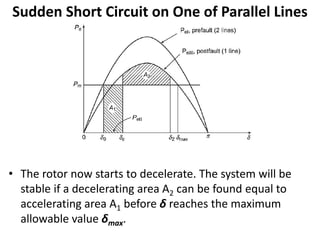
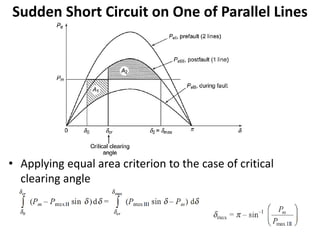
• The rotor now starts to decelerate. The system will be
stable if a decelerating area A2 can be found equal to
accelerating area A1 before δ reaches the maximum
allowable value δmax.
Sudden Short Circuit on One of Parallel Lines
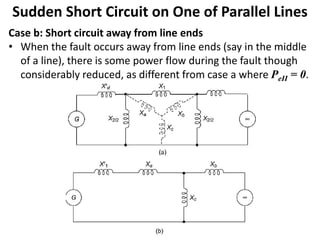
Case b: Short circuit away from line ends
• When the fault occurs away from line ends (say in the middle
of a line), there is some power flow during the fault though
considerably reduced, as different from case a where PeII = 0.
Sudden Short Circuit on One of Parallel Lines
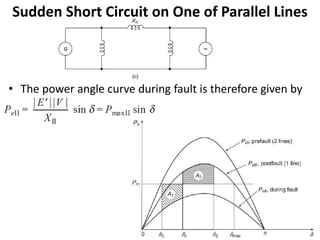
• The power angle curve during fault is therefore given by
Sudden Short Circuit on One of Parallel Lines
• Applying equal area criterion to the case of critical
clearing angle
Sudden Short Circuit on One of Parallel Lines
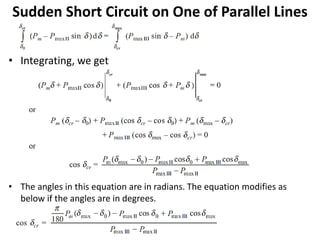
• Integrating, we get
• The angles in this equation are in radians. The equation modifies as
below if the angles are in degrees.
Sudden Short Circuit on One of Parallel Lines
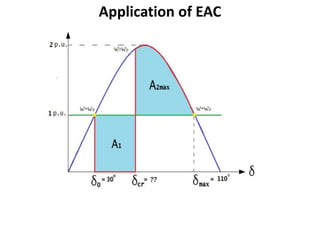
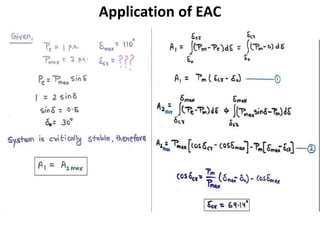
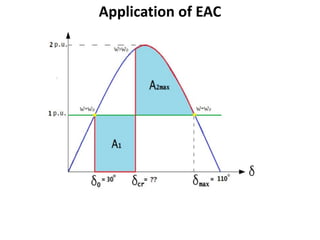
• A generator delivers 1.0 p.u. power to an
infinite bus through a purely reactive
network. Maximum power that could be
delivered by this generator is 2 p.u. A 3
phase fault occurs at the terminals of the
generator which reduces the generator
output to zero. The fault is cleared after tc
seconds. The original network is restored.
The maximum swing of the rotor angle is
found to be 110 electrical degrees. Then find
the rotor angle at t = tc seconds.
Application of EAC
Application of EAC
Application of EAC
Application of EAC
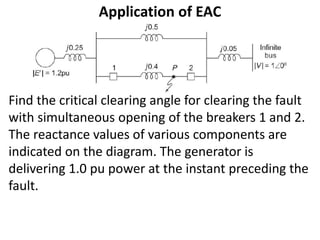
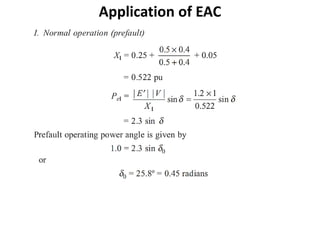
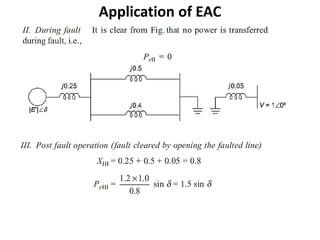
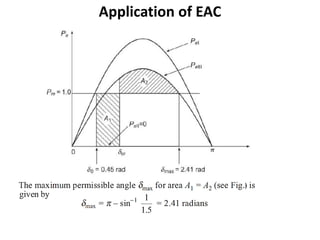
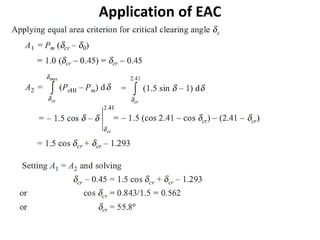
Find the critical clearing angle for clearing the fault
with simultaneous opening of the breakers 1 and 2.
The reactance values of various components are
indicated on the diagram. The generator is
delivering 1.0 pu power at the instant preceding the
fault.
Application of EAC
Application of EAC
Application of EAC
Application of EAC
Application of EAC

Application of Equal Area Criterion (EAC).pdf

  • 1.
    Application of EqualArea Criterion (EAC)
  • 2.
    Sudden Loss ofone of Parallel Lines • Before switching off, power angle curve is given by • Immediately on switching off line 2, power angle curve is given by
  • 3.
    Sudden Loss ofone of Parallel Lines • The system is operating initially with a steady power transfer Pe = Pm at a torque angle δ0 on curve I. • Immediately on switching off line 2, the electrical operating point shifts to curve II (point b). • For the limiting case of stability, δ1 has a maximum value given by
  • 4.
    Sudden Short Circuiton One of Parallel Lines Case a : Short circuit at one end of line • Before the occurrence of a fault, the power angle curve is given by • Upon occurrence of a three-phase fault at the generator end of line 2 the generator gets isolated from the power system.
  • 5.
    • Thus duringthe period the fault lasts, Pe II = 0 • The rotor therefore accelerates and angles δ increases. Synchronism will be lost unless the fault is cleared in time. • The circuit breakers at the two ends of the faulted line open at time tc (corresponding to angle δc), the clearing time, disconnecting the faulted line. • The power flow is now restored via the healthy line (through higher line reactance X2 in place of X1||X2), with power angle curve Sudden Short Circuit on One of Parallel Lines
  • 6.
    • The rotornow starts to decelerate. The system will be stable if a decelerating area A2 can be found equal to accelerating area A1 before δ reaches the maximum allowable value δmax. Sudden Short Circuit on One of Parallel Lines
  • 7.
    Case b: Shortcircuit away from line ends • When the fault occurs away from line ends (say in the middle of a line), there is some power flow during the fault though considerably reduced, as different from case a where PeII = 0. Sudden Short Circuit on One of Parallel Lines
  • 8.
    • The powerangle curve during fault is therefore given by Sudden Short Circuit on One of Parallel Lines
  • 9.
    • Applying equalarea criterion to the case of critical clearing angle Sudden Short Circuit on One of Parallel Lines
  • 10.
    • Integrating, weget • The angles in this equation are in radians. The equation modifies as below if the angles are in degrees. Sudden Short Circuit on One of Parallel Lines
  • 11.
    • A generatordelivers 1.0 p.u. power to an infinite bus through a purely reactive network. Maximum power that could be delivered by this generator is 2 p.u. A 3 phase fault occurs at the terminals of the generator which reduces the generator output to zero. The fault is cleared after tc seconds. The original network is restored. The maximum swing of the rotor angle is found to be 110 electrical degrees. Then find the rotor angle at t = tc seconds. Application of EAC
  • 12.
  • 13.
  • 14.
  • 15.
    Find the criticalclearing angle for clearing the fault with simultaneous opening of the breakers 1 and 2. The reactance values of various components are indicated on the diagram. The generator is delivering 1.0 pu power at the instant preceding the fault. Application of EAC
  • 16.
  • 17.
  • 18.
  • 19.