Optimal power flowpower flow
Power flow
• is a of the flow of electric
power in an system.
• focuses on various of AC power parameters, such
as voltages, voltage angles, real power and
reactive power.
• uses simplified notation such as on-line diagram
or per-unit system,
• It analyzes the power systems in
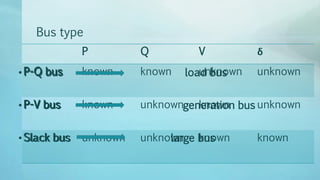
P Q V δ
P-Q bus known known unknown unknown
P-V bus known unknown known unknown
Slack bus unknown unknown known known
Bus type
• P-Q bus load bus
• P-V bus generation bus
• Slack bus large bus
Power flow
•The goal is to obtain complete voltage
angle and magnitude for each bus for
specified load and generator real power
and voltage conditions
•Once it’s known, real and reactive
power flow on each branch and
generator reactive power output can be
analytically determined
Power flow
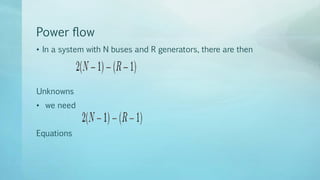
• In a system with N buses and R generators, there are then
Unknowns
• we need
Equations
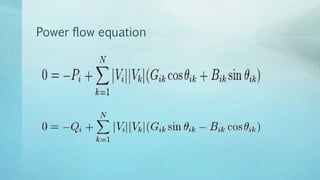
Power flow equation
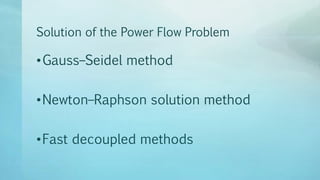
Solution of the Power Flow Problem
•Gauss–Seidel method
•Newton–Raphson solution method
•Fast decoupled methods
OPTIMAL POWER FLOW
Is power flow with
optimization (minimize or
maximize) a predefined
objective.
OPTIMAL POWER FLOW -Objective function
• fuel cost,
• transmission losses
• reactive source allocation
OPTIMAL POWER FLOW - fuel cost Minimization
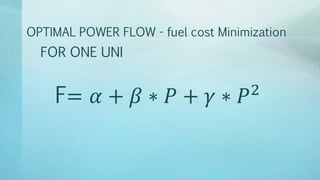
FOR ONE UNI
F= 𝛼 + 𝛽 ∗ 𝑃 + 𝛾 ∗ 𝑃2
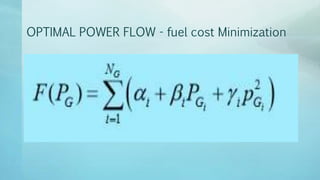
OPTIMAL POWER FLOW - fuel cost Minimization
OPTIMAL POWER FLOW
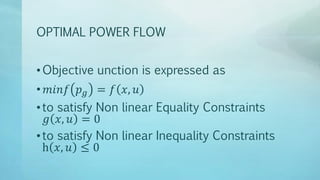
•Objective unction is expressed as
• 𝑚𝑖𝑛𝑓 𝑝 𝑔 = 𝑓 𝑥, 𝑢
•to satisfy Non linear Equality Constraints
𝑔 𝑥, 𝑢 = 0
•to satisfy Non linear Inequality Constraints
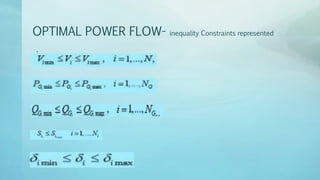
h 𝑥, 𝑢 ≤ 0
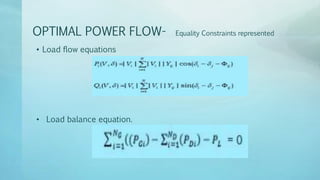
OPTIMAL POWER FLOW- Equality Constraints represented
• Load flow equations
• Load balance equation.
OPTIMAL POWER FLOW- inequality Constraints represented
.
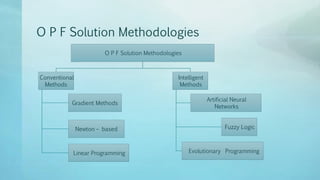
O P F Solution Methodologies
Conventional
Methods
Gradient Methods
Newton – based
Linear Programming
Intelligent
Methods
Artificial Neural
Networks
Evolutionary Programming
Fuzzy Logic

power flow and optimal power flow

  • 1.
  • 2.
    Power flow • isa of the flow of electric power in an system. • focuses on various of AC power parameters, such as voltages, voltage angles, real power and reactive power. • uses simplified notation such as on-line diagram or per-unit system, • It analyzes the power systems in
  • 3.
    P Q Vδ P-Q bus known known unknown unknown P-V bus known unknown known unknown Slack bus unknown unknown known known Bus type • P-Q bus load bus • P-V bus generation bus • Slack bus large bus
  • 4.
    Power flow •The goalis to obtain complete voltage angle and magnitude for each bus for specified load and generator real power and voltage conditions •Once it’s known, real and reactive power flow on each branch and generator reactive power output can be analytically determined
  • 5.
    Power flow • Ina system with N buses and R generators, there are then Unknowns • we need Equations
  • 6.
  • 7.
    Solution of thePower Flow Problem •Gauss–Seidel method •Newton–Raphson solution method •Fast decoupled methods
  • 8.
    OPTIMAL POWER FLOW Ispower flow with optimization (minimize or maximize) a predefined objective.
  • 9.
    OPTIMAL POWER FLOW-Objective function • fuel cost, • transmission losses • reactive source allocation
  • 10.
    OPTIMAL POWER FLOW- fuel cost Minimization FOR ONE UNI F= 𝛼 + 𝛽 ∗ 𝑃 + 𝛾 ∗ 𝑃2
  • 11.
    OPTIMAL POWER FLOW- fuel cost Minimization
  • 12.
    OPTIMAL POWER FLOW •Objectiveunction is expressed as • 𝑚𝑖𝑛𝑓 𝑝 𝑔 = 𝑓 𝑥, 𝑢 •to satisfy Non linear Equality Constraints 𝑔 𝑥, 𝑢 = 0 •to satisfy Non linear Inequality Constraints h 𝑥, 𝑢 ≤ 0
  • 13.
    OPTIMAL POWER FLOW-Equality Constraints represented • Load flow equations • Load balance equation.
  • 14.
    OPTIMAL POWER FLOW-inequality Constraints represented .
  • 15.
    O P FSolution Methodologies O P F Solution Methodologies Conventional Methods Gradient Methods Newton – based Linear Programming Intelligent Methods Artificial Neural Networks Evolutionary Programming Fuzzy Logic