ICH/USFDA
VALIDATION PARAMETERS
OF
ANALYTICAL METHOD
Kushal Shah,
M.Pharm (Pharmaceutical Analysis)
 FDA-guidelines:
◦ Validation is establishing documented evidence
which provides a high degree of assurance that a
specific process will consistently produce a product
meeting its pre-determined specifications and
quality attributes
 “Methods validation is the process of
demonstrating that analytical procedures are
suitable for their intended use”
5/14/2017 2
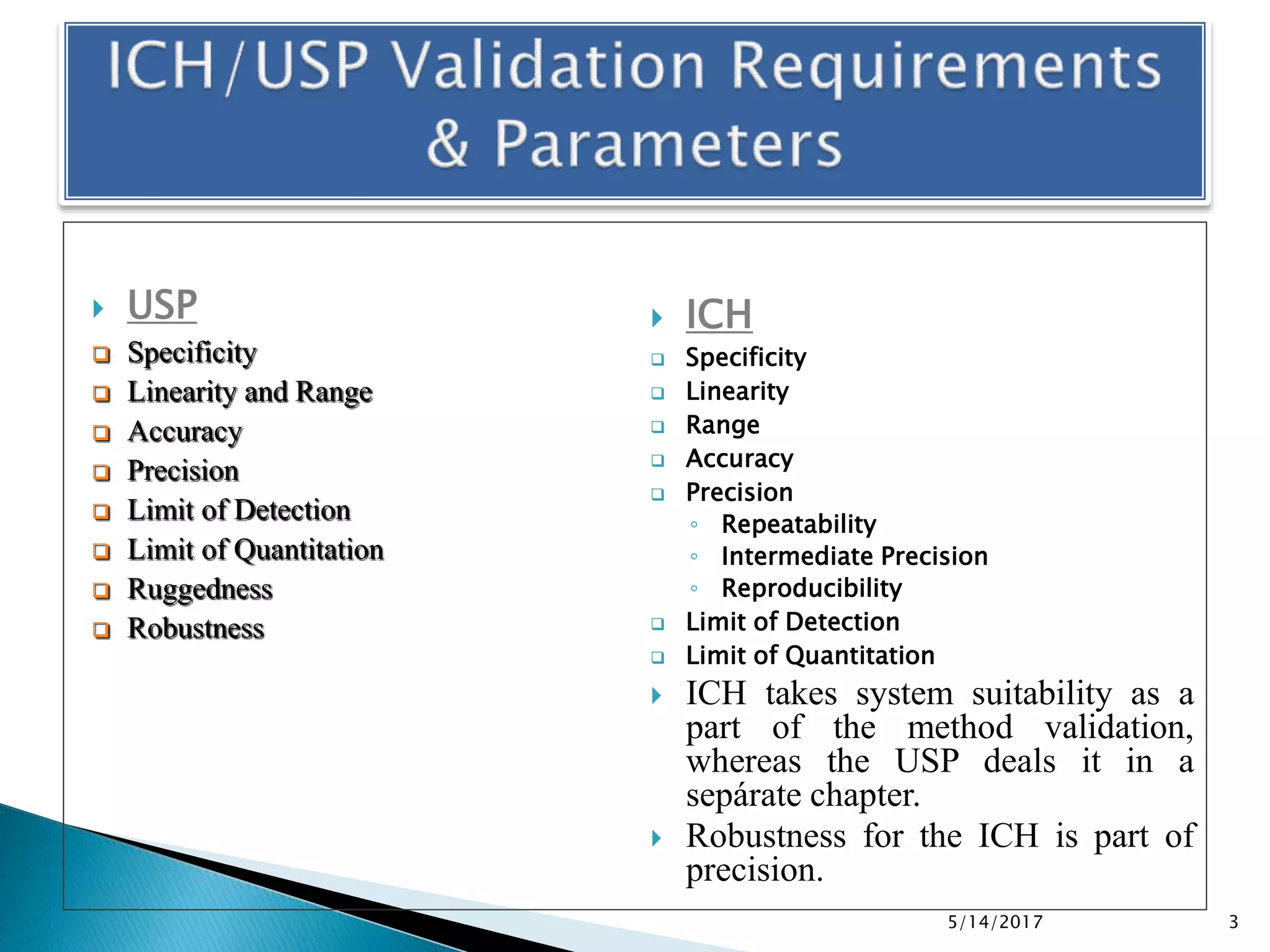
 USP
 Specificity
 Linearity and Range
 Accuracy
 Precision
 Limit of Detection
 Limit of Quantitation
 Ruggedness
 Robustness
 ICH
 Specificity
 Linearity
 Range
 Accuracy
 Precision
◦ Repeatability
◦ Intermediate Precision
◦ Reproducibility
 Limit of Detection
 Limit of Quantitation
 ICH takes system suitability as a
part of the method validation,
whereas the USP deals it in a
sepárate chapter.
 Robustness for the ICH is part of
precision.
5/14/2017 3
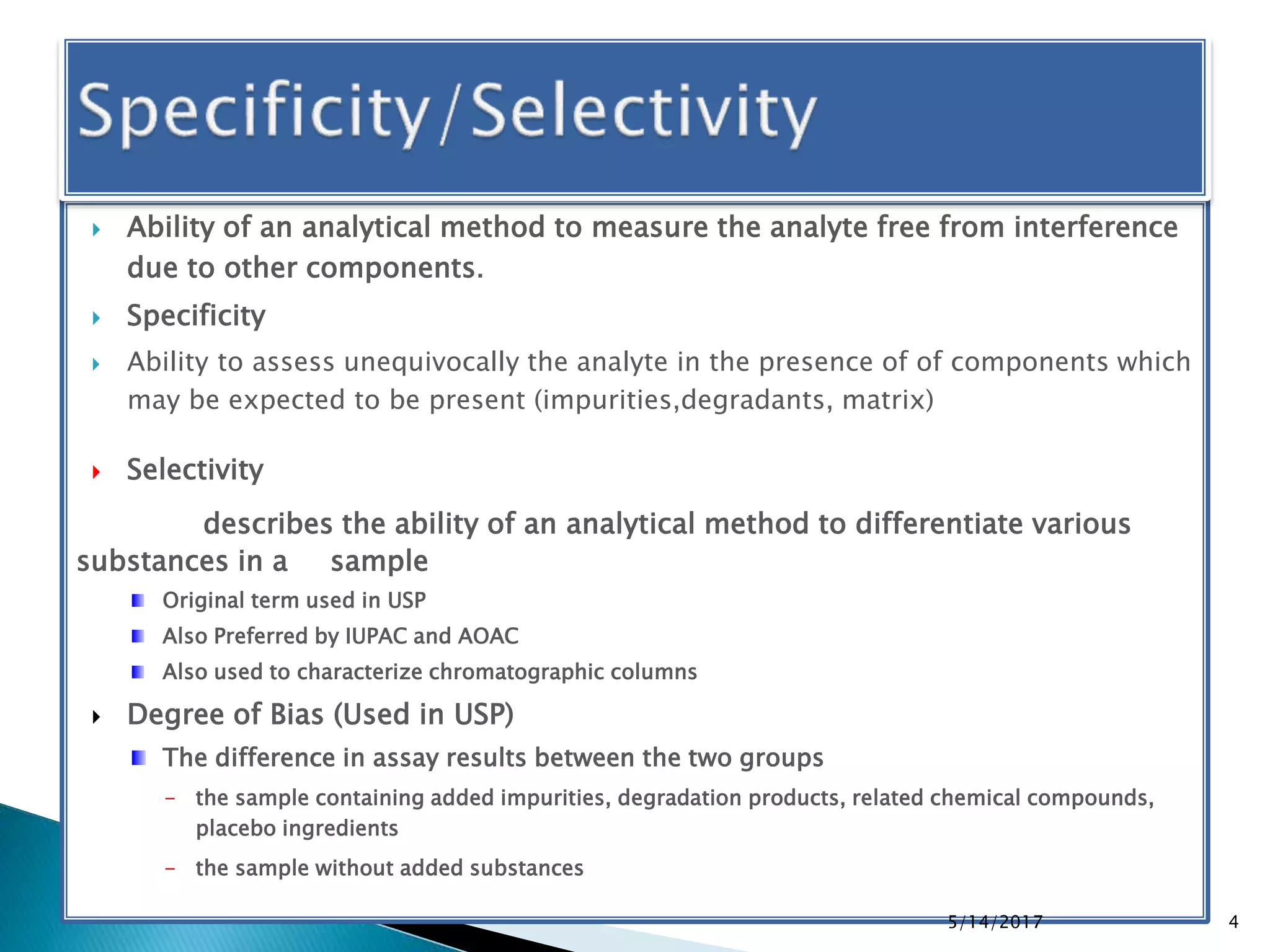
 Ability of an analytical method to measure the analyte free from interference
due to other components.
 Specificity
 Ability to assess unequivocally the analyte in the presence of of components which
may be expected to be present (impurities,degradants, matrix)
 Selectivity
describes the ability of an analytical method to differentiate various
substances in a sample
Original term used in USP
Also Preferred by IUPAC and AOAC
Also used to characterize chromatographic columns
 Degree of Bias (Used in USP)
The difference in assay results between the two groups
- the sample containing added impurities, degradation products, related chemical compounds,
placebo ingredients
- the sample without added substances
5/14/2017 4
 Ability of an assay to
elicit a direct and
proportional
response to changes
in analyte
concentration.
5/14/2017 5
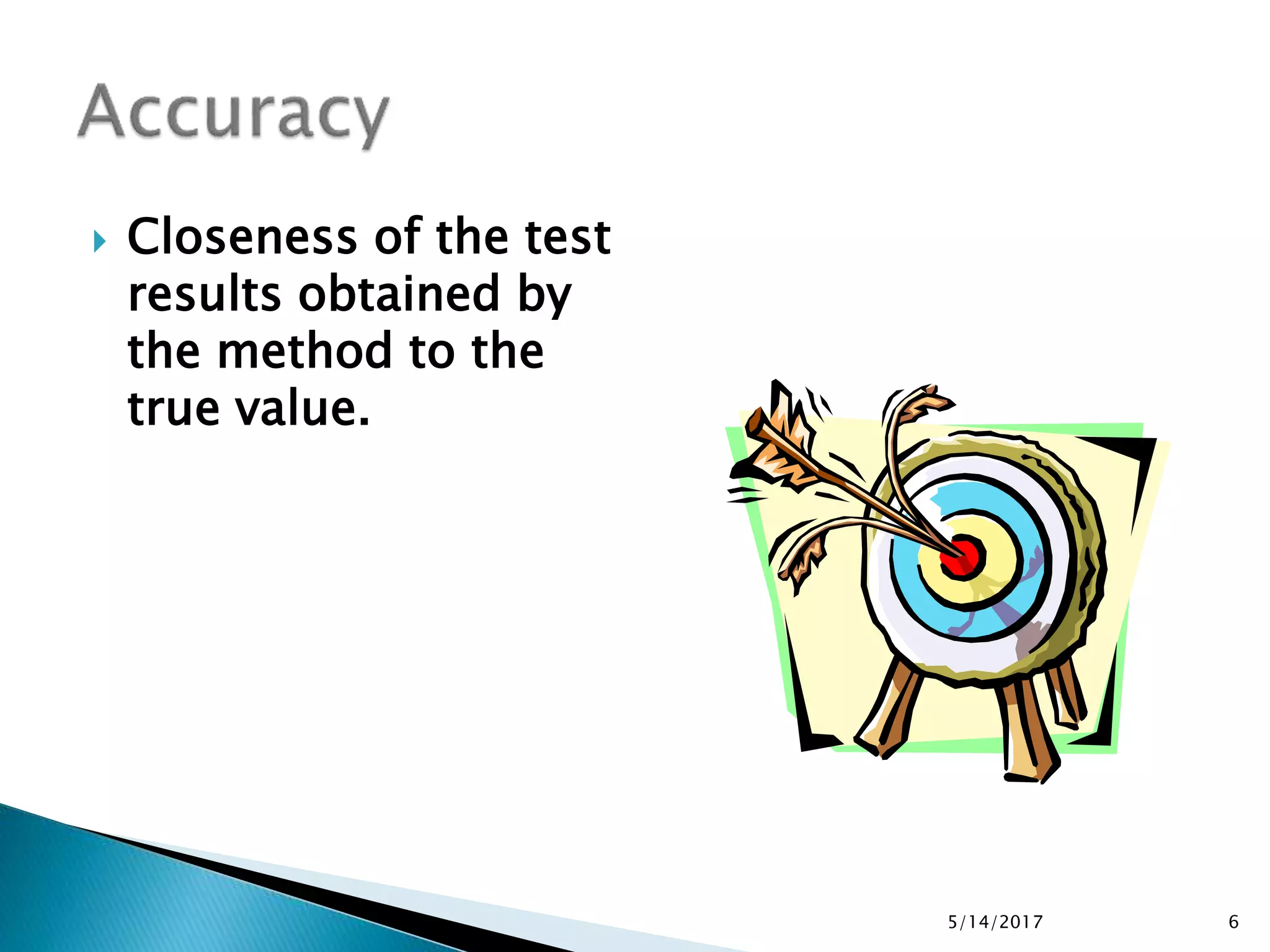
 Closeness of the test
results obtained by
the method to the
true value.
5/14/2017 6
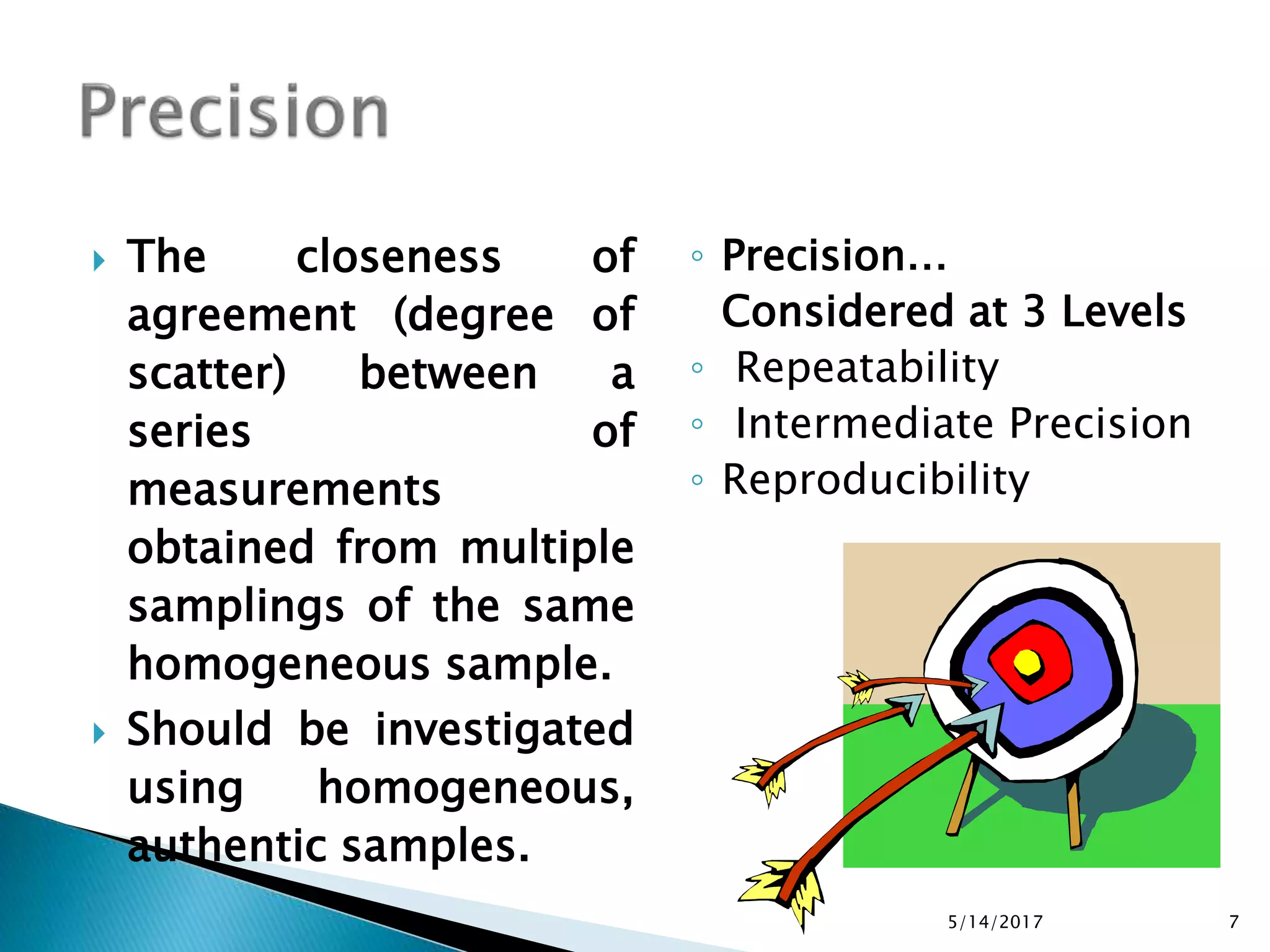
 The closeness of
agreement (degree of
scatter) between a
series of
measurements
obtained from multiple
samplings of the same
homogeneous sample.
 Should be investigated
using homogeneous,
authentic samples.
◦ Precision…
Considered at 3 Levels
◦ Repeatability
◦ Intermediate Precision
◦ Reproducibility
5/14/2017 7
 Precision under the same operating conditions
over a short interval of time.
 Method
- 9 determinations covering the specified
range
- or: 6 determinations at 100% of the test
concentration
5/14/2017 8
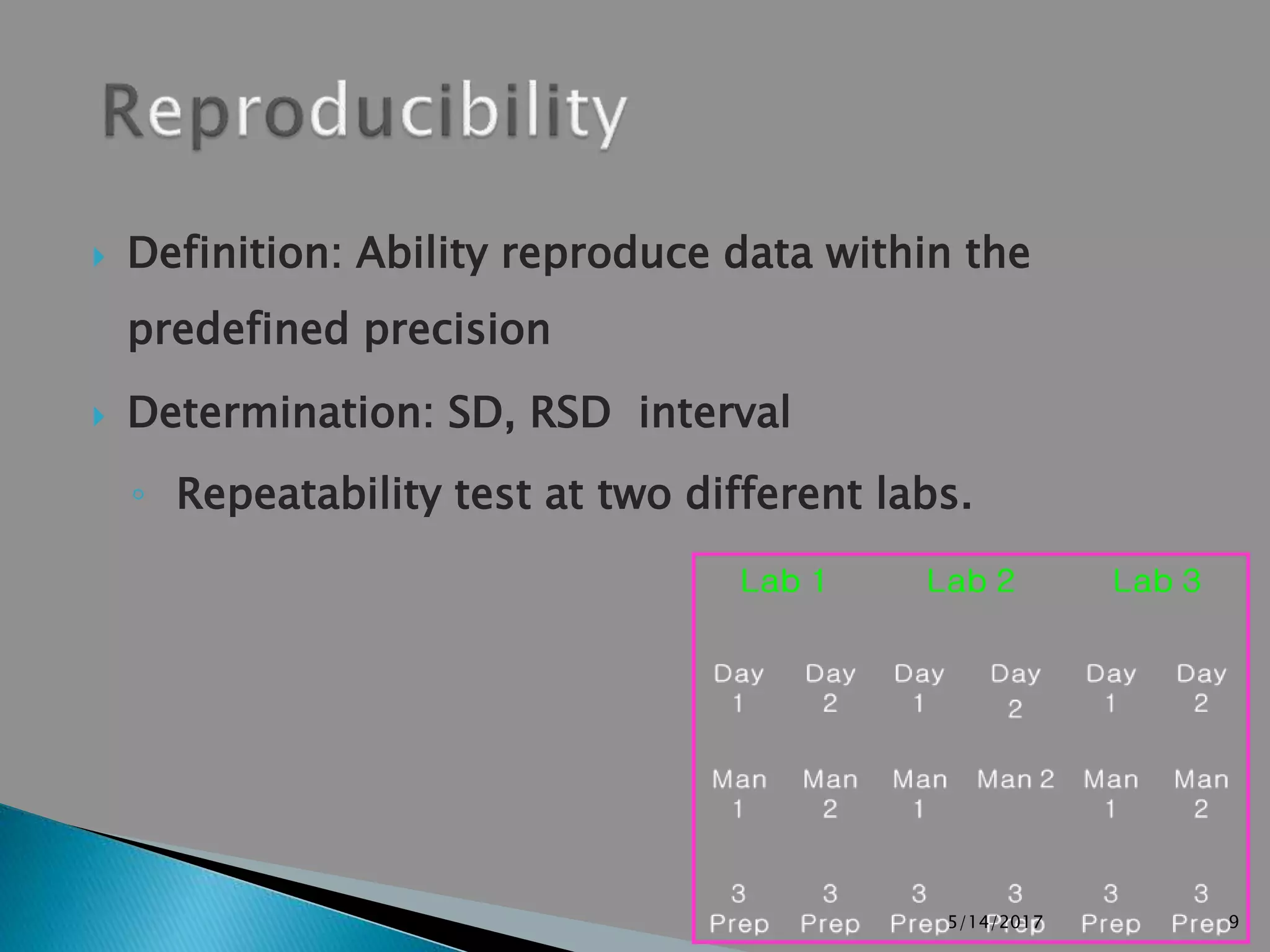
 Definition: Ability reproduce data within the
predefined precision
 Determination: SD, RSD interval
◦ Repeatability test at two different labs.
95/14/2017
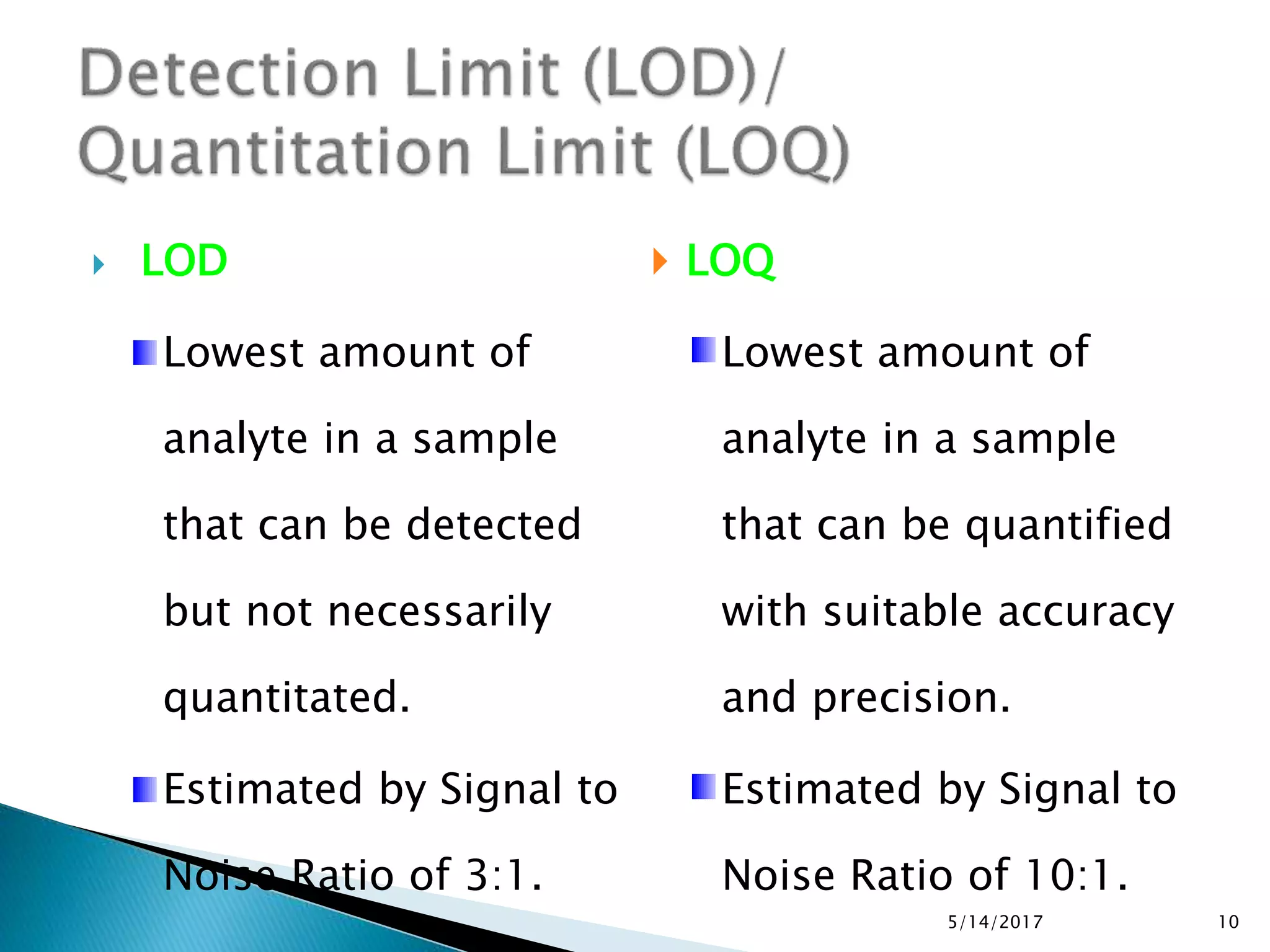
 LOD
Lowest amount of
analyte in a sample
that can be detected
but not necessarily
quantitated.
Estimated by Signal to
Noise Ratio of 3:1.
 LOQ
Lowest amount of
analyte in a sample
that can be quantified
with suitable accuracy
and precision.
Estimated by Signal to
Noise Ratio of 10:1.
5/14/2017 10
 Definition: Capacity to remain unaffected by
small but deliberate variations in method
parameters
 Determination: Comparison results under
differing conditions with precision under normal
conditions
5/14/2017 11
 Degree of reproducibility of test results under a
variety of conditions
 Different Laboratories
 Different Analysts
 Different Instruments
 Different Reagents
 Different Days
 Etc.
 Expressed as %RSD
5/14/2017 12
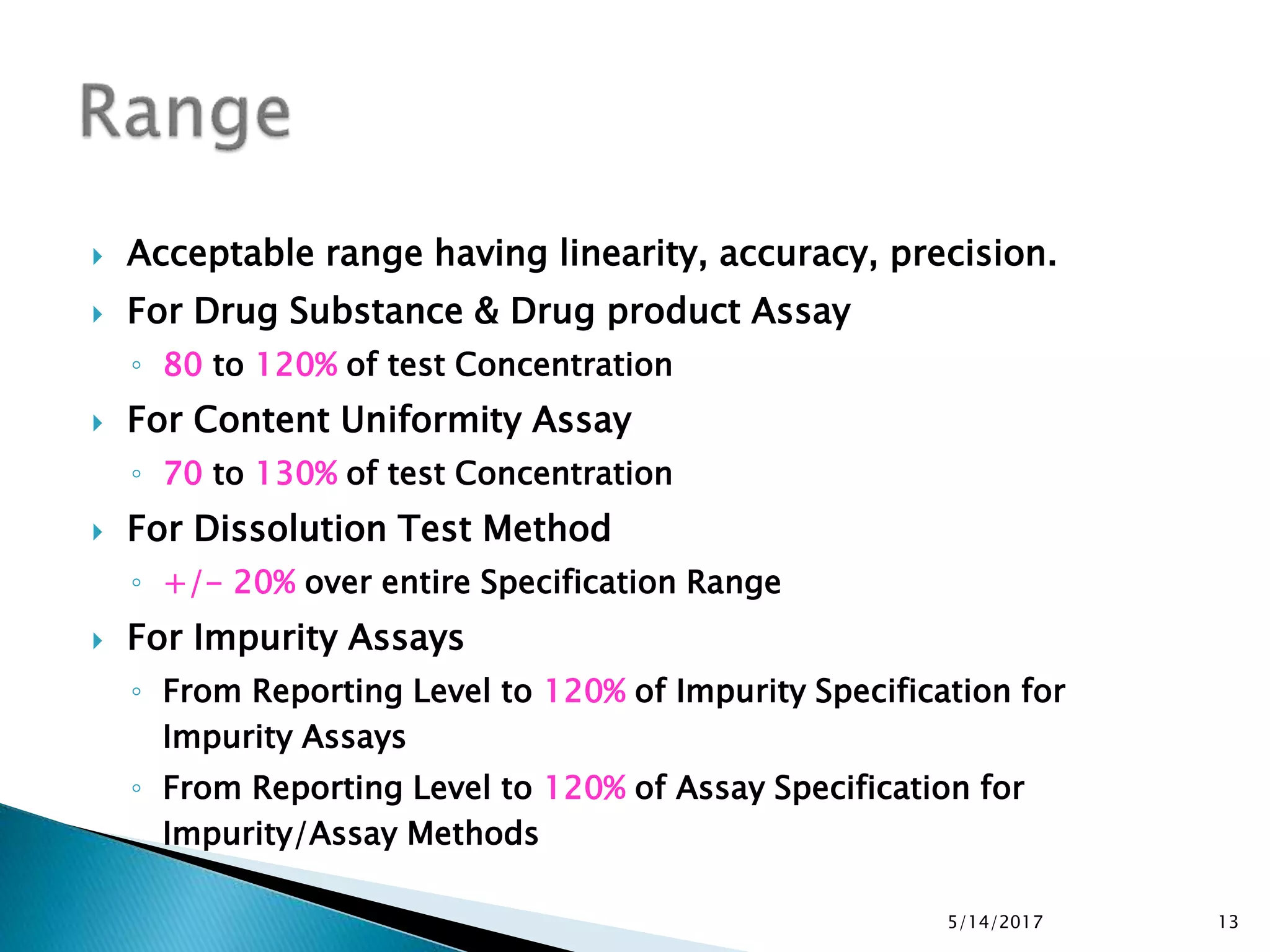
 Acceptable range having linearity, accuracy, precision.
 For Drug Substance & Drug product Assay
◦ 80 to 120% of test Concentration
 For Content Uniformity Assay
◦ 70 to 130% of test Concentration
 For Dissolution Test Method
◦ +/- 20% over entire Specification Range
 For Impurity Assays
◦ From Reporting Level to 120% of Impurity Specification for
Impurity Assays
◦ From Reporting Level to 120% of Assay Specification for
Impurity/Assay Methods
5/14/2017 13
Definition
◦ Set of parameters and criteria there off to ensure
the system is working properly.
 Aspects
- Dependent on type of test
- For chromatographic methods: tailing factor, rel.
retention times, resolution factor, rel. st.
deviation, number of theoretical plates
- To be checked before start of run and to be
verified afterwards
- Described in Pharmacopoeias
System Suitability Test
5/14/2017 14
 THANK YOU
5/14/2017 15

Analytical Method Validation as per ICH vs USP

  • 1.
    ICH/USFDA VALIDATION PARAMETERS OF ANALYTICAL METHOD KushalShah, M.Pharm (Pharmaceutical Analysis)
  • 2.
     FDA-guidelines: ◦ Validationis establishing documented evidence which provides a high degree of assurance that a specific process will consistently produce a product meeting its pre-determined specifications and quality attributes  “Methods validation is the process of demonstrating that analytical procedures are suitable for their intended use” 5/14/2017 2
  • 3.
     USP  Specificity Linearity and Range  Accuracy  Precision  Limit of Detection  Limit of Quantitation  Ruggedness  Robustness  ICH  Specificity  Linearity  Range  Accuracy  Precision ◦ Repeatability ◦ Intermediate Precision ◦ Reproducibility  Limit of Detection  Limit of Quantitation  ICH takes system suitability as a part of the method validation, whereas the USP deals it in a sepárate chapter.  Robustness for the ICH is part of precision. 5/14/2017 3
  • 4.
     Ability ofan analytical method to measure the analyte free from interference due to other components.  Specificity  Ability to assess unequivocally the analyte in the presence of of components which may be expected to be present (impurities,degradants, matrix)  Selectivity describes the ability of an analytical method to differentiate various substances in a sample Original term used in USP Also Preferred by IUPAC and AOAC Also used to characterize chromatographic columns  Degree of Bias (Used in USP) The difference in assay results between the two groups - the sample containing added impurities, degradation products, related chemical compounds, placebo ingredients - the sample without added substances 5/14/2017 4
  • 5.
     Ability ofan assay to elicit a direct and proportional response to changes in analyte concentration. 5/14/2017 5
  • 6.
     Closeness ofthe test results obtained by the method to the true value. 5/14/2017 6
  • 7.
     The closenessof agreement (degree of scatter) between a series of measurements obtained from multiple samplings of the same homogeneous sample.  Should be investigated using homogeneous, authentic samples. ◦ Precision… Considered at 3 Levels ◦ Repeatability ◦ Intermediate Precision ◦ Reproducibility 5/14/2017 7
  • 8.
     Precision underthe same operating conditions over a short interval of time.  Method - 9 determinations covering the specified range - or: 6 determinations at 100% of the test concentration 5/14/2017 8
  • 9.
     Definition: Abilityreproduce data within the predefined precision  Determination: SD, RSD interval ◦ Repeatability test at two different labs. 95/14/2017
  • 10.
     LOD Lowest amountof analyte in a sample that can be detected but not necessarily quantitated. Estimated by Signal to Noise Ratio of 3:1.  LOQ Lowest amount of analyte in a sample that can be quantified with suitable accuracy and precision. Estimated by Signal to Noise Ratio of 10:1. 5/14/2017 10
  • 11.
     Definition: Capacityto remain unaffected by small but deliberate variations in method parameters  Determination: Comparison results under differing conditions with precision under normal conditions 5/14/2017 11
  • 12.
     Degree ofreproducibility of test results under a variety of conditions  Different Laboratories  Different Analysts  Different Instruments  Different Reagents  Different Days  Etc.  Expressed as %RSD 5/14/2017 12
  • 13.
     Acceptable rangehaving linearity, accuracy, precision.  For Drug Substance & Drug product Assay ◦ 80 to 120% of test Concentration  For Content Uniformity Assay ◦ 70 to 130% of test Concentration  For Dissolution Test Method ◦ +/- 20% over entire Specification Range  For Impurity Assays ◦ From Reporting Level to 120% of Impurity Specification for Impurity Assays ◦ From Reporting Level to 120% of Assay Specification for Impurity/Assay Methods 5/14/2017 13
  • 14.
    Definition ◦ Set ofparameters and criteria there off to ensure the system is working properly.  Aspects - Dependent on type of test - For chromatographic methods: tailing factor, rel. retention times, resolution factor, rel. st. deviation, number of theoretical plates - To be checked before start of run and to be verified afterwards - Described in Pharmacopoeias System Suitability Test 5/14/2017 14
  • 15.