ELEMENTAL IMPURITIES
Presented by :
k. jayalakshmi
D/o k. kristaiah
1st yr M.pharm,
Pharmaceutical analysis.
CONTENTS
 Elemental impurities definition.
 Identification of potential elemental impurities.
 Analytical procedures
 C,H,N and S analysis
Elemental impurities definition
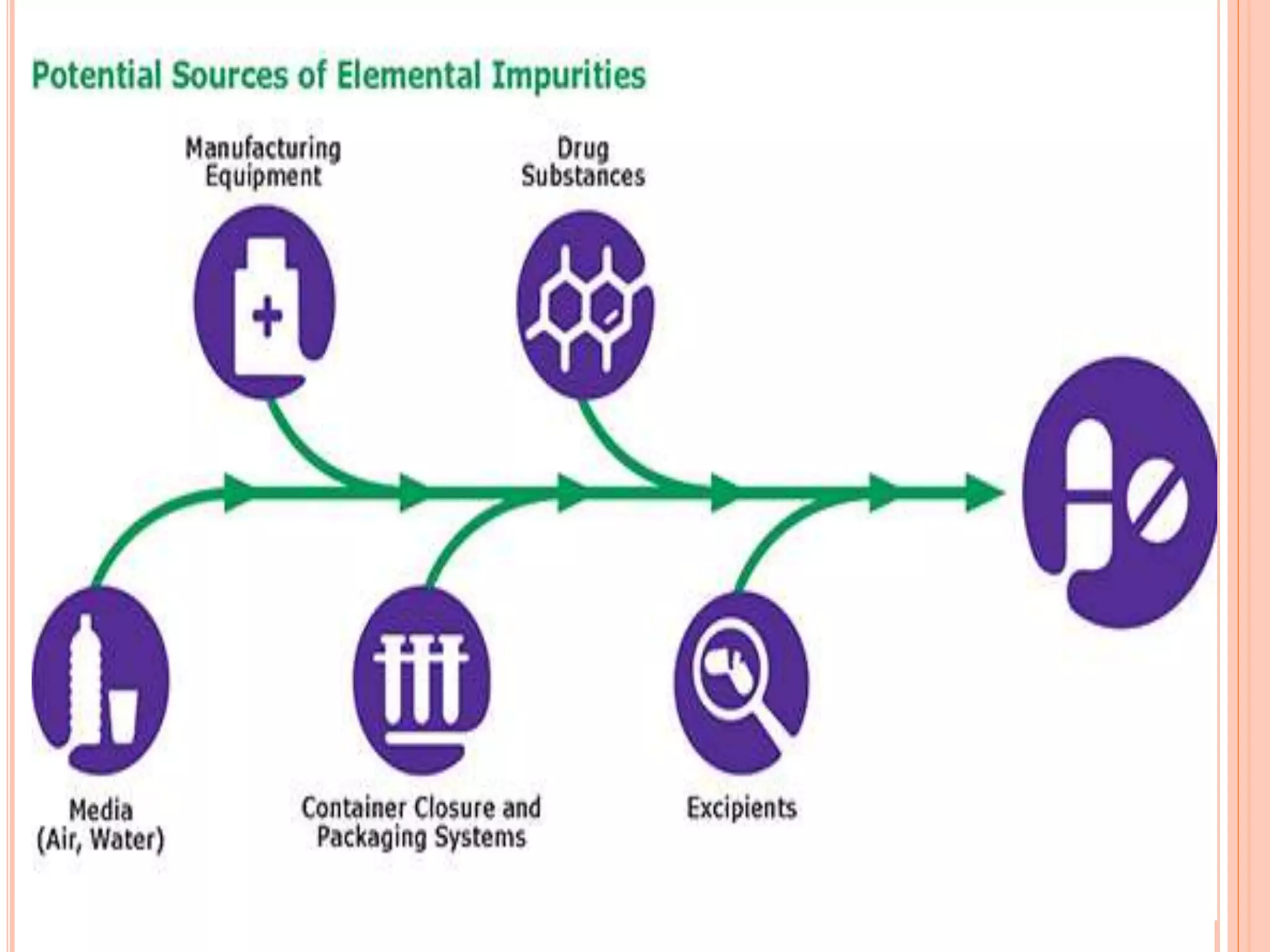
Elemental impurities are traces of metals that
can end up in finished drug products.
These impurities can come from multiple
points in the manufacturing process, such as
residual catalysts from a product's synthesis or
from contact with manufacturing equipment,
containers and other materials.
Identification of potential elemental
impurities
Potential elemental impurities derived from intentionally added
catalysts and inorganic reagents.
Potential elemental impurities that may be present in drug
substances and/or excipients.
Potential elemental impurities derived from manufacturing
equipment.
Elemental impurities leached from container closure systems.
 Potential elemental impurities derived from intentionally
added catalysts and inorganic reagents:
 If any element listed is intentionally added, it should be
considered in the risk assessment. For this category, the identity
of the potential impurities is known and techniques for
controlling the elemental impurities are easily characterized and
defined.
 Potential elemental impurities derived from manufacturing
equipment:
 The contribution of elemental impurities from this source may be
limited, and the subset of elemental impurities that should be
considered in the risk assessment will depend on the
manufacturing equipment used in the production of the drug
product.
 Application of process knowledge, selection of equipment,
equipment qualification, and GMP controls ensure a low
contribution from manufacturing equipment.
Potential elemental impurities that may be present in
drug substances and/or excipients:
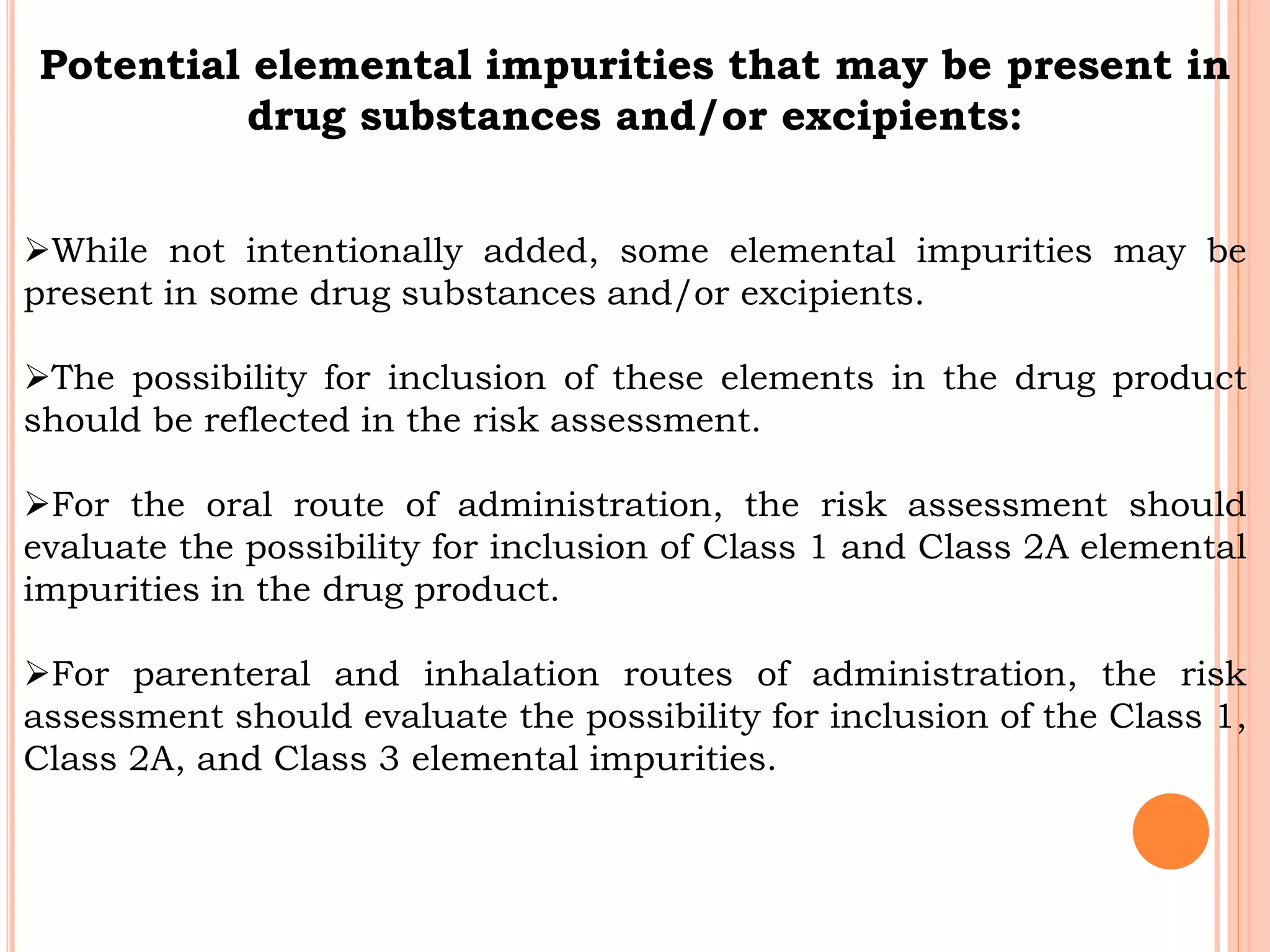
While not intentionally added, some elemental impurities may be
present in some drug substances and/or excipients.
The possibility for inclusion of these elements in the drug product
should be reflected in the risk assessment.
For the oral route of administration, the risk assessment should
evaluate the possibility for inclusion of Class 1 and Class 2A elemental
impurities in the drug product.
For parenteral and inhalation routes of administration, the risk
assessment should evaluate the possibility for inclusion of the Class 1,
Class 2A, and Class 3 elemental impurities.
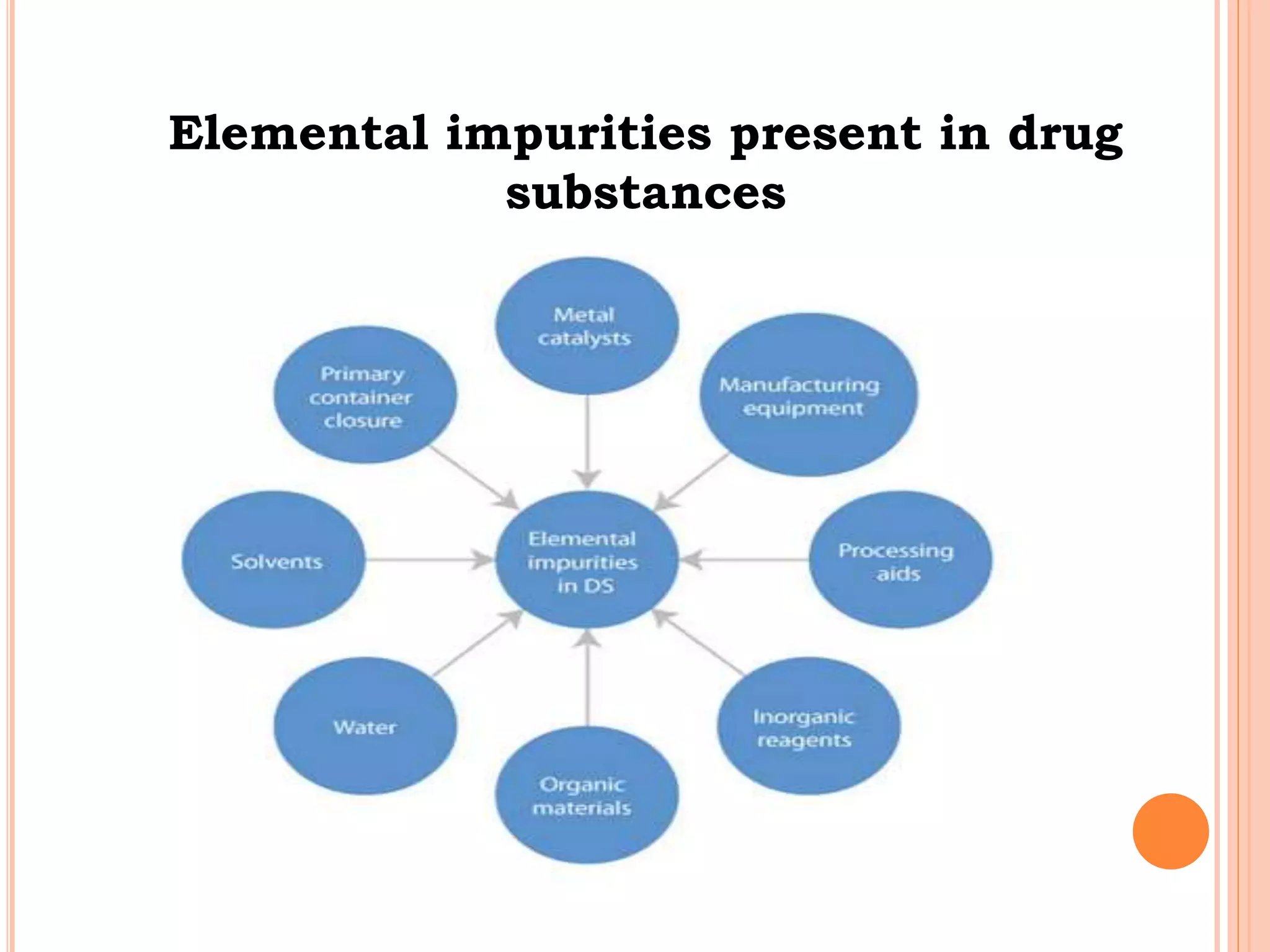
Elemental impurities present in drug
substances
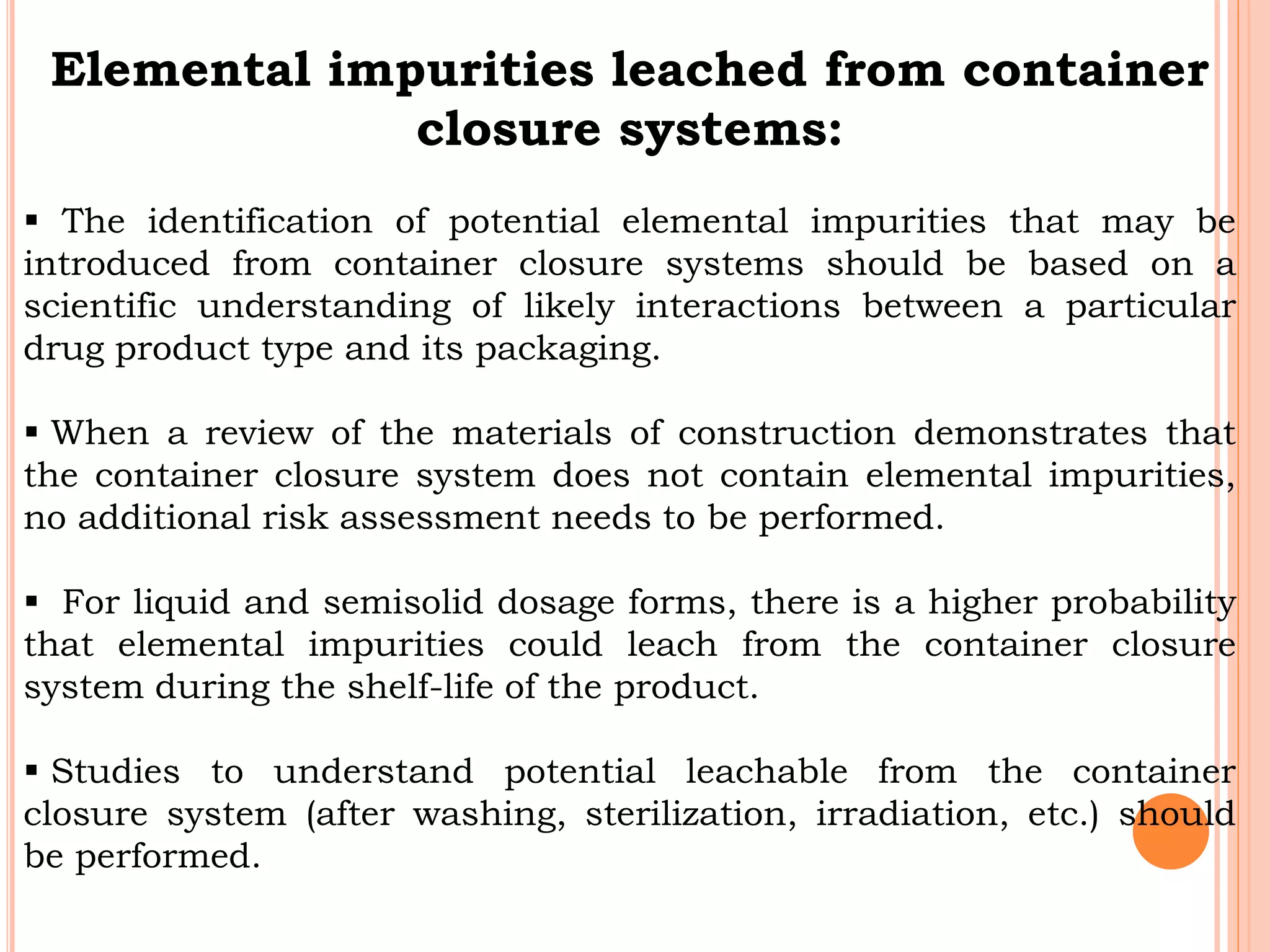
Elemental impurities leached from container
closure systems:
 The identification of potential elemental impurities that may be
introduced from container closure systems should be based on a
scientific understanding of likely interactions between a particular
drug product type and its packaging.
 When a review of the materials of construction demonstrates that
the container closure system does not contain elemental impurities,
no additional risk assessment needs to be performed.
 For liquid and semisolid dosage forms, there is a higher probability
that elemental impurities could leach from the container closure
system during the shelf-life of the product.
 Studies to understand potential leachable from the container
closure system (after washing, sterilization, irradiation, etc.) should
be performed.
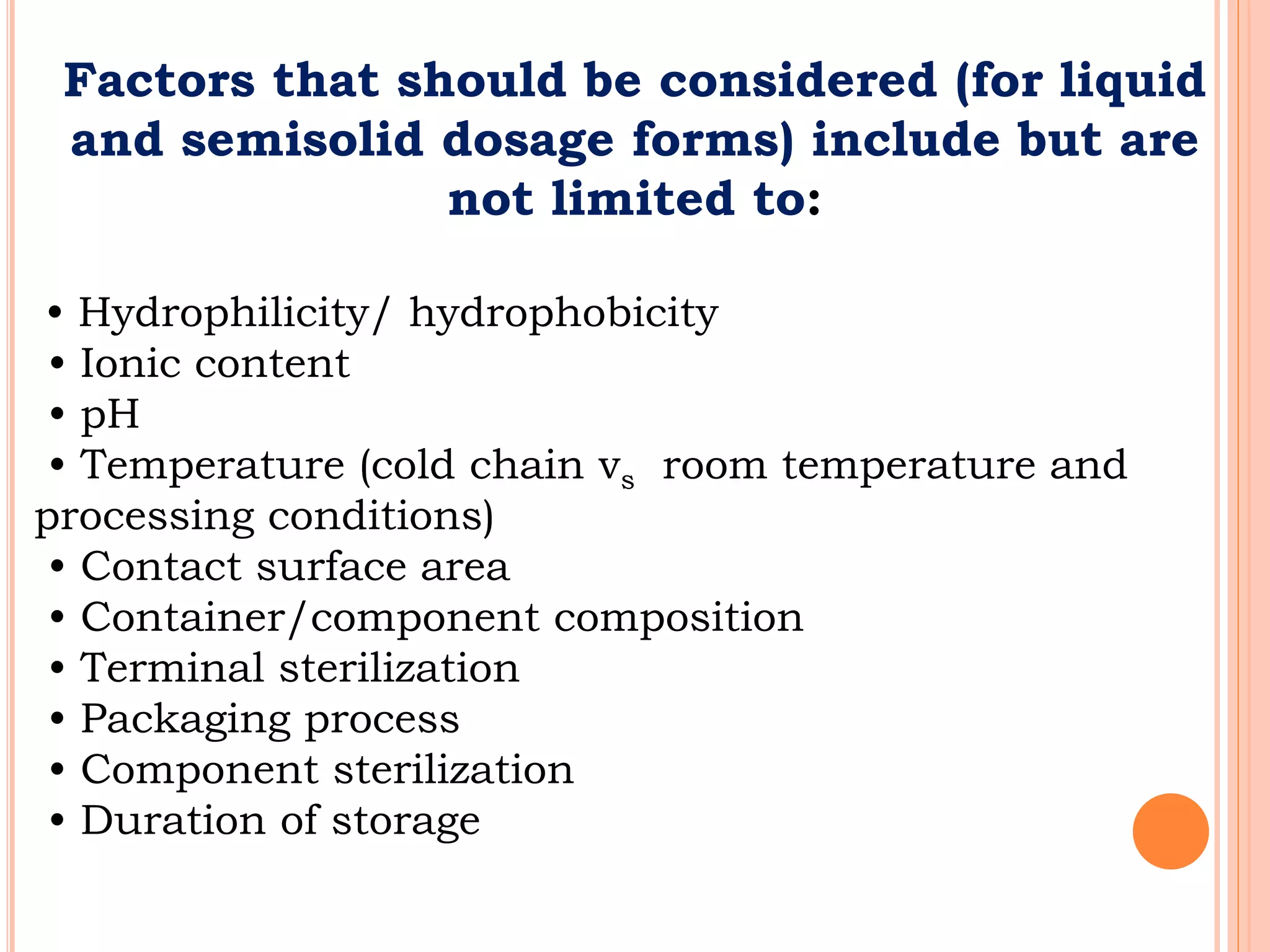
Factors that should be considered (for liquid
and semisolid dosage forms) include but are
not limited to:
• Hydrophilicity/ hydrophobicity
• Ionic content
• pH
• Temperature (cold chain vs room temperature and
processing conditions)
• Contact surface area
• Container/component composition
• Terminal sterilization
• Packaging process
• Component sterilization
• Duration of storage
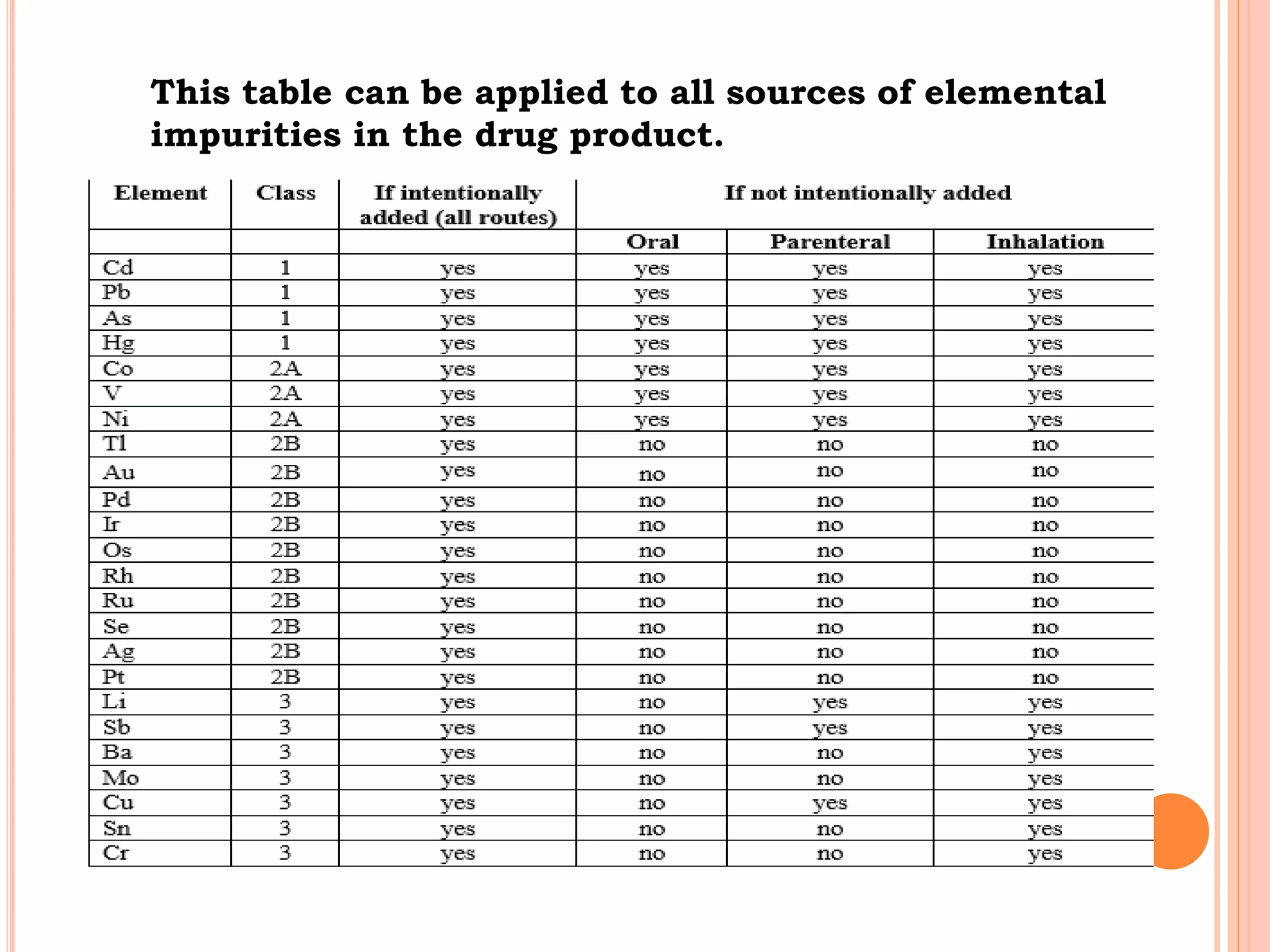
This table can be applied to all sources of elemental
impurities in the drug product.
ANALYTICAL PROCEDURES
The determination of elemental impurities should be conducted
using appropriate procedures suitable for their intended purposes.
 Unless otherwise justified, the test should be specific for each
elemental impurity identified for control during the risk
assessment.
 Pharmacopoeia procedures or suitable alternative procedures for
determining levels of elemental impurities should be used.
After identifying the elemental
impurity
Quantifying the elemental impurity
Specific impurity perform the
specific procedure
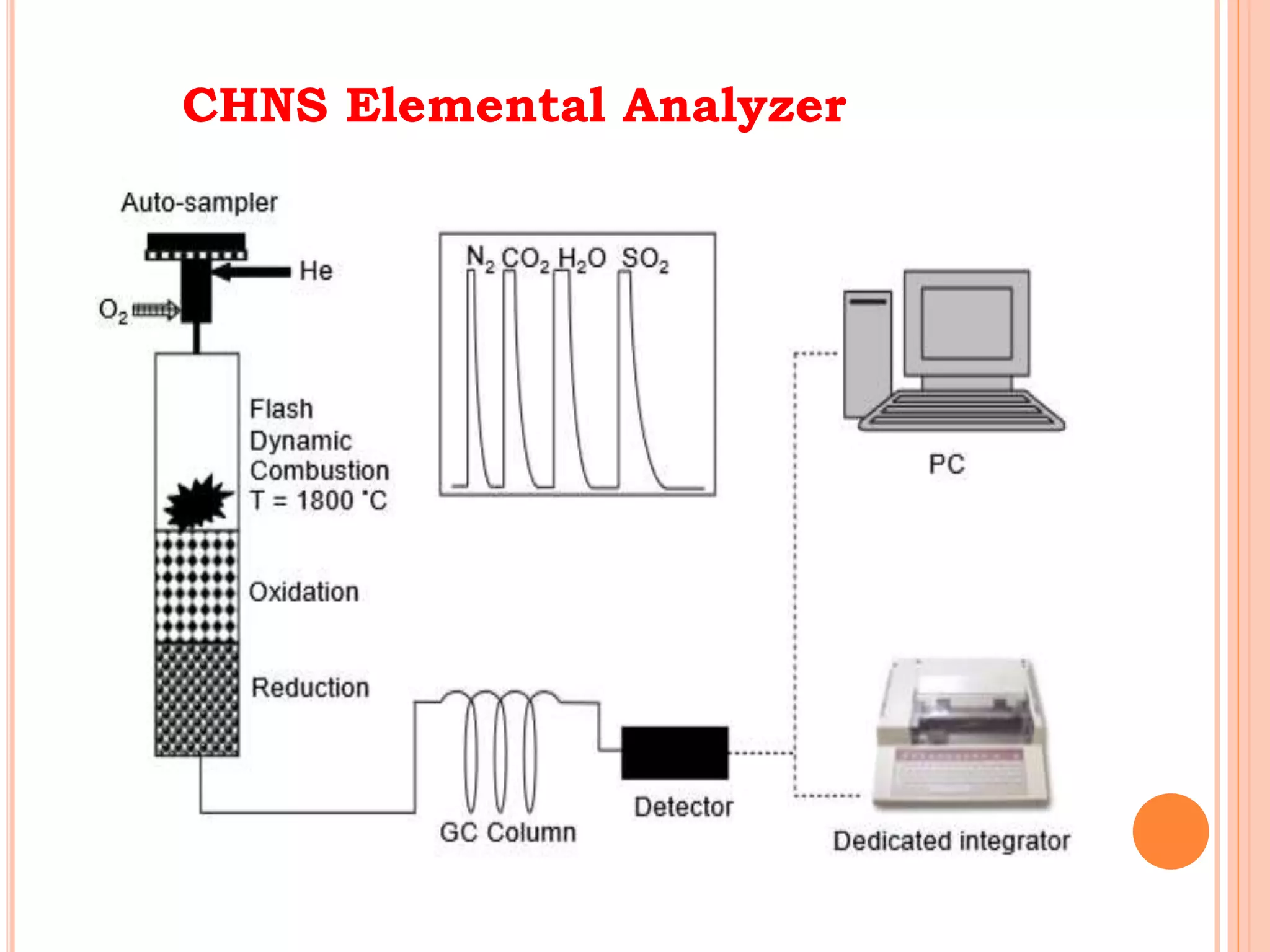
CHNS Elemental Analyzer
 CHNS elemental analysers provide a means for the
rapid determination of carbon, hydrogen, nitrogen
and sulphur in organic matrices and other types of
materials.
 They are capable of handling a wide variety of sample
types, including solids, liquids, volatile and viscous
samples, in the fields of pharmaceuticals, polymers,
chemicals, environment, food and energy.
Basic principles
In the combustion process (furnace at ca. 1000oC),
• carbon is converted to carbon dioxide;
• hydrogen to water;
• nitrogen to nitrogen gas/ oxides of nitrogen and
• sulphur to sulphur dioxide.
If other elements such as chlorine are present, they will
also be converted to combustion products, such as
hydrogen chloride.
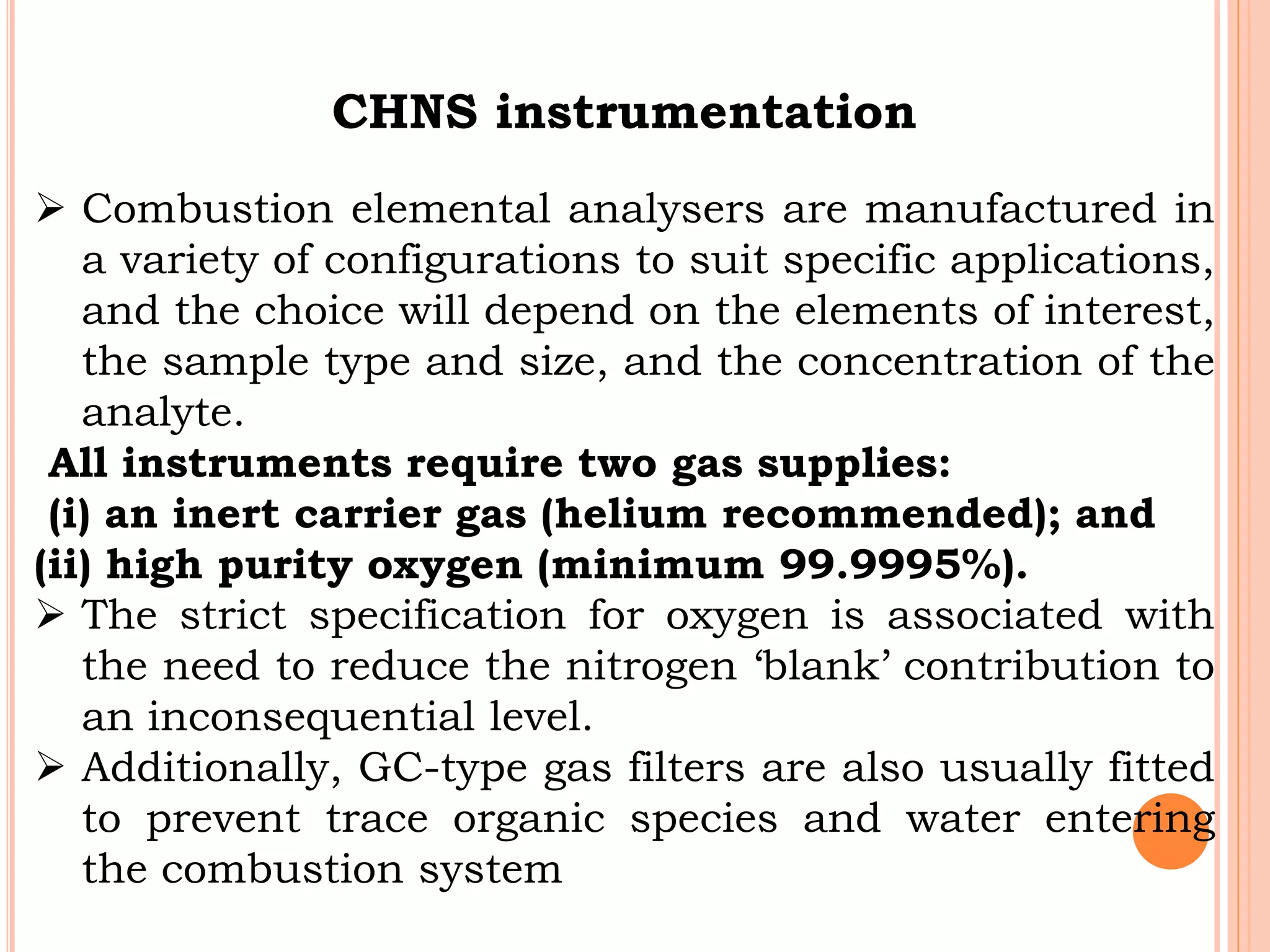
CHNS instrumentation
 Combustion elemental analysers are manufactured in
a variety of configurations to suit specific applications,
and the choice will depend on the elements of interest,
the sample type and size, and the concentration of the
analyte.
All instruments require two gas supplies:
(i) an inert carrier gas (helium recommended); and
(ii) high purity oxygen (minimum 99.9995%).
 The strict specification for oxygen is associated with
the need to reduce the nitrogen ‘blank’ contribution to
an inconsequential level.
 Additionally, GC-type gas filters are also usually fitted
to prevent trace organic species and water entering
the combustion system
 The choice of sample introduction systems will
depend on the application and the sample type. For
solids or viscous liquids, samples are weighed out
into tin capsules; for liquids, samples can be sealed
in individual aluminium vials or introduced via a
liquid auto-sampler. Both capsules and vials are pre-
cleaned and dried to avoid trace contamination from
oils and water acquired during their manufacture.
 Instruments are classified as either ‘static’ or
‘dynamic’ in terms of their combustion
characteristics. In the ‘static’ type, a pre-set volume of
oxygen is added to the combustion tube before the
sample is introduced. In the ‘dynamic’ type, the
oxygen is added to the tube at the same time as the
sample introduction and continues to flow for a set
time.
Applications of CHNS Elemental Analysers
CHNS elemental analysers have been used in analytical
laboratories for over thirty years.
The method is used extensively across a wide range of applications,
including pharmaceuticals, chemicals, oil-related products, catalysts
and food.
In the oil industry, an important application is the regular
monitoring of coke build-up on refinery catalysts to ensure that
regeneration procedures (involving controlled burning of the carbon)
are executed at optimal intervals.
 Since many of these catalyst systems involve large quantities of
noble metals such as platinum, palladium and rhenium,
mismanagement of this testing would entail serious financial losses.
In food analysis, the determination of nitrogen (as a surrogate for
protein) is very important for pricing grain and evaluating meat
products, and is increasingly undertaken by combustion analysis.
Potential elemental impurities ,chns analyser

Potential elemental impurities ,chns analyser

  • 1.
    ELEMENTAL IMPURITIES Presented by: k. jayalakshmi D/o k. kristaiah 1st yr M.pharm, Pharmaceutical analysis.
  • 2.
    CONTENTS  Elemental impuritiesdefinition.  Identification of potential elemental impurities.  Analytical procedures  C,H,N and S analysis
  • 3.
    Elemental impurities definition Elementalimpurities are traces of metals that can end up in finished drug products. These impurities can come from multiple points in the manufacturing process, such as residual catalysts from a product's synthesis or from contact with manufacturing equipment, containers and other materials.
  • 4.
    Identification of potentialelemental impurities Potential elemental impurities derived from intentionally added catalysts and inorganic reagents. Potential elemental impurities that may be present in drug substances and/or excipients. Potential elemental impurities derived from manufacturing equipment. Elemental impurities leached from container closure systems.
  • 6.
     Potential elementalimpurities derived from intentionally added catalysts and inorganic reagents:  If any element listed is intentionally added, it should be considered in the risk assessment. For this category, the identity of the potential impurities is known and techniques for controlling the elemental impurities are easily characterized and defined.  Potential elemental impurities derived from manufacturing equipment:  The contribution of elemental impurities from this source may be limited, and the subset of elemental impurities that should be considered in the risk assessment will depend on the manufacturing equipment used in the production of the drug product.  Application of process knowledge, selection of equipment, equipment qualification, and GMP controls ensure a low contribution from manufacturing equipment.
  • 7.
    Potential elemental impuritiesthat may be present in drug substances and/or excipients: While not intentionally added, some elemental impurities may be present in some drug substances and/or excipients. The possibility for inclusion of these elements in the drug product should be reflected in the risk assessment. For the oral route of administration, the risk assessment should evaluate the possibility for inclusion of Class 1 and Class 2A elemental impurities in the drug product. For parenteral and inhalation routes of administration, the risk assessment should evaluate the possibility for inclusion of the Class 1, Class 2A, and Class 3 elemental impurities.
  • 8.
    Elemental impurities presentin drug substances
  • 9.
    Elemental impurities leachedfrom container closure systems:  The identification of potential elemental impurities that may be introduced from container closure systems should be based on a scientific understanding of likely interactions between a particular drug product type and its packaging.  When a review of the materials of construction demonstrates that the container closure system does not contain elemental impurities, no additional risk assessment needs to be performed.  For liquid and semisolid dosage forms, there is a higher probability that elemental impurities could leach from the container closure system during the shelf-life of the product.  Studies to understand potential leachable from the container closure system (after washing, sterilization, irradiation, etc.) should be performed.
  • 10.
    Factors that shouldbe considered (for liquid and semisolid dosage forms) include but are not limited to: • Hydrophilicity/ hydrophobicity • Ionic content • pH • Temperature (cold chain vs room temperature and processing conditions) • Contact surface area • Container/component composition • Terminal sterilization • Packaging process • Component sterilization • Duration of storage
  • 11.
    This table canbe applied to all sources of elemental impurities in the drug product.
  • 12.
    ANALYTICAL PROCEDURES The determinationof elemental impurities should be conducted using appropriate procedures suitable for their intended purposes.  Unless otherwise justified, the test should be specific for each elemental impurity identified for control during the risk assessment.  Pharmacopoeia procedures or suitable alternative procedures for determining levels of elemental impurities should be used. After identifying the elemental impurity Quantifying the elemental impurity Specific impurity perform the specific procedure
  • 13.
  • 14.
     CHNS elementalanalysers provide a means for the rapid determination of carbon, hydrogen, nitrogen and sulphur in organic matrices and other types of materials.  They are capable of handling a wide variety of sample types, including solids, liquids, volatile and viscous samples, in the fields of pharmaceuticals, polymers, chemicals, environment, food and energy. Basic principles In the combustion process (furnace at ca. 1000oC), • carbon is converted to carbon dioxide; • hydrogen to water; • nitrogen to nitrogen gas/ oxides of nitrogen and • sulphur to sulphur dioxide. If other elements such as chlorine are present, they will also be converted to combustion products, such as hydrogen chloride.
  • 15.
    CHNS instrumentation  Combustionelemental analysers are manufactured in a variety of configurations to suit specific applications, and the choice will depend on the elements of interest, the sample type and size, and the concentration of the analyte. All instruments require two gas supplies: (i) an inert carrier gas (helium recommended); and (ii) high purity oxygen (minimum 99.9995%).  The strict specification for oxygen is associated with the need to reduce the nitrogen ‘blank’ contribution to an inconsequential level.  Additionally, GC-type gas filters are also usually fitted to prevent trace organic species and water entering the combustion system
  • 16.
     The choiceof sample introduction systems will depend on the application and the sample type. For solids or viscous liquids, samples are weighed out into tin capsules; for liquids, samples can be sealed in individual aluminium vials or introduced via a liquid auto-sampler. Both capsules and vials are pre- cleaned and dried to avoid trace contamination from oils and water acquired during their manufacture.  Instruments are classified as either ‘static’ or ‘dynamic’ in terms of their combustion characteristics. In the ‘static’ type, a pre-set volume of oxygen is added to the combustion tube before the sample is introduced. In the ‘dynamic’ type, the oxygen is added to the tube at the same time as the sample introduction and continues to flow for a set time.
  • 17.
    Applications of CHNSElemental Analysers CHNS elemental analysers have been used in analytical laboratories for over thirty years. The method is used extensively across a wide range of applications, including pharmaceuticals, chemicals, oil-related products, catalysts and food. In the oil industry, an important application is the regular monitoring of coke build-up on refinery catalysts to ensure that regeneration procedures (involving controlled burning of the carbon) are executed at optimal intervals.  Since many of these catalyst systems involve large quantities of noble metals such as platinum, palladium and rhenium, mismanagement of this testing would entail serious financial losses. In food analysis, the determination of nitrogen (as a surrogate for protein) is very important for pricing grain and evaluating meat products, and is increasingly undertaken by combustion analysis.