GMP
Is a system for ensuring that products are consistently
produced and controlled according to quality standards
Quality control
Is a procedure intended to ensure that a manufactured
product adheres to a defined set of quality criteria
 The analytical procedure refers to the way of
performing the analysis.
 It should describe in detail the steps necessary to
perform each analytical test.
 This may include : the sample, the reference
standard, the reagents preparations, use of the
apparatus, generation of the calibration curve, use
of the formulae for the calculation…..etc.
optimization
development
validation
What is validation ?
It is the process to confirm that the analytical
procedure employed for a specific test is suitable
for its intended use.
Why we make validation ?
-Identification of sources and quantitation of
potential errors.
-Determination if method is acceptable for intended
use.
-Satisfy FDA, GMP and ICH requirements.
 Before method introduction into routine use.
 Whenever the environmental conditions have been
changed. ex. new lab, air conditioner, reagent grade,
etc..
 Whenever the experimental conditions have been
changed. ex. new wavelength, mobile phase ratio.
1. Specificity/Selectivity.
2. Precision.
3. Accuracy.
4. Linearity.
5. Range.
6. LOD.
7. LOQ.
8. Robustness.
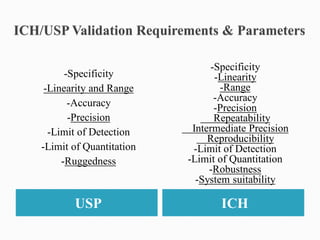
USP ICH
-Specificity
-Linearity and Range
-Accuracy
-Precision
-Limit of Detection
-Limit of Quantitation
-Ruggedness
-Specificity
-Linearity
-Range
-Accuracy
-Precision
Repeatability
Intermediate Precision
Reproducibility
-Limit of Detection
-Limit of Quantitation
-Robustness
-System suitability
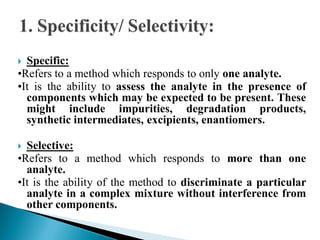
 Specific:
•Refers to a method which responds to only one analyte.
•It is the ability to assess the analyte in the presence of
components which may be expected to be present. These
might include impurities, degradation products,
synthetic intermediates, excipients, enantiomers.
 Selective:
•Refers to a method which responds to more than one
analyte.
•It is the ability of the method to discriminate a particular
analyte in a complex mixture without interference from
other components.
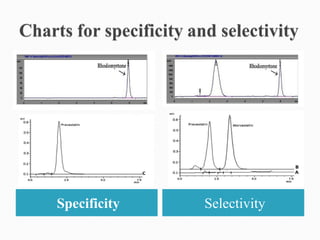
Specificity Selectivity
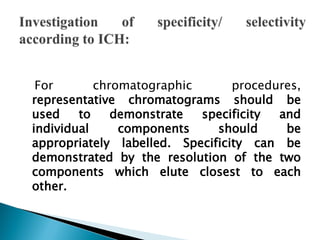
For chromatographic procedures,
representative chromatograms should be
used to demonstrate specificity and
individual components should be
appropriately labelled. Specificity can be
demonstrated by the resolution of the two
components which elute closest to each
other.
This should involve demonstration of the
discrimination of the analyte in the presence of
impurities and/or excipients; practically, this can be
done by “spiking” pure substances (drug substance or
drug product) with appropriate levels of impurities
and/or excipients and demonstrating that the assay
result is unaffected by the presence of these materials
(by comparison with the assay result obtained on
unspiked samples).
If impurity or degradation product standards are
unavailable, specificity may be demonstrated by
comparing the test results of “samples”
containing impurities or degradation products to a
second well-characterized procedure e.g.:
pharmacopoeial method or other validated
analytical procedure (independent procedure).
For the assay, the two results should be
compared.
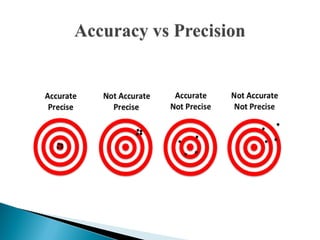
 The precision of an analytical procedure
expresses the closeness / agreement (degree of
scatter) between a series of measurements
obtained from multiple sampling of the same
homogeneous sample under the prescribed
conditions.
 Precision may be considered at three levels:
repeatability, intermediate precision and
reproducibility.
 Repeatability expresses the precision under the
same operating conditions over a short interval of
time. Repeatability is also termed intra-assay
precision .
 Repeatability should be assessed using:
 a) a minimum of 9 determinations covering the
specified range for the procedure (e.g., 3
concentrations/3 replicates each);
 or
 b) a minimum of 6 determinations at 100% of the
test concentration.
 Intermediate precision expresses within-
laboratories variations.
 Typical variations to be studied include days,
analysts, etc. It is not considered necessary to
study these effects individually.
 Reproducibility expresses the precision between
laboratories.
 Reproducibility is assessed by means of an inter-
laboratory trial.
 Reproducibility should be considered in case of
the standardization of an analytical procedure, for
instance, for inclusion of procedures in
pharmacopoeias. These data are not part of the
marketing authorization record.
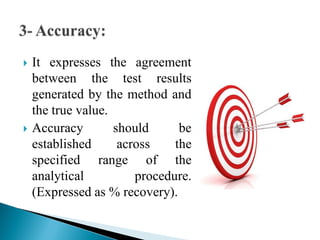
 It expresses the agreement
between the test results
generated by the method and
the true value.
 Accuracy should be
established across the
specified range of the
analytical procedure.
(Expressed as % recovery).
 The linearity of an analytical procedure is its
ability to obtain test results that are directly
proportional to the concentration of analytes in
samples within a given range.
 A linear relationship should be evaluated
across the range of the analytical procedure.
 It is demonstrated directly on the drug
substance (by dilution of a standard stock
solution)
 Linearity is determined by a series of 3 to 6 injections
of five or more standards whose concentration range
spans 80-120 % of the expected concentration.
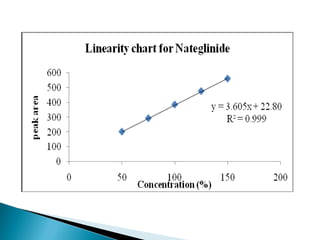
 A linear regression equation applied to the results
should have an intercept not significantly different
from zero.
 In addition to mathematical equation, Linearity is
evaluated graphically by visual inspection of a plot of
response (signal height, peak area or absorbance) as a
function of analyte concentration.
 It is the interval between the upper and lower levels that
have been demonstrated to be determined with precision,
accuracy and linearity using the method as written.
 It is normally expressed in the same units as the test
results obtained by the analytical method.
 It is established by confirming that the analytical
procedure provides an acceptable degree of linearity,
accuracy and precision when applied to samples
containing amounts of analyte within or at the extremes
of the specified range of the analytical procedure.
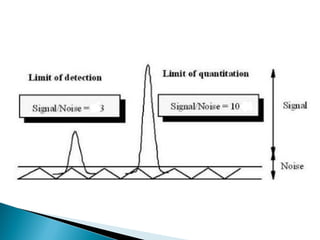
 It is the lowest concentration of the analyte that
produces a response above the noise level (i.e.
could be detected but not necessarily quantified).
 In chromatography, It is the injected amount that
results in a peak with a height at least twice or
three times as high as the baseline noise level.
Calculated by:
LOD = 3.3 σ /S
where, σ : the standard deviation of the y-
intercepts of the regression line and S : the slope
of the calibration curve.
 The slope S may be estimated from the
calibration curve of the analyte.
 It is the lowest concentration of analyte in a sample that
can be quantitatively determined with suitable precision
and accuracy.
 The quantitation limit (LOQ) may be expressed as:
LOQ = 10 σ/S
where, σ : the standard deviation of the y-intercepts of
the regression line ) and S : the slope of the calibration
curve.
 The slope S may be estimated from the calibration
curve of the analyte.
 It is the measure of the method’s capacity to remain
unaffected by small , deliberate variations in method
parameters and provides an indication of its reliability
during normal usage.
 In the case of liquid chromatography, examples of
typical variations are:
- influence of variations of pH in a mobile phase
- influence of variations in mobile phase composition
- flow rate.
 In the case of gas-chromatography, examples of typical
variations are:
- temperature
- flow rate
 It is defined by ICH as "the checking of a system,
before or during analysis of unknowns, to ensure
system performance."
System suitability testing (SST) parameters:
-Capacity factor (k’),
-Number of theoretical plates (N),
-Resolution (Rs),
-Tailing factor (T),
-Selectivity (α).
Capacity factor No of theoretical plate
resolution
Tailing factor
selectivity
Ruggedness:
It is defined in the current USP guideline as the
measure of reproducibility of test results obtained
by the analysis of the same samples under a
variety of conditions, such as different:
•laboratories;
•analysts;
•instruments;
•reagent lots;
•elapsed assay times;
•assay temperatures; and
•days.
 The use of the term ruggedness, however, is
not used by the ICH, but is certainly
addressed in guideline Q2 (R1) under
intermediate precision (within-laboratory
variations; different days, analysts, and so
forth) and reproducibility (between-
laboratory variations ).
 ICH takes system suitability as part of the
method validation parameters, whereas the
USP deals it in a separate chapter.

Validation of Analytical Procedures.pdf

  • 2.
    GMP Is a systemfor ensuring that products are consistently produced and controlled according to quality standards Quality control Is a procedure intended to ensure that a manufactured product adheres to a defined set of quality criteria
  • 3.
     The analyticalprocedure refers to the way of performing the analysis.  It should describe in detail the steps necessary to perform each analytical test.  This may include : the sample, the reference standard, the reagents preparations, use of the apparatus, generation of the calibration curve, use of the formulae for the calculation…..etc.
  • 4.
  • 5.
    What is validation? It is the process to confirm that the analytical procedure employed for a specific test is suitable for its intended use. Why we make validation ? -Identification of sources and quantitation of potential errors. -Determination if method is acceptable for intended use. -Satisfy FDA, GMP and ICH requirements.
  • 6.
     Before methodintroduction into routine use.  Whenever the environmental conditions have been changed. ex. new lab, air conditioner, reagent grade, etc..  Whenever the experimental conditions have been changed. ex. new wavelength, mobile phase ratio.
  • 7.
    1. Specificity/Selectivity. 2. Precision. 3.Accuracy. 4. Linearity. 5. Range. 6. LOD. 7. LOQ. 8. Robustness.
  • 8.
    USP ICH -Specificity -Linearity andRange -Accuracy -Precision -Limit of Detection -Limit of Quantitation -Ruggedness -Specificity -Linearity -Range -Accuracy -Precision Repeatability Intermediate Precision Reproducibility -Limit of Detection -Limit of Quantitation -Robustness -System suitability
  • 9.
     Specific: •Refers toa method which responds to only one analyte. •It is the ability to assess the analyte in the presence of components which may be expected to be present. These might include impurities, degradation products, synthetic intermediates, excipients, enantiomers.  Selective: •Refers to a method which responds to more than one analyte. •It is the ability of the method to discriminate a particular analyte in a complex mixture without interference from other components.
  • 10.
  • 11.
    For chromatographic procedures, representativechromatograms should be used to demonstrate specificity and individual components should be appropriately labelled. Specificity can be demonstrated by the resolution of the two components which elute closest to each other.
  • 12.
    This should involvedemonstration of the discrimination of the analyte in the presence of impurities and/or excipients; practically, this can be done by “spiking” pure substances (drug substance or drug product) with appropriate levels of impurities and/or excipients and demonstrating that the assay result is unaffected by the presence of these materials (by comparison with the assay result obtained on unspiked samples).
  • 13.
    If impurity ordegradation product standards are unavailable, specificity may be demonstrated by comparing the test results of “samples” containing impurities or degradation products to a second well-characterized procedure e.g.: pharmacopoeial method or other validated analytical procedure (independent procedure). For the assay, the two results should be compared.
  • 14.
     The precisionof an analytical procedure expresses the closeness / agreement (degree of scatter) between a series of measurements obtained from multiple sampling of the same homogeneous sample under the prescribed conditions.  Precision may be considered at three levels: repeatability, intermediate precision and reproducibility.
  • 15.
     Repeatability expressesthe precision under the same operating conditions over a short interval of time. Repeatability is also termed intra-assay precision .  Repeatability should be assessed using:  a) a minimum of 9 determinations covering the specified range for the procedure (e.g., 3 concentrations/3 replicates each);  or  b) a minimum of 6 determinations at 100% of the test concentration.
  • 16.
     Intermediate precisionexpresses within- laboratories variations.  Typical variations to be studied include days, analysts, etc. It is not considered necessary to study these effects individually.
  • 17.
     Reproducibility expressesthe precision between laboratories.  Reproducibility is assessed by means of an inter- laboratory trial.  Reproducibility should be considered in case of the standardization of an analytical procedure, for instance, for inclusion of procedures in pharmacopoeias. These data are not part of the marketing authorization record.
  • 18.
     It expressesthe agreement between the test results generated by the method and the true value.  Accuracy should be established across the specified range of the analytical procedure. (Expressed as % recovery).
  • 20.
     The linearityof an analytical procedure is its ability to obtain test results that are directly proportional to the concentration of analytes in samples within a given range.  A linear relationship should be evaluated across the range of the analytical procedure.  It is demonstrated directly on the drug substance (by dilution of a standard stock solution)
  • 22.
     Linearity isdetermined by a series of 3 to 6 injections of five or more standards whose concentration range spans 80-120 % of the expected concentration.  A linear regression equation applied to the results should have an intercept not significantly different from zero.  In addition to mathematical equation, Linearity is evaluated graphically by visual inspection of a plot of response (signal height, peak area or absorbance) as a function of analyte concentration.
  • 23.
     It isthe interval between the upper and lower levels that have been demonstrated to be determined with precision, accuracy and linearity using the method as written.  It is normally expressed in the same units as the test results obtained by the analytical method.  It is established by confirming that the analytical procedure provides an acceptable degree of linearity, accuracy and precision when applied to samples containing amounts of analyte within or at the extremes of the specified range of the analytical procedure.
  • 24.
     It isthe lowest concentration of the analyte that produces a response above the noise level (i.e. could be detected but not necessarily quantified).  In chromatography, It is the injected amount that results in a peak with a height at least twice or three times as high as the baseline noise level.
  • 25.
    Calculated by: LOD =3.3 σ /S where, σ : the standard deviation of the y- intercepts of the regression line and S : the slope of the calibration curve.  The slope S may be estimated from the calibration curve of the analyte.
  • 26.
     It isthe lowest concentration of analyte in a sample that can be quantitatively determined with suitable precision and accuracy.  The quantitation limit (LOQ) may be expressed as: LOQ = 10 σ/S where, σ : the standard deviation of the y-intercepts of the regression line ) and S : the slope of the calibration curve.  The slope S may be estimated from the calibration curve of the analyte.
  • 28.
     It isthe measure of the method’s capacity to remain unaffected by small , deliberate variations in method parameters and provides an indication of its reliability during normal usage.  In the case of liquid chromatography, examples of typical variations are: - influence of variations of pH in a mobile phase - influence of variations in mobile phase composition - flow rate.  In the case of gas-chromatography, examples of typical variations are: - temperature - flow rate
  • 29.
     It isdefined by ICH as "the checking of a system, before or during analysis of unknowns, to ensure system performance." System suitability testing (SST) parameters: -Capacity factor (k’), -Number of theoretical plates (N), -Resolution (Rs), -Tailing factor (T), -Selectivity (α).
  • 30.
    Capacity factor Noof theoretical plate
  • 31.
  • 32.
    Ruggedness: It is definedin the current USP guideline as the measure of reproducibility of test results obtained by the analysis of the same samples under a variety of conditions, such as different: •laboratories; •analysts; •instruments; •reagent lots; •elapsed assay times; •assay temperatures; and •days.
  • 33.
     The useof the term ruggedness, however, is not used by the ICH, but is certainly addressed in guideline Q2 (R1) under intermediate precision (within-laboratory variations; different days, analysts, and so forth) and reproducibility (between- laboratory variations ).  ICH takes system suitability as part of the method validation parameters, whereas the USP deals it in a separate chapter.