Extraction of drugs and metabolites
from biological matrices
Mahesh.M
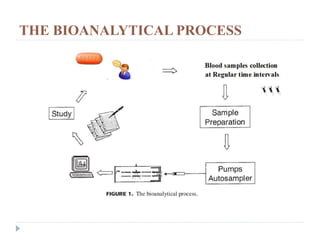
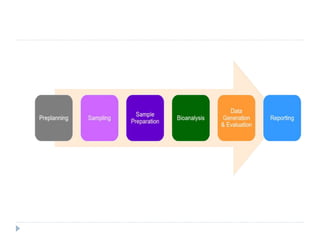
THE BIOANALYTICAL PROCESS
What is Bioanalytical
 A sub-discipline of analytical chemistry, Bioanalysis covers the
quantitative measurement of xenobiotics and biotics in a
biological system. xenobiotics means drugs and their
metabolites, and biological molecules in unnatural
locations/concentrations. biotics are macromolecules, proteins,
DNA, large molecule drugs and metabolites.
 The focus of bioanalysis in the pharmaceutical industry is to
provide a quantitative measure of the active drug and/or its
metabolite(s) for the purpose of pharmacokinetics,
toxicokinetics, bioequivalence and exposure–response.
Bioanalysis also applies to drugs used for illicit purposes,
forensic investigations, anti-doping testing in sports, and
environmental concerns.
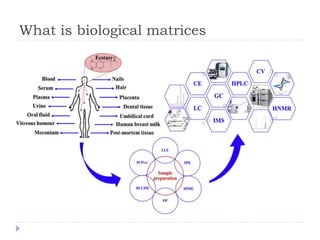
What is biological matrices
Sample Characterization
 Target molecules for bioanalysis, or analytes in chemistry
verbiage, fall into one of two broad categories – small
molecules or large molecules. Small molecules are
typically synthesized or isolated from natural sources,
have lower molecular weights, and are usually assayed
using chromatographic assays chemical entities (drugs),
metabolites, or pharmacodynamic. Large molecules
include higher molecular weight peptides, proteins,
nucleic acids, lipids, and polysaccharides, and are usually
assayed using ligand binding assays.
SAMPLE CLEANUP
Protein Removal
 Proteins and phospholipids are one of the most common
interferents found in biological samples while measuring
biomarkers, drugs, and metabolites.
 Proteins can precipitate and clog a chromatographic column if
left unremoved from these samples.
 Proteins can also bind to the small molecules of interest, which
may include the analyte, preventing an accurate measurement of
analyte concentration.
 Commonly used techniques for protein removal include protein
precipitation (PPT), liquid-liquid extraction (LLE), and solid
phase extraction (SPE).
Phospholipid Removal
 We know that there are numerous phospholipids in biological samples such
as plasma – a common type of biological sample for drug metabolism and
pharmacokinetic (DMPK) studies.
 Phospholipids are organic molecules that are found in cell membranes and
are composed of a hydrophilic head group which contains phosphate and
choline, plus a hydrophobic fatty acid chain tail.
 Phospholipids interfere with the reliability of data collected by LC-MS/MS
with electrospray ionization (ESI) because, as surfactants, phospholipids
aggregate at the surface of the droplets formed during the liquid-to-gas
transition of ions. With the phospholipids covering the surface of the
droplets, the analyte ions are less able to escape the droplet which
Suppresses/Enhances analyte detection.
 Therefore, to improve analyte detection, the removal of phospholipids before
analysis is often essential. Commonly used methods for phospholipid
removal from samples include LLE and SPE, although some phospholipids
can be removed from a sample during PPT as well.
Objectives for bioanalytical sample
preparation ........
1. Removal of unwanted matrix components (primarily protein) that would
interfere with analyte determination
2. Concentration of analyte to meet the detection limits of the analytical
instrument
3. Exchange of the solvent or solution in which the analyte resides so that it
is Compatible with mobile phase for injection into a chromatographic
system
4. Removal of selected analyte components if the resolving power of the
chromatographic column is insufficient to separate all the components
completely
5. Removal of material that could block the chromatographic tubing or foul
the interface to the detector
6. Dilution to reduce solvent strength or avoid solvent incompatibility
7. Solubilization of compounds to enable injection under the initial
chromatographic conditions
8. Stabilization of analyte to avoid hydrolytic or enzymatic degradation
Extraction Procedure
 Sample matrices for bioanalysis almost always contain
some amount of protein, along with other endogenous
macromolecules, small molecules, metabolic byproducts,
salts and possibly coadministered drugs.
 These components must be removed from the sample
before analysis in order to attain a selective technique for
the desired analytes.
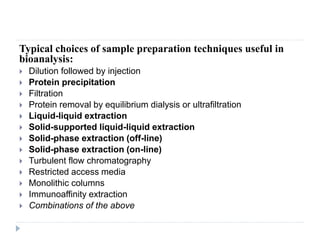
Typical choices of sample preparation techniques useful in
bioanalysis:
 Dilution followed by injection
 Protein precipitation
 Filtration
 Protein removal by equilibrium dialysis or ultrafiltration
 Liquid-liquid extraction
 Solid-supported liquid-liquid extraction
 Solid-phase extraction (off-line)
 Solid-phase extraction (on-line)
 Turbulent flow chromatography
 Restricted access media
 Monolithic columns
 Immunoaffinity extraction
 Combinations of the above
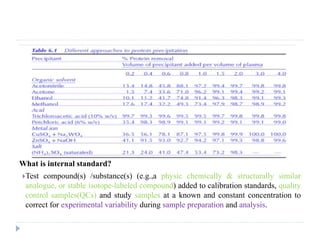
PROTEIN PRECIPITATION METHOD
 Proteins play an important role in the transport and storage of drug substances.
 Most biological matrices contain protein to varying extents. Protein binding
phenomena are known to influence drug-drug interactions in the clinical setting.
Acids Used as Precipitating Agents:
 Proteins are known to precipitate from solution when subjected to strong acids,
organic solvents and certain salts of heavy metal cations.
 The following acids (in typically used concentrations) protonate basic sites on
the protein to change its conformation, subsequently forming insoluble salts at a
pH below their isoelectric point: trichloroacetic acid (TCA; 10%, w/v),
perchloric acid
 A protein has its minimum viscosity at its isoelectric point and can be
coagulated more easily at this value
Organic Solvents Used as Precipitating Agents:
 Organic solvents are known to lower the dielectric constant & increases
electrostatic interactions of protein solutions and increase the protein-protein
interactions.
What is internal standard?
Test compound(s) /substance(s) (e.g.,a physic chemically & structurally similar
analogue, or stable isotope-labeled compound) added to calibration standards, quality
control samples(QCs) and study samples at a known and constant concentration to
correct for experimental variability during sample preparation and analysis.
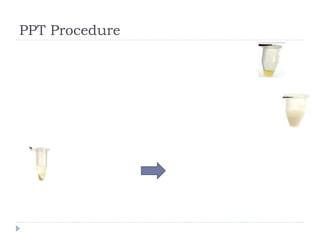
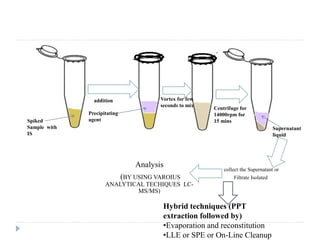
PPT Procedure
Spiked
Sample with
IS
Precipitating
agent
Vortex for few
seconds to mix
addition
Centrifuge for
14000rpm for
15 mins
Supernatant
liquid
collect the Supernatant or
Filtrate Isolated
Analysis
(BY USING VAROIUS
ANALYTICAL TECHIQUES LC-
MS/MS)
Hybrid techniques (PPT
extraction followed by)
•Evaporation and reconstitution
•LLE or SPE or On-Line Cleanup
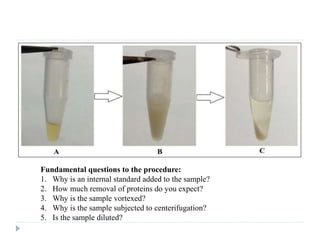
Fundamental questions to the procedure:
1. Why is an internal standard added to the sample?
2. How much removal of proteins do you expect?
3. Why is the sample vortexed?
4. Why is the sample subjected to centerifugation?
5. Is the sample diluted?
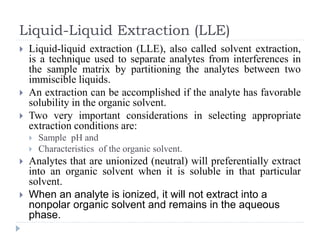
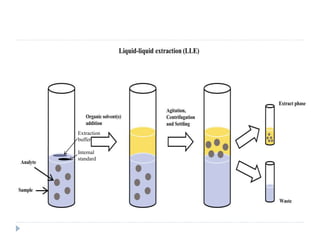
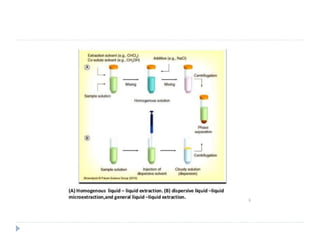
Liquid-Liquid Extraction (LLE)
 Liquid-liquid extraction (LLE), also called solvent extraction,
is a technique used to separate analytes from interferences in
the sample matrix by partitioning the analytes between two
immiscible liquids.
 An extraction can be accomplished if the analyte has favorable
solubility in the organic solvent.
 Two very important considerations in selecting appropriate
extraction conditions are:
 Sample pH and
 Characteristics of the organic solvent.
 Analytes that are unionized (neutral) will preferentially extract
into an organic solvent when it is soluble in that particular
solvent.
 When an analyte is ionized, it will not extract into a
nonpolar organic solvent and remains in the aqueous
phase.
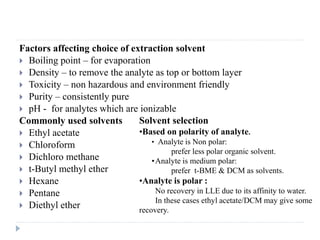
Factors affecting choice of extraction solvent
 Boiling point – for evaporation
 Density – to remove the analyte as top or bottom layer
 Toxicity – non hazardous and environment friendly
 Purity – consistently pure
 pH - for analytes which are ionizable
Commonly used solvents
 Ethyl acetate
 Chloroform
 Dichloro methane
 t-Butyl methyl ether
 Hexane
 Pentane
 Diethyl ether
Solvent selection
•Based on polarity of analyte.
• Analyte is Non polar:
prefer less polar organic solvent.
•Analyte is medium polar:
prefer t-BME & DCM as solvents.
•Analyte is polar :
No recovery in LLE due to its affinity to water.
In these cases ethyl acetate/DCM may give some
recovery.
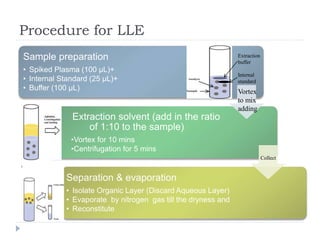
Procedure for LLE
Sample preparation
• Spiked Plasma (100 µL)+
• Internal Standard (25 µL)+
• Buffer (100 µL)
Extraction solvent (add in the ratio
of 1:10 to the sample)
•Vortex for 10 mins
•Centrifugation for 5 mins
Separation & evaporation
• Isolate Organic Layer (Discard Aqueous Layer)
• Evaporate by nitrogen gas till the dryness and
• Reconstitute
Collect
Vortex
to mix
adding
Extraction
buffer
Internal
standard
Extraction
buffer
Internal
standard
Several disadvantages exist with the liquid-liquid extraction
technique:
 It is a very labor intensive procedure because of multiple
transfer steps and the need to frequently cap and uncap
tubes
 It requires large volumes of organic solvents which can
be expensive to purchase and presents added costs for
disposal as hazardous waste
 Exposure of these solvents to personnel can present
health hazards
 The procedure has been difficult to fully automate using
traditional liquid handling instruments
 Evaporative losses may sometimes occur upon dry-down
with volatile or oxygen labile reactive analytes
 Emulsion formation is a potential problem
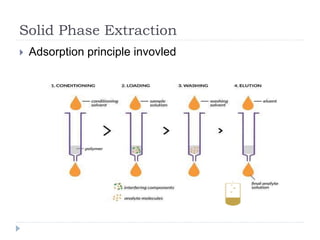
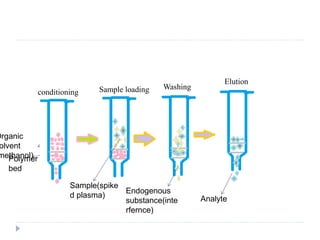
Solid Phase Extraction
 Adsorption principle invovled
conditioning Sample loading Washing
Elution
Polymer
bed
Organic
olvent
methanol)
Sample(spike
d plasma)
Endogenous
substance(inte
rfernce)
Analyte
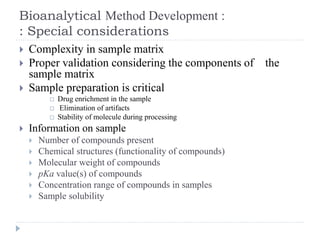
Bioanalytical Method Development :
: Special considerations
 Complexity in sample matrix
 Proper validation considering the components of the
sample matrix
 Sample preparation is critical
 Drug enrichment in the sample
 Elimination of artifacts
 Stability of molecule during processing
 Information on sample
 Number of compounds present
 Chemical structures (functionality of compounds)
 Molecular weight of compounds
 pKa value(s) of compounds
 Concentration range of compounds in samples
 Sample solubility
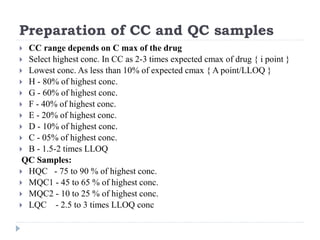
Preparation of CC and QC samples
 CC range depends on C max of the drug
 Select highest conc. In CC as 2-3 times expected cmax of drug { i point }
 Lowest conc. As less than 10% of expected cmax { A point/LLOQ }
 H - 80% of highest conc.
 G - 60% of highest conc.
 F - 40% of highest conc.
 E - 20% of highest conc.
 D - 10% of highest conc.
 C - 05% of highest conc.
 B - 1.5-2 times LLOQ
QC Samples:
 HQC - 75 to 90 % of highest conc.
 MQC1 - 45 to 65 % of highest conc.
 MQC2 - 10 to 25 % of highest conc.
 LQC - 2.5 to 3 times LLOQ conc
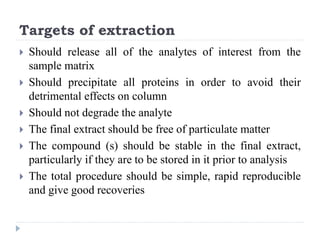
Targets of extraction
 Should release all of the analytes of interest from the
sample matrix
 Should precipitate all proteins in order to avoid their
detrimental effects on column
 Should not degrade the analyte
 The final extract should be free of particulate matter
 The compound (s) should be stable in the final extract,
particularly if they are to be stored in it prior to analysis
 The total procedure should be simple, rapid reproducible
and give good recoveries
Validation Methods
 Validation of analytical methods includes all the
procedures recommended to demonstrate that a particular
method, for a given matrix, is reliable and reproducible
 Selective and sensitive analytical methods for the
quantitative determination of drugs and their metabolites
(analytes) are critical for successful performance of PK
and bioequivalence studies
Validation Methods
1. A priori validation:
 Pre-study validation for analytical method development and method
establishment
2. Full validation
(Routine validation)
Partial validation
 Partial validations are modifications of already validated bioanalytical methods or
Modification of validated bioanalytical methods that do not necessarily call for full
revalidation. Partial validation can range from as little as one intra-assay accuracy
and precision determination to a nearly full validation. Typical bioanalytical method
changes that fall into this category include, but are not limited.
Cross validation
 Comparison of two BMs used for the same study
 Original validated bioanalytical method serves as the “reference”
 Revised BM is the “comparator”
 The comparisons should be done both ways
 Cross validation with spiked matrix and subject samples Should be conducted at
VALIDATION PARAMETERS
 System suitability
 Auto sampler carryover
 Specificity/Blank Screening
 Matrix Effect
 Anticoagulant Effect
 Linearity
 Precision
 Accuracy
 Sensitivity
 Recovery/Extraction Efficiency
 Stability
Stock Solution Stability:
 Short Term Stock Solution Stability
(STSS):
 Long Term Stock Solution Stability
(LTSS)
 Stability in Matrix
 Bench Top Stability
 Auto Sampler Stability
 Wet Extract Stability at room and
refrigerator temperature
 Dry Extract Stability
 Freeze Thaw Stability
 Long Term Stability in Matrix
 Stability of analyte in Blood
Validation methods 30
A priori validation: criteria to be validated
1. Calibration curve
2. Accuracy
3. Precision (repeatability, reproducibility)
4. Limit of quantification (LOQ)
5. Limit of detection (LOD)
6. Sensitivity
7. Specificity/selectivity
8. Stability of the analyte in the matrix under study
9. Others (ruggedness, agreement,…)
Accuracy
Closeness of determined value to the true
value.
The acceptance criteria is mean value  15%
deviation from true value.
At LOQ, 20% deviation is acceptable.
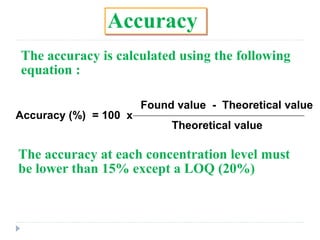
Accuracy
The accuracy is calculated using the following
equation :
Accuracy (%) = 100 x
Found value - Theoretical value
Theoretical value
The accuracy at each concentration level must
be lower than 15% except a LOQ (20%)
Accuracy
 Determination
 by replicate analysis of the sample containing known
amount of analyte
 5 samples for at least 3 levels
 The mean value should be within 15% of the actual
value except at LOQ where it should not deviate by
more than 20%
Validation methods 34
Precision
The closeness of replicate
determinations of a sample by an assay.
The acceptance criteria is  15% CV.
At LOQ, 20% deviation is acceptable.
Validation methods 35
Repeatability (r)
Agreement between successive
measurements on the same sample under
the same conditions
Reproducibility (R)
The closeness of agreement between
results
obtained with the same method under
Precision
Validation methods 36
Precision… Considered at 3 Levels
 Repeatability
 Intermediate Precision
 Reproducibility
Validation methods 37
Repeatability
 Express the precision under the same operating
conditions over a short interval of time.
 Also referred to as Intra-assay precision
 (within day)
Validation methods 38
Intermediate Precision
• Express within-laboratory variations.
• Between days variability
• Known as part of Ruggedness in
USP
Validation methods 39
Reproducibility
 Definition: Ability reproduce data within the
predefined precision
 Repeatability test at two different labs
Validation methods 40
Precision: measurement
 Should be measured using a minimum of 5
determinations per concentration
 A minimum of 3 concentrations in the range of expected
concentrations
 The precision at each concentration should not exceed
15% except for the LOQ (20%)
Validation methods 41
Precision: measurement
 for a single measurement : CV(%)
 for intra-day and inter-day precision
 ANOVA
Validation methods
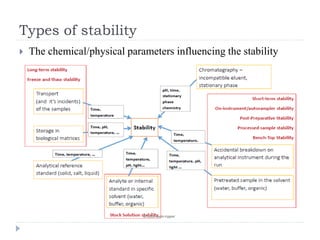
Types of stability
 The chemical/physical parameters influencing the stability
bioanalytical extraction methods and validation parameters.pptx

bioanalytical extraction methods and validation parameters.pptx

  • 1.
    Extraction of drugsand metabolites from biological matrices Mahesh.M
  • 2.
  • 3.
    What is Bioanalytical A sub-discipline of analytical chemistry, Bioanalysis covers the quantitative measurement of xenobiotics and biotics in a biological system. xenobiotics means drugs and their metabolites, and biological molecules in unnatural locations/concentrations. biotics are macromolecules, proteins, DNA, large molecule drugs and metabolites.  The focus of bioanalysis in the pharmaceutical industry is to provide a quantitative measure of the active drug and/or its metabolite(s) for the purpose of pharmacokinetics, toxicokinetics, bioequivalence and exposure–response. Bioanalysis also applies to drugs used for illicit purposes, forensic investigations, anti-doping testing in sports, and environmental concerns.
  • 4.
  • 5.
    Sample Characterization  Targetmolecules for bioanalysis, or analytes in chemistry verbiage, fall into one of two broad categories – small molecules or large molecules. Small molecules are typically synthesized or isolated from natural sources, have lower molecular weights, and are usually assayed using chromatographic assays chemical entities (drugs), metabolites, or pharmacodynamic. Large molecules include higher molecular weight peptides, proteins, nucleic acids, lipids, and polysaccharides, and are usually assayed using ligand binding assays.
  • 6.
    SAMPLE CLEANUP Protein Removal Proteins and phospholipids are one of the most common interferents found in biological samples while measuring biomarkers, drugs, and metabolites.  Proteins can precipitate and clog a chromatographic column if left unremoved from these samples.  Proteins can also bind to the small molecules of interest, which may include the analyte, preventing an accurate measurement of analyte concentration.  Commonly used techniques for protein removal include protein precipitation (PPT), liquid-liquid extraction (LLE), and solid phase extraction (SPE).
  • 7.
    Phospholipid Removal  Weknow that there are numerous phospholipids in biological samples such as plasma – a common type of biological sample for drug metabolism and pharmacokinetic (DMPK) studies.  Phospholipids are organic molecules that are found in cell membranes and are composed of a hydrophilic head group which contains phosphate and choline, plus a hydrophobic fatty acid chain tail.  Phospholipids interfere with the reliability of data collected by LC-MS/MS with electrospray ionization (ESI) because, as surfactants, phospholipids aggregate at the surface of the droplets formed during the liquid-to-gas transition of ions. With the phospholipids covering the surface of the droplets, the analyte ions are less able to escape the droplet which Suppresses/Enhances analyte detection.  Therefore, to improve analyte detection, the removal of phospholipids before analysis is often essential. Commonly used methods for phospholipid removal from samples include LLE and SPE, although some phospholipids can be removed from a sample during PPT as well.
  • 8.
    Objectives for bioanalyticalsample preparation ........ 1. Removal of unwanted matrix components (primarily protein) that would interfere with analyte determination 2. Concentration of analyte to meet the detection limits of the analytical instrument 3. Exchange of the solvent or solution in which the analyte resides so that it is Compatible with mobile phase for injection into a chromatographic system 4. Removal of selected analyte components if the resolving power of the chromatographic column is insufficient to separate all the components completely 5. Removal of material that could block the chromatographic tubing or foul the interface to the detector 6. Dilution to reduce solvent strength or avoid solvent incompatibility 7. Solubilization of compounds to enable injection under the initial chromatographic conditions 8. Stabilization of analyte to avoid hydrolytic or enzymatic degradation
  • 9.
    Extraction Procedure  Samplematrices for bioanalysis almost always contain some amount of protein, along with other endogenous macromolecules, small molecules, metabolic byproducts, salts and possibly coadministered drugs.  These components must be removed from the sample before analysis in order to attain a selective technique for the desired analytes.
  • 10.
    Typical choices ofsample preparation techniques useful in bioanalysis:  Dilution followed by injection  Protein precipitation  Filtration  Protein removal by equilibrium dialysis or ultrafiltration  Liquid-liquid extraction  Solid-supported liquid-liquid extraction  Solid-phase extraction (off-line)  Solid-phase extraction (on-line)  Turbulent flow chromatography  Restricted access media  Monolithic columns  Immunoaffinity extraction  Combinations of the above
  • 11.
    PROTEIN PRECIPITATION METHOD Proteins play an important role in the transport and storage of drug substances.  Most biological matrices contain protein to varying extents. Protein binding phenomena are known to influence drug-drug interactions in the clinical setting. Acids Used as Precipitating Agents:  Proteins are known to precipitate from solution when subjected to strong acids, organic solvents and certain salts of heavy metal cations.  The following acids (in typically used concentrations) protonate basic sites on the protein to change its conformation, subsequently forming insoluble salts at a pH below their isoelectric point: trichloroacetic acid (TCA; 10%, w/v), perchloric acid  A protein has its minimum viscosity at its isoelectric point and can be coagulated more easily at this value Organic Solvents Used as Precipitating Agents:  Organic solvents are known to lower the dielectric constant & increases electrostatic interactions of protein solutions and increase the protein-protein interactions.
  • 12.
    What is internalstandard? Test compound(s) /substance(s) (e.g.,a physic chemically & structurally similar analogue, or stable isotope-labeled compound) added to calibration standards, quality control samples(QCs) and study samples at a known and constant concentration to correct for experimental variability during sample preparation and analysis.
  • 13.
  • 14.
    Spiked Sample with IS Precipitating agent Vortex forfew seconds to mix addition Centrifuge for 14000rpm for 15 mins Supernatant liquid collect the Supernatant or Filtrate Isolated Analysis (BY USING VAROIUS ANALYTICAL TECHIQUES LC- MS/MS) Hybrid techniques (PPT extraction followed by) •Evaporation and reconstitution •LLE or SPE or On-Line Cleanup
  • 15.
    Fundamental questions tothe procedure: 1. Why is an internal standard added to the sample? 2. How much removal of proteins do you expect? 3. Why is the sample vortexed? 4. Why is the sample subjected to centerifugation? 5. Is the sample diluted?
  • 16.
    Liquid-Liquid Extraction (LLE) Liquid-liquid extraction (LLE), also called solvent extraction, is a technique used to separate analytes from interferences in the sample matrix by partitioning the analytes between two immiscible liquids.  An extraction can be accomplished if the analyte has favorable solubility in the organic solvent.  Two very important considerations in selecting appropriate extraction conditions are:  Sample pH and  Characteristics of the organic solvent.  Analytes that are unionized (neutral) will preferentially extract into an organic solvent when it is soluble in that particular solvent.  When an analyte is ionized, it will not extract into a nonpolar organic solvent and remains in the aqueous phase.
  • 17.
    Factors affecting choiceof extraction solvent  Boiling point – for evaporation  Density – to remove the analyte as top or bottom layer  Toxicity – non hazardous and environment friendly  Purity – consistently pure  pH - for analytes which are ionizable Commonly used solvents  Ethyl acetate  Chloroform  Dichloro methane  t-Butyl methyl ether  Hexane  Pentane  Diethyl ether Solvent selection •Based on polarity of analyte. • Analyte is Non polar: prefer less polar organic solvent. •Analyte is medium polar: prefer t-BME & DCM as solvents. •Analyte is polar : No recovery in LLE due to its affinity to water. In these cases ethyl acetate/DCM may give some recovery.
  • 18.
    Procedure for LLE Samplepreparation • Spiked Plasma (100 µL)+ • Internal Standard (25 µL)+ • Buffer (100 µL) Extraction solvent (add in the ratio of 1:10 to the sample) •Vortex for 10 mins •Centrifugation for 5 mins Separation & evaporation • Isolate Organic Layer (Discard Aqueous Layer) • Evaporate by nitrogen gas till the dryness and • Reconstitute Collect Vortex to mix adding Extraction buffer Internal standard
  • 19.
  • 20.
    Several disadvantages existwith the liquid-liquid extraction technique:  It is a very labor intensive procedure because of multiple transfer steps and the need to frequently cap and uncap tubes  It requires large volumes of organic solvents which can be expensive to purchase and presents added costs for disposal as hazardous waste  Exposure of these solvents to personnel can present health hazards  The procedure has been difficult to fully automate using traditional liquid handling instruments  Evaporative losses may sometimes occur upon dry-down with volatile or oxygen labile reactive analytes  Emulsion formation is a potential problem
  • 21.
    Solid Phase Extraction Adsorption principle invovled
  • 22.
    conditioning Sample loadingWashing Elution Polymer bed Organic olvent methanol) Sample(spike d plasma) Endogenous substance(inte rfernce) Analyte
  • 24.
    Bioanalytical Method Development: : Special considerations  Complexity in sample matrix  Proper validation considering the components of the sample matrix  Sample preparation is critical  Drug enrichment in the sample  Elimination of artifacts  Stability of molecule during processing  Information on sample  Number of compounds present  Chemical structures (functionality of compounds)  Molecular weight of compounds  pKa value(s) of compounds  Concentration range of compounds in samples  Sample solubility
  • 25.
    Preparation of CCand QC samples  CC range depends on C max of the drug  Select highest conc. In CC as 2-3 times expected cmax of drug { i point }  Lowest conc. As less than 10% of expected cmax { A point/LLOQ }  H - 80% of highest conc.  G - 60% of highest conc.  F - 40% of highest conc.  E - 20% of highest conc.  D - 10% of highest conc.  C - 05% of highest conc.  B - 1.5-2 times LLOQ QC Samples:  HQC - 75 to 90 % of highest conc.  MQC1 - 45 to 65 % of highest conc.  MQC2 - 10 to 25 % of highest conc.  LQC - 2.5 to 3 times LLOQ conc
  • 26.
    Targets of extraction Should release all of the analytes of interest from the sample matrix  Should precipitate all proteins in order to avoid their detrimental effects on column  Should not degrade the analyte  The final extract should be free of particulate matter  The compound (s) should be stable in the final extract, particularly if they are to be stored in it prior to analysis  The total procedure should be simple, rapid reproducible and give good recoveries
  • 27.
    Validation Methods  Validationof analytical methods includes all the procedures recommended to demonstrate that a particular method, for a given matrix, is reliable and reproducible  Selective and sensitive analytical methods for the quantitative determination of drugs and their metabolites (analytes) are critical for successful performance of PK and bioequivalence studies
  • 28.
    Validation Methods 1. Apriori validation:  Pre-study validation for analytical method development and method establishment 2. Full validation (Routine validation) Partial validation  Partial validations are modifications of already validated bioanalytical methods or Modification of validated bioanalytical methods that do not necessarily call for full revalidation. Partial validation can range from as little as one intra-assay accuracy and precision determination to a nearly full validation. Typical bioanalytical method changes that fall into this category include, but are not limited. Cross validation  Comparison of two BMs used for the same study  Original validated bioanalytical method serves as the “reference”  Revised BM is the “comparator”  The comparisons should be done both ways  Cross validation with spiked matrix and subject samples Should be conducted at
  • 29.
    VALIDATION PARAMETERS  Systemsuitability  Auto sampler carryover  Specificity/Blank Screening  Matrix Effect  Anticoagulant Effect  Linearity  Precision  Accuracy  Sensitivity  Recovery/Extraction Efficiency  Stability Stock Solution Stability:  Short Term Stock Solution Stability (STSS):  Long Term Stock Solution Stability (LTSS)  Stability in Matrix  Bench Top Stability  Auto Sampler Stability  Wet Extract Stability at room and refrigerator temperature  Dry Extract Stability  Freeze Thaw Stability  Long Term Stability in Matrix  Stability of analyte in Blood
  • 30.
    Validation methods 30 Apriori validation: criteria to be validated 1. Calibration curve 2. Accuracy 3. Precision (repeatability, reproducibility) 4. Limit of quantification (LOQ) 5. Limit of detection (LOD) 6. Sensitivity 7. Specificity/selectivity 8. Stability of the analyte in the matrix under study 9. Others (ruggedness, agreement,…)
  • 31.
    Accuracy Closeness of determinedvalue to the true value. The acceptance criteria is mean value  15% deviation from true value. At LOQ, 20% deviation is acceptable.
  • 32.
    Accuracy The accuracy iscalculated using the following equation : Accuracy (%) = 100 x Found value - Theoretical value Theoretical value The accuracy at each concentration level must be lower than 15% except a LOQ (20%)
  • 33.
    Accuracy  Determination  byreplicate analysis of the sample containing known amount of analyte  5 samples for at least 3 levels  The mean value should be within 15% of the actual value except at LOQ where it should not deviate by more than 20%
  • 34.
    Validation methods 34 Precision Thecloseness of replicate determinations of a sample by an assay. The acceptance criteria is  15% CV. At LOQ, 20% deviation is acceptable.
  • 35.
    Validation methods 35 Repeatability(r) Agreement between successive measurements on the same sample under the same conditions Reproducibility (R) The closeness of agreement between results obtained with the same method under Precision
  • 36.
    Validation methods 36 Precision…Considered at 3 Levels  Repeatability  Intermediate Precision  Reproducibility
  • 37.
    Validation methods 37 Repeatability Express the precision under the same operating conditions over a short interval of time.  Also referred to as Intra-assay precision  (within day)
  • 38.
    Validation methods 38 IntermediatePrecision • Express within-laboratory variations. • Between days variability • Known as part of Ruggedness in USP
  • 39.
    Validation methods 39 Reproducibility Definition: Ability reproduce data within the predefined precision  Repeatability test at two different labs
  • 40.
    Validation methods 40 Precision:measurement  Should be measured using a minimum of 5 determinations per concentration  A minimum of 3 concentrations in the range of expected concentrations  The precision at each concentration should not exceed 15% except for the LOQ (20%)
  • 41.
    Validation methods 41 Precision:measurement  for a single measurement : CV(%)  for intra-day and inter-day precision  ANOVA
  • 42.
  • 46.
    Types of stability The chemical/physical parameters influencing the stability