X
Lesson 5
Lesson 6
Lesson 7
X
X
You should be able to:
1. define receptors and effectors.
2. describe the relationship between the
receptor, the central nervous system
and the effector.
3
X
Our survival depends on us being sensitive to
our surroundings - i.e. to be able to detect any
changes both externally and internally and be
able to respond to them in appropriate ways so
that we maintain homeostasis.
We do that through our nervous system.
4
X
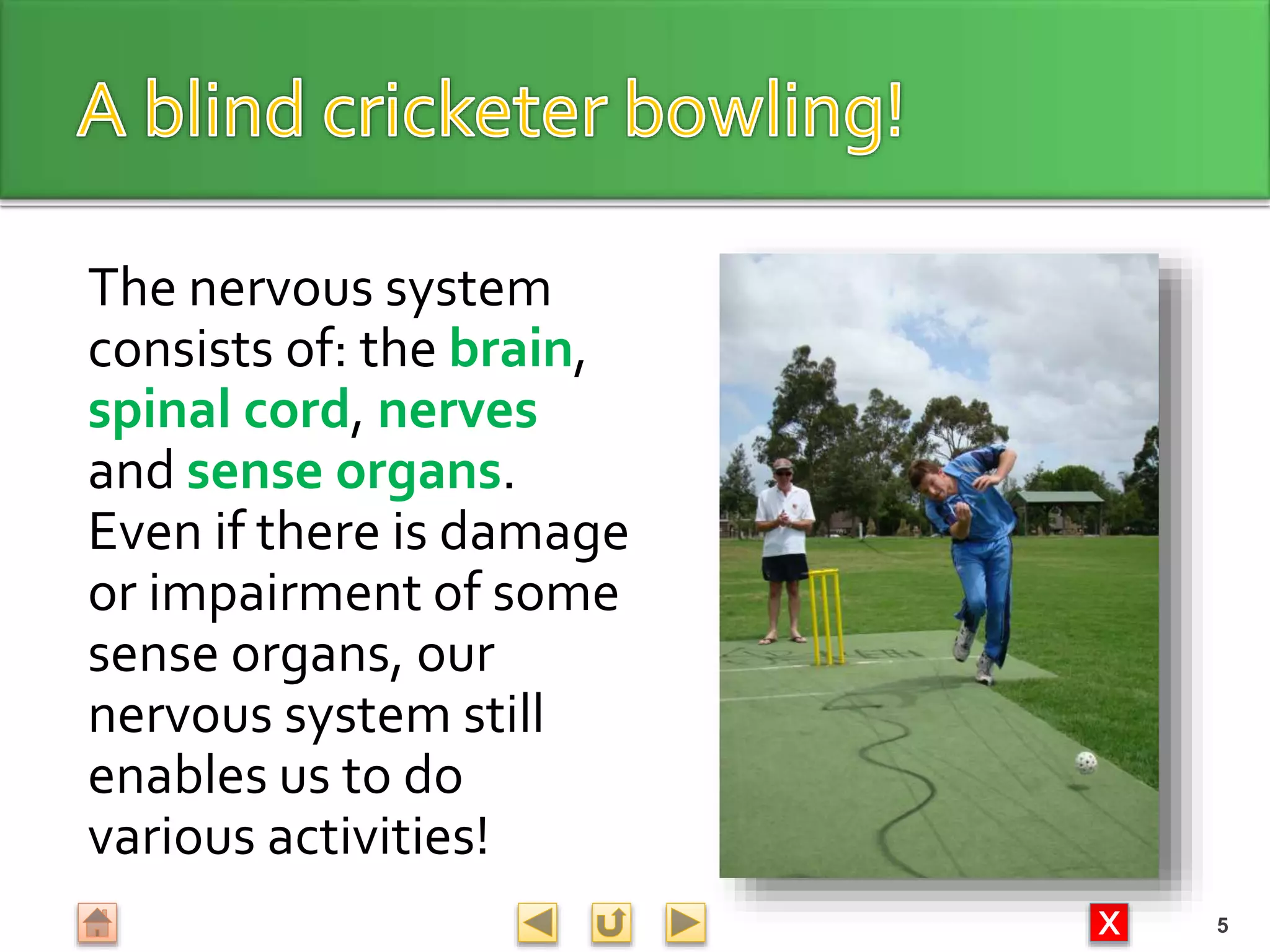
The nervous system
consists of: the brain,
spinal cord, nerves
and sense organs.
Even if there is damage
or impairment of some
sense organs, our
nervous system still
enables us to do
various activities!
5
X
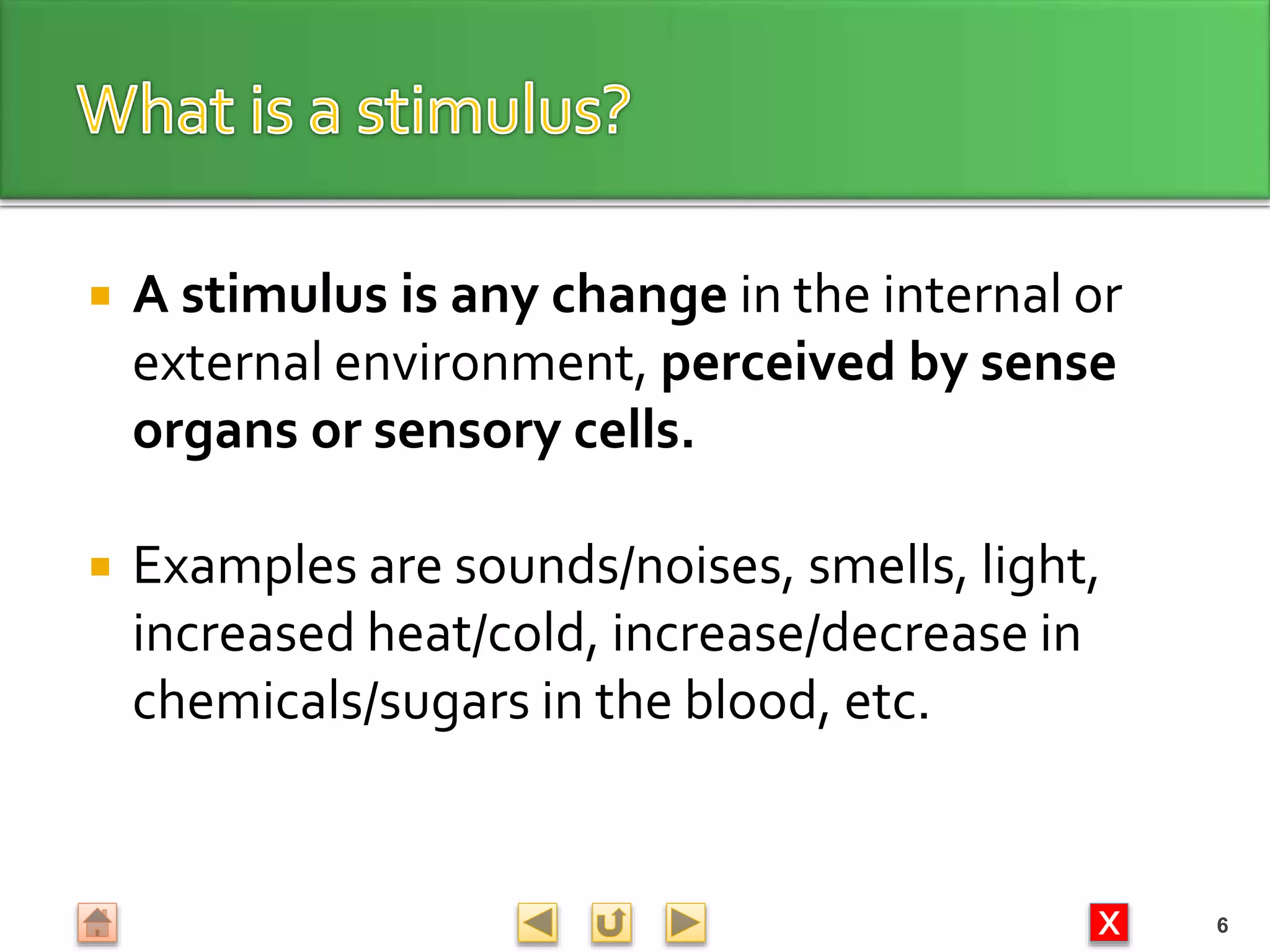
 A stimulus is any change in the internal or
external environment, perceived by sense
organs or sensory cells.
 Examples are sounds/noises, smells, light,
increased heat/cold, increase/decrease in
chemicals/sugars in the blood, etc.
6
X
 Response is the change in behaviour of an
organism, because of a stimulus.
 In animals, responses can be learned or are
in-born/innate, and are carried out by
muscles (so involve movement) or glands.
 A response can also be in the form of growth
of specific body parts, e.g. breathing roots
that grow in mangroves.
 Responses usually ensure homeostasis and
are important for survival.
7
X
 You have the ability to receive external stimuli
via receptors in four sense organs (of sight,
hearing, smell, and taste) located in specific
parts of your body, but, your sense of touch is
found all over.
 Your internal organs also have sensory nerve
endings with their sensory receptors which
receive stimuli from your internal environment -
e.g. about concentration of chemicals,
temperature.
8
X
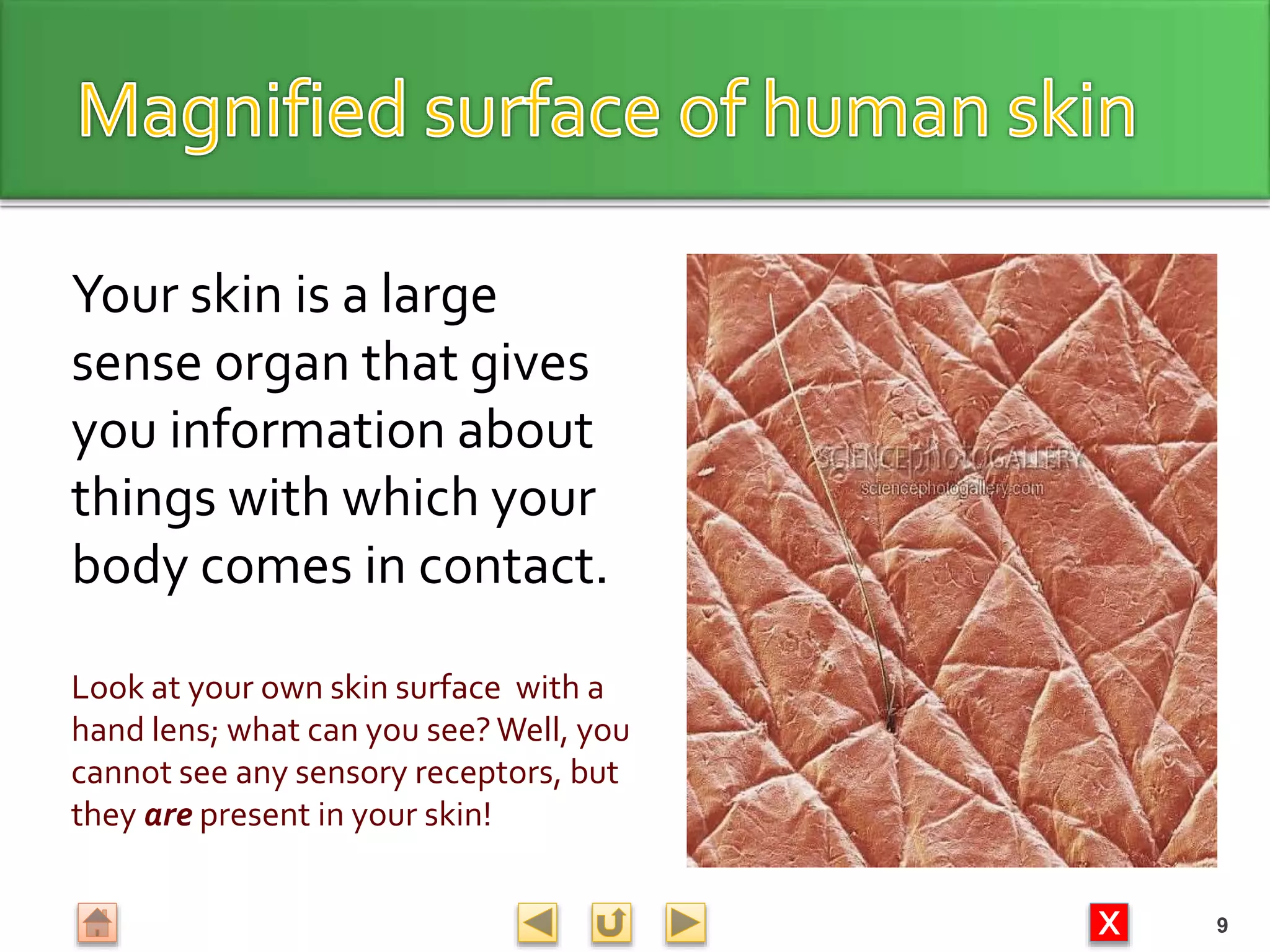
Your skin is a large
sense organ that gives
you information about
things with which your
body comes in contact.
Look at your own skin surface with a
hand lens; what can you see?Well, you
cannot see any sensory receptors, but
they are present in your skin!
9
X
 Your body has different types of nerve endings
scattered throughout your skin, many with
receptors at the endings, that all receive stimuli
from outside.
 The most common receptors in skin are: touch
or pressure, pain, heat and cold. Look at them
in the diagram in the next slide.
 Pain receptors are probably the most important
for your safety because they can protect you by
sending impulses to your brain that your body is
hurt!
10
X 11
Dermis
X
 How do these receptors in your skin relate to
other parts of your nervous system?Watch
the video at the website below:
http://health.howstuffworks.com/adam-
200012.htm
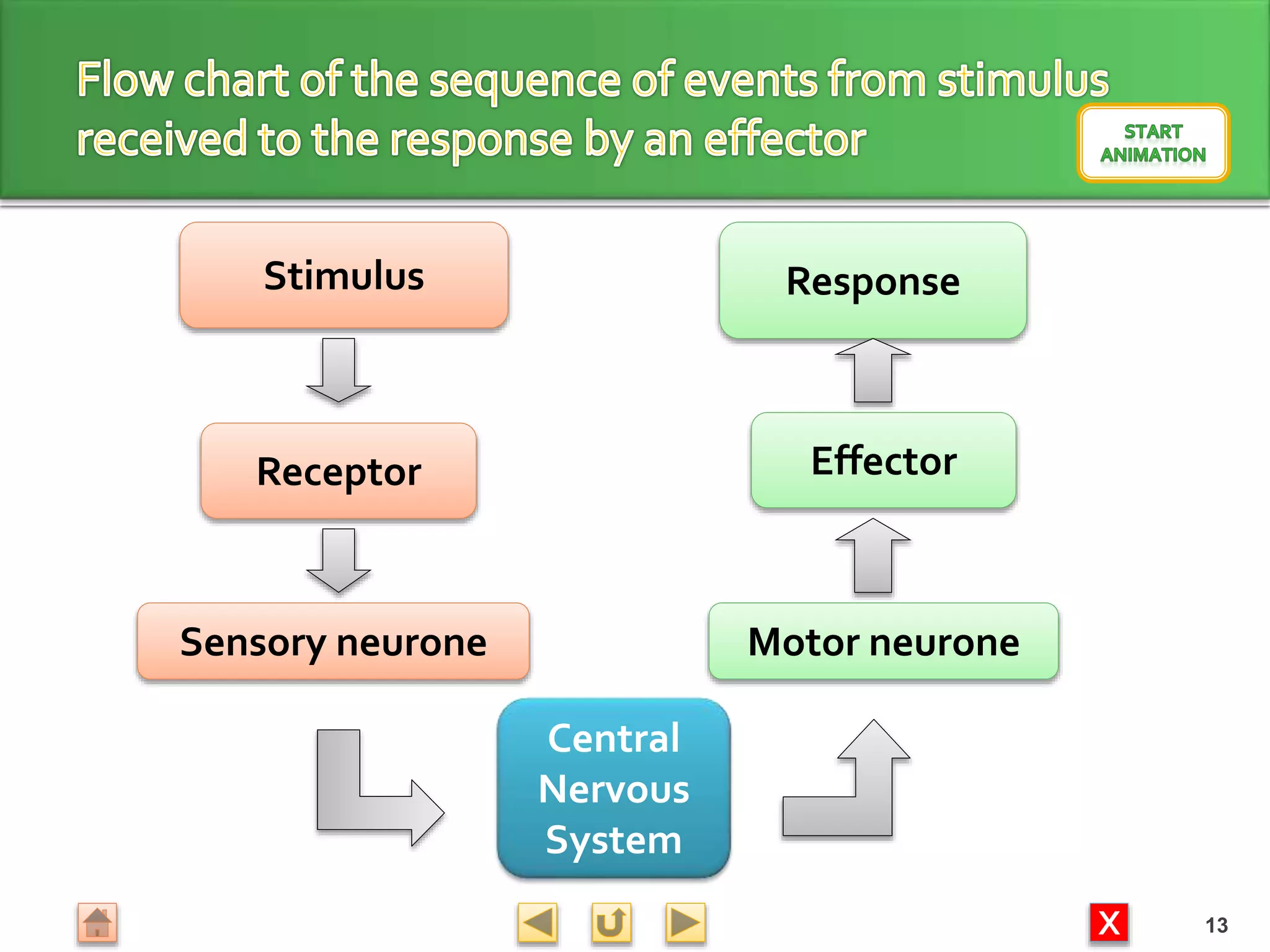
 View the next slide which shows a flow chart
of the sequence of events from stimulus
received to the response by an effector.Talk
about it with your teacher.
12
X
Stimulus
Receptor
Sensory neurone
Central
Nervous
System
Motor neurone
Effector
Response
13
X
 Our sense organs contain special receptor cells which will
detect a change in our external/internal environment (a
stimulus)
 The receptor cells will change the stimulus into an electrical
impulse which is passed along nerve cells
 The message will usually go to the brain, and sometimes to
the spinal cord, which will then process and interpret it
 The brain/spinal cord then sends an electrical message along
nerve cells to an effector organ (usually a muscle or a gland)
 The effector organ will then give a response (e.g. a muscle
will move, or a gland will produce a hormone)
14
X 15
X
Review the pictures on the previous slide.
 What emotions are the dancers feeling?
 Are the babies happy or sad?
 How hard are the respiratory organs and muscles of
the ball players responding? Perhaps their hearts
are beating faster than usual?Their eyes opened
wider?Their breathing is deeper and faster?
 What digestive juices are flowing in the little boy’s
body as he eats his apple?
The Nervous system controls all of these!
16
X
You should be able to:
1. describe the parts of the central
nervous system.
2. list the main function/s that each part
performs.
17
X
 The nervous system consists of: the brain, spinal
cord, nerves and sense organs.
 Central nervous system = brain and brain stem and
the spinal cord;
 Peripheral nervous system = all nerves off the brain
(cranial nerves), nerves coming off the spinal cord
(spinal nerves) and sense organs.
Talk with your teacher about the organizational flow
chart in the next slide.
18
X 19
X
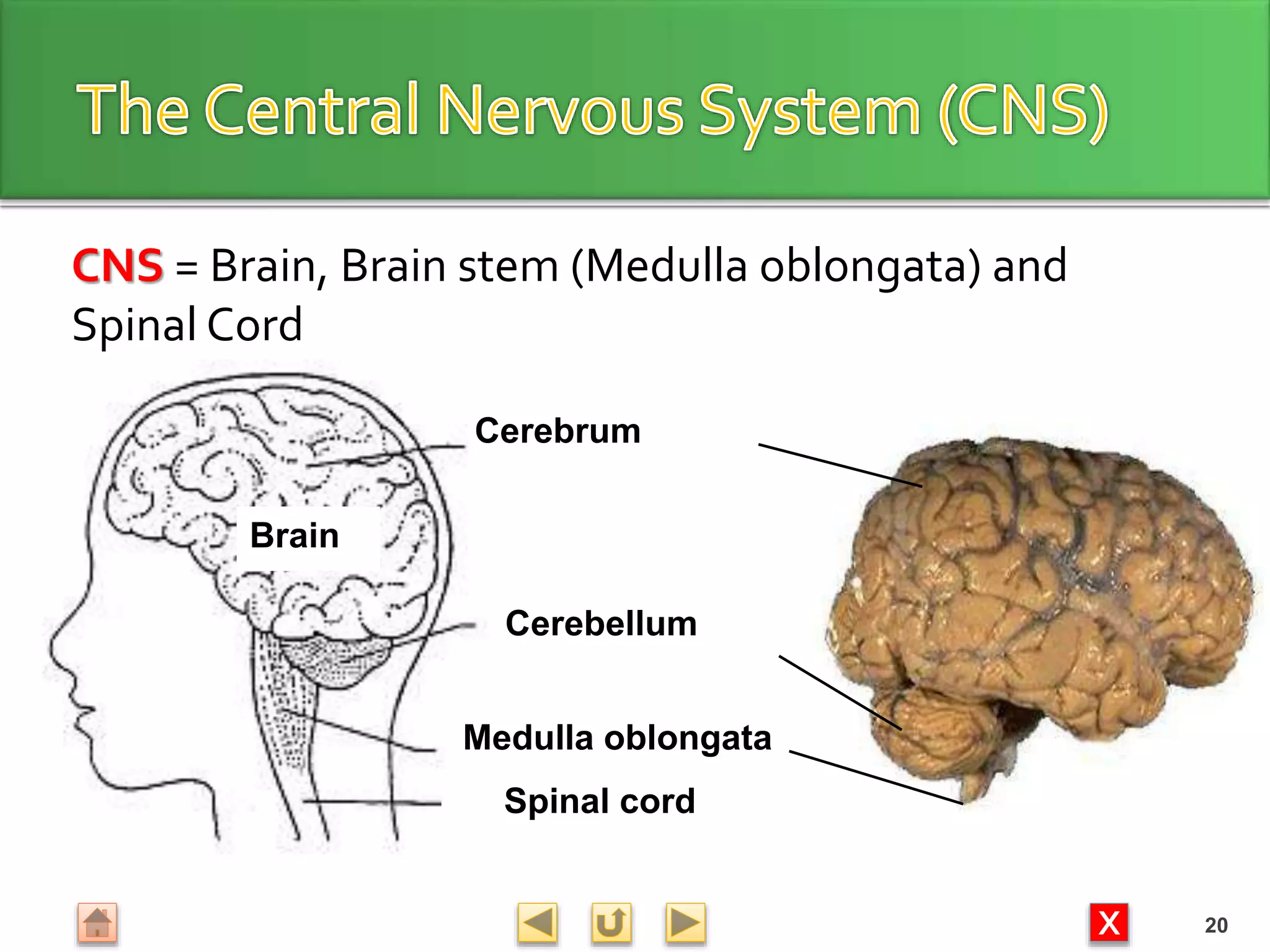
Brain
Spinal cord
Cerebellum
Cerebrum
Medulla oblongata
CNS = Brain, Brain stem (Medulla oblongata) and
Spinal Cord
20
X
The brain is the centre of the nervous system, like the
microprocessor in a computer.
 The Cerebrum is the biggest and heaviest part. It is
the ‘thinking part’ of the brain controlling voluntary
or conscious activities such as learning, judgment
etc.
 The Cerebellum is at the back of the brain below
the cerebrum; controls balance, movement and co-
ordination.
21
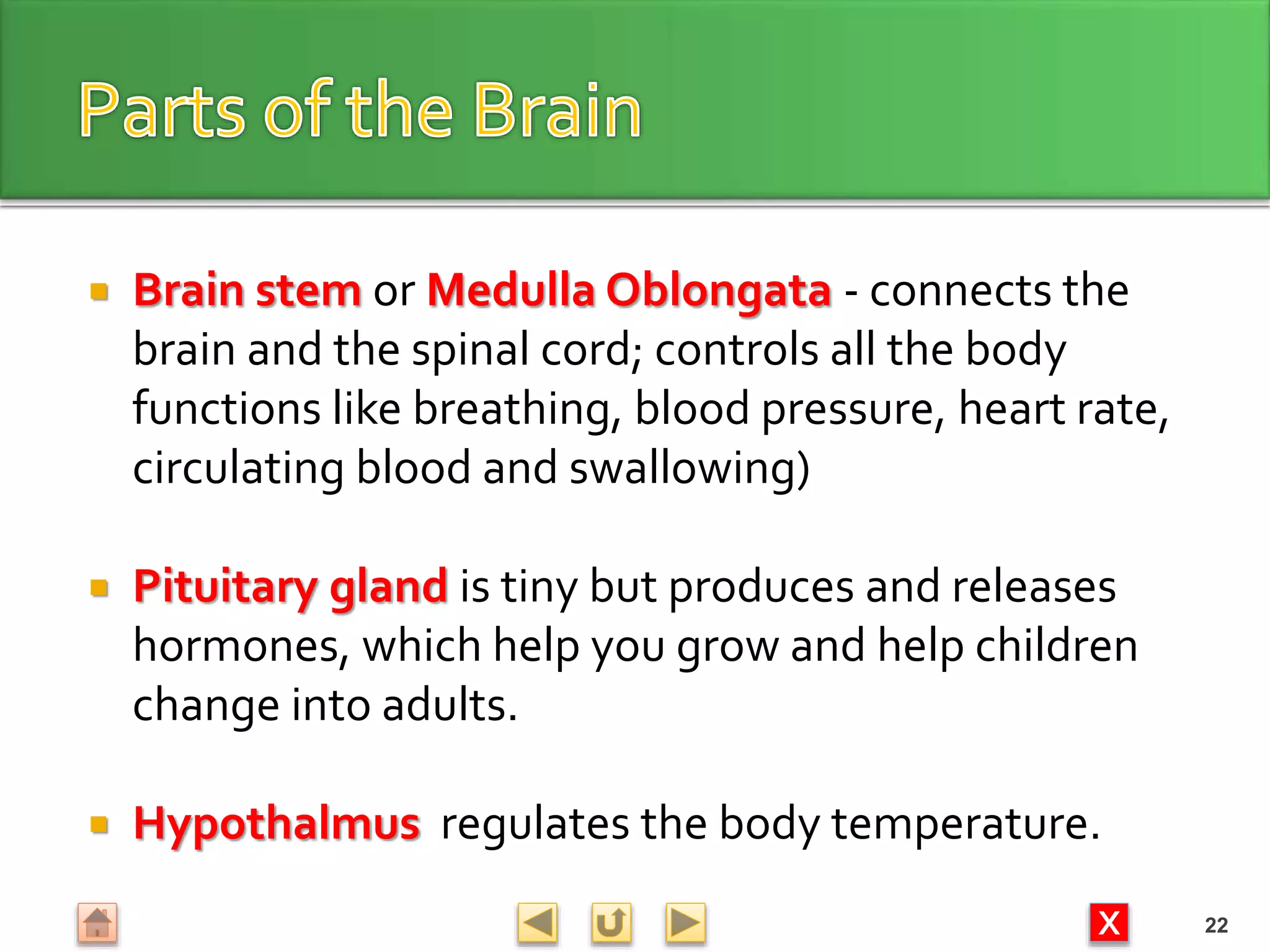
X
 Brain stem or Medulla Oblongata - connects the
brain and the spinal cord; controls all the body
functions like breathing, blood pressure, heart rate,
circulating blood and swallowing)
 Pituitary gland is tiny but produces and releases
hormones, which help you grow and help children
change into adults.
 Hypothalmus regulates the body temperature.
22
X
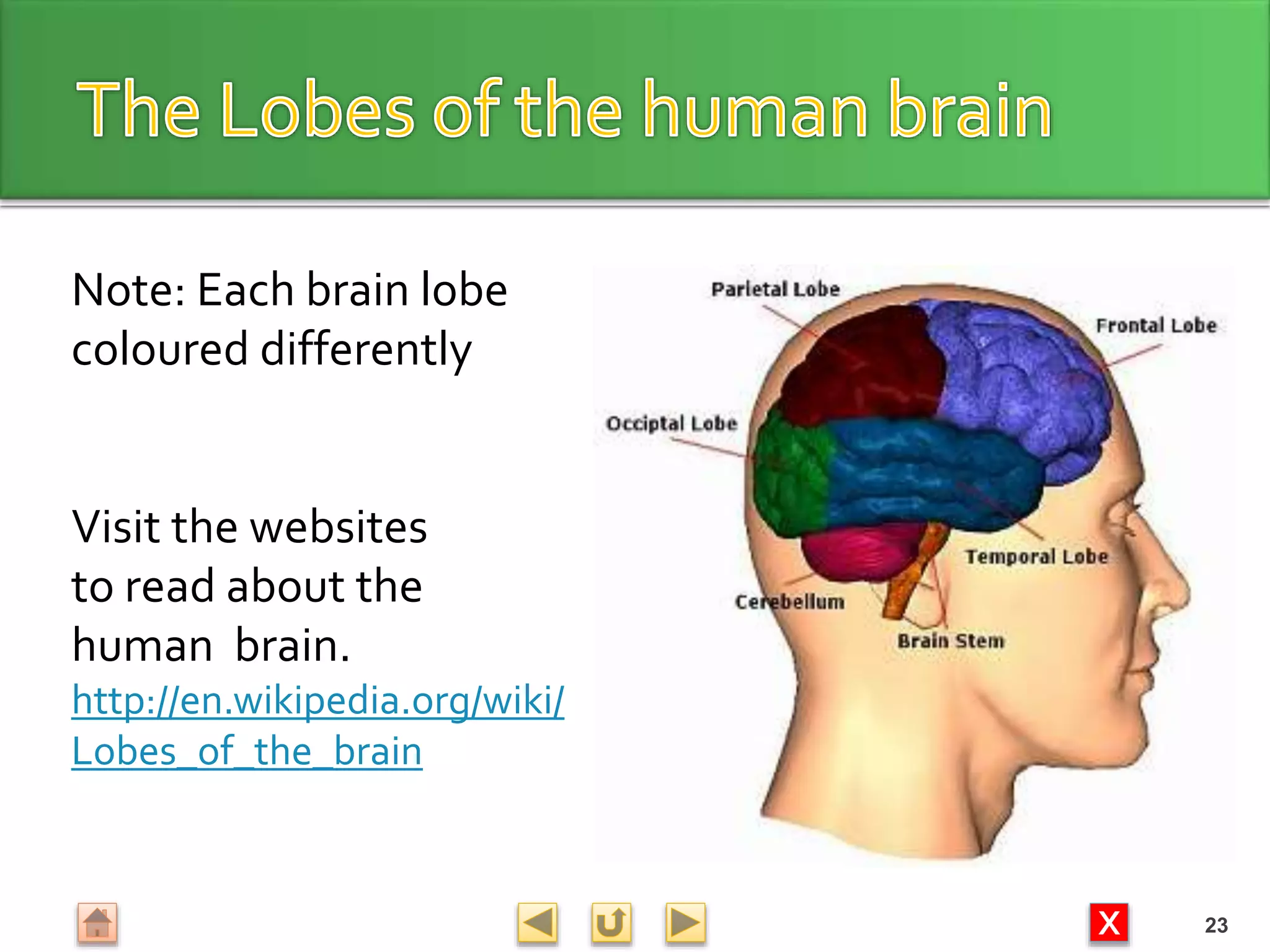
Note: Each brain lobe
coloured differently
Visit the websites
to read about the
human brain.
http://en.wikipedia.org/wiki/
Lobes_of_the_brain
23
X
 Frontal lobe - conscious thought; damage can
result in mood changes
 Parietal lobe - plays important roles in
integrating sensory information from various
senses, and in the manipulation of objects;
portions of the parietal lobe are involved with
visuo-spatial processing
 Occipital lobe - sense of sight; lesions can
produce hallucinations
 Temporal lobe - senses of smell and sound, as
well as processing of complex stimuli like faces
and scenes.
24
X
 Sense organs receive external and internal
stimuli so they act as receptors. Each type of
receptor is sensitive to only one type of
stimulus.
 When a receptor is stimulated, it generates
nerve impulses that are transmitted to the
spinal cord and/or the brain, but we are
conscious of a sensation only if the impulses
reach the cerebrum.
25
X 26
X
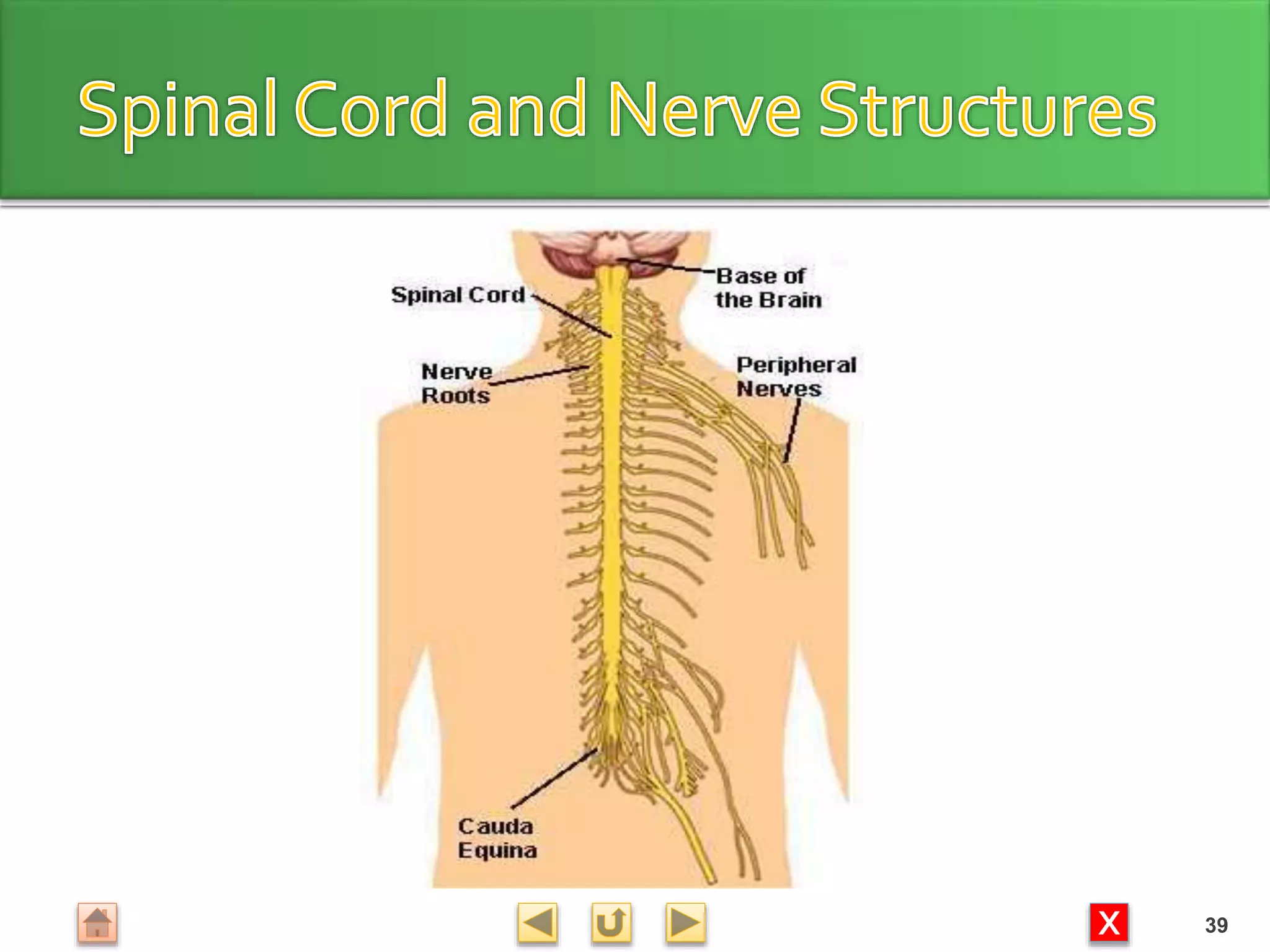
The spinal cord is a bundle
of nerve tissues. It is protected
by a series of doughnut-shaped
bones called vertebrae
which surround it.
It is about 43 - 45 cm long
and approximately as wide
as a human finger.
About 13,500,000 neurons
transmit their electro-chemical
signals through the spinal cord.
27
X
 Serve as a conduit for sensory information,
which travels up the spinal cord.
 Serve as a conduit for motor information,
which travels down the spinal cord.
 Serve as a centre for coordinating certain
reflexes.
http://en.wikipedia.org/wiki/Spinal_cord
28
X 29
X
You should be able to:
1. describe the parts of the peripheral
nervous system.
2. list the main function/s that each part
performs.
30
X
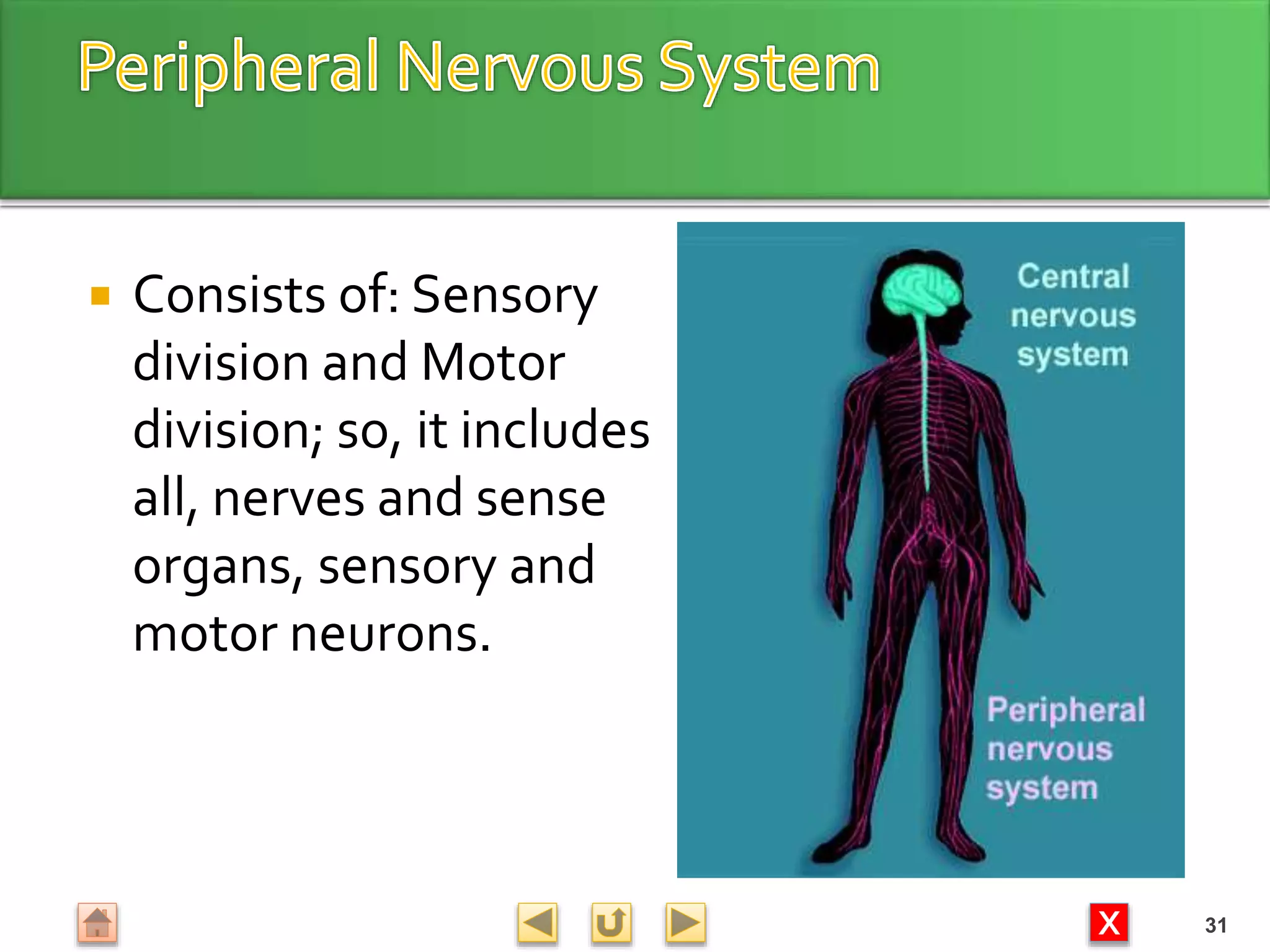
 Consists of: Sensory
division and Motor
division; so, it includes
all, nerves and sense
organs, sensory and
motor neurons.
31
X
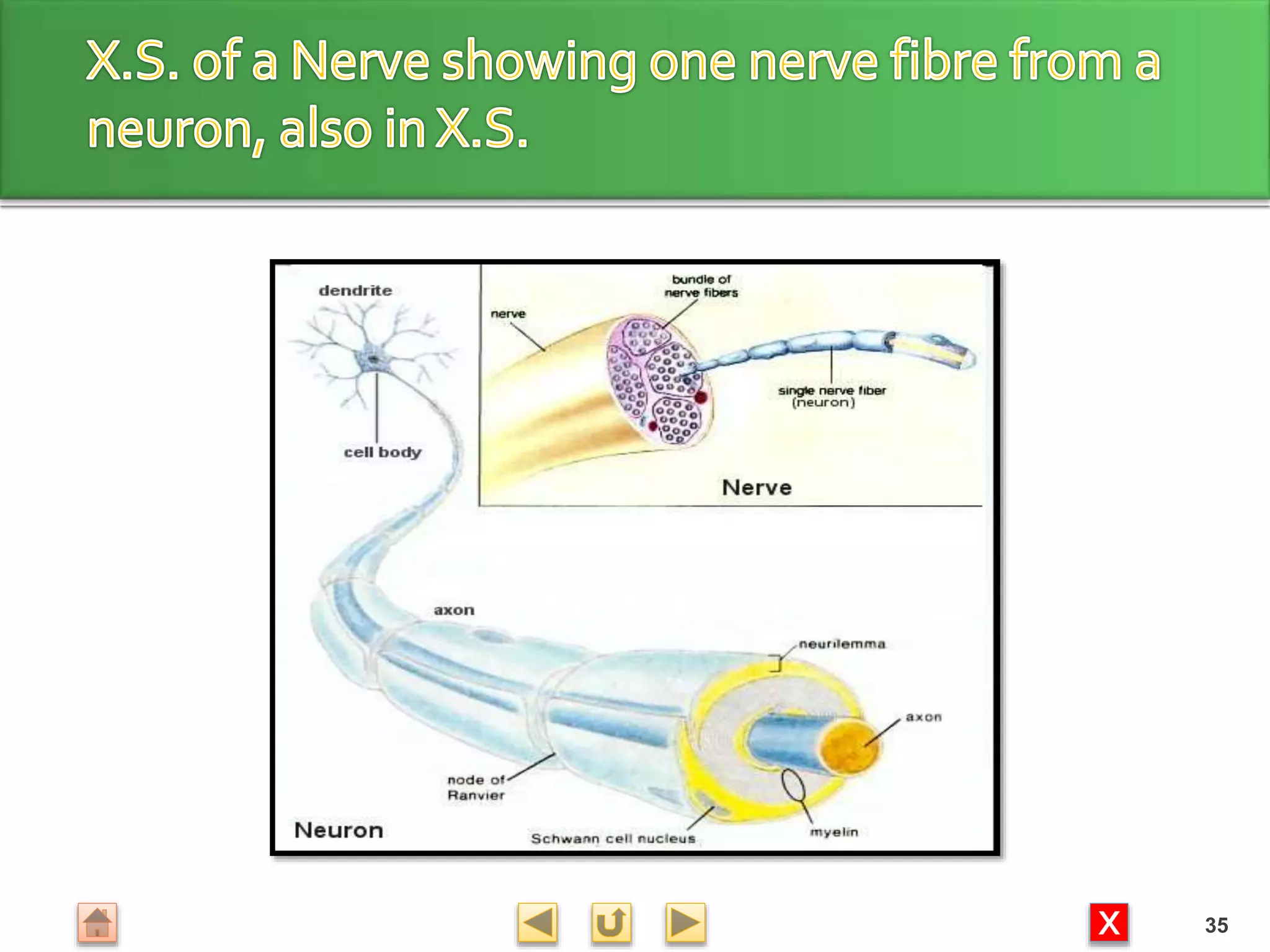
 You should be able to:
 distinguish between a nerve and a nerve cell
or neuron.
 identify and label diagrams of each type of
neuron, and state the main function of each
type.
32
X
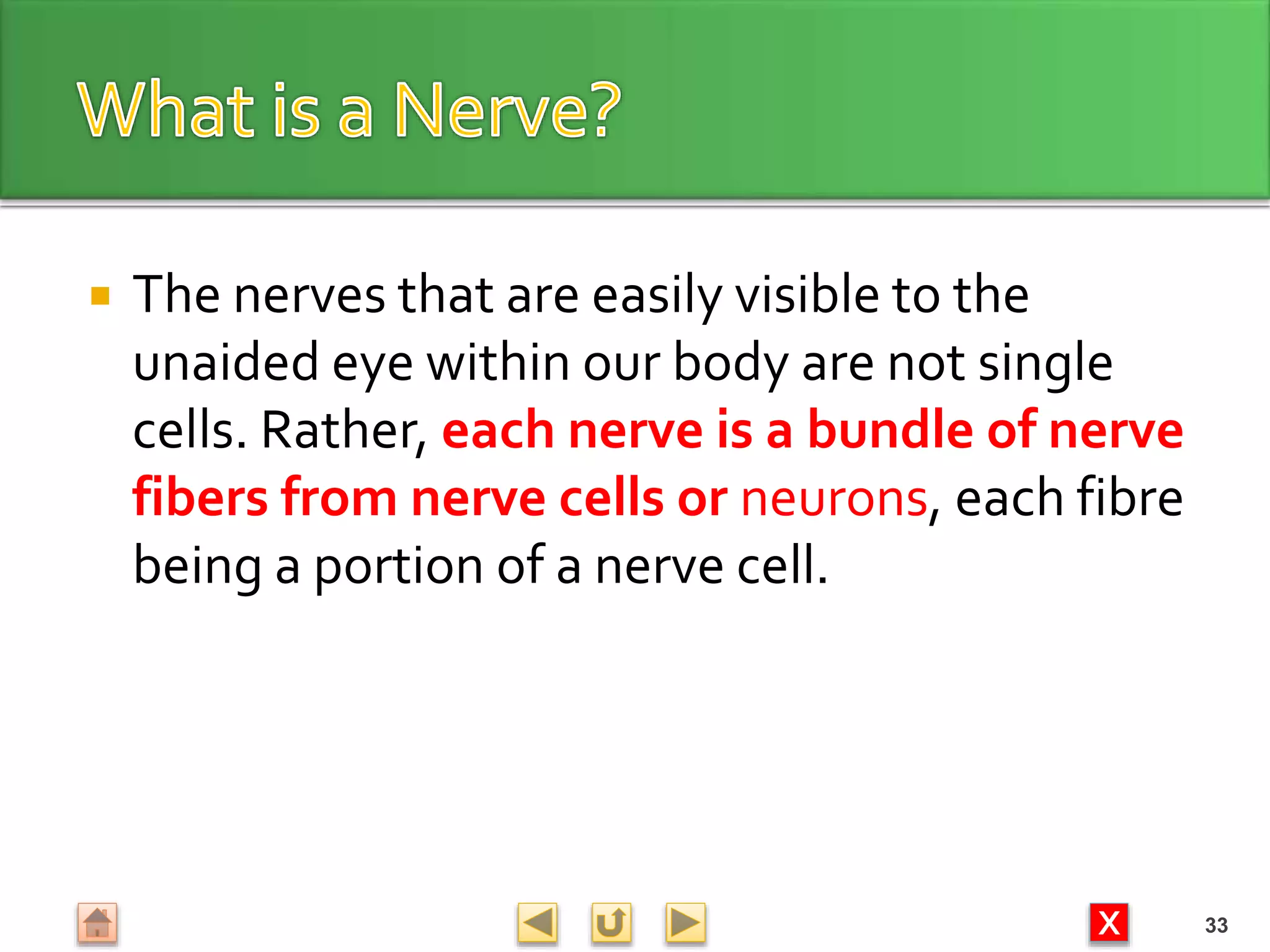
 The nerves that are easily visible to the
unaided eye within our body are not single
cells. Rather, each nerve is a bundle of nerve
fibers from nerve cells or neurons, each fibre
being a portion of a nerve cell.
33
X
The fibers that make up a nerve are all traveling
in the same direction and are bound together
with connective tissue for the sake of
convenience, though the individual fibers of the
bundle may have widely differing functions.
34
X 35
X
 There are no cell bodies of neurons in nerves
– only fibres; the cell bodies of neurons (nerve
cells) are found only in the CNS or in the
ganglia.
 Nerves carry electrochemical signals to and
from different areas of the nervous system
and between the nervous system and other
tissues/organs.
36
X
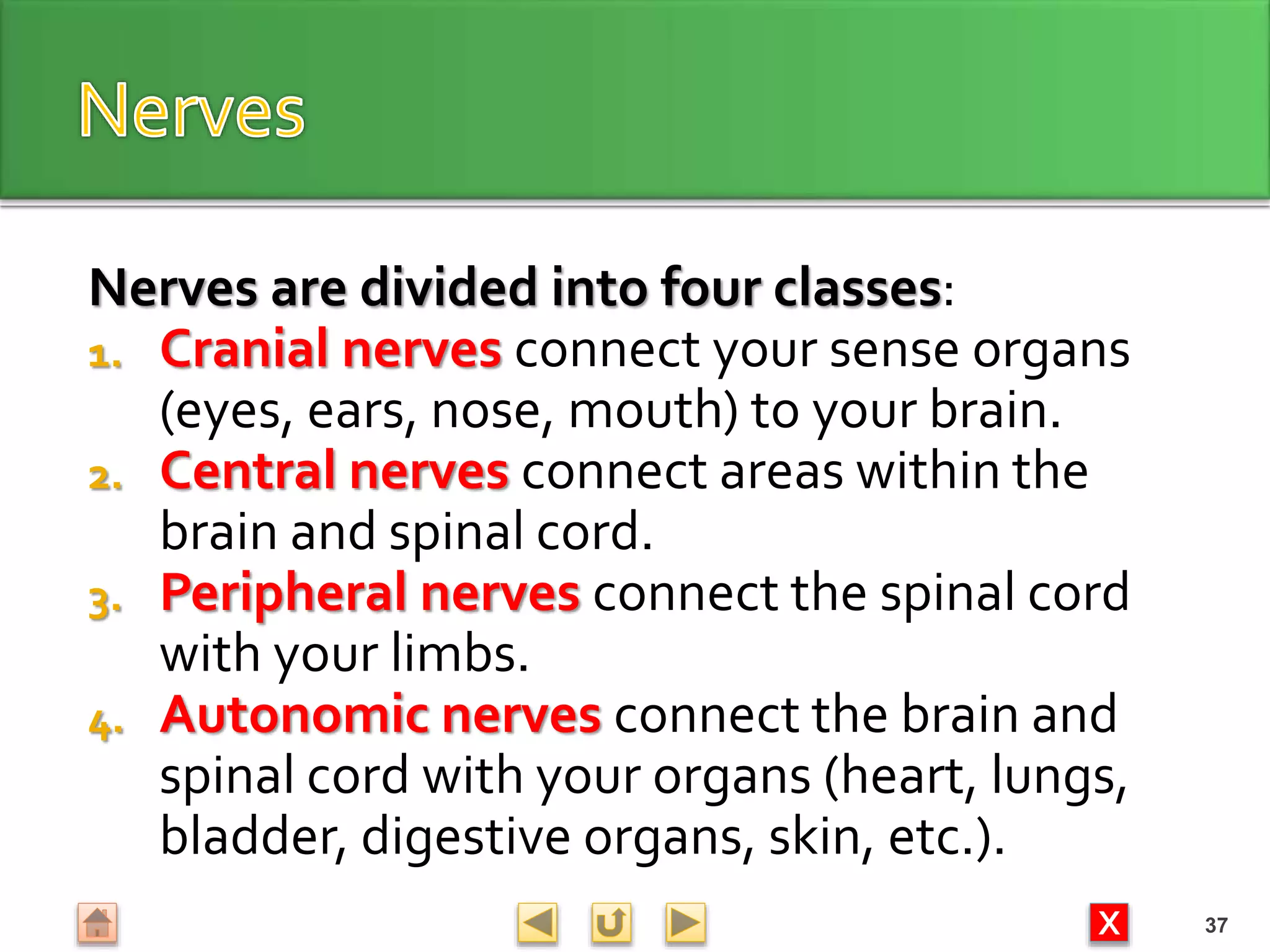
Nerves are divided into four classes:
1. Cranial nerves connect your sense organs
(eyes, ears, nose, mouth) to your brain.
2. Central nerves connect areas within the
brain and spinal cord.
3. Peripheral nerves connect the spinal cord
with your limbs.
4. Autonomic nerves connect the brain and
spinal cord with your organs (heart, lungs,
bladder, digestive organs, skin, etc.).
37
X 38
X 39
X
 A neuron is a long, wiry, nerve cell that
carries nerve impulses or electrical messages
to and from the brain, and throughout the
nervous system, at up to 200 mph.
 The messages come from receptors in the
eyes, skin, nose, ears, tongue as well as in
various internal organs/glands.
40
X
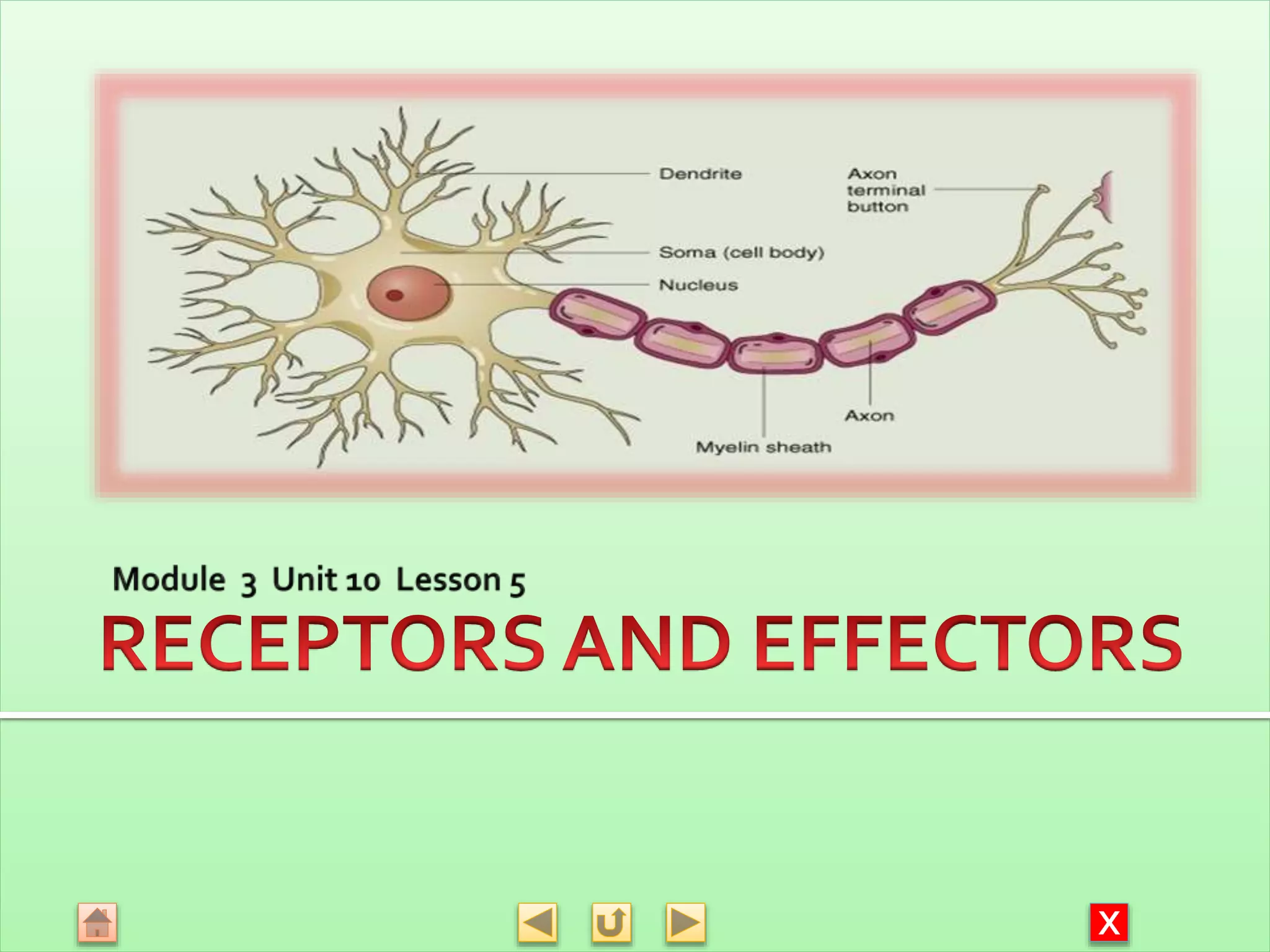
 The neuron consists of a cell body with
branching dendrites or signal receivers and a
projection called an axon, along which the
nerve signal travels.
 At the other end of the axon, the axon
terminals or transmitters pass the electro-
chemical signal across a synapse (the gap
between the axon terminal and the receiving
cell).
41
X 42
X
Neurons are named according to their function
1. Sensory (Receptor/Afferent) Neuron:
 Receives stimuli from the environment.
 ‘Afferent’ means carrying towards a central
organ or point e.g. brain or spinal cord.
 Relays nerve impulses from receptors to the
brain or spinal cord.
43
X
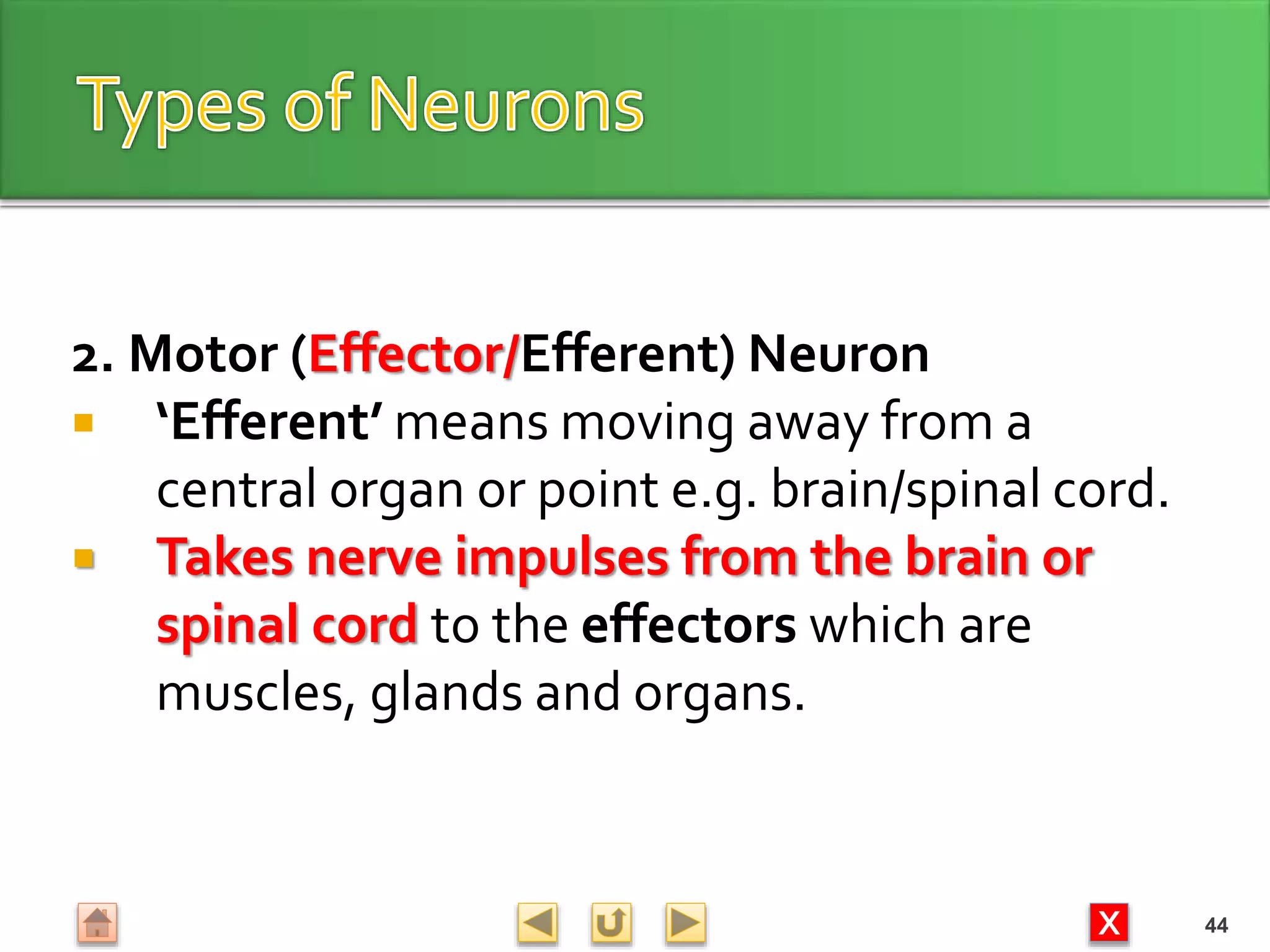
2. Motor (Effector/Efferent) Neuron
 ‘Efferent’ means moving away from a
central organ or point e.g. brain/spinal cord.
 Takes nerve impulses from the brain or
spinal cord to the effectors which are
muscles, glands and organs.
44
X
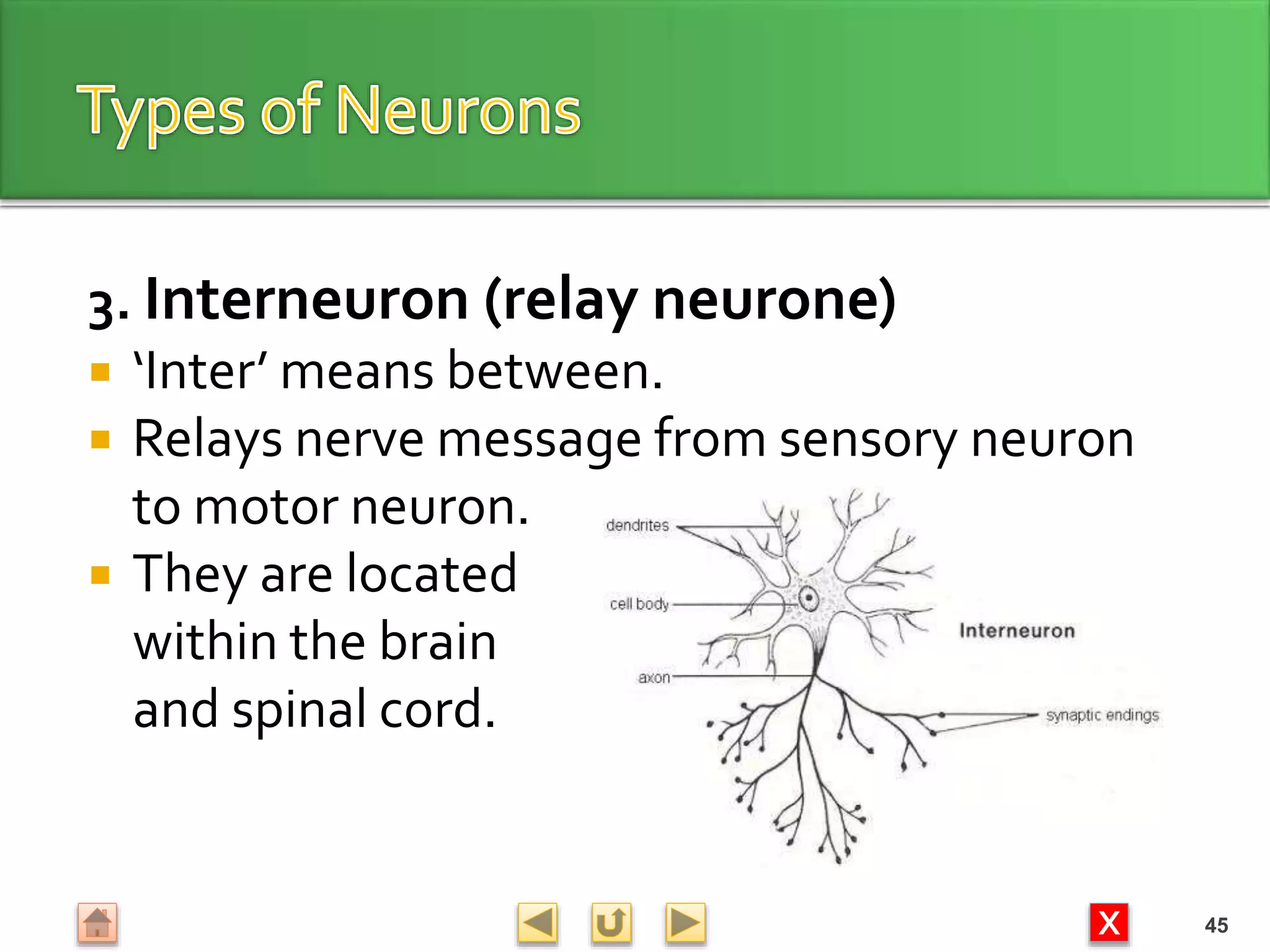
3. Interneuron (relay neurone)
 ‘Inter’ means between.
 Relays nerve message from sensory neuron
to motor neuron.
 They are located
within the brain
and spinal cord.
45
X 46
X
 Sensory receptors receive stimuli and send that
“information” as an electrical message that we call a
‘nerve impulse’ along the fibre of afferent neurons to
the spinal cord/brain, where the impulse can be
registered and interpreted.
 A response message is sent as another nerve impulse
along efferent fibres to the effector.
 Muscle movement, glandular secretion or sight, speech
etc. occurs as a direct response to the stimuli.
47
X
Sensory
Neuron
Interneuron
Motor
Neuron Sensory Neuron
Interneuron
Motor Neuron
Muscle
Contracts
Synapse
Synapse
Synapse
48
X
 The autonomic nervous system (ANS) is the
command network that the CNS uses to
maintain the body's homeostasis.
 It automatically regulates heartbeat and
controls muscle contractions in the walls of
blood vessels, digestive, urinary, and
reproductive tracts.
 It also carries messages that help stimulate
glands to secrete tears, mucus, and digestive
enzymes.
49
X 50
X
 The brain is the control centre for our nervous system. It determines how
our body works.The brain works out what the messages it receives are so
we know what we are seeing, touching, hearing, smelling and tasting,
and if something hurts, feels good or makes us happy.
 The brain makes sure our heart keeps beating and our lungs and other
organs/glands keep working without us having to think about it. Part of
the brain makes our muscles work, so we move.
 The biggest part of the brain makes us think, see, hear, feel and taste;
other parts maintain balance, controls growth and influences
development and also maintains homeostasis.
51
X
Brain (2007). [Online], Available:www.kidcyber.com.au
http://www.enchantedlearning.com/subjects/anatomy/brain/Spine.shtml
http://www.childrensuniversity.manchester.ac.uk/interactives/science/brain
andsenses/brain.asp
52

Biology M3 Response

  • 1.
  • 2.
  • 3.
    X You should beable to: 1. define receptors and effectors. 2. describe the relationship between the receptor, the central nervous system and the effector. 3
  • 4.
    X Our survival dependson us being sensitive to our surroundings - i.e. to be able to detect any changes both externally and internally and be able to respond to them in appropriate ways so that we maintain homeostasis. We do that through our nervous system. 4
  • 5.
    X The nervous system consistsof: the brain, spinal cord, nerves and sense organs. Even if there is damage or impairment of some sense organs, our nervous system still enables us to do various activities! 5
  • 6.
    X  A stimulusis any change in the internal or external environment, perceived by sense organs or sensory cells.  Examples are sounds/noises, smells, light, increased heat/cold, increase/decrease in chemicals/sugars in the blood, etc. 6
  • 7.
    X  Response isthe change in behaviour of an organism, because of a stimulus.  In animals, responses can be learned or are in-born/innate, and are carried out by muscles (so involve movement) or glands.  A response can also be in the form of growth of specific body parts, e.g. breathing roots that grow in mangroves.  Responses usually ensure homeostasis and are important for survival. 7
  • 8.
    X  You havethe ability to receive external stimuli via receptors in four sense organs (of sight, hearing, smell, and taste) located in specific parts of your body, but, your sense of touch is found all over.  Your internal organs also have sensory nerve endings with their sensory receptors which receive stimuli from your internal environment - e.g. about concentration of chemicals, temperature. 8
  • 9.
    X Your skin isa large sense organ that gives you information about things with which your body comes in contact. Look at your own skin surface with a hand lens; what can you see?Well, you cannot see any sensory receptors, but they are present in your skin! 9
  • 10.
    X  Your bodyhas different types of nerve endings scattered throughout your skin, many with receptors at the endings, that all receive stimuli from outside.  The most common receptors in skin are: touch or pressure, pain, heat and cold. Look at them in the diagram in the next slide.  Pain receptors are probably the most important for your safety because they can protect you by sending impulses to your brain that your body is hurt! 10
  • 11.
  • 12.
    X  How dothese receptors in your skin relate to other parts of your nervous system?Watch the video at the website below: http://health.howstuffworks.com/adam- 200012.htm  View the next slide which shows a flow chart of the sequence of events from stimulus received to the response by an effector.Talk about it with your teacher. 12
  • 13.
  • 14.
    X  Our senseorgans contain special receptor cells which will detect a change in our external/internal environment (a stimulus)  The receptor cells will change the stimulus into an electrical impulse which is passed along nerve cells  The message will usually go to the brain, and sometimes to the spinal cord, which will then process and interpret it  The brain/spinal cord then sends an electrical message along nerve cells to an effector organ (usually a muscle or a gland)  The effector organ will then give a response (e.g. a muscle will move, or a gland will produce a hormone) 14
  • 15.
  • 16.
    X Review the pictureson the previous slide.  What emotions are the dancers feeling?  Are the babies happy or sad?  How hard are the respiratory organs and muscles of the ball players responding? Perhaps their hearts are beating faster than usual?Their eyes opened wider?Their breathing is deeper and faster?  What digestive juices are flowing in the little boy’s body as he eats his apple? The Nervous system controls all of these! 16
  • 17.
    X You should beable to: 1. describe the parts of the central nervous system. 2. list the main function/s that each part performs. 17
  • 18.
    X  The nervoussystem consists of: the brain, spinal cord, nerves and sense organs.  Central nervous system = brain and brain stem and the spinal cord;  Peripheral nervous system = all nerves off the brain (cranial nerves), nerves coming off the spinal cord (spinal nerves) and sense organs. Talk with your teacher about the organizational flow chart in the next slide. 18
  • 19.
  • 20.
    X Brain Spinal cord Cerebellum Cerebrum Medulla oblongata CNS= Brain, Brain stem (Medulla oblongata) and Spinal Cord 20
  • 21.
    X The brain isthe centre of the nervous system, like the microprocessor in a computer.  The Cerebrum is the biggest and heaviest part. It is the ‘thinking part’ of the brain controlling voluntary or conscious activities such as learning, judgment etc.  The Cerebellum is at the back of the brain below the cerebrum; controls balance, movement and co- ordination. 21
  • 22.
    X  Brain stemor Medulla Oblongata - connects the brain and the spinal cord; controls all the body functions like breathing, blood pressure, heart rate, circulating blood and swallowing)  Pituitary gland is tiny but produces and releases hormones, which help you grow and help children change into adults.  Hypothalmus regulates the body temperature. 22
  • 23.
    X Note: Each brainlobe coloured differently Visit the websites to read about the human brain. http://en.wikipedia.org/wiki/ Lobes_of_the_brain 23
  • 24.
    X  Frontal lobe- conscious thought; damage can result in mood changes  Parietal lobe - plays important roles in integrating sensory information from various senses, and in the manipulation of objects; portions of the parietal lobe are involved with visuo-spatial processing  Occipital lobe - sense of sight; lesions can produce hallucinations  Temporal lobe - senses of smell and sound, as well as processing of complex stimuli like faces and scenes. 24
  • 25.
    X  Sense organsreceive external and internal stimuli so they act as receptors. Each type of receptor is sensitive to only one type of stimulus.  When a receptor is stimulated, it generates nerve impulses that are transmitted to the spinal cord and/or the brain, but we are conscious of a sensation only if the impulses reach the cerebrum. 25
  • 26.
  • 27.
    X The spinal cordis a bundle of nerve tissues. It is protected by a series of doughnut-shaped bones called vertebrae which surround it. It is about 43 - 45 cm long and approximately as wide as a human finger. About 13,500,000 neurons transmit their electro-chemical signals through the spinal cord. 27
  • 28.
    X  Serve asa conduit for sensory information, which travels up the spinal cord.  Serve as a conduit for motor information, which travels down the spinal cord.  Serve as a centre for coordinating certain reflexes. http://en.wikipedia.org/wiki/Spinal_cord 28
  • 29.
  • 30.
    X You should beable to: 1. describe the parts of the peripheral nervous system. 2. list the main function/s that each part performs. 30
  • 31.
    X  Consists of:Sensory division and Motor division; so, it includes all, nerves and sense organs, sensory and motor neurons. 31
  • 32.
    X  You shouldbe able to:  distinguish between a nerve and a nerve cell or neuron.  identify and label diagrams of each type of neuron, and state the main function of each type. 32
  • 33.
    X  The nervesthat are easily visible to the unaided eye within our body are not single cells. Rather, each nerve is a bundle of nerve fibers from nerve cells or neurons, each fibre being a portion of a nerve cell. 33
  • 34.
    X The fibers thatmake up a nerve are all traveling in the same direction and are bound together with connective tissue for the sake of convenience, though the individual fibers of the bundle may have widely differing functions. 34
  • 35.
  • 36.
    X  There areno cell bodies of neurons in nerves – only fibres; the cell bodies of neurons (nerve cells) are found only in the CNS or in the ganglia.  Nerves carry electrochemical signals to and from different areas of the nervous system and between the nervous system and other tissues/organs. 36
  • 37.
    X Nerves are dividedinto four classes: 1. Cranial nerves connect your sense organs (eyes, ears, nose, mouth) to your brain. 2. Central nerves connect areas within the brain and spinal cord. 3. Peripheral nerves connect the spinal cord with your limbs. 4. Autonomic nerves connect the brain and spinal cord with your organs (heart, lungs, bladder, digestive organs, skin, etc.). 37
  • 38.
  • 39.
  • 40.
    X  A neuronis a long, wiry, nerve cell that carries nerve impulses or electrical messages to and from the brain, and throughout the nervous system, at up to 200 mph.  The messages come from receptors in the eyes, skin, nose, ears, tongue as well as in various internal organs/glands. 40
  • 41.
    X  The neuronconsists of a cell body with branching dendrites or signal receivers and a projection called an axon, along which the nerve signal travels.  At the other end of the axon, the axon terminals or transmitters pass the electro- chemical signal across a synapse (the gap between the axon terminal and the receiving cell). 41
  • 42.
  • 43.
    X Neurons are namedaccording to their function 1. Sensory (Receptor/Afferent) Neuron:  Receives stimuli from the environment.  ‘Afferent’ means carrying towards a central organ or point e.g. brain or spinal cord.  Relays nerve impulses from receptors to the brain or spinal cord. 43
  • 44.
    X 2. Motor (Effector/Efferent)Neuron  ‘Efferent’ means moving away from a central organ or point e.g. brain/spinal cord.  Takes nerve impulses from the brain or spinal cord to the effectors which are muscles, glands and organs. 44
  • 45.
    X 3. Interneuron (relayneurone)  ‘Inter’ means between.  Relays nerve message from sensory neuron to motor neuron.  They are located within the brain and spinal cord. 45
  • 46.
  • 47.
    X  Sensory receptorsreceive stimuli and send that “information” as an electrical message that we call a ‘nerve impulse’ along the fibre of afferent neurons to the spinal cord/brain, where the impulse can be registered and interpreted.  A response message is sent as another nerve impulse along efferent fibres to the effector.  Muscle movement, glandular secretion or sight, speech etc. occurs as a direct response to the stimuli. 47
  • 48.
    X Sensory Neuron Interneuron Motor Neuron Sensory Neuron Interneuron MotorNeuron Muscle Contracts Synapse Synapse Synapse 48
  • 49.
    X  The autonomicnervous system (ANS) is the command network that the CNS uses to maintain the body's homeostasis.  It automatically regulates heartbeat and controls muscle contractions in the walls of blood vessels, digestive, urinary, and reproductive tracts.  It also carries messages that help stimulate glands to secrete tears, mucus, and digestive enzymes. 49
  • 50.
  • 51.
    X  The brainis the control centre for our nervous system. It determines how our body works.The brain works out what the messages it receives are so we know what we are seeing, touching, hearing, smelling and tasting, and if something hurts, feels good or makes us happy.  The brain makes sure our heart keeps beating and our lungs and other organs/glands keep working without us having to think about it. Part of the brain makes our muscles work, so we move.  The biggest part of the brain makes us think, see, hear, feel and taste; other parts maintain balance, controls growth and influences development and also maintains homeostasis. 51
  • 52.
    X Brain (2007). [Online],Available:www.kidcyber.com.au http://www.enchantedlearning.com/subjects/anatomy/brain/Spine.shtml http://www.childrensuniversity.manchester.ac.uk/interactives/science/brain andsenses/brain.asp 52