Nervous System
3 Important Functions of the Nervous System: It receives information from the environment and inside the body. It interprets the information it receives. It makes the body respond to the information.
DIVISIONS OF THE NERVOUS SYSTEM 2 Main Divisions of the Nervous System:   1. Central Nervous System (CNS) It consists of the brain and the spinal cord. It receives and sorts out information coming from the environment and from inside the body and determines the appropriate action.
2.   Peripheral Nervous System (PNS) It is made up of nerves that extend throughout the body. It is through these nerve cells that communication between the central nervous system and the body tissues take place.
2 Divisions of the Peripheral Nervous System: Somatic Nervous System (SNS) Autonomic Nervous System (ANS)
1. Somatic Nervous System (SNS) It communicates with the skin and skeletal muscles. The somatic nervous system is the part of the  peripheral nervous system  associated with the  voluntary  control of body movements through the action of  skeletal muscles , and with  reception  of external  stimuli , which helps keep the body in touch with its surroundings (e.g.,  touch ,  hearing , and  sight ). The system includes all the  neurons  connected with  muscles ,  skin  and  sense organs .
2. Autonomic Nervous System (ANS)  It communicates with smooth muscles, heart muscles and glands.  It is the part of the  peripheral nervous system  that acts as a  control system , maintaining  homeostasis  in the body. These maintenance activities are primarily performed without conscious control or sensation. The ANS has far reaching effects, including: heart rate, digestion, respiration rate, salivation, perspiration, diameter of the pupils, micturition (the discharge of urine), and erection. Most of its actions are involuntary.
2 Divisions of Autonomic Division 1. Sympathetic Nervous System The sympathetic nerves speed up or slow down some body processes. It is always active and becomes more active during times of  stress .
2. Parasympathetic Nervous System   The parasympathetic nerves have the opposite effect on the same body processes.
ā€œ The sympathetic and parasympathetic divisions typically function in opposition to each other. But this opposition is better termed complementary in nature rather than antagonistic. For an analogy, one may think of the sympathetic division as the accelerator and the parasympathetic division as the brake. The sympathetic division typically functions in actions requiring quick responses. The parasympathetic division functions with actions that do not require immediate reaction.ā€
The Nerve Impulse Each neuron is like a tiny biological battery. Electrically charged molecules called  ions  are found in varying numbers inside and outside of each neuron. Two types of ions, positive and negative, can be found. The most important  negative ion  is chloride (Cl). The most important  positive ions  are potassium (K) and sodium (Na).
When the neuron is not sending or receiving a signal, it is in a resting state. The inside of the neuron is about -70 millivolts. This electrical charge of a neuron at rest is its  resting potential . Message arriving from other neurons changes the resting potential until it reaches a threshold, the point at which a nerve impulse is fired or triggered. When a neuron reaches this point (-50 millivolts), a nerve impulse or  action potential  sweeps down the axon.
Similar to a game of dominoes, when once the first domino drops, a rapid wave of falling dominoes zips through the end of the line, when a nerve impulse is triggered near the soma, a wave of activity travels down the axon to the axon terminals.
Parts of the Nervous System
Neurons or nerve cells Spinal cord Brain
Neurons
Parts of Neurons Dendrites receive nerve impulses and send them to cell body  Cell body contains the nucleus of the cell Axons send impulses from the cell body to other neurons
Synapse - a very tiny space between the axon of a neuron and a dendrite of another neuron, across which a message is transmitted.  myelin sheath - fatty layer of cells that covers the axons in the brain and spinal cord and acts as an insulator and aids in the conduction of impulses terminal buttons - small knobs at the ends of the branched axon which are directly involved in transmitting a signal from one neuron to the next.
Ā 
Types of Neurons Sensory (afferent) neurons receive stimuli from the environment and carry them to the brain for interpretation Motor (efferent) neurons relay messages from the brain to the muscles or glands Interneurons/association neurons connect the impulse from the axon of the sensory neuron to the dendrite of the motor neuron
Ā 
Neurons are similar to other body cells because: neurons are surrounded by a cell membrane; neurons have a nucleus that contains genes; neurons contain cytoplasm, mitochondria and other organelles; and neurons carry out basic cellular processes such as energy production.
Neurons differ from other body cells because: neurons have specialized extensions called dendrites and axons; and neurons communicate with each other through nerve impulse.
Neurotransmitters If there is a gap between the neurons, why doesn’t the signal stop when it reaches the terminal button? The answer involves special chemicals called  neurotransmitters , which are stored in tiny pockets called  synaptic vesicles  that are located in the terminal buttons. These are substances that facilitate transmission of information from one neuron to another.
Spinal Cord
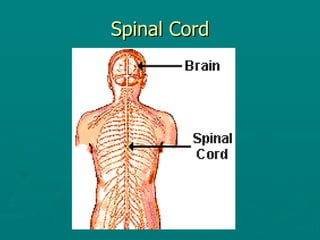
The spinal cord is a cylinder of nerve tissue as thick as a finger and about 45 centimeters long. It begins at the base of the skull and extends throughout most of the backbone.
It is the link between the peripheral nervous system and the brain. The spinal cord can also handle some information coming from the senses and provide motor responses that do not come from the brain. This is called a  reflex action .
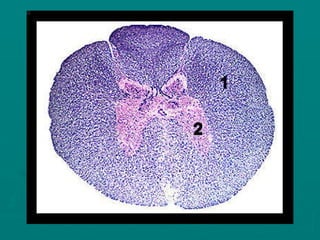
Components of the Spinal Cord At the center of the cord is the  gray matter . The gray matter contains the cell bodies and dendrites of neurons.
Surrounding the gray matter is the  white matter . It contains the axons of neurons that run lengthwise through the spinal cord.  It is also made up of bundle of interneuronal axons ( tracts ). Some tracts are  ascending   (carrying messages to the brain); others are  descending  (carrying messages from the brain).
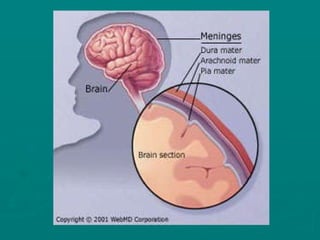
The spinal cord is surrounded by membranes called  meninges .
Ā 
Brain
Brain The brain is the body’s control center. It receives messages from and sends messages to all organs and tissues of the body. It controls both voluntary and involuntary activities. The brain gives us the ability to learn, to reason, and to feel.
The brain is a mass of billions of neurons. These neurons are surrounded by cells called  glia , or  glial cells , which support (hold the neurons in place) and supply them with nutrients.
The brain is protected by the skull. It is also protected by three layers of tissues called meninges. The inner layer acts as a wall that prevents bacteria fro reaching the brain. The middle layer supplies it with nutrients and oxygen. The outer layer lines the inner surface of the skull.
3 Main Parts of the Brain Brain Stem It is the lowest section of the brain which connects it to the spinal cord. It acts as a pathway for messages traveling between some parts of the brain and the spinal cord.
Ā 
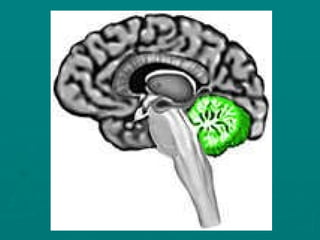
Cerebellum It is at the back of the brain stem. It is concerned with the maintenance of posture and balance, and the coordination of movements.
Ā 
Cerebrum It is the largest part of the brain.  It is the seat of human intelligence.
Ā 
Brain Stem It has three main parts: Medulla Pons Midbrain
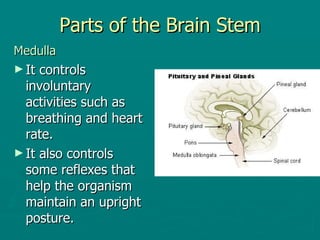
Parts of the Brain Stem Medulla   It controls involuntary activities such as breathing and heart rate. It also controls some reflexes that help the organism maintain an upright posture.
Parts of the Brain Stem Pons The pons, which means bridge, serves as a pathway, connecting the various parts of the brain with each other.
Parts of the Brain Stem Midbrain It controls the eye movements. It also coordinates head movement with sight and sound.
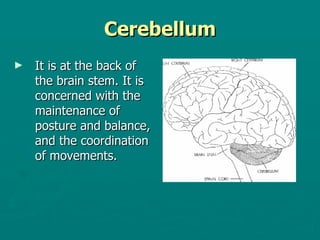
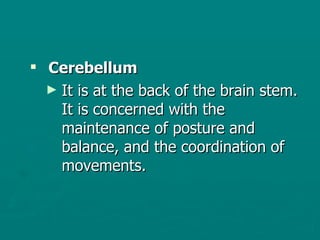
Cerebellum It is at the back of the brain stem. It is concerned with the maintenance of posture and balance, and the coordination of movements.
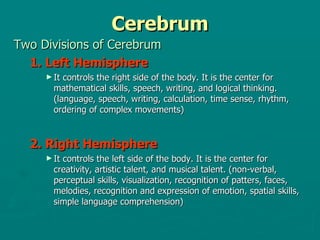
Cerebrum Two Divisions of Cerebrum 1. Left Hemisphere It controls the right side of the body. It is the center for mathematical skills, speech, writing, and logical thinking. (language, speech, writing, calculation, time sense, rhythm, ordering of complex movements) 2. Right Hemisphere It controls the left side of the body. It is the center for creativity, artistic talent, and musical talent. (non-verbal, perceptual skills, visualization, recognition of patters, faces, melodies, recognition and expression of emotion, spatial skills, simple language comprehension)
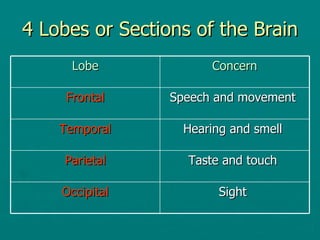
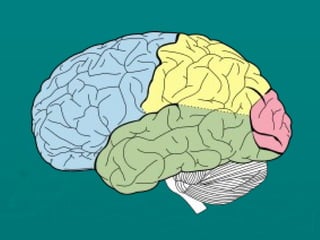
4 Lobes or Sections of the Brain Lobe Concern Frontal Speech and movement  Temporal Hearing and smell  Parietal Taste and touch  Occipital Sight
Ā 
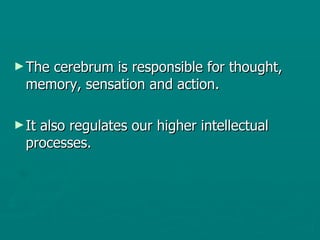
The cerebrum is responsible for thought, memory, sensation and action. It also regulates our higher intellectual processes.
THE ORGANIZATION OF THE BRAIN Cerebrum Central Core Limbic System
Central Core It is also known as the brainstem. It regulates our primitive behaviors (breathing, vomiting, sleeping, drinking, and temperature regulation) It also controls the involuntary behaviors like sneezing and coughing.
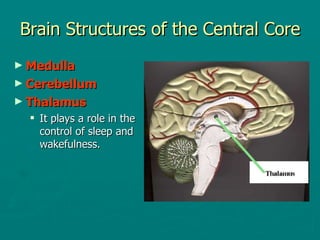
Brain Structures of the Central Core Medulla Cerebellum Thalamus It plays a role in the control of sleep and wakefulness.
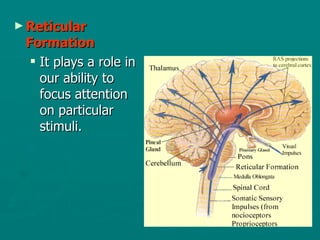
Reticular Formation It plays a role in our ability to focus attention on particular stimuli.
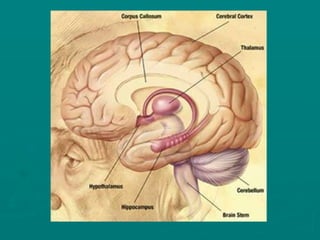
Hypothalamus It mediates eating and drinking.  It also regulates endocrine activity. It plays a role in emotion and response to stress (it is considered as the stress center).
Limbic System This area controls our emotions. The other brain structures of the limbic system are: Hypothalamus Hippocampus It has a special role in memory (storing new events, but not for the retrieval of older memories).
Ā 
HOW THE NERVOUS SYSTEM WORKS
From the Sense Organs to the Sensory Neurons The organs (eyes, ears, nose, tongue  and skin) contain special cells called  sensory receptors .  Sensory  receptors receive information from  the environment in the form of light,  sound,  chemical, heat, cold or  pressure.
From the Sensory Neurons to the Central Nervous System  The sensory receptors in the sense  organs transmit messages to  sensory  neurons . A message may be relayed  from one neuron to another until it  reaches the  brain . It is the brain that  tells what a person sees, hears,  smells, tastes, or feels.
From the Central Nervous System to the Motor Neurons Within the  brain , interneurons  integrate and interpret the  information received from one or  more  sensory neurons .
From the Motor Neurons to the Body Organs The  brain  relays the appropriate  response message to the  motor  neurons  leading to the different body  organs.
AILMENTS OF THE NERVOUS SYSTEM
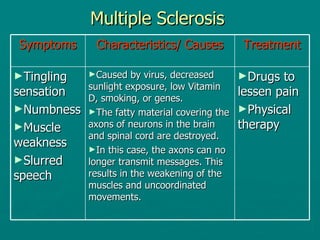
Multiple Sclerosis  Symptoms Characteristics/ Causes Treatment Tingling sensation Numbness Muscle weakness Slurred speech  Caused by virus, decreased sunlight exposure, low Vitamin D, smoking, or genes. The fatty material covering the axons of neurons in the brain and spinal cord are destroyed. In this case, the axons can no longer transmit messages. This results in the weakening of the muscles and uncoordinated movements.  Drugs to lessen pain  Physical therapy
Ā 
Polio (Poliomyelitis)  Symptoms Characteristics/ Causes Treatment Fever Sore throat Vomiting Headache It is an infectious disease caused by a virus, which destroys the motor neurons in the gray matter of the spinal cord or the brain.  This results in the paralysis of the skeletal muscles.  There is no drug treatment. Physical therapy should be given. It can be prevented by vaccination given during infancy.
Ā 
Brain Tumor  Symptoms Characteristics/ Causes Treatment Muscle weakness Loss of vision Speech difficulties It is an abnormal growth in or on the brain.  It may arise from tissues within the skull or spread through the bloodstream from tumors in some parts of the body.  Stereotactic radiosurgery  (a surgical technique involving the use of narrow beams of radiation, that are precisely targeted by stereotactic methods to destroy tumors)
Ā 
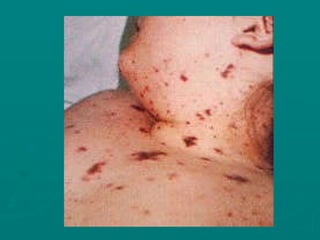
Meningitis  Symptoms Characteristics/ Causes Treatment Headache Fever Nausea Vomiting In some cases, rashes develop on the skin  It is an inflammation of the meninges that cover the brain and the spinal cord. It is caused by a virus or a bacterium. Viral meningitis is not serious but bacterial meningitis is.  Treatment for bacterial meningitis includes large doses of antibiotics. Treatment for viral meningitis are antiviral drugs, analgesics for pain and fever, and  bed rest
Ā 
Ā 
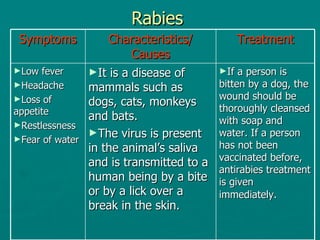
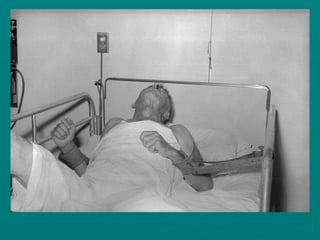
Rabies  Symptoms Characteristics/ Causes Treatment Low fever Headache Loss of appetite Restlessness Fear of water It is a disease of mammals such as dogs, cats, monkeys and bats. The virus is present in the animal’s saliva and is transmitted to a human being by a bite or by a lick over a break in the skin. If a person is bitten by a dog, the wound should be thoroughly cleansed with soap and water. If a person has not been vaccinated before, antirabies treatment is given immediately.
Ā 
Stroke Symptoms Characteristics/ Causes Treatment Altered smell, taste, hearing, or vision (total or partial)  Decreased reflexes: swallow, pupil reactivity to light  Decreased sensation and muscle weakness of the face  Balance problems Altered breathing and heart rate Aphasia   Apraxia   Memory deficits  A stroke occurs when the blood supply to a part of the brain is cut off.  The nerve cells in the affected area die.  When this happens, the victim may lose the ability to carry out functions controlled by the affected part of the brain.   Rehabilitation
Ā 
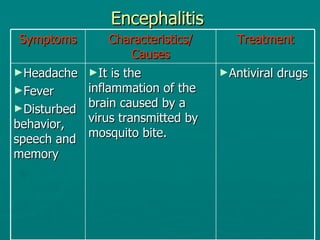
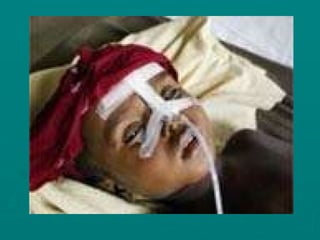
Encephalitis  Symptoms Characteristics/ Causes Treatment Headache Fever Disturbed behavior, speech and memory  It is the inflammation of the brain caused by a virus transmitted by mosquito bite.  Antiviral drugs
Ā 

Nervous system

  • 1.
  • 2.
    3 Important Functionsof the Nervous System: It receives information from the environment and inside the body. It interprets the information it receives. It makes the body respond to the information.
  • 3.
    DIVISIONS OF THENERVOUS SYSTEM 2 Main Divisions of the Nervous System: 1. Central Nervous System (CNS) It consists of the brain and the spinal cord. It receives and sorts out information coming from the environment and from inside the body and determines the appropriate action.
  • 4.
    2. Peripheral Nervous System (PNS) It is made up of nerves that extend throughout the body. It is through these nerve cells that communication between the central nervous system and the body tissues take place.
  • 5.
    2 Divisions ofthe Peripheral Nervous System: Somatic Nervous System (SNS) Autonomic Nervous System (ANS)
  • 6.
    1. Somatic NervousSystem (SNS) It communicates with the skin and skeletal muscles. The somatic nervous system is the part of the peripheral nervous system associated with the voluntary control of body movements through the action of skeletal muscles , and with reception of external stimuli , which helps keep the body in touch with its surroundings (e.g., touch , hearing , and sight ). The system includes all the neurons connected with muscles , skin and sense organs .
  • 7.
    2. Autonomic NervousSystem (ANS) It communicates with smooth muscles, heart muscles and glands. It is the part of the peripheral nervous system that acts as a control system , maintaining homeostasis in the body. These maintenance activities are primarily performed without conscious control or sensation. The ANS has far reaching effects, including: heart rate, digestion, respiration rate, salivation, perspiration, diameter of the pupils, micturition (the discharge of urine), and erection. Most of its actions are involuntary.
  • 8.
    2 Divisions ofAutonomic Division 1. Sympathetic Nervous System The sympathetic nerves speed up or slow down some body processes. It is always active and becomes more active during times of stress .
  • 9.
    2. Parasympathetic NervousSystem The parasympathetic nerves have the opposite effect on the same body processes.
  • 10.
    ā€œ The sympatheticand parasympathetic divisions typically function in opposition to each other. But this opposition is better termed complementary in nature rather than antagonistic. For an analogy, one may think of the sympathetic division as the accelerator and the parasympathetic division as the brake. The sympathetic division typically functions in actions requiring quick responses. The parasympathetic division functions with actions that do not require immediate reaction.ā€
  • 11.
    The Nerve ImpulseEach neuron is like a tiny biological battery. Electrically charged molecules called ions are found in varying numbers inside and outside of each neuron. Two types of ions, positive and negative, can be found. The most important negative ion is chloride (Cl). The most important positive ions are potassium (K) and sodium (Na).
  • 12.
    When the neuronis not sending or receiving a signal, it is in a resting state. The inside of the neuron is about -70 millivolts. This electrical charge of a neuron at rest is its resting potential . Message arriving from other neurons changes the resting potential until it reaches a threshold, the point at which a nerve impulse is fired or triggered. When a neuron reaches this point (-50 millivolts), a nerve impulse or action potential sweeps down the axon.
  • 13.
    Similar to agame of dominoes, when once the first domino drops, a rapid wave of falling dominoes zips through the end of the line, when a nerve impulse is triggered near the soma, a wave of activity travels down the axon to the axon terminals.
  • 14.
    Parts of theNervous System
  • 15.
    Neurons or nervecells Spinal cord Brain
  • 16.
  • 17.
    Parts of NeuronsDendrites receive nerve impulses and send them to cell body Cell body contains the nucleus of the cell Axons send impulses from the cell body to other neurons
  • 18.
    Synapse - avery tiny space between the axon of a neuron and a dendrite of another neuron, across which a message is transmitted. myelin sheath - fatty layer of cells that covers the axons in the brain and spinal cord and acts as an insulator and aids in the conduction of impulses terminal buttons - small knobs at the ends of the branched axon which are directly involved in transmitting a signal from one neuron to the next.
  • 19.
  • 20.
    Types of NeuronsSensory (afferent) neurons receive stimuli from the environment and carry them to the brain for interpretation Motor (efferent) neurons relay messages from the brain to the muscles or glands Interneurons/association neurons connect the impulse from the axon of the sensory neuron to the dendrite of the motor neuron
  • 21.
  • 22.
    Neurons are similarto other body cells because: neurons are surrounded by a cell membrane; neurons have a nucleus that contains genes; neurons contain cytoplasm, mitochondria and other organelles; and neurons carry out basic cellular processes such as energy production.
  • 23.
    Neurons differ fromother body cells because: neurons have specialized extensions called dendrites and axons; and neurons communicate with each other through nerve impulse.
  • 24.
    Neurotransmitters If thereis a gap between the neurons, why doesn’t the signal stop when it reaches the terminal button? The answer involves special chemicals called neurotransmitters , which are stored in tiny pockets called synaptic vesicles that are located in the terminal buttons. These are substances that facilitate transmission of information from one neuron to another.
  • 25.
  • 26.
    The spinal cordis a cylinder of nerve tissue as thick as a finger and about 45 centimeters long. It begins at the base of the skull and extends throughout most of the backbone.
  • 27.
    It is thelink between the peripheral nervous system and the brain. The spinal cord can also handle some information coming from the senses and provide motor responses that do not come from the brain. This is called a reflex action .
  • 28.
    Components of theSpinal Cord At the center of the cord is the gray matter . The gray matter contains the cell bodies and dendrites of neurons.
  • 29.
    Surrounding the graymatter is the white matter . It contains the axons of neurons that run lengthwise through the spinal cord. It is also made up of bundle of interneuronal axons ( tracts ). Some tracts are ascending (carrying messages to the brain); others are descending (carrying messages from the brain).
  • 30.
    The spinal cordis surrounded by membranes called meninges .
  • 31.
  • 32.
  • 33.
    Brain The brainis the body’s control center. It receives messages from and sends messages to all organs and tissues of the body. It controls both voluntary and involuntary activities. The brain gives us the ability to learn, to reason, and to feel.
  • 34.
    The brain isa mass of billions of neurons. These neurons are surrounded by cells called glia , or glial cells , which support (hold the neurons in place) and supply them with nutrients.
  • 35.
    The brain isprotected by the skull. It is also protected by three layers of tissues called meninges. The inner layer acts as a wall that prevents bacteria fro reaching the brain. The middle layer supplies it with nutrients and oxygen. The outer layer lines the inner surface of the skull.
  • 36.
    3 Main Partsof the Brain Brain Stem It is the lowest section of the brain which connects it to the spinal cord. It acts as a pathway for messages traveling between some parts of the brain and the spinal cord.
  • 37.
  • 38.
    Cerebellum It isat the back of the brain stem. It is concerned with the maintenance of posture and balance, and the coordination of movements.
  • 39.
  • 40.
    Cerebrum It isthe largest part of the brain. It is the seat of human intelligence.
  • 41.
  • 42.
    Brain Stem Ithas three main parts: Medulla Pons Midbrain
  • 43.
    Parts of theBrain Stem Medulla It controls involuntary activities such as breathing and heart rate. It also controls some reflexes that help the organism maintain an upright posture.
  • 44.
    Parts of theBrain Stem Pons The pons, which means bridge, serves as a pathway, connecting the various parts of the brain with each other.
  • 45.
    Parts of theBrain Stem Midbrain It controls the eye movements. It also coordinates head movement with sight and sound.
  • 46.
    Cerebellum It isat the back of the brain stem. It is concerned with the maintenance of posture and balance, and the coordination of movements.
  • 47.
    Cerebrum Two Divisionsof Cerebrum 1. Left Hemisphere It controls the right side of the body. It is the center for mathematical skills, speech, writing, and logical thinking. (language, speech, writing, calculation, time sense, rhythm, ordering of complex movements) 2. Right Hemisphere It controls the left side of the body. It is the center for creativity, artistic talent, and musical talent. (non-verbal, perceptual skills, visualization, recognition of patters, faces, melodies, recognition and expression of emotion, spatial skills, simple language comprehension)
  • 48.
    4 Lobes orSections of the Brain Lobe Concern Frontal Speech and movement Temporal Hearing and smell Parietal Taste and touch Occipital Sight
  • 49.
  • 50.
    The cerebrum isresponsible for thought, memory, sensation and action. It also regulates our higher intellectual processes.
  • 51.
    THE ORGANIZATION OFTHE BRAIN Cerebrum Central Core Limbic System
  • 52.
    Central Core Itis also known as the brainstem. It regulates our primitive behaviors (breathing, vomiting, sleeping, drinking, and temperature regulation) It also controls the involuntary behaviors like sneezing and coughing.
  • 53.
    Brain Structures ofthe Central Core Medulla Cerebellum Thalamus It plays a role in the control of sleep and wakefulness.
  • 54.
    Reticular Formation Itplays a role in our ability to focus attention on particular stimuli.
  • 55.
    Hypothalamus It mediateseating and drinking. It also regulates endocrine activity. It plays a role in emotion and response to stress (it is considered as the stress center).
  • 56.
    Limbic System Thisarea controls our emotions. The other brain structures of the limbic system are: Hypothalamus Hippocampus It has a special role in memory (storing new events, but not for the retrieval of older memories).
  • 57.
  • 58.
    HOW THE NERVOUSSYSTEM WORKS
  • 59.
    From the SenseOrgans to the Sensory Neurons The organs (eyes, ears, nose, tongue and skin) contain special cells called sensory receptors . Sensory receptors receive information from the environment in the form of light, sound, chemical, heat, cold or pressure.
  • 60.
    From the SensoryNeurons to the Central Nervous System The sensory receptors in the sense organs transmit messages to sensory neurons . A message may be relayed from one neuron to another until it reaches the brain . It is the brain that tells what a person sees, hears, smells, tastes, or feels.
  • 61.
    From the CentralNervous System to the Motor Neurons Within the brain , interneurons integrate and interpret the information received from one or more sensory neurons .
  • 62.
    From the MotorNeurons to the Body Organs The brain relays the appropriate response message to the motor neurons leading to the different body organs.
  • 63.
    AILMENTS OF THENERVOUS SYSTEM
  • 64.
    Multiple Sclerosis Symptoms Characteristics/ Causes Treatment Tingling sensation Numbness Muscle weakness Slurred speech Caused by virus, decreased sunlight exposure, low Vitamin D, smoking, or genes. The fatty material covering the axons of neurons in the brain and spinal cord are destroyed. In this case, the axons can no longer transmit messages. This results in the weakening of the muscles and uncoordinated movements. Drugs to lessen pain Physical therapy
  • 65.
  • 66.
    Polio (Poliomyelitis) Symptoms Characteristics/ Causes Treatment Fever Sore throat Vomiting Headache It is an infectious disease caused by a virus, which destroys the motor neurons in the gray matter of the spinal cord or the brain. This results in the paralysis of the skeletal muscles. There is no drug treatment. Physical therapy should be given. It can be prevented by vaccination given during infancy.
  • 67.
  • 68.
    Brain Tumor Symptoms Characteristics/ Causes Treatment Muscle weakness Loss of vision Speech difficulties It is an abnormal growth in or on the brain. It may arise from tissues within the skull or spread through the bloodstream from tumors in some parts of the body. Stereotactic radiosurgery (a surgical technique involving the use of narrow beams of radiation, that are precisely targeted by stereotactic methods to destroy tumors)
  • 69.
  • 70.
    Meningitis SymptomsCharacteristics/ Causes Treatment Headache Fever Nausea Vomiting In some cases, rashes develop on the skin It is an inflammation of the meninges that cover the brain and the spinal cord. It is caused by a virus or a bacterium. Viral meningitis is not serious but bacterial meningitis is. Treatment for bacterial meningitis includes large doses of antibiotics. Treatment for viral meningitis are antiviral drugs, analgesics for pain and fever, and bed rest
  • 71.
  • 72.
  • 73.
    Rabies SymptomsCharacteristics/ Causes Treatment Low fever Headache Loss of appetite Restlessness Fear of water It is a disease of mammals such as dogs, cats, monkeys and bats. The virus is present in the animal’s saliva and is transmitted to a human being by a bite or by a lick over a break in the skin. If a person is bitten by a dog, the wound should be thoroughly cleansed with soap and water. If a person has not been vaccinated before, antirabies treatment is given immediately.
  • 74.
  • 75.
    Stroke Symptoms Characteristics/Causes Treatment Altered smell, taste, hearing, or vision (total or partial) Decreased reflexes: swallow, pupil reactivity to light Decreased sensation and muscle weakness of the face Balance problems Altered breathing and heart rate Aphasia Apraxia Memory deficits A stroke occurs when the blood supply to a part of the brain is cut off. The nerve cells in the affected area die. When this happens, the victim may lose the ability to carry out functions controlled by the affected part of the brain. Rehabilitation
  • 76.
  • 77.
    Encephalitis SymptomsCharacteristics/ Causes Treatment Headache Fever Disturbed behavior, speech and memory It is the inflammation of the brain caused by a virus transmitted by mosquito bite. Antiviral drugs
  • 78.