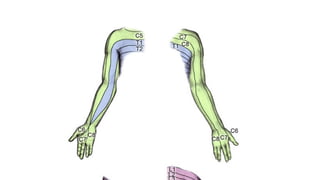
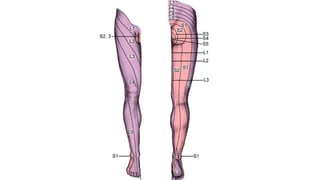
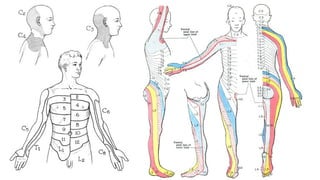
Dermatomes
& some other relevant stuff..

1
Overview

The surface of the skin is divided into specific areas called dermatomes,
which are derived from the cells of a somite.
These cells differentiate into 3 regions /
1- Myotome ; gives rise to the skeletal musculature.
2-Dermatome ; gives rise to the connective tissue of the skin.
3-Sclerotome ; gives rise to the vertebrae

2
Dermatome
A dermatome is an area of skin in which sensory nerves derive from
a single spinal nerve root.
In the developing embryo, the dermatome arises from 1 of the 3
segments (somites) of the mesoderm, the middle layer of embryonic
tissue

3
4
Variations?
The dermatomes along the arms and legs differ from the
pattern of the trunk dermatomes, because they run
longitudinally along the limbs. The general pattern is similar in
all people, but significant variations exist in dermatome maps
from person to person

8
Natural Variants

The dermatome is a basic concept, yet much variability
exists between dermatome maps in standard anatomy and
medical guideline textbooks.

9
Clinical significance
•

Dermatomes are useful to help localize neurologic
levels, particularly in radiculopathy.

•

Viruses that infect spinal nerves, such as herpes
zoster infections (shingles), can reveal their origin by
showing up as a painful dermatomic area.

11
Thank you

For further info. /
http://emedicine.medscape.com/article/1878388-overview#showall

Dermatomes & some relevant stuff

  • 1.
    Dermatomes & some otherrelevant stuff.. 1
  • 2.
    Overview The surface ofthe skin is divided into specific areas called dermatomes, which are derived from the cells of a somite. These cells differentiate into 3 regions / 1- Myotome ; gives rise to the skeletal musculature. 2-Dermatome ; gives rise to the connective tissue of the skin. 3-Sclerotome ; gives rise to the vertebrae 2
  • 3.
    Dermatome A dermatome isan area of skin in which sensory nerves derive from a single spinal nerve root. In the developing embryo, the dermatome arises from 1 of the 3 segments (somites) of the mesoderm, the middle layer of embryonic tissue 3
  • 4.
  • 8.
    Variations? The dermatomes alongthe arms and legs differ from the pattern of the trunk dermatomes, because they run longitudinally along the limbs. The general pattern is similar in all people, but significant variations exist in dermatome maps from person to person 8
  • 9.
    Natural Variants The dermatomeis a basic concept, yet much variability exists between dermatome maps in standard anatomy and medical guideline textbooks. 9
  • 11.
    Clinical significance • Dermatomes areuseful to help localize neurologic levels, particularly in radiculopathy. • Viruses that infect spinal nerves, such as herpes zoster infections (shingles), can reveal their origin by showing up as a painful dermatomic area. 11
  • 13.
    Thank you For furtherinfo. / http://emedicine.medscape.com/article/1878388-overview#showall

Editor's Notes

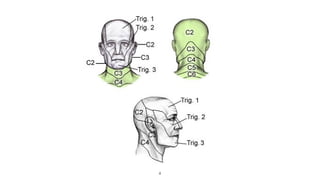
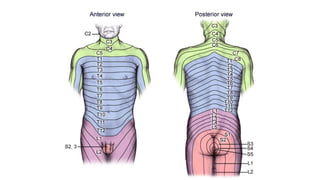
  • #6 Head,neck & trunk/ •C2 and C3 - Posterior head and neck •T4 - Nipple •T10 - Umbilicus
  • #7 Upper extremity/ •C6 - Thumb •C7 - Middle finger •C8 - Little finger •T1 - Inner forearm •T2 - Upper inner arm
  • #8 Lower extremity/ •L3 - Knee •L4 - Medial malleolus •L5 - Dorsum of foot •L5 - Toes 1-3 •S1 - Toes 4 and 5; lateral malleolus
  • #11 Grant’s Atlas
  • #12 •Effacement (histology), the shortening, or thinning, of a tissue. Effacement or encroachment of a spinal nerve may or may not exhibit symptoms in the dermatomic area covered by the compressed nerve roots in addition to weakness, or deep tendon reflex loss. Herpes zoster, a virus that can be dormant in the dorsal root ganglion, migrates along the spinal nerve to affect only the area of skin served by that nerve.
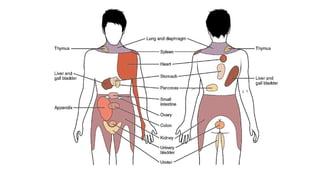
  • #13 Conscious perception of visceral sensations map to specific regions of the body, as shown in this chart. Some sensations are felt locally, whereas others are perceived as affecting areas that are quite distant from the involved organ. NOTE: Pain due to pleurisy, peritonitis, or gallbladder disease can often be referred to the skin over the point of the shoulder, halfway down the lateral side of the deltoid muscle. This is because this area of skin is supplied by the supraclavicular nerves (C3 and C4), and the pain generated from pleurisy, peritonitis, and/or gallbladder disease is carried from the diaphragmatic pleura and peritoneum via afferent fibers of the phrenic nerve (C3-C5)