LO-To understand the function of
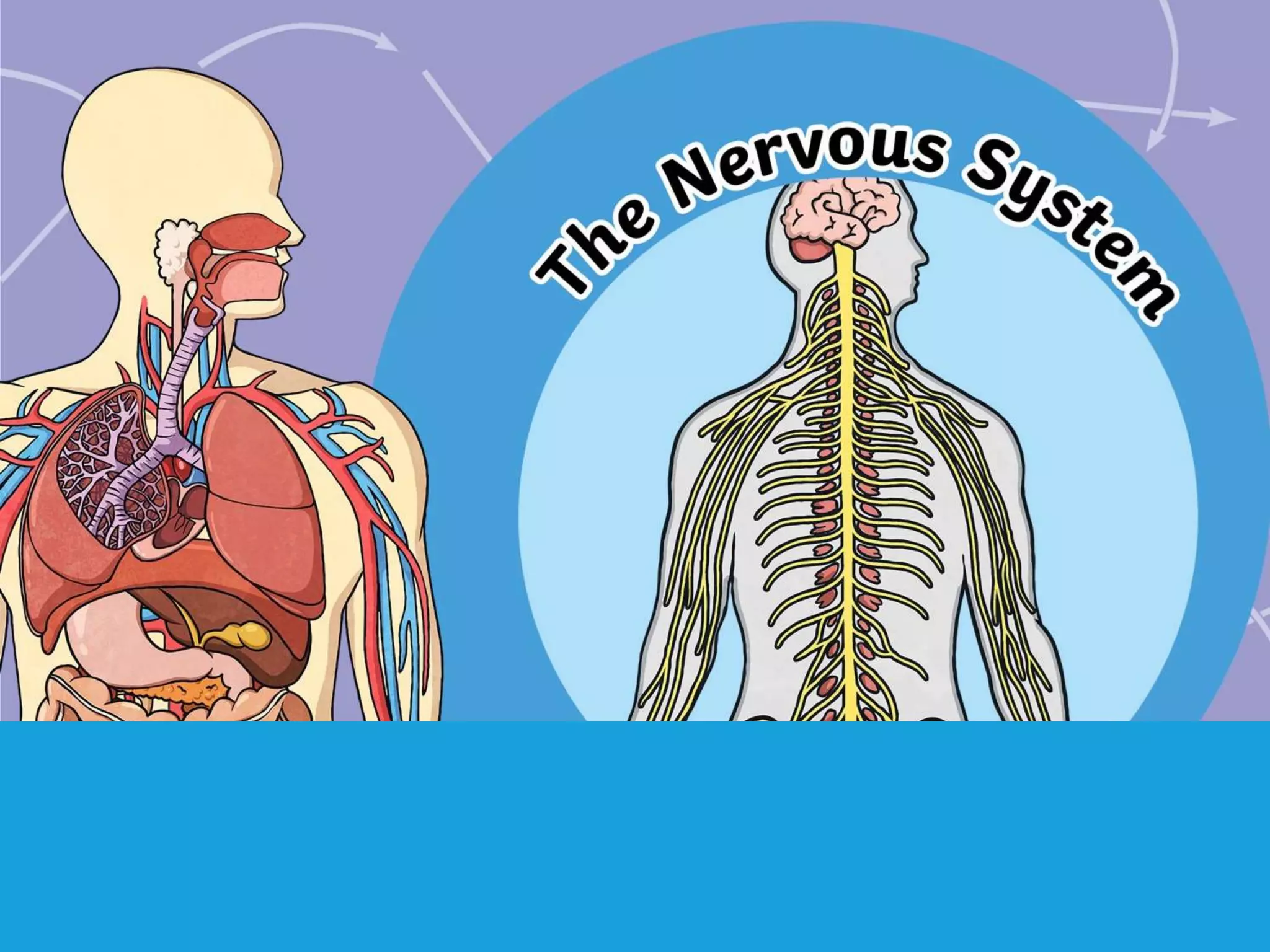
nervous system
Components of nervous system
Purpose of the Nervous System
• The nervous system is a complex
network of cells that transmit
impulses (also called ‘messages’) to
and from the brain and spinal cord
to different parts of the body.
• This network governs how our bodies
respond to different situations and
sensations.
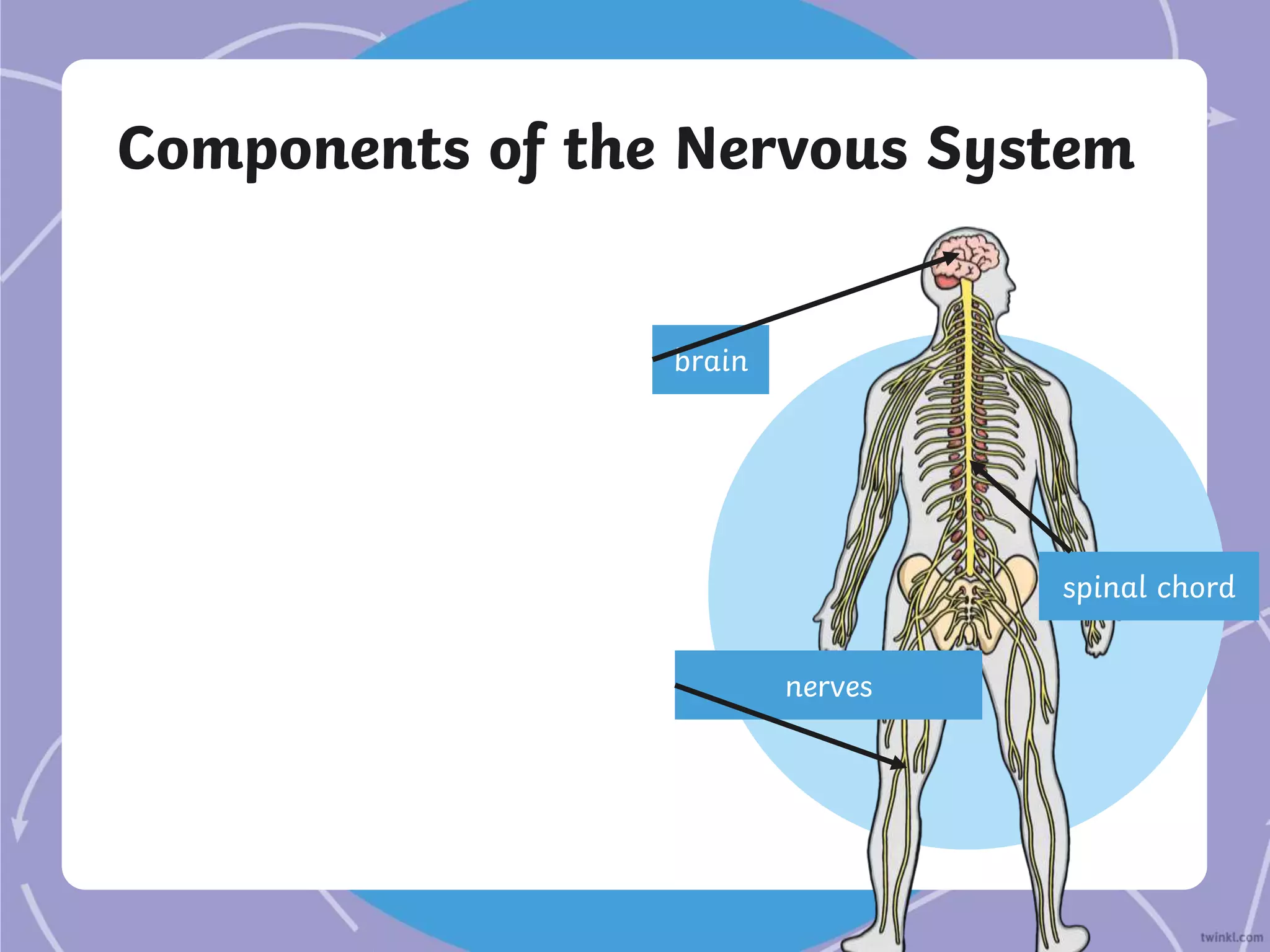
Components of the Nervous System
brain
spinal chord
nerves
The brain can use around 20% of all the body’s oxygen.
Every brain neuron makes connections with around
10,000 other brain cells.
The average brain weighs about three pounds and is over
five inches long.
Brain Facts
The brain contains cells, called neurons, that send messages. There are 100 billion
neurons in the human brain, which is about the same number of stars estimated
to be in the Milky Way galaxy.
Scientists are constantly working to understand the brain better, and we still
don’t fully understand everything!
However, more recent
research has shown
that many skills, for
example, responding to
music, are split between
areas of both
hemispheres of
the brain.
The right side of the
brain controls the left
side of the body.
The left side of the brain
controls the right side of
the body.
The Hemispheres
It was once believed that
each side of the brain
was used for different
abilities and skills, with
the right side of the brain
being the “creative” side
and the left hand being
the “logical” side.
Three Main Areas
The brainstem is the part of the brain linked by the spinal cord
to the rest of the body. A little like a superhighway, it is responsible for all
unconscious activities, such as breathing.
The smaller and rear part
of the brain is called the
cerebellum and is mainly
responsible for motor
control (your movements)
and balance.
The front and larger part
of the brain is called the
cerebrum. It is
responsible for the senses,
thinking, and memory.
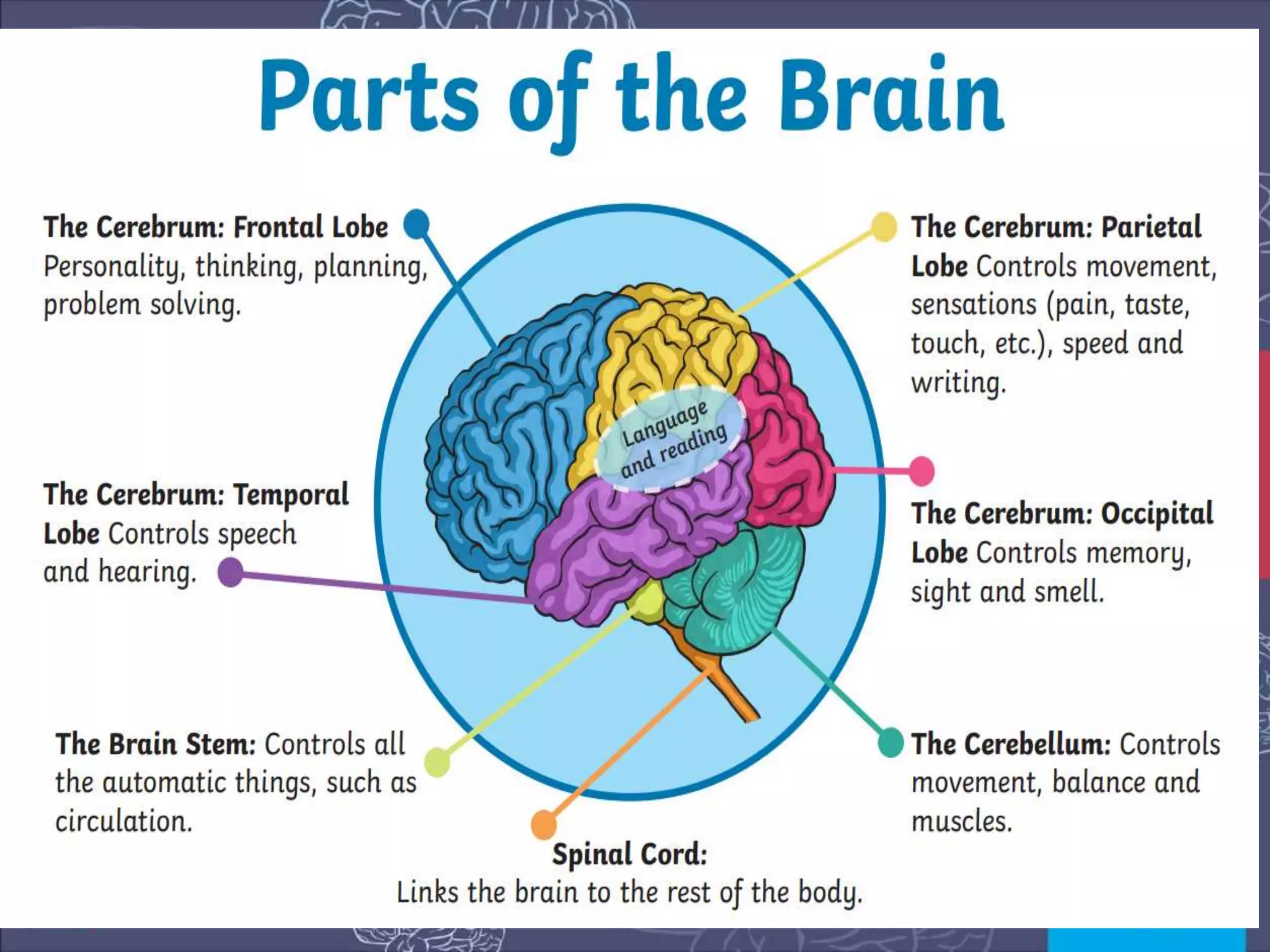
The Cerebrum Lobes
The different lobes each perform
different functions and are linked to different senses.
frontal lobe
temporal lobes occipital lobe
parietal lobe
The cerebrum is split into different areas called lobes.
Part of the frontal lobe is connected to speech ability.
This area of the brain is involved in decision-making,
judgment, and impulse control.
The frontal lobe is the control panel
for your personality and the way you
communicate.
The Frontal Lobe
The frontal lobe is where you do your problem-solving and conscious motor
control (movements).
These lobes are also responsible for object and
facial recognition.
The temporal lobes are involved with
short-term memory.
The temporal lobes are located on the sides
of the brain and are linked closely to your hearing.
The Temporal Lobe
The temporal lobes are connected with musical rhythm.
This lobe is also responsible for your spatial awareness
and navigational skills (proprioception).
Spoken language is processed and understood in
this lobe.
The parietal lobe is all about the
senses and interpreting things, including pain and touch.
The Parietal Lobe
The sense of touch is processed here, including being able to recognize a word
someone is “writing” on your skin through the sense of touch.
Occipital comes from the Latin word occiput, meaning
“back of the head.”
Different areas of the occipital lobe focus on spatial
perception, color, and movement.
The occipital lobe controls visual
processing, and it gets its information from the eyes.
The Occipital Lobe
Language and Reading
This is because there are so many different skills involved in these tasks.
Think how long it took you to learn to read and write!
There are a few different lobes that are involved in language and reading..
The Cerebellum
This part of the brain helps your motor skills (movements) by controlling
coordination, balance, and timing.
Cerebellum is a Latin word meaning “little brain.”
The Brainstem
The brainstem is the central part of the brain (like the apple core) and joins into
the spinal cord.
It is made up of three different parts: the medulla oblongata, the pons, and the
midbrain.
The brainstem does three jobs:
1. It controls various functions related to
hearing, movement, and responses to
the environment.
2. It enables activities such as chewing,
blinking, and tear production.
3. It is in charge of things you
automatically do (like breathing), the
sleep cycle, and circulating blood.
Click here to look inside
The brain and the spinal cord together form the central
nervous system (CNS).
It runs from the brain to the bottom of your spine
and is protected by the spinal column (vertebrae).
The spinal cord is the information
superhighway of the nerves, connecting the brain to
the rest of the body.
The Spinal Cord
In adults, the spinal cord is about 18 inches long and has a diameter of close to
one-half of an inch.
How can you protect your spinal cord?
Why do you think it’s important to protect your spinal cord?
Turn and Talk
What is the nervous system?
The Nervous System is split into the Central
Nervous System (CNS) and the Peripheral Nervous
System (PNS).
The CNS is the brain and spinal cord.
The PNS transmits electrical impulses to and from
the CNS.
What is the nervous system?
1. What does the Central Nervous System consist of?
2. What role does the Peripheral Nervous System have?
The central nervous system consists of the brain and spinal cord.
The peripheral nervous system transmits electrical impulses to and from
the central nervous system.
Voluntary and Involuntary Responses
Voluntary responses are things that you can control, for example picking
up a pen, kicking a ball.
Your brain sends an impulse down the spinal cord which then passes an
impulse to your motor neurones to complete the action.
Voluntary and Involuntary Responses
Involuntary responses are things you can’t control.
These are how you react to pain, your eyes dilating and contracting, your
heart beating etc.
NEURONS
•Neurons are the building blocks of
the nervous system. They receive
and transmit signals to different
parts of the body. This is carried
out in both physical and electrical
forms. There are several different
types of neurons that facilitate the
transmission of information.
sensory
receptors
sensory
neuron
interneuron
motor
neuron
effector
The Reflex Arc
PNS
CNS
• A Simple Nerve Circuit – the Reflex Arc.
– A reflex is an autonomic response.
REFLEX ARC
•An involuntary or automatic, action
that your body does in response to
something without you even having
to think about it.
The Reflex Arc
PNS
CNS
1. Nerves
• Nerves are the long fibres that transmit messages from the brain and
spinal cord (the central nervous system) to the rest of the body (the
peripheral nervous system) and back again.
• Your brain contains billions of nerve cells called neurons that act as the
‘messengers’ between your brain and spinal cord and the rest of the body.
• The ‘messages’ carried back and forth dictate how
we move, think, learn and behave.
• There are two ways that the nervous
system receives stimuli:
• Sensory neurons are activated
through touch, sight, smell, sound and
taste.
• Motor neurons carry the messages away
from the brain and spinal cord to the
rest of the body.
2. Brain
• The brain forms part of the central nervous system and consists of many
folds and grooves; it is protected by the bones in your skull.
• Despite its importance, the brain only weighs around 1,4kg!
• When the brain receives a message from anywhere in
the body, it tells the body how to react.
• The brain is divided into three areas:
• The forebrain
• The midbrain
• The hindbrain
• Each of these areas has different functions
and they all communicate with each other.
• The brain is attached to the spinal cord
through the brain stem.
3. Spinal Cord
• The spinal cord is a long (45,7cm)
bundle of nerves that forms part of
the central nervous system.
• It runs from the brain stem down
your spine and extends to the other
parts of your body
• The spinal cord is also protected:
ring-shaped bones called vertebrae
and a special fluid called
cerebrospinal fluid cushion the
nerves.
• Peripheral nerves stem from the
spinal cord to the rest of the body
like threads.
4. Sensory Organs
• The peripheral nervous system is the second part of the nervous system
within our bodies and stems from the central nervous system through the
spinal cord.
• The peripheral nervous system carries neurons to various muscles and organs
in the body.
• Sensory organs are muscles and organs based
on the five senses:
• ears (hearing)
• nose (smelling)
• eyes (seeing)
• skin (feeling)
• tongue (tasting)
• These organs are responsible for
gathering information all throughout
the body and sending it via sensory
nerves to the central nervous system.
Main Processes in the
Nervous System
• The nervous system is responsible for key processes in the body
and the body cannot optimally function if parts of it are
damaged.
• The nervous system sends and receives electrical impulses from
multiple sources at any given moment and determines how we
sense the world around us.
Main Processes in the Nervous System
These processes are:
Sound waves are transformed into electrical signals that
travel along the auditory nerve to the brain. This makes us
understand what we are hearing.
Hearing
Seeing and understanding what you are seeing are complex
processes. Light enters your eye upside-down and stimulates
specialised cells in your eye. These cells broadcast signals to
the brain along the optic nerve, where they are turned
around and interpreted as sight.
Seeing
The skin allows us to feel and experience everything around
us through touch. There are millions of nerve endings called
receptors in the skin, muscles, bones and joints, internal
organs and the circulatory system. These receptors respond
to pressure, pain, movement and temperature.
Feeling
Main Processes in the Nervous System
Taste buds on your tongue and parts of your mouth can
distinguish between different flavours: sweet, sour, bitter and
salty. These receptors and the receptors in the nose work very
closely together. The taste and scent of food are sent to the
brain where it is processed and interpreted.
Tasting
Nerve cells in the lining of your nose
react to molecules in the air. They send
messages to the brain which interprets
the smell accordingly and recognises
any of +- 10 000 different smells!
Smelling
Main Processes in the Nervous System
It is important to maintain a balance within the human
body. It includes regulating our body temperature. Our
bodies need to be kept at about 37ᵒC to work best. If the
body is too hot, the brain might try and cool the body
down through increased sweating. When you are very
cold, your body will shiver to generate heat energy. Your
nervous system controls these responses to changes in
body temperature.
Regulating
Health Issues Involving the Nervous System
• The loss of nervous function, where nerves ‘die’ and cease to function
as they should, is also known as neuropathy.
• Neuropathy can be caused by the following factors:
Traumatic brain and spinal cord injuries
Any damage to the brain or spinal cord can have harmful effects on
the human body. For example, people who break their necks in an
accident frequently damage their spinal cord. This prevents the
brain from sending and receiving messages to the body and the
person can become either partly or fully paralysed.
Strokes
Brain cells begin to die when blood flow to the
brain is cut off, even after just a few minutes
without blood or oxygen. This can cause a stroke
where a part of the brain function is lost.
Degenerative disorders
There are several problems related to the nervous system that causes a
gradual loss of function over time. This includes Alzheimer's Disease,
Parkinson's Disease and Multiple Sclerosis.
Health Issues Involving the Nervous System
Diabetic complications
Uncontrolled diabetes can lead to a lack of proper functioning of the
nerves, making patients lose sensation in their extremities (hands and
feet) first but eventually affecting more organs and senses.
Mental health problems
Examples are depression, anxiety disorder and personality disorders.
Health Issues Involving the Nervous System
Other sensory organ problems
These include deafness, blindness and short-sightedness

-nervous-system-powerpoint_ver_4 (1).pptx

  • 2.
    LO-To understand thefunction of nervous system Components of nervous system
  • 4.
    Purpose of theNervous System • The nervous system is a complex network of cells that transmit impulses (also called ‘messages’) to and from the brain and spinal cord to different parts of the body. • This network governs how our bodies respond to different situations and sensations.
  • 5.
    Components of theNervous System brain spinal chord nerves
  • 11.
    The brain canuse around 20% of all the body’s oxygen. Every brain neuron makes connections with around 10,000 other brain cells. The average brain weighs about three pounds and is over five inches long. Brain Facts The brain contains cells, called neurons, that send messages. There are 100 billion neurons in the human brain, which is about the same number of stars estimated to be in the Milky Way galaxy. Scientists are constantly working to understand the brain better, and we still don’t fully understand everything!
  • 12.
    However, more recent researchhas shown that many skills, for example, responding to music, are split between areas of both hemispheres of the brain. The right side of the brain controls the left side of the body. The left side of the brain controls the right side of the body. The Hemispheres It was once believed that each side of the brain was used for different abilities and skills, with the right side of the brain being the “creative” side and the left hand being the “logical” side.
  • 13.
    Three Main Areas Thebrainstem is the part of the brain linked by the spinal cord to the rest of the body. A little like a superhighway, it is responsible for all unconscious activities, such as breathing. The smaller and rear part of the brain is called the cerebellum and is mainly responsible for motor control (your movements) and balance. The front and larger part of the brain is called the cerebrum. It is responsible for the senses, thinking, and memory.
  • 14.
    The Cerebrum Lobes Thedifferent lobes each perform different functions and are linked to different senses. frontal lobe temporal lobes occipital lobe parietal lobe The cerebrum is split into different areas called lobes.
  • 15.
    Part of thefrontal lobe is connected to speech ability. This area of the brain is involved in decision-making, judgment, and impulse control. The frontal lobe is the control panel for your personality and the way you communicate. The Frontal Lobe The frontal lobe is where you do your problem-solving and conscious motor control (movements).
  • 16.
    These lobes arealso responsible for object and facial recognition. The temporal lobes are involved with short-term memory. The temporal lobes are located on the sides of the brain and are linked closely to your hearing. The Temporal Lobe The temporal lobes are connected with musical rhythm.
  • 17.
    This lobe isalso responsible for your spatial awareness and navigational skills (proprioception). Spoken language is processed and understood in this lobe. The parietal lobe is all about the senses and interpreting things, including pain and touch. The Parietal Lobe The sense of touch is processed here, including being able to recognize a word someone is “writing” on your skin through the sense of touch.
  • 18.
    Occipital comes fromthe Latin word occiput, meaning “back of the head.” Different areas of the occipital lobe focus on spatial perception, color, and movement. The occipital lobe controls visual processing, and it gets its information from the eyes. The Occipital Lobe
  • 19.
    Language and Reading Thisis because there are so many different skills involved in these tasks. Think how long it took you to learn to read and write! There are a few different lobes that are involved in language and reading..
  • 20.
    The Cerebellum This partof the brain helps your motor skills (movements) by controlling coordination, balance, and timing. Cerebellum is a Latin word meaning “little brain.”
  • 21.
    The Brainstem The brainstemis the central part of the brain (like the apple core) and joins into the spinal cord. It is made up of three different parts: the medulla oblongata, the pons, and the midbrain. The brainstem does three jobs: 1. It controls various functions related to hearing, movement, and responses to the environment. 2. It enables activities such as chewing, blinking, and tear production. 3. It is in charge of things you automatically do (like breathing), the sleep cycle, and circulating blood. Click here to look inside
  • 22.
    The brain andthe spinal cord together form the central nervous system (CNS). It runs from the brain to the bottom of your spine and is protected by the spinal column (vertebrae). The spinal cord is the information superhighway of the nerves, connecting the brain to the rest of the body. The Spinal Cord In adults, the spinal cord is about 18 inches long and has a diameter of close to one-half of an inch.
  • 23.
    How can youprotect your spinal cord? Why do you think it’s important to protect your spinal cord? Turn and Talk
  • 24.
    What is thenervous system? The Nervous System is split into the Central Nervous System (CNS) and the Peripheral Nervous System (PNS). The CNS is the brain and spinal cord. The PNS transmits electrical impulses to and from the CNS.
  • 25.
    What is thenervous system? 1. What does the Central Nervous System consist of? 2. What role does the Peripheral Nervous System have? The central nervous system consists of the brain and spinal cord. The peripheral nervous system transmits electrical impulses to and from the central nervous system.
  • 26.
    Voluntary and InvoluntaryResponses Voluntary responses are things that you can control, for example picking up a pen, kicking a ball. Your brain sends an impulse down the spinal cord which then passes an impulse to your motor neurones to complete the action.
  • 27.
    Voluntary and InvoluntaryResponses Involuntary responses are things you can’t control. These are how you react to pain, your eyes dilating and contracting, your heart beating etc.
  • 29.
    NEURONS •Neurons are thebuilding blocks of the nervous system. They receive and transmit signals to different parts of the body. This is carried out in both physical and electrical forms. There are several different types of neurons that facilitate the transmission of information.
  • 35.
  • 37.
  • 38.
    • A SimpleNerve Circuit – the Reflex Arc. – A reflex is an autonomic response.
  • 39.
    REFLEX ARC •An involuntaryor automatic, action that your body does in response to something without you even having to think about it.
  • 40.
  • 41.
    1. Nerves • Nervesare the long fibres that transmit messages from the brain and spinal cord (the central nervous system) to the rest of the body (the peripheral nervous system) and back again. • Your brain contains billions of nerve cells called neurons that act as the ‘messengers’ between your brain and spinal cord and the rest of the body. • The ‘messages’ carried back and forth dictate how we move, think, learn and behave. • There are two ways that the nervous system receives stimuli: • Sensory neurons are activated through touch, sight, smell, sound and taste. • Motor neurons carry the messages away from the brain and spinal cord to the rest of the body.
  • 42.
    2. Brain • Thebrain forms part of the central nervous system and consists of many folds and grooves; it is protected by the bones in your skull. • Despite its importance, the brain only weighs around 1,4kg! • When the brain receives a message from anywhere in the body, it tells the body how to react. • The brain is divided into three areas: • The forebrain • The midbrain • The hindbrain • Each of these areas has different functions and they all communicate with each other. • The brain is attached to the spinal cord through the brain stem.
  • 43.
    3. Spinal Cord •The spinal cord is a long (45,7cm) bundle of nerves that forms part of the central nervous system. • It runs from the brain stem down your spine and extends to the other parts of your body • The spinal cord is also protected: ring-shaped bones called vertebrae and a special fluid called cerebrospinal fluid cushion the nerves. • Peripheral nerves stem from the spinal cord to the rest of the body like threads.
  • 44.
    4. Sensory Organs •The peripheral nervous system is the second part of the nervous system within our bodies and stems from the central nervous system through the spinal cord. • The peripheral nervous system carries neurons to various muscles and organs in the body. • Sensory organs are muscles and organs based on the five senses: • ears (hearing) • nose (smelling) • eyes (seeing) • skin (feeling) • tongue (tasting) • These organs are responsible for gathering information all throughout the body and sending it via sensory nerves to the central nervous system.
  • 45.
    Main Processes inthe Nervous System • The nervous system is responsible for key processes in the body and the body cannot optimally function if parts of it are damaged. • The nervous system sends and receives electrical impulses from multiple sources at any given moment and determines how we sense the world around us.
  • 46.
    Main Processes inthe Nervous System These processes are: Sound waves are transformed into electrical signals that travel along the auditory nerve to the brain. This makes us understand what we are hearing. Hearing Seeing and understanding what you are seeing are complex processes. Light enters your eye upside-down and stimulates specialised cells in your eye. These cells broadcast signals to the brain along the optic nerve, where they are turned around and interpreted as sight. Seeing The skin allows us to feel and experience everything around us through touch. There are millions of nerve endings called receptors in the skin, muscles, bones and joints, internal organs and the circulatory system. These receptors respond to pressure, pain, movement and temperature. Feeling
  • 47.
    Main Processes inthe Nervous System Taste buds on your tongue and parts of your mouth can distinguish between different flavours: sweet, sour, bitter and salty. These receptors and the receptors in the nose work very closely together. The taste and scent of food are sent to the brain where it is processed and interpreted. Tasting Nerve cells in the lining of your nose react to molecules in the air. They send messages to the brain which interprets the smell accordingly and recognises any of +- 10 000 different smells! Smelling
  • 48.
    Main Processes inthe Nervous System It is important to maintain a balance within the human body. It includes regulating our body temperature. Our bodies need to be kept at about 37ᵒC to work best. If the body is too hot, the brain might try and cool the body down through increased sweating. When you are very cold, your body will shiver to generate heat energy. Your nervous system controls these responses to changes in body temperature. Regulating
  • 49.
    Health Issues Involvingthe Nervous System • The loss of nervous function, where nerves ‘die’ and cease to function as they should, is also known as neuropathy. • Neuropathy can be caused by the following factors: Traumatic brain and spinal cord injuries Any damage to the brain or spinal cord can have harmful effects on the human body. For example, people who break their necks in an accident frequently damage their spinal cord. This prevents the brain from sending and receiving messages to the body and the person can become either partly or fully paralysed. Strokes Brain cells begin to die when blood flow to the brain is cut off, even after just a few minutes without blood or oxygen. This can cause a stroke where a part of the brain function is lost.
  • 50.
    Degenerative disorders There areseveral problems related to the nervous system that causes a gradual loss of function over time. This includes Alzheimer's Disease, Parkinson's Disease and Multiple Sclerosis. Health Issues Involving the Nervous System Diabetic complications Uncontrolled diabetes can lead to a lack of proper functioning of the nerves, making patients lose sensation in their extremities (hands and feet) first but eventually affecting more organs and senses. Mental health problems Examples are depression, anxiety disorder and personality disorders.
  • 51.
    Health Issues Involvingthe Nervous System Other sensory organ problems These include deafness, blindness and short-sightedness