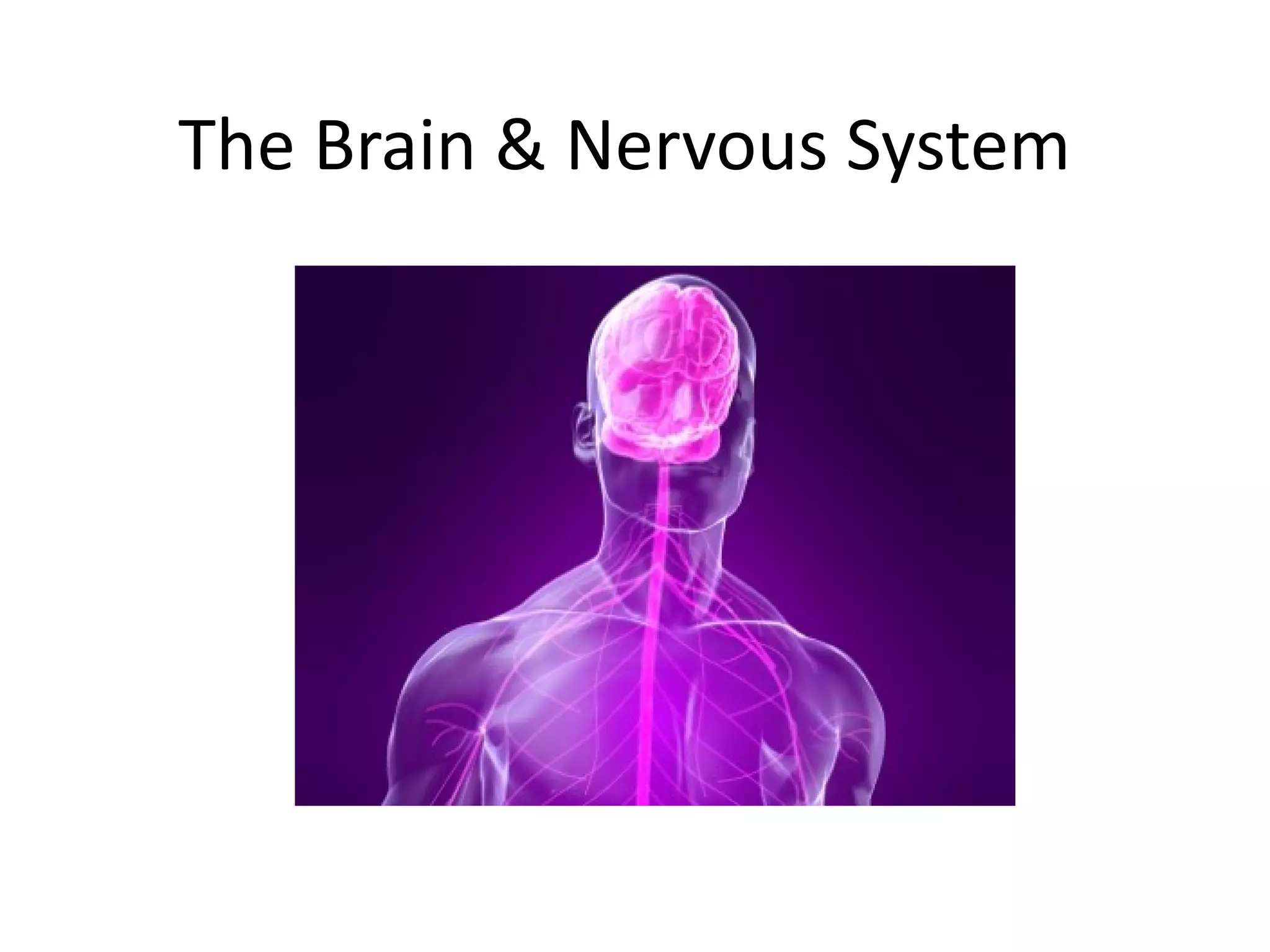
The document summarizes the main components and functions of the nervous system. It describes how the peripheral nervous system communicates sensory information to the central nervous system and receives motor instructions from the central nervous system to control the body's organs, muscles and glands. It then explains the somatic and autonomic nervous systems, with the autonomic system regulating involuntary functions and having sympathetic and parasympathetic divisions for fight-or-flight response and restoring homeostasis. Finally, it outlines the central nervous system of the brain and spinal cord which processes information and coordinates the body.
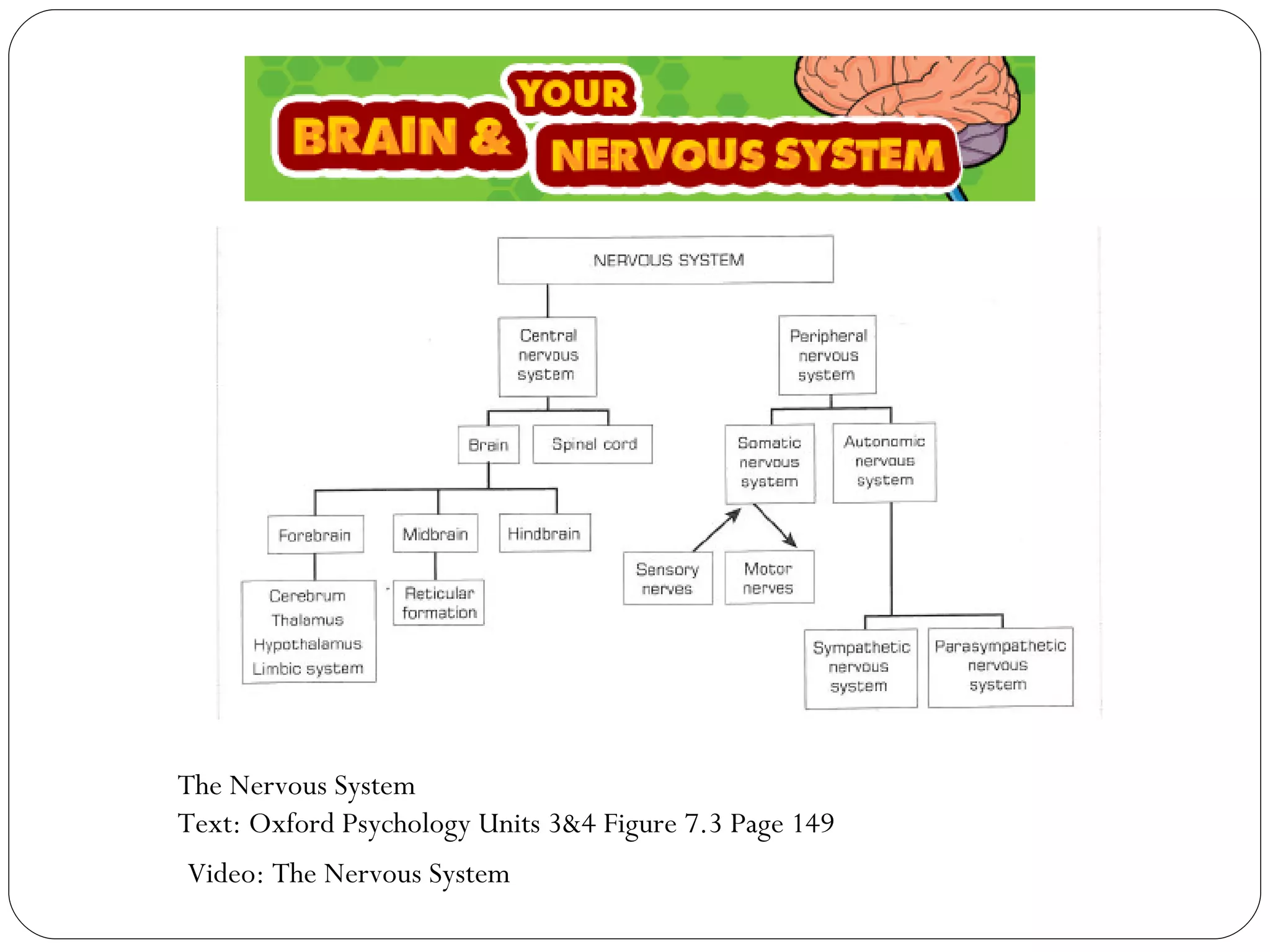
Video: The NervousSystem The Nervous System Text: Oxford Psychology Units 3&4 Figure 7.3 Page 149
3.
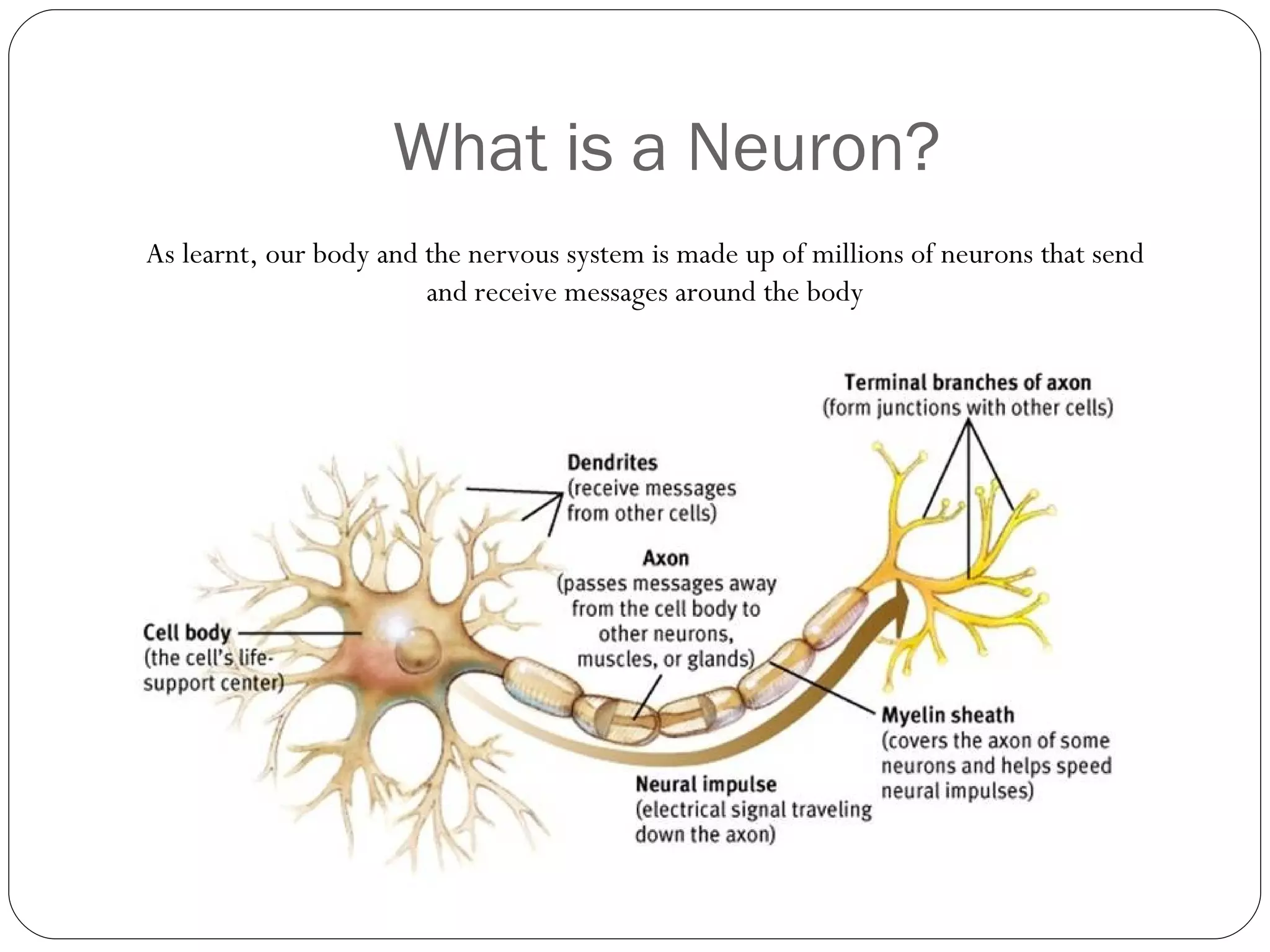
What is aNeuron? As learnt, our body and the nervous system is made up of millions of neurons that send and receive messages around the body
4.
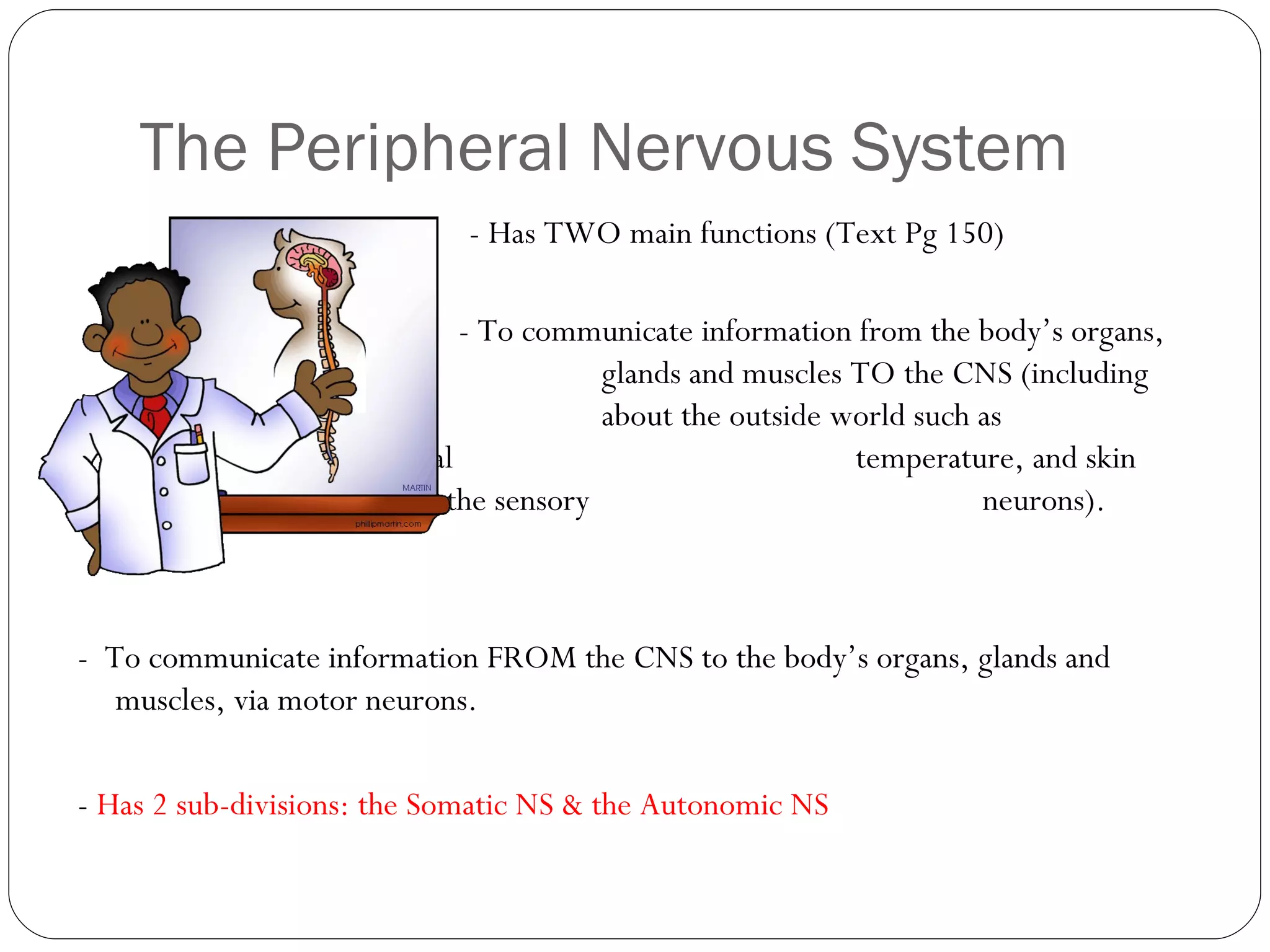
The Peripheral NervousSystem - Has TWO main functions (Text Pg 150) - To communicate information from the body’s organs, glands and muscles TO the CNS (including information about the outside world such as environmental temperature, and skin sensation, via the sensory neurons). - To communicate information FROM the CNS to the body’s organs, glands and muscles, via motor neurons. - Has 2 sub-divisions: the Somatic NS & the Autonomic NS
5.
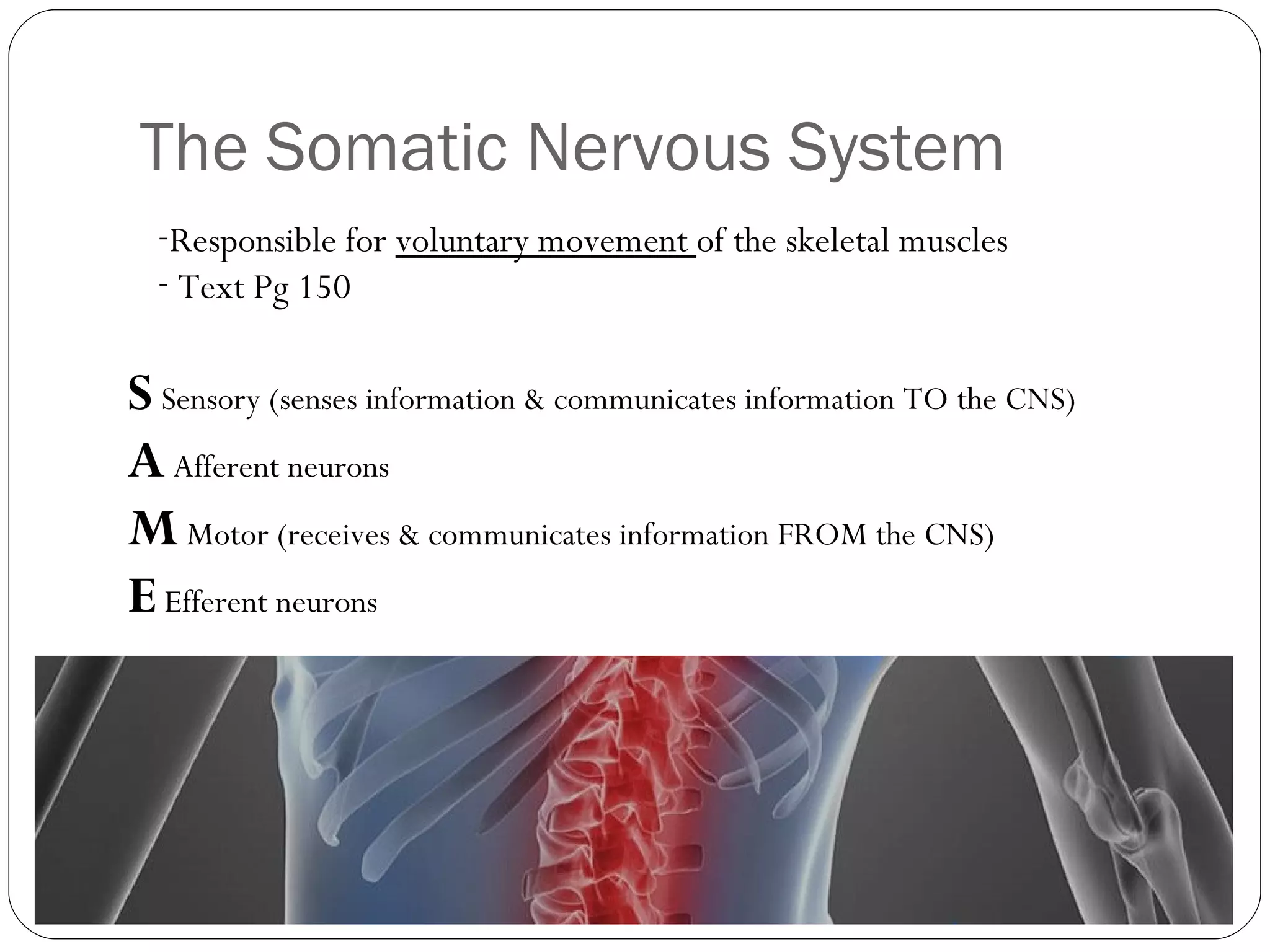
The Somatic NervousSystem S Sensory (senses information & communicates information TO the CNS) A Afferent neurons M Motor (receives & communicates information FROM the CNS) E Efferent neurons Responsible for voluntary movement of the skeletal muscles Text Pg 150
6.
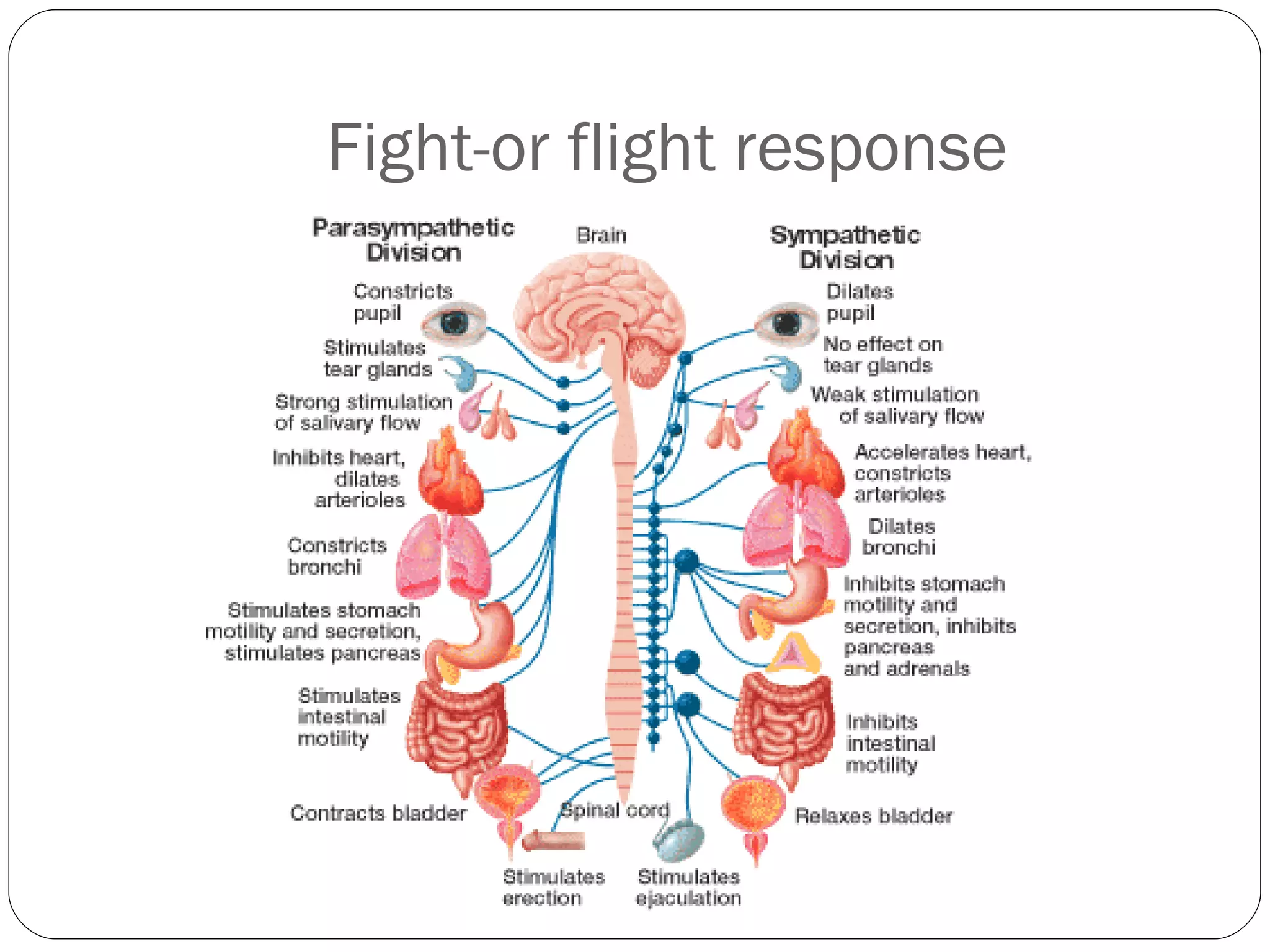
The Autonomic NervousSystem Think Autonomic = Automatic (but don’t get them mixed up!) Responsible for the regulation of automatic/involuntary operations concerned with internal bodily functions such as respiration & heart beat. Non-skeletal muscles. (Text Pg 151-153) Also has 2 divisions. The Sympathetic & Parasympathetic Nervous systems which are responsible for the fight-or-flight response. Key Terms: Do you know what these mean? Fight-or-flight response Arousal Physiological response Homeostasis
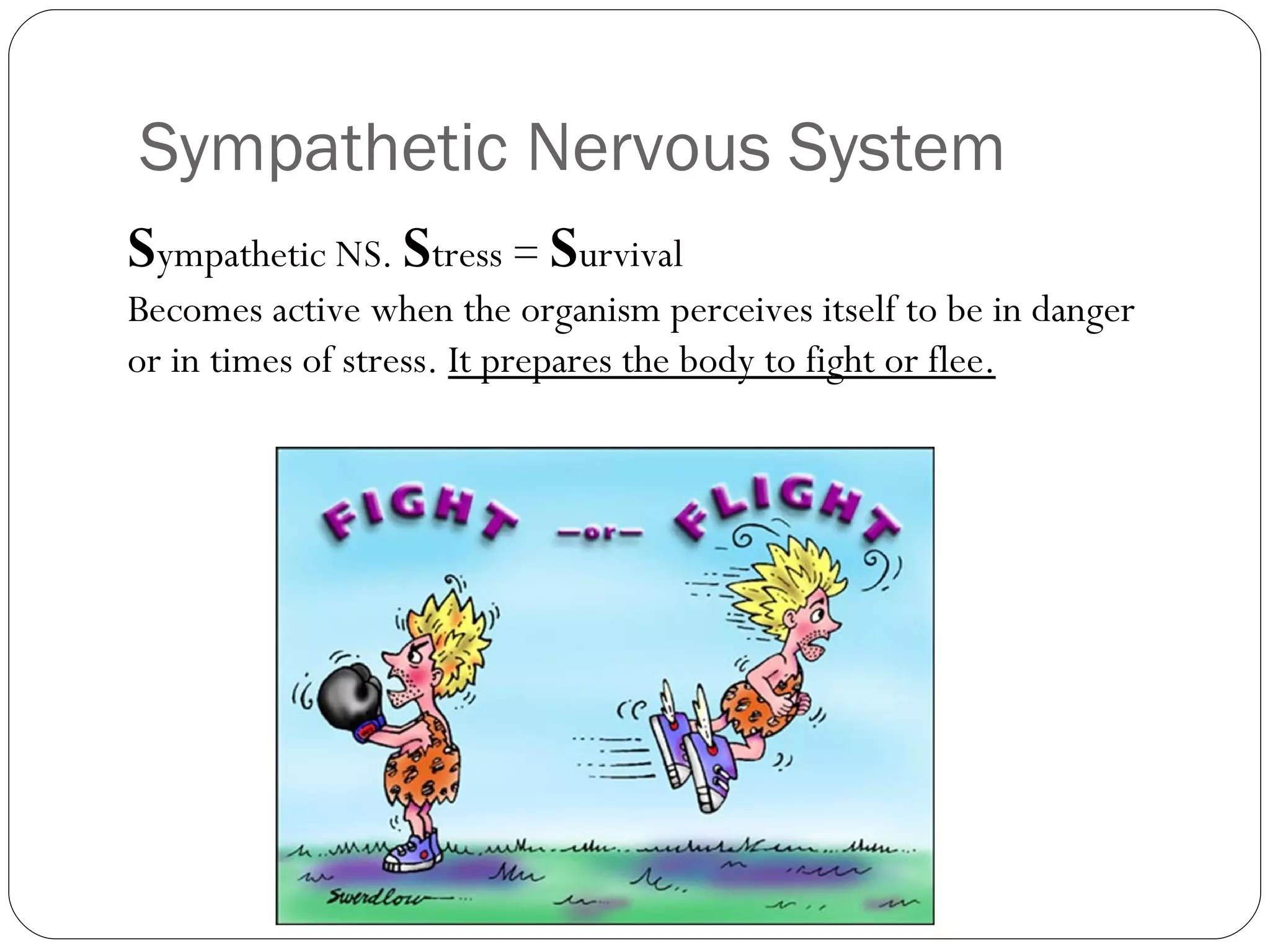
Sympathetic Nervous SystemS ympathetic NS. S tress = S urvival Becomes active when the organism perceives itself to be in danger or in times of stress. It prepares the body to fight or flee.
9.
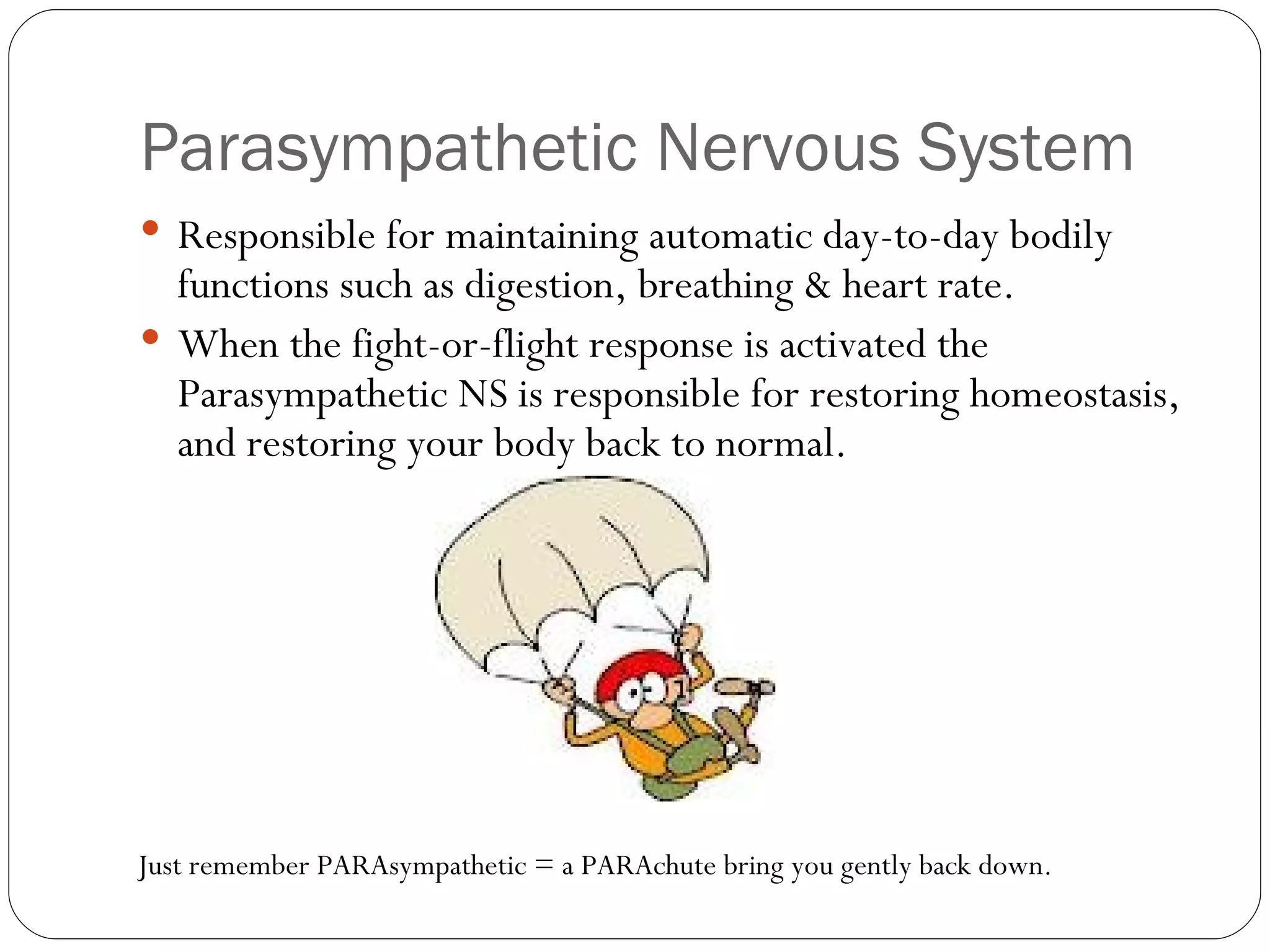
Parasympathetic Nervous SystemResponsible for maintaining automatic day-to-day bodily functions such as digestion, breathing & heart rate. When the fight-or-flight response is activated the Parasympathetic NS is responsible for restoring homeostasis, and restoring your body back to normal. Just remember PARAsympathetic = a PARAchute bring you gently back down.
10.
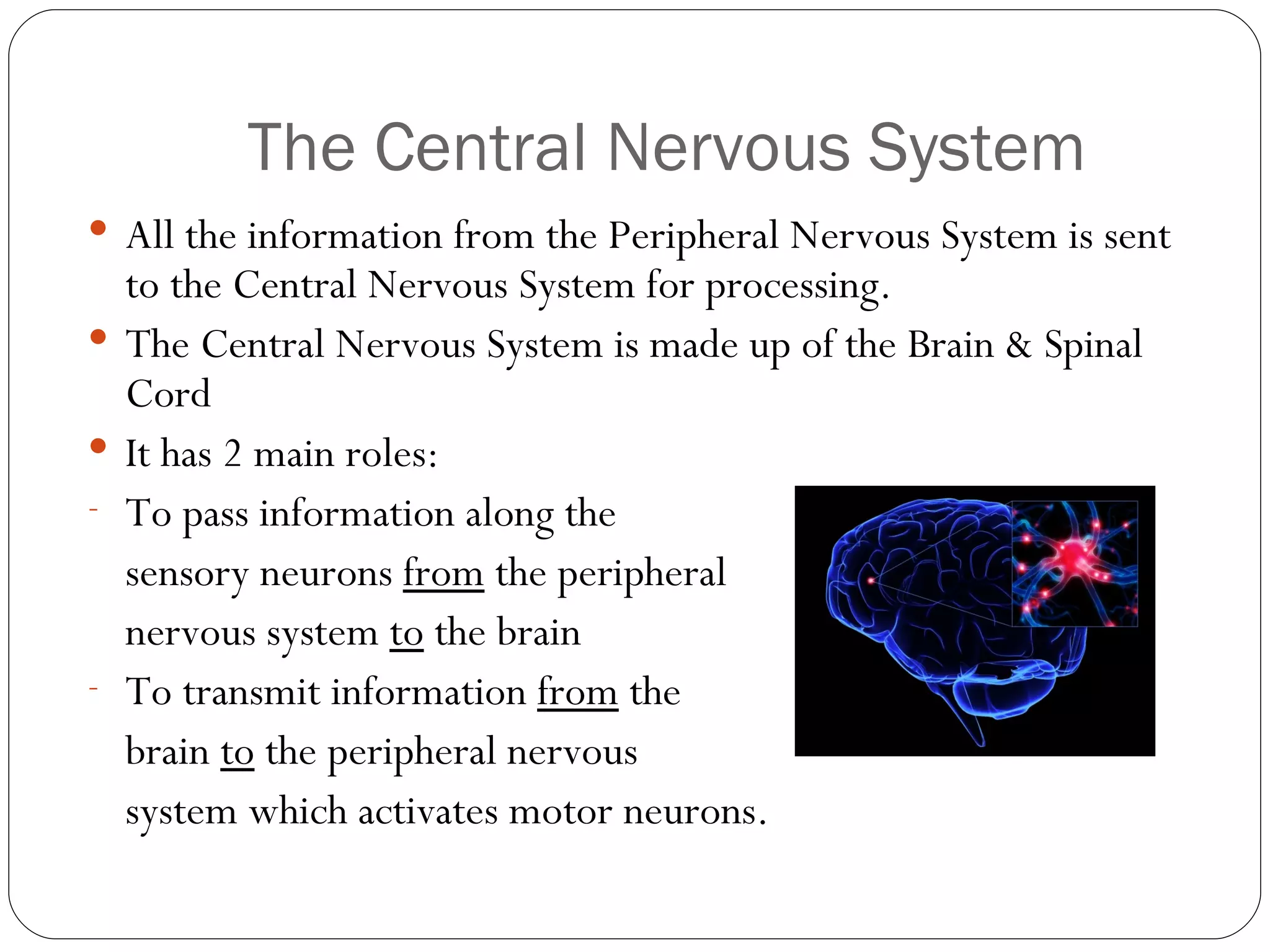
The Central NervousSystem All the information from the Peripheral Nervous System is sent to the Central Nervous System for processing. The Central Nervous System is made up of the Brain & Spinal Cord It has 2 main roles: To pass information along the sensory neurons from the peripheral nervous system to the brain To transmit information from the brain to the peripheral nervous system which activates motor neurons.
11.
Comparison of thePNS & CNS The role of the CNS is to integrate and co-ordinate all of the incoming neural information and to initiate neural messages to the rest of the body. The role of the PNS is to carry information from the sensory and internal organs TO the CNS and carry information FROM the CNS to muscles, organs and glands.
12.
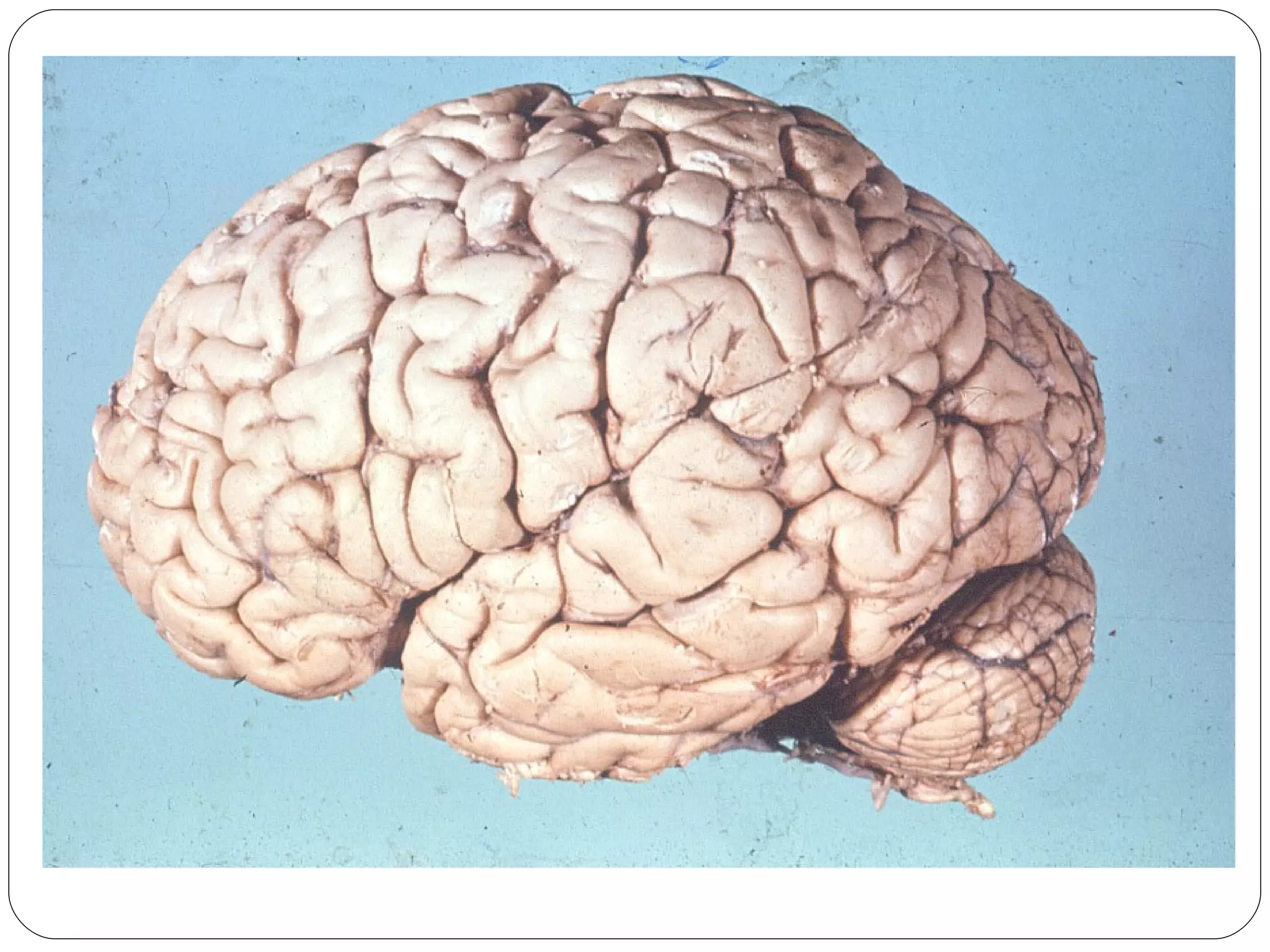
The Brain Thebrain is broken into two halves known as Cerebral Hemispheres. The two halves are connected by the Corpus Callosum , which is a dense bundle of nerve fibres that allow the two hemispheres to communicate with each other. The Cerebrum is covered by the Cerebral Cortex which is spongy grey matter approximately 3-4mm thick that protects the brain. The surface of each area is highly convoluted (wrinkled) to increase the surface area
13.
14.
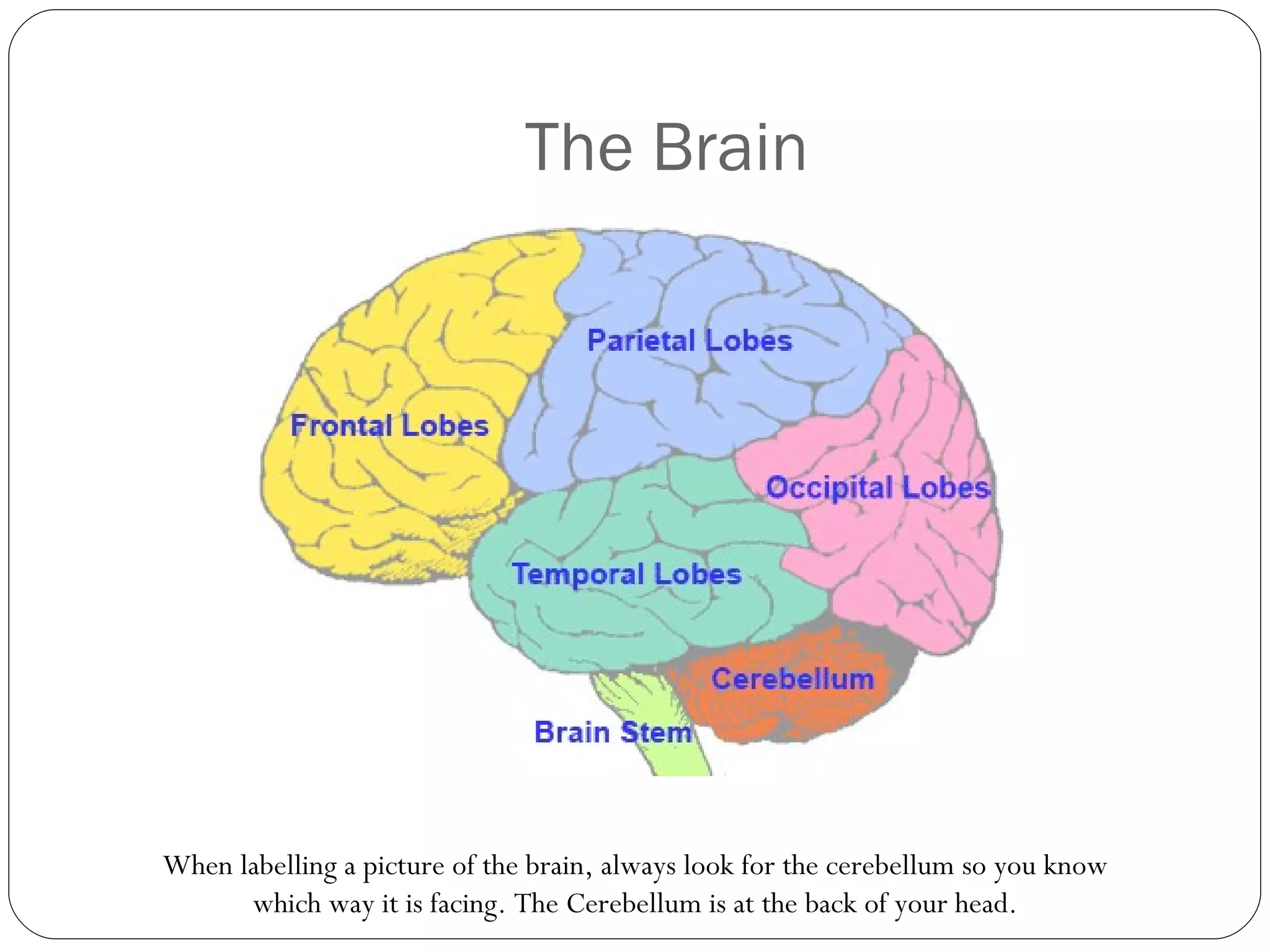
The Brain Whenlabelling a picture of the brain, always look for the cerebellum so you know which way it is facing. The Cerebellum is at the back of your head.
#9 Stress: a psychological and physical response to internal or external sources of tension (stressors) that challenge a person’s ability to cope. These sources of tension/stressors can be positive, negative, environmental psychological or social in nature.



![The nervous system[1]](https://cdn.slidesharecdn.com/ss_thumbnails/thenervoussystem1-100413143207-phpapp02-thumbnail.jpg?width=640&height=640&fit=bounds)


