Visual Tracking and Fixing
Visual Tracking

•   Why Visual Tracking ?
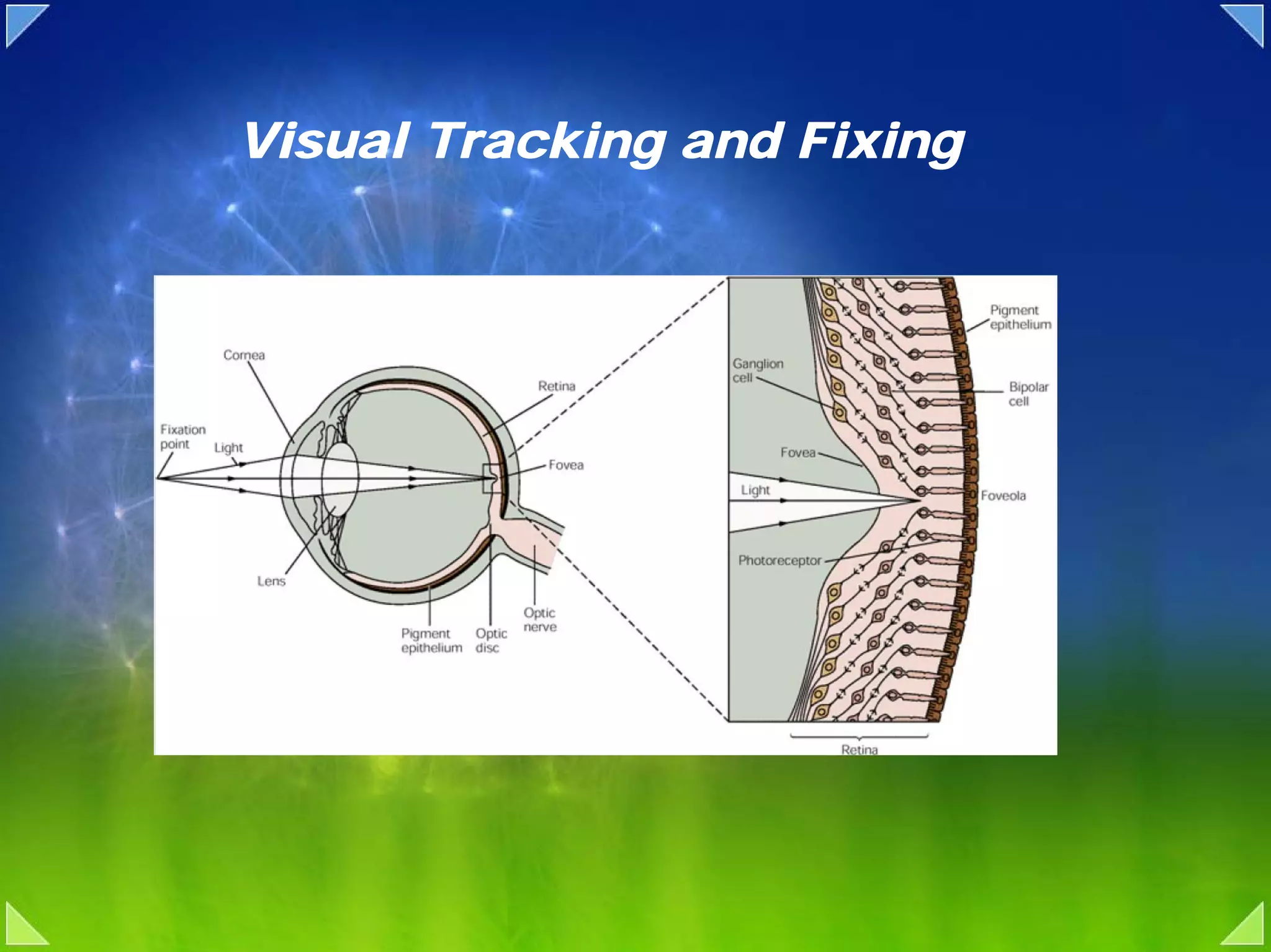
    –   To keep the image in the Fovea which is less than 1mm size and
        detect visual field of less than diameter of full moon.
    –   It keeps the eye still when the image is still and stabilizes the
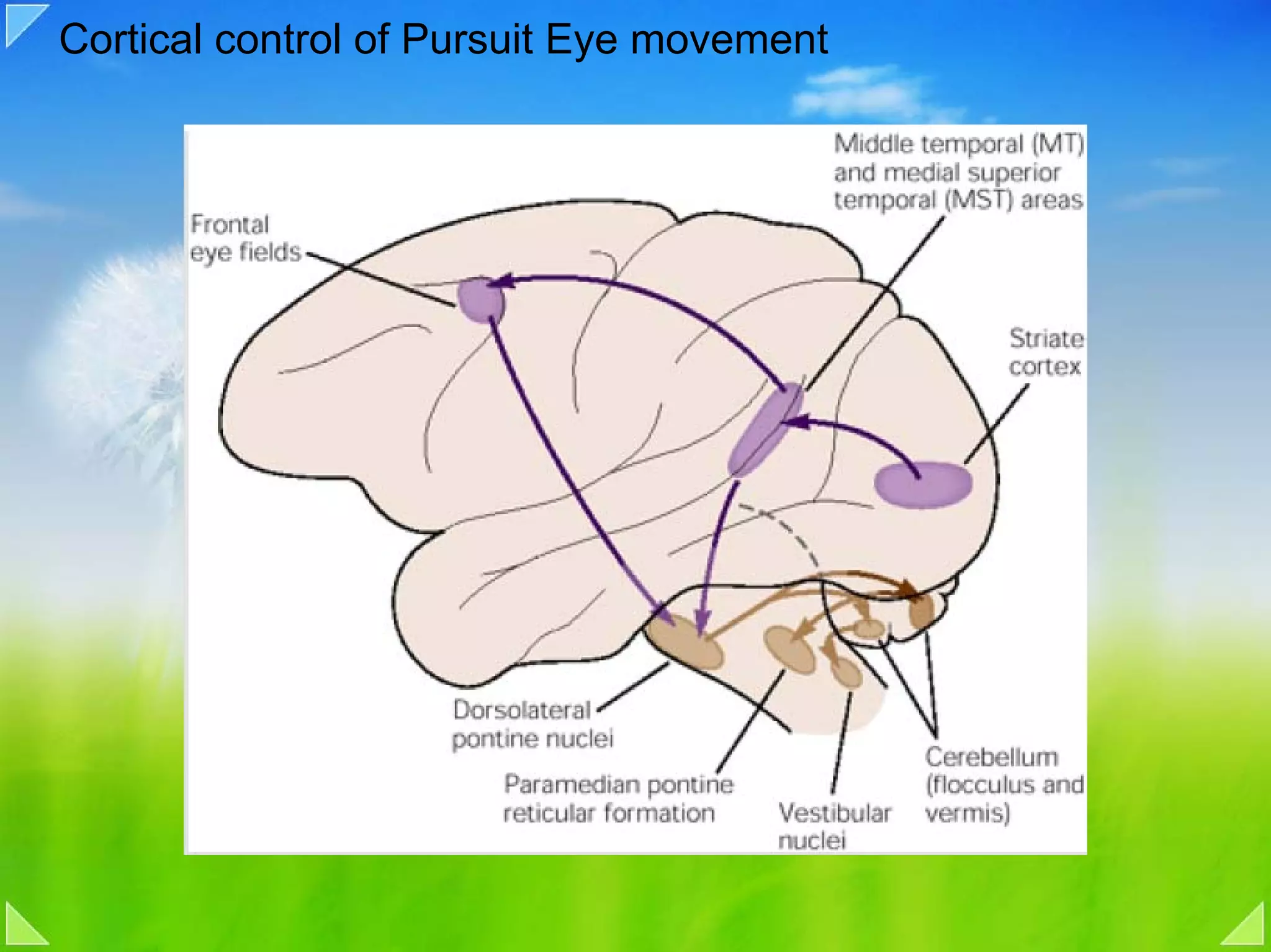
        image when the object moves in the world or when the head itself
        moves.


•   How Visual Tracking?
    –   Oculomotor system: moves the eye in the orbit
    –   Head movement which moves the orbit in the space
    –   Information of head motion processed by the vestibular system
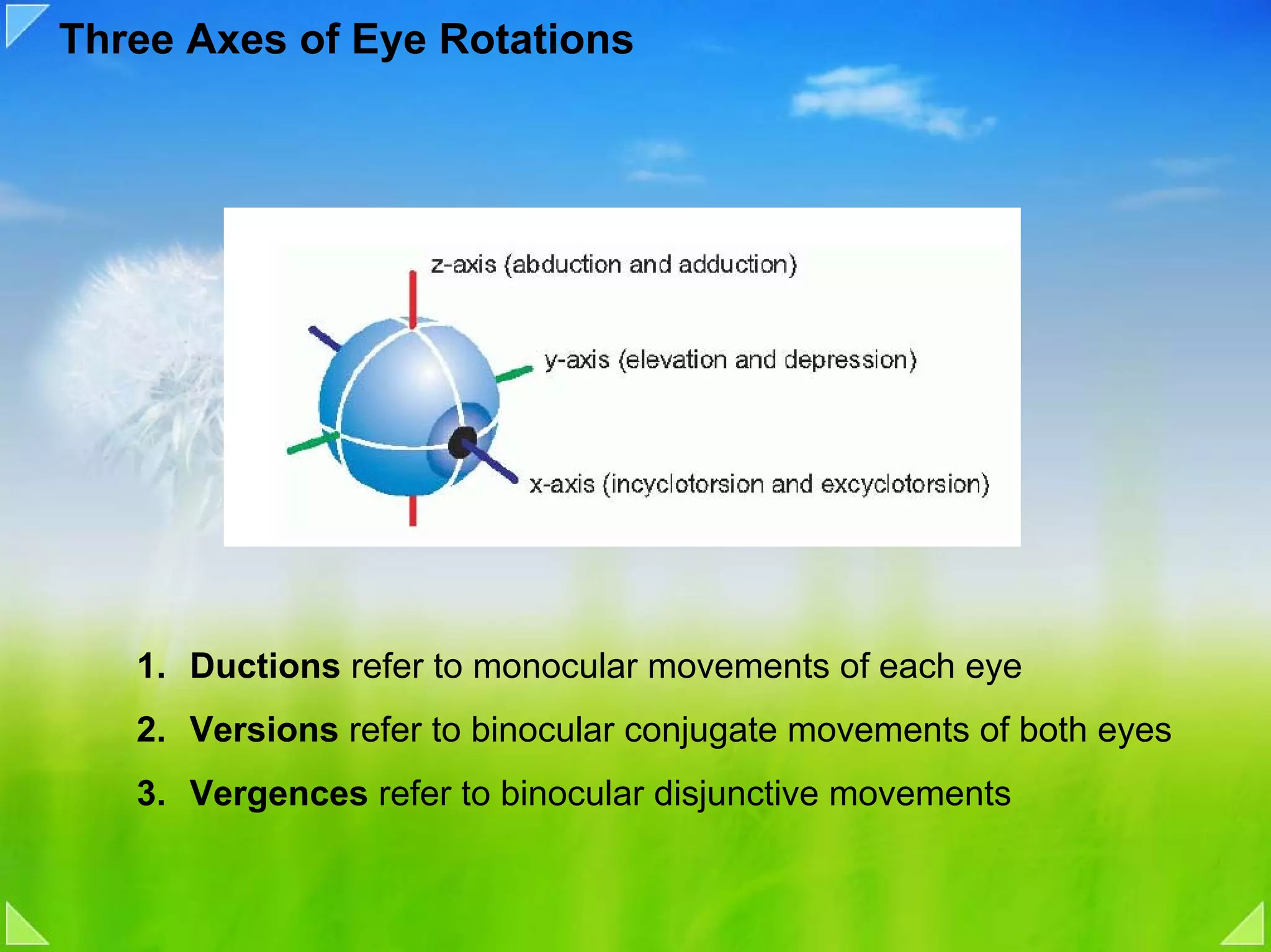
Three Axes of Eye Rotations


   1. Ductions refer to monocular movements of each eye
   2. Versions refer to binocular conjugate movements of both eyes
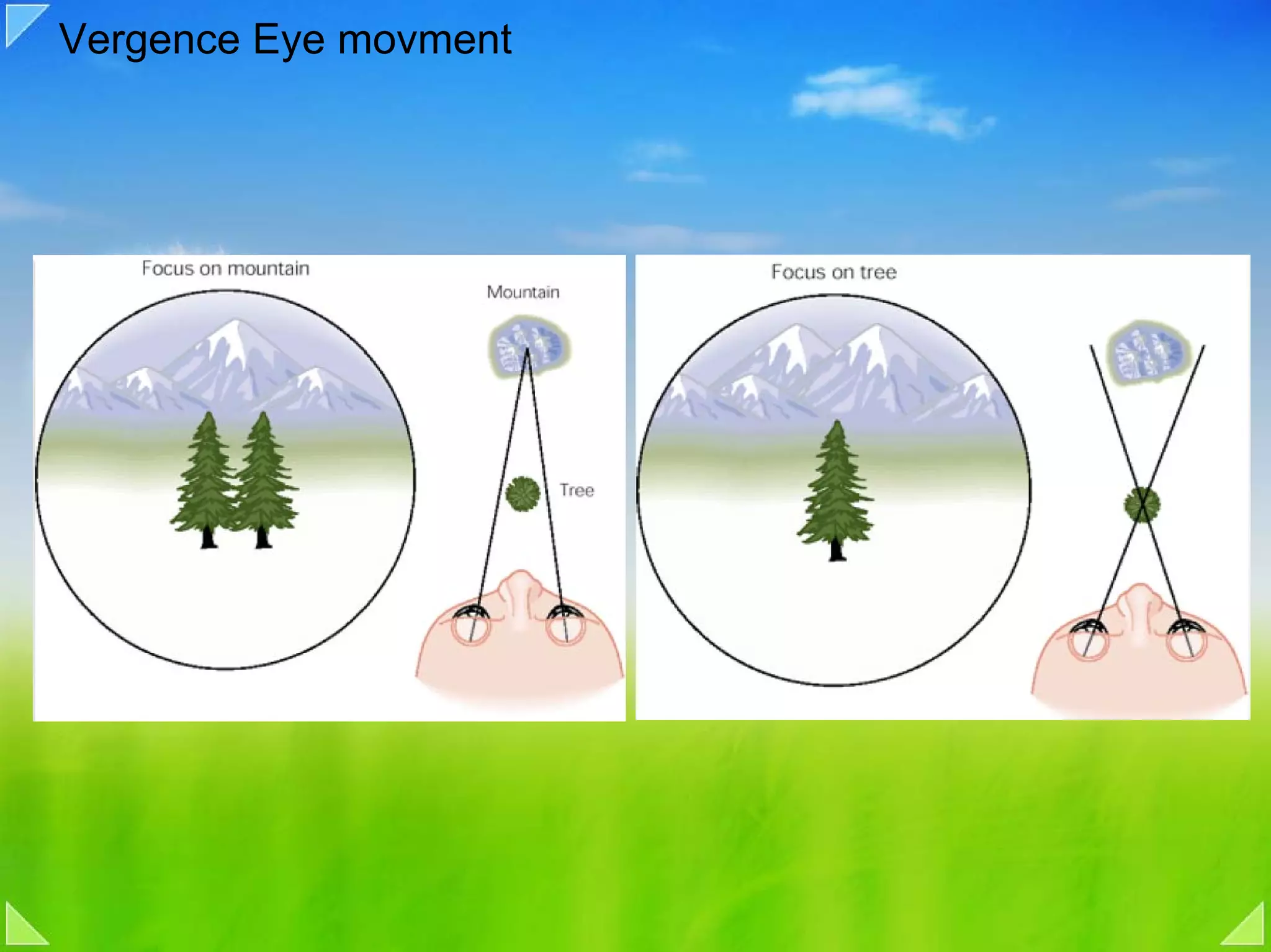
   3. Vergences refer to binocular disjunctive movements
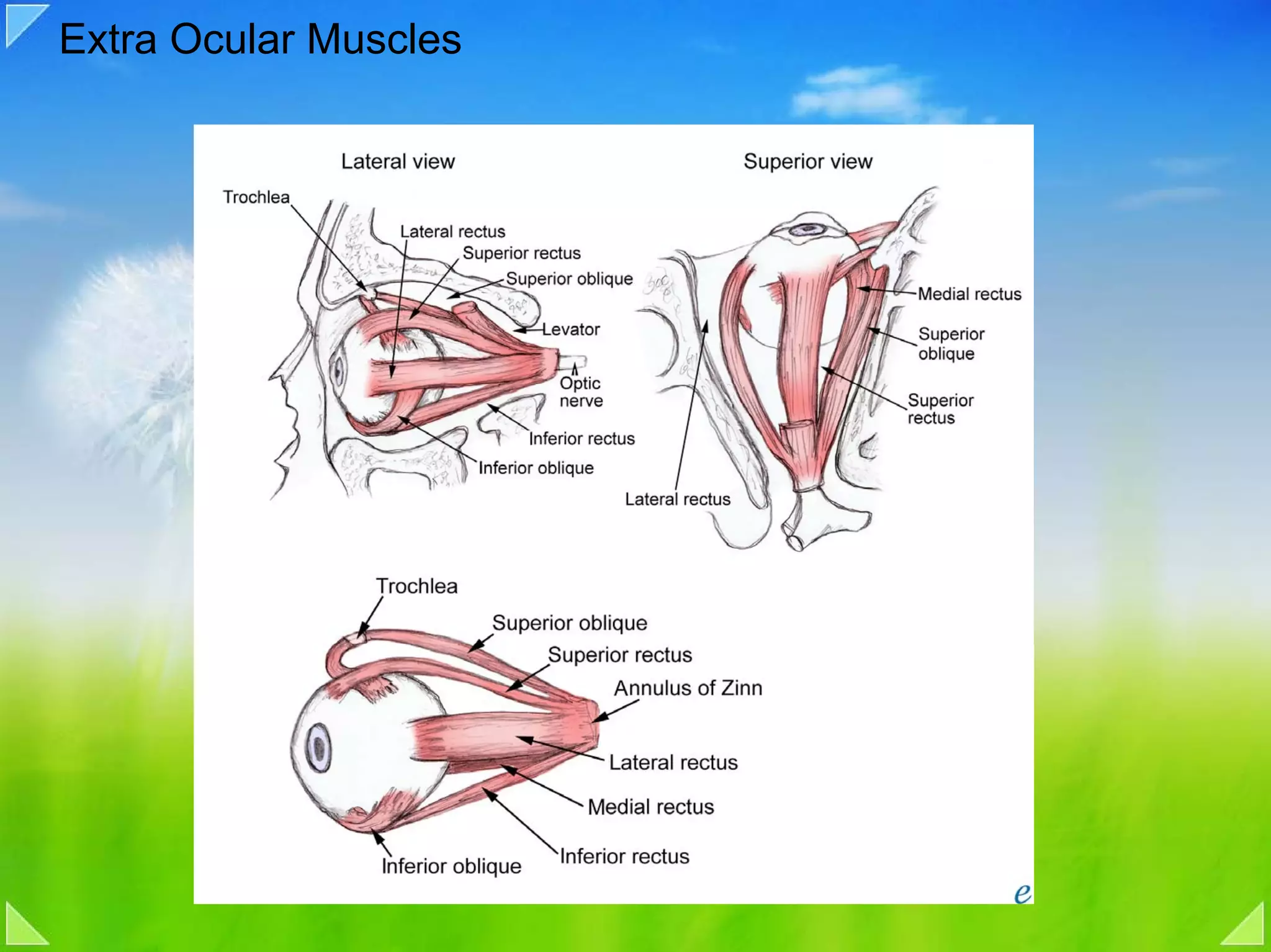
Extra Ocular Muscles
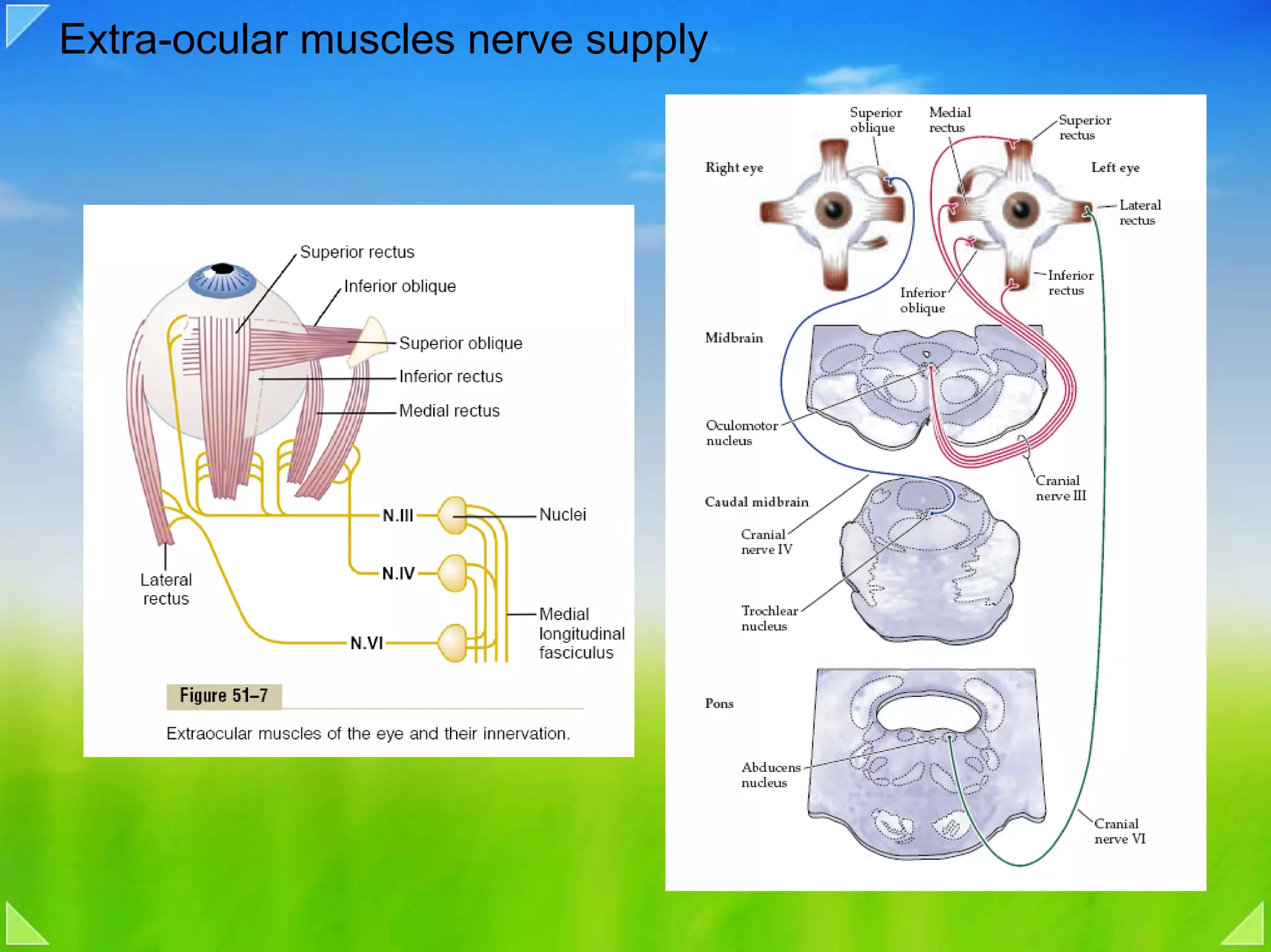
Extra-ocular muscles nerve supply
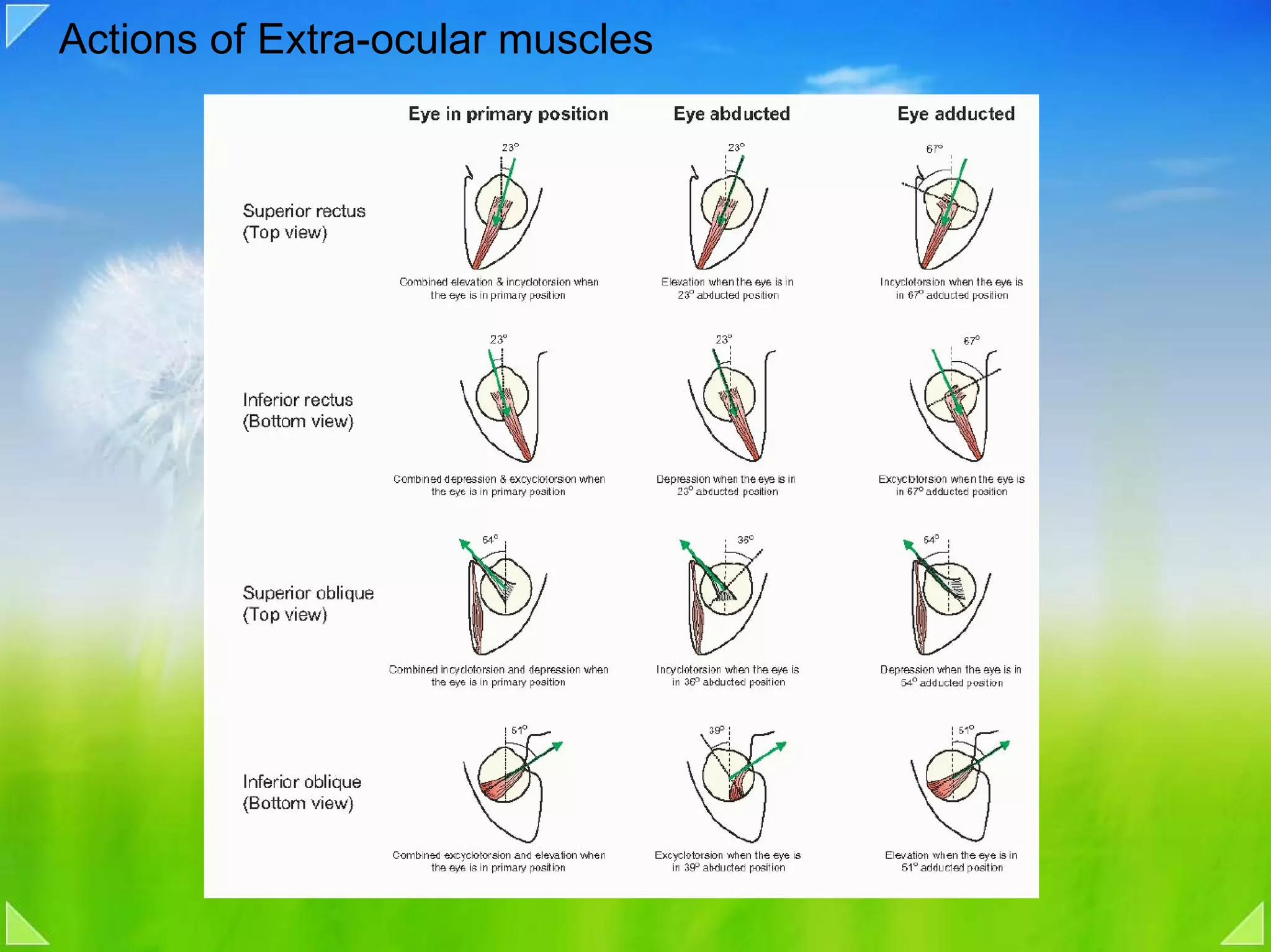
Actions of Extra-ocular muscles
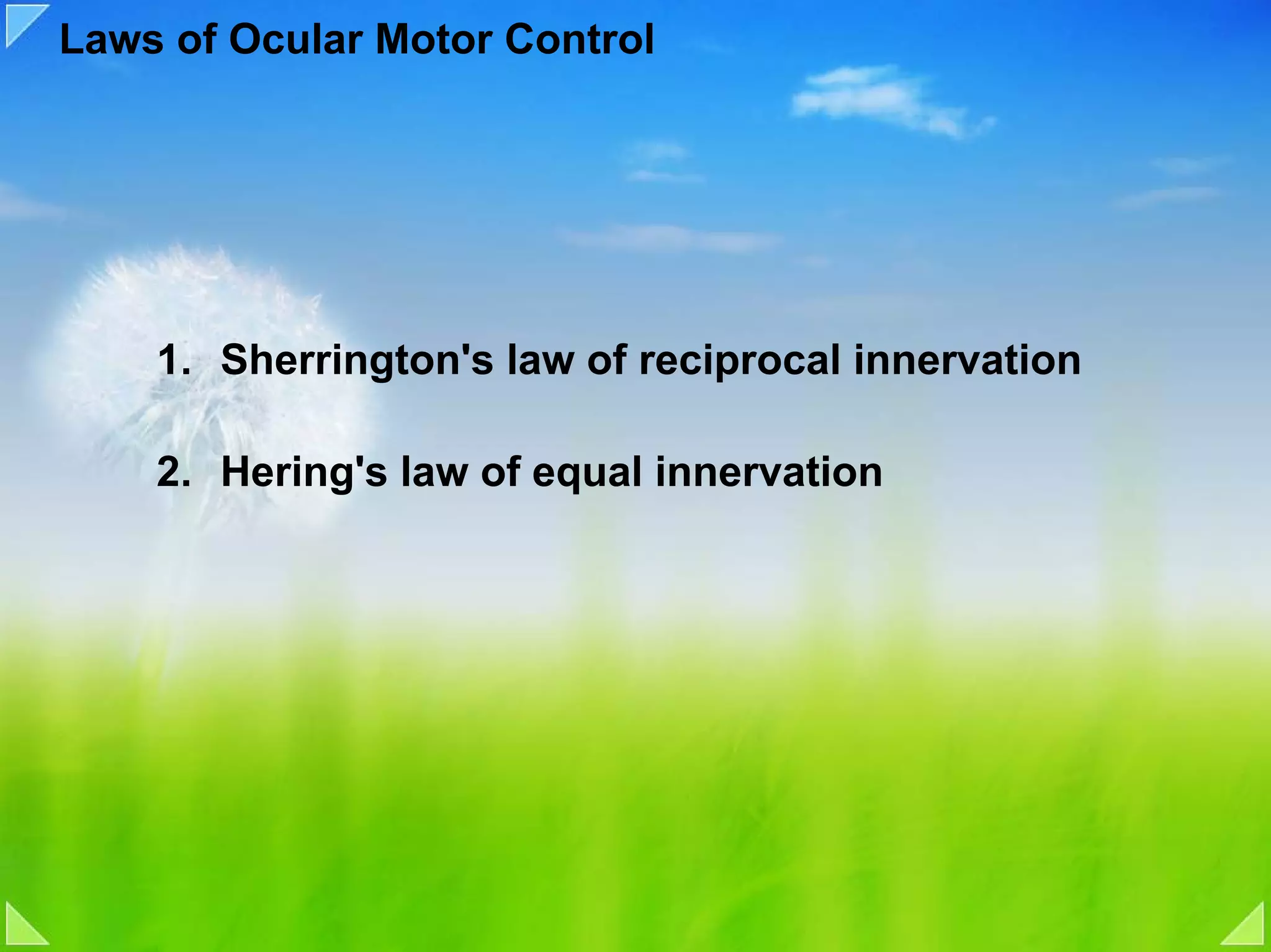
Laws of Ocular Motor Control


    1. Sherrington's law of reciprocal innervation

    2. Hering's law of equal innervation
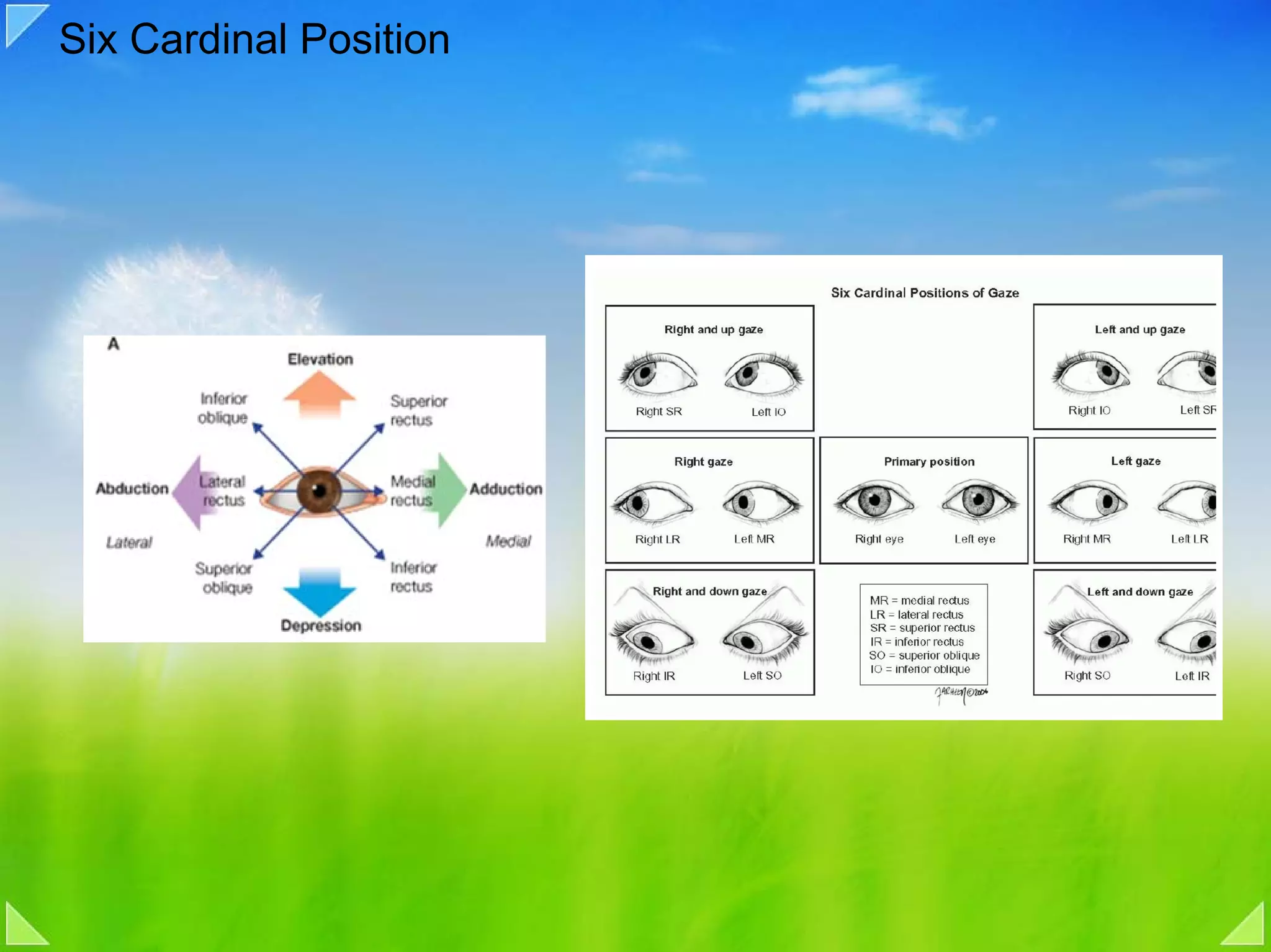
Six Cardinal Position
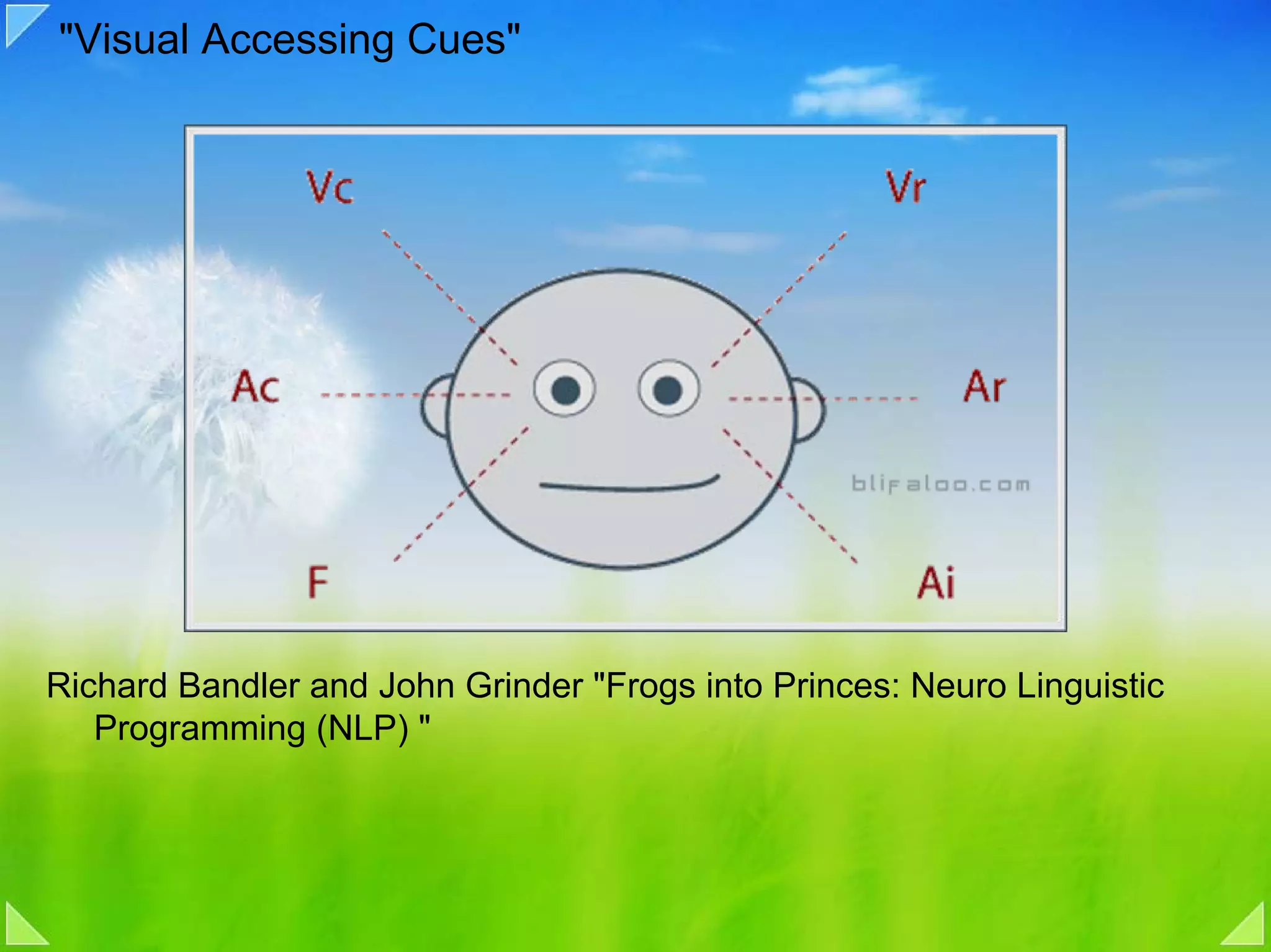
"Visual Accessing Cues"


Richard Bandler and John Grinder "Frogs into Princes: Neuro Linguistic
   Programming (NLP) "
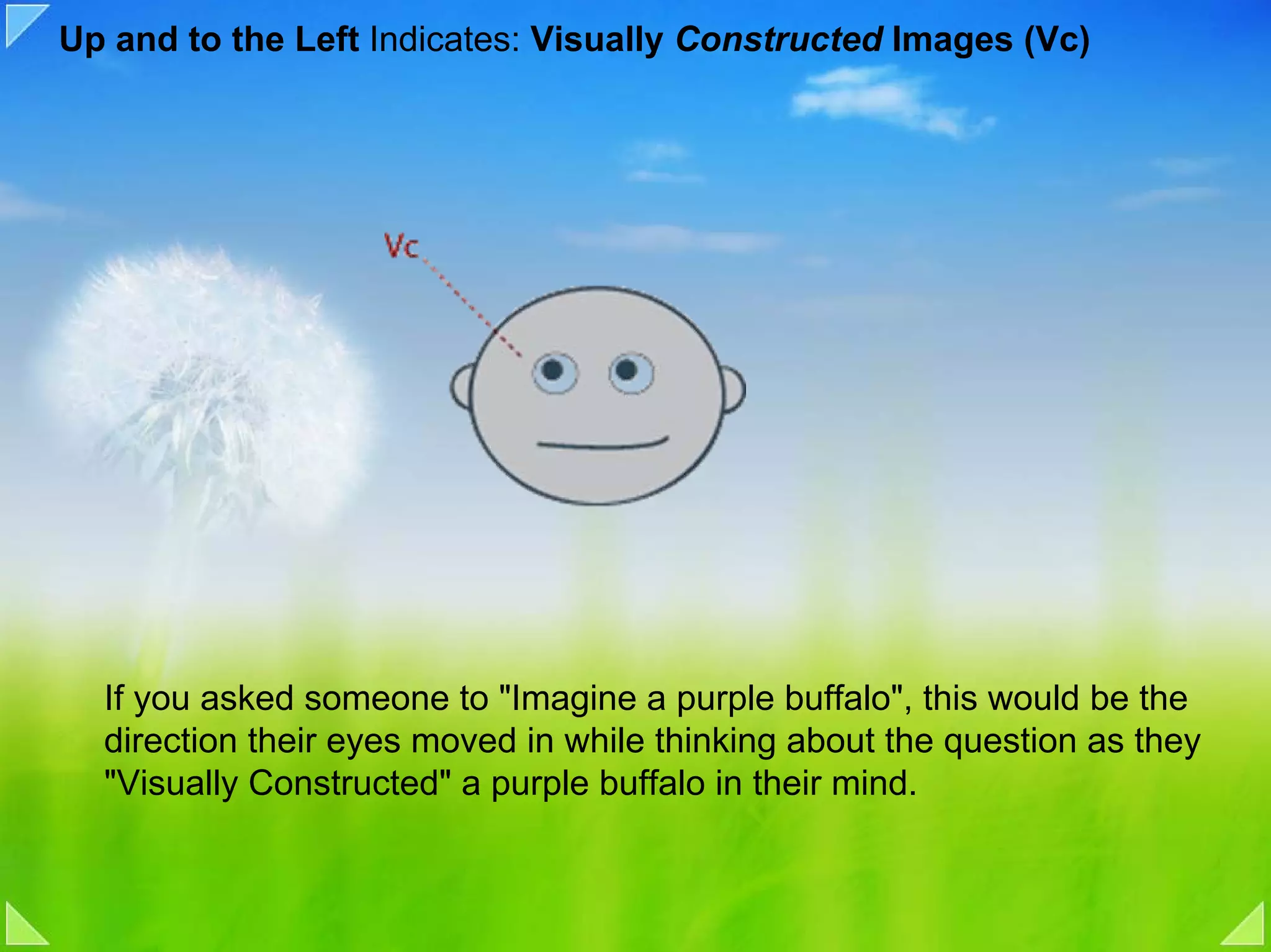
Up and to the Left Indicates: Visually Constructed Images (Vc)


  If you asked someone to "Imagine a purple buffalo", this would be the
  direction their eyes moved in while thinking about the question as they
  "Visually Constructed" a purple buffalo in their mind.
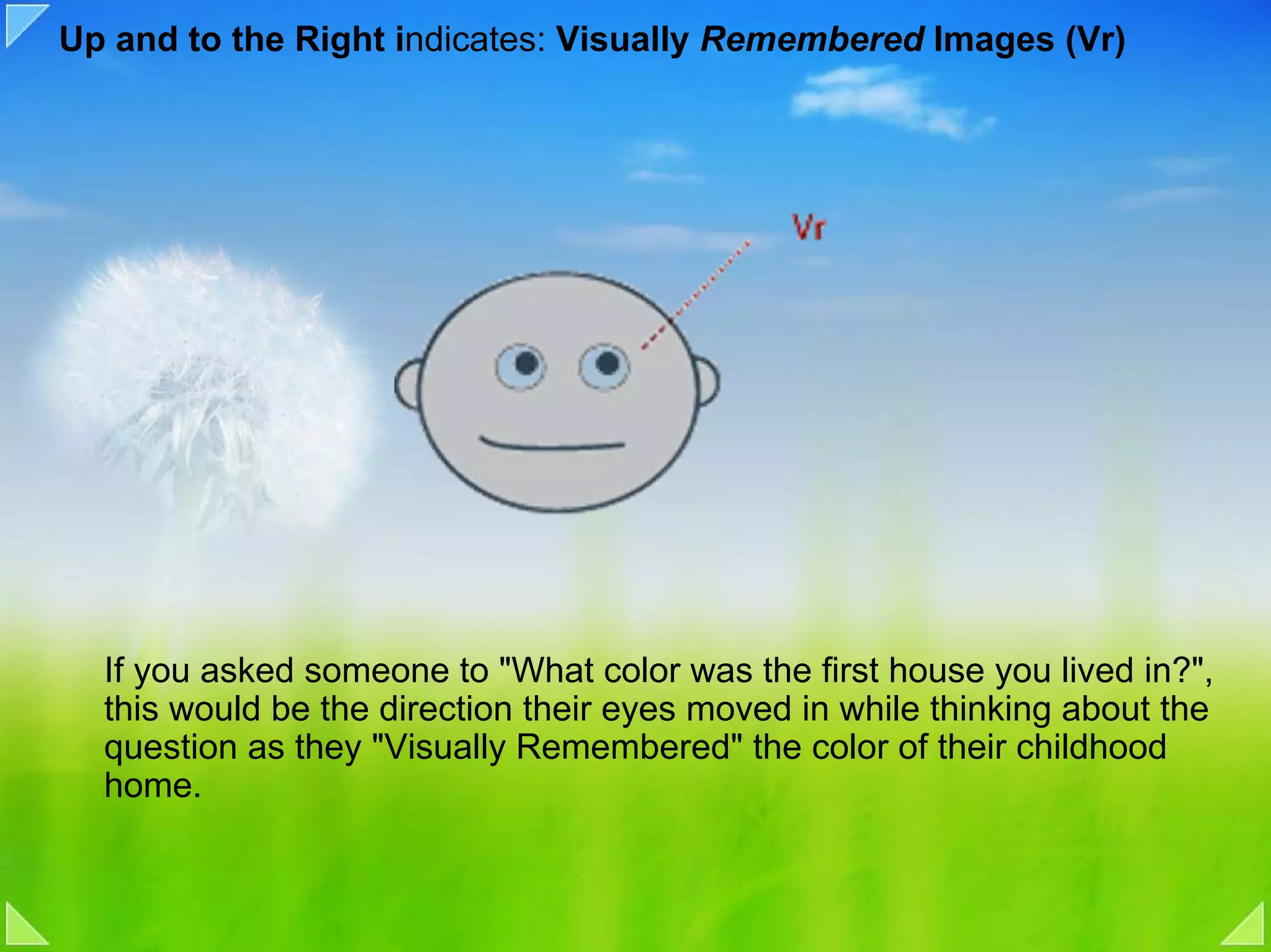
Up and to the Right indicates: Visually Remembered Images (Vr)


  If you asked someone to "What color was the first house you lived in?",
  this would be the direction their eyes moved in while thinking about the
  question as they "Visually Remembered" the color of their childhood
  home.
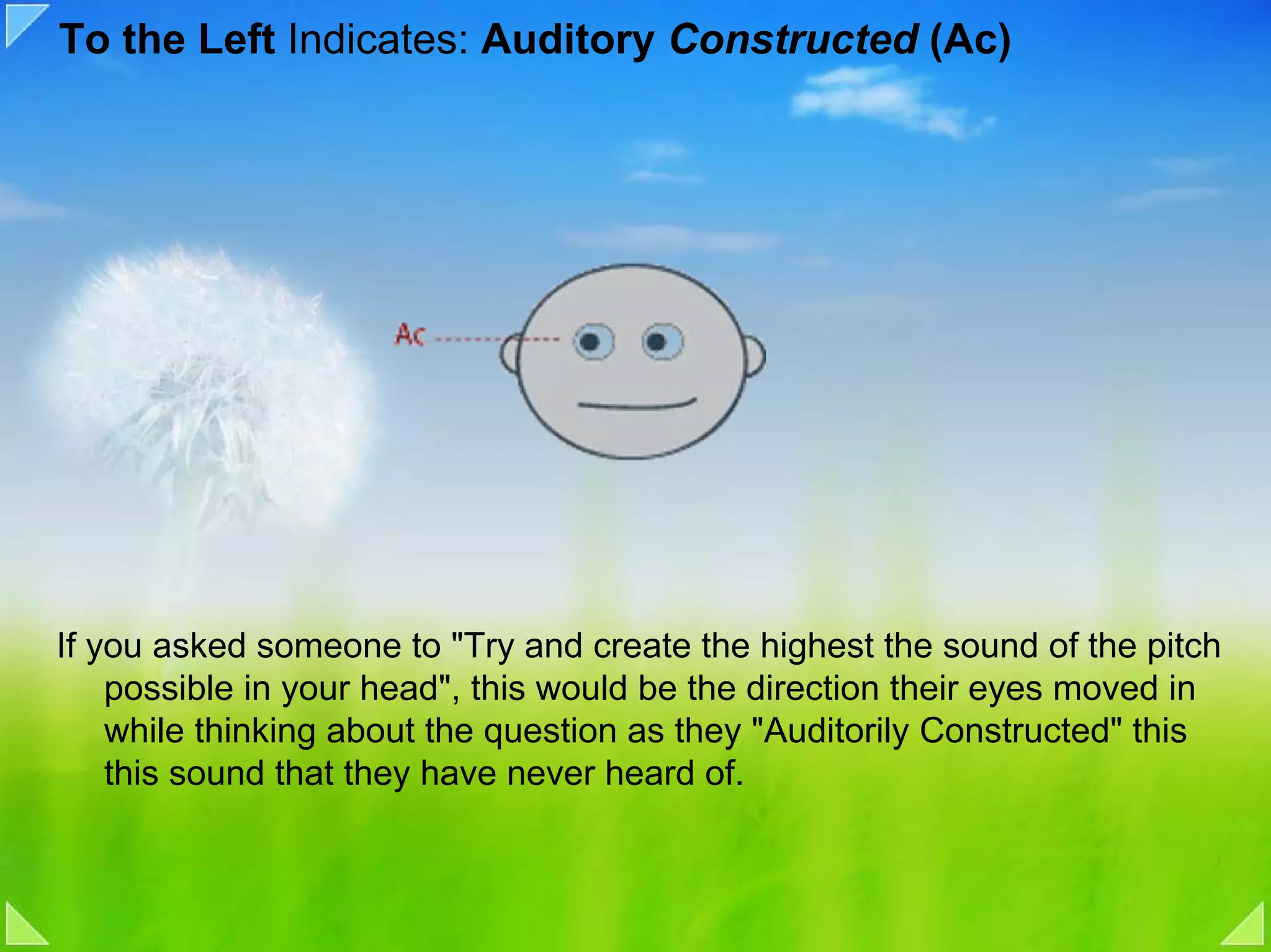
To the Left Indicates: Auditory Constructed (Ac)


If you asked someone to "Try and create the highest the sound of the pitch
    possible in your head", this would be the direction their eyes moved in
    while thinking about the question as they "Auditorily Constructed" this
    this sound that they have never heard of.
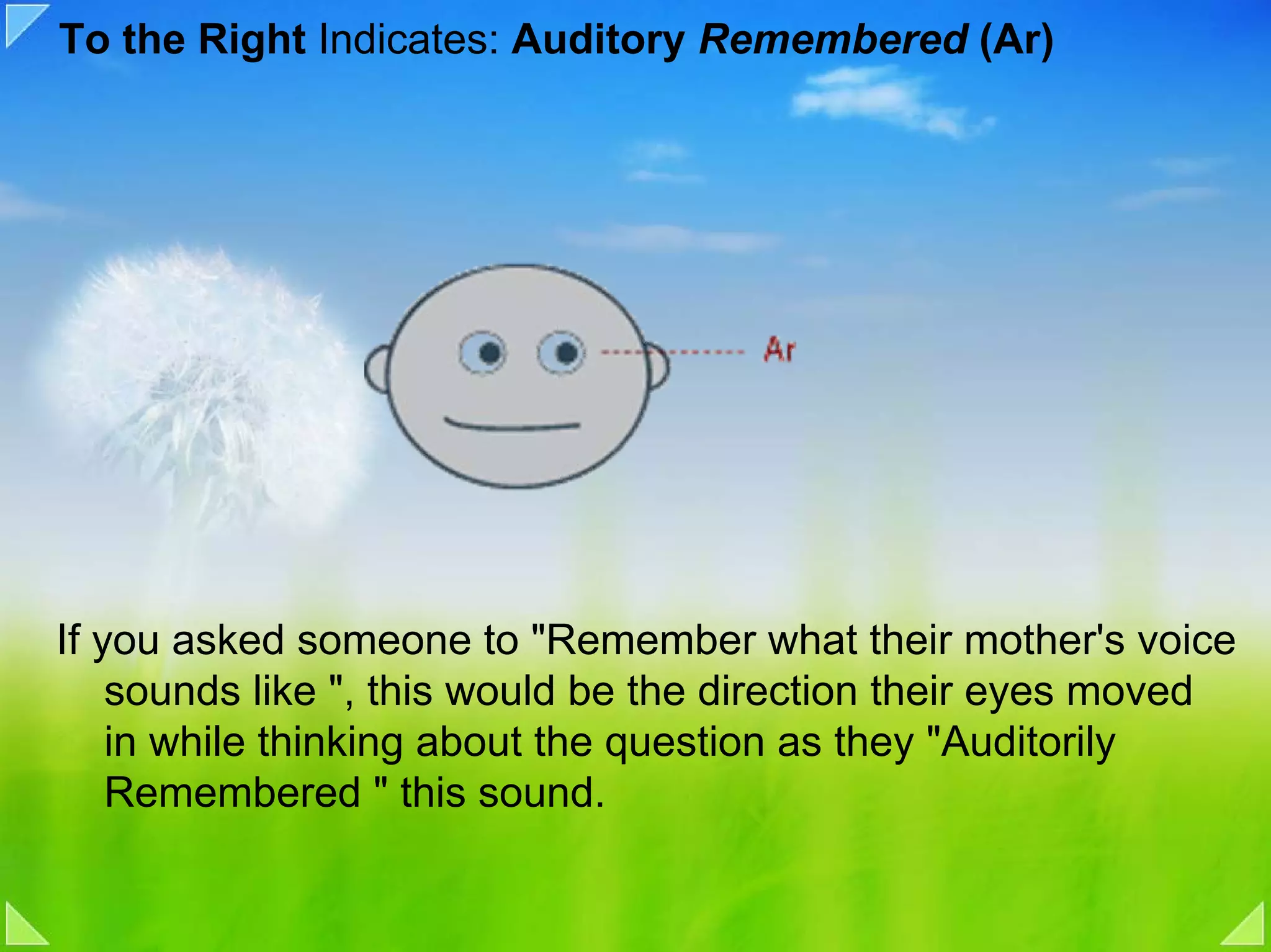
To the Right Indicates: Auditory Remembered (Ar)


If you asked someone to "Remember what their mother's voice
    sounds like ", this would be the direction their eyes moved
    in while thinking about the question as they "Auditorily
    Remembered " this sound.
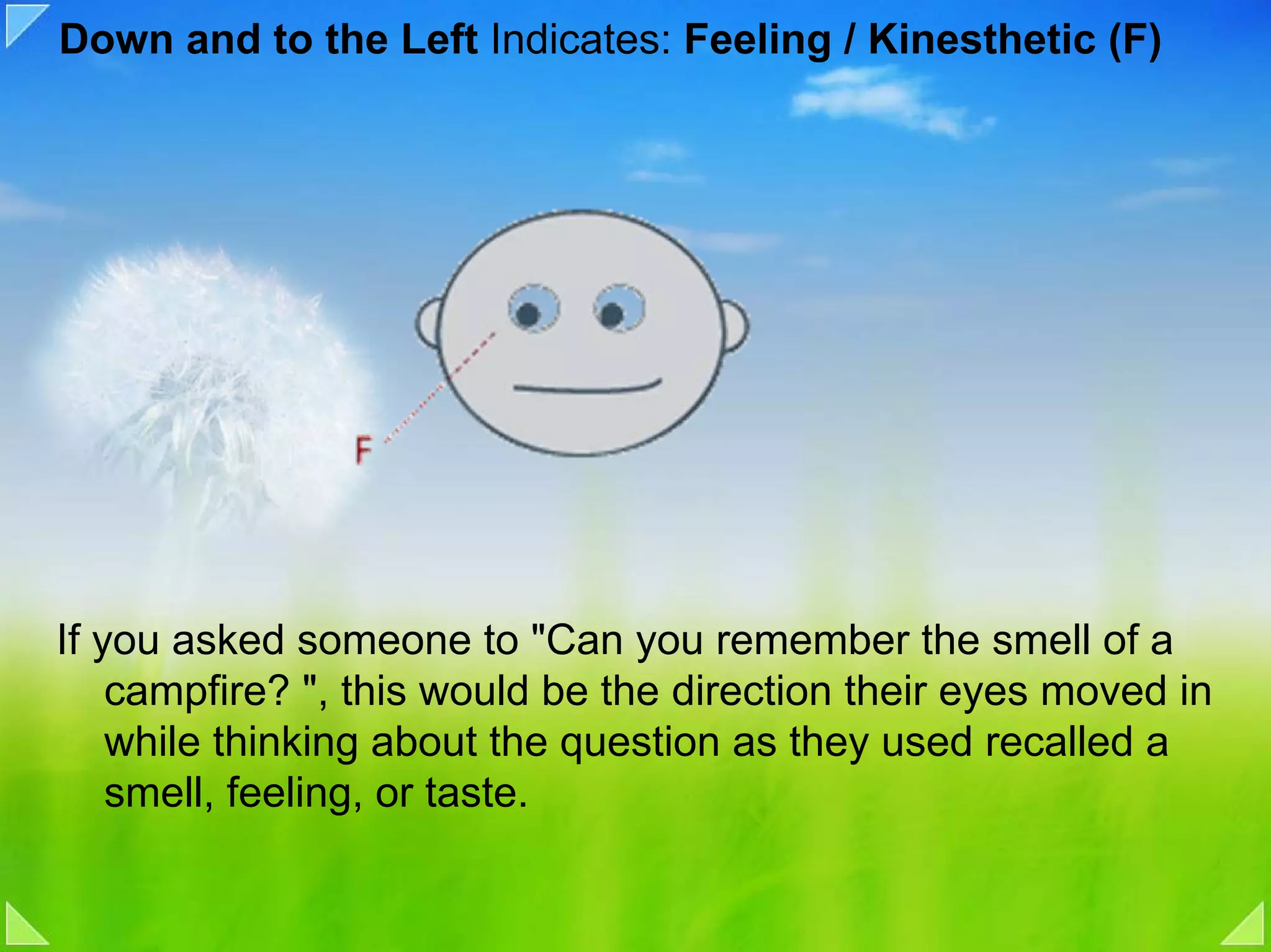
Down and to the Left Indicates: Feeling / Kinesthetic (F)


If you asked someone to "Can you remember the smell of a
    campfire? ", this would be the direction their eyes moved in
    while thinking about the question as they used recalled a
    smell, feeling, or taste.
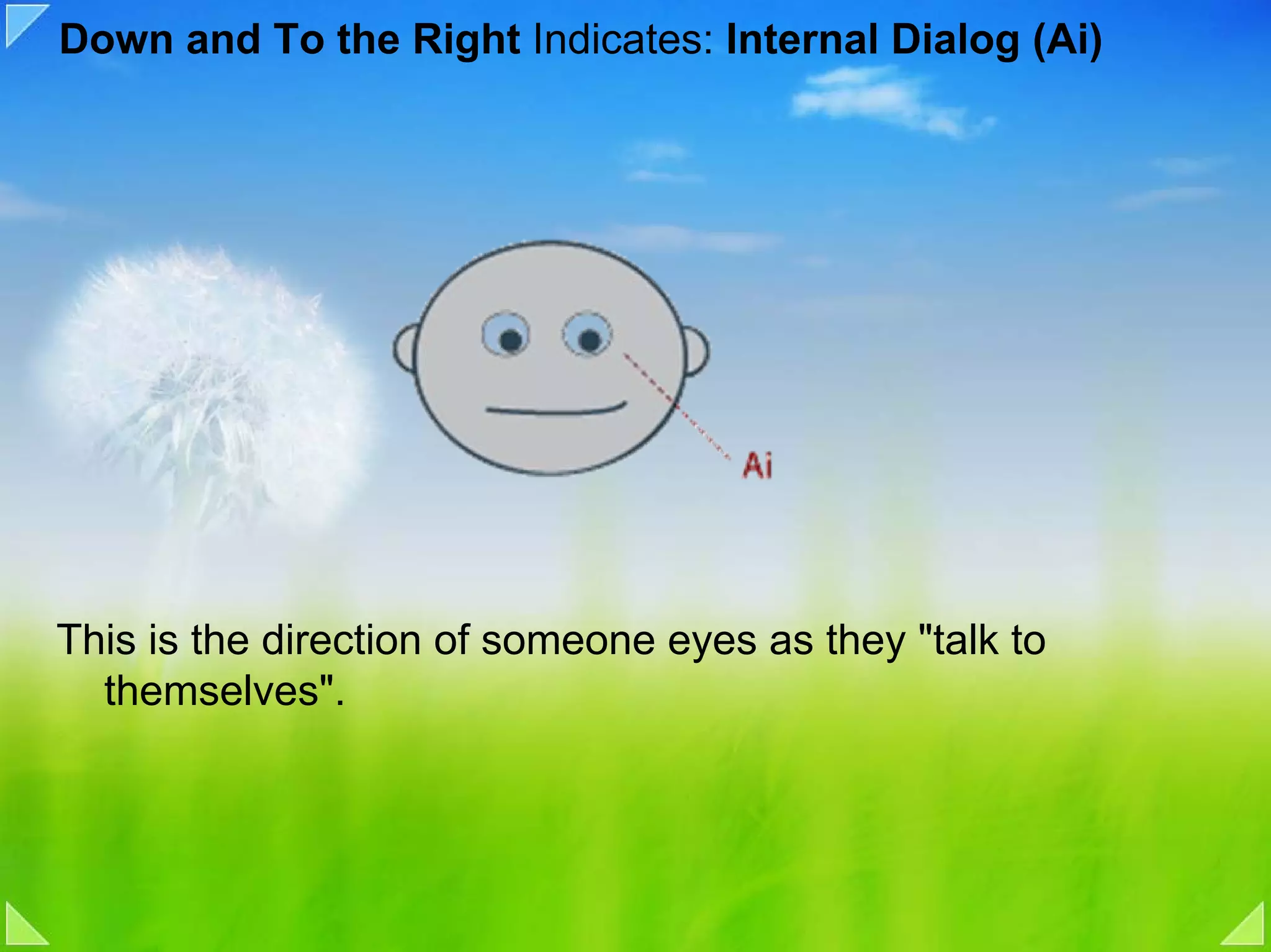
Down and To the Right Indicates: Internal Dialog (Ai)


This is the direction of someone eyes as they "talk to
  themselves".
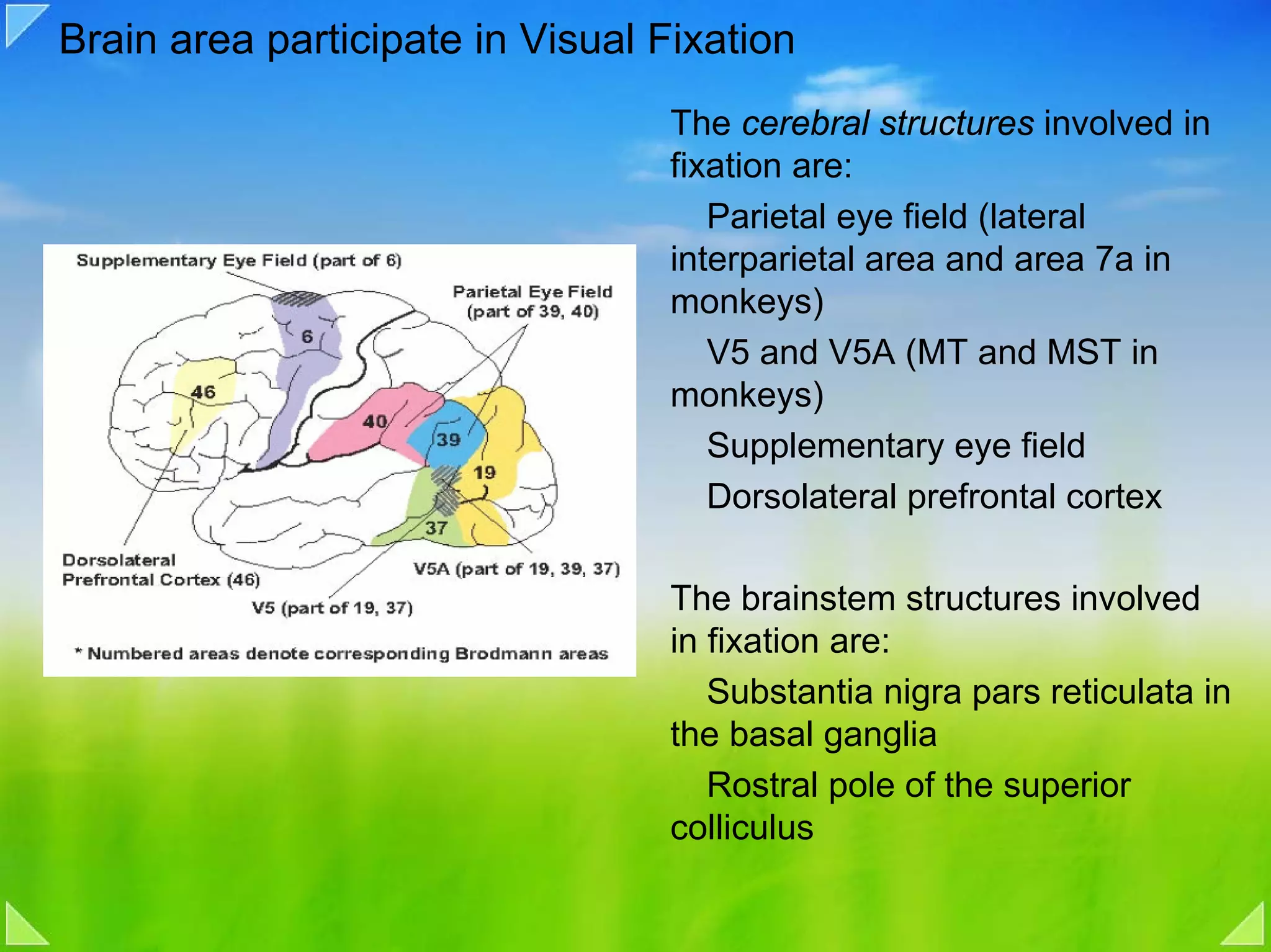
Brain area participate in Visual Fixation
                                  The cerebral structures involved in
                                  fixation are:
                                     Parietal eye field (lateral
                                  interparietal area and area 7a in
                                  monkeys)
                                     V5 and V5A (MT and MST in
                                  monkeys)
                                     Supplementary eye field
                                     Dorsolateral prefrontal cortex

                                  The brainstem structures involved
                                  in fixation are:
                                     Substantia nigra pars reticulata in
                                  the basal ganglia
                                     Rostral pole of the superior
                                  colliculus
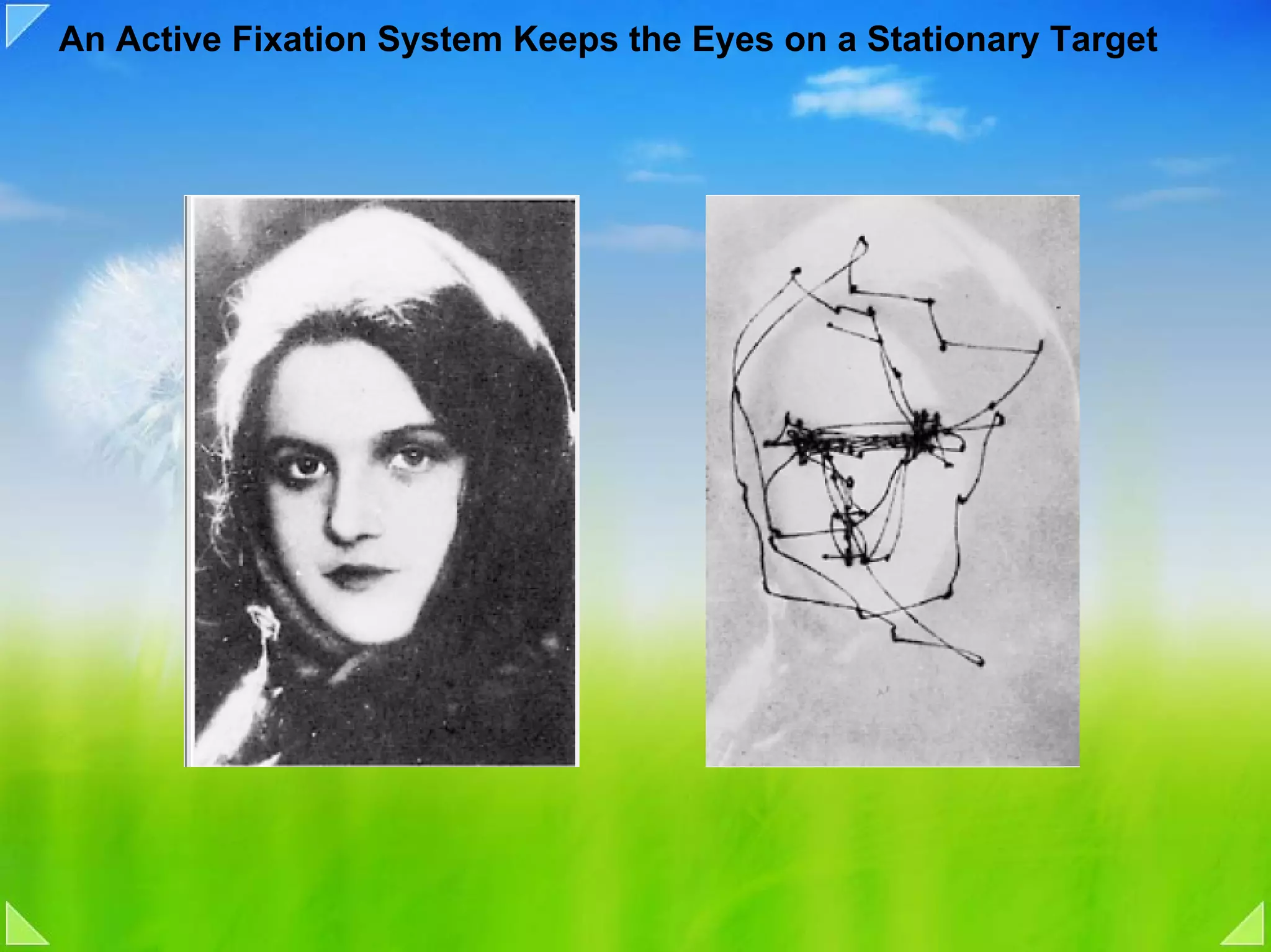
An Active Fixation System Keeps the Eyes on a Stationary Target
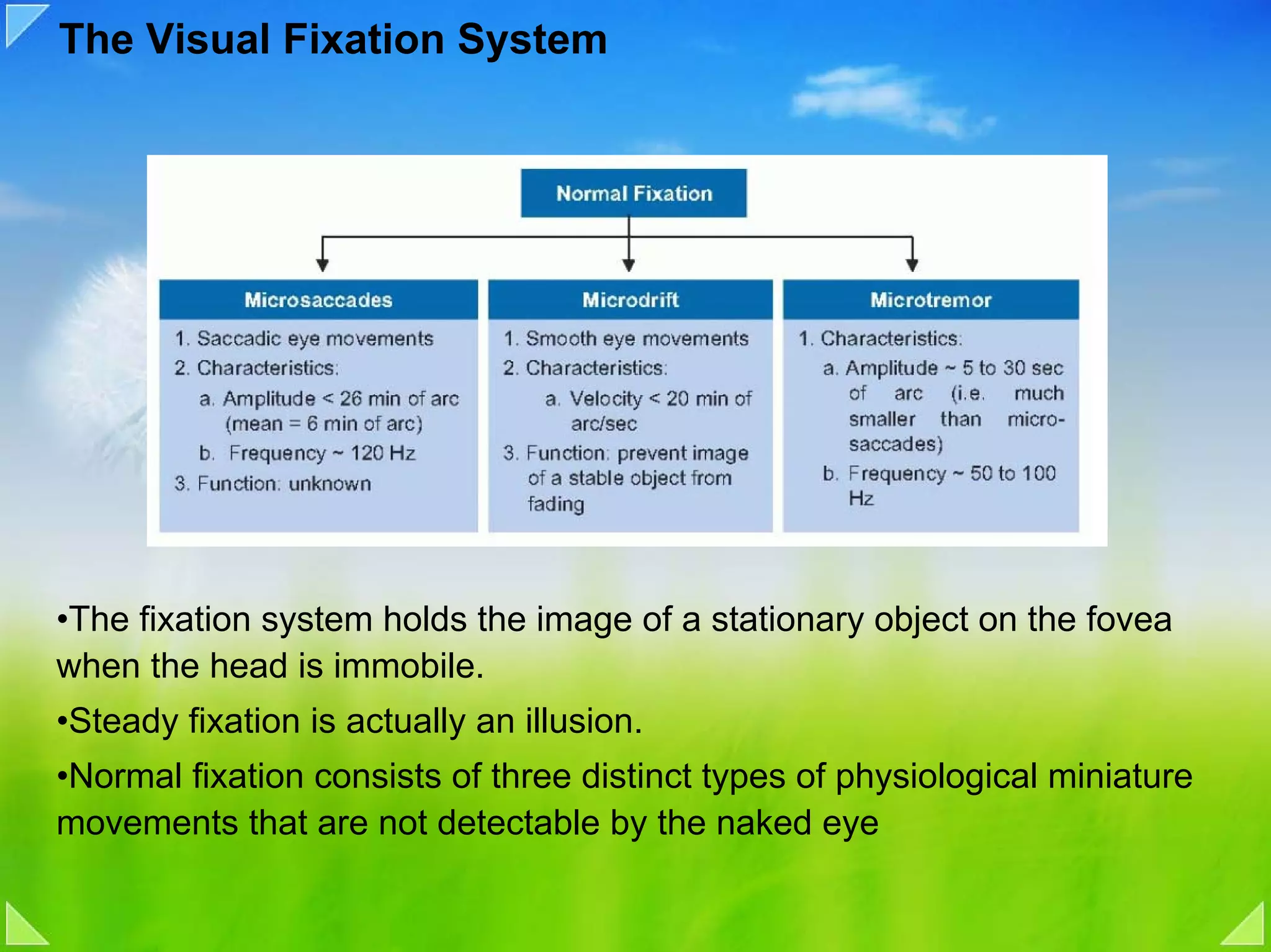
The Visual Fixation System


•The fixation system holds the image of a stationary object on the fovea
when the head is immobile.
•Steady fixation is actually an illusion.
•Normal fixation consists of three distinct types of physiological miniature
movements that are not detectable by the naked eye
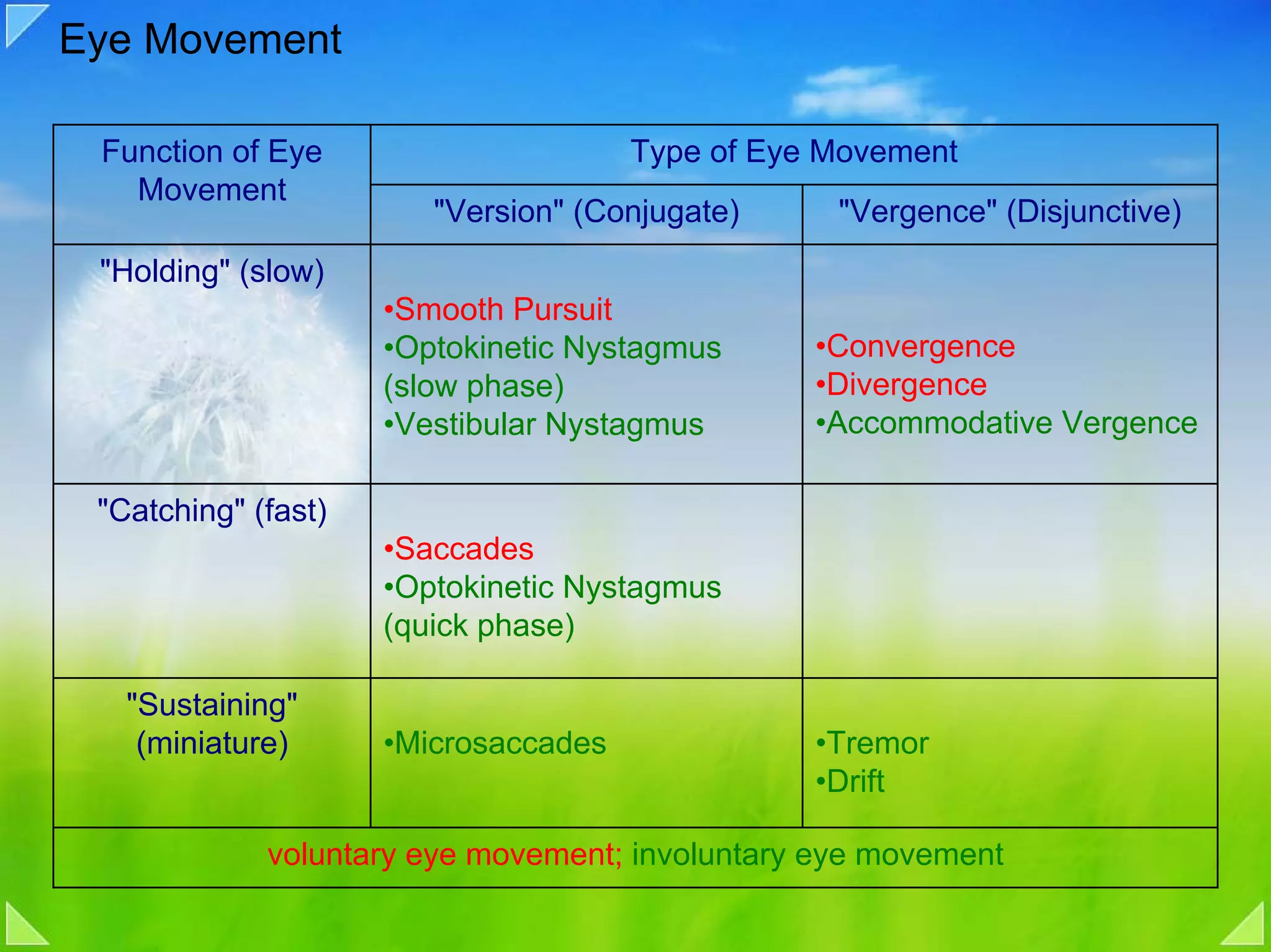
Eye Movement

 Function of Eye                      Type of Eye Movement
   Movement
                        "Version" (Conjugate)     "Vergence" (Disjunctive)
 "Holding" (slow)
                     •Smooth Pursuit
                     •Optokinetic Nystagmus      •Convergence
                     (slow phase)                •Divergence
                     •Vestibular Nystagmus       •Accommodative Vergence

 "Catching" (fast)
                     •Saccades
                     •Optokinetic Nystagmus
                     (quick phase)

   "Sustaining"
    (miniature)      •Microsaccades              •Tremor
                                                 •Drift

             voluntary eye movement; involuntary eye movement
The Vestibular and Optokinetic Systems

• The vestibulo-ocular and optokinetic reflexes are the
  earliest eye movements to appear phylogenetically

• The vestibulo-ocular reflex (VOR) stabilizes retinal
  images during head motion by counter-rotating the eyes at
  the same speed as the head but in the opposite direction

• Optokinetic eye movements stabilize the eyes during
  tracking of a large moving visual scene, which causes an
  illusionary sensation of self rotation (circularvection) in the
  opposite direction
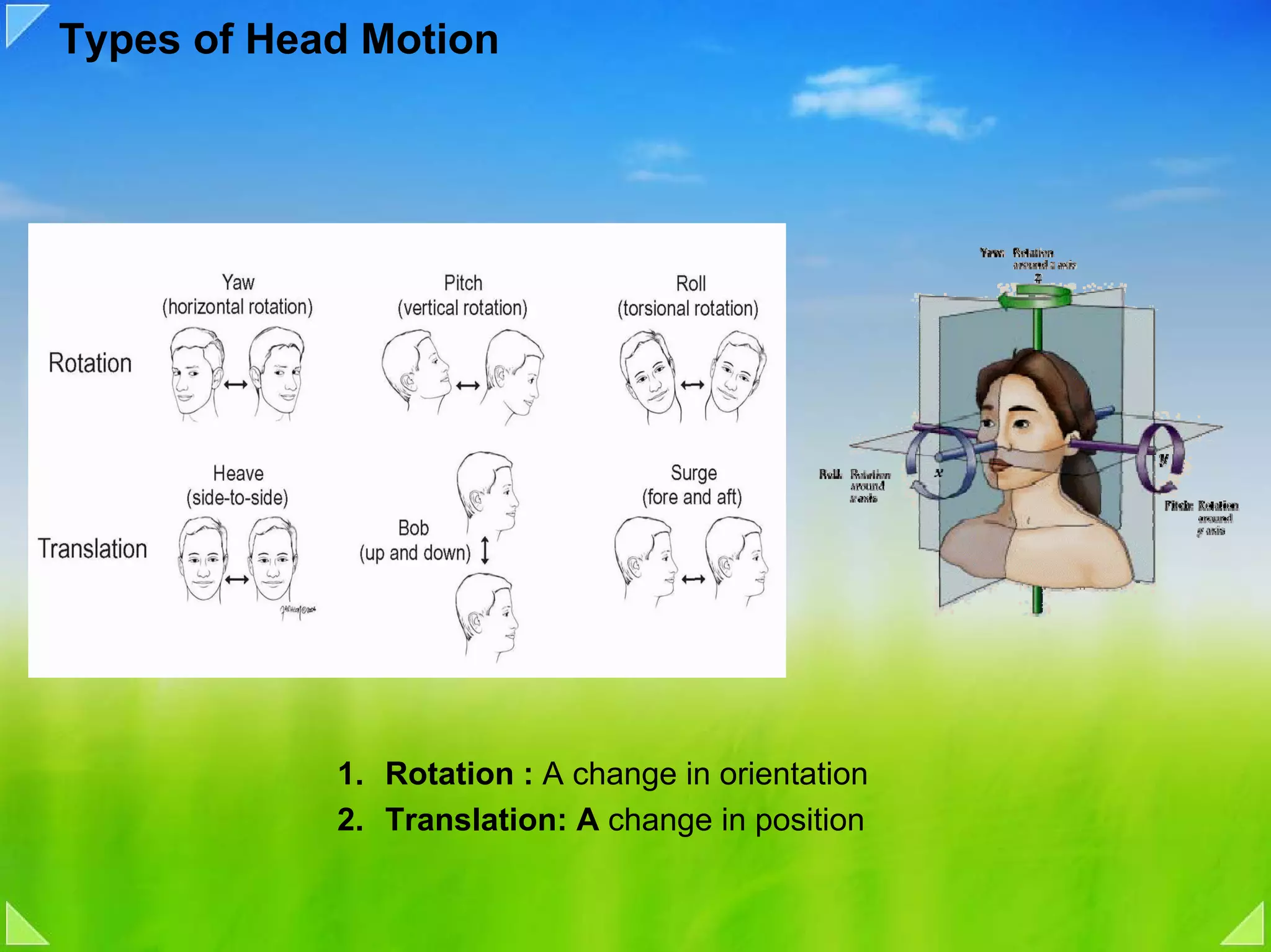
Types of Head Motion


            1. Rotation : A change in orientation
            2. Translation: A change in position
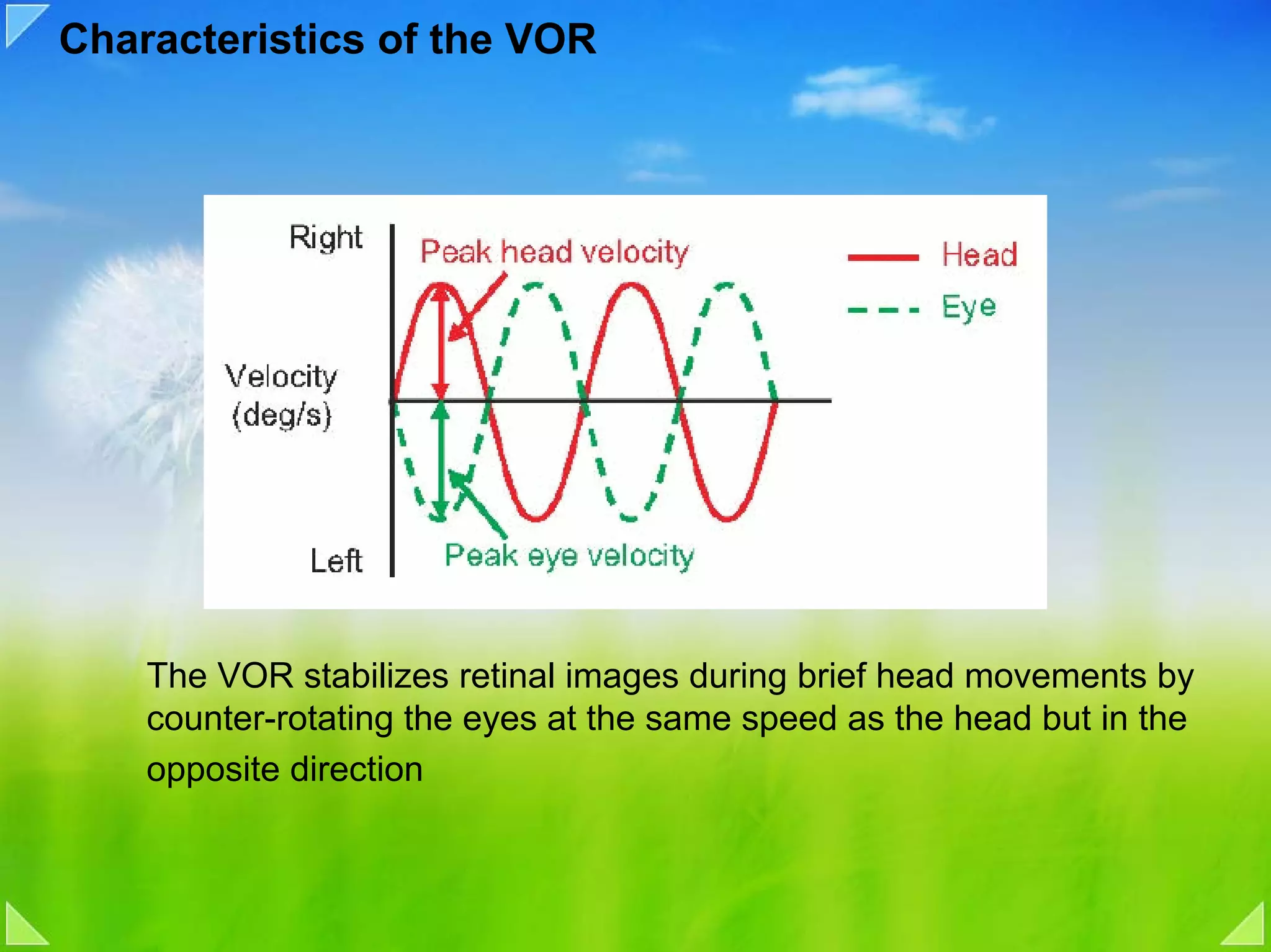
Characteristics of the VOR


    The VOR stabilizes retinal images during brief head movements by
    counter-rotating the eyes at the same speed as the head but in the
    opposite direction
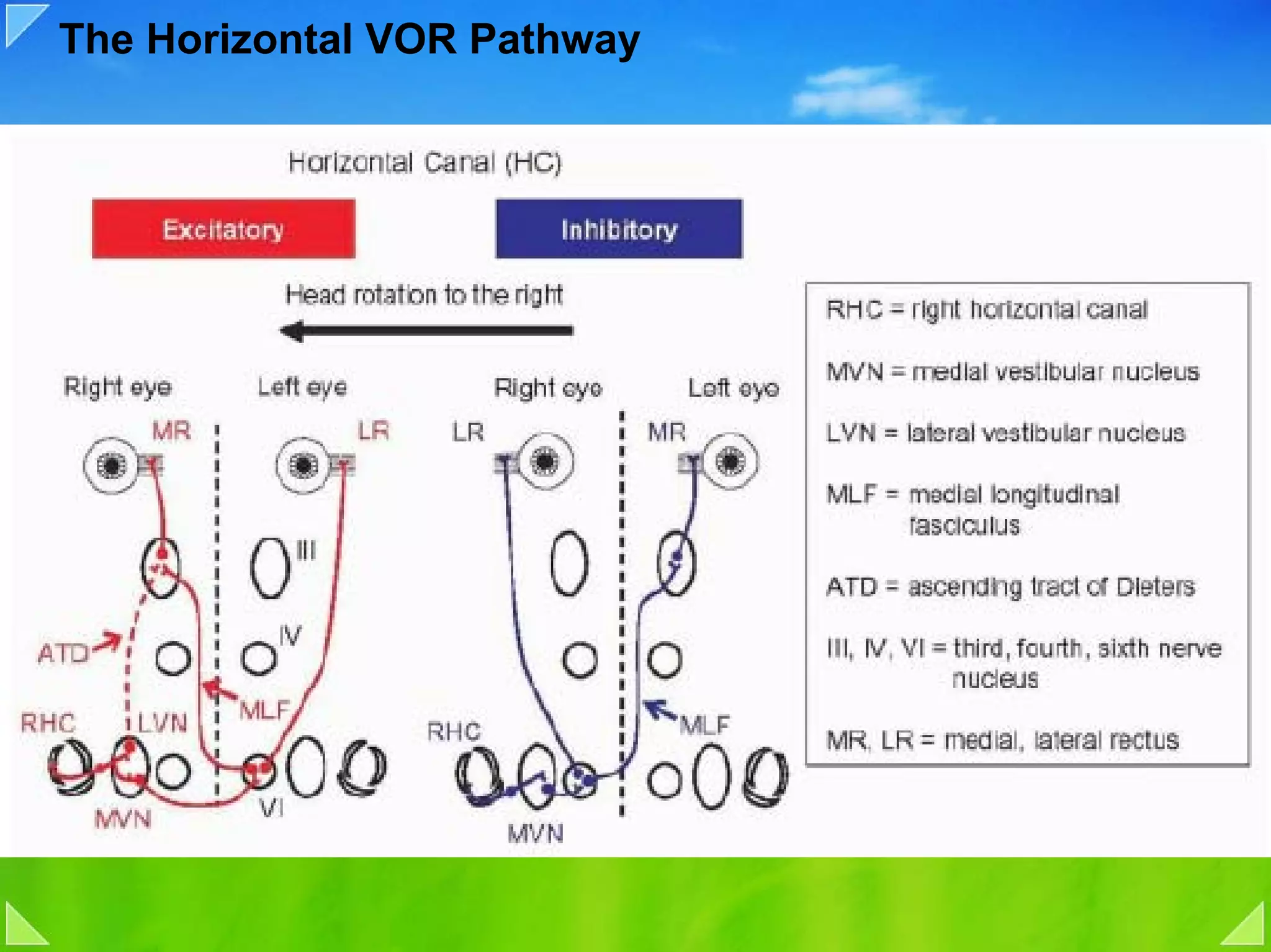
The Horizontal VOR Pathway
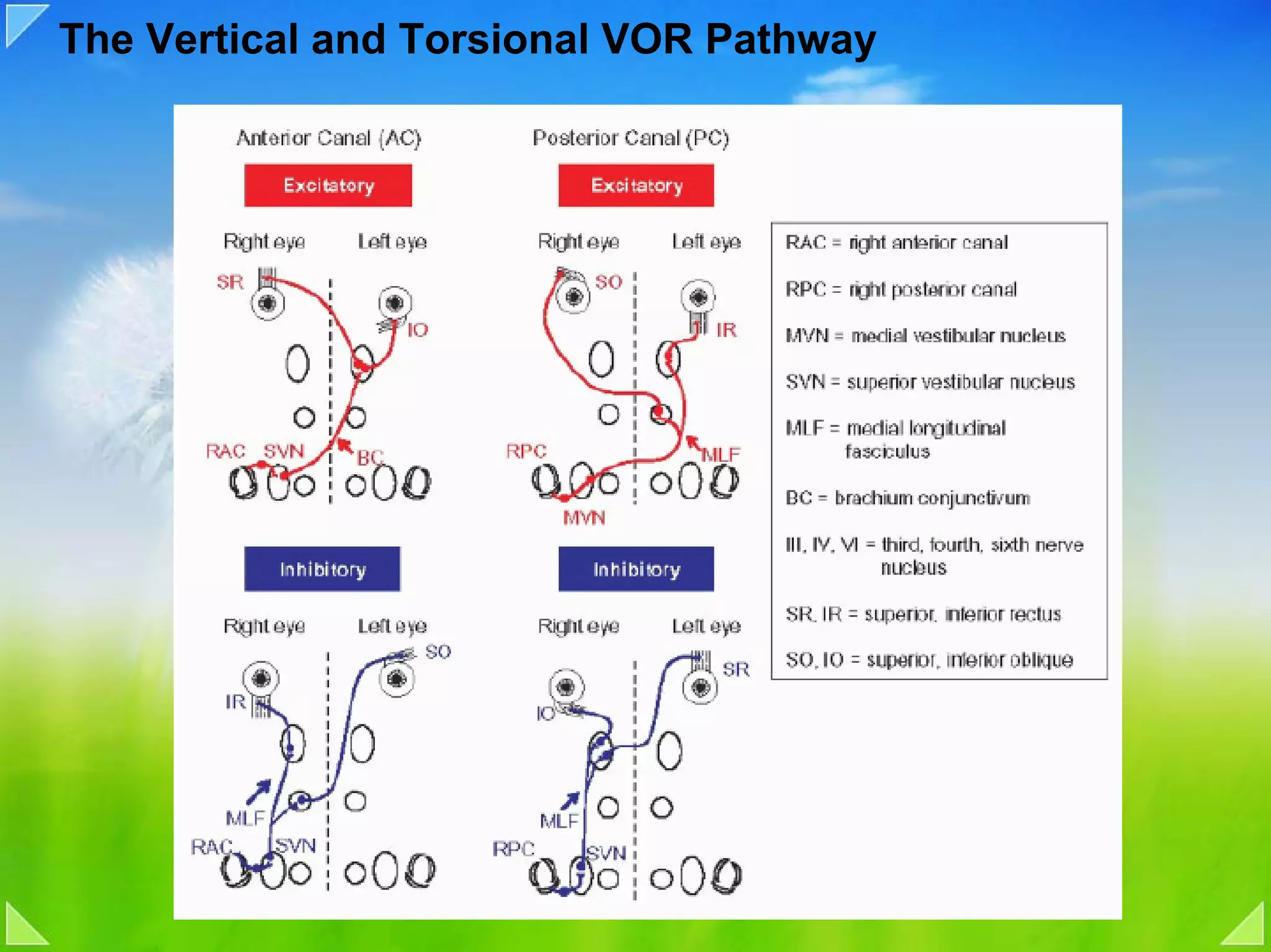
The Vertical and Torsional VOR Pathway
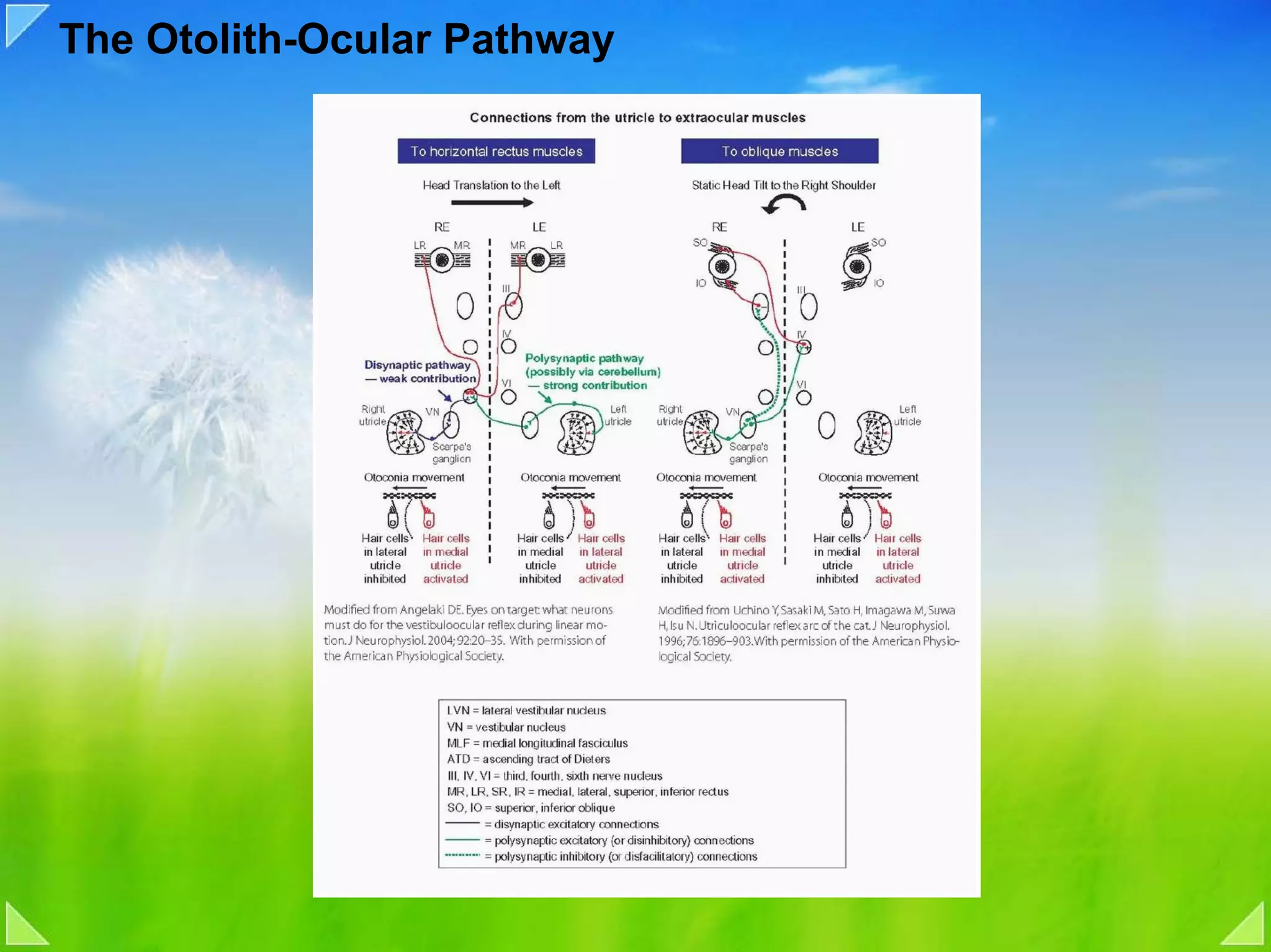
The Otolith-Ocular Pathway
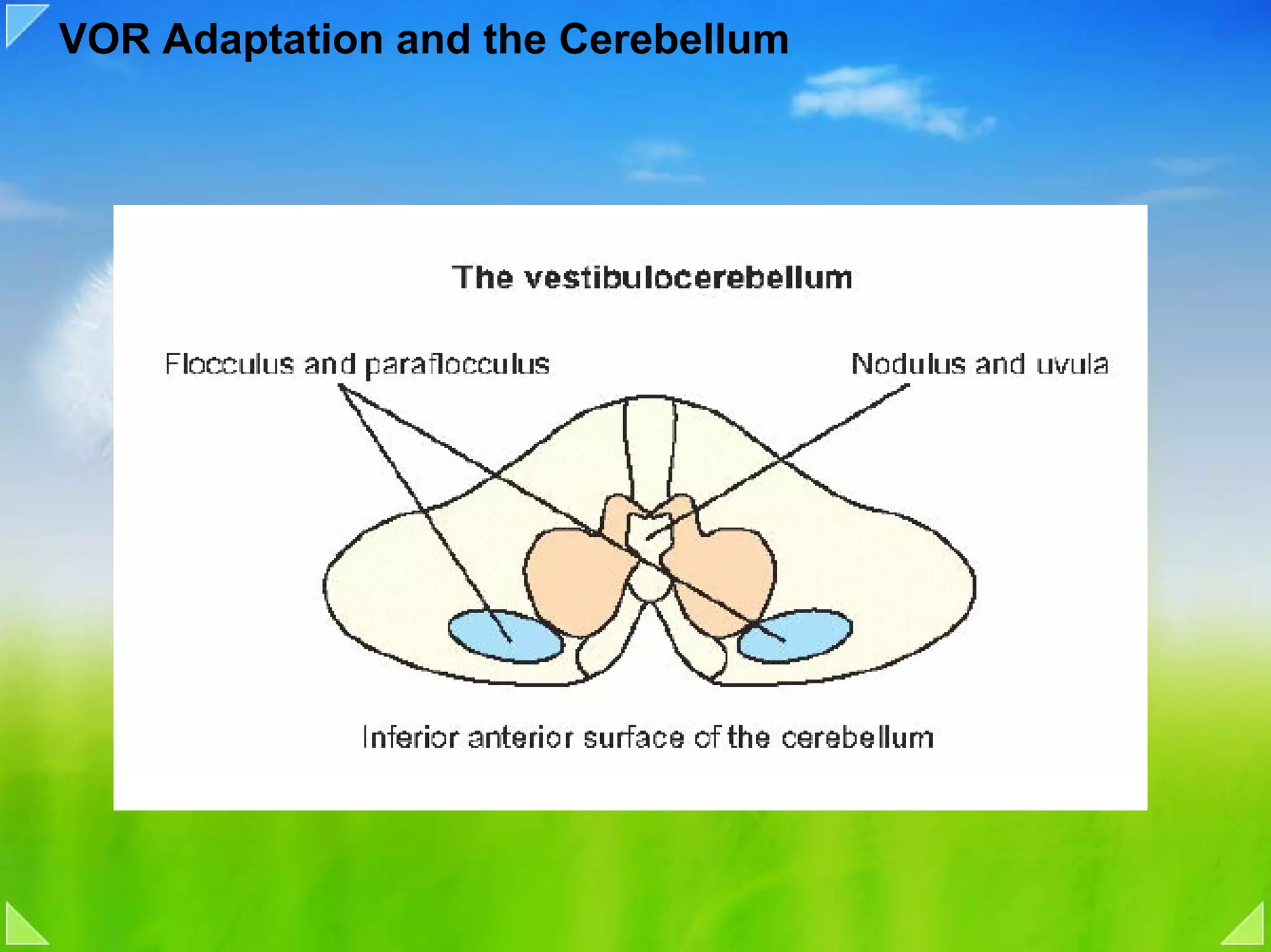
VOR Adaptation and the Cerebellum
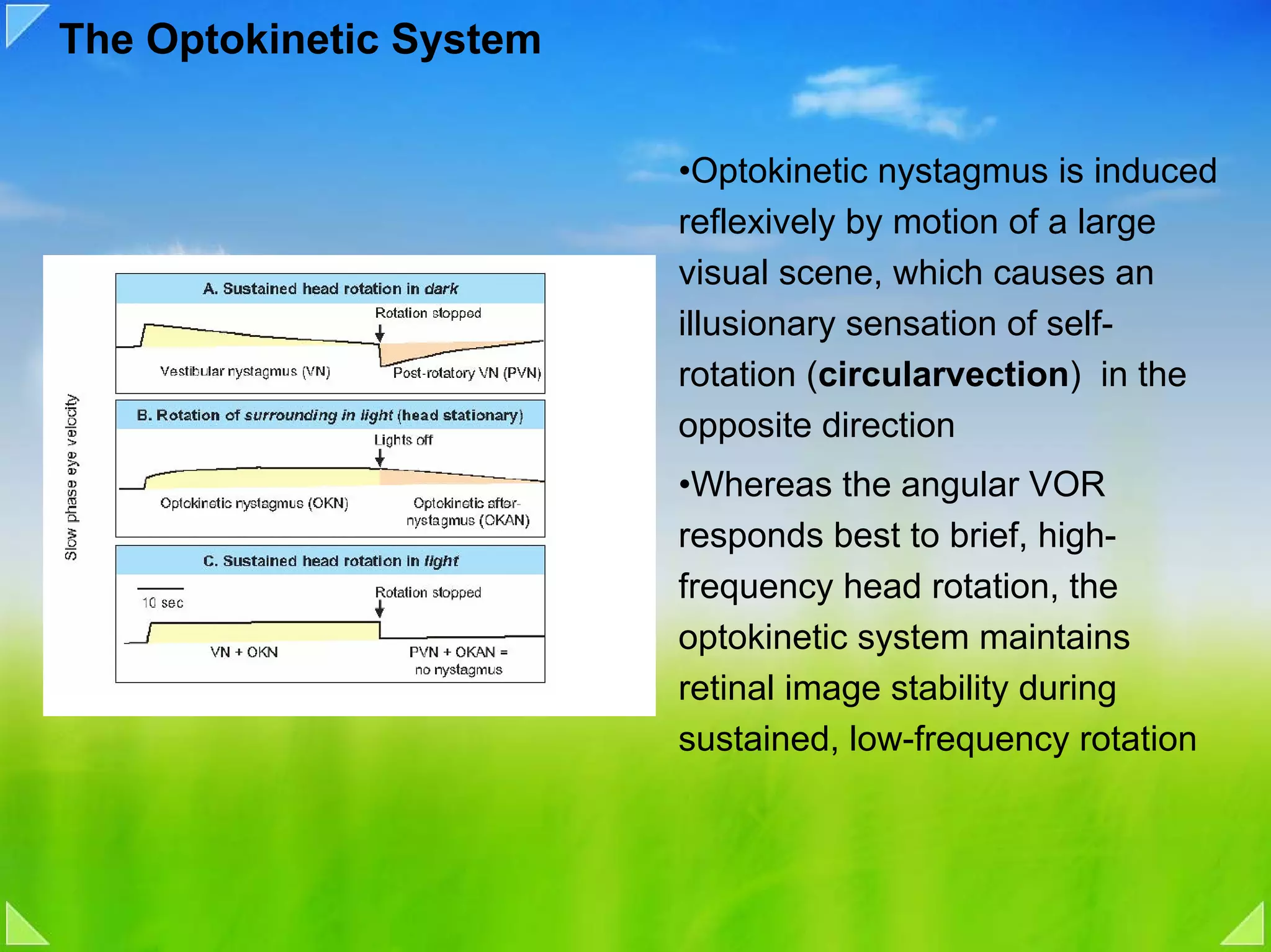
The Optokinetic System


                         •Optokinetic nystagmus is induced
                         reflexively by motion of a large
                         visual scene, which causes an
                         illusionary sensation of self-
                         rotation (circularvection) in the
                         opposite direction
                         •Whereas the angular VOR
                         responds best to brief, high-
                         frequency head rotation, the
                         optokinetic system maintains
                         retinal image stability during
                         sustained, low-frequency rotation
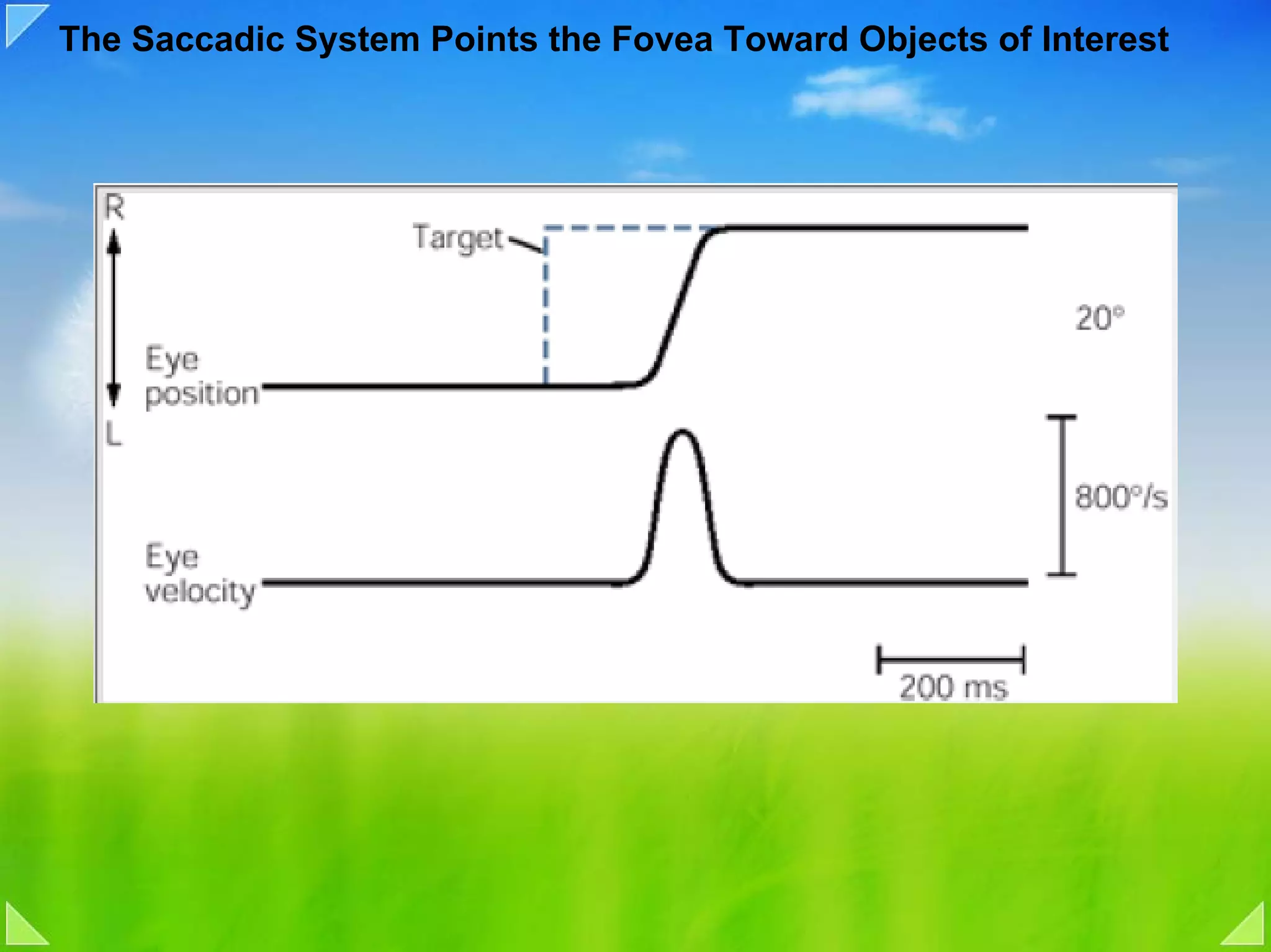
The Saccadic System Points the Fovea Toward Objects of Interest
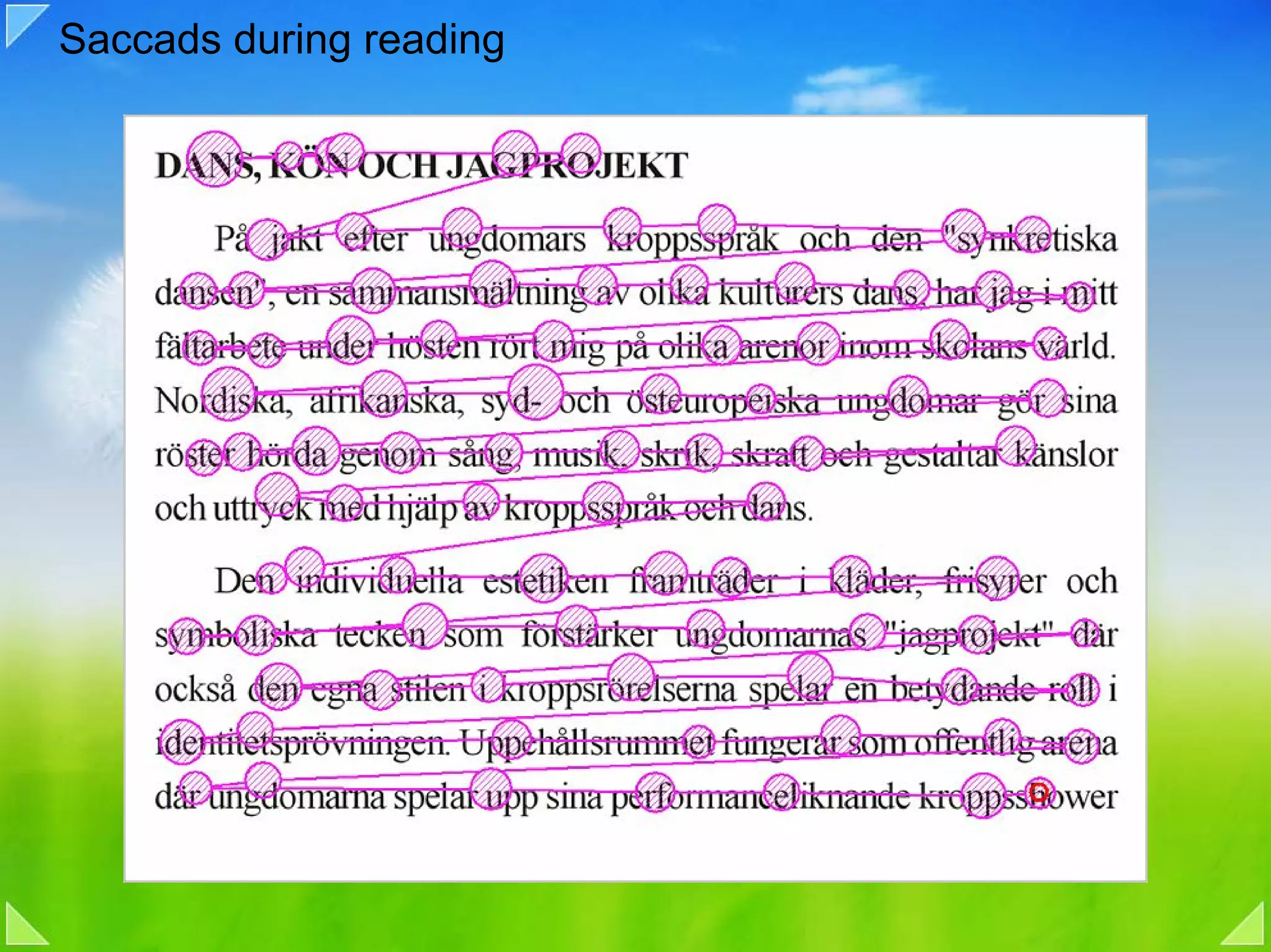
Saccads during reading
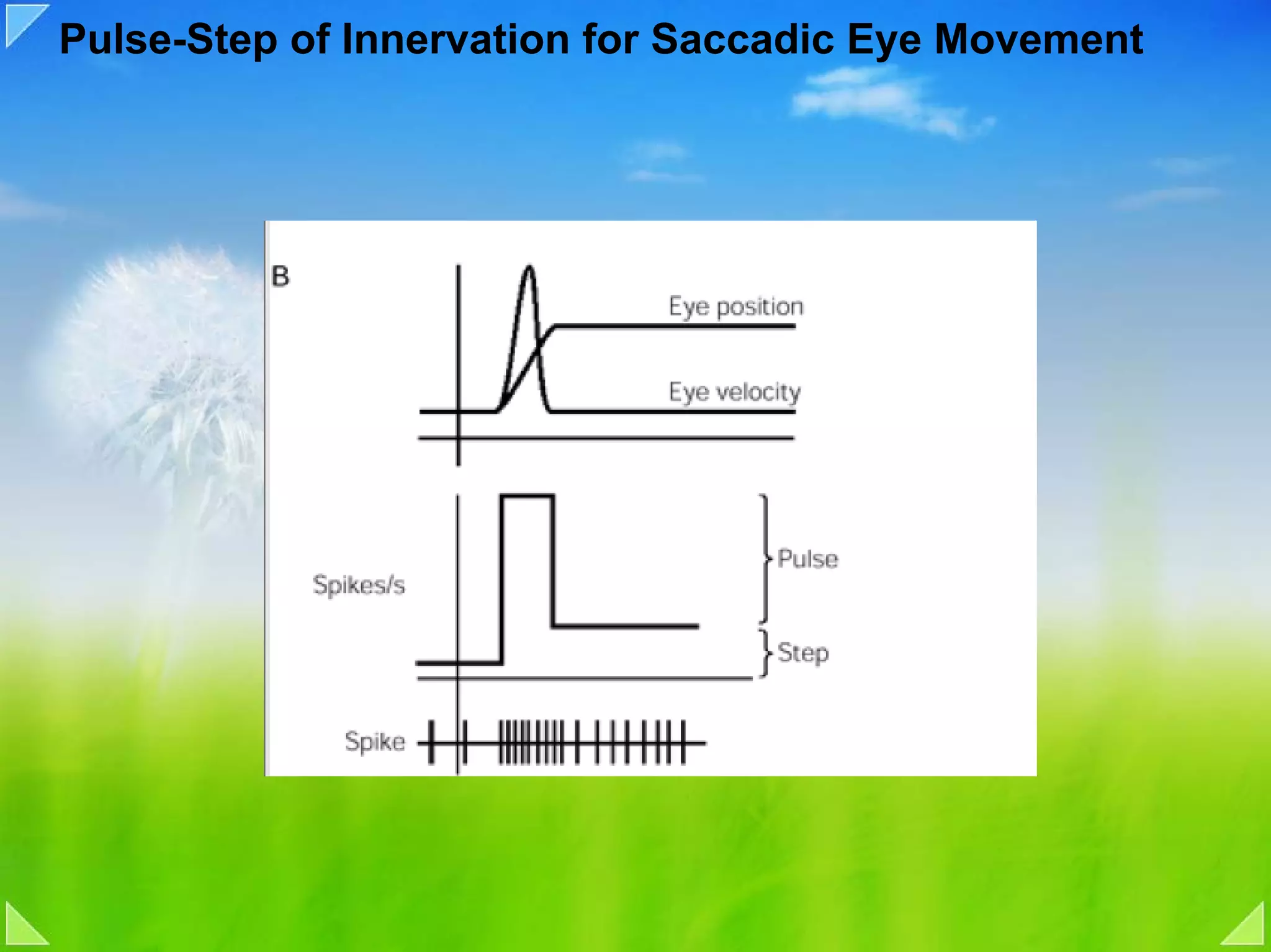
Pulse-Step of Innervation for Saccadic Eye Movement
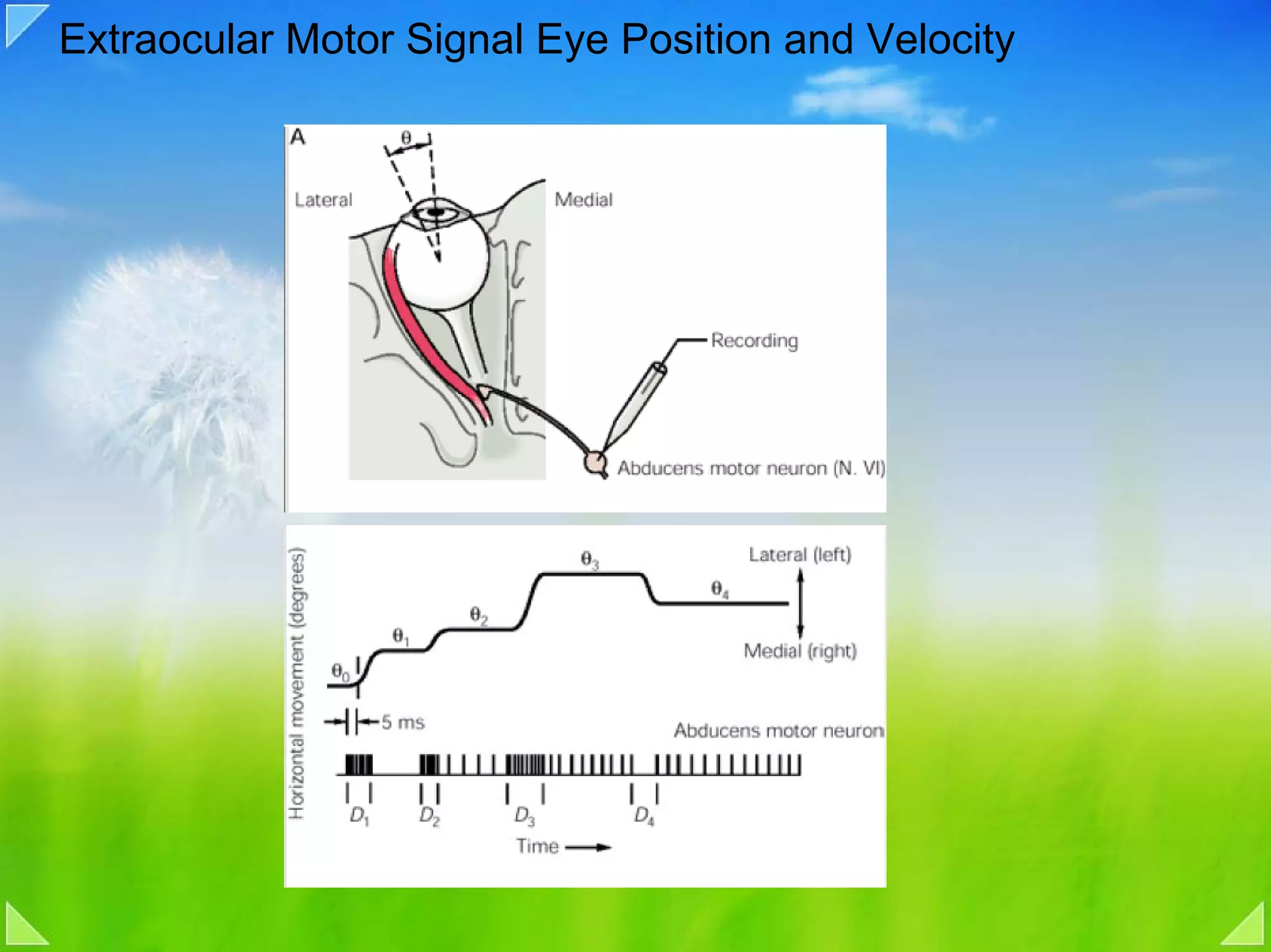
Extraocular Motor Signal Eye Position and Velocity
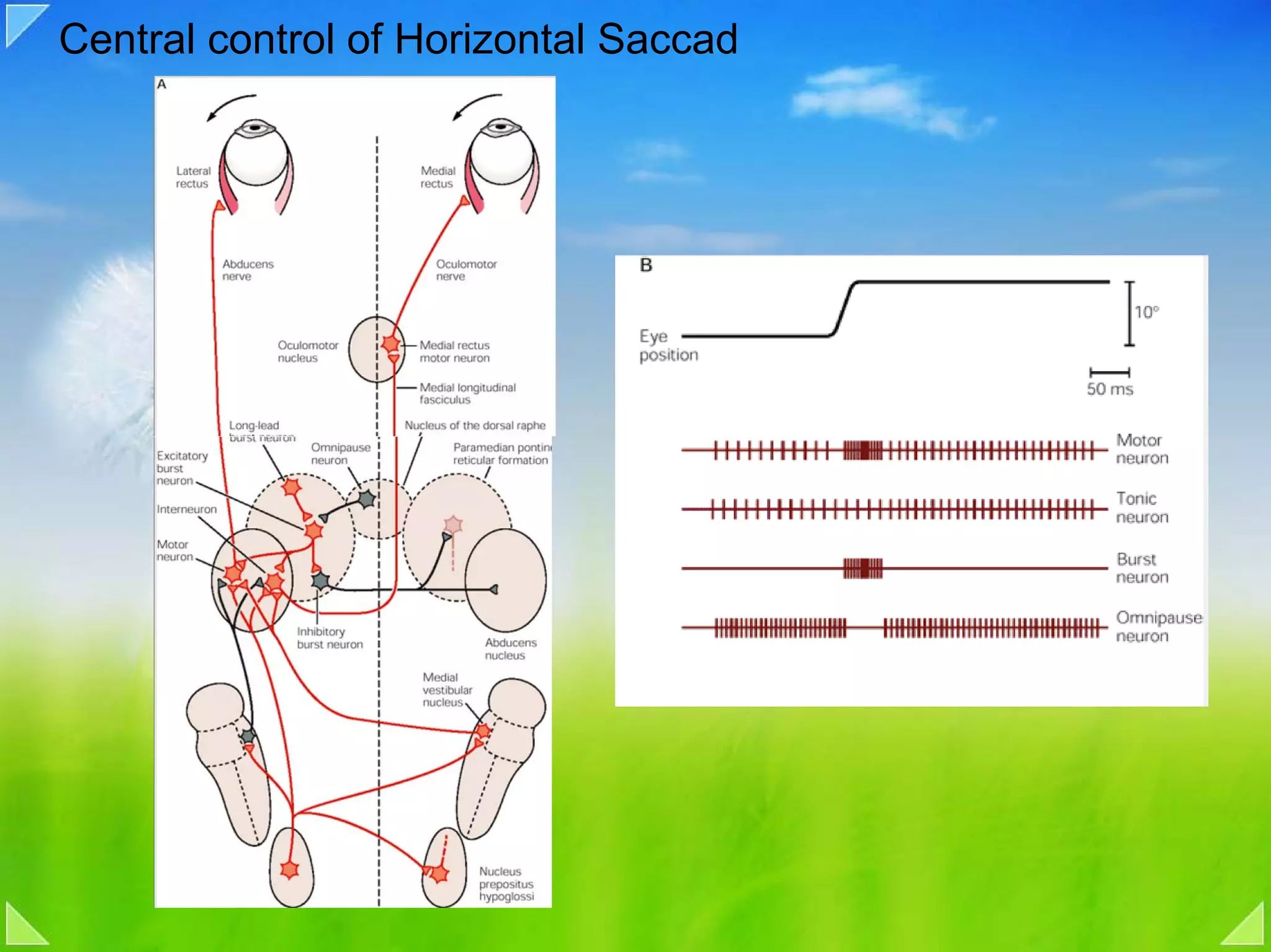
Central control of Horizontal Saccad
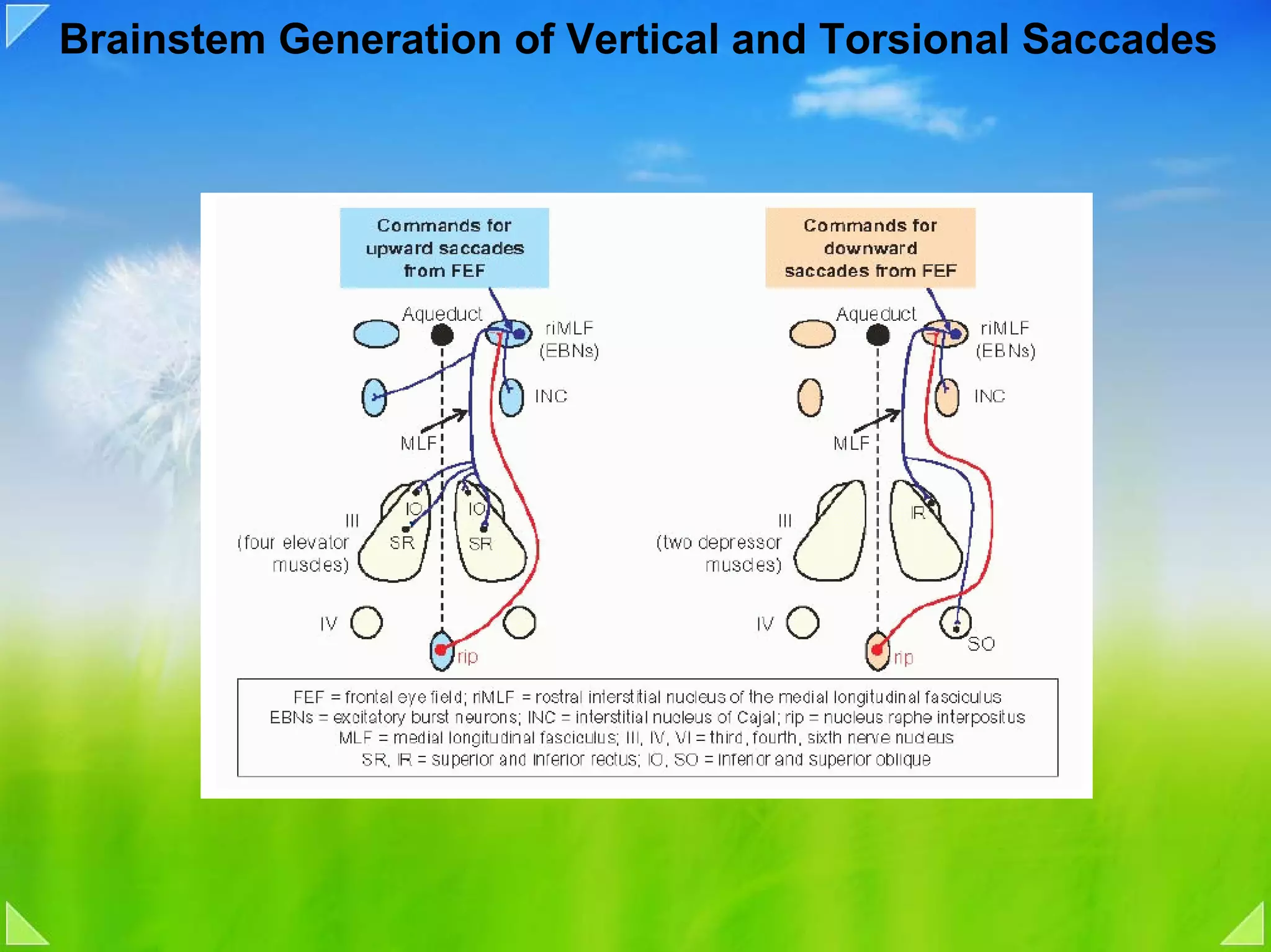
Brainstem Generation of Vertical and Torsional Saccades
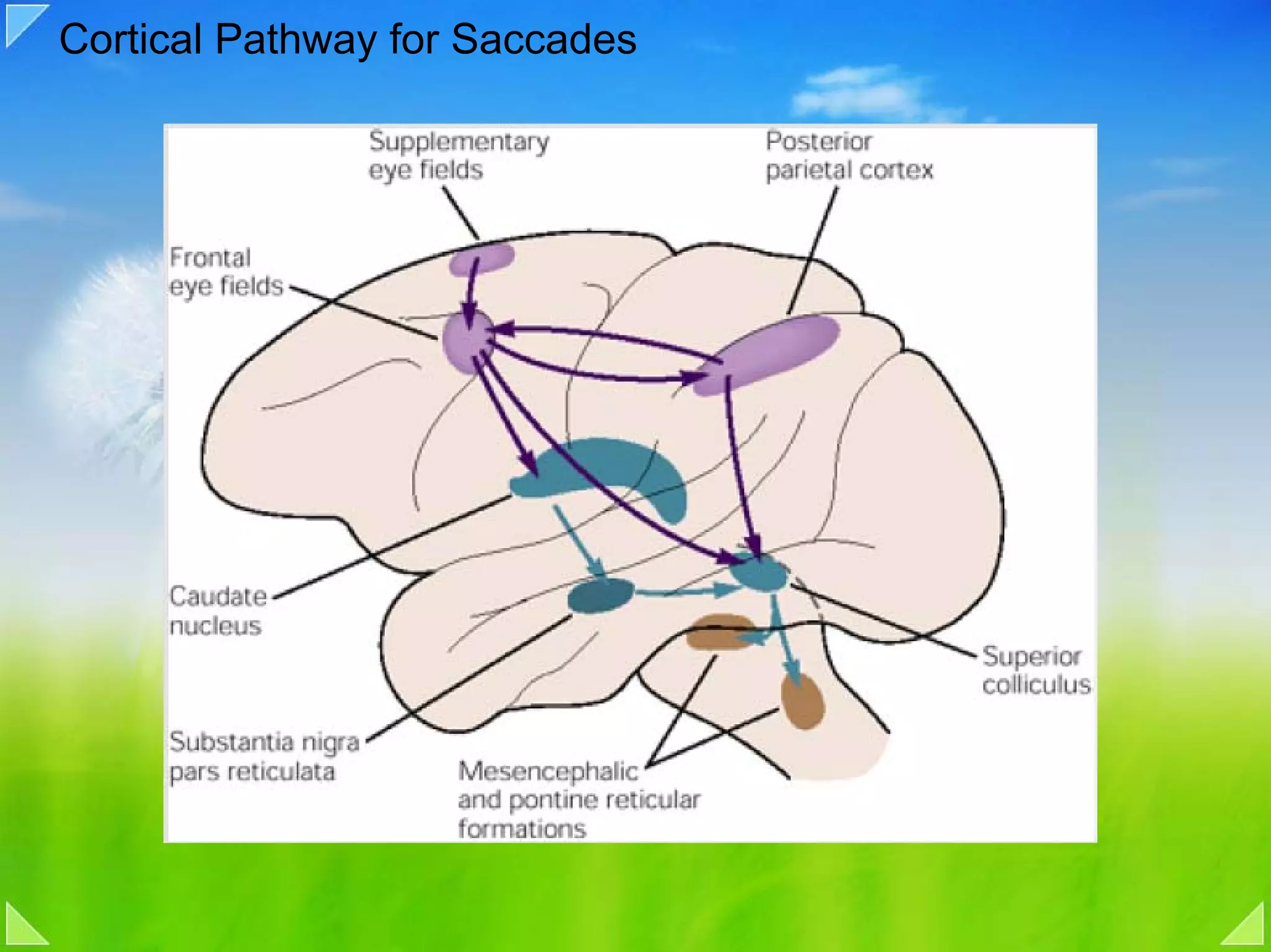
Cortical Pathway for Saccades
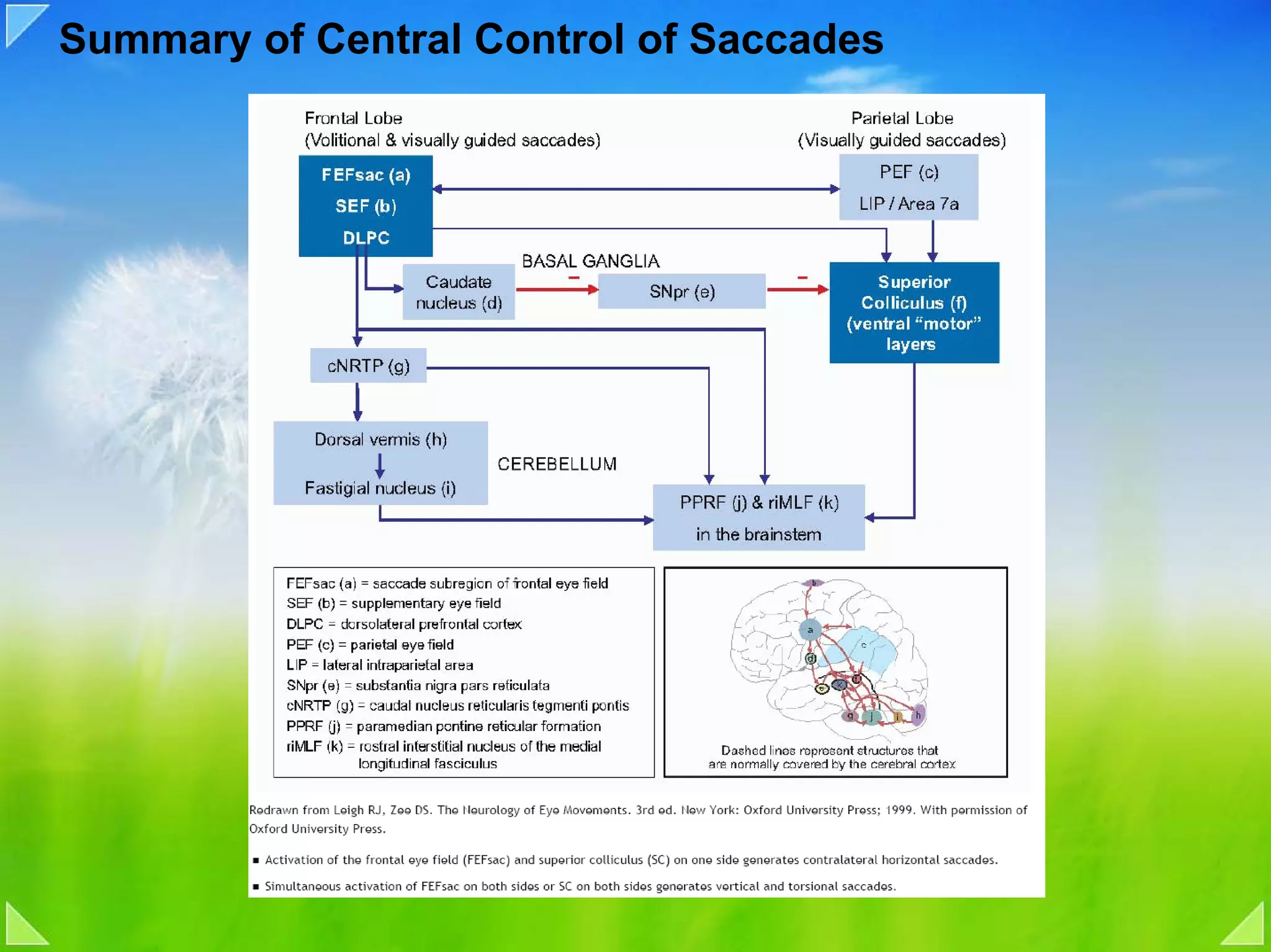
Summary of Central Control of Saccades
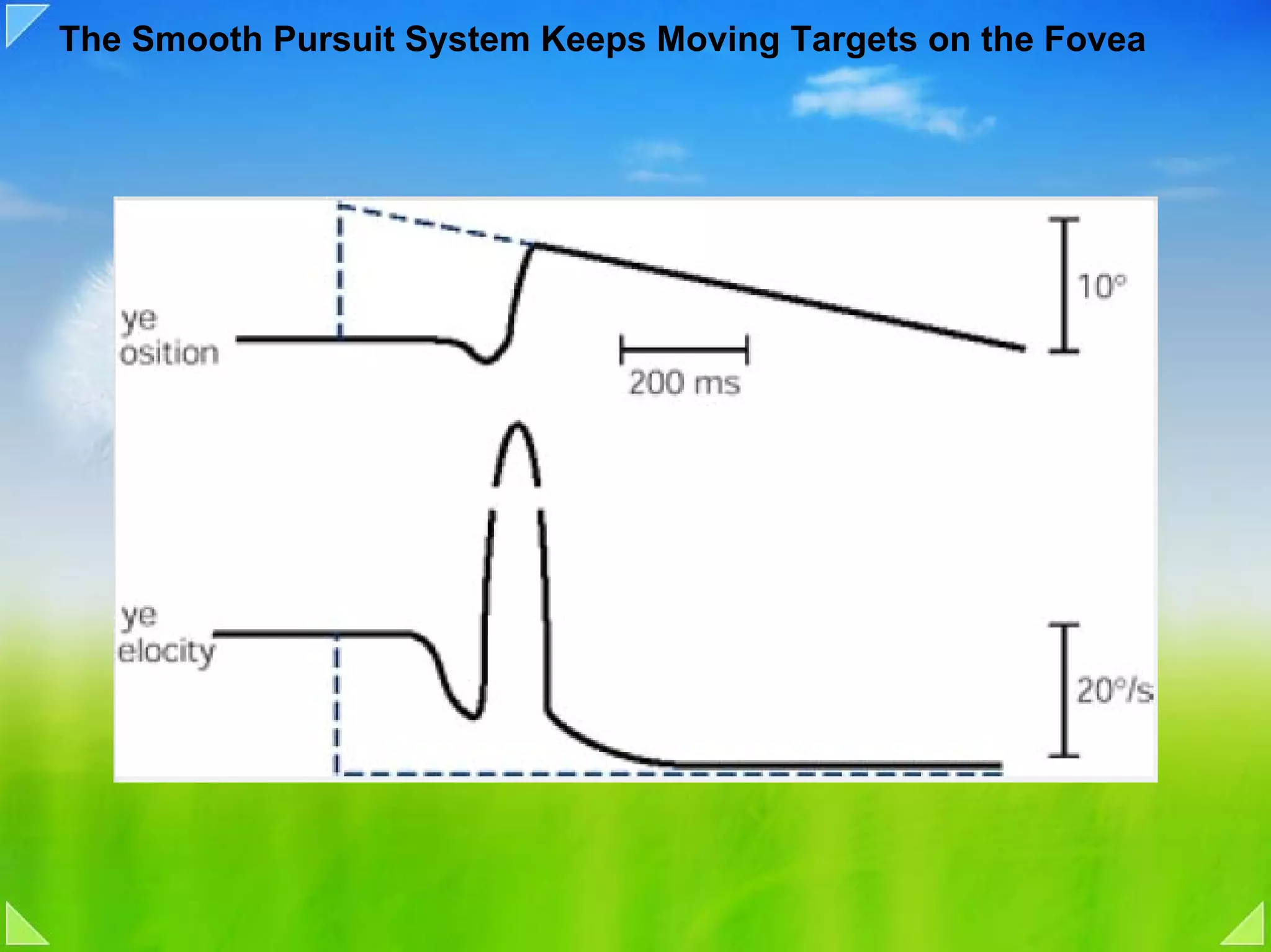
The Smooth Pursuit System Keeps Moving Targets on the Fovea
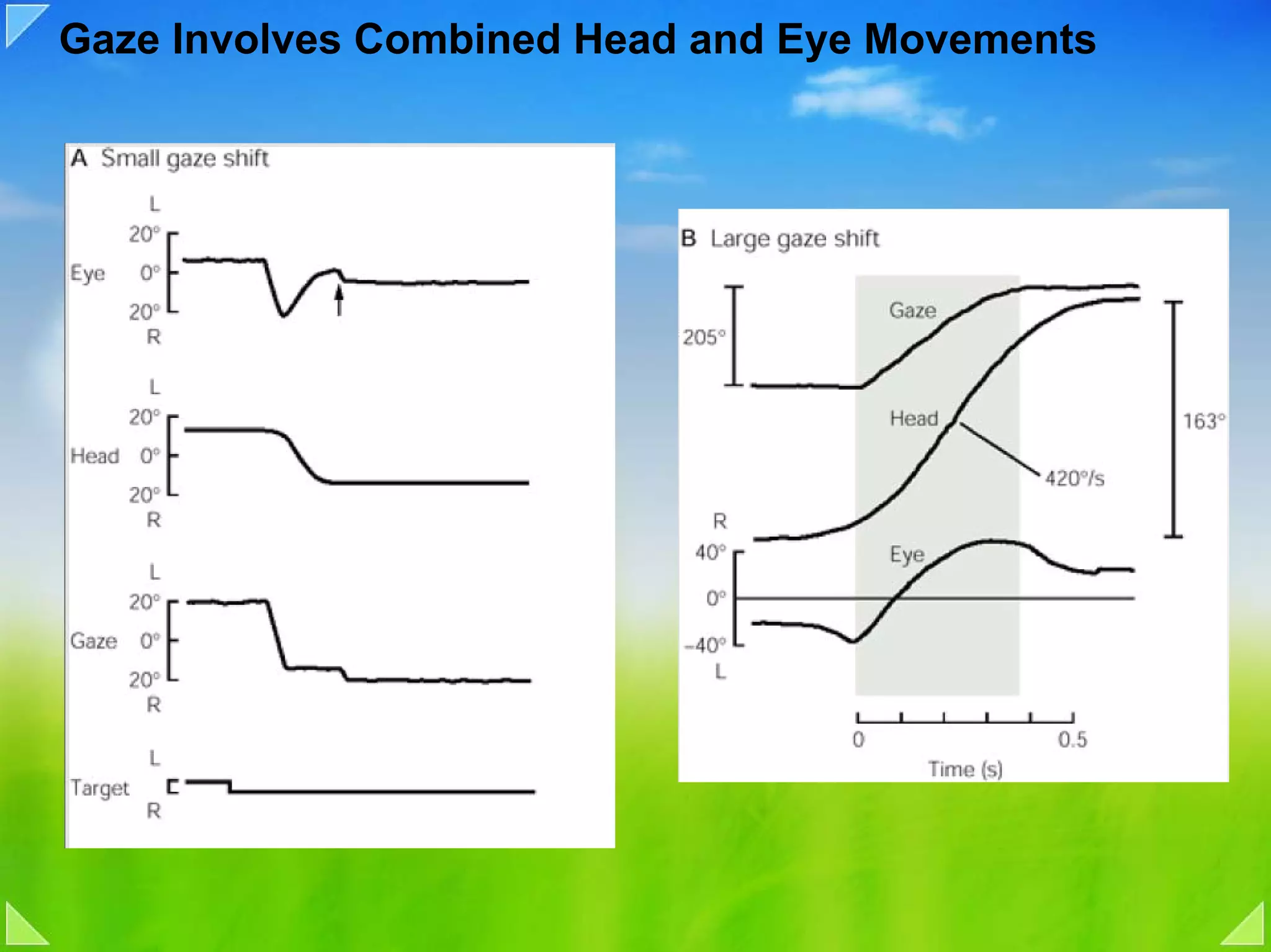
Gaze Involves Combined Head and Eye Movements
Cortical control of Pursuit Eye movement
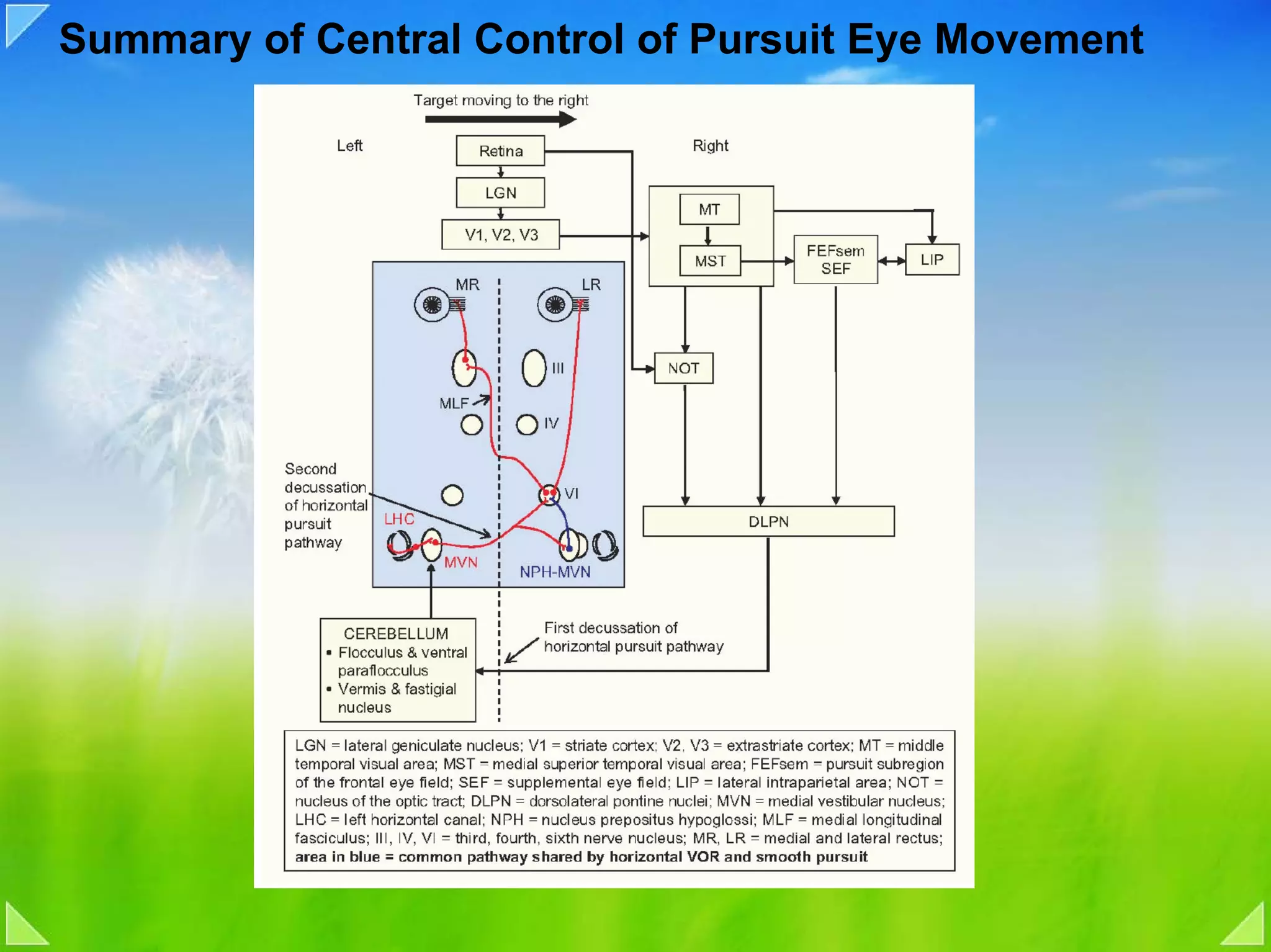
Summary of Central Control of Pursuit Eye Movement
Vergence Eye movment
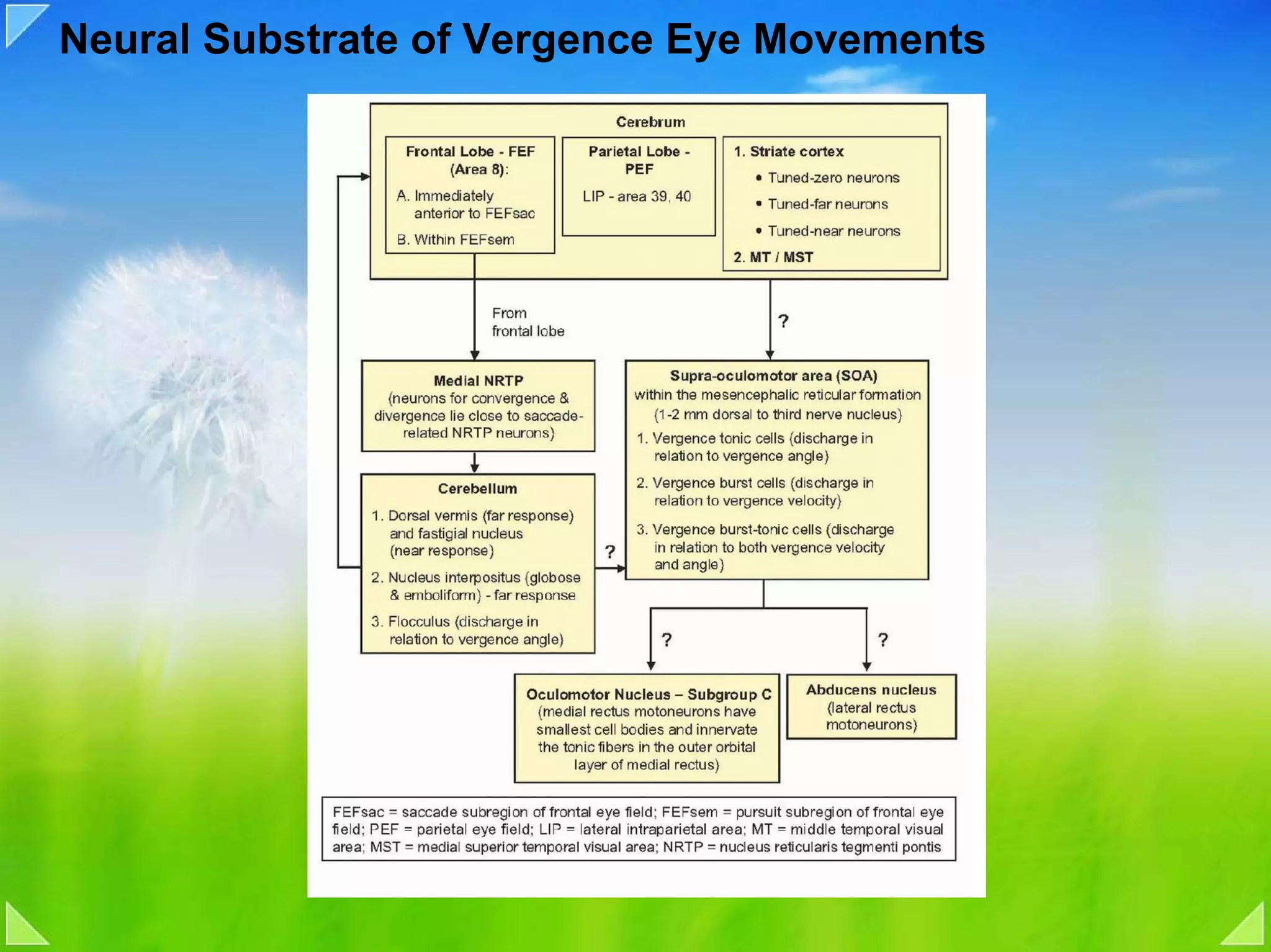
Neural Substrate of Vergence Eye Movements
Thank You

05d eye movement control

  • 1.
  • 2.
    Visual Tracking • Why Visual Tracking ? – To keep the image in the Fovea which is less than 1mm size and detect visual field of less than diameter of full moon. – It keeps the eye still when the image is still and stabilizes the image when the object moves in the world or when the head itself moves. • How Visual Tracking? – Oculomotor system: moves the eye in the orbit – Head movement which moves the orbit in the space – Information of head motion processed by the vestibular system
  • 3.
    Three Axes ofEye Rotations 1. Ductions refer to monocular movements of each eye 2. Versions refer to binocular conjugate movements of both eyes 3. Vergences refer to binocular disjunctive movements
  • 4.
  • 5.
  • 6.
  • 7.
    Laws of OcularMotor Control 1. Sherrington's law of reciprocal innervation 2. Hering's law of equal innervation
  • 8.
  • 9.
    "Visual Accessing Cues" RichardBandler and John Grinder "Frogs into Princes: Neuro Linguistic Programming (NLP) "
  • 10.
    Up and tothe Left Indicates: Visually Constructed Images (Vc) If you asked someone to "Imagine a purple buffalo", this would be the direction their eyes moved in while thinking about the question as they "Visually Constructed" a purple buffalo in their mind.
  • 11.
    Up and tothe Right indicates: Visually Remembered Images (Vr) If you asked someone to "What color was the first house you lived in?", this would be the direction their eyes moved in while thinking about the question as they "Visually Remembered" the color of their childhood home.
  • 12.
    To the LeftIndicates: Auditory Constructed (Ac) If you asked someone to "Try and create the highest the sound of the pitch possible in your head", this would be the direction their eyes moved in while thinking about the question as they "Auditorily Constructed" this this sound that they have never heard of.
  • 13.
    To the RightIndicates: Auditory Remembered (Ar) If you asked someone to "Remember what their mother's voice sounds like ", this would be the direction their eyes moved in while thinking about the question as they "Auditorily Remembered " this sound.
  • 14.
    Down and tothe Left Indicates: Feeling / Kinesthetic (F) If you asked someone to "Can you remember the smell of a campfire? ", this would be the direction their eyes moved in while thinking about the question as they used recalled a smell, feeling, or taste.
  • 15.
    Down and Tothe Right Indicates: Internal Dialog (Ai) This is the direction of someone eyes as they "talk to themselves".
  • 16.
    Brain area participatein Visual Fixation The cerebral structures involved in fixation are: Parietal eye field (lateral interparietal area and area 7a in monkeys) V5 and V5A (MT and MST in monkeys) Supplementary eye field Dorsolateral prefrontal cortex The brainstem structures involved in fixation are: Substantia nigra pars reticulata in the basal ganglia Rostral pole of the superior colliculus
  • 17.
    An Active FixationSystem Keeps the Eyes on a Stationary Target
  • 18.
    The Visual FixationSystem •The fixation system holds the image of a stationary object on the fovea when the head is immobile. •Steady fixation is actually an illusion. •Normal fixation consists of three distinct types of physiological miniature movements that are not detectable by the naked eye
  • 19.
    Eye Movement Functionof Eye Type of Eye Movement Movement "Version" (Conjugate) "Vergence" (Disjunctive) "Holding" (slow) •Smooth Pursuit •Optokinetic Nystagmus •Convergence (slow phase) •Divergence •Vestibular Nystagmus •Accommodative Vergence "Catching" (fast) •Saccades •Optokinetic Nystagmus (quick phase) "Sustaining" (miniature) •Microsaccades •Tremor •Drift voluntary eye movement; involuntary eye movement
  • 20.
    The Vestibular andOptokinetic Systems • The vestibulo-ocular and optokinetic reflexes are the earliest eye movements to appear phylogenetically • The vestibulo-ocular reflex (VOR) stabilizes retinal images during head motion by counter-rotating the eyes at the same speed as the head but in the opposite direction • Optokinetic eye movements stabilize the eyes during tracking of a large moving visual scene, which causes an illusionary sensation of self rotation (circularvection) in the opposite direction
  • 21.
    Types of HeadMotion 1. Rotation : A change in orientation 2. Translation: A change in position
  • 22.
    Characteristics of theVOR The VOR stabilizes retinal images during brief head movements by counter-rotating the eyes at the same speed as the head but in the opposite direction
  • 23.
  • 24.
    The Vertical andTorsional VOR Pathway
  • 25.
  • 26.
    VOR Adaptation andthe Cerebellum
  • 27.
    The Optokinetic System •Optokinetic nystagmus is induced reflexively by motion of a large visual scene, which causes an illusionary sensation of self- rotation (circularvection) in the opposite direction •Whereas the angular VOR responds best to brief, high- frequency head rotation, the optokinetic system maintains retinal image stability during sustained, low-frequency rotation
  • 28.
    The Saccadic SystemPoints the Fovea Toward Objects of Interest
  • 29.
  • 30.
    Pulse-Step of Innervationfor Saccadic Eye Movement
  • 31.
    Extraocular Motor SignalEye Position and Velocity
  • 32.
    Central control ofHorizontal Saccad
  • 33.
    Brainstem Generation ofVertical and Torsional Saccades
  • 34.
  • 35.
    Summary of CentralControl of Saccades
  • 36.
    The Smooth PursuitSystem Keeps Moving Targets on the Fovea
  • 37.
    Gaze Involves CombinedHead and Eye Movements
  • 38.
    Cortical control ofPursuit Eye movement
  • 39.
    Summary of CentralControl of Pursuit Eye Movement
  • 40.
  • 41.
    Neural Substrate ofVergence Eye Movements
  • 42.