MYOCLONUS
Dr PS Deb MD, DM
Director Neurology
GNRC Hospitals ,
Guwahati,
Assam, India
MYOCLONUS
 Definition
ď‚— Sudden shock like contraction of muscle.
ď‚— Flexor of upper limb and extensor of lower limb
ď‚— Varying in severity from insufficient to move the joints to fall in
ground
ď‚— Sensory stimulation aggravate attack.
 EMG
ď‚— Burst of 30-60 ms synchronous
ď‚— Burst of 75-125 ms asynchronous
ď‚— Burst of >150 ms synchronous
 C-reflex – Stimulation of nerve → time locked response.
 EEG
ď‚— Variable pattern
ď‚— Time lag with EMG activity before or after
ď‚— Back averaging required
FOCAL MYOCLONUS
 Rhythmic, unchanged by rest, action, sleep,
walking due to generation of discharge from
discrete segment of neuraxis.
 Segmental myoclonus when segment of neuraxis
involved. Arrhythmic.
 Spontaneous / Action / intentional / reflex
 Cortical
ď‚— Usually multifocal
ď‚— Distal > proximal, flexor > extensor
ď‚— Intentional or reflex , may be modality specific
EPILEPSIA PARTIALIS CONTINUA
 Rhythmic form, Group of muscles – face, arm or leg,
persist for months
 Etiology – vascular, trauma, infection, MS, tumor
 EMG: Burst of agonist muscles, synchronous with
antagonistic muscle
 EEG – Focal positive negative transient over sensory-
motor cortex contralateral to the jerk, time locked 20sec.
 C-Reflex – correlated with giant somato-sensory evoked
potential
 Evoked potential – large component of P1N2 has some
relation to C-reflex as the positive negative transient to
the spontaneous jerk
 Cranial nerve involvement cephalocaudal
CORTICAL MYOCLONUS
 Mechanism
 Hyper excitability of the sensory-motor cortex → large
synchronous discharge → muscle jerk
ď‚— Paroxysmal depolarization shift (fragment of epilepsy)
 Cause
ď‚— Any focal cortical damage
 Tumor,
 Angioma
 Encephalitis
 Idiopathic
 Treatment
ď‚— Surgical removal of the cause
ď‚— Anticonvulsant
BRAINSTEM MYOCLONUS: PALATAL
MYOCLONUS
 Clinical
ď‚— Rhythmic oscillation of palate sometime other part
(ocular, tongue, larynx, pharynx, diaphragm)
ď‚— Brachial muscles are affected related to rhythmicity of
respiration/gill movement
ď‚— Persist during sleep -1.5-3Hz
 Mechanism:
 Tegmental tract lesion → Inf. Olive oscillate → Purkunji
cell → Reticulospinal tract / vestibulospinal tract
 Any lesion of Gullain Mollaret Triangle – Dentate – Red
nucleus – Inf. Olive
 Pathology
ď‚— Hypertrophic degeneration of inf. Olive.
PALATAL MYOCLONUS CONT…
 Cause
ď‚— Idiopathic
ď‚— Stroke
ď‚— Trauma
 Tumor → 10months later
ď‚— Metabolic encephalopathy
 Prognosis: Resistant
 Treatment
ď‚— Tetrabenazine
ď‚— Halloparidol
ď‚— 5-Hydroxytryptophan
ď‚— Carbamazipine
 Bulbar myoclonus: Tongue and neck movement
SPINAL MYOCLONUS
 Clinical
ď‚— Rhythmic > arrhythmic
ď‚— Spontaneous, persist in sleep
ď‚— One limb, adjacent trunk or both legs
 Cause
ď‚— Degenerative
ď‚— Demylination
ď‚— C. myelopathy
ď‚— Tumor,
ď‚— Following spinal anesthesia
ď‚— Contrast injection
ď‚— Rarely idiopathic
ď‚— Ischemic myelopathy : stimulus sensitive myoclonus
 Rx: Clonazepam
PERIPHERAL MYOCLONUS
 Rarely true myoclonus is seen with acute or chronic
denervation in involved muscle
 Lesion:
ď‚— Nerve
ď‚— Brachial plexus
ď‚— Nerve root
 Essential – rarely focal
 Treatment: Clonazepam
MULTIFOCAL OR GENERALIZED (EPILEPTIC
MYOCLONUS)
 Types
ď‚— Multifocal : focal jerks at different part of body
ď‚— Generalized: Large part of body affected
ď‚— Etiology may be same
 Cortical:
ď‚— Increased excitability of brain due to paroxysmal
depolarization shift involving group of neuron in different
part of brain – Fragment of epilepsy
ď‚— EEG shows typical multifocal discharge and cortical
correlation
 SSEP - ↑
RETICULAR – GENERALIZED
 Clinical
ď‚— Proximal more than distal
ď‚— Flexor more than extensor
ď‚— Sometime segment of body all muscle
ď‚— Spontaneous or reflex or action
 Cranial muscle → caudo-cephalic involvement
 Mechanism
ď‚— Hyper-excitability of a portion of the caudal brain stem reticular
formation – the nucleus reticularis gigentocellularis
 EEG:
ď‚— Spike, generalized highest amplitude vertex
ď‚— Follow the EMG burst of myoclonus
ď‚— Spike is not time locked to the myoclonus, spike is projected and
not directly responsible for myoclonus
ď‚— SEP is not enhance (no cortical hyperactivity)
 Combined Reticular and Cortical myoclonus due to combined
lesion
PRIMARY GENERALIZED EPILEPTIC
MYOCLONUS
 Focal
ď‚— Commonly small focal movement with finger movement
(minipolymyoclonus also seen with peripheral denervation)
 Generalized
ď‚— Synchronized whole body jerk (fragment of gen. epilepsy)
ď‚— Cranial muscle activation down the brain stem
 Mechanism
ď‚— Whole cortex is hyper excitable and is driven to a paroxysm
by normal ascending impulse from the brain stem reticular
formation and non specific thalamic nuclei.
ď‚— Ascending impulse could be paroxysmal
 EEG:
ď‚— Generalized fronto central predominance, slow negativity
which precedes the myoclonus
ď‚— For small jerk this event last 100-250 ms and jitter in time with
respect to jerk
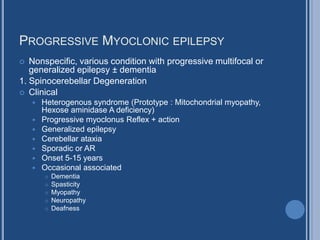
PROGRESSIVE MYOCLONIC EPILEPSY
 Nonspecific, various condition with progressive multifocal or
generalized epilepsy ± dementia
1. Spinocerebellar Degeneration
 Clinical
ď‚— Heterogenous syndrome (Prototype : Mitochondrial myopathy,
Hexose aminidase A deficiency)
ď‚— Progressive myoclonus Reflex + action
ď‚— Generalized epilepsy
ď‚— Cerebellar ataxia
ď‚— Sporadic or AR
ď‚— Onset 5-15 years
ď‚— Occasional associated
 Dementia
 Spasticity
 Myopathy
 Neuropathy
 Deafness
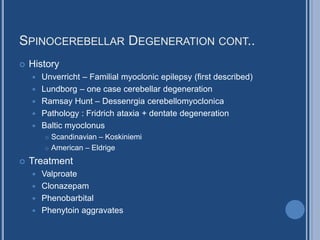
SPINOCEREBELLAR DEGENERATION CONT..
 History
 Unverricht – Familial myoclonic epilepsy (first described)
 Lundborg – one case cerebellar degeneration
 Ramsay Hunt – Dessenrgia cerebellomyoclonica
ď‚— Pathology : Fridrich ataxia + dentate degeneration
ď‚— Baltic myoclonus
 Scandinavian – Koskiniemi
 American – Eldrige
 Treatment
ď‚— Valproate
ď‚— Clonazepam
ď‚— Phenobarbital
ď‚— Phenytoin aggravates
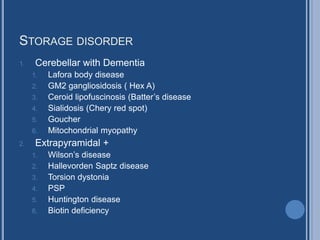
STORAGE DISORDER
1. Cerebellar with Dementia
1. Lafora body disease
2. GM2 gangliosidosis ( Hex A)
3. Ceroid lipofuscinosis (Batter’s disease
4. Sialidosis (Chery red spot)
5. Goucher
6. Mitochondrial myopathy
2. Extrapyramidal +
1. Wilson’s disease
2. Hallevorden Saptz disease
3. Torsion dystonia
4. PSP
5. Huntington disease
6. Biotin deficiency
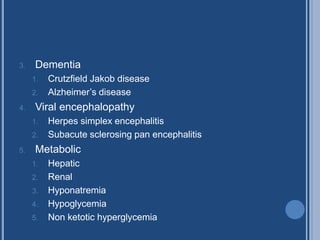
3. Dementia
1. Crutzfield Jakob disease
2. Alzheimer’s disease
4. Viral encephalopathy
1. Herpes simplex encephalitis
2. Subacute sclerosing pan encephalitis
5. Metabolic
1. Hepatic
2. Renal
3. Hyponatremia
4. Hypoglycemia
5. Non ketotic hyperglycemia
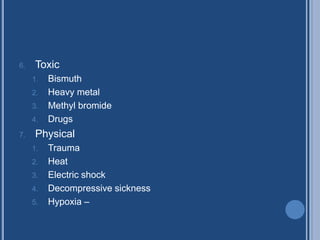
6. Toxic
1. Bismuth
2. Heavy metal
3. Methyl bromide
4. Drugs
7. Physical
1. Trauma
2. Heat
3. Electric shock
4. Decompressive sickness
5. Hypoxia –
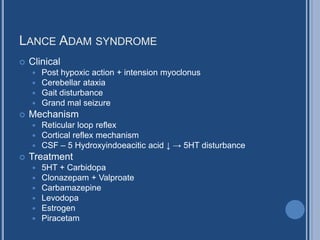
LANCE ADAM SYNDROME
 Clinical
ď‚— Post hypoxic action + intension myoclonus
ď‚— Cerebellar ataxia
ď‚— Gait disturbance
ď‚— Grand mal seizure
 Mechanism
ď‚— Reticular loop reflex
ď‚— Cortical reflex mechanism
 CSF – 5 Hydroxyindoeacitic acid ↓ → 5HT disturbance
 Treatment
ď‚— 5HT + Carbidopa
ď‚— Clonazepam + Valproate
ď‚— Carbamazepine
ď‚— Levodopa
ď‚— Estrogen
ď‚— Piracetam
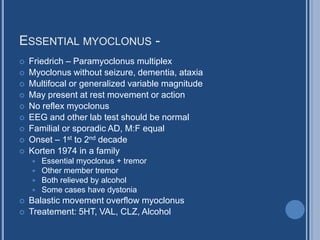
ESSENTIAL MYOCLONUS -
 Friedrich – Paramyoclonus multiplex
 Myoclonus without seizure, dementia, ataxia
 Multifocal or generalized variable magnitude
 May present at rest movement or action
 No reflex myoclonus
 EEG and other lab test should be normal
 Familial or sporadic AD, M:F equal
 Onset – 1st to 2nd decade
 Korten 1974 in a family
ď‚— Essential myoclonus + tremor
ď‚— Other member tremor
ď‚— Both relieved by alcohol
ď‚— Some cases have dystonia
 Balastic movement overflow myoclonus
 Treatement: 5HT, VAL, CLZ, Alcohol
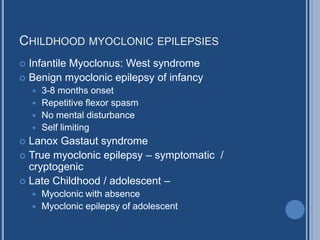
CHILDHOOD MYOCLONIC EPILEPSIES
 Infantile Myoclonus: West syndrome
 Benign myoclonic epilepsy of infancy
ď‚— 3-8 months onset
ď‚— Repetitive flexor spasm
ď‚— No mental disturbance
ď‚— Self limiting
 Lanox Gastaut syndrome
 True myoclonic epilepsy – symptomatic /
cryptogenic
 Late Childhood / adolescent –
ď‚— Myoclonic with absence
ď‚— Myoclonic epilepsy of adolescent
OSCILLATORY MYOCLONUS
 Burst of myoclonic jerk which tend to wane in
amplitude
 Once started in part of the body the movement may
spread to other part and gradually wane
 No other abnormality
 Obeso described anoxic injury
STARTLE SYNDROME
 Clinical
ď‚— Sudden muscular contraction to surprise stimuli
ď‚— Onset when start walking
 Exaggerated startle → stiffness of body may → fall ± shout
 Prominent hypnogogic ± diurnal generalized myoclonic jerks
ď‚— Hesitant broad based gait
ď‚— May improve or persist in later life
 EMG
ď‚— response are shorter than normal latency
 EEG –
ď‚— Abrupt onset of spike and slow wave complex maximum from
centrally → background dysynchronization → normal
 SSEP –
ď‚— significant increased amplitude
 Hyperactive long latency reflex due to dys-inhibition of certain
brainstem center
 May be stimulus sensitive myoclonic disorder
STARTLE EPILEPSY
 Non habituating startle → tonic extensor spasm →
epilepsy ±
 EEG – Desynchornization → frank epileptiform
discharge bilaterally symmetrical or even focal
 Jumping/ Latah/ Myriachit – Initial violent startle in
response to sudden unexpected sensory
stimulation → echolalia, echopraxia, coprolalia or
the assumption of defensive posture
NOCTURNAL MYOCLONUS
 Physiological
ď‚— Familial nocturnal start
 Occur at sleep onset
 Gross, generalized body jerk → arousal
ď‚— Physiological fragmentary myoclonus
 Small fragmentary jerk of head face or diffuse
 REM sleep or drowsiness
 Benign neonatal sleep myoclonus
ď‚— During all stages of sleep
ď‚— Lack EEG correlation
ď‚— No neurological abnormality
NOCTURNAL MYOCLONUS
 Pathological
ď‚— Periodic movement in sleep
 EEG burst of 200-500ms more than myoclonus
 Common in flexor muscle
 Periodic 20-30 sec
 Two side of the body can be activated independently
 Simultaneously or alternating during
 NREM sleep or drowsiness
 Normally asymptomatic
 Baclofen reduces amplitude
SLEEP RELATED MOVEMENT DISORDER
 Restless leg syndrome
 Intense feeling of paresthesia or funny feeling in leg →
desire to move → improve
ď‚— May be associated with peripheral neuropathy or familial
ď‚— May be associated with myoclonus or PMS
ď‚— Clonazepam
 Excessive fragmentary myoclonus in NREM sleep
ď‚— > 50 jerks/ min for 20 consecutive NREM
ď‚— Associated with other disorder and PMS
THANKS

Myoclonus

  • 1.
    MYOCLONUS Dr PS DebMD, DM Director Neurology GNRC Hospitals , Guwahati, Assam, India
  • 2.
    MYOCLONUS  Definition  Suddenshock like contraction of muscle.  Flexor of upper limb and extensor of lower limb  Varying in severity from insufficient to move the joints to fall in ground  Sensory stimulation aggravate attack.  EMG  Burst of 30-60 ms synchronous  Burst of 75-125 ms asynchronous  Burst of >150 ms synchronous  C-reflex – Stimulation of nerve → time locked response.  EEG  Variable pattern  Time lag with EMG activity before or after  Back averaging required
  • 3.
    FOCAL MYOCLONUS  Rhythmic,unchanged by rest, action, sleep, walking due to generation of discharge from discrete segment of neuraxis.  Segmental myoclonus when segment of neuraxis involved. Arrhythmic.  Spontaneous / Action / intentional / reflex  Cortical  Usually multifocal  Distal > proximal, flexor > extensor  Intentional or reflex , may be modality specific
  • 4.
    EPILEPSIA PARTIALIS CONTINUA Rhythmic form, Group of muscles – face, arm or leg, persist for months  Etiology – vascular, trauma, infection, MS, tumor  EMG: Burst of agonist muscles, synchronous with antagonistic muscle  EEG – Focal positive negative transient over sensory- motor cortex contralateral to the jerk, time locked 20sec.  C-Reflex – correlated with giant somato-sensory evoked potential  Evoked potential – large component of P1N2 has some relation to C-reflex as the positive negative transient to the spontaneous jerk  Cranial nerve involvement cephalocaudal
  • 5.
    CORTICAL MYOCLONUS  Mechanism Hyper excitability of the sensory-motor cortex → large synchronous discharge → muscle jerk  Paroxysmal depolarization shift (fragment of epilepsy)  Cause  Any focal cortical damage  Tumor,  Angioma  Encephalitis  Idiopathic  Treatment  Surgical removal of the cause  Anticonvulsant
  • 6.
    BRAINSTEM MYOCLONUS: PALATAL MYOCLONUS Clinical  Rhythmic oscillation of palate sometime other part (ocular, tongue, larynx, pharynx, diaphragm)  Brachial muscles are affected related to rhythmicity of respiration/gill movement  Persist during sleep -1.5-3Hz  Mechanism:  Tegmental tract lesion → Inf. Olive oscillate → Purkunji cell → Reticulospinal tract / vestibulospinal tract  Any lesion of Gullain Mollaret Triangle – Dentate – Red nucleus – Inf. Olive  Pathology  Hypertrophic degeneration of inf. Olive.
  • 7.
    PALATAL MYOCLONUS CONT… Cause  Idiopathic  Stroke  Trauma  Tumor → 10months later  Metabolic encephalopathy  Prognosis: Resistant  Treatment  Tetrabenazine  Halloparidol  5-Hydroxytryptophan  Carbamazipine  Bulbar myoclonus: Tongue and neck movement
  • 8.
    SPINAL MYOCLONUS  Clinical Rhythmic > arrhythmic  Spontaneous, persist in sleep  One limb, adjacent trunk or both legs  Cause  Degenerative  Demylination  C. myelopathy  Tumor,  Following spinal anesthesia  Contrast injection  Rarely idiopathic  Ischemic myelopathy : stimulus sensitive myoclonus  Rx: Clonazepam
  • 9.
    PERIPHERAL MYOCLONUS  Rarelytrue myoclonus is seen with acute or chronic denervation in involved muscle  Lesion:  Nerve  Brachial plexus  Nerve root  Essential – rarely focal  Treatment: Clonazepam
  • 10.
    MULTIFOCAL OR GENERALIZED(EPILEPTIC MYOCLONUS)  Types  Multifocal : focal jerks at different part of body  Generalized: Large part of body affected  Etiology may be same  Cortical:  Increased excitability of brain due to paroxysmal depolarization shift involving group of neuron in different part of brain – Fragment of epilepsy  EEG shows typical multifocal discharge and cortical correlation  SSEP - ↑
  • 11.
    RETICULAR – GENERALIZED Clinical  Proximal more than distal  Flexor more than extensor  Sometime segment of body all muscle  Spontaneous or reflex or action  Cranial muscle → caudo-cephalic involvement  Mechanism  Hyper-excitability of a portion of the caudal brain stem reticular formation – the nucleus reticularis gigentocellularis  EEG:  Spike, generalized highest amplitude vertex  Follow the EMG burst of myoclonus  Spike is not time locked to the myoclonus, spike is projected and not directly responsible for myoclonus  SEP is not enhance (no cortical hyperactivity)  Combined Reticular and Cortical myoclonus due to combined lesion
  • 12.
    PRIMARY GENERALIZED EPILEPTIC MYOCLONUS Focal  Commonly small focal movement with finger movement (minipolymyoclonus also seen with peripheral denervation)  Generalized  Synchronized whole body jerk (fragment of gen. epilepsy)  Cranial muscle activation down the brain stem  Mechanism  Whole cortex is hyper excitable and is driven to a paroxysm by normal ascending impulse from the brain stem reticular formation and non specific thalamic nuclei.  Ascending impulse could be paroxysmal  EEG:  Generalized fronto central predominance, slow negativity which precedes the myoclonus  For small jerk this event last 100-250 ms and jitter in time with respect to jerk
  • 13.
    PROGRESSIVE MYOCLONIC EPILEPSY Nonspecific, various condition with progressive multifocal or generalized epilepsy ± dementia 1. Spinocerebellar Degeneration  Clinical  Heterogenous syndrome (Prototype : Mitochondrial myopathy, Hexose aminidase A deficiency)  Progressive myoclonus Reflex + action  Generalized epilepsy  Cerebellar ataxia  Sporadic or AR  Onset 5-15 years  Occasional associated  Dementia  Spasticity  Myopathy  Neuropathy  Deafness
  • 14.
    SPINOCEREBELLAR DEGENERATION CONT.. History  Unverricht – Familial myoclonic epilepsy (first described)  Lundborg – one case cerebellar degeneration  Ramsay Hunt – Dessenrgia cerebellomyoclonica  Pathology : Fridrich ataxia + dentate degeneration  Baltic myoclonus  Scandinavian – Koskiniemi  American – Eldrige  Treatment  Valproate  Clonazepam  Phenobarbital  Phenytoin aggravates
  • 15.
    STORAGE DISORDER 1. Cerebellarwith Dementia 1. Lafora body disease 2. GM2 gangliosidosis ( Hex A) 3. Ceroid lipofuscinosis (Batter’s disease 4. Sialidosis (Chery red spot) 5. Goucher 6. Mitochondrial myopathy 2. Extrapyramidal + 1. Wilson’s disease 2. Hallevorden Saptz disease 3. Torsion dystonia 4. PSP 5. Huntington disease 6. Biotin deficiency
  • 16.
    3. Dementia 1. CrutzfieldJakob disease 2. Alzheimer’s disease 4. Viral encephalopathy 1. Herpes simplex encephalitis 2. Subacute sclerosing pan encephalitis 5. Metabolic 1. Hepatic 2. Renal 3. Hyponatremia 4. Hypoglycemia 5. Non ketotic hyperglycemia
  • 17.
    6. Toxic 1. Bismuth 2.Heavy metal 3. Methyl bromide 4. Drugs 7. Physical 1. Trauma 2. Heat 3. Electric shock 4. Decompressive sickness 5. Hypoxia –
  • 18.
    LANCE ADAM SYNDROME Clinical  Post hypoxic action + intension myoclonus  Cerebellar ataxia  Gait disturbance  Grand mal seizure  Mechanism  Reticular loop reflex  Cortical reflex mechanism  CSF – 5 Hydroxyindoeacitic acid ↓ → 5HT disturbance  Treatment  5HT + Carbidopa  Clonazepam + Valproate  Carbamazepine  Levodopa  Estrogen  Piracetam
  • 19.
    ESSENTIAL MYOCLONUS - Friedrich – Paramyoclonus multiplex  Myoclonus without seizure, dementia, ataxia  Multifocal or generalized variable magnitude  May present at rest movement or action  No reflex myoclonus  EEG and other lab test should be normal  Familial or sporadic AD, M:F equal  Onset – 1st to 2nd decade  Korten 1974 in a family  Essential myoclonus + tremor  Other member tremor  Both relieved by alcohol  Some cases have dystonia  Balastic movement overflow myoclonus  Treatement: 5HT, VAL, CLZ, Alcohol
  • 20.
    CHILDHOOD MYOCLONIC EPILEPSIES Infantile Myoclonus: West syndrome  Benign myoclonic epilepsy of infancy  3-8 months onset  Repetitive flexor spasm  No mental disturbance  Self limiting  Lanox Gastaut syndrome  True myoclonic epilepsy – symptomatic / cryptogenic  Late Childhood / adolescent –  Myoclonic with absence  Myoclonic epilepsy of adolescent
  • 21.
    OSCILLATORY MYOCLONUS  Burstof myoclonic jerk which tend to wane in amplitude  Once started in part of the body the movement may spread to other part and gradually wane  No other abnormality  Obeso described anoxic injury
  • 22.
    STARTLE SYNDROME  Clinical Sudden muscular contraction to surprise stimuli  Onset when start walking  Exaggerated startle → stiffness of body may → fall ± shout  Prominent hypnogogic ± diurnal generalized myoclonic jerks  Hesitant broad based gait  May improve or persist in later life  EMG  response are shorter than normal latency  EEG –  Abrupt onset of spike and slow wave complex maximum from centrally → background dysynchronization → normal  SSEP –  significant increased amplitude  Hyperactive long latency reflex due to dys-inhibition of certain brainstem center  May be stimulus sensitive myoclonic disorder
  • 23.
    STARTLE EPILEPSY  Nonhabituating startle → tonic extensor spasm → epilepsy ±  EEG – Desynchornization → frank epileptiform discharge bilaterally symmetrical or even focal  Jumping/ Latah/ Myriachit – Initial violent startle in response to sudden unexpected sensory stimulation → echolalia, echopraxia, coprolalia or the assumption of defensive posture
  • 24.
    NOCTURNAL MYOCLONUS  Physiological Familial nocturnal start  Occur at sleep onset  Gross, generalized body jerk → arousal  Physiological fragmentary myoclonus  Small fragmentary jerk of head face or diffuse  REM sleep or drowsiness  Benign neonatal sleep myoclonus  During all stages of sleep  Lack EEG correlation  No neurological abnormality
  • 25.
    NOCTURNAL MYOCLONUS  Pathological Periodic movement in sleep  EEG burst of 200-500ms more than myoclonus  Common in flexor muscle  Periodic 20-30 sec  Two side of the body can be activated independently  Simultaneously or alternating during  NREM sleep or drowsiness  Normally asymptomatic  Baclofen reduces amplitude
  • 26.
    SLEEP RELATED MOVEMENTDISORDER  Restless leg syndrome  Intense feeling of paresthesia or funny feeling in leg → desire to move → improve  May be associated with peripheral neuropathy or familial  May be associated with myoclonus or PMS  Clonazepam  Excessive fragmentary myoclonus in NREM sleep  > 50 jerks/ min for 20 consecutive NREM  Associated with other disorder and PMS
  • 27.