Extraocular Eye
Movements
Dr Zaid Azhar
Need for eye movement
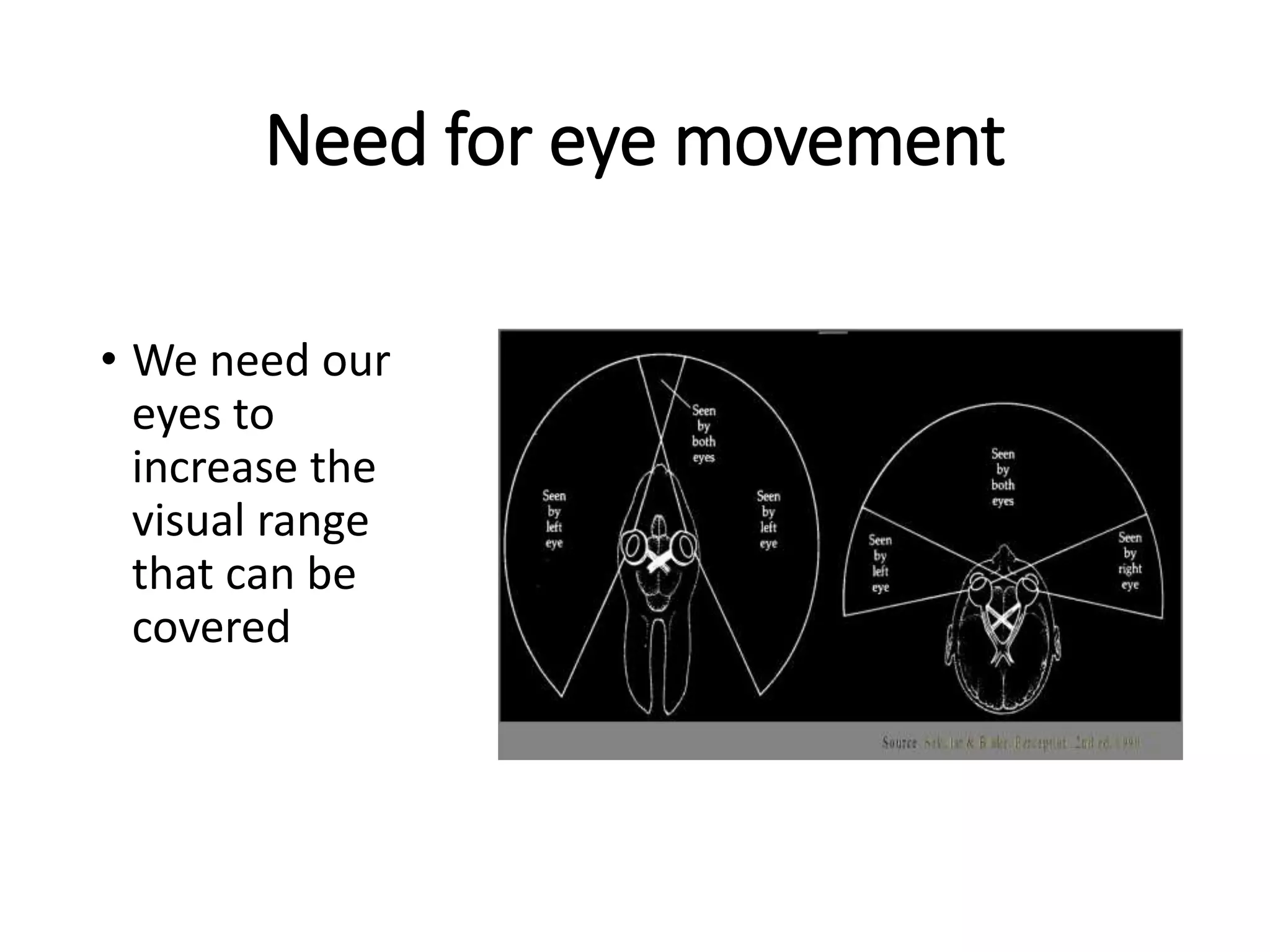
• We need our
eyes to
increase the
visual range
that can be
covered
Need for eye movement
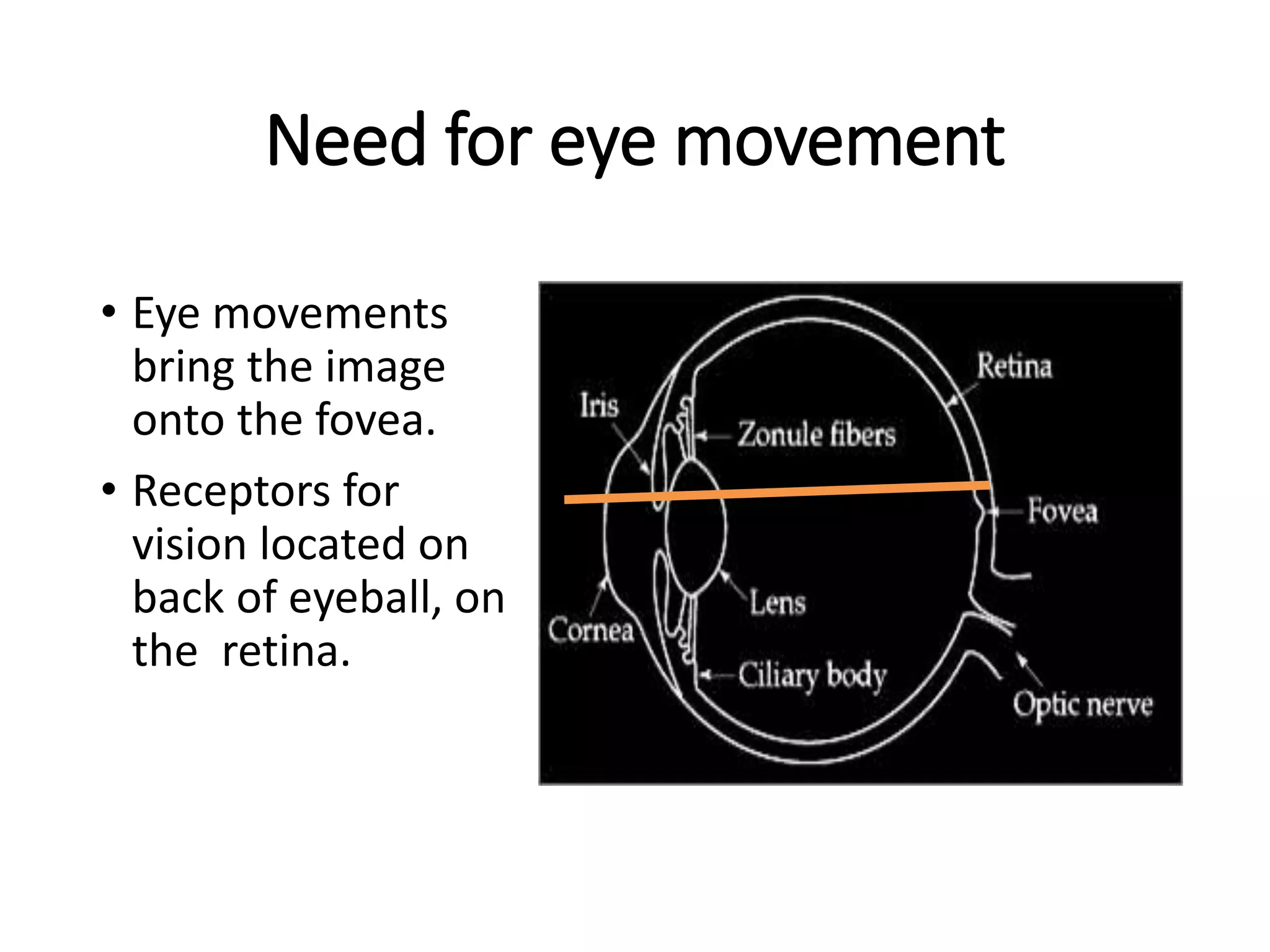
• Eye movements
bring the image
onto the fovea.
• Receptors for
vision located on
back of eyeball, on
the retina.
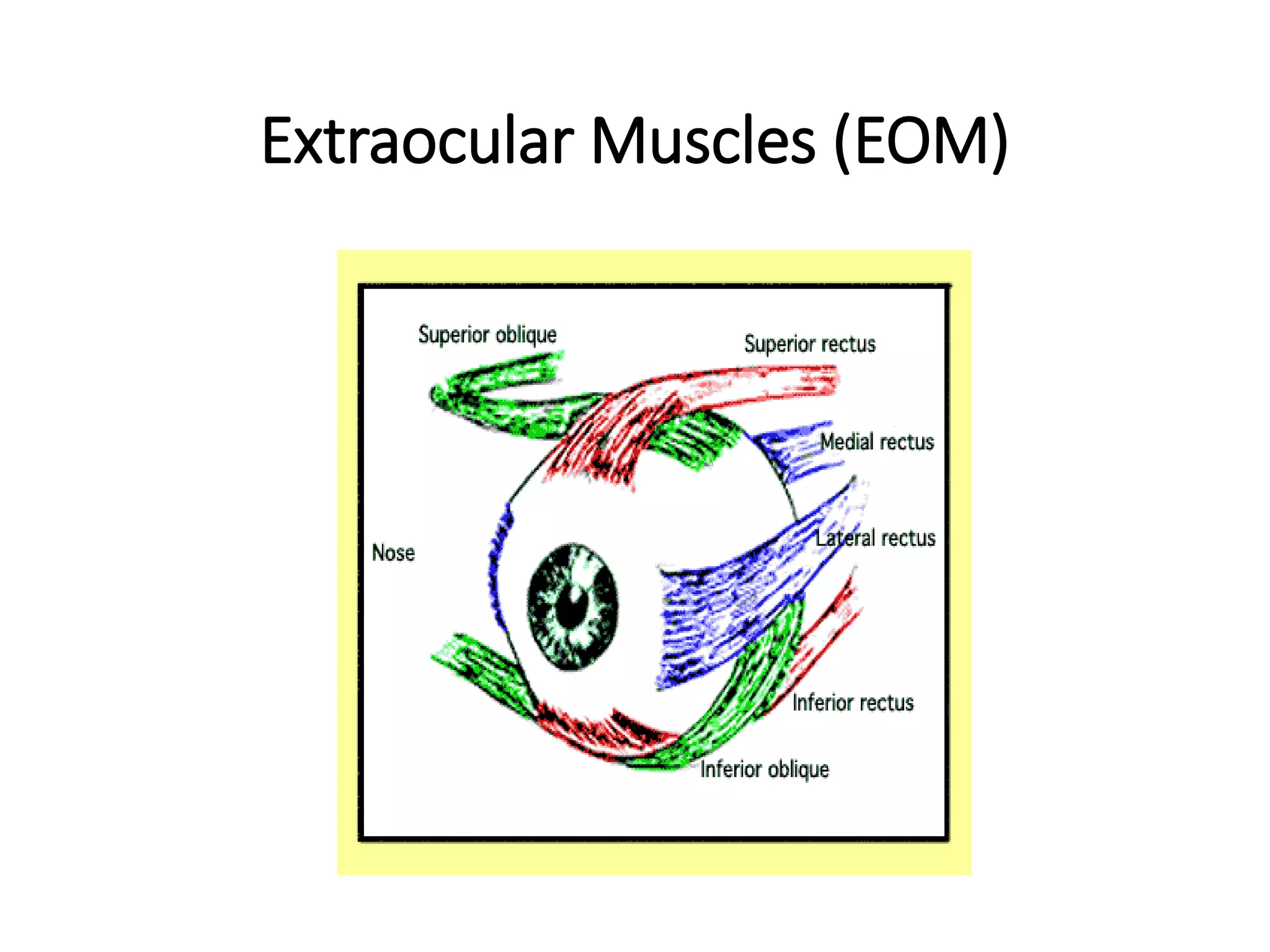
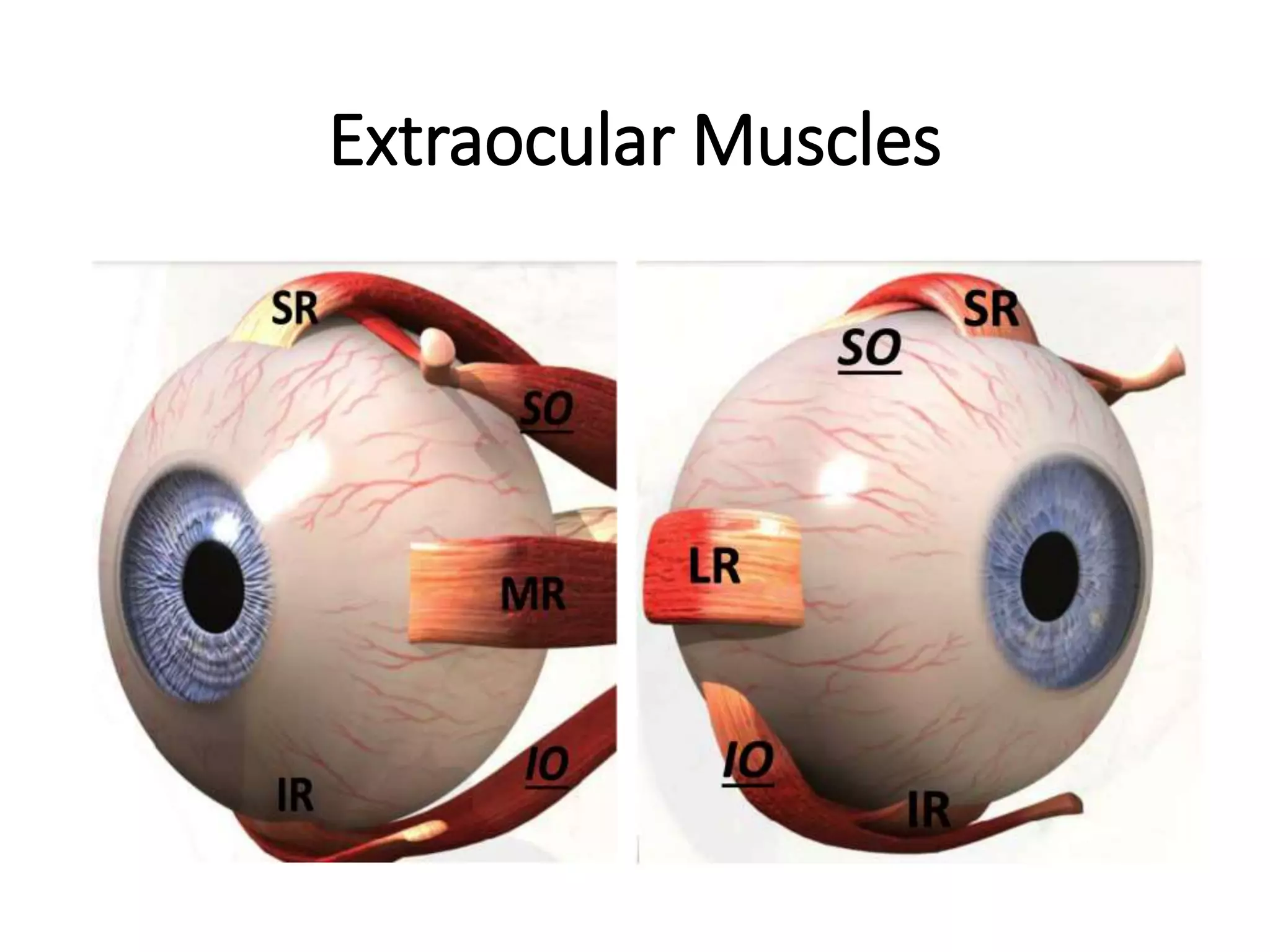
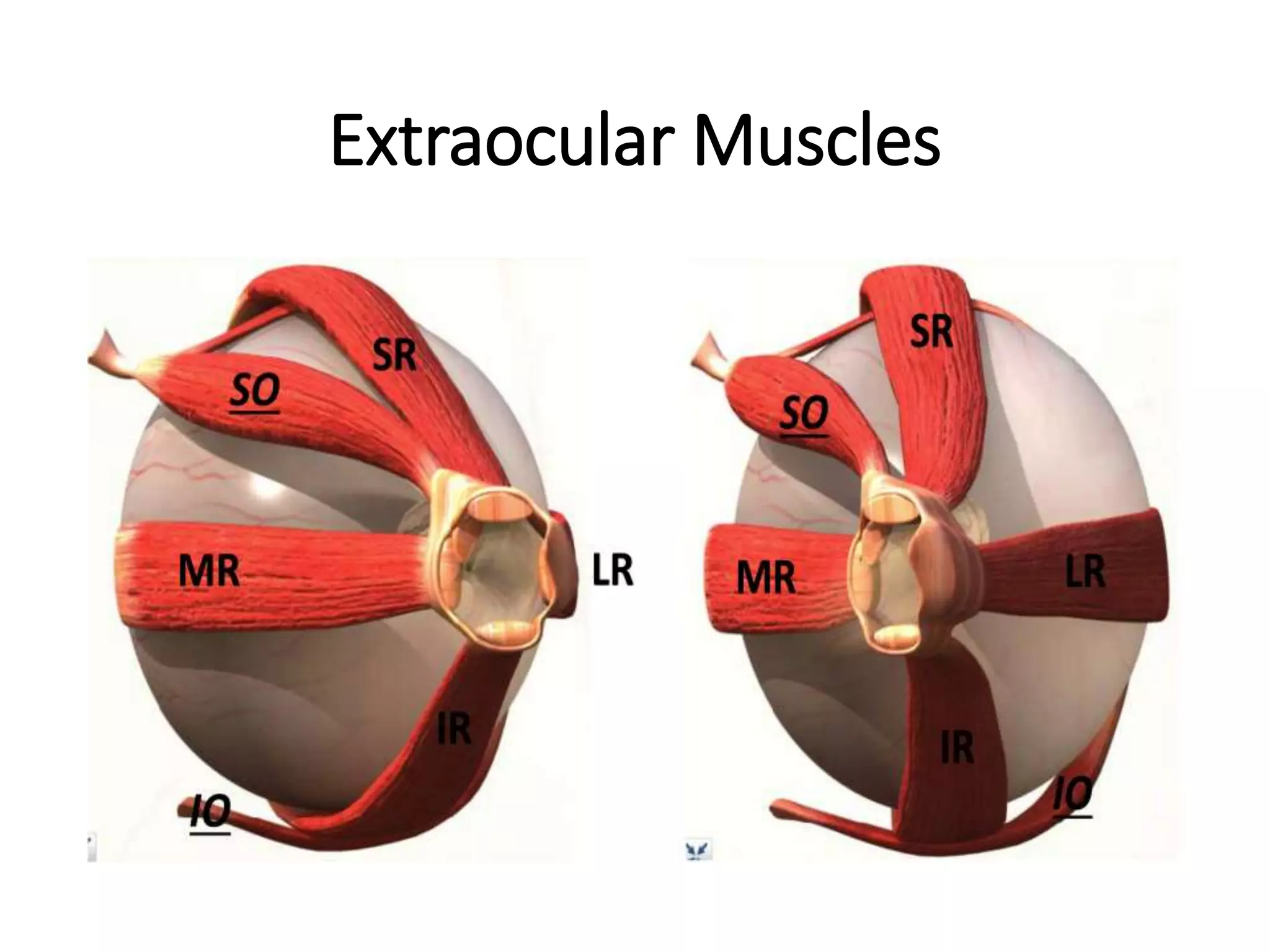
Extraocular Muscles (EOM)
Extraocular Muscles
Extraocular Muscles
Extraocular Muscles
Muscle innervation
LR6 SO4 O3
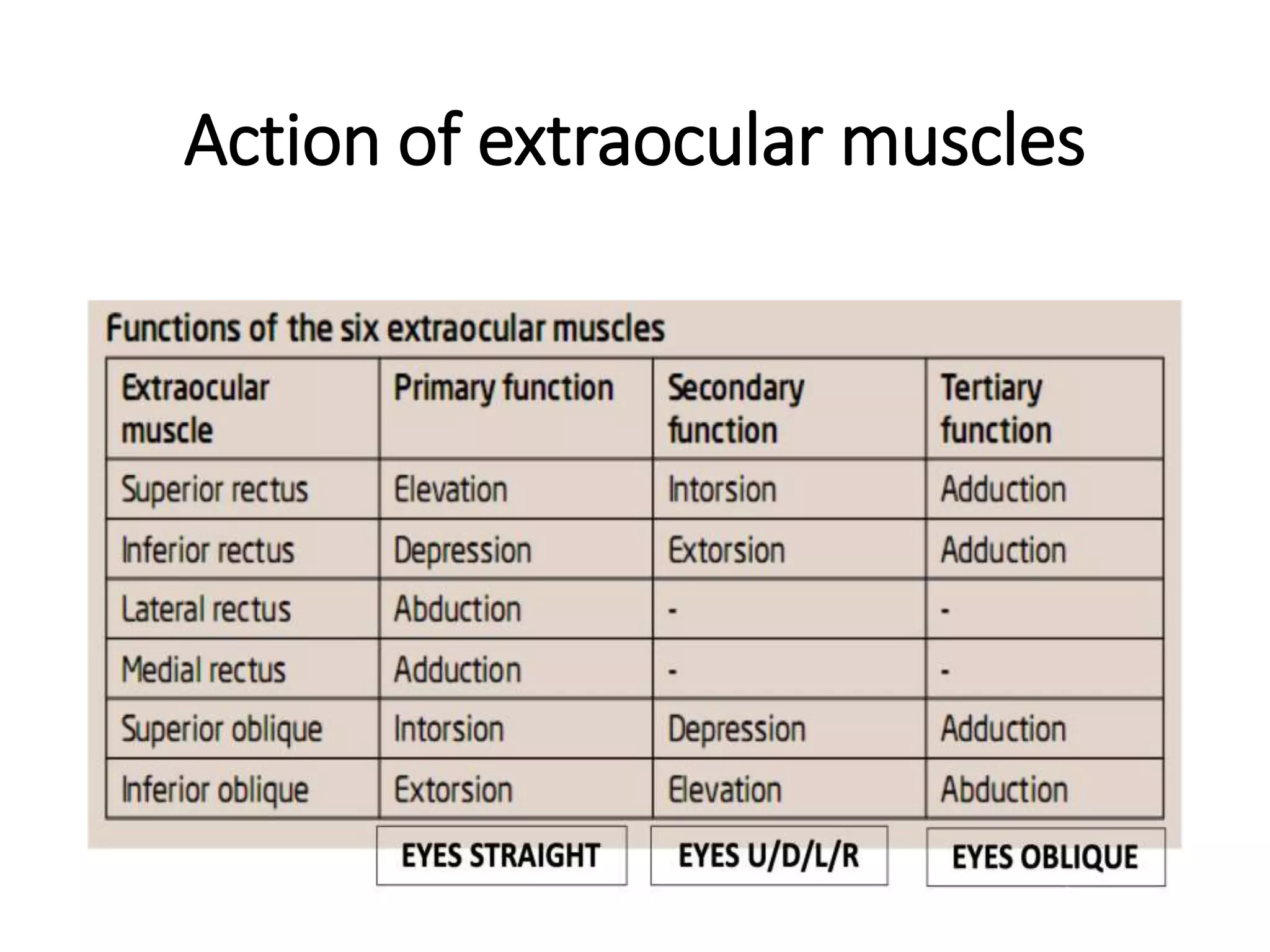
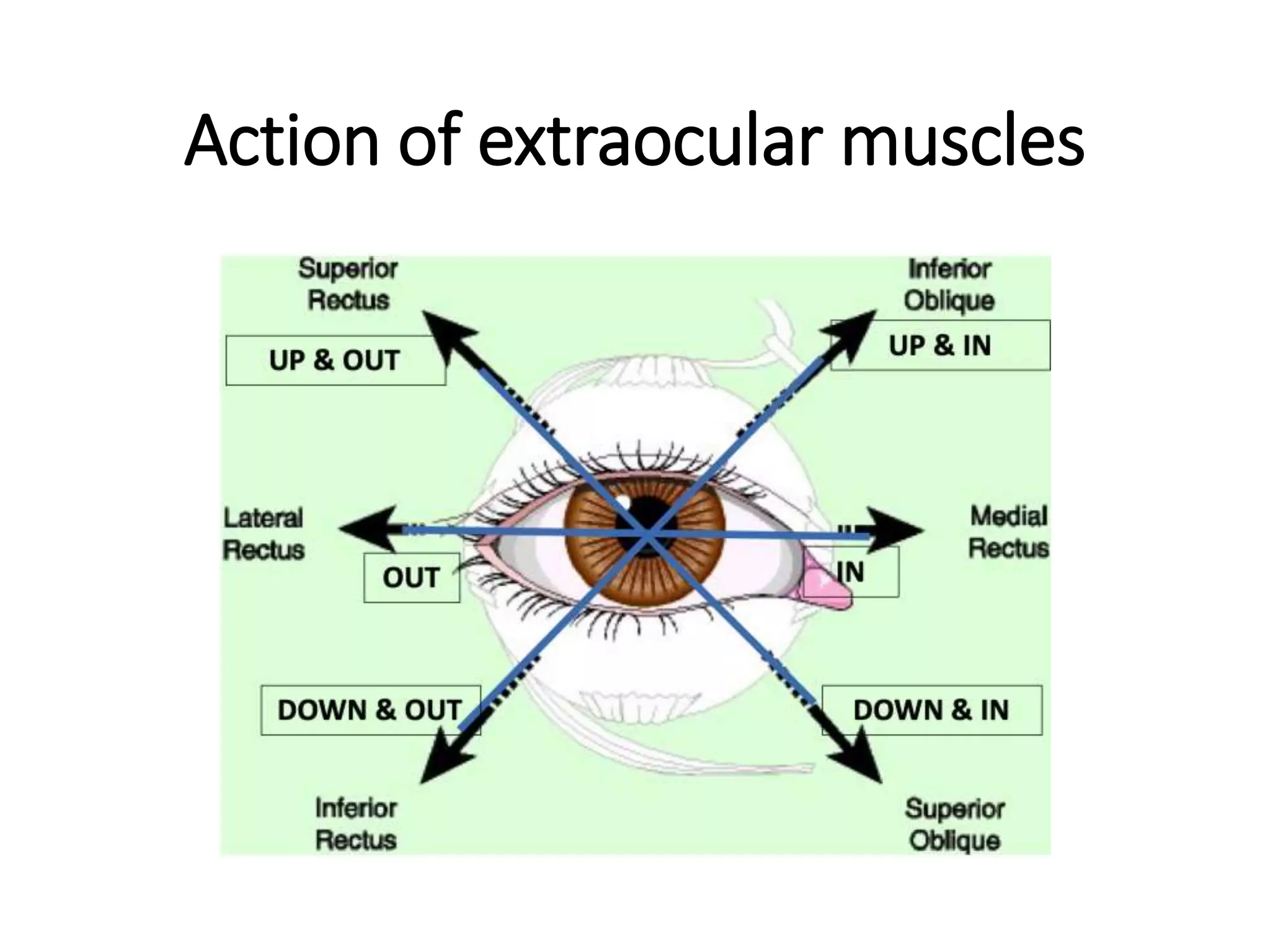
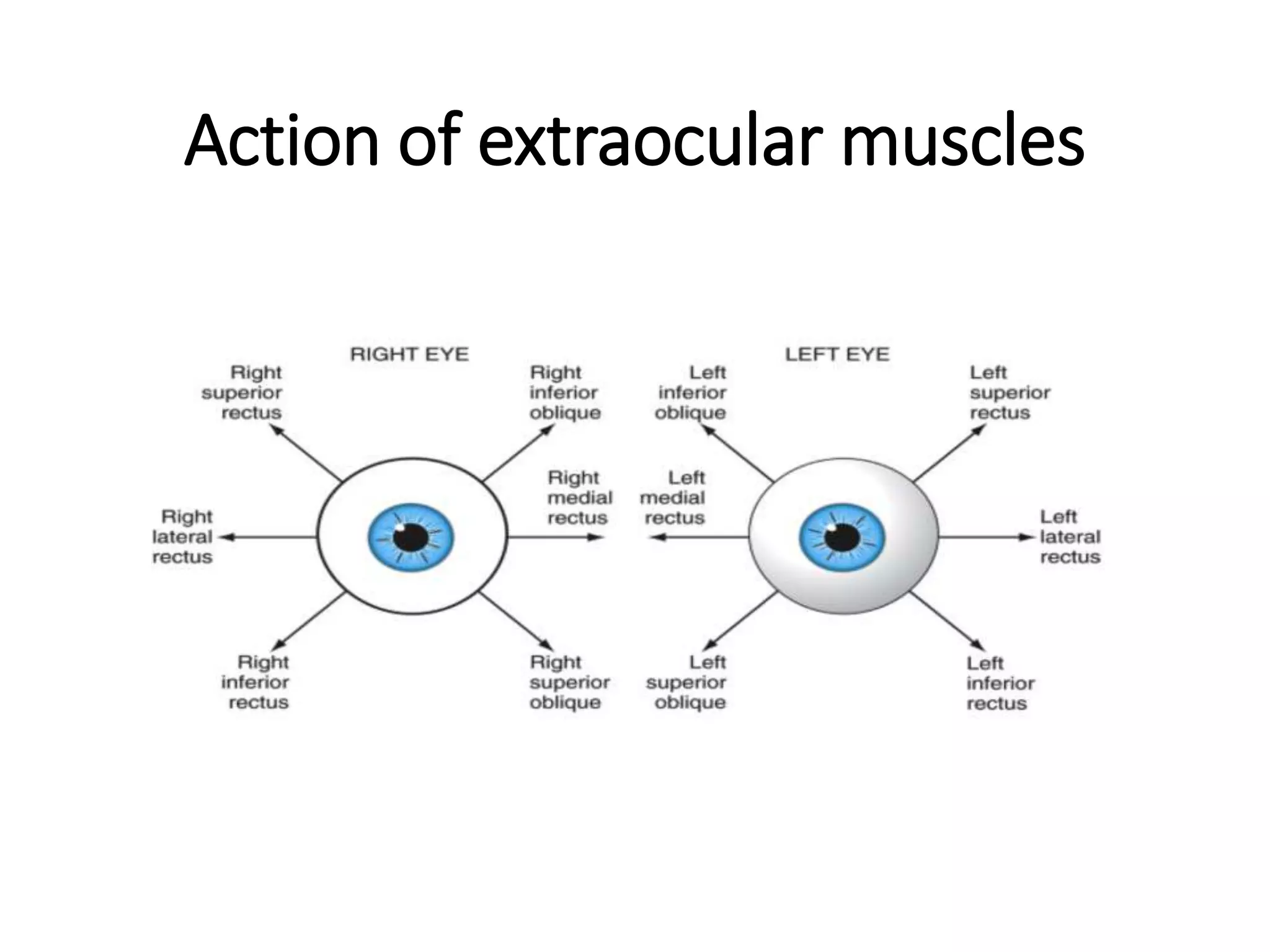
Action of extraocular muscles
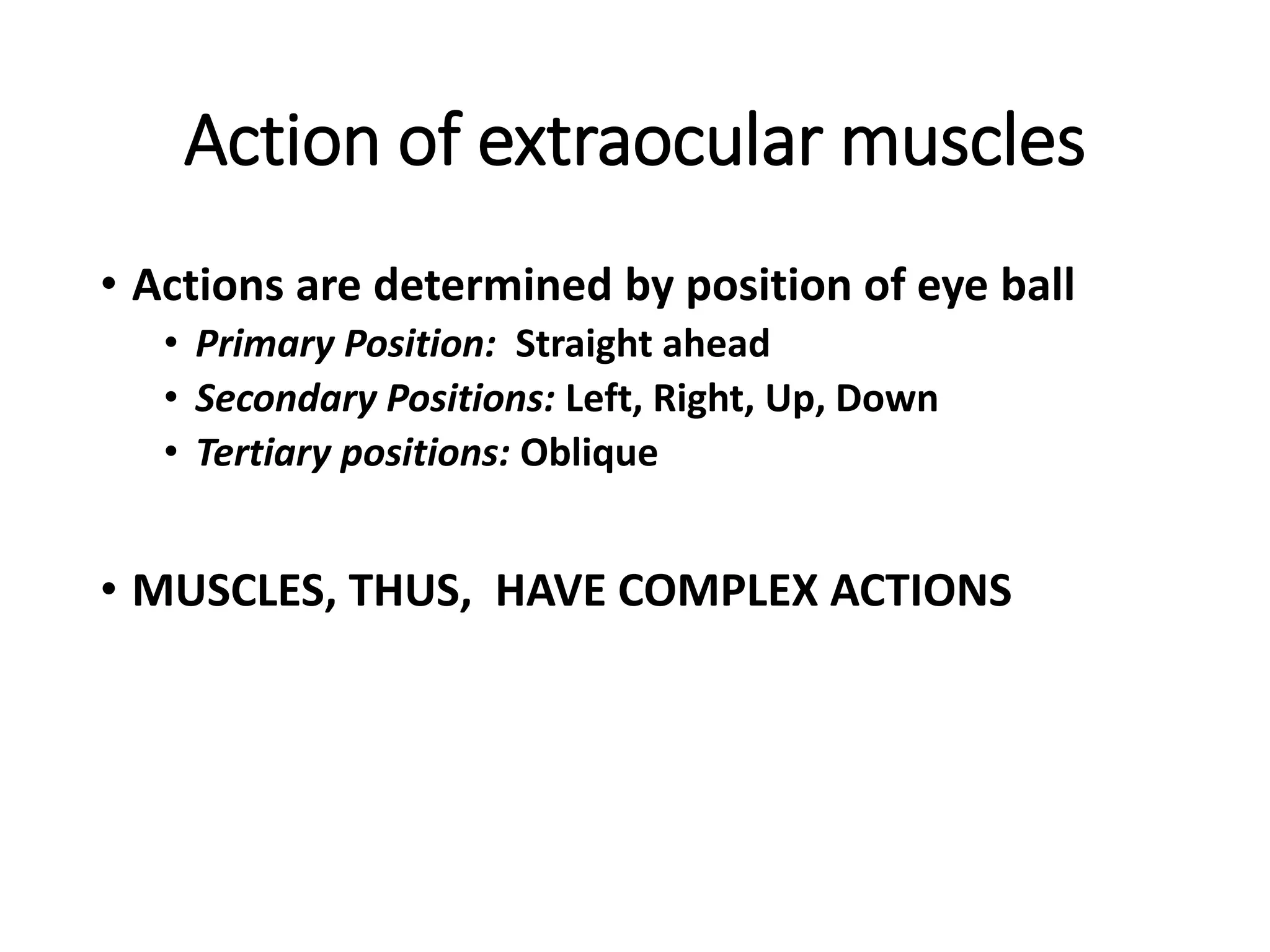
• Actions are determined by position of eye ball
• Primary Position: Straight ahead
• Secondary Positions: Left, Right, Up, Down
• Tertiary positions: Oblique
• MUSCLES, THUS, HAVE COMPLEX ACTIONS
Action of extraocular muscles
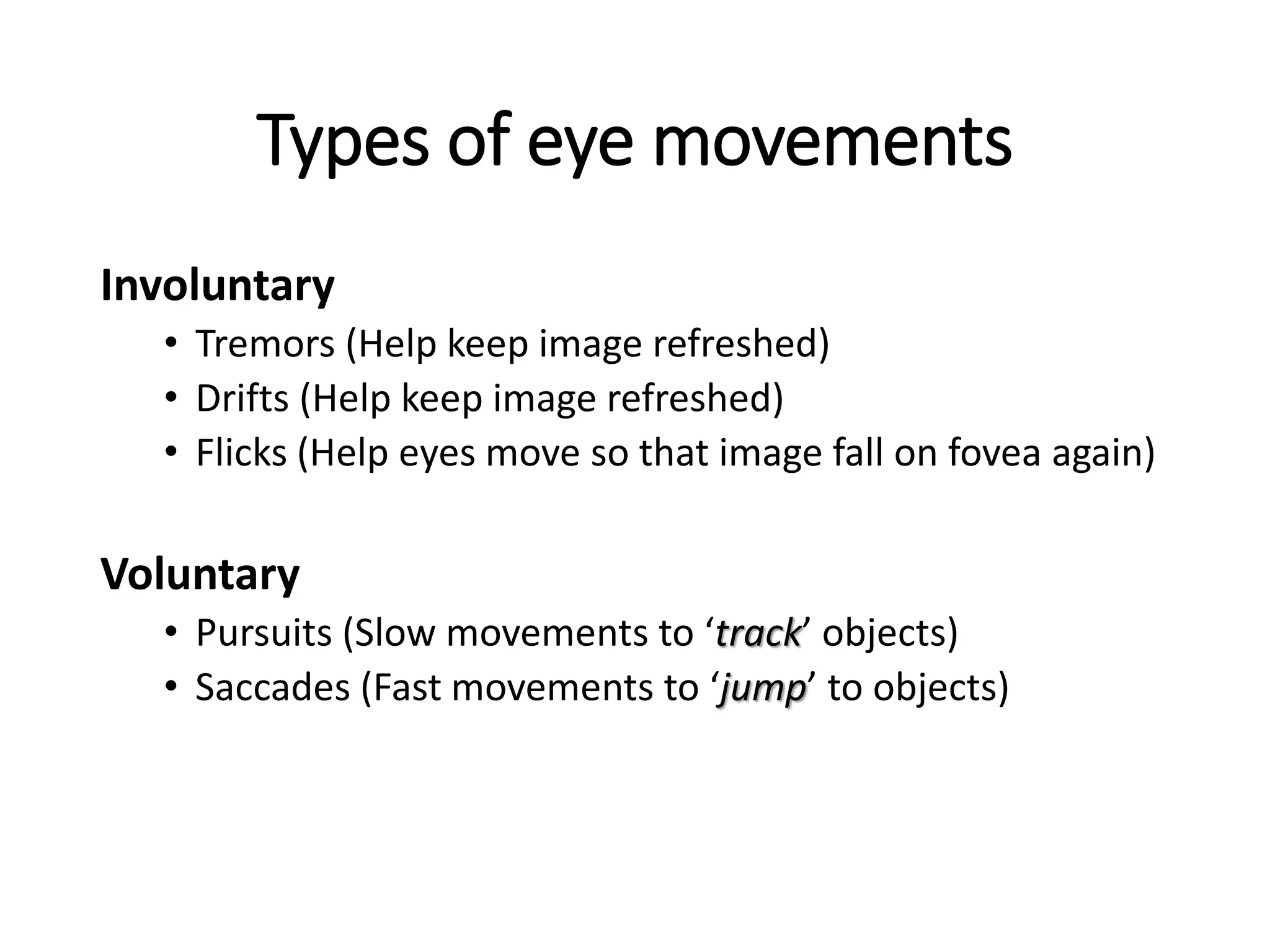
Types of eye movements
Involuntary
• Tremors (Help keep image refreshed)
• Drifts (Help keep image refreshed)
• Flicks (Help eyes move so that image fall on fovea again)
Voluntary
• Pursuits (Slow movements to ‘track’ objects)
• Saccades (Fast movements to ‘jump’ to objects)
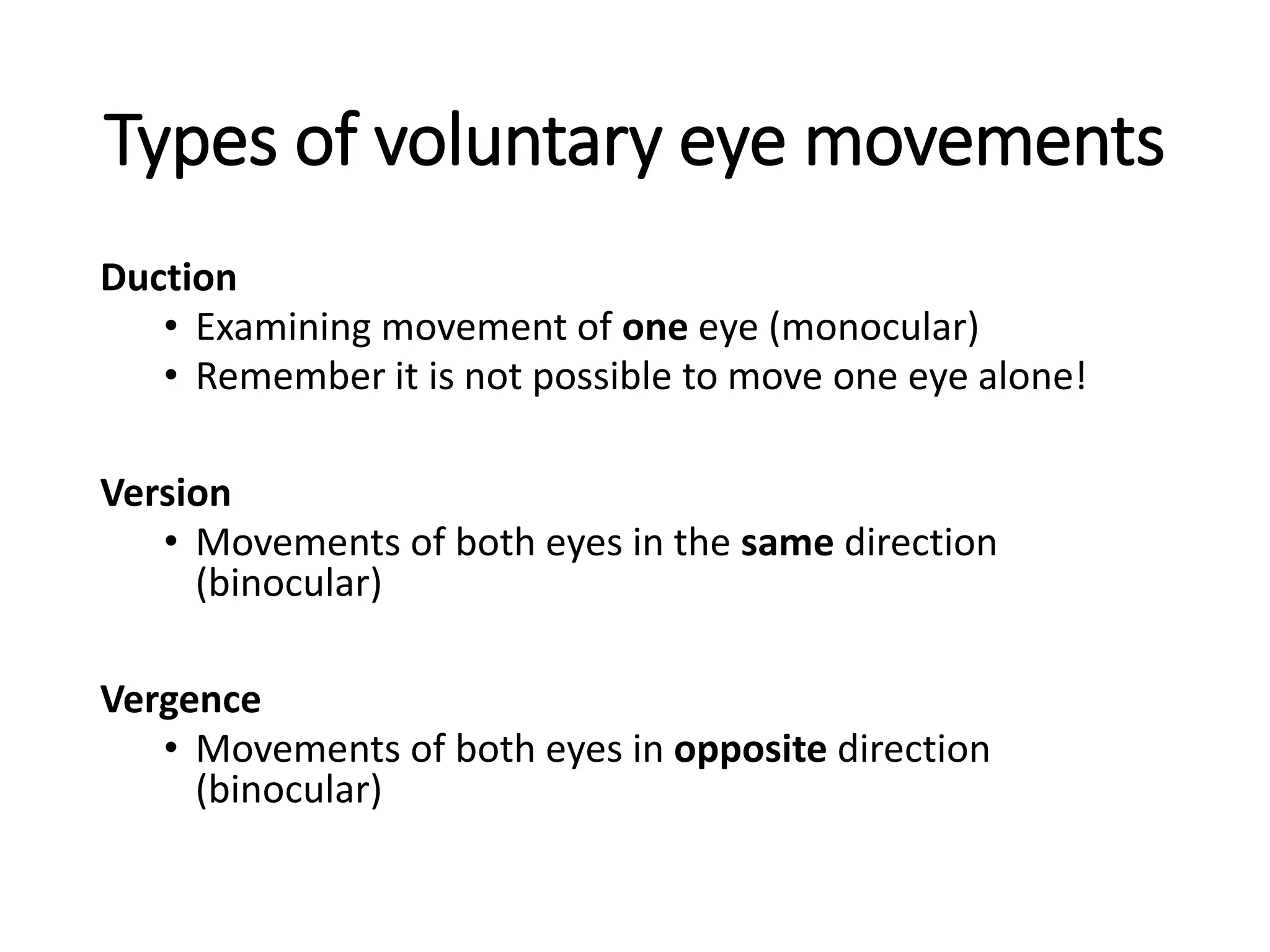
Types of voluntary eye movements
Pursuits
• To ‘follow’ objects
• What we usually test
Saccades
• To ‘rapidly’ shift gaze to an object of interest
Types of voluntary eye movements
Duction
• Examining movement of one eye (monocular)
• Remember it is not possible to move one eye alone!
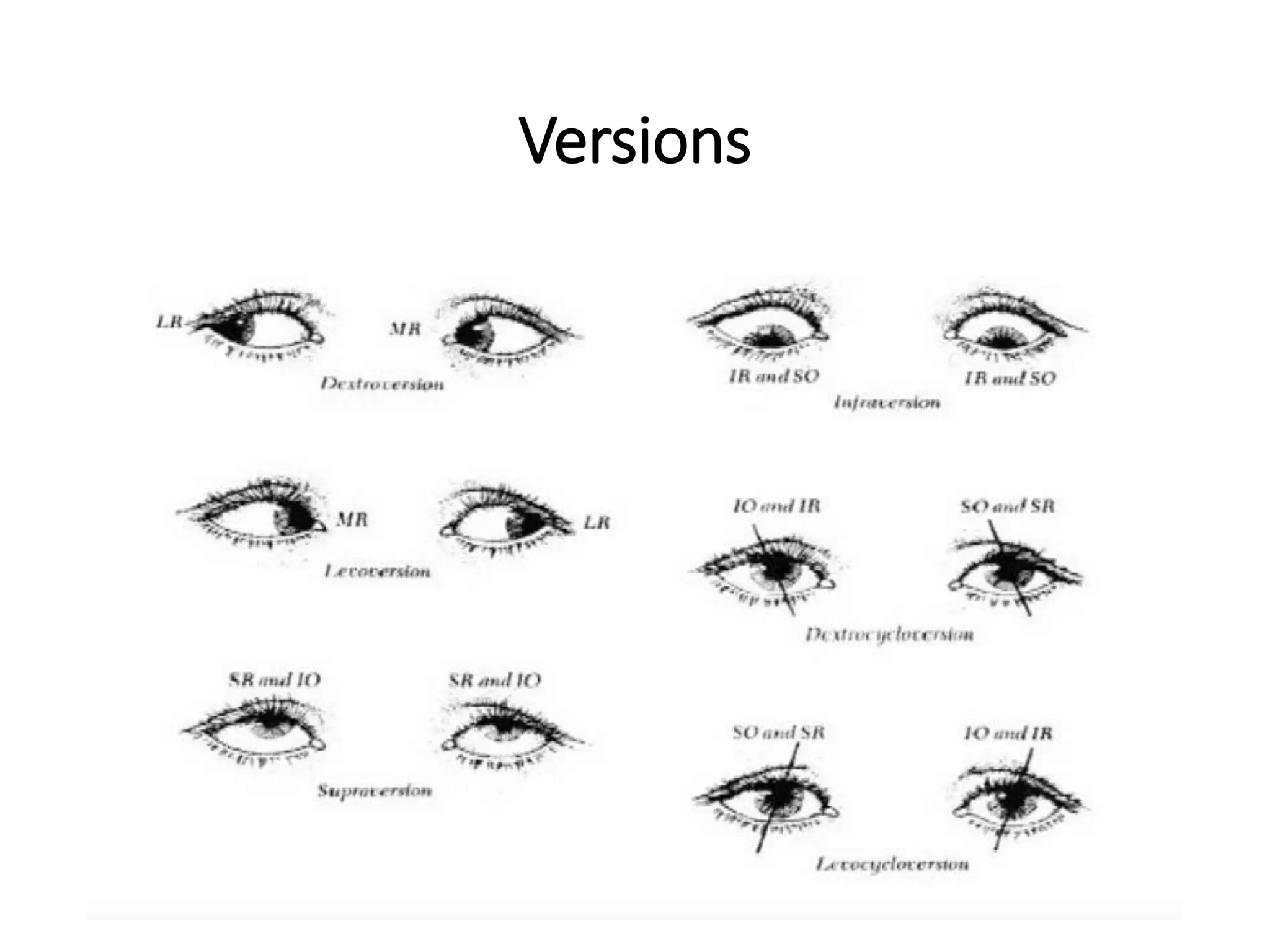
Version
• Movements of both eyes in the same direction
(binocular)
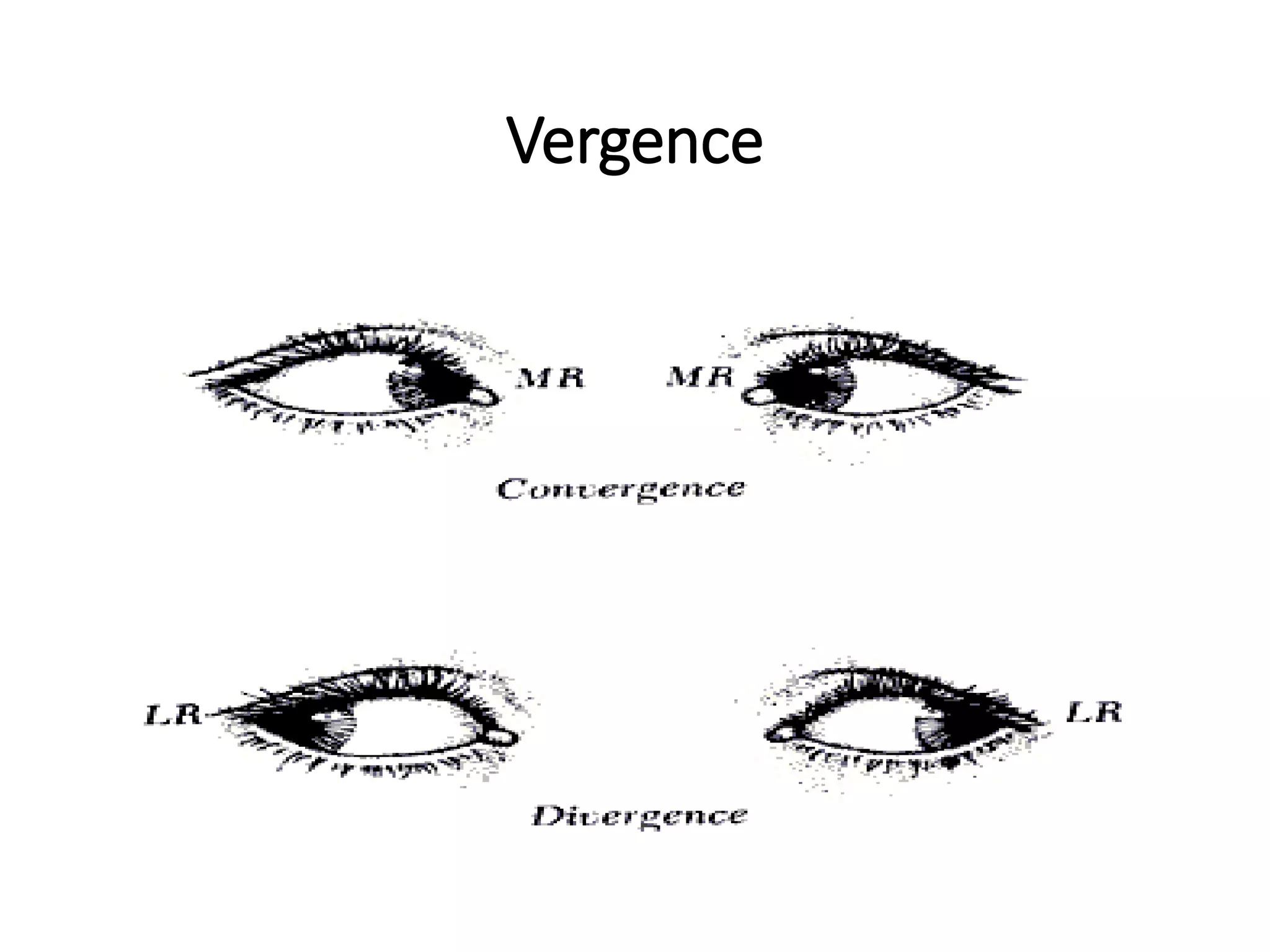
Vergence
• Movements of both eyes in opposite direction
(binocular)
Ductions
Vergence
Versions
Horizontal conjugate gaze
Rule 1
• Both eyes must move together
• Muscles in both eyes are thus paired
• Paired muscles (yoke muscles) help move the eye in
a given direction.
• They both thus get similar stimulatory signals from
the brain (herrings law)
Rule 2
• Muscles in one eye have an agonist- antagonist
relationship
• The horizontal rectii form one set
• The vertical rectii/ obliques for the other set
• When one muscle in the set contract the other
must relax (sherrington’s law)
Versions
INFRA VERSION
DEXTRO
VERSION
LEVO
VERSION
SUPRA VERSION
One eye
follows
the other
Agonist
Pairs in
both eyes
These are
called
‘Yoke’
muscles
Both get
equal
impulses
HERING’S LAW
Versions
INFRA VERSION
DEXTRO
VERSION
LEVO
VERSION
SUPRA VERSION
The
antagonist
muscles to
yokes…
… are
inhibited…
…to allow
for
optimal
actions…
…of yoke
muscles
SHERRINGTON’S LAW
Horizontal conjugate gaze
Higher control of eye movements
Cortex
• Primary eye field in
Area 8 controls
voluntary saccadic
conjugate movements
• Occipital eye field in
Area 18 and 19 controls
smooth pursuit
movements
Higher control of eye movements
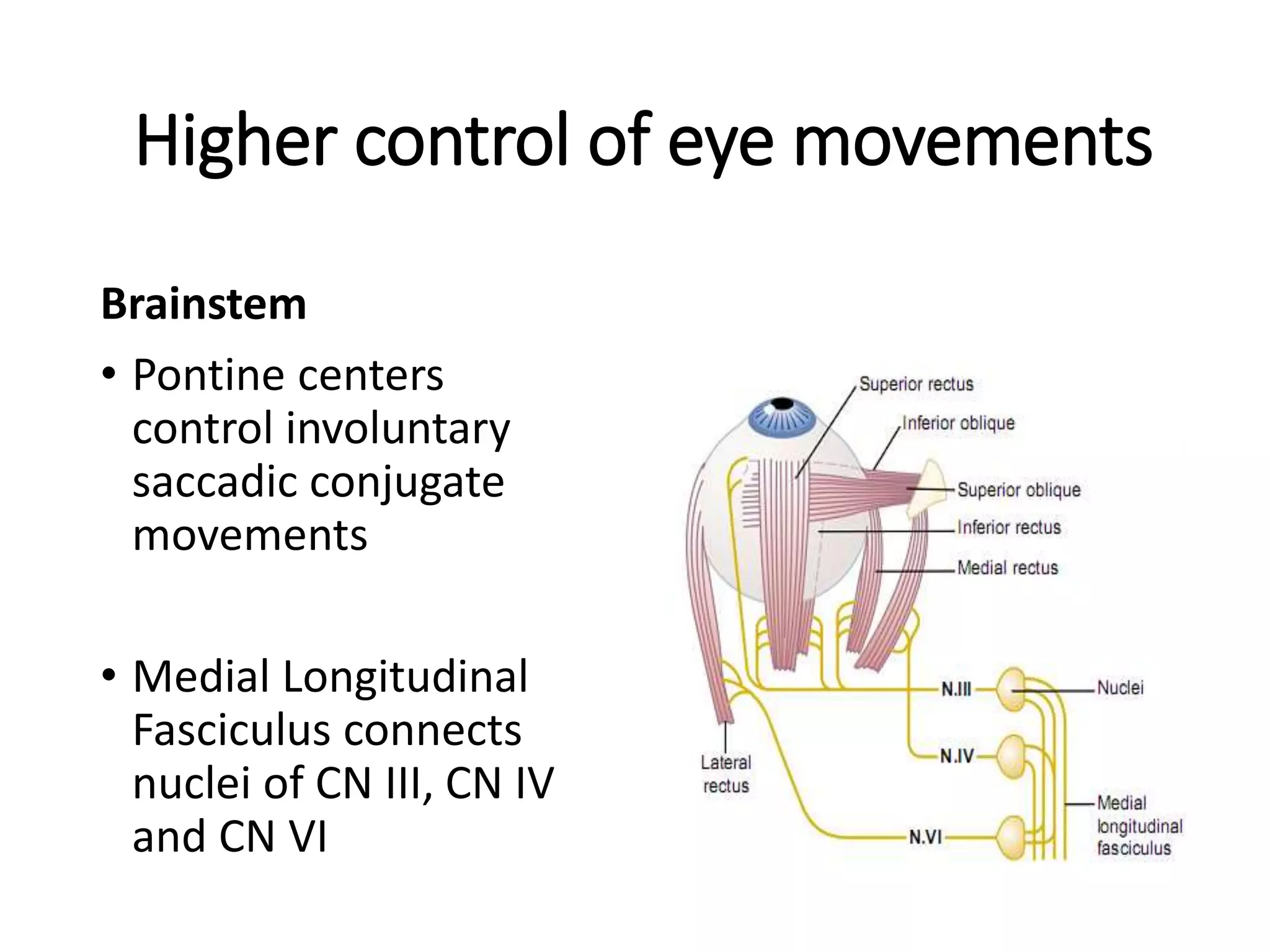
Brainstem
• Pontine centers
control involuntary
saccadic conjugate
movements
• Medial Longitudinal
Fasciculus connects
nuclei of CN III, CN IV
and CN VI
Eye Movements.pptx

Eye Movements.pptx