Supranuclear and
Internuclear Gaze
Pathways
DR.R.BRINDA
EYE MOVEMENTS
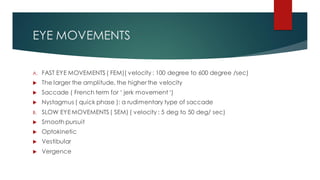
A. FAST EYE MOVEMENTS ( FEM)( velocity : 100 degree to 600 degree /sec)
 The larger the amplitude, the higher the velocity
 Saccade ( French term for ‘ jerk movement ‘)
 Nystagmus ( quick phase ): a rudimentary type of saccade
B. SLOW EYE MOVEMENTS ( SEM) ( velocity : 5 deg to 50 deg/ sec)
 Smooth pursuit
 Optokinetic
 Vestibular
 Vergence
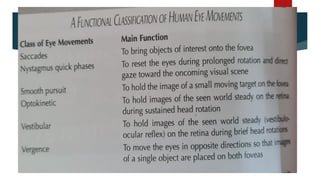
Functional classification of eye movts
A. FEM : saccades
1. Stimuli:
 Voluntary saccade: voluntary changes in direction
 Reflexivesaccade: sudden peripheral visual,auditory or sensory stimulus
2. Visual “suppression”during saccades: even though the visual world is
rapidly sweeping across retina , there is no sense of a blurred image.
B.FEM: nystagmus quick phases
1. Stimulus: vestibular or optokinetic stimulationwould lead the eyes to
extreme deviation unless prevented by corrective quick phases
2. Provide automatic resetting movements in the presence of spontaneous
drifts of the eyes.
3.This type of FEM is the phylogeneticforerunner of voluntary saccades
C. SEM ; smooth pursuit
1.Stimuli:
 Motion of the image of a target across the foveal and perifoveal retina
 Occasionallynonvisual stimuli such as proprioception can also generate
smooth pursuit movts
 If the target is moving at a velocity of greater than 50 degree per second,
then the eyes after falling behind in the pursuit,willexecute saccadic
voluntary FEM in order to regain macular fixation, the eyes will then pursue
with the smooth SEM until they fall behind again, this results in another
“catch up” saccadic FEM as in the phenomenon of cogwheel pursuit.
 Visual fixation- holds the image of the stationary object on the fovea
 D. SEM : Optokinetic system:
1 .Stimulus:sustainedhead rotation
2. The vestibular system responds only to acceleration. With sustainedhead
rotation at a constant velocity , the vestibular response fades and the
optokineticsystem supplements visually driven compensatory slow-phase eye
movts
 E. SEM : Vestibular:
1. Stimulation of each set of semicircular canals influences a particular pair of
eye muscles
a. Lateral ( horizontal ) canals : horizontal ( I/L MR and C/L LR )
b. Posterior ( inferior ) canals – downward and tortional ( I/L SO, C/L IR )
c. Anterior ( superior ) canals : upward and tortional ( I/L SR, C/L IO )
2. The horizontal semicircular canals are oriented 30 degrees above the
horizontal, with the ampullae anteriorly located
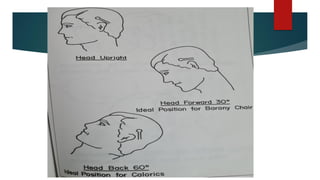
3. To maximally affect the horizontal semicircular canals, a specifichead
positionis required.
 Head is inclinedforward 30 degrees for maximal effect of rotational forces
in the Barany chair ( 30 deg above supine position )
 Head is inclinedbackward 60 degree for maximal effect for the
convection currents of endolymph flow with calorie testing
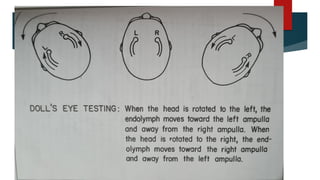
 During Doll’s eye testing, when head is rotated towards left side, the
endolymph move towars the left ampullaand away from Right ampulla
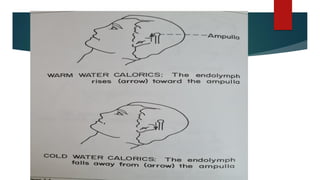
 Movt of the endolymph ( by warm water calorics , Barany chair rotation, or
doll’s eye testing) toward the ampullaresults in stimulation of that
ampullah
 Movt of the endolymph ( by cold water calorics ) away from ampulla
results in inhibitionof that ampulla
 Calorie diag
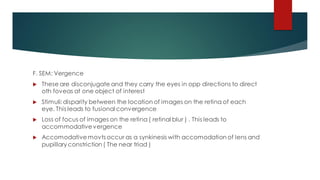
F. SEM: Vergence
 These are disconjugate and they carry the eyes in opp directions to direct
oth foveas at one object of interest
 Stimuli:disparity between the location of images on the retina of each
eye. This leads to fusional convergence
 Loss of focus of images on the retina ( retinal blur ) . This leads to
accommodativevergence
 Accomodative movts occur as a synkinesis with accomodation of lens and
pupillary constriction ( The near triad )
Functional classification of human eye
movts
Neural pathways for eye movts
FEM Saccades:
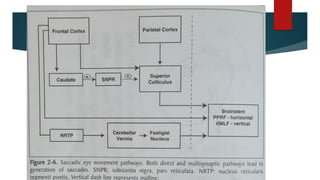
 Mediated by parallel pathways that converge in the brainstem from
a. Frontal cortex- Frontal eyefield( FEF) , supplementary eye field,dorsolateral
prefrontal cortex
b. Posterior parietal cortex
c. Superior colliculus
 Horizontal saccades:
a. Cortical pathways originate in FEF ( which encompasses the lateral part of
precentral gyrus and parts of middle frontal and superior frontal gyri
b. From FEF , the projections course dorsomediallyto pass through the anterior
limbof internal capsule. Most fibres reach the I/L Superior colliculus.
Projections from SC decussate in the lower midbrain and upper pons and
terminae in the PPRF in the lower pons.
c. Stimulationof left FEF results in conjugate movt of the eyes to right side
d. Stimulationof Rt FEF results in conjugate movt of the eyes to left side
e. The pathway from FEF is involvedwith self generated saccades from
rememberedor learned behaviour,
f. the parietal pathwayis more concerned with reorienting gaze to new
targets appearing in space
 Vertical saccades:
a. Cortical pathways descend to the rostral interstitial nucleus of the MLF (
riMLF) in the Mid brain just rostral to the 3rd N Nucleus at the junction of MB
and Thalamus
b. B/L stimulation of FEF is required to elicit purely vertical saccades
FEM: Nystagmus quick phases
 Originate in PPRF and riMLF
SEM : smooth pursuit
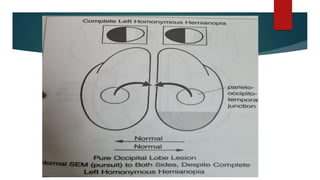
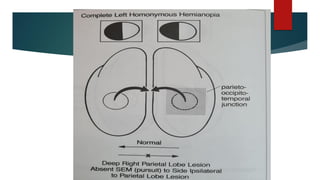
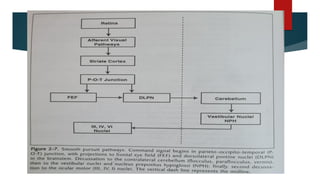
 This is mainlycontrolledby parieto-occipito-temporal ( P-O-T) jn, which is a
confluenceof Brogmann areas 19,37 and 39
 These pathways that transmit pursuit commands have a double
decussation
 The Rt P-O-T jn controls smooth pursuit to the Rt and the left jn to the left
 A pure Occipital lobe lesion , despite the production of homonymous
hemianopia, will not cause deficiency of pursuit movts since the pursuit
pathways remain intact.
 Once the half macula(of the remaining visual field ) is able to achieve
fixation, the eye is able to pursue the target to either side
 General rule: Pts with Homonymous hemianopia due to Optic tract, temporal
lobe or occipital lobe lesions will not have difficulty with smooth pursuit to either
side
 Deep parietal lobe lesions disrupt optomotor fibres intended for ipsilateral pons
and thereby disrupt smooth pursuit to I/L side, the pt may still be able to pursue
a target to the I/L of the lesion, but it will be admixed with catch up saccades,
thus exhibiting nonsmooth , cogwheel pursuit
 Deep parietal lobe lesions result in asymmetric smooth pursuit, as elicited by
optokinetic drum, when the drum is rotated toward the side of the lesion
 Lesion in POT jn causes akinetopsia, as the pt reports defects of motion
perception
Smooth pursuit pathway
SEM optokinetic (OKN) system
 Only present when afferent visual pathways to the visual cortex and the
connections to the brainstem ocular motor system are intact
 OKN serves as a means of image stabilisation to supplement the fading
vestibular response of sustainedhead rotation at a constant velocity
SEM :Vestibular ( labyrinthine – pontine pathway )
 Information from the ampullaof the rt horizontal semicircular canal is
deliveredto the rt vestibular nuclear complex. This in turn is relayed to the
left 6th N nucleus ( horizontal gaze centre) , resulting in SEM( vestibular ) to
the left side
 Same for Left
 Information from the anterior and posterior semicircular canals results in
combinations of torsional and vertical eye movts.This probably accounts
for the horizontal-torsional nystagmus being the hallmark of labrynthine
disease, involving all the three canals on one side
SEM : Vergence ( occipito- mesencephalic pathway )
 This pathway involves occipital cortex and descends to neurons in
midbrain reticular formation, dorsal and dorsolateral to the oculomotor
nuclei.
 3 types of neurons in MB reticular formation
1. Vergence tonic cells- discharge in relation to vergence angle
2. Vergence burst cells- discharge in relation to vergencevelocity
3. Vergence burst-tonic cells: discharge in relation to both stimuli
 Subsequent specific stimulationof the 3rd N nuclear complex leads to the
near triad: accommodation,miosis and convergence
Eye movt pathways within the brain
stem
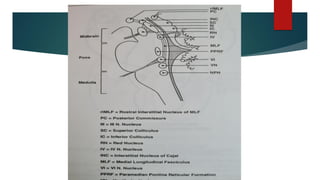
 As a general rule , horizontal eye movts are generated in the pons and
vertical eye movts in the MB
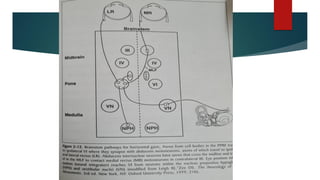
 Horizontal gaze pathways :
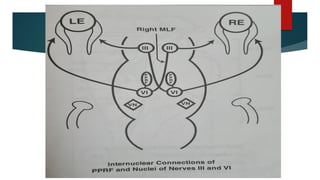
1. Abducent nucleus is the site of horizontal versional command.
2. It has 2 kinds of neurons a.) abducens motorneurons , with axons that
innervate the I/L Lateral rectus . b) abducens internuclear neurons, with
axons that project through the C/L MLF to the Medial rectus subdivisionof
the C/L 3rd N nucleus
3. Stimulation of the Rt Abducens N causes conjugate gaze to the rt, and
viceversa
4. The PPRF contains cells that project directly to the I/L abducens nucleus
5. The PPRF contains excitatory burst neurons ( EBN) that discharge just prior to
a horizontal saccade to stimulate the I/L AN. The EBNs are under the inhibitory
control of pause neurons that discharge continuously except immediately
prior to and during saccades.
6. To maintainthe eye in eccentric position, Tonicgaze-holding mechanism
requires a neural network that integrates velocity –coded signals into position-
coded signals. This is referred to as the neural integrator
7.Gaze-holding neural integrator for horizontal gaze includes : 1) medial
vestibular nucleus 2) nucleus prepositus hypoglossi
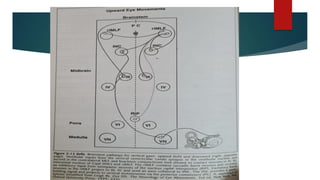
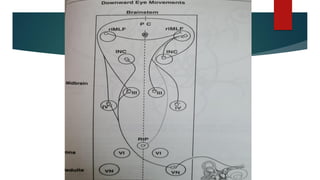
Vertical gaze pathways
 The rostral interstitial nucleus of MLF ( riMLF) lies dorsomedial to the red
nucleus at the jn of the MB and Thalamus
 The riMLF contains excitatory burst neurons for vertical and tortional
saccades
 Efferent information for :
a. Upward gaze: upward saccadic commandfrom the riMLF projects B/Lly
to 3rd N nucleus
b. Downward gaze : downward saccadic commandprojects mainly I/Lly to
the 3rd and 4 th CN
 U/L activation of the riMLF will generate torsional conjugate movts
a. Stimulate Rt riMLF – clockwise eye movts ( RE Extorts and LE intorts )
b. Stimulate Lt ri MLF –counterclockwise eye movts ( RE intorts LE extorts )
 B/L activation is necessary for conjugate vertical eye movts
 Each riMLF receives descending projections from FEF and ascending
projections from vestibular nuclei and PPRF
 Gaze holding neural integrator for vertical gaze is in interstitial nucleus of
Cajal
Vestibularly elicited horizontal eye
movts
 Non comatose pt:
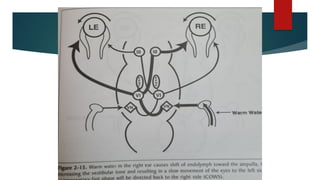
1. warm water in Rt ear- endolymph moves toward the ampullaof the
horizontal canal- increasedtone of output to Left Abducens N- slow
conjugate contraction ( vestibular SEM ) of the Left lateral rectus mus and
the Rt medial rectus mus ( viathe MLF) – compensatory FEM back to right
side and the combined effect of left (vestibular) SEM and rt (
compensatory) FEM produces the rt – beating nystagmus .
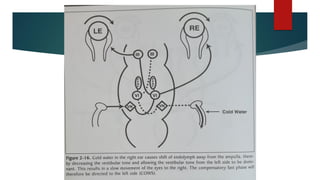
2. Cold water will produce the opp response
3. Mnemonic“COWS”
4. Note that the vestibular input produced by warm water in Rt ear is
responsible not for FEM back to the rt but only for the initial SEM to the left
5. FEM ( jerk component ) is actually a compensatory saccadic movt that is
seen only in the non comatose pt who has intact PPRF
6. The infant’s eyes tonically deviate in the direction of the movt with jerk
phase of nystagmus toward the opp side, on head rotation on rt and left
semicircular canals
Comatose pt
1. When warm water is placed in the Rt ear, there will be slow tonic
conjugate movt ( vestibular SEM ) of the eyes to the left side without
compensatory Rt jerk nystagmus ( fronto pontine connections are
nonfunctional in coma) The eye will remain deviatedto the left side for 30
to 60 secs and then return back to midlineas the symmetrical tone of the
semicircular canals is reestablished
2. Similarly , when cold water is placed in the rt ear, the pt’s eyes will slowly,
tonically deviate to the rt side, then return to the midline
3. Doll’s eye testing with rotation to th ehead to the rt also produces a tonic
SEM ( vestibular ) to the left. The SEM tone produced by Doll’s eye testing is
not sustainedenough to result in compensatory FEM ( jerk nystagmus )

Supranuclear and Internuclear Gaze Pathway

  • 1.
  • 2.
    EYE MOVEMENTS A. FASTEYE MOVEMENTS ( FEM)( velocity : 100 degree to 600 degree /sec)  The larger the amplitude, the higher the velocity  Saccade ( French term for ‘ jerk movement ‘)  Nystagmus ( quick phase ): a rudimentary type of saccade B. SLOW EYE MOVEMENTS ( SEM) ( velocity : 5 deg to 50 deg/ sec)  Smooth pursuit  Optokinetic  Vestibular  Vergence
  • 3.
    Functional classification ofeye movts A. FEM : saccades 1. Stimuli:  Voluntary saccade: voluntary changes in direction  Reflexivesaccade: sudden peripheral visual,auditory or sensory stimulus 2. Visual “suppression”during saccades: even though the visual world is rapidly sweeping across retina , there is no sense of a blurred image. B.FEM: nystagmus quick phases 1. Stimulus: vestibular or optokinetic stimulationwould lead the eyes to extreme deviation unless prevented by corrective quick phases
  • 4.
    2. Provide automaticresetting movements in the presence of spontaneous drifts of the eyes. 3.This type of FEM is the phylogeneticforerunner of voluntary saccades C. SEM ; smooth pursuit 1.Stimuli:  Motion of the image of a target across the foveal and perifoveal retina  Occasionallynonvisual stimuli such as proprioception can also generate smooth pursuit movts
  • 5.
     If thetarget is moving at a velocity of greater than 50 degree per second, then the eyes after falling behind in the pursuit,willexecute saccadic voluntary FEM in order to regain macular fixation, the eyes will then pursue with the smooth SEM until they fall behind again, this results in another “catch up” saccadic FEM as in the phenomenon of cogwheel pursuit.  Visual fixation- holds the image of the stationary object on the fovea
  • 6.
     D. SEM: Optokinetic system: 1 .Stimulus:sustainedhead rotation 2. The vestibular system responds only to acceleration. With sustainedhead rotation at a constant velocity , the vestibular response fades and the optokineticsystem supplements visually driven compensatory slow-phase eye movts  E. SEM : Vestibular: 1. Stimulation of each set of semicircular canals influences a particular pair of eye muscles
  • 7.
    a. Lateral (horizontal ) canals : horizontal ( I/L MR and C/L LR ) b. Posterior ( inferior ) canals – downward and tortional ( I/L SO, C/L IR ) c. Anterior ( superior ) canals : upward and tortional ( I/L SR, C/L IO ) 2. The horizontal semicircular canals are oriented 30 degrees above the horizontal, with the ampullae anteriorly located 3. To maximally affect the horizontal semicircular canals, a specifichead positionis required.  Head is inclinedforward 30 degrees for maximal effect of rotational forces in the Barany chair ( 30 deg above supine position )
  • 8.
     Head isinclinedbackward 60 degree for maximal effect for the convection currents of endolymph flow with calorie testing  During Doll’s eye testing, when head is rotated towards left side, the endolymph move towars the left ampullaand away from Right ampulla  Movt of the endolymph ( by warm water calorics , Barany chair rotation, or doll’s eye testing) toward the ampullaresults in stimulation of that ampullah  Movt of the endolymph ( by cold water calorics ) away from ampulla results in inhibitionof that ampulla
  • 9.
  • 12.
    F. SEM: Vergence These are disconjugate and they carry the eyes in opp directions to direct oth foveas at one object of interest  Stimuli:disparity between the location of images on the retina of each eye. This leads to fusional convergence  Loss of focus of images on the retina ( retinal blur ) . This leads to accommodativevergence  Accomodative movts occur as a synkinesis with accomodation of lens and pupillary constriction ( The near triad )
  • 13.
  • 14.
    Neural pathways foreye movts FEM Saccades:  Mediated by parallel pathways that converge in the brainstem from a. Frontal cortex- Frontal eyefield( FEF) , supplementary eye field,dorsolateral prefrontal cortex b. Posterior parietal cortex c. Superior colliculus  Horizontal saccades: a. Cortical pathways originate in FEF ( which encompasses the lateral part of precentral gyrus and parts of middle frontal and superior frontal gyri
  • 15.
    b. From FEF, the projections course dorsomediallyto pass through the anterior limbof internal capsule. Most fibres reach the I/L Superior colliculus. Projections from SC decussate in the lower midbrain and upper pons and terminae in the PPRF in the lower pons. c. Stimulationof left FEF results in conjugate movt of the eyes to right side d. Stimulationof Rt FEF results in conjugate movt of the eyes to left side e. The pathway from FEF is involvedwith self generated saccades from rememberedor learned behaviour, f. the parietal pathwayis more concerned with reorienting gaze to new targets appearing in space
  • 17.
     Vertical saccades: a.Cortical pathways descend to the rostral interstitial nucleus of the MLF ( riMLF) in the Mid brain just rostral to the 3rd N Nucleus at the junction of MB and Thalamus b. B/L stimulation of FEF is required to elicit purely vertical saccades FEM: Nystagmus quick phases  Originate in PPRF and riMLF
  • 18.
    SEM : smoothpursuit  This is mainlycontrolledby parieto-occipito-temporal ( P-O-T) jn, which is a confluenceof Brogmann areas 19,37 and 39  These pathways that transmit pursuit commands have a double decussation  The Rt P-O-T jn controls smooth pursuit to the Rt and the left jn to the left  A pure Occipital lobe lesion , despite the production of homonymous hemianopia, will not cause deficiency of pursuit movts since the pursuit pathways remain intact.  Once the half macula(of the remaining visual field ) is able to achieve fixation, the eye is able to pursue the target to either side
  • 21.
     General rule:Pts with Homonymous hemianopia due to Optic tract, temporal lobe or occipital lobe lesions will not have difficulty with smooth pursuit to either side  Deep parietal lobe lesions disrupt optomotor fibres intended for ipsilateral pons and thereby disrupt smooth pursuit to I/L side, the pt may still be able to pursue a target to the I/L of the lesion, but it will be admixed with catch up saccades, thus exhibiting nonsmooth , cogwheel pursuit  Deep parietal lobe lesions result in asymmetric smooth pursuit, as elicited by optokinetic drum, when the drum is rotated toward the side of the lesion  Lesion in POT jn causes akinetopsia, as the pt reports defects of motion perception
  • 22.
  • 23.
    SEM optokinetic (OKN)system  Only present when afferent visual pathways to the visual cortex and the connections to the brainstem ocular motor system are intact  OKN serves as a means of image stabilisation to supplement the fading vestibular response of sustainedhead rotation at a constant velocity SEM :Vestibular ( labyrinthine – pontine pathway )  Information from the ampullaof the rt horizontal semicircular canal is deliveredto the rt vestibular nuclear complex. This in turn is relayed to the left 6th N nucleus ( horizontal gaze centre) , resulting in SEM( vestibular ) to the left side  Same for Left
  • 24.
     Information fromthe anterior and posterior semicircular canals results in combinations of torsional and vertical eye movts.This probably accounts for the horizontal-torsional nystagmus being the hallmark of labrynthine disease, involving all the three canals on one side SEM : Vergence ( occipito- mesencephalic pathway )  This pathway involves occipital cortex and descends to neurons in midbrain reticular formation, dorsal and dorsolateral to the oculomotor nuclei.
  • 25.
     3 typesof neurons in MB reticular formation 1. Vergence tonic cells- discharge in relation to vergence angle 2. Vergence burst cells- discharge in relation to vergencevelocity 3. Vergence burst-tonic cells: discharge in relation to both stimuli  Subsequent specific stimulationof the 3rd N nuclear complex leads to the near triad: accommodation,miosis and convergence
  • 26.
    Eye movt pathwayswithin the brain stem  As a general rule , horizontal eye movts are generated in the pons and vertical eye movts in the MB  Horizontal gaze pathways : 1. Abducent nucleus is the site of horizontal versional command. 2. It has 2 kinds of neurons a.) abducens motorneurons , with axons that innervate the I/L Lateral rectus . b) abducens internuclear neurons, with axons that project through the C/L MLF to the Medial rectus subdivisionof the C/L 3rd N nucleus 3. Stimulation of the Rt Abducens N causes conjugate gaze to the rt, and viceversa
  • 30.
    4. The PPRFcontains cells that project directly to the I/L abducens nucleus 5. The PPRF contains excitatory burst neurons ( EBN) that discharge just prior to a horizontal saccade to stimulate the I/L AN. The EBNs are under the inhibitory control of pause neurons that discharge continuously except immediately prior to and during saccades. 6. To maintainthe eye in eccentric position, Tonicgaze-holding mechanism requires a neural network that integrates velocity –coded signals into position- coded signals. This is referred to as the neural integrator 7.Gaze-holding neural integrator for horizontal gaze includes : 1) medial vestibular nucleus 2) nucleus prepositus hypoglossi
  • 31.
    Vertical gaze pathways The rostral interstitial nucleus of MLF ( riMLF) lies dorsomedial to the red nucleus at the jn of the MB and Thalamus  The riMLF contains excitatory burst neurons for vertical and tortional saccades  Efferent information for : a. Upward gaze: upward saccadic commandfrom the riMLF projects B/Lly to 3rd N nucleus b. Downward gaze : downward saccadic commandprojects mainly I/Lly to the 3rd and 4 th CN
  • 34.
     U/L activationof the riMLF will generate torsional conjugate movts a. Stimulate Rt riMLF – clockwise eye movts ( RE Extorts and LE intorts ) b. Stimulate Lt ri MLF –counterclockwise eye movts ( RE intorts LE extorts )  B/L activation is necessary for conjugate vertical eye movts  Each riMLF receives descending projections from FEF and ascending projections from vestibular nuclei and PPRF  Gaze holding neural integrator for vertical gaze is in interstitial nucleus of Cajal
  • 35.
    Vestibularly elicited horizontaleye movts  Non comatose pt: 1. warm water in Rt ear- endolymph moves toward the ampullaof the horizontal canal- increasedtone of output to Left Abducens N- slow conjugate contraction ( vestibular SEM ) of the Left lateral rectus mus and the Rt medial rectus mus ( viathe MLF) – compensatory FEM back to right side and the combined effect of left (vestibular) SEM and rt ( compensatory) FEM produces the rt – beating nystagmus . 2. Cold water will produce the opp response 3. Mnemonic“COWS”
  • 38.
    4. Note thatthe vestibular input produced by warm water in Rt ear is responsible not for FEM back to the rt but only for the initial SEM to the left 5. FEM ( jerk component ) is actually a compensatory saccadic movt that is seen only in the non comatose pt who has intact PPRF 6. The infant’s eyes tonically deviate in the direction of the movt with jerk phase of nystagmus toward the opp side, on head rotation on rt and left semicircular canals
  • 39.
    Comatose pt 1. Whenwarm water is placed in the Rt ear, there will be slow tonic conjugate movt ( vestibular SEM ) of the eyes to the left side without compensatory Rt jerk nystagmus ( fronto pontine connections are nonfunctional in coma) The eye will remain deviatedto the left side for 30 to 60 secs and then return back to midlineas the symmetrical tone of the semicircular canals is reestablished 2. Similarly , when cold water is placed in the rt ear, the pt’s eyes will slowly, tonically deviate to the rt side, then return to the midline 3. Doll’s eye testing with rotation to th ehead to the rt also produces a tonic SEM ( vestibular ) to the left. The SEM tone produced by Doll’s eye testing is not sustainedenough to result in compensatory FEM ( jerk nystagmus )