VLSI Fabrication Technology

CMOS Technology
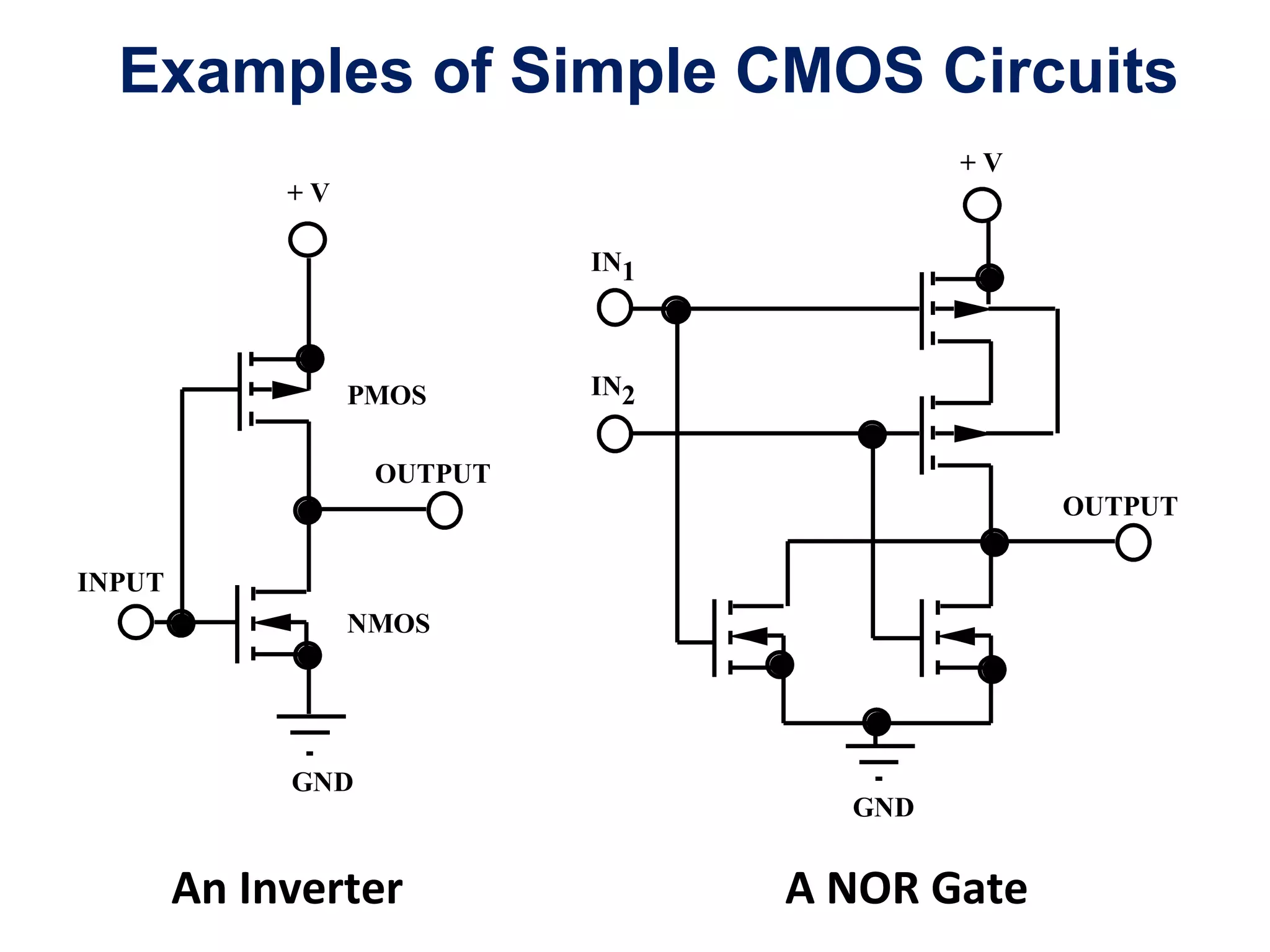
Examples of Simple CMOS Circuits
+V
+V
IN1

PMOS

IN2

OUTPUT
OUTPUT
INPUT
NMOS

GND
GND

An Inverter

A NOR Gate
CMOS Process Flow
D

G

D

Sub

Sub

G

S

S

G

P+

S

D

N

S

N+

P+

N Well - PMOS Substrate

D

G

P

N+

P Well - NMOS Substrate

P

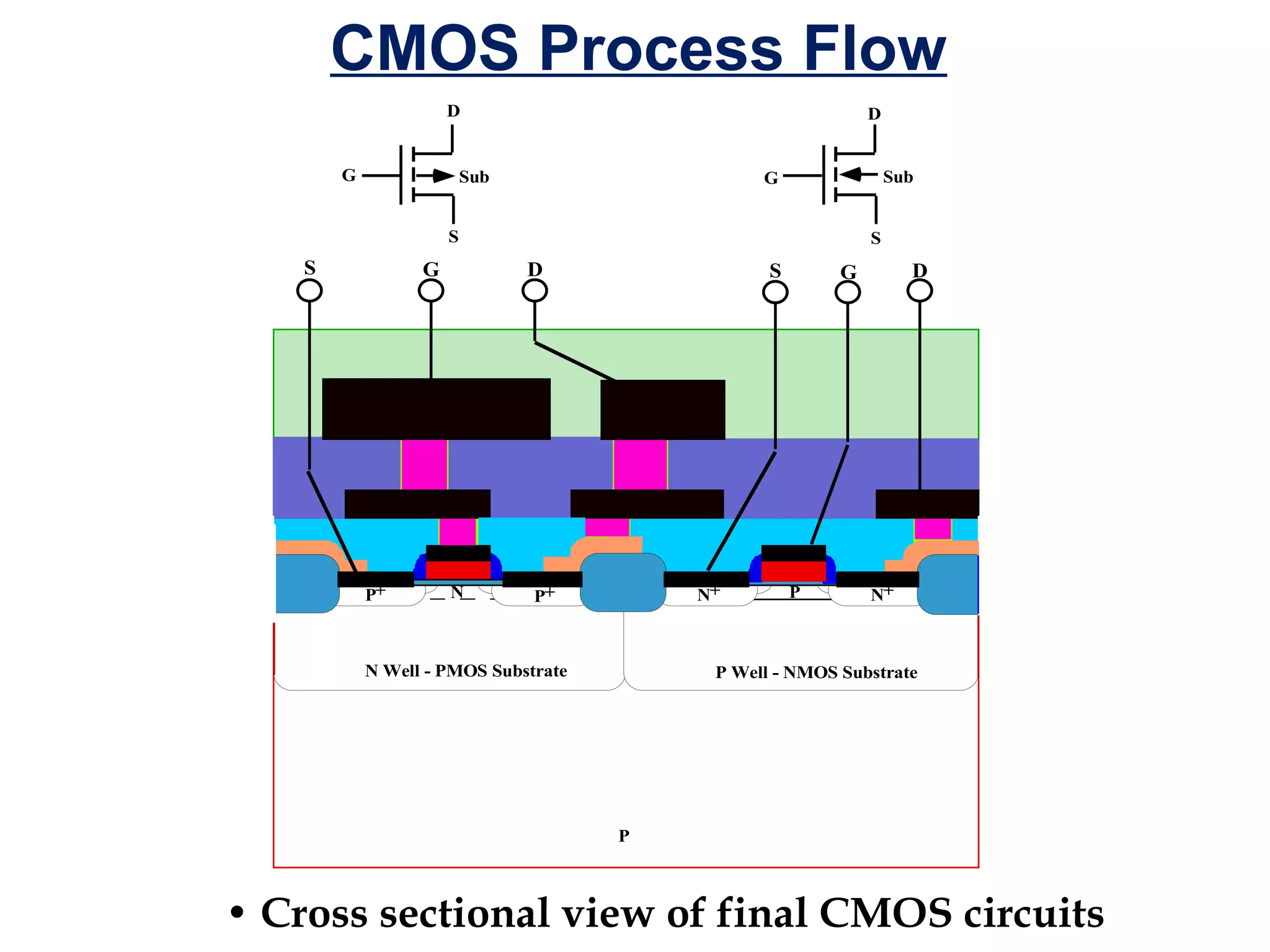
• Cross sectional view of final CMOS circuits
CMOS Process Flow
Photoresist
Si3N4
SiO2

Si, (100), P Type, 5-50 žcm

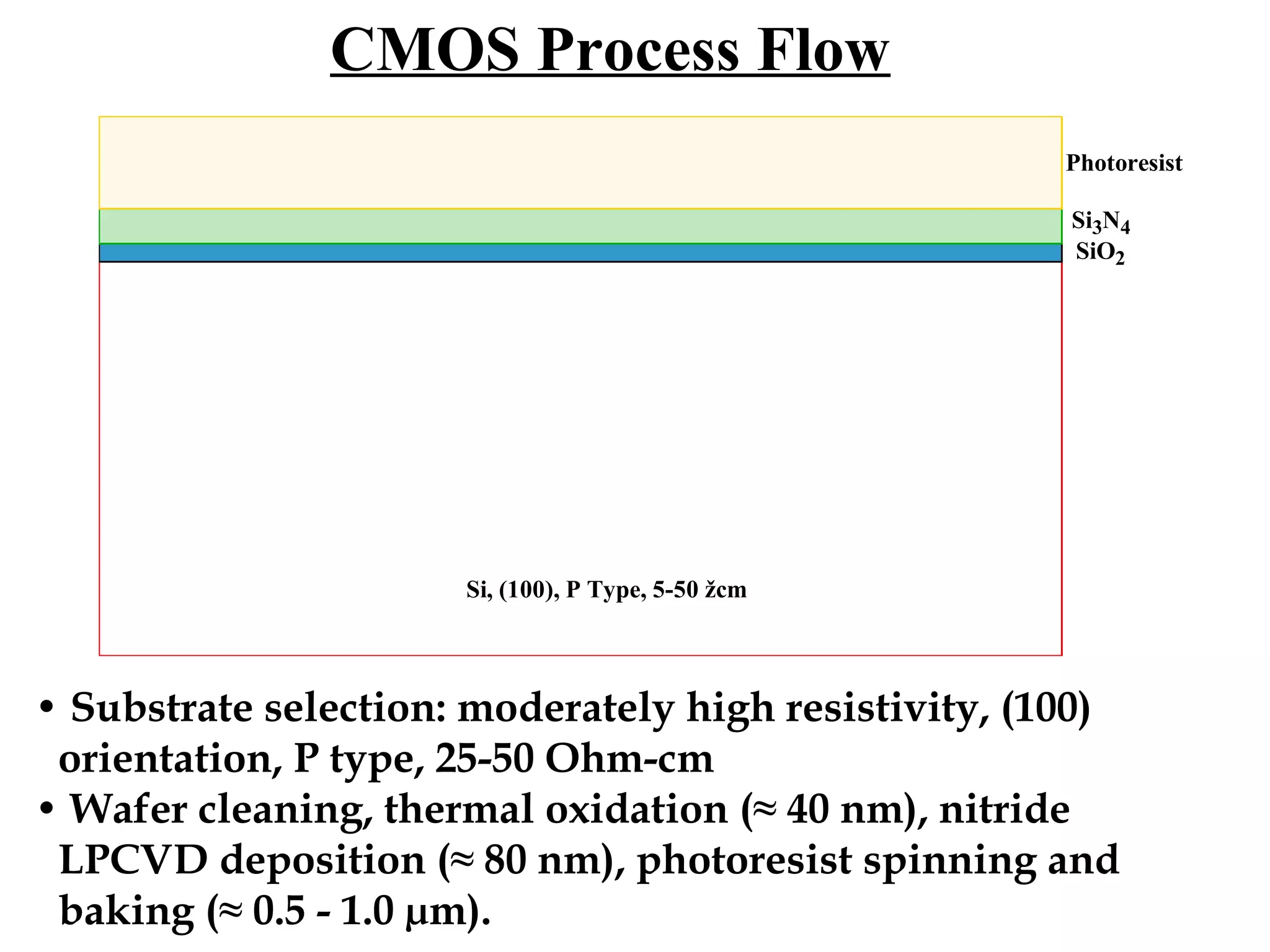
• Substrate selection: moderately high resistivity, (100)
orientation, P type, 25-50 Ohm-cm
• Wafer cleaning, thermal oxidation (≈ 40 nm), nitride
LPCVD deposition (≈ 80 nm), photoresist spinning and
baking (≈ 0.5 - 1.0 µm).
CMOS Process Flow

P

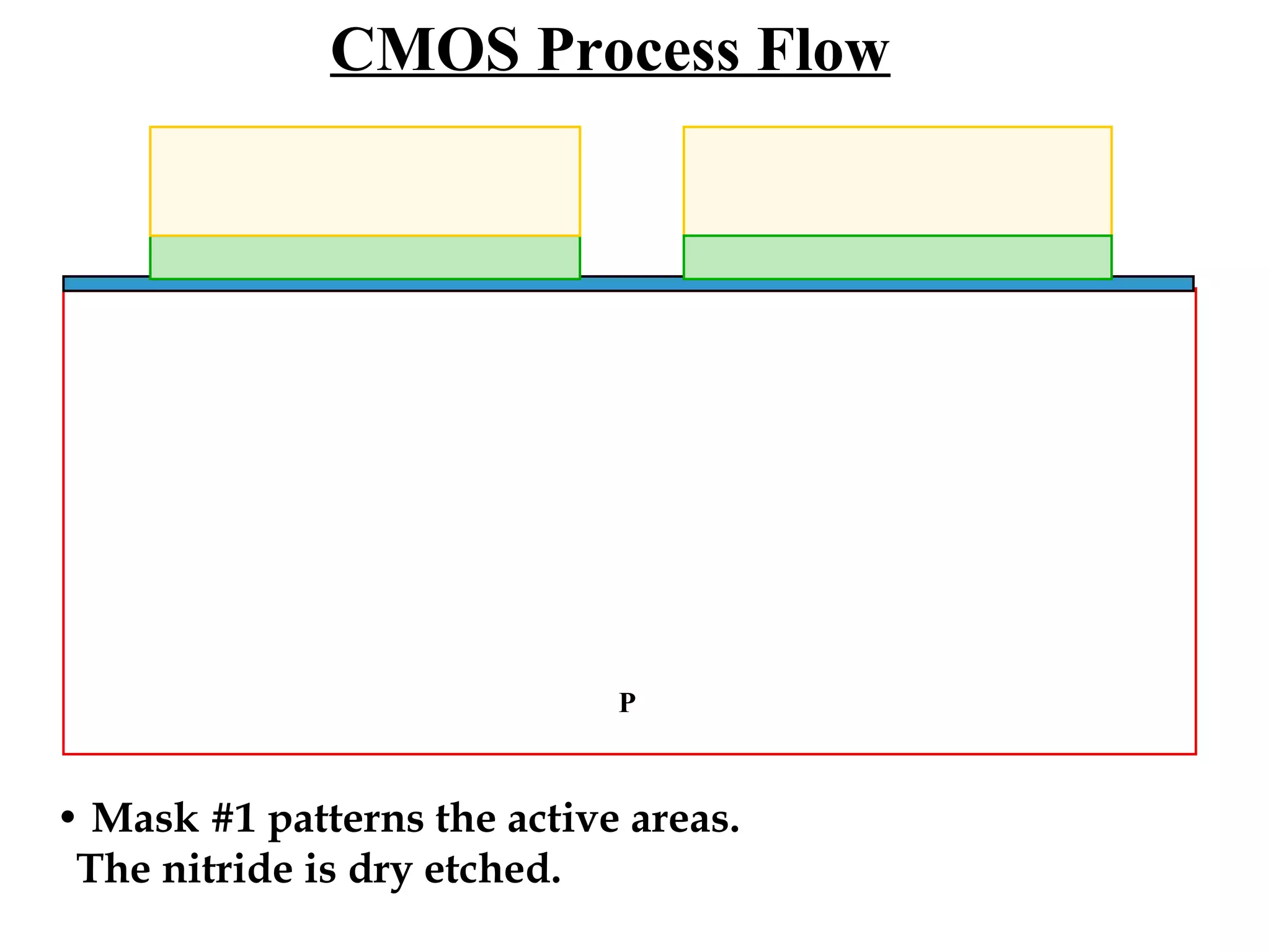
• Mask #1 patterns the active areas.
The nitride is dry etched.
CMOS Process Flow

P

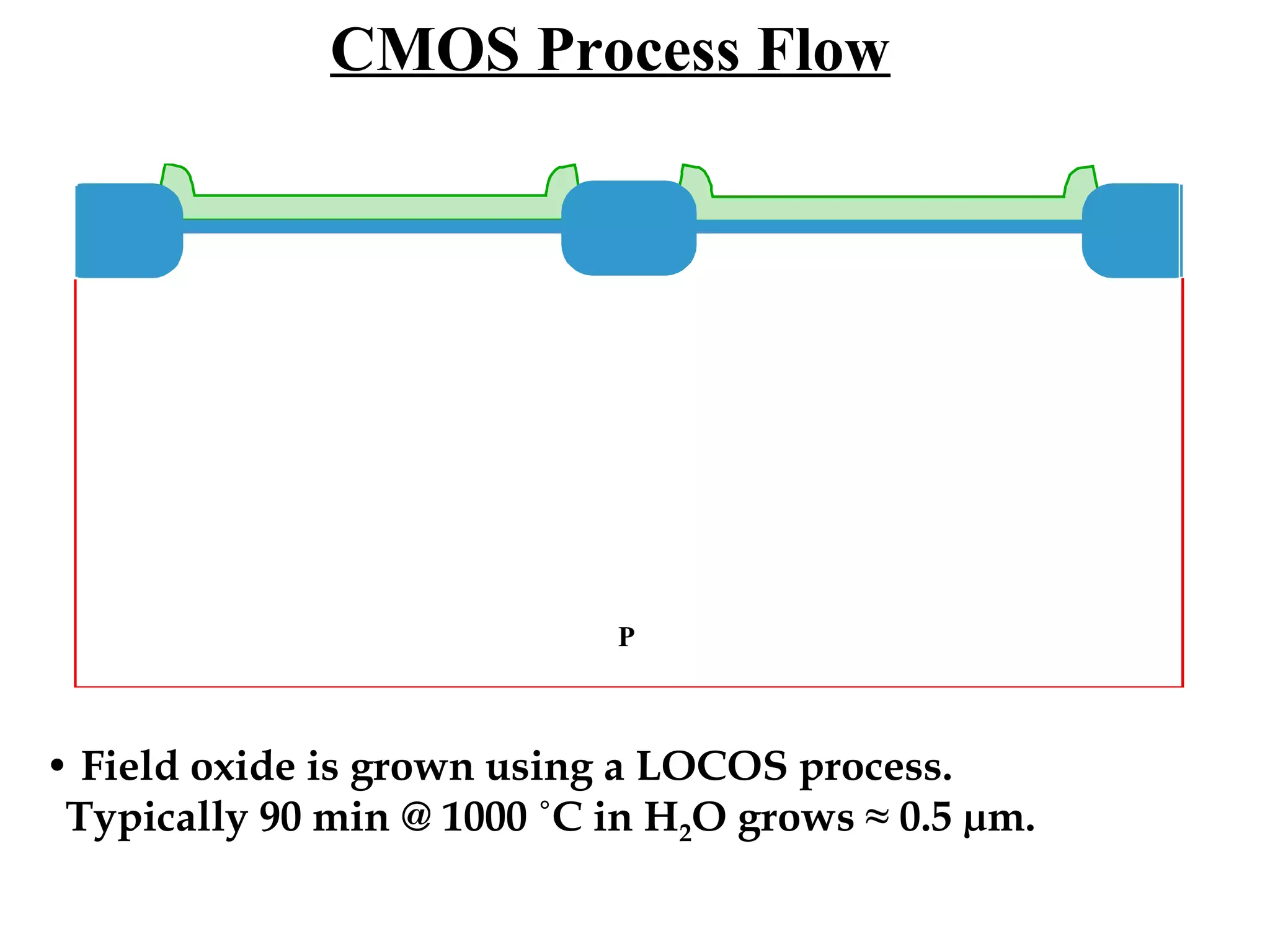
• Field oxide is grown using a LOCOS process.
Typically 90 min @ 1000 ˚C in H2O grows ≈ 0.5 µm.
CMOS Process Flow

Boron

P Implant

P

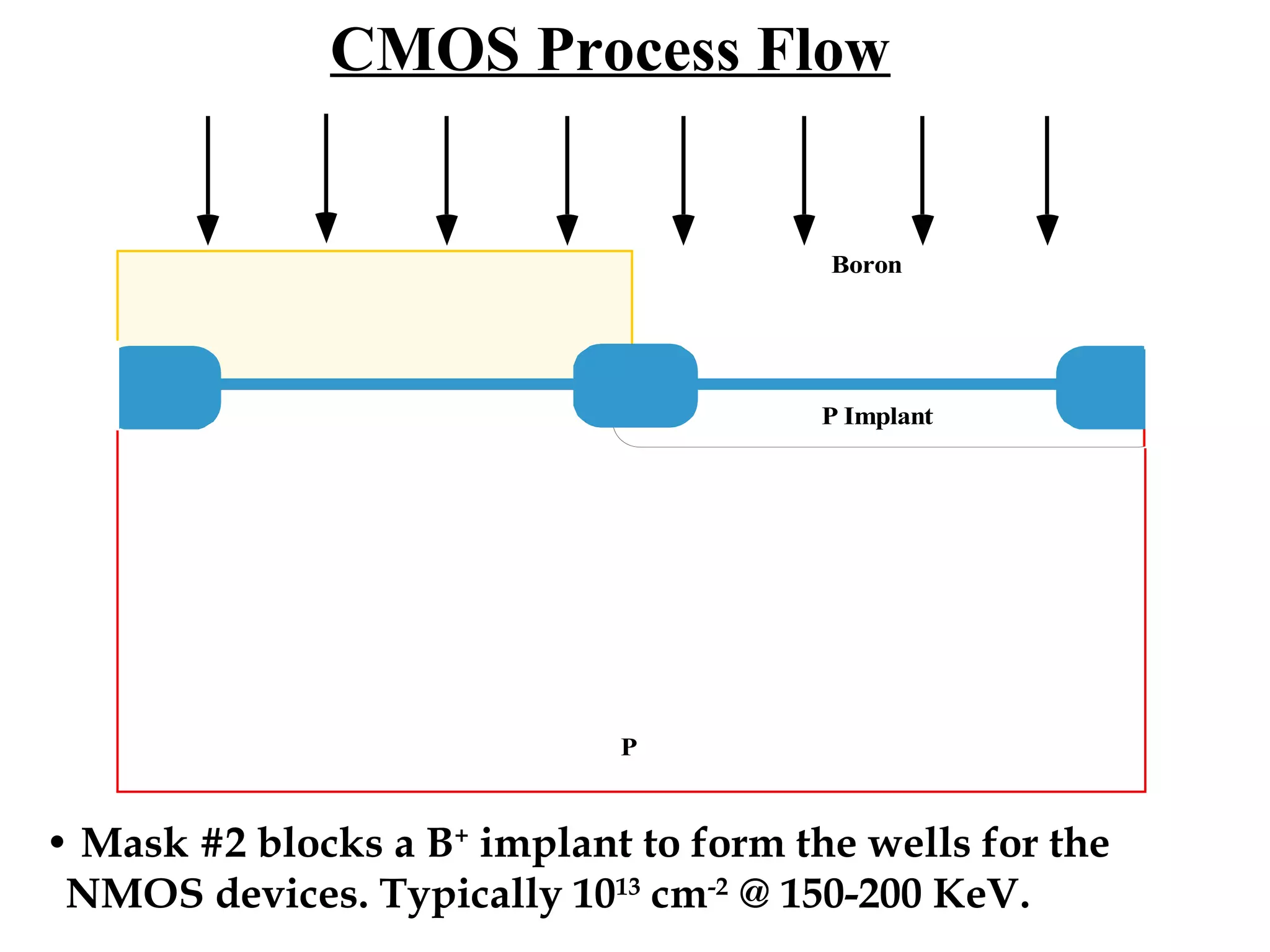
• Mask #2 blocks a B+ implant to form the wells for the
NMOS devices. Typically 1013 cm-2 @ 150-200 KeV.
CMOS Process Flow

Phosphorus

N Implant

P Implant

P

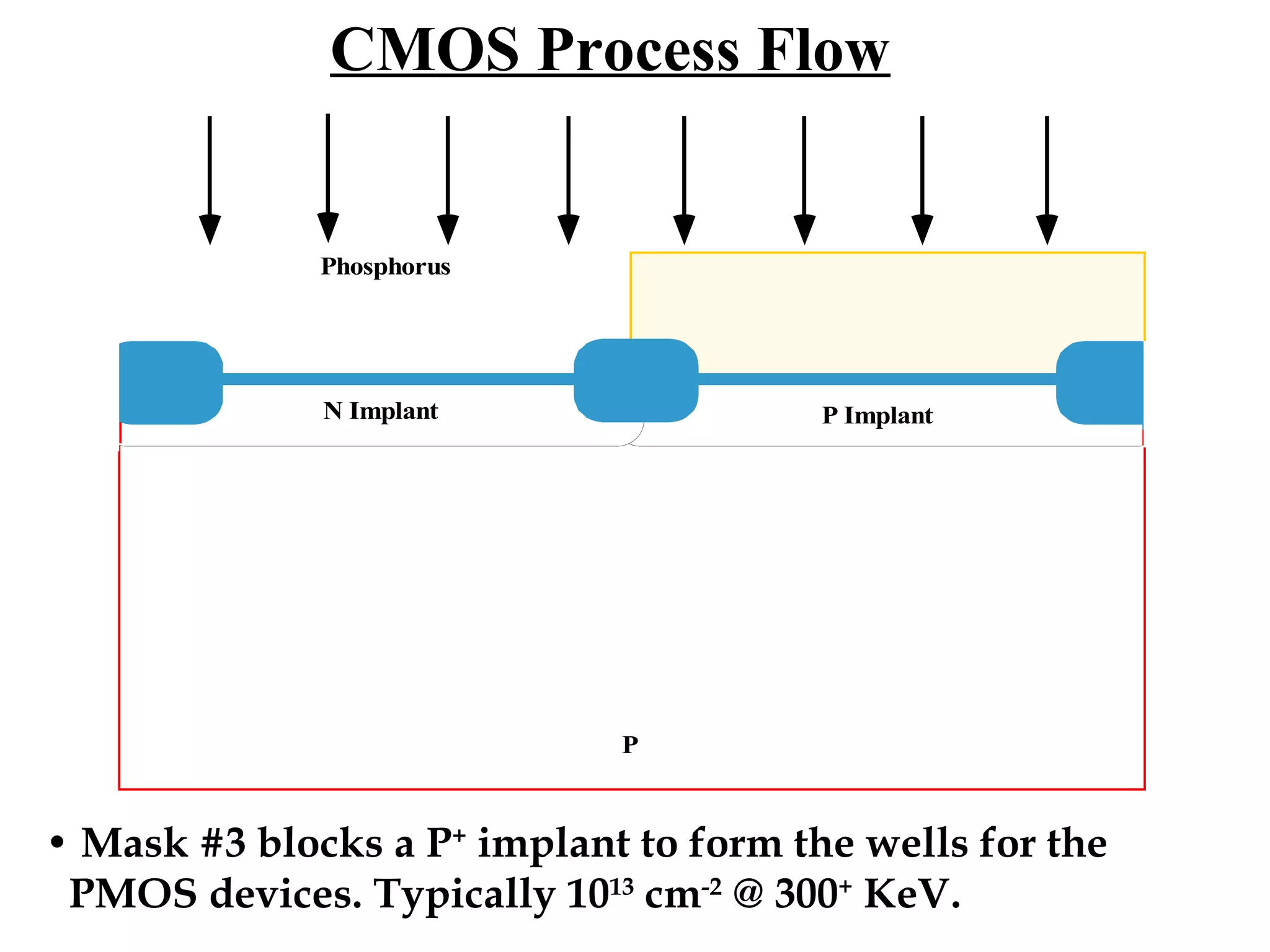
• Mask #3 blocks a P+ implant to form the wells for the
PMOS devices. Typically 1013 cm-2 @ 300+ KeV.
CMOS Process Flow

N Well

P Well

P

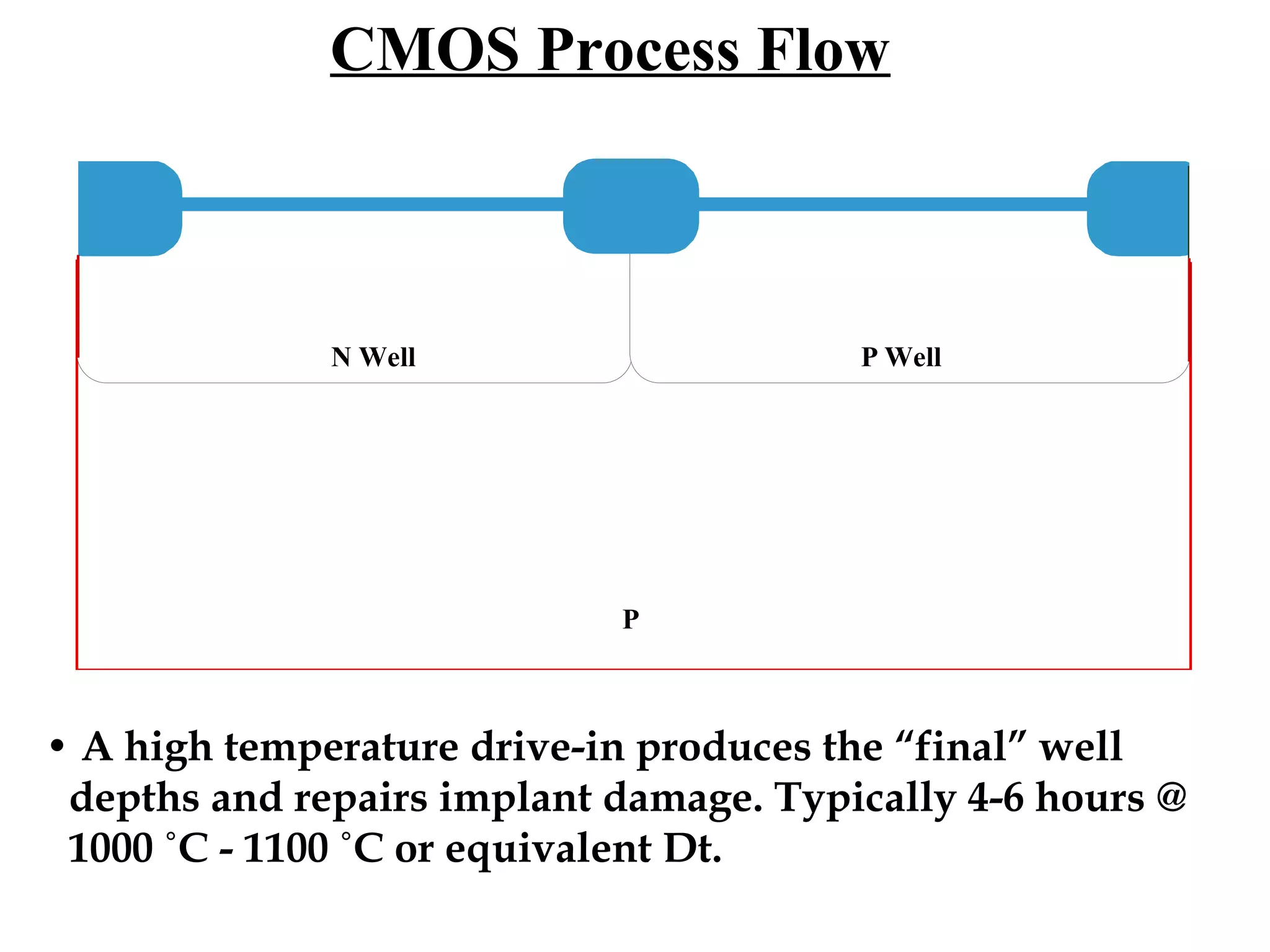
• A high temperature drive-in produces the “final” well
depths and repairs implant damage. Typically 4-6 hours @
1000 ˚C - 1100 ˚C or equivalent Dt.
CMOS Process Flow

Boron

P

N Well

P Well

P

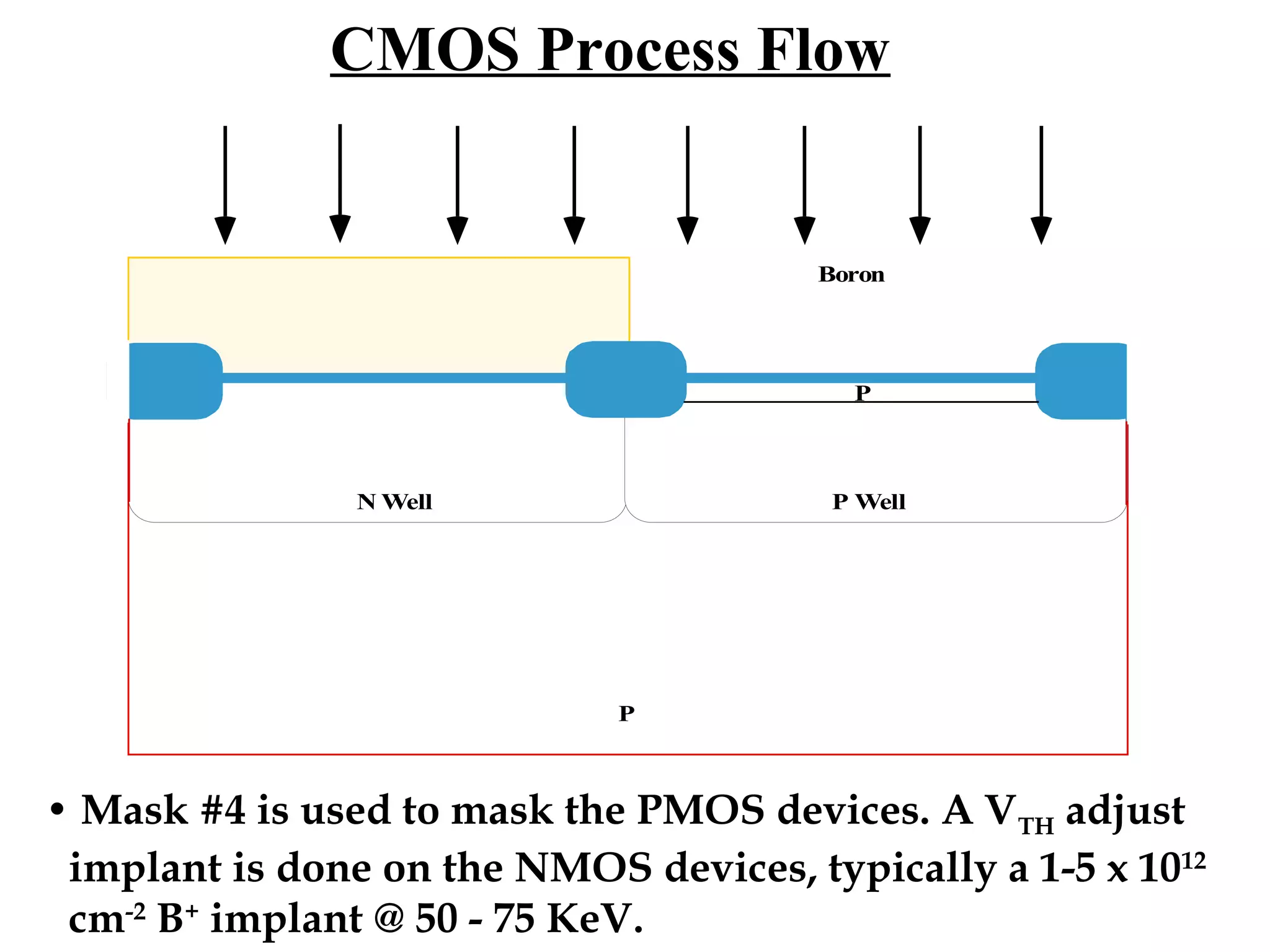
• Mask #4 is used to mask the PMOS devices. A VTH adjust
implant is done on the NMOS devices, typically a 1-5 x 10¹²
cm-2 B+ implant @ 50 - 75 KeV.
CMOS Process Flow
Arsenic

N

P

N Well

P Well

P

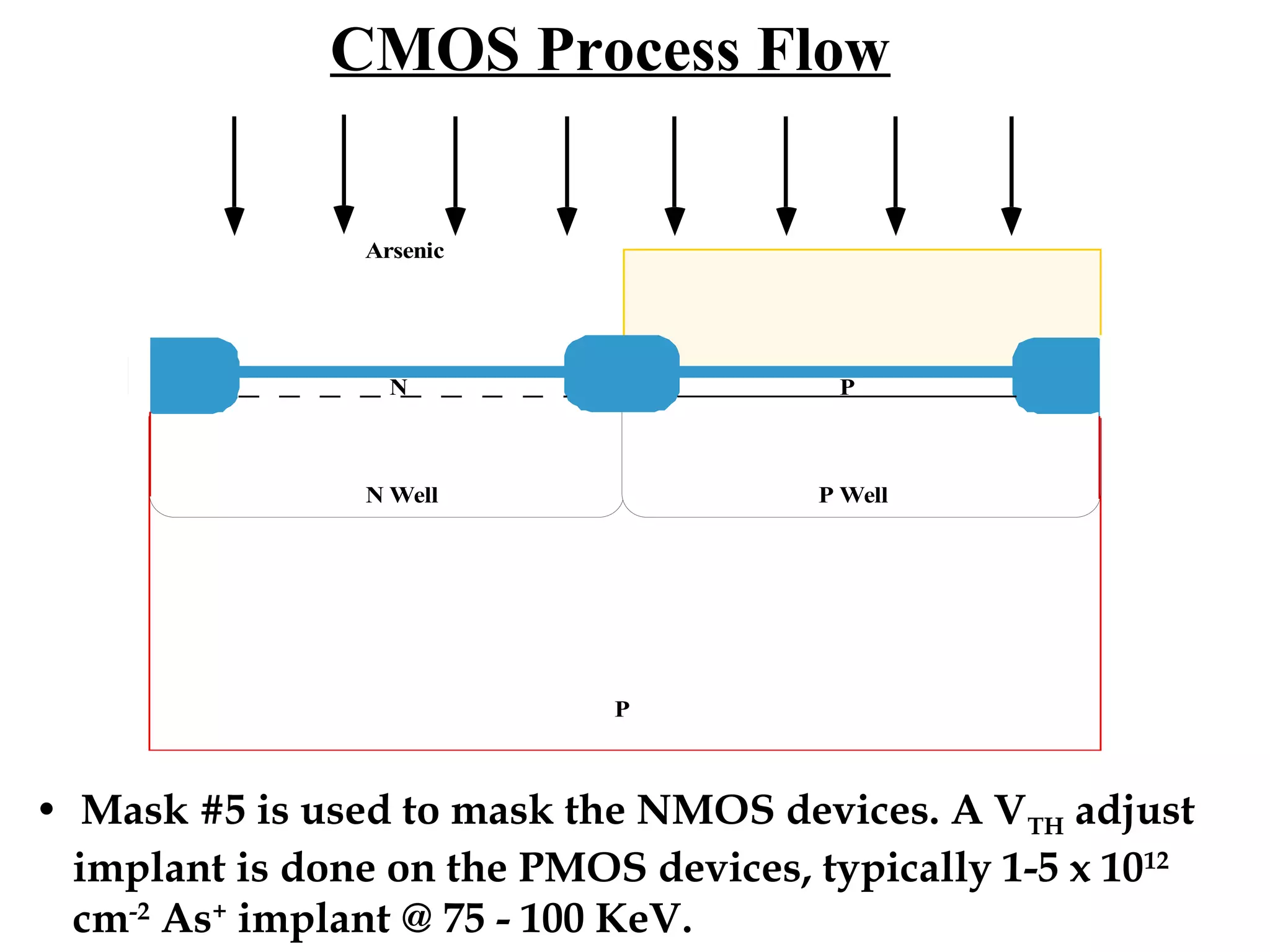
• Mask #5 is used to mask the NMOS devices. A VTH adjust
implant is done on the PMOS devices, typically 1-5 x 10¹²
cm-2 As+ implant @ 75 - 100 KeV.
CMOS Process Flow
N

P

N Well

P Well

P

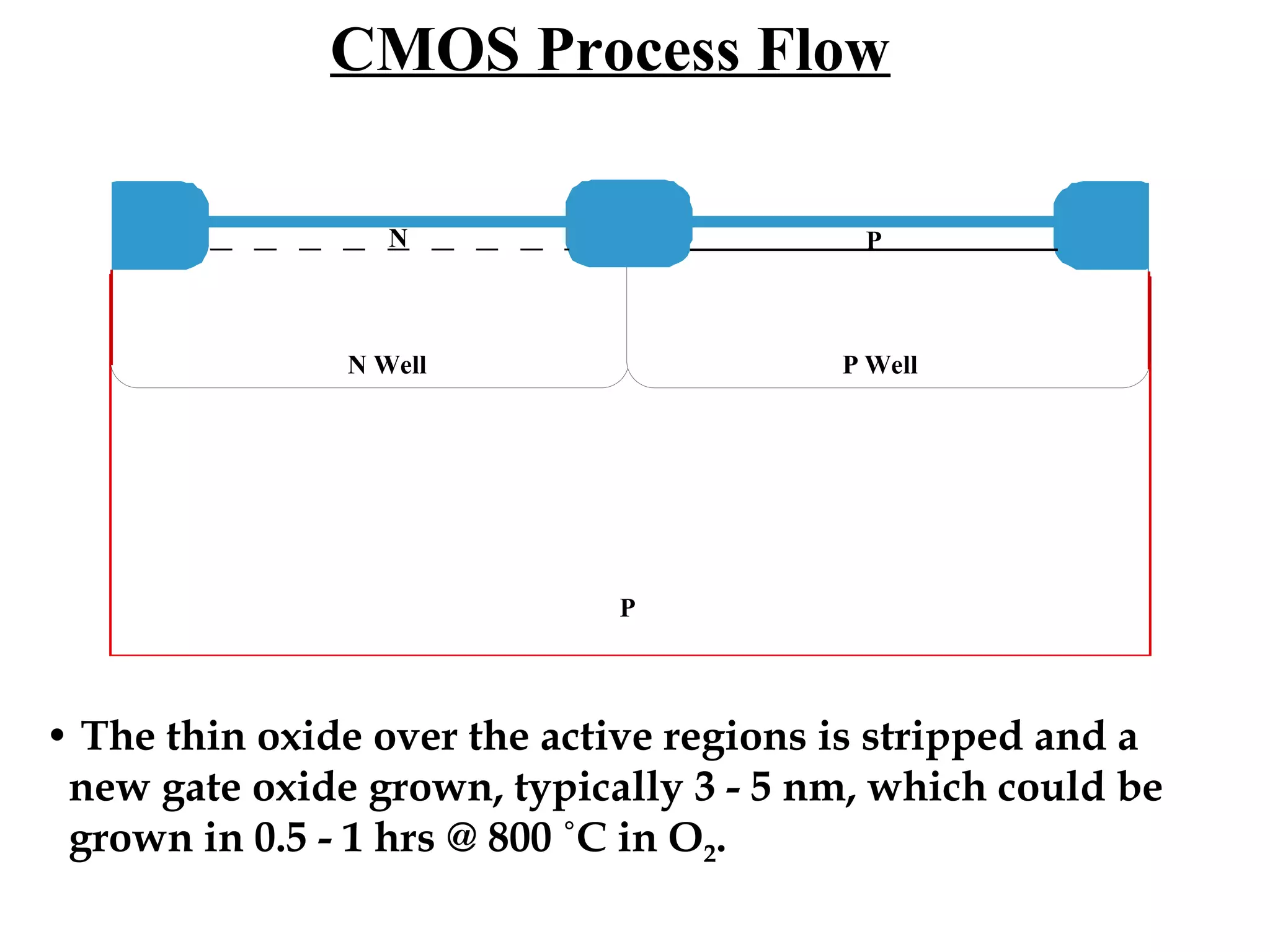
• The thin oxide over the active regions is stripped and a
new gate oxide grown, typically 3 - 5 nm, which could be
grown in 0.5 - 1 hrs @ 800 ˚C in O2.
CMOS Process Flow

N

P

N Well

P Well

P

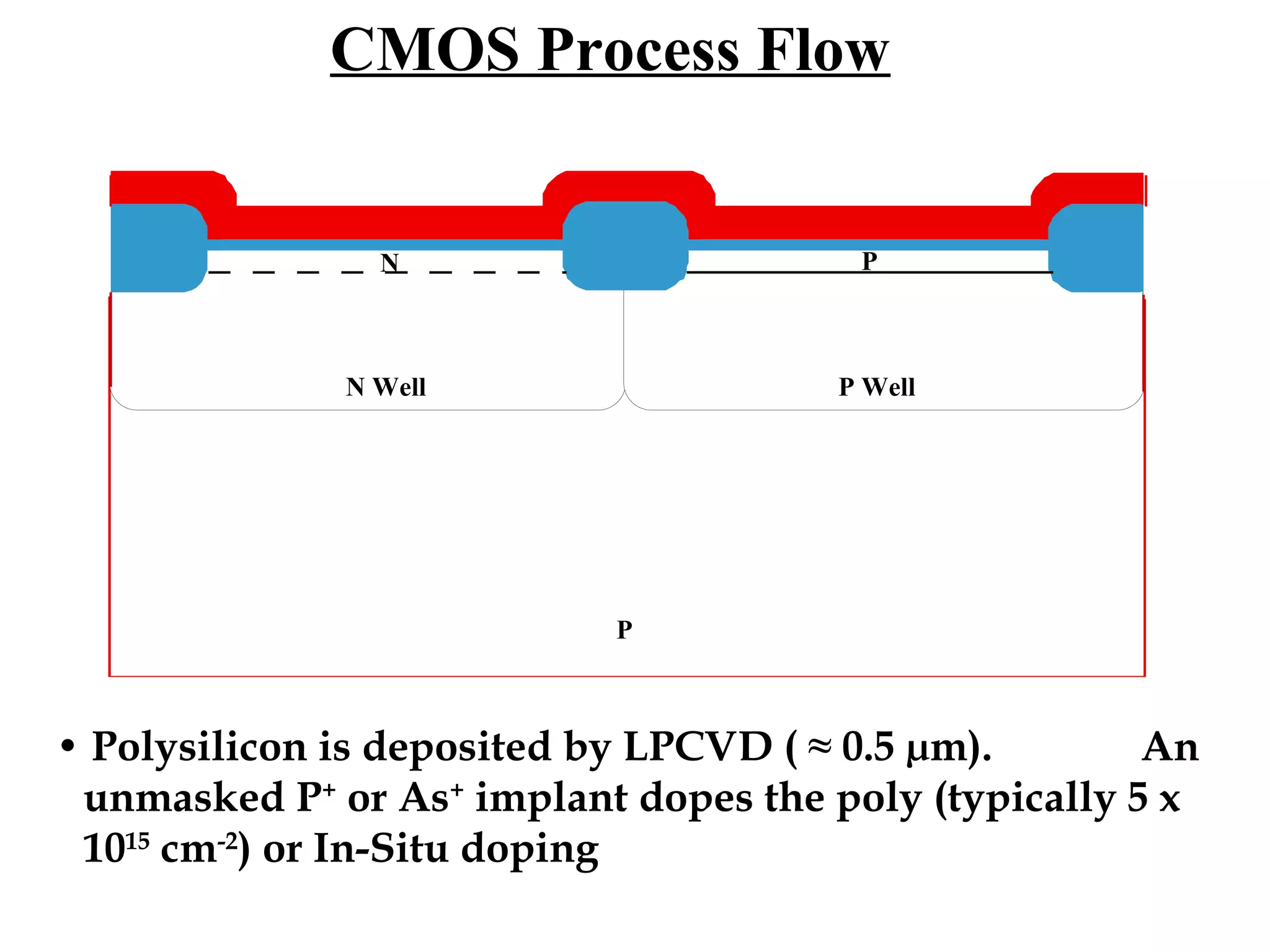
• Polysilicon is deposited by LPCVD ( ≈ 0.5 µm).
An
unmasked P+ or As+ implant dopes the poly (typically 5 x
1015 cm-2) or In-Situ doping
CMOS Process Flow

N

P

N Well

P Well

P

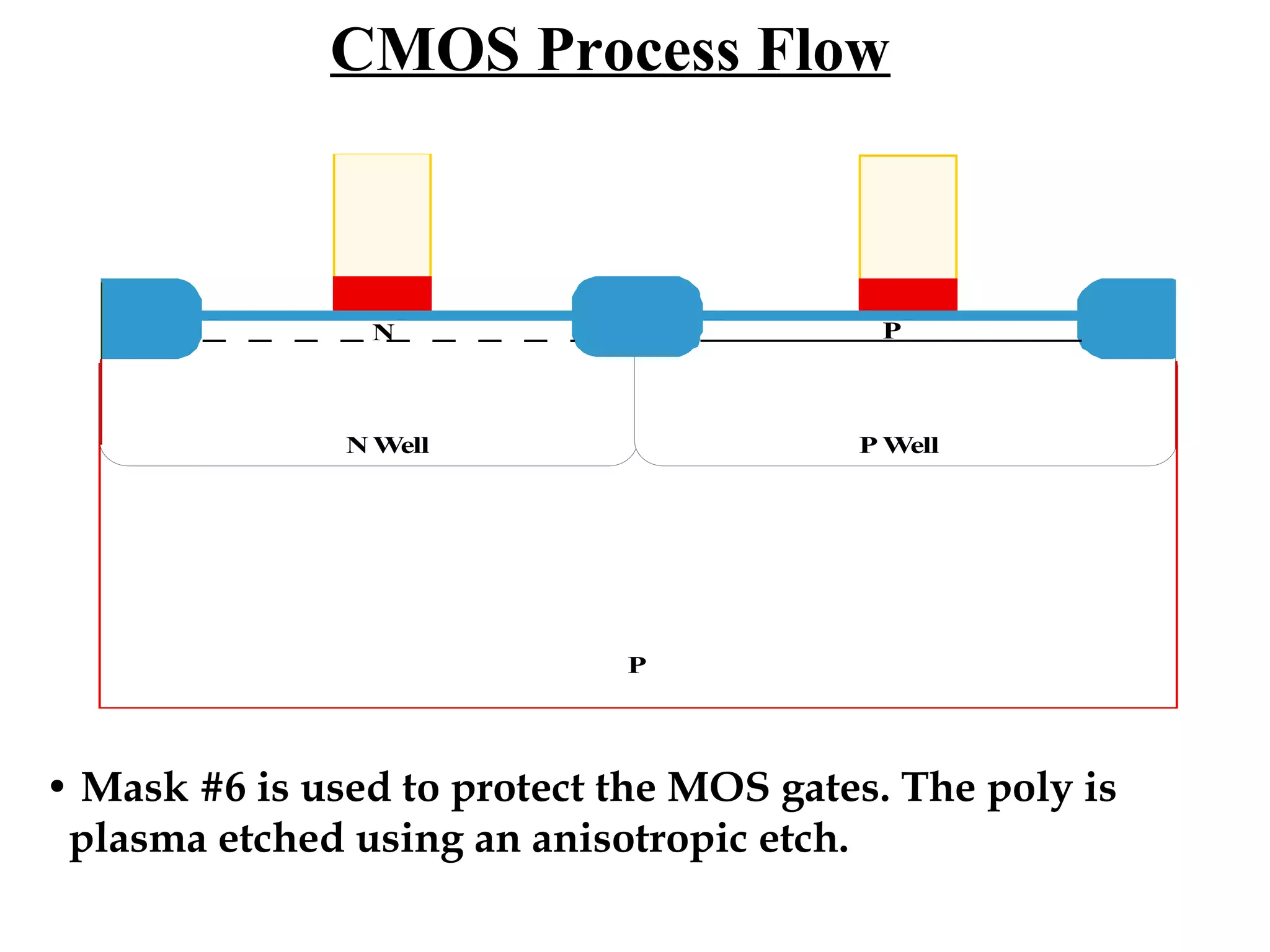
• Mask #6 is used to protect the MOS gates. The poly is
plasma etched using an anisotropic etch.
CMOS Process Flow

Phosphorus

P

N

N Im
plant
NW
ell

PW
ell

P

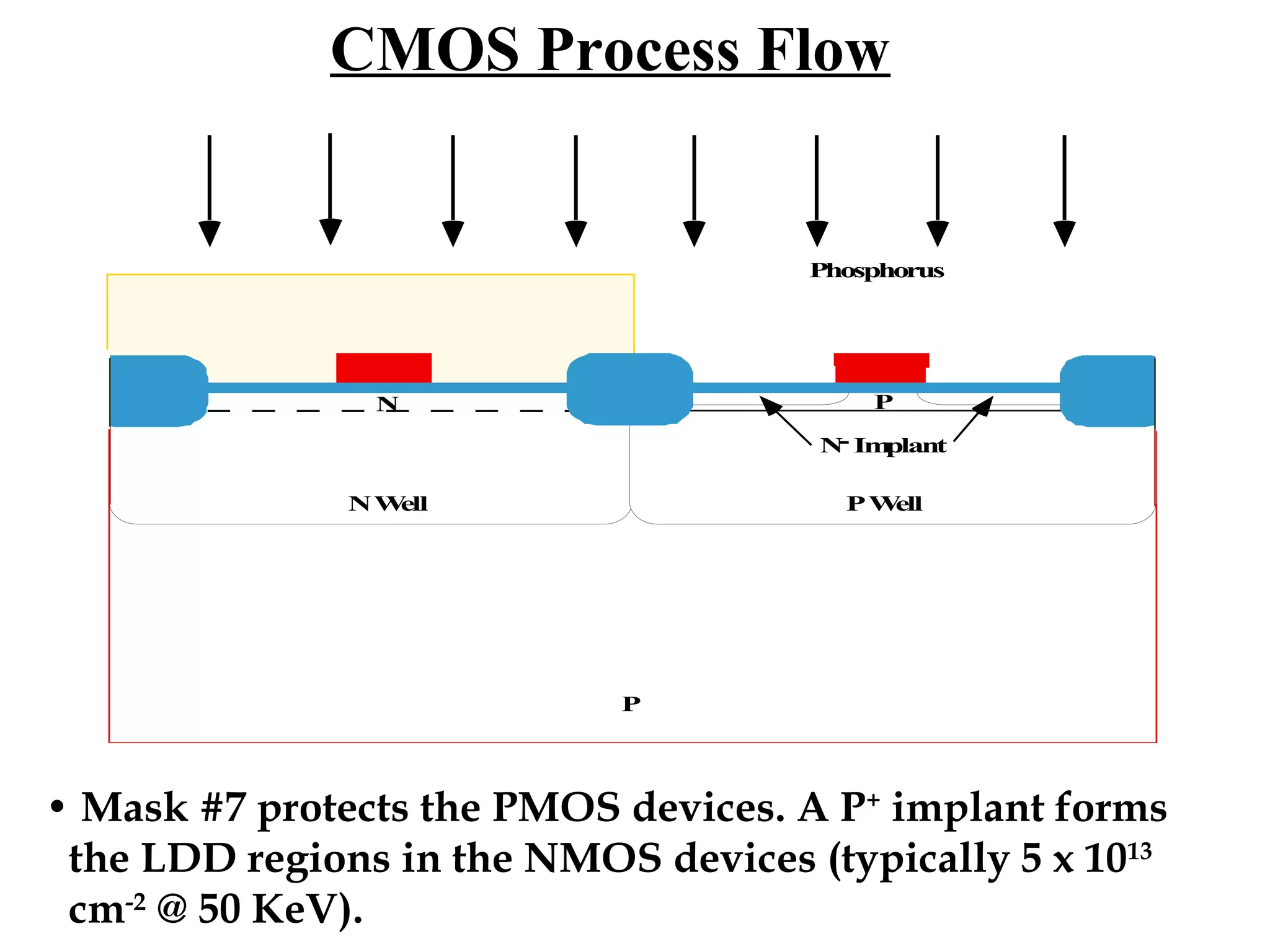
• Mask #7 protects the PMOS devices. A P+ implant forms
the LDD regions in the NMOS devices (typically 5 x 10¹³
cm-2 @ 50 KeV).
CMOS Process Flow

Boron

N

P

P Im
plan
t

N Im
plan
t

NW
ell

PW
ell

P

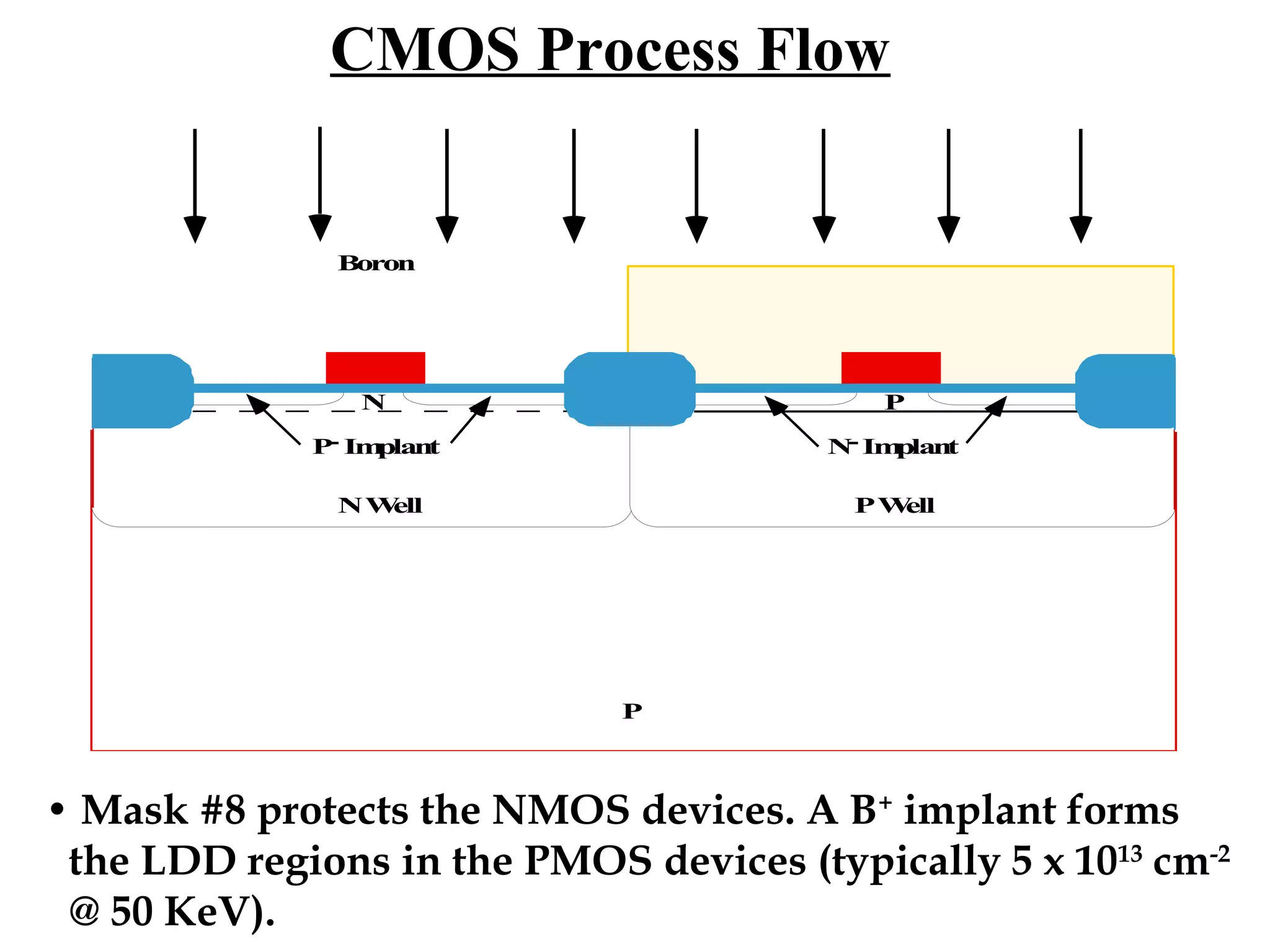
• Mask #8 protects the NMOS devices. A B+ implant forms
the LDD regions in the PMOS devices (typically 5 x 1013 cm-2
@ 50 KeV).
CMOS Process Flow

N

P

P- Implant

N- Implant

N Well

P Well

P

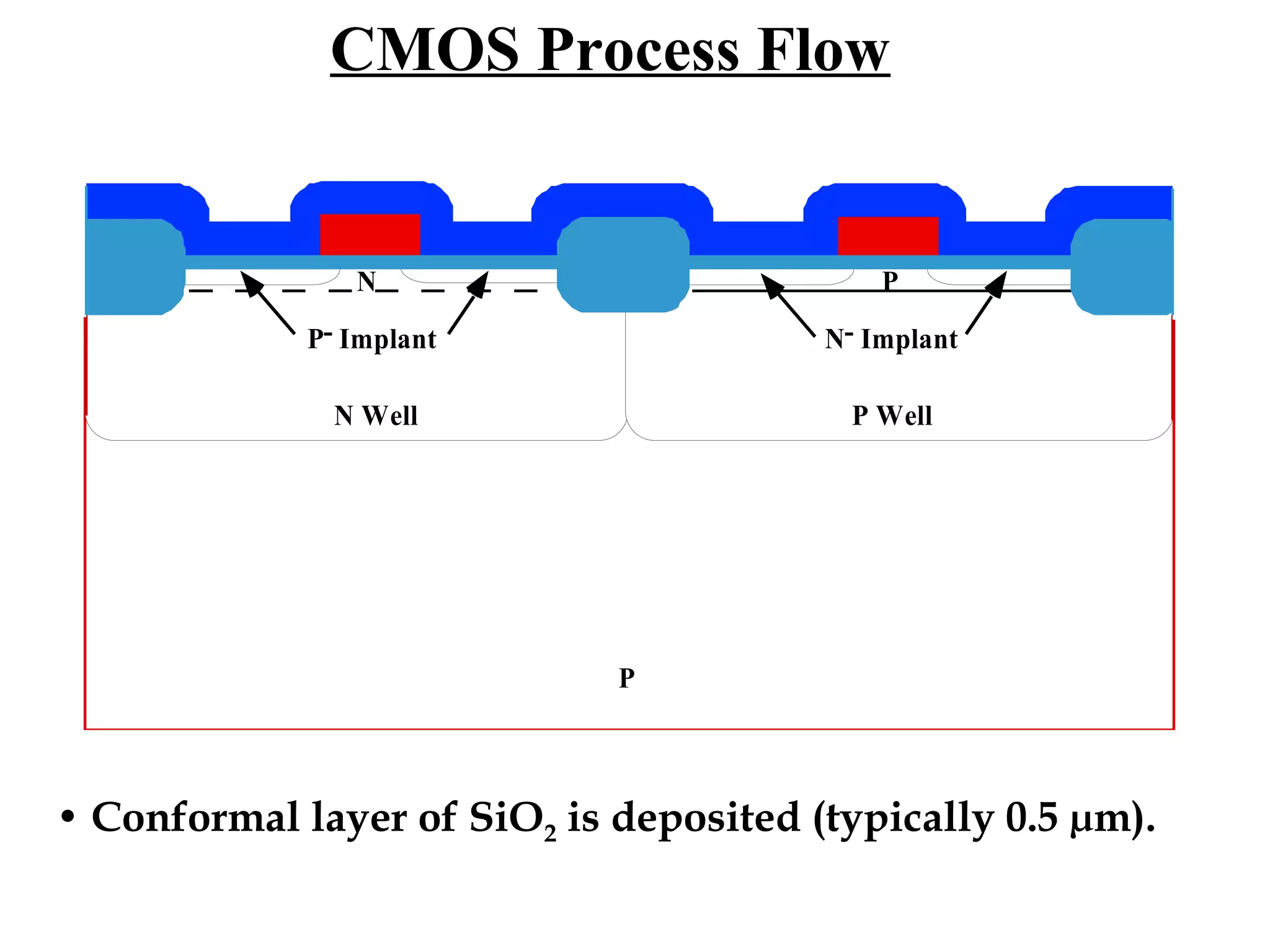
• Conformal layer of SiO2 is deposited (typically 0.5 µm).
CMOS Process Flow

N

P

P- Implant

N- Implant

N Well

P Well

P

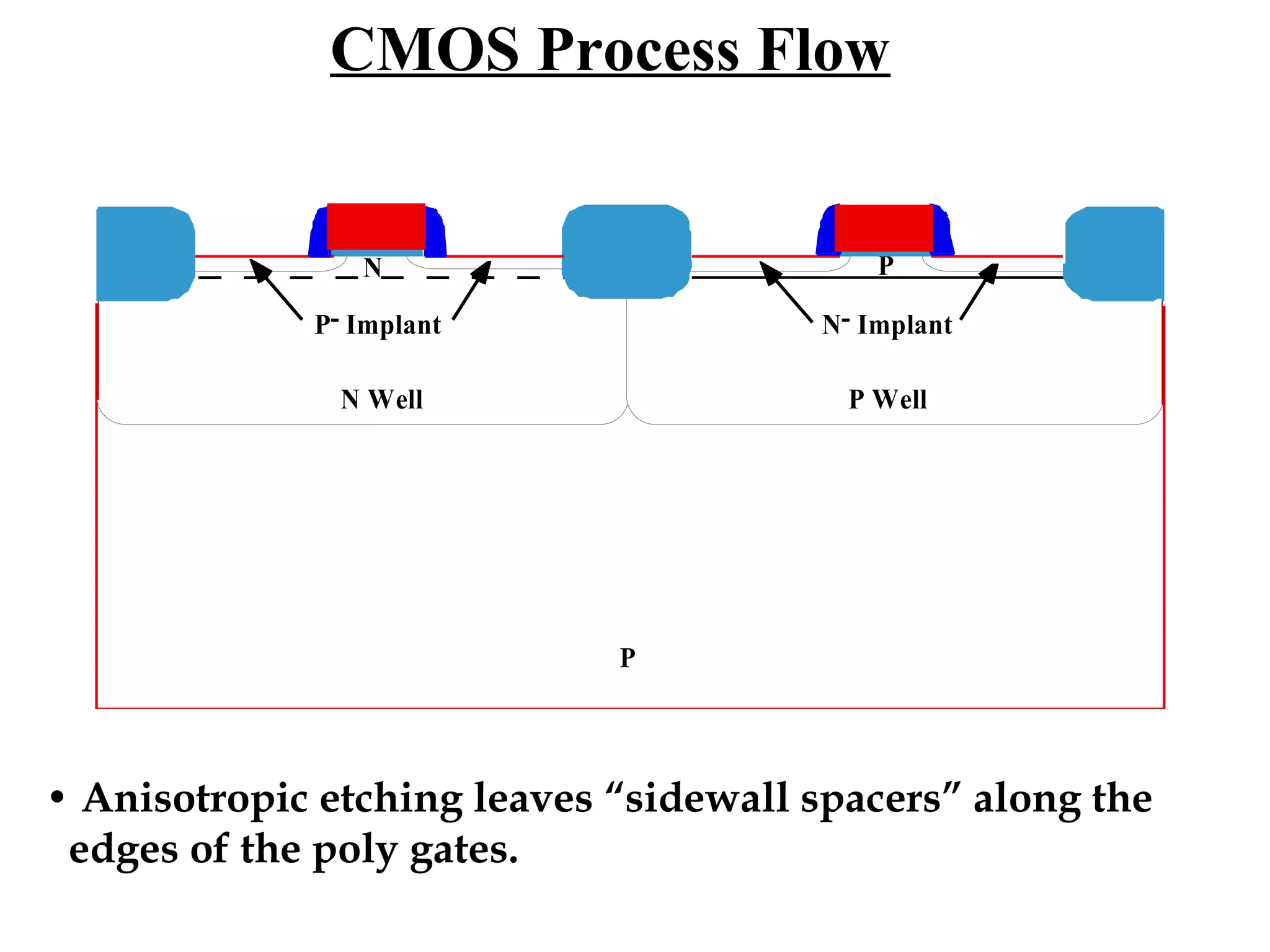
• Anisotropic etching leaves “sidewall spacers” along the
edges of the poly gates.
CMOS Process Flow

Arsenic

N

P
N+ Implant

N Well

P Well

P

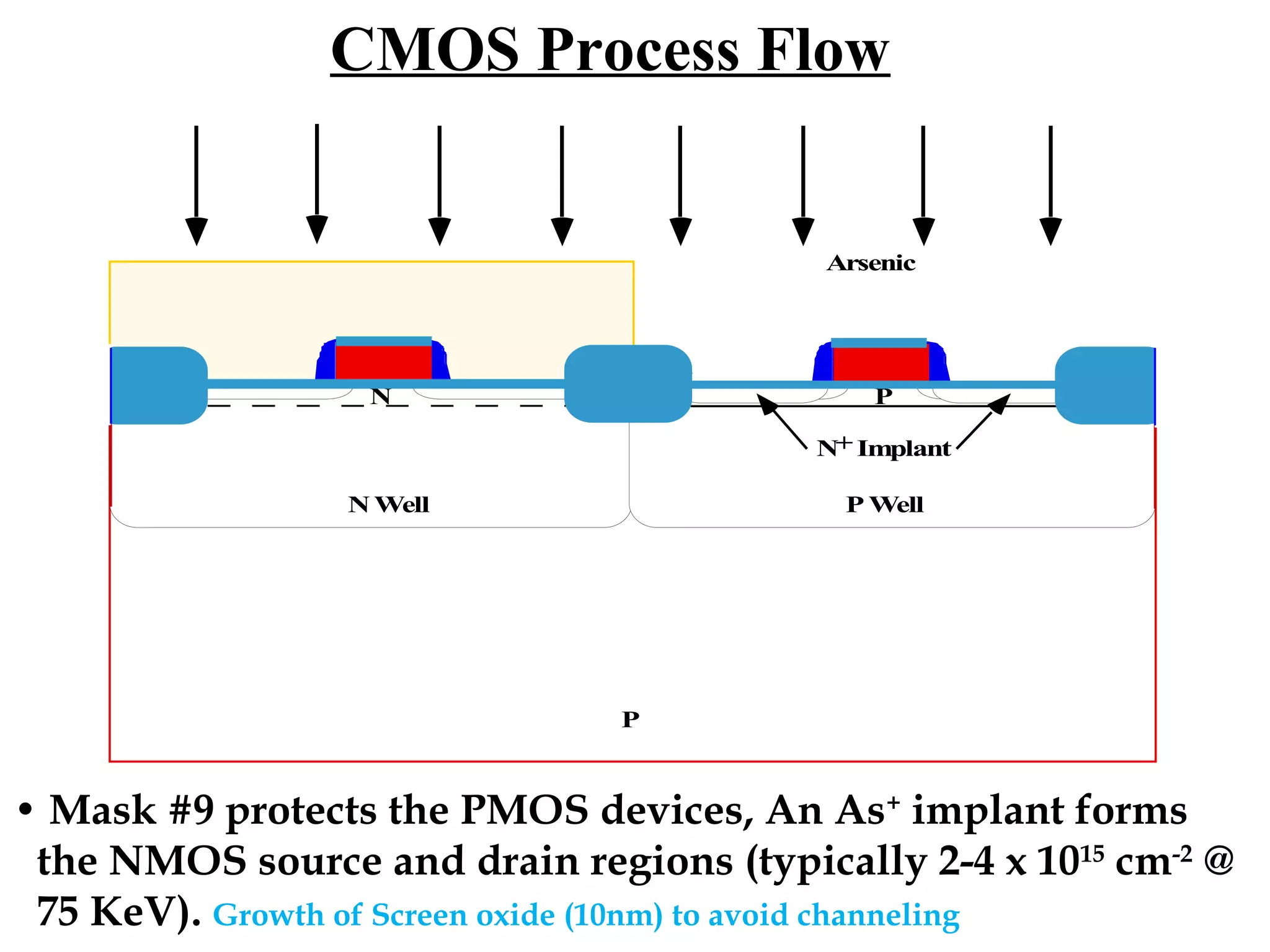
• Mask #9 protects the PMOS devices, An As+ implant forms
the NMOS source and drain regions (typically 2-4 x 1015 cm-2 @
75 KeV). Growth of Screen oxide (10nm) to avoid channeling
CMOS Process Flow

Boron

N

P

P+ Implant

N+ Implant

N Well

P Well

P

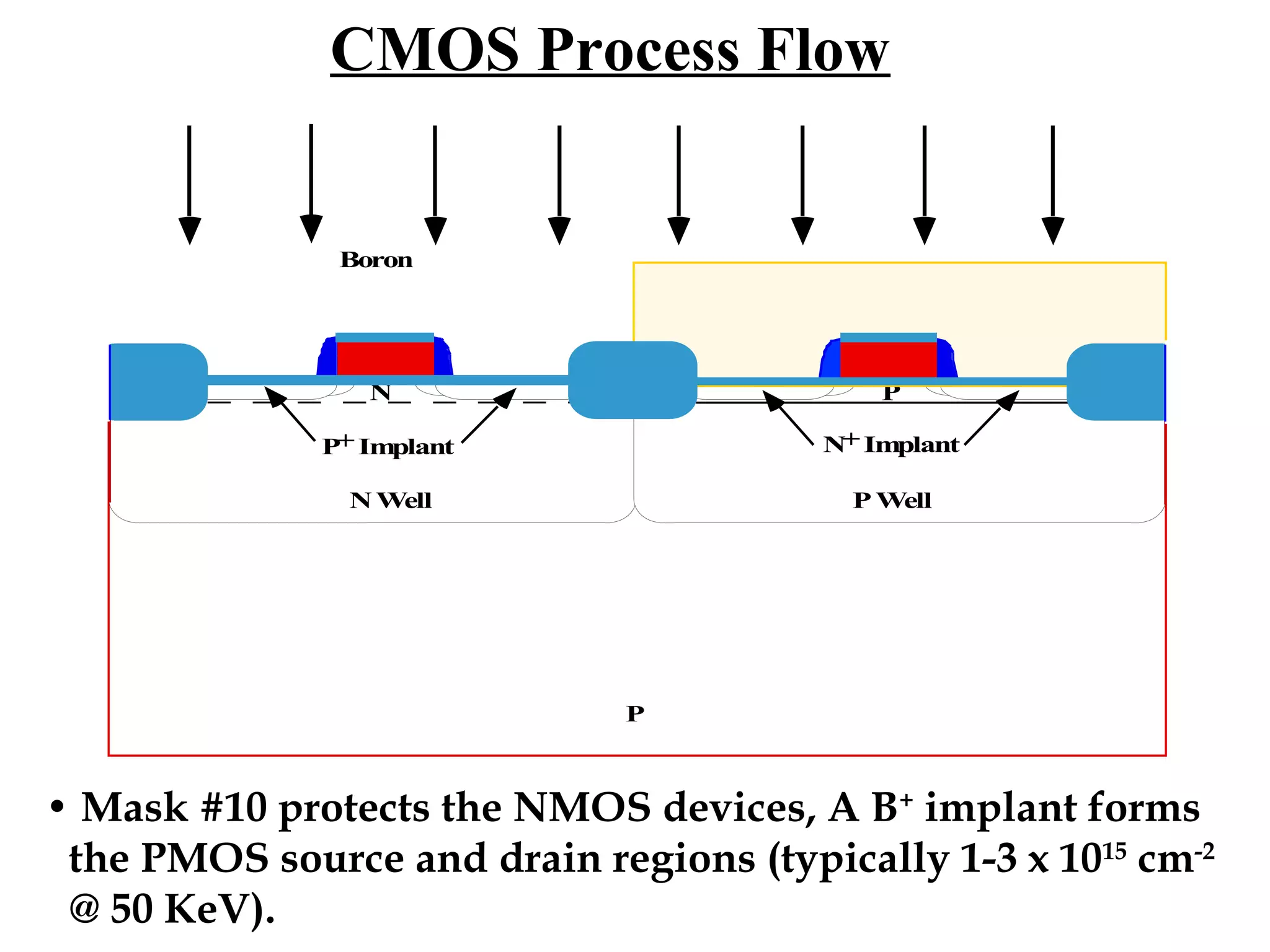
• Mask #10 protects the NMOS devices, A B+ implant forms
the PMOS source and drain regions (typically 1-3 x 1015 cm-2
@ 50 KeV).
CMOS Process Flow
P+

N

N+

P+

N Well

P

N+

P Well

P

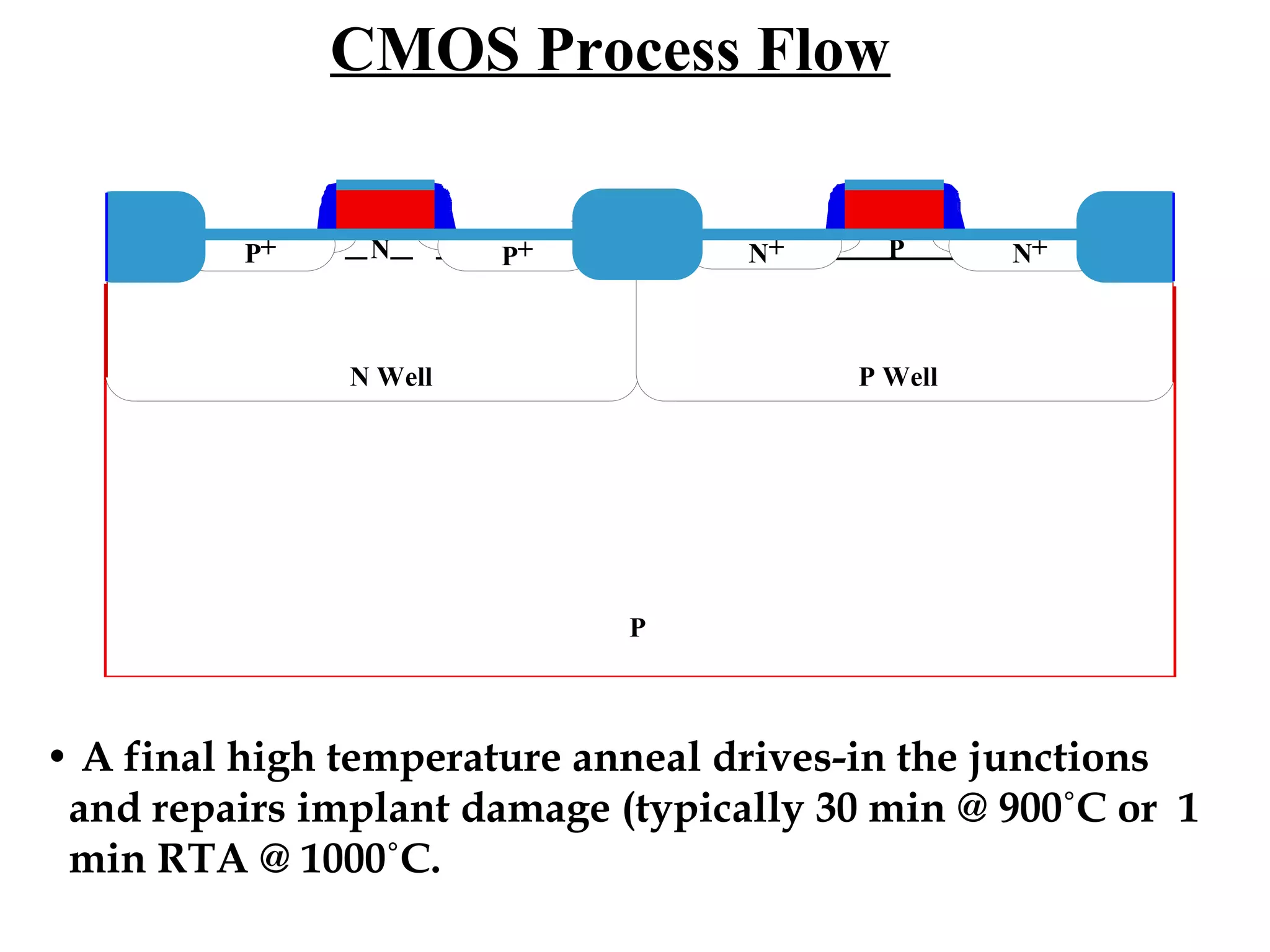
• A final high temperature anneal drives-in the junctions
and repairs implant damage (typically 30 min @ 900˚C or 1
min RTA @ 1000˚C.
CMOS Process Flow
P+

N

P+

N+

N Well

P

N+

P Well

P

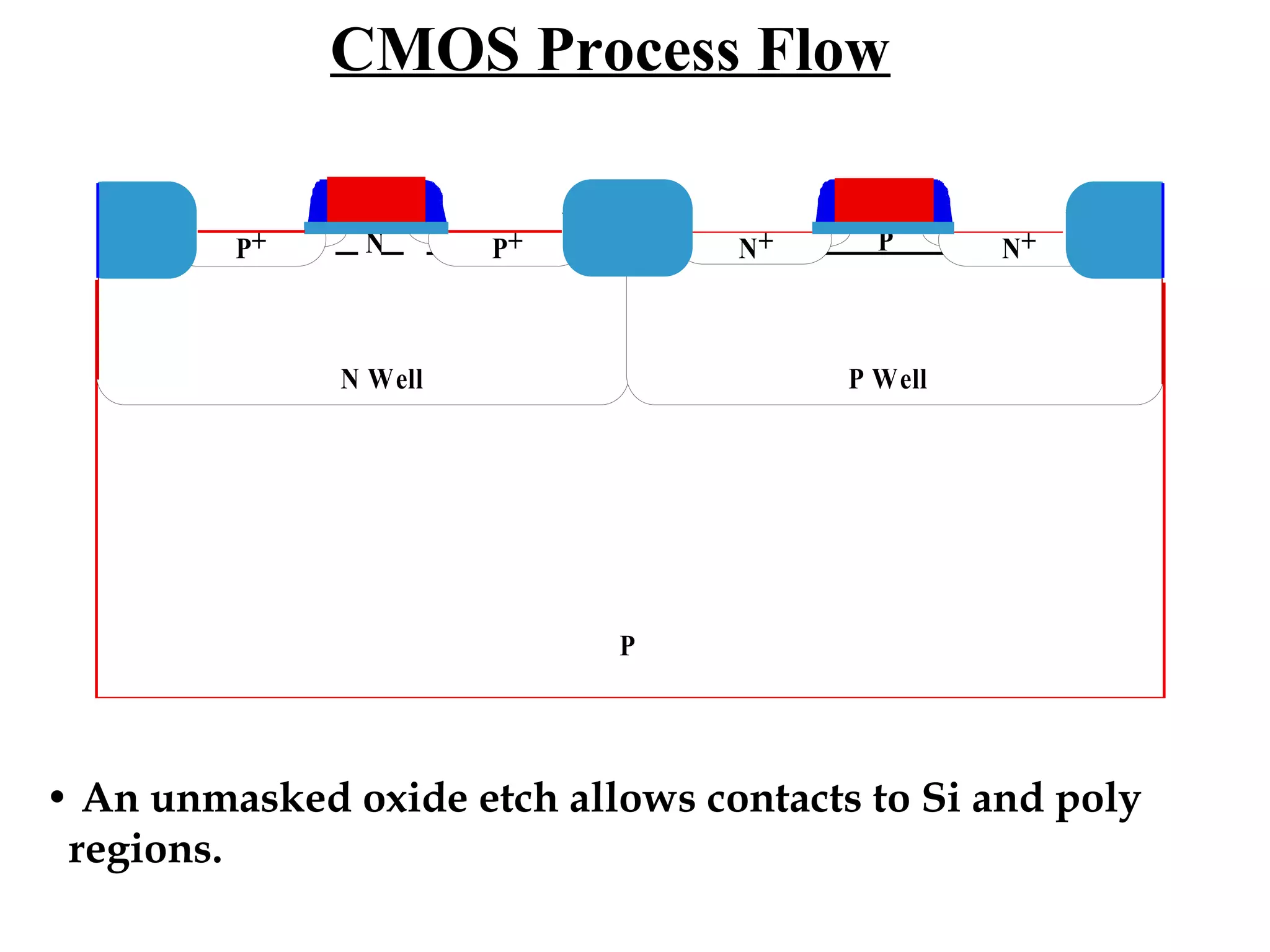
• An unmasked oxide etch allows contacts to Si and poly
regions.
CMOS Process Flow

P+

N

P+

N+

N Well

P

N+

P Well

P

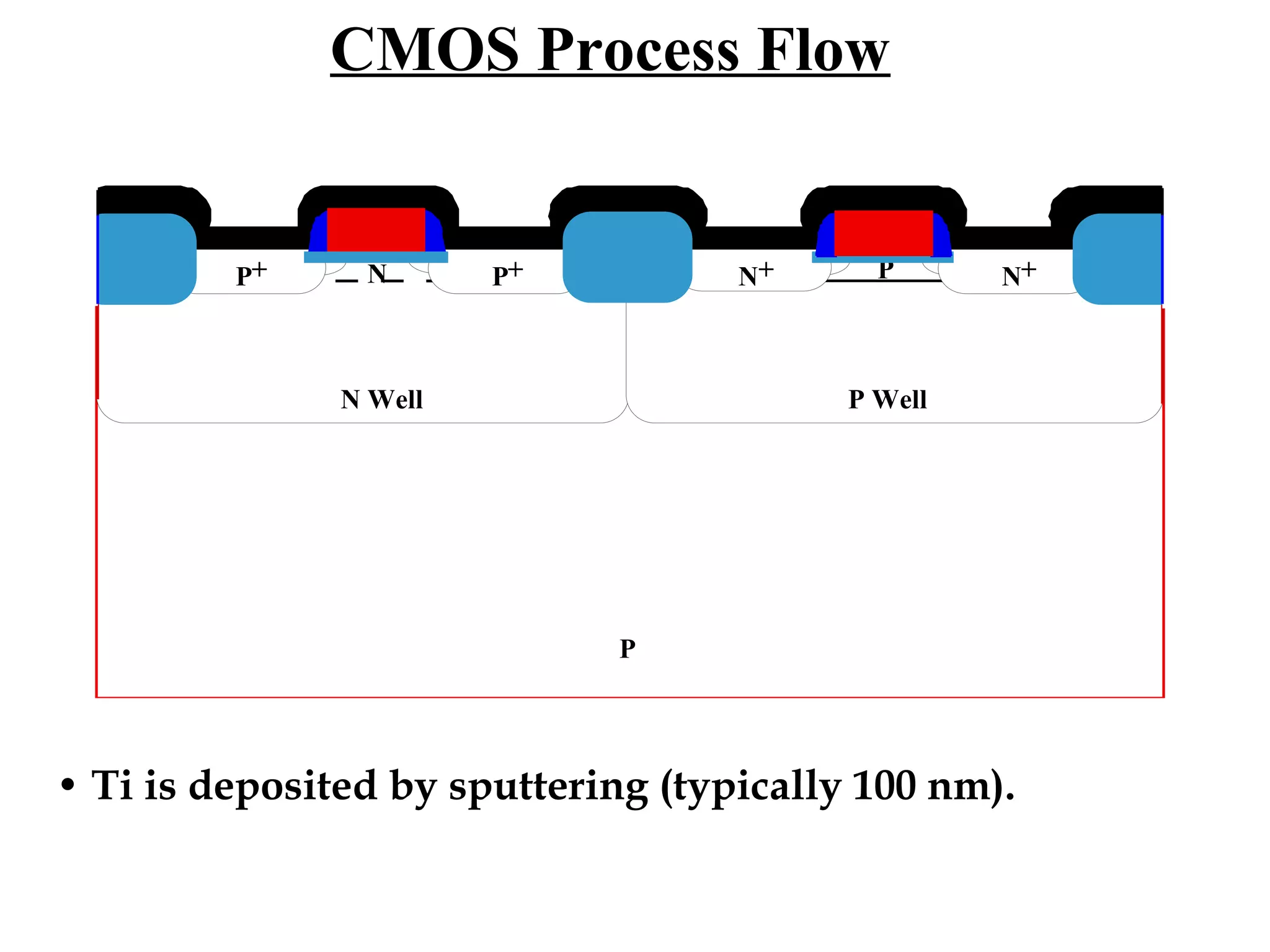
• Ti is deposited by sputtering (typically 100 nm).
CMOS Process Flow

P+

N

P+

N+

N Well

P

N+

P Well

P

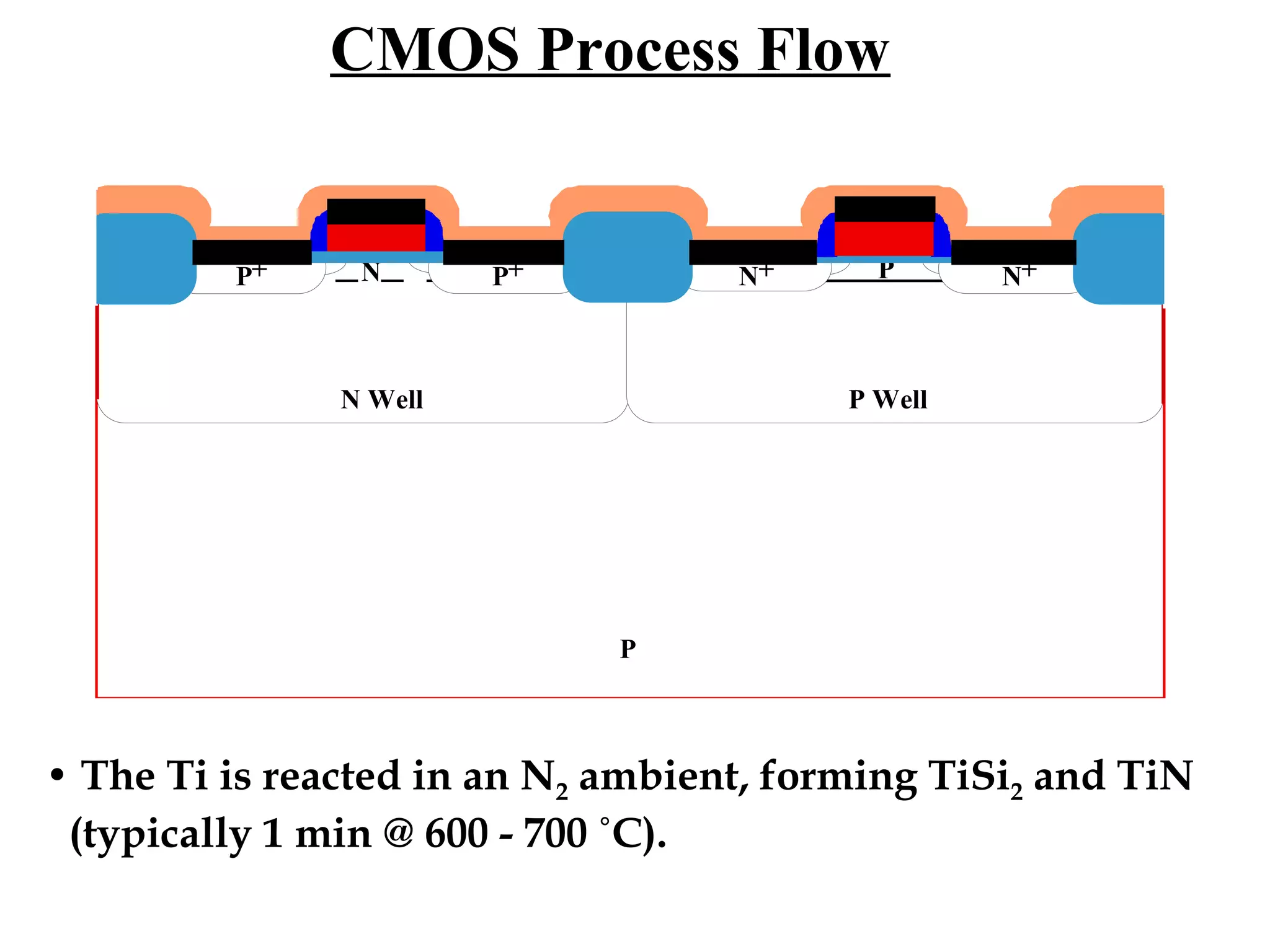
• The Ti is reacted in an N2 ambient, forming TiSi2 and TiN
(typically 1 min @ 600 - 700 ˚C).
CMOS Process Flow

P+

N

P+

N+

N Well

P

N+

P Well

P

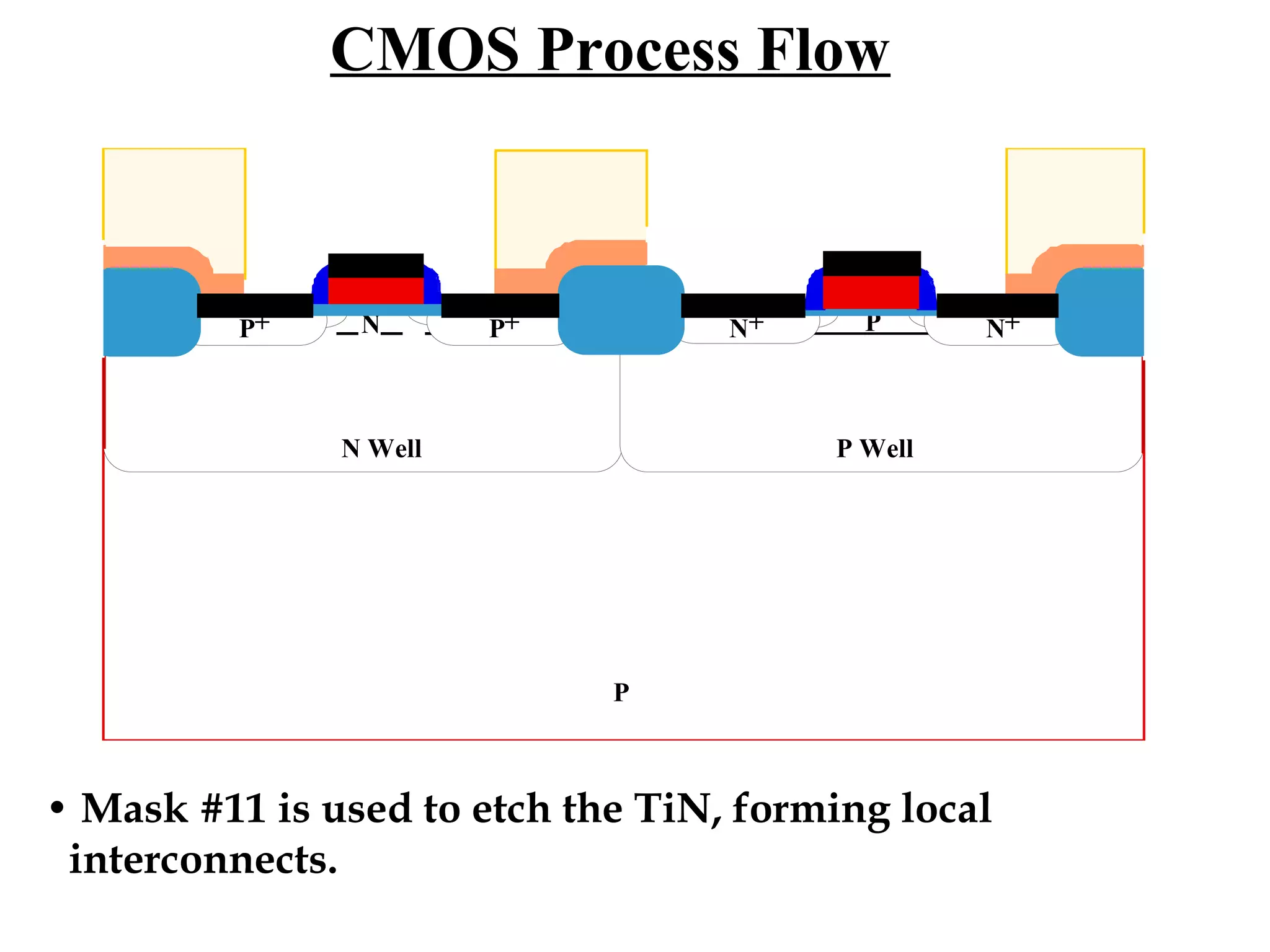
• Mask #11 is used to etch the TiN, forming local
interconnects.
CMOS Process Flow

P+

N

P+

N+

N Well

P

N+

P Well

P

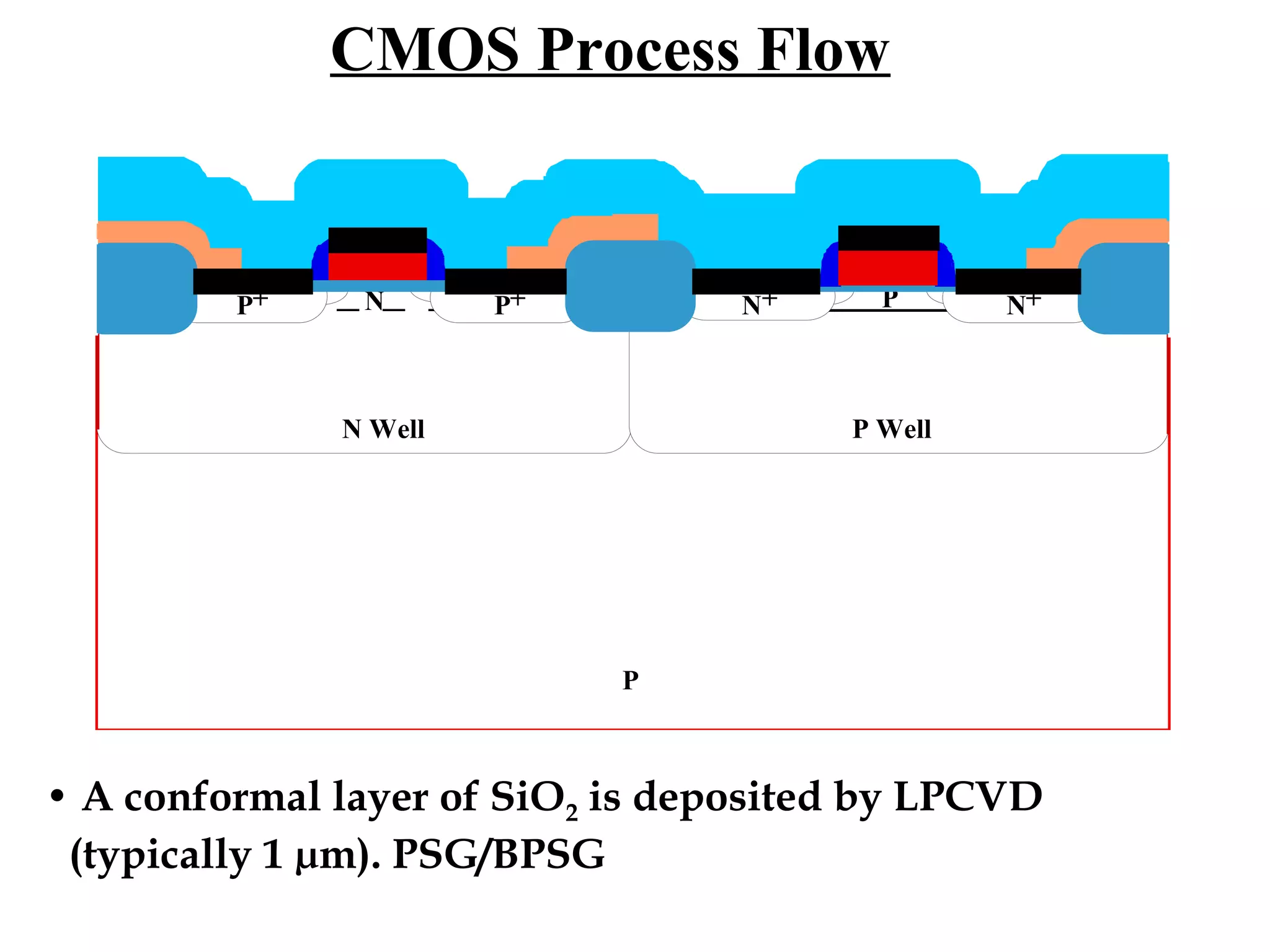
• A conformal layer of SiO2 is deposited by LPCVD
(typically 1 µm). PSG/BPSG
CMOS Process Flow

P+

N

P+

N+

N Well

P

P Well

P

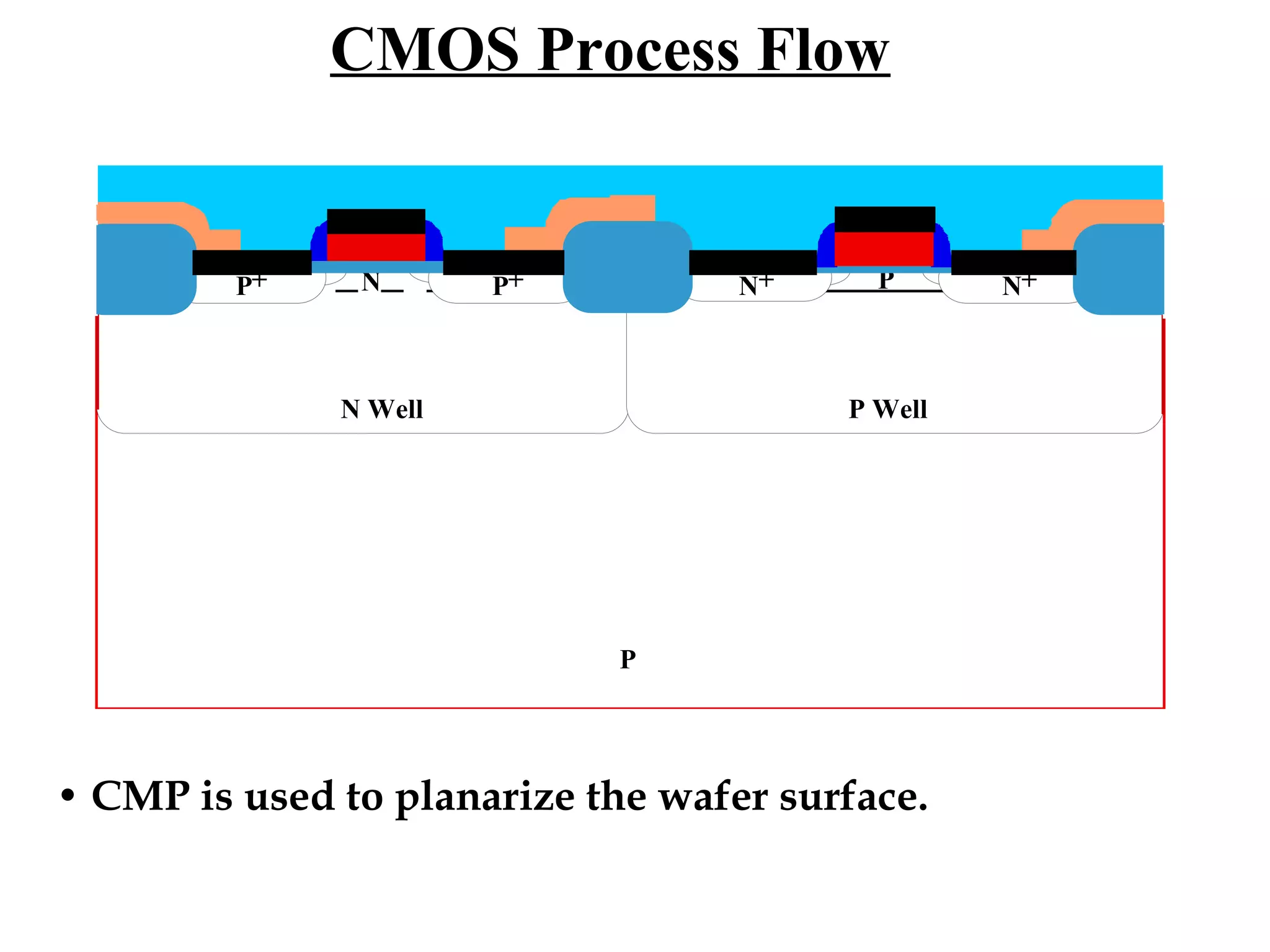
• CMP is used to planarize the wafer surface.

N+
CMOS Process Flow

P+

N

P+

N+

N Well

P

P Well

P

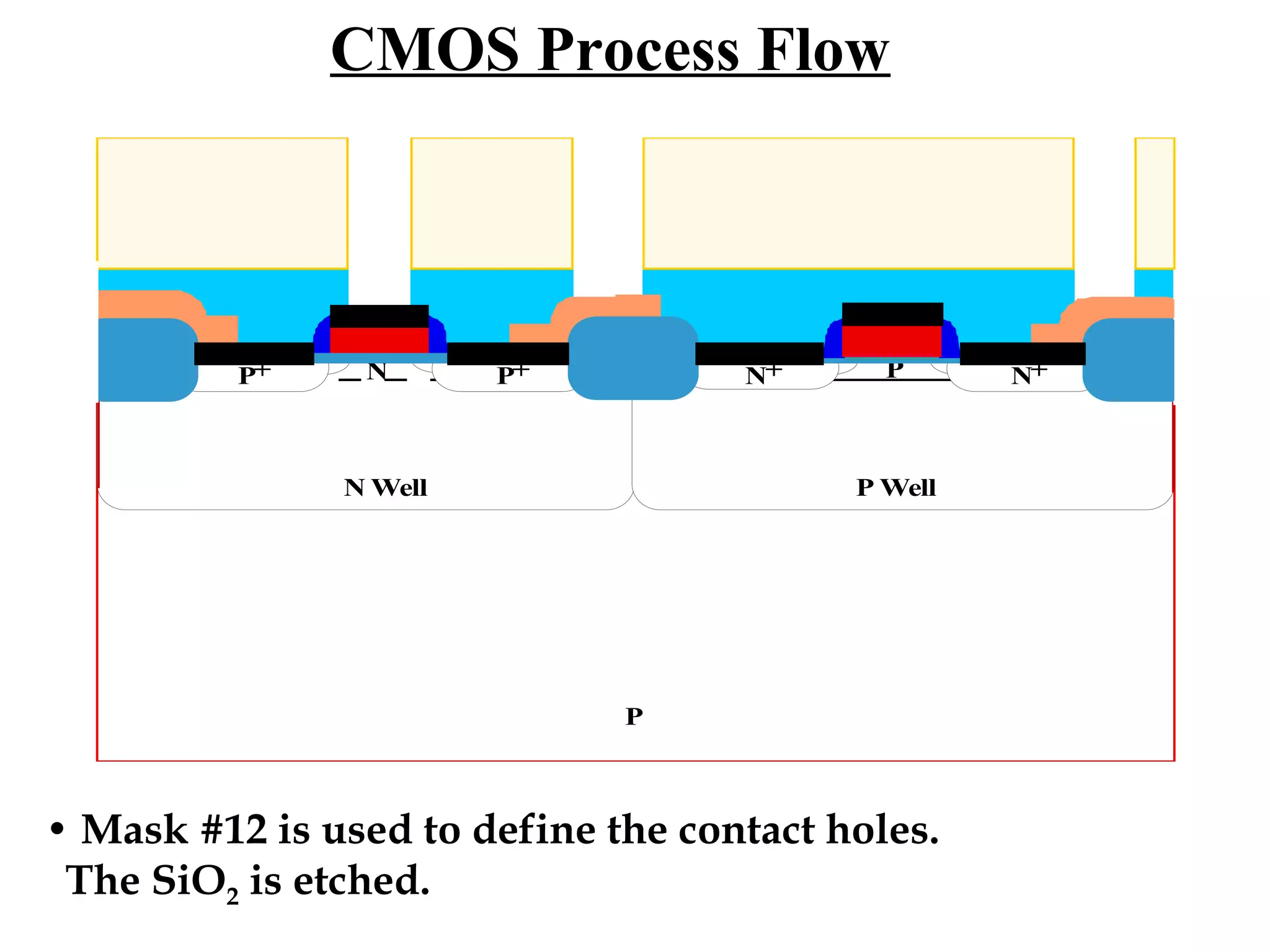
• Mask #12 is used to define the contact holes.
The SiO2 is etched.

N+
CMOS Process Flow
TiN

W

P+

N

P+

N+

N Well

P

N+

P Well

P

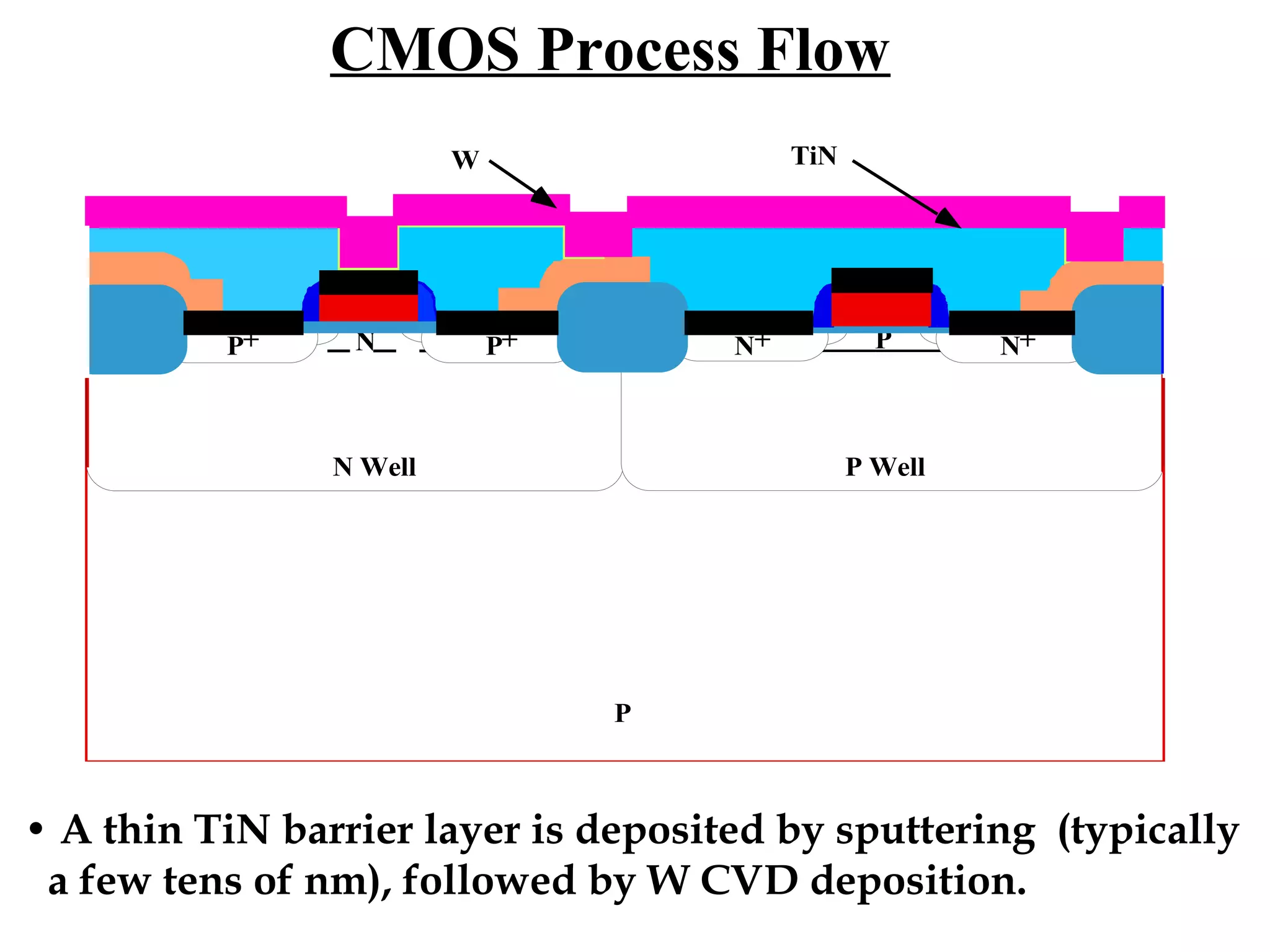
• A thin TiN barrier layer is deposited by sputtering (typically
a few tens of nm), followed by W CVD deposition.
CMOS Process Flow

• CMP is used to planarize the wafer surface, completing the
damascene process.
CMOS Process Flow

P+

N

P+

N+

N Well

P

N+

P Well

P

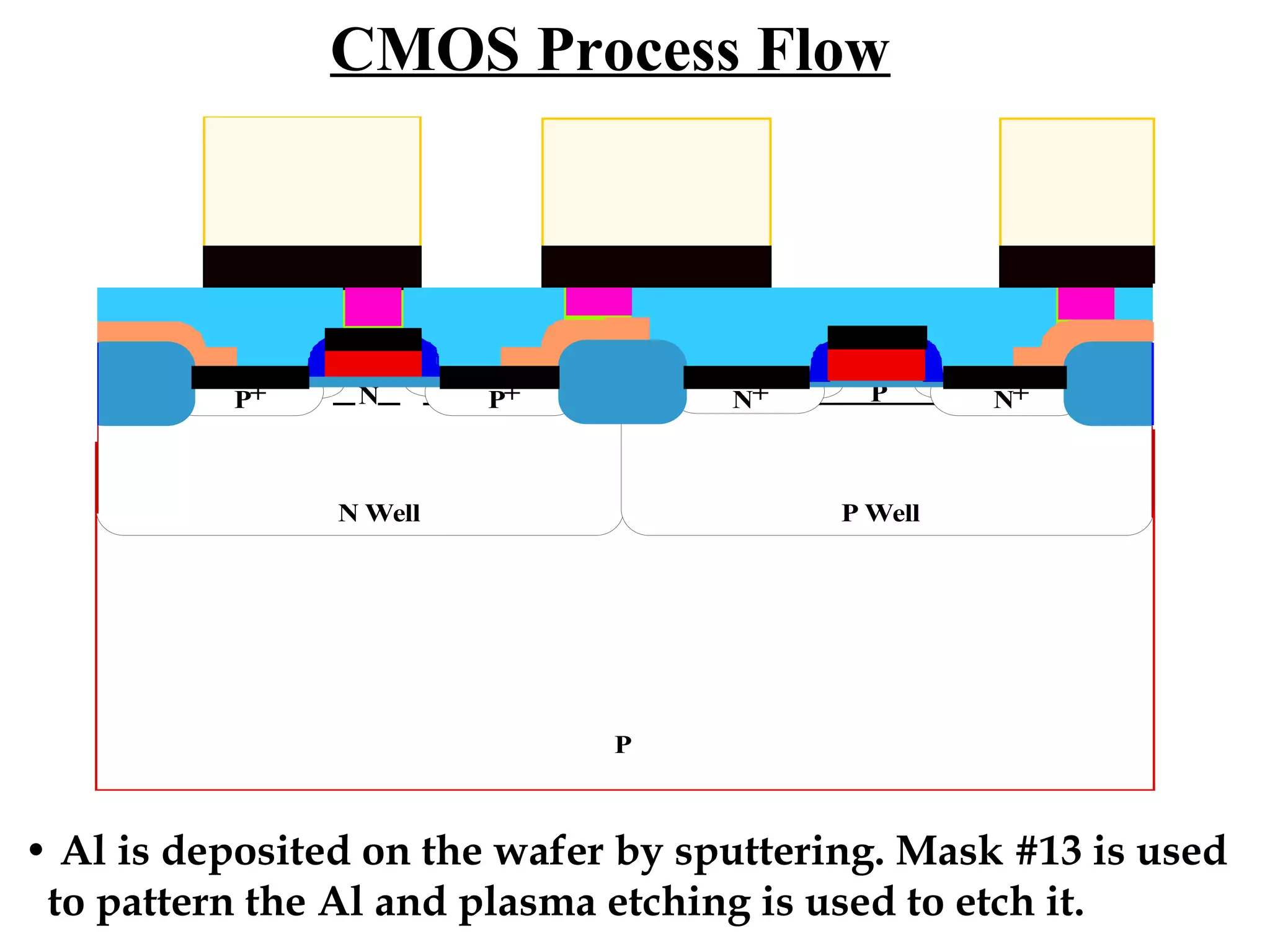
• Al is deposited on the wafer by sputtering. Mask #13 is used
to pattern the Al and plasma etching is used to etch it.
CMOS Process Flow

P+

N

P+

N+

N Well

P

N+

P Well

P

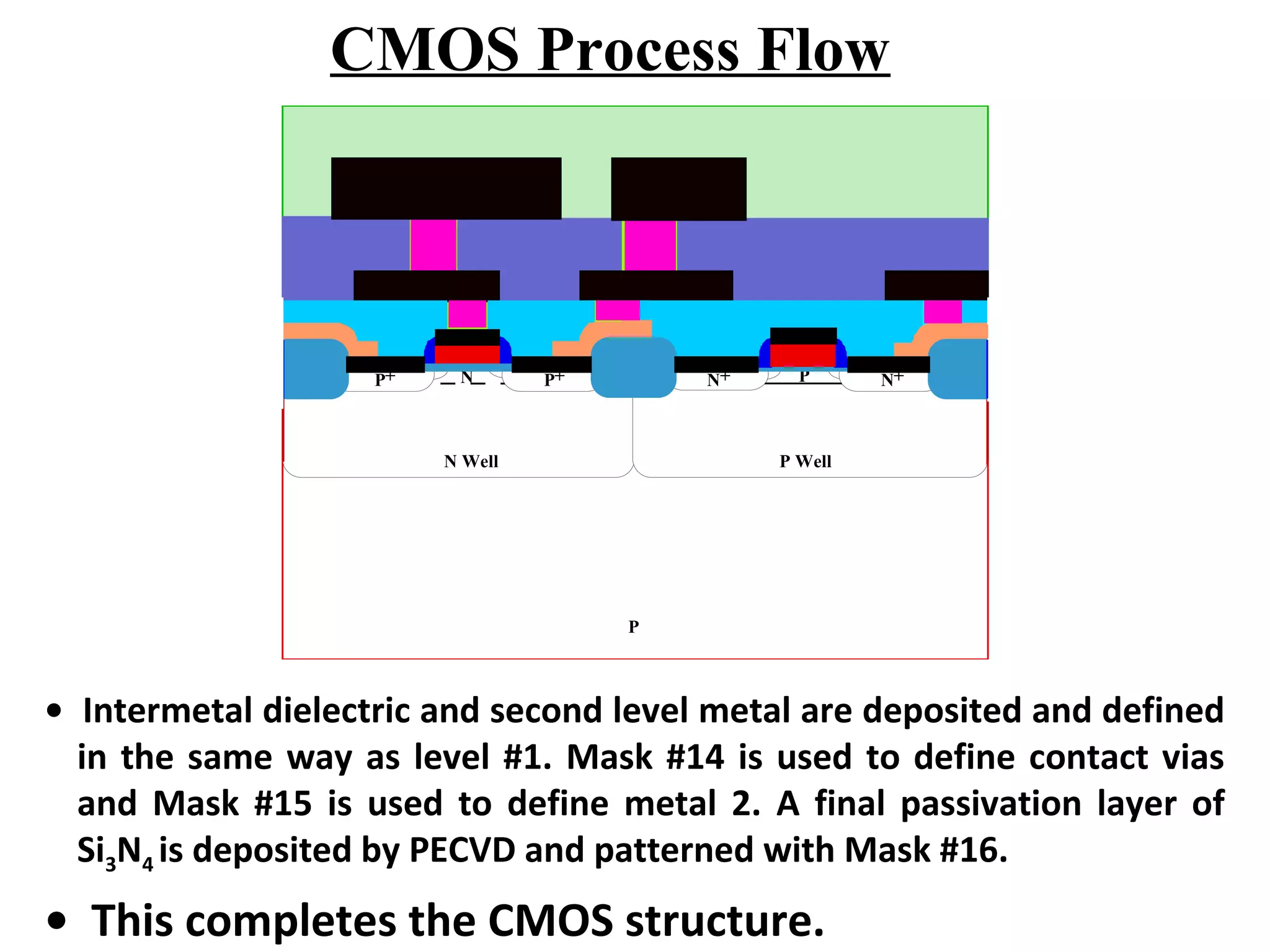
• Intermetal dielectric and second level metal are deposited and defined
in the same way as level #1. Mask #14 is used to define contact vias
and Mask #15 is used to define metal 2. A final passivation layer of
Si3N4 is deposited by PECVD and patterned with Mask #16.

• This completes the CMOS structure.
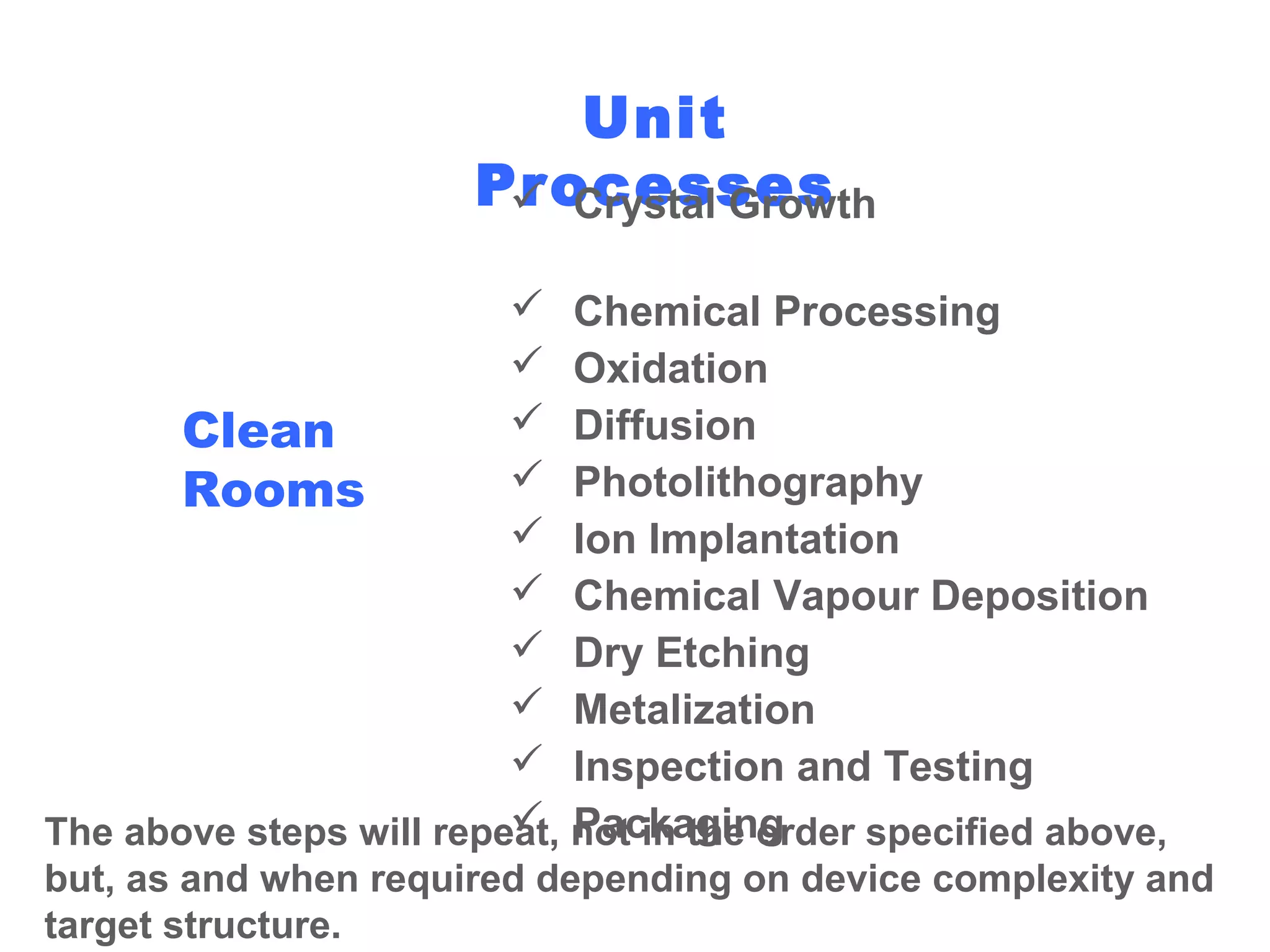
Unit
Processes
 Crystal Growth
 Chemical Processing
 Oxidation
 Diffusion
Clean
 Photolithography
Rooms
 Ion Implantation
 Chemical Vapour Deposition
 Dry Etching
 Metalization
 Inspection and Testing
 Packaging
The above steps will repeat, not in the order specified above,
but, as and when required depending on device complexity and
target structure.
Summary
•

An initial discussion on the CMOS process
flow provides an introduction to the modern
VLSI technology.

• It provides a perspective on how individual
technologies
like
oxidation
and
ion
implantation are actually used.
• There are many variations on CMOS process
flows used in the industry.
• The process described here is intended to
be representative, although it is simplified
compared to many current process flows.
Summary

• Perhaps the most important point is that while
individual process steps like oxidation and
ion implantation are usually studied as
isolated technologies, their actual use is very
much complicated by the fact that IC
manufacturing consists of many sequential
steps, each of which must integrate together
to make the whole process flow work in
manufacturing.
Modern CMOS Technology
• We will describe a modern CMOS process flow.
• In the simplest CMOS technologies, we need to realize
simply NMOS and PMOS transistors for circuits like those
illustrated in the next slide.
• Typical CMOS technologies in manufacturing today add
additional steps to implement multiple device VTH, TFT
devices for loads in SRAMs, capacitors for DRAMs etc.
• Process described here will require 16 masks (through
metal 2) and > 100 process steps.
• There are many possible variations on CMOS process
flow e.g. Device Isolation using Field Oxide or Shallow
Trench Formation.

Cmos process flow

  • 1.
  • 2.
    Examples of SimpleCMOS Circuits +V +V IN1 PMOS IN2 OUTPUT OUTPUT INPUT NMOS GND GND An Inverter A NOR Gate
  • 3.
    CMOS Process Flow D G D Sub Sub G S S G P+ S D N S N+ P+ NWell - PMOS Substrate D G P N+ P Well - NMOS Substrate P • Cross sectional view of final CMOS circuits
  • 4.
    CMOS Process Flow Photoresist Si3N4 SiO2 Si,(100), P Type, 5-50 žcm • Substrate selection: moderately high resistivity, (100) orientation, P type, 25-50 Ohm-cm • Wafer cleaning, thermal oxidation (≈ 40 nm), nitride LPCVD deposition (≈ 80 nm), photoresist spinning and baking (≈ 0.5 - 1.0 µm).
  • 5.
    CMOS Process Flow P •Mask #1 patterns the active areas. The nitride is dry etched.
  • 6.
    CMOS Process Flow P •Field oxide is grown using a LOCOS process. Typically 90 min @ 1000 ˚C in H2O grows ≈ 0.5 µm.
  • 7.
    CMOS Process Flow Boron PImplant P • Mask #2 blocks a B+ implant to form the wells for the NMOS devices. Typically 1013 cm-2 @ 150-200 KeV.
  • 8.
    CMOS Process Flow Phosphorus NImplant P Implant P • Mask #3 blocks a P+ implant to form the wells for the PMOS devices. Typically 1013 cm-2 @ 300+ KeV.
  • 9.
    CMOS Process Flow NWell P Well P • A high temperature drive-in produces the “final” well depths and repairs implant damage. Typically 4-6 hours @ 1000 ˚C - 1100 ˚C or equivalent Dt.
  • 10.
    CMOS Process Flow Boron P NWell P Well P • Mask #4 is used to mask the PMOS devices. A VTH adjust implant is done on the NMOS devices, typically a 1-5 x 1012 cm-2 B+ implant @ 50 - 75 KeV.
  • 11.
    CMOS Process Flow Arsenic N P NWell P Well P • Mask #5 is used to mask the NMOS devices. A VTH adjust implant is done on the PMOS devices, typically 1-5 x 1012 cm-2 As+ implant @ 75 - 100 KeV.
  • 12.
    CMOS Process Flow N P NWell P Well P • The thin oxide over the active regions is stripped and a new gate oxide grown, typically 3 - 5 nm, which could be grown in 0.5 - 1 hrs @ 800 ˚C in O2.
  • 13.
    CMOS Process Flow N P NWell P Well P • Polysilicon is deposited by LPCVD ( ≈ 0.5 µm). An unmasked P+ or As+ implant dopes the poly (typically 5 x 1015 cm-2) or In-Situ doping
  • 14.
    CMOS Process Flow N P NWell P Well P • Mask #6 is used to protect the MOS gates. The poly is plasma etched using an anisotropic etch.
  • 15.
    CMOS Process Flow Phosphorus P N NIm plant NW ell PW ell P • Mask #7 protects the PMOS devices. A P+ implant forms the LDD regions in the NMOS devices (typically 5 x 1013 cm-2 @ 50 KeV).
  • 16.
    CMOS Process Flow Boron N P PIm plan t N Im plan t NW ell PW ell P • Mask #8 protects the NMOS devices. A B+ implant forms the LDD regions in the PMOS devices (typically 5 x 1013 cm-2 @ 50 KeV).
  • 17.
    CMOS Process Flow N P P-Implant N- Implant N Well P Well P • Conformal layer of SiO2 is deposited (typically 0.5 µm).
  • 18.
    CMOS Process Flow N P P-Implant N- Implant N Well P Well P • Anisotropic etching leaves “sidewall spacers” along the edges of the poly gates.
  • 19.
    CMOS Process Flow Arsenic N P N+Implant N Well P Well P • Mask #9 protects the PMOS devices, An As+ implant forms the NMOS source and drain regions (typically 2-4 x 1015 cm-2 @ 75 KeV). Growth of Screen oxide (10nm) to avoid channeling
  • 20.
    CMOS Process Flow Boron N P P+Implant N+ Implant N Well P Well P • Mask #10 protects the NMOS devices, A B+ implant forms the PMOS source and drain regions (typically 1-3 x 1015 cm-2 @ 50 KeV).
  • 21.
    CMOS Process Flow P+ N N+ P+ NWell P N+ P Well P • A final high temperature anneal drives-in the junctions and repairs implant damage (typically 30 min @ 900˚C or 1 min RTA @ 1000˚C.
  • 22.
    CMOS Process Flow P+ N P+ N+ NWell P N+ P Well P • An unmasked oxide etch allows contacts to Si and poly regions.
  • 23.
    CMOS Process Flow P+ N P+ N+ NWell P N+ P Well P • Ti is deposited by sputtering (typically 100 nm).
  • 24.
    CMOS Process Flow P+ N P+ N+ NWell P N+ P Well P • The Ti is reacted in an N2 ambient, forming TiSi2 and TiN (typically 1 min @ 600 - 700 ˚C).
  • 25.
    CMOS Process Flow P+ N P+ N+ NWell P N+ P Well P • Mask #11 is used to etch the TiN, forming local interconnects.
  • 26.
    CMOS Process Flow P+ N P+ N+ NWell P N+ P Well P • A conformal layer of SiO2 is deposited by LPCVD (typically 1 µm). PSG/BPSG
  • 27.
    CMOS Process Flow P+ N P+ N+ NWell P P Well P • CMP is used to planarize the wafer surface. N+
  • 28.
    CMOS Process Flow P+ N P+ N+ NWell P P Well P • Mask #12 is used to define the contact holes. The SiO2 is etched. N+
  • 29.
    CMOS Process Flow TiN W P+ N P+ N+ NWell P N+ P Well P • A thin TiN barrier layer is deposited by sputtering (typically a few tens of nm), followed by W CVD deposition.
  • 30.
    CMOS Process Flow •CMP is used to planarize the wafer surface, completing the damascene process.
  • 31.
    CMOS Process Flow P+ N P+ N+ NWell P N+ P Well P • Al is deposited on the wafer by sputtering. Mask #13 is used to pattern the Al and plasma etching is used to etch it.
  • 32.
    CMOS Process Flow P+ N P+ N+ NWell P N+ P Well P • Intermetal dielectric and second level metal are deposited and defined in the same way as level #1. Mask #14 is used to define contact vias and Mask #15 is used to define metal 2. A final passivation layer of Si3N4 is deposited by PECVD and patterned with Mask #16. • This completes the CMOS structure.
  • 33.
    Unit Processes  Crystal Growth Chemical Processing  Oxidation  Diffusion Clean  Photolithography Rooms  Ion Implantation  Chemical Vapour Deposition  Dry Etching  Metalization  Inspection and Testing  Packaging The above steps will repeat, not in the order specified above, but, as and when required depending on device complexity and target structure.
  • 34.
    Summary • An initial discussionon the CMOS process flow provides an introduction to the modern VLSI technology. • It provides a perspective on how individual technologies like oxidation and ion implantation are actually used. • There are many variations on CMOS process flows used in the industry. • The process described here is intended to be representative, although it is simplified compared to many current process flows.
  • 35.
    Summary • Perhaps themost important point is that while individual process steps like oxidation and ion implantation are usually studied as isolated technologies, their actual use is very much complicated by the fact that IC manufacturing consists of many sequential steps, each of which must integrate together to make the whole process flow work in manufacturing.
  • 37.
    Modern CMOS Technology •We will describe a modern CMOS process flow. • In the simplest CMOS technologies, we need to realize simply NMOS and PMOS transistors for circuits like those illustrated in the next slide. • Typical CMOS technologies in manufacturing today add additional steps to implement multiple device VTH, TFT devices for loads in SRAMs, capacitors for DRAMs etc. • Process described here will require 16 masks (through metal 2) and > 100 process steps. • There are many possible variations on CMOS process flow e.g. Device Isolation using Field Oxide or Shallow Trench Formation.