1
CMOS Fabrication and Layout
• Transistors are fabricated on a thin silicon wafer that
serve as both a mechanical support and electrical
common point called substrate
• Fabrication process (a.k.a. Lithography) is similar to
printing press
– On each step, different materials are deposited
or etched
• Easiest way to understand physical layout is to look
at the wafer from two perspectives:
– Top-section
– Cross-section
2
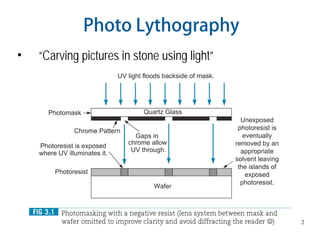
Photo Lythography
• “Carving pictures in stone using light”
3
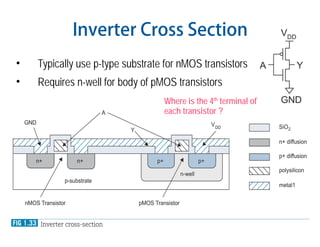
Inverter Cross Section
• Typically use p-type substrate for nMOS transistors
• Requires n-well for body of pMOS transistors
Where is the 4th
terminal of
each transistor ?
4
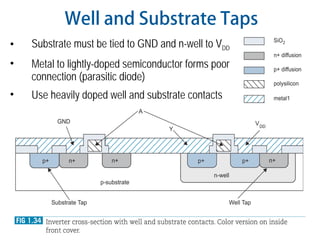
Well and Substrate Taps
• Substrate must be tied to GND and n-well to VDD
• Metal to lightly-doped semiconductor forms poor
connection (parasitic diode)
• Use heavily doped well and substrate contacts
5
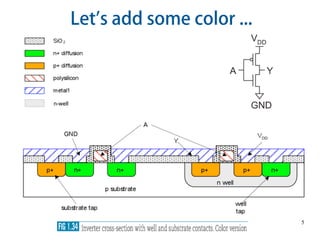
Let's add some color ...
n-well
6
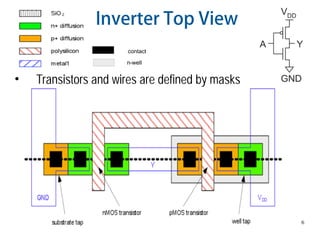
Inverter Top View
• Transistors and wires are defined by masks
contact
n-well
7
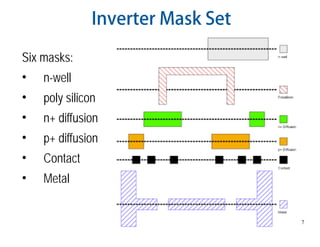
Inverter Mask Set
Six masks:
• n-well
• poly silicon
• n+ diffusion
• p+ diffusion
• Contact
• Metal
8
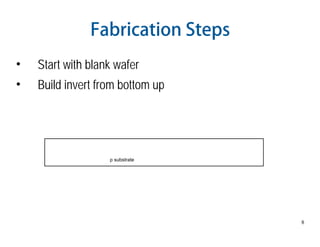
Fabrication Steps
• Start with blank wafer
• Build invert from bottom up
p substrate
9
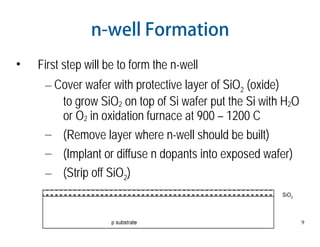
n-well Formation
• First step will be to form the n-well
– Cover wafer with protective layer of SiO2 (oxide)
to grow SiO2 on top of Si wafer put the Si with H2O
or O2 in oxidation furnace at 900 – 1200 C
– (Remove layer where n-well should be built)
– (Implant or diffuse n dopants into exposed wafer)
– (Strip off SiO2)
10
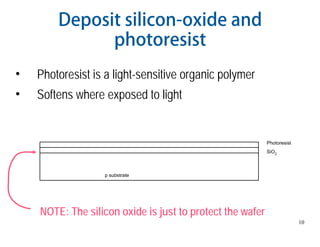
Deposit silicon-oxide and
photoresist
• Photoresist is a light-sensitive organic polymer
• Softens where exposed to light
p substrate
SiO2
Photoresist
NOTE: The silicon oxide is just to protect the wafer
11
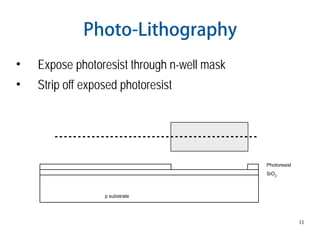
Photo-Lithography
• Expose photoresist through n-well mask
• Strip off exposed photoresist
p substrate
SiO2
Photoresist
12
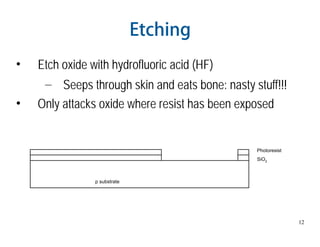
Etching
• Etch oxide with hydrofluoric acid (HF)
– Seeps through skin and eats bone: nasty stuff!!!
• Only attacks oxide where resist has been exposed
p substrate
SiO2
Photoresist
13
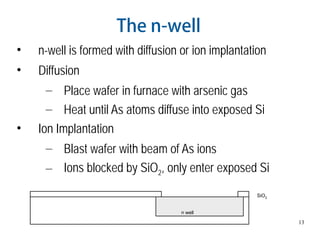
The n-well
• n-well is formed with diffusion or ion implantation
• Diffusion
– Place wafer in furnace with arsenic gas
– Heat until As atoms diffuse into exposed Si
• Ion Implantation
– Blast wafer with beam of As ions
– Ions blocked by SiO2, only enter exposed Si
n well
SiO2
14
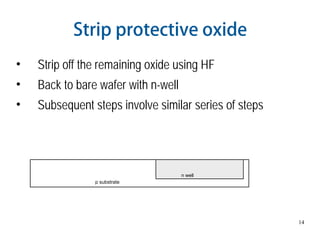
Strip protective oxide
• Strip off the remaining oxide using HF
• Back to bare wafer with n-well
• Subsequent steps involve similar series of steps
p substrate
n well
15
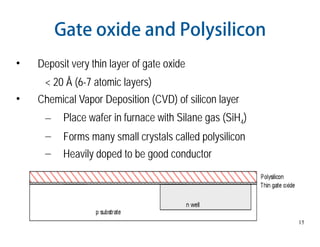
Gate oxide and Polysilicon
• Deposit very thin layer of gate oxide
< 20 Å (6-7 atomic layers)
• Chemical Vapor Deposition (CVD) of silicon layer
– Place wafer in furnace with Silane gas (SiH4)
– Forms many small crystals called polysilicon
– Heavily doped to be good conductor
16
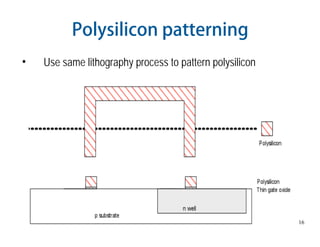
Polysilicon patterning
• Use same lithography process to pattern polysilicon
17
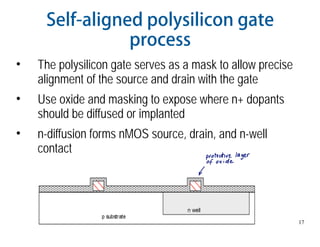
Self-aligned polysilicon gate
process
• The polysilicon gate serves as a mask to allow precise
alignment of the source and drain with the gate
• Use oxide and masking to expose where n+ dopants
should be diffused or implanted
• n-diffusion forms nMOS source, drain, and n-well
contact
18
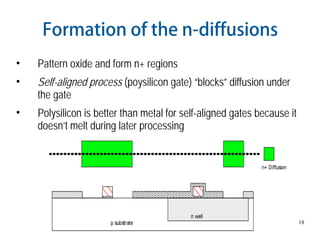
Formation of the n-diffusions
• Pattern oxide and form n+ regions
• Self-aligned process (poysilicon gate) “blocks” diffusion under
the gate
• Polysilicon is better than metal for self-aligned gates because it
doesn’t melt during later processing
19
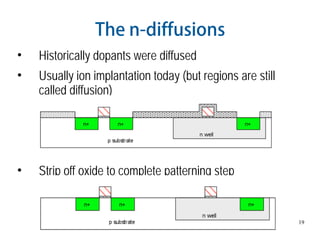
The n-diffusions
• Historically dopants were diffused
• Usually ion implantation today (but regions are still
called diffusion)
• Strip off oxide to complete patterning step
20
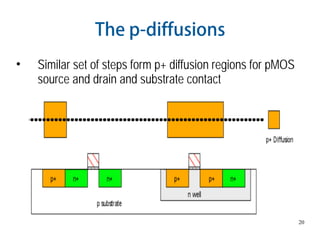
The p-diffusions
• Similar set of steps form p+ diffusion regions for pMOS
source and drain and substrate contact
21
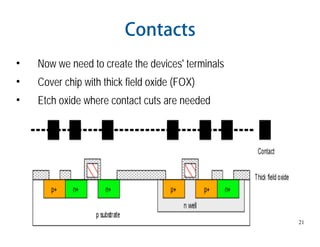
Contacts
• Now we need to create the devices' terminals
• Cover chip with thick field oxide (FOX)
• Etch oxide where contact cuts are needed
22
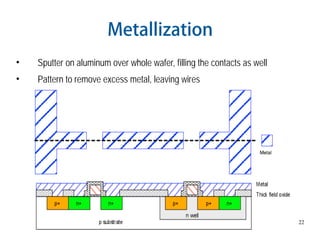
Metallization
• Sputter on aluminum over whole wafer, filling the contacts as well
• Pattern to remove excess metal, leaving wires
23
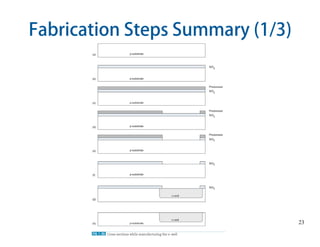
Fabrication Steps Summary (1/3)
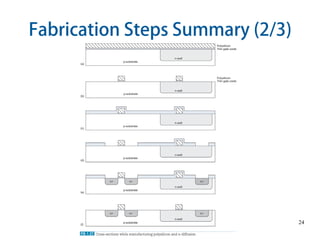
24
Fabrication Steps Summary (2/3)
25
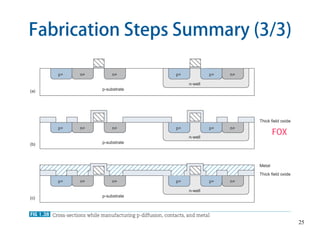
Fabrication Steps Summary (3/3)
FOX
26
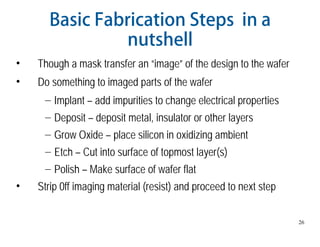
Basic Fabrication Steps in a
nutshell
• Though a mask transfer an “image” of the design to the wafer
• Do something to imaged parts of the wafer
– Implant – add impurities to change electrical properties
– Deposit – deposit metal, insulator or other layers
– Grow Oxide – place silicon in oxidizing ambient
– Etch – Cut into surface of topmost layer(s)
– Polish – Make surface of wafer flat
• Strip 0ff imaging material (resist) and proceed to next step
27
Layout Design
• Chips are specified with set of masks
• Minimum dimensions of masks determine transistor size (and
hence speed, cost, and power)
• Feature size f = distance between source and drain
– Set by minimum width of polysilicon
• Feature size improves 30% every 3 years or so
• Normalize for feature size when describing design rules
• Express rules in terms of  = f/2
– E.g.  = 0.3 μm in 0.6 μm process
28
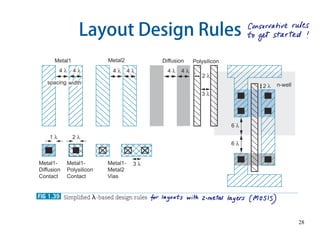
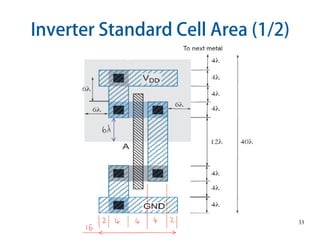
Layout Design Rules
29
Design Rules Summary
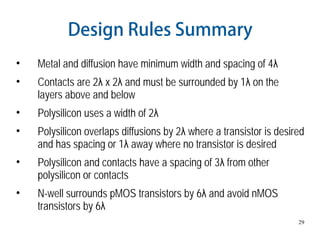
• Metal and diffusion have minimum width and spacing of 4
• Contacts are 2 x 2 and must be surrounded by 1 on the
layers above and below
• Polysilicon uses a width of 2
• Polysilicon overlaps diffusions by 2 where a transistor is desired
and has spacing or 1 away where no transistor is desired
• Polysilicon and contacts have a spacing of 3 from other
polysilicon or contacts
• N-well surrounds pMOS transistors by 6 and avoid nMOS
transistors by 6
30
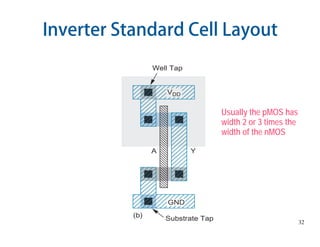
Logic Gates layout
• Layout can be very time consuming
• Design gates to fit together nicely
• Build a library of standard cells
• Standard cell design methodology
– VDD and GND should abut (standard height)
– Adjacent gates should satisfy design rules
– nMOS at bottom and pMOS at top
– All gates include well and substrate contacts
31
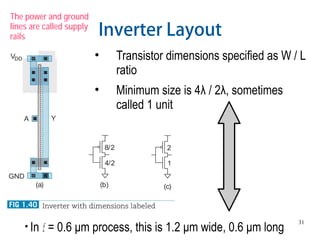
Inverter Layout
• Transistor dimensions specified as W / L
ratio
• Minimum size is 4 / 2, sometimes
called 1 unit
• In f = 0.6 μm process, this is 1.2 μm wide, 0.6 μm long
The power and ground
lines are called supply
rails
32
Inverter Standard Cell Layout
Usually the pMOS has
width 2 or 3 times the
width of the nMOS
33
Inverter Standard Cell Area (1/2)
34
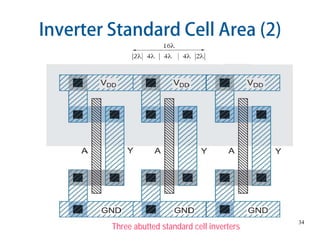
Inverter Standard Cell Area (2)
Three abutted standard cell inverters
35
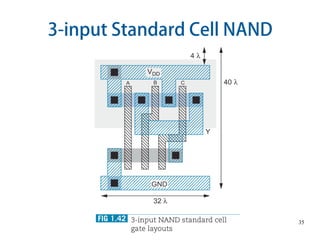
3-input Standard Cell NAND
36
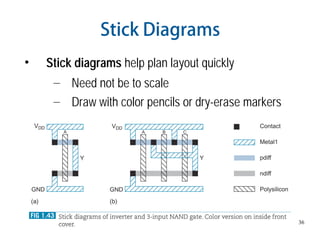
Stick Diagrams
• Stick diagrams help plan layout quickly
– Need not be to scale
– Draw with color pencils or dry-erase markers
37
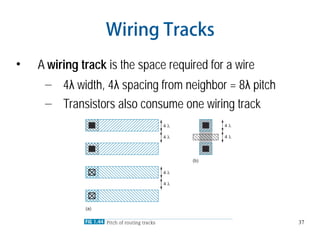
Wiring Tracks
• A wiring track is the space required for a wire
– 4 width, 4 spacing from neighbor = 8 pitch
– Transistors also consume one wiring track
38
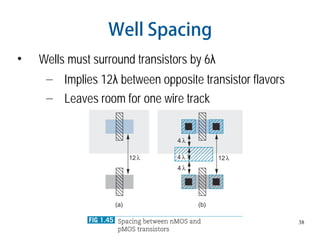
Well Spacing
• Wells must surround transistors by 6
– Implies 12 between opposite transistor flavors
– Leaves room for one wire track
39
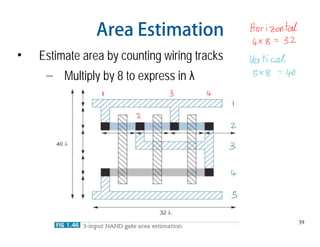
Area Estimation
• Estimate area by counting wiring tracks
– Multiply by 8 to express in

layout.pdf

  • 1.
    1 CMOS Fabrication andLayout • Transistors are fabricated on a thin silicon wafer that serve as both a mechanical support and electrical common point called substrate • Fabrication process (a.k.a. Lithography) is similar to printing press – On each step, different materials are deposited or etched • Easiest way to understand physical layout is to look at the wafer from two perspectives: – Top-section – Cross-section
  • 2.
    2 Photo Lythography • “Carvingpictures in stone using light”
  • 3.
    3 Inverter Cross Section •Typically use p-type substrate for nMOS transistors • Requires n-well for body of pMOS transistors Where is the 4th terminal of each transistor ?
  • 4.
    4 Well and SubstrateTaps • Substrate must be tied to GND and n-well to VDD • Metal to lightly-doped semiconductor forms poor connection (parasitic diode) • Use heavily doped well and substrate contacts
  • 5.
    5 Let's add somecolor ... n-well
  • 6.
    6 Inverter Top View •Transistors and wires are defined by masks contact n-well
  • 7.
    7 Inverter Mask Set Sixmasks: • n-well • poly silicon • n+ diffusion • p+ diffusion • Contact • Metal
  • 8.
    8 Fabrication Steps • Startwith blank wafer • Build invert from bottom up p substrate
  • 9.
    9 n-well Formation • Firststep will be to form the n-well – Cover wafer with protective layer of SiO2 (oxide) to grow SiO2 on top of Si wafer put the Si with H2O or O2 in oxidation furnace at 900 – 1200 C – (Remove layer where n-well should be built) – (Implant or diffuse n dopants into exposed wafer) – (Strip off SiO2)
  • 10.
    10 Deposit silicon-oxide and photoresist •Photoresist is a light-sensitive organic polymer • Softens where exposed to light p substrate SiO2 Photoresist NOTE: The silicon oxide is just to protect the wafer
  • 11.
    11 Photo-Lithography • Expose photoresistthrough n-well mask • Strip off exposed photoresist p substrate SiO2 Photoresist
  • 12.
    12 Etching • Etch oxidewith hydrofluoric acid (HF) – Seeps through skin and eats bone: nasty stuff!!! • Only attacks oxide where resist has been exposed p substrate SiO2 Photoresist
  • 13.
    13 The n-well • n-wellis formed with diffusion or ion implantation • Diffusion – Place wafer in furnace with arsenic gas – Heat until As atoms diffuse into exposed Si • Ion Implantation – Blast wafer with beam of As ions – Ions blocked by SiO2, only enter exposed Si n well SiO2
  • 14.
    14 Strip protective oxide •Strip off the remaining oxide using HF • Back to bare wafer with n-well • Subsequent steps involve similar series of steps p substrate n well
  • 15.
    15 Gate oxide andPolysilicon • Deposit very thin layer of gate oxide < 20 Å (6-7 atomic layers) • Chemical Vapor Deposition (CVD) of silicon layer – Place wafer in furnace with Silane gas (SiH4) – Forms many small crystals called polysilicon – Heavily doped to be good conductor
  • 16.
    16 Polysilicon patterning • Usesame lithography process to pattern polysilicon
  • 17.
    17 Self-aligned polysilicon gate process •The polysilicon gate serves as a mask to allow precise alignment of the source and drain with the gate • Use oxide and masking to expose where n+ dopants should be diffused or implanted • n-diffusion forms nMOS source, drain, and n-well contact
  • 18.
    18 Formation of then-diffusions • Pattern oxide and form n+ regions • Self-aligned process (poysilicon gate) “blocks” diffusion under the gate • Polysilicon is better than metal for self-aligned gates because it doesn’t melt during later processing
  • 19.
    19 The n-diffusions • Historicallydopants were diffused • Usually ion implantation today (but regions are still called diffusion) • Strip off oxide to complete patterning step
  • 20.
    20 The p-diffusions • Similarset of steps form p+ diffusion regions for pMOS source and drain and substrate contact
  • 21.
    21 Contacts • Now weneed to create the devices' terminals • Cover chip with thick field oxide (FOX) • Etch oxide where contact cuts are needed
  • 22.
    22 Metallization • Sputter onaluminum over whole wafer, filling the contacts as well • Pattern to remove excess metal, leaving wires
  • 23.
  • 24.
  • 25.
  • 26.
    26 Basic Fabrication Stepsin a nutshell • Though a mask transfer an “image” of the design to the wafer • Do something to imaged parts of the wafer – Implant – add impurities to change electrical properties – Deposit – deposit metal, insulator or other layers – Grow Oxide – place silicon in oxidizing ambient – Etch – Cut into surface of topmost layer(s) – Polish – Make surface of wafer flat • Strip 0ff imaging material (resist) and proceed to next step
  • 27.
    27 Layout Design • Chipsare specified with set of masks • Minimum dimensions of masks determine transistor size (and hence speed, cost, and power) • Feature size f = distance between source and drain – Set by minimum width of polysilicon • Feature size improves 30% every 3 years or so • Normalize for feature size when describing design rules • Express rules in terms of = f/2 – E.g. = 0.3 μm in 0.6 μm process
  • 28.
  • 29.
    29 Design Rules Summary •Metal and diffusion have minimum width and spacing of 4 • Contacts are 2 x 2 and must be surrounded by 1 on the layers above and below • Polysilicon uses a width of 2 • Polysilicon overlaps diffusions by 2 where a transistor is desired and has spacing or 1 away where no transistor is desired • Polysilicon and contacts have a spacing of 3 from other polysilicon or contacts • N-well surrounds pMOS transistors by 6 and avoid nMOS transistors by 6
  • 30.
    30 Logic Gates layout •Layout can be very time consuming • Design gates to fit together nicely • Build a library of standard cells • Standard cell design methodology – VDD and GND should abut (standard height) – Adjacent gates should satisfy design rules – nMOS at bottom and pMOS at top – All gates include well and substrate contacts
  • 31.
    31 Inverter Layout • Transistordimensions specified as W / L ratio • Minimum size is 4 / 2, sometimes called 1 unit • In f = 0.6 μm process, this is 1.2 μm wide, 0.6 μm long The power and ground lines are called supply rails
  • 32.
    32 Inverter Standard CellLayout Usually the pMOS has width 2 or 3 times the width of the nMOS
  • 33.
  • 34.
    34 Inverter Standard CellArea (2) Three abutted standard cell inverters
  • 35.
  • 36.
    36 Stick Diagrams • Stickdiagrams help plan layout quickly – Need not be to scale – Draw with color pencils or dry-erase markers
  • 37.
    37 Wiring Tracks • Awiring track is the space required for a wire – 4 width, 4 spacing from neighbor = 8 pitch – Transistors also consume one wiring track
  • 38.
    38 Well Spacing • Wellsmust surround transistors by 6 – Implies 12 between opposite transistor flavors – Leaves room for one wire track
  • 39.
    39 Area Estimation • Estimatearea by counting wiring tracks – Multiply by 8 to express in