Applied Electronics –PT
Coimbatore - india
Twin well Process
Provide separate optimization of the n-type and p-type transistors
This means that transistor parameters such as threshold voltage, body
effect and the channel transconductance of both types of transistors can be
tuned independently
n+ or p+ substrate, with a lightly doped epitaxial layer on top, forms the
starting material for this technology.
The n-well and pwell are formed on this epitaxial layer which forms the
actual substrate.
The dopant concentrations can be carefully optimized to produce the
desired device characteristics because two independent doping steps are
performed to create the well regions.
The starting material is either an n+ or p+ substrate with a lightly doped
epitaxial layer, which is used for protection against latch up
This process provides separately optimized wells, balanced performance n-
transistors and p-transistors may be constructed
Tub formation
 Thin-oxide construction
 Source and drain implantations
 Contact cut definition
 Metallization
Twin well Process Continued…,
Twin well Process Steps
Step1:
N or p type substrate is taken Initially
Step2:
Epitaxial Layer Deposition, Lightly Doped Epitaxial Layer is
Deposited above n+ or p+ Substrate.
Electrical Properties of Layer is Fixed by Dopant and its
Concentration.
The Aim of This Step is to Deposite High-Purity Silicon Layer.
Concentration of Dopant Distributed Throught the Layer
Step3:
Tub Formation
n -well-Formation
Protect certain region in this by using an oxide nitride mask
Phosphorus implantation
Form n-well
Entire substrate to an oxidation process
The oxide is going to be formed only over the n-well
The rest of the portions are protected by the oxide nitride mask
This n-well will also be driven deeper
Step4:
p -well-Formation
Protect certain region in this by using an oxide nitride mask
Boron implantation
Form p-well
Entire substrate to an oxidation process
Implant The p-well
Step 5:
Polysilicon Layer is Formed The Overall Surface
Step 6:
Polysilicon gates Are Formed for n-well and p-well by Using Photo-Etching
Process
Step 7:
Using Blanket Implantation(Auto Aligning The Wells)
Step 8:
n+ Diffusion is Formed in n-well
p+ Diffusion is Formed in p-well
These Are Used For VDD and VSS Contacts(Substrate Formation)
Step9:
Contact Cuts Are Defined In Both The Wells
Step10:
Metalization Process (Metal Contacts Are Created)
p-
p-epitaxial
p well N well
p+n+
gate oxide
Al (Cu)
tungsten
SiO2
SiO2
TiSi2
Dual-Well Trench-Isolated CMOS
field oxide
Advantages of Twin Tub Method:
Separate Optimized Wells Are Available
Balanced Performance of N and P Transistors is Obtained(Speciality)
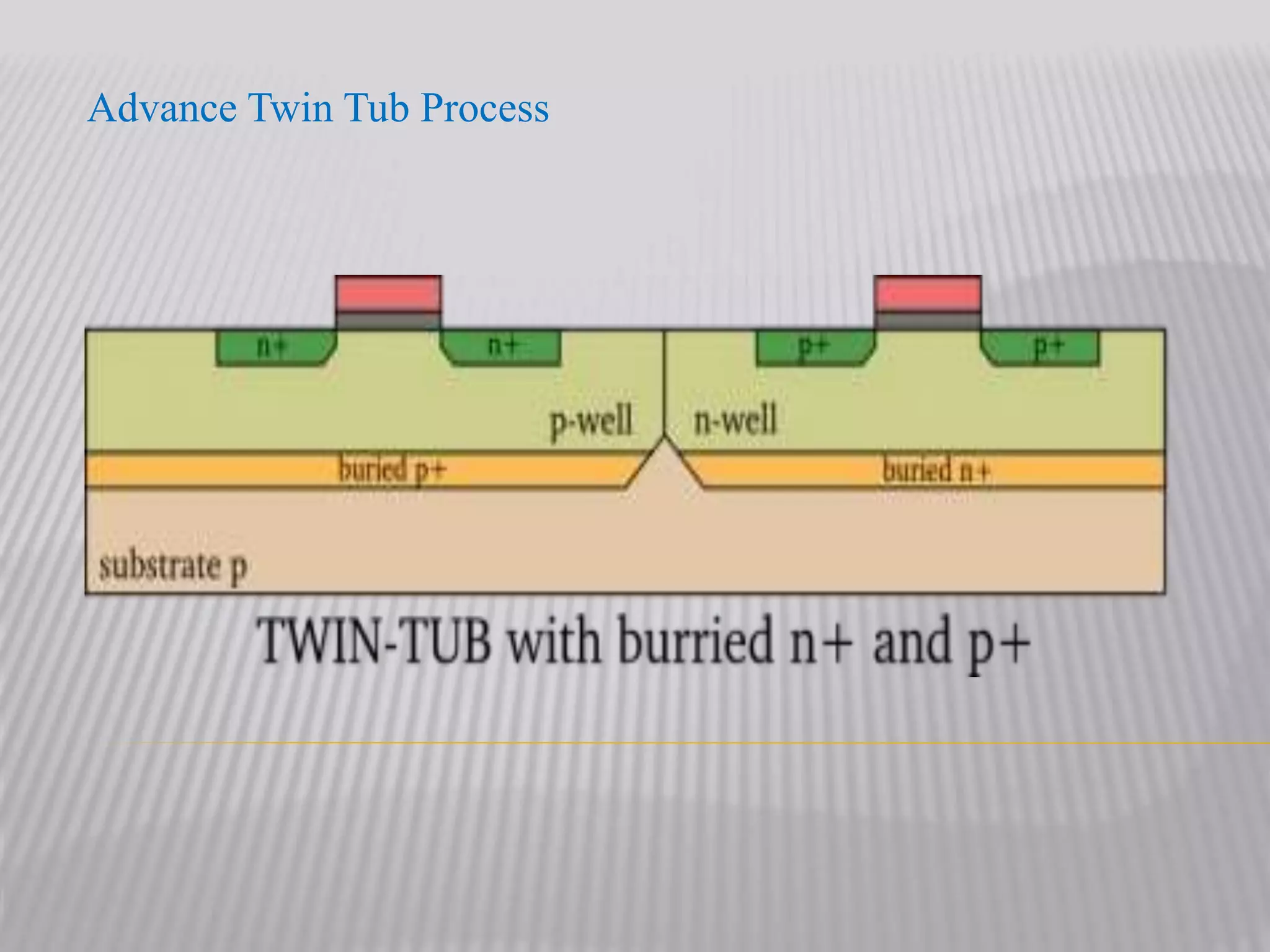
Advance Twin Tub Process
Twin well process

Twin well process

  • 1.
  • 2.
    Twin well Process Provideseparate optimization of the n-type and p-type transistors This means that transistor parameters such as threshold voltage, body effect and the channel transconductance of both types of transistors can be tuned independently n+ or p+ substrate, with a lightly doped epitaxial layer on top, forms the starting material for this technology. The n-well and pwell are formed on this epitaxial layer which forms the actual substrate. The dopant concentrations can be carefully optimized to produce the desired device characteristics because two independent doping steps are performed to create the well regions.
  • 3.
    The starting materialis either an n+ or p+ substrate with a lightly doped epitaxial layer, which is used for protection against latch up This process provides separately optimized wells, balanced performance n- transistors and p-transistors may be constructed Tub formation  Thin-oxide construction  Source and drain implantations  Contact cut definition  Metallization Twin well Process Continued…,
  • 4.
    Twin well ProcessSteps Step1: N or p type substrate is taken Initially Step2: Epitaxial Layer Deposition, Lightly Doped Epitaxial Layer is Deposited above n+ or p+ Substrate. Electrical Properties of Layer is Fixed by Dopant and its Concentration. The Aim of This Step is to Deposite High-Purity Silicon Layer. Concentration of Dopant Distributed Throught the Layer Step3: Tub Formation n -well-Formation Protect certain region in this by using an oxide nitride mask Phosphorus implantation Form n-well Entire substrate to an oxidation process The oxide is going to be formed only over the n-well The rest of the portions are protected by the oxide nitride mask This n-well will also be driven deeper
  • 5.
    Step4: p -well-Formation Protect certainregion in this by using an oxide nitride mask Boron implantation Form p-well Entire substrate to an oxidation process Implant The p-well Step 5: Polysilicon Layer is Formed The Overall Surface Step 6: Polysilicon gates Are Formed for n-well and p-well by Using Photo-Etching Process Step 7: Using Blanket Implantation(Auto Aligning The Wells) Step 8: n+ Diffusion is Formed in n-well p+ Diffusion is Formed in p-well These Are Used For VDD and VSS Contacts(Substrate Formation)
  • 6.
    Step9: Contact Cuts AreDefined In Both The Wells Step10: Metalization Process (Metal Contacts Are Created)
  • 7.
    p- p-epitaxial p well Nwell p+n+ gate oxide Al (Cu) tungsten SiO2 SiO2 TiSi2 Dual-Well Trench-Isolated CMOS field oxide
  • 8.
    Advantages of TwinTub Method: Separate Optimized Wells Are Available Balanced Performance of N and P Transistors is Obtained(Speciality)
  • 9.