MANUFACTURING RESOURCE
PLANNING (MRP II)
Presented By - MOHSIN DALVI
13MT07IND014
M. Tech (Indl. Engg), Sem-II
MANUFACTURING RESOURCE
PLANNING (MRP II)
Manufacturing
Resource
Planning
(MRP II)
Evolution of MRP II
2
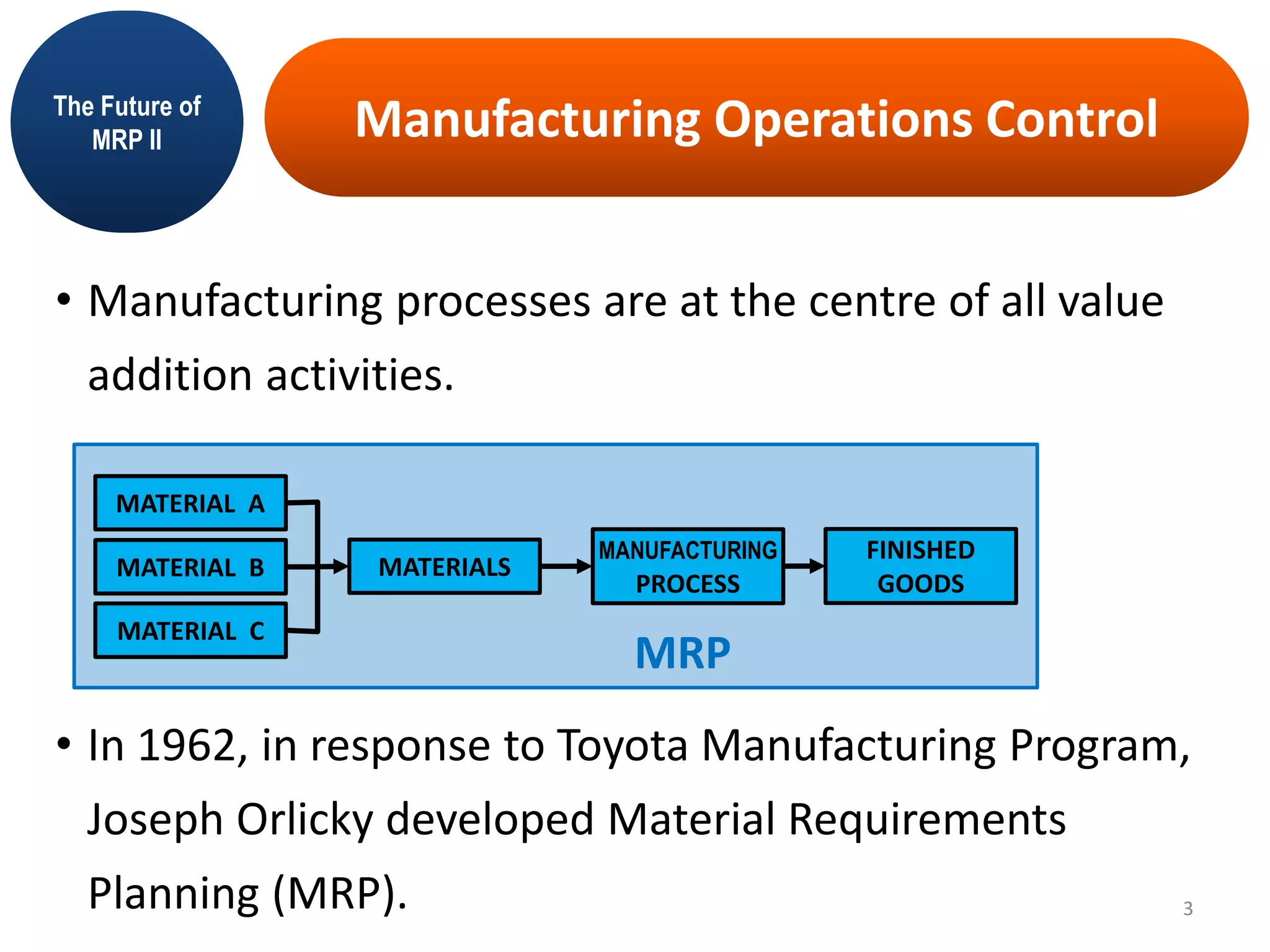
• Manufacturing processes are at the centre of all value
addition activities.
• In 1962, in response to Toyota Manufacturing Program,
Joseph Orlicky developed Material Requirements
Planning (MRP).
MRP
MATERIAL B
MATERIAL A
MATERIAL C
MANUFACTURING
PROCESS
MATERIALS
FINISHED
GOODS
Manufacturing Operations ControlThe Future of
MRP II
3
Material Requirements Planning
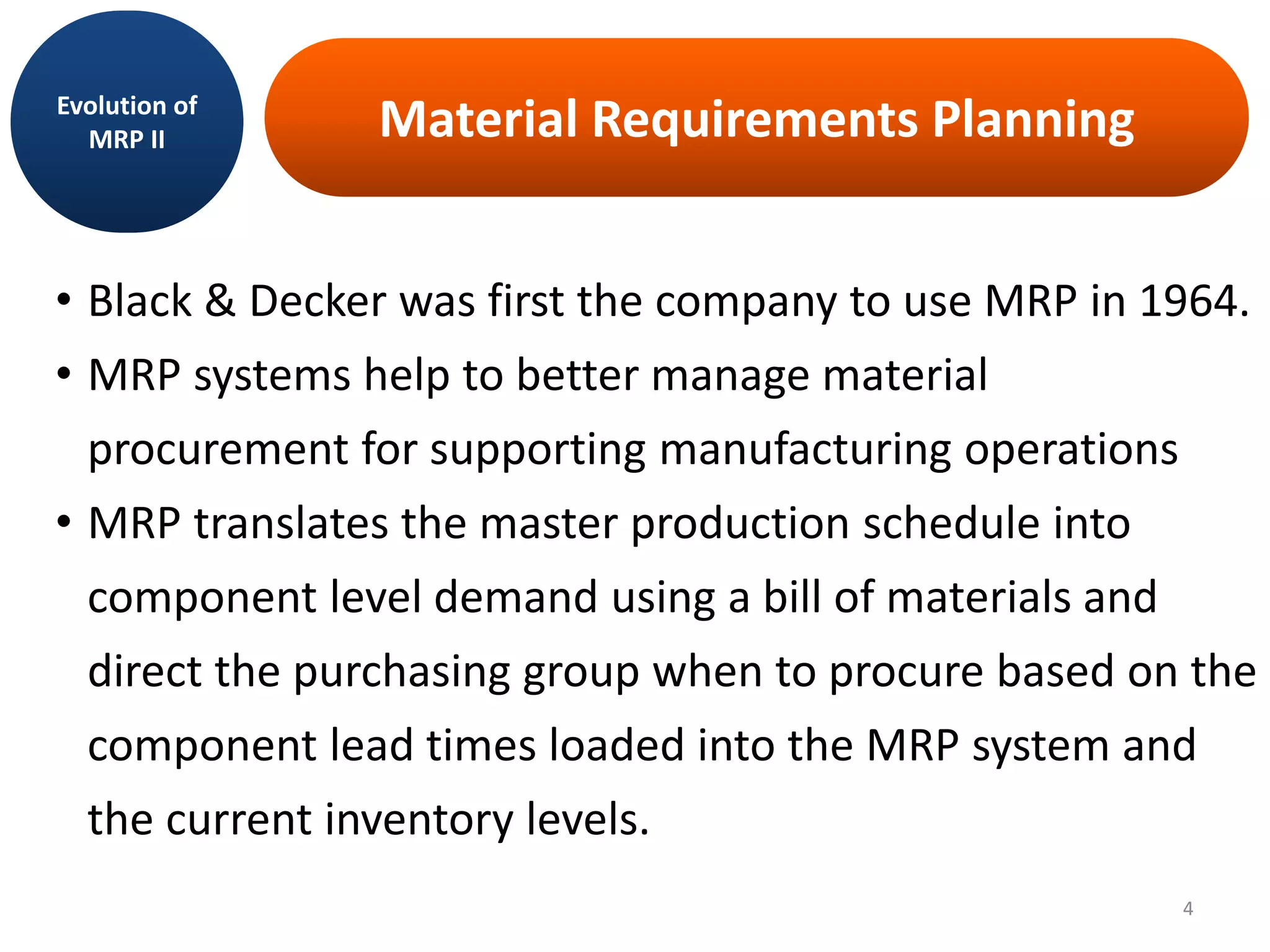
• Black & Decker was first the company to use MRP in 1964.
• MRP systems help to better manage material
procurement for supporting manufacturing operations
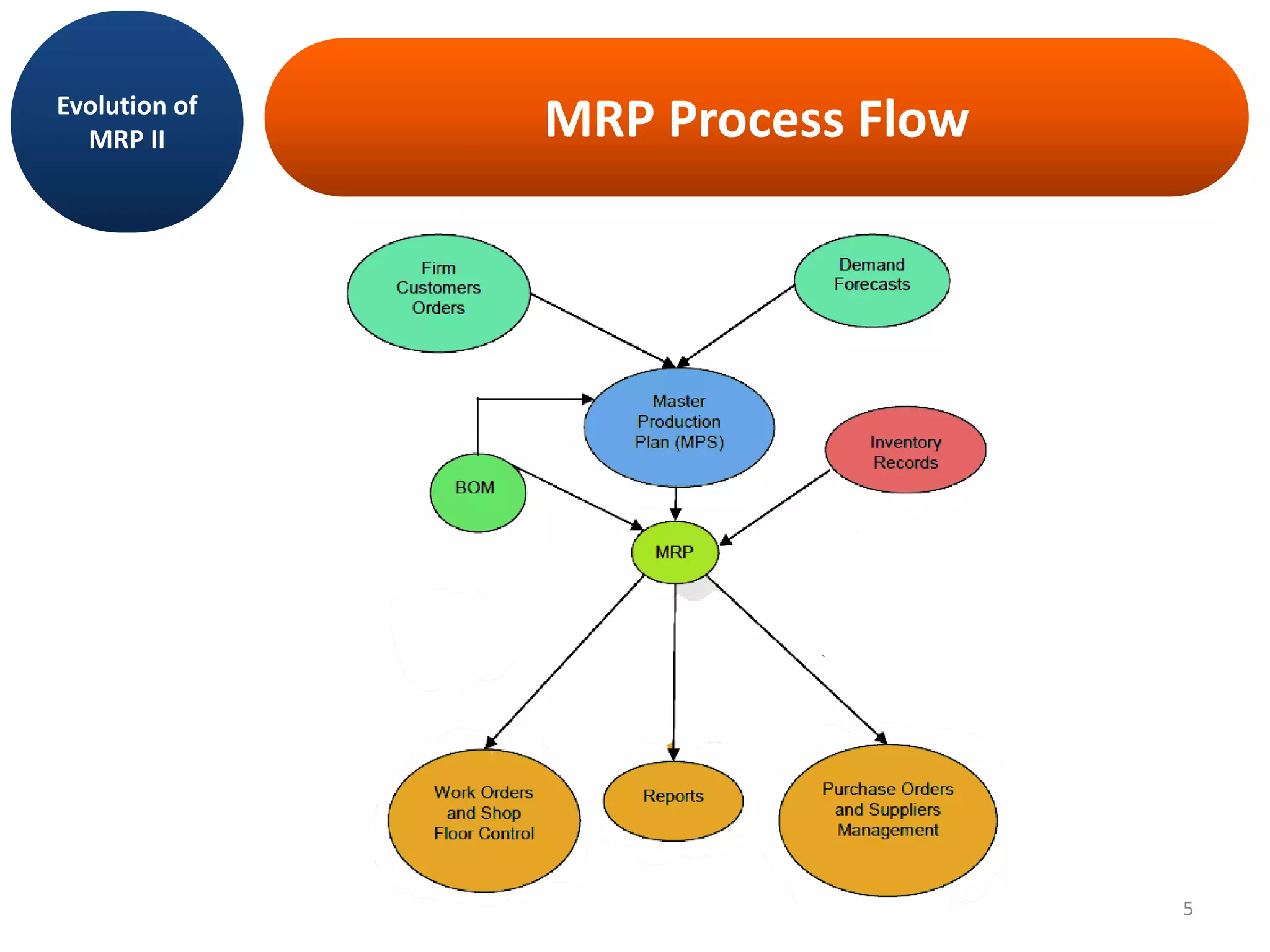
• MRP translates the master production schedule into
component level demand using a bill of materials and
direct the purchasing group when to procure based on the
component lead times loaded into the MRP system and
the current inventory levels.
Evolution of
MRP II
4
MRP Process FlowEvolution of
MRP II
5
Problems With MRP
• The user has to specify how long it takes a factory to
make a product from its component parts.
• The system design assumes that manufacturing lead
time will be constant every time.
• It takes no account of capacity in its calculations. Thus
it will give results that are impossible to implement
due to manpower or machine or supplier capacity
constraints.
Evolution of
MRP II
6
Opportunities Beyond MRP
• Once an MRP system is in place, inventory data can
be augmented by other useful information
• Labor hours
• Material costs
• Capital costs
• Virtually any resource
Evolution of
MRP II
7
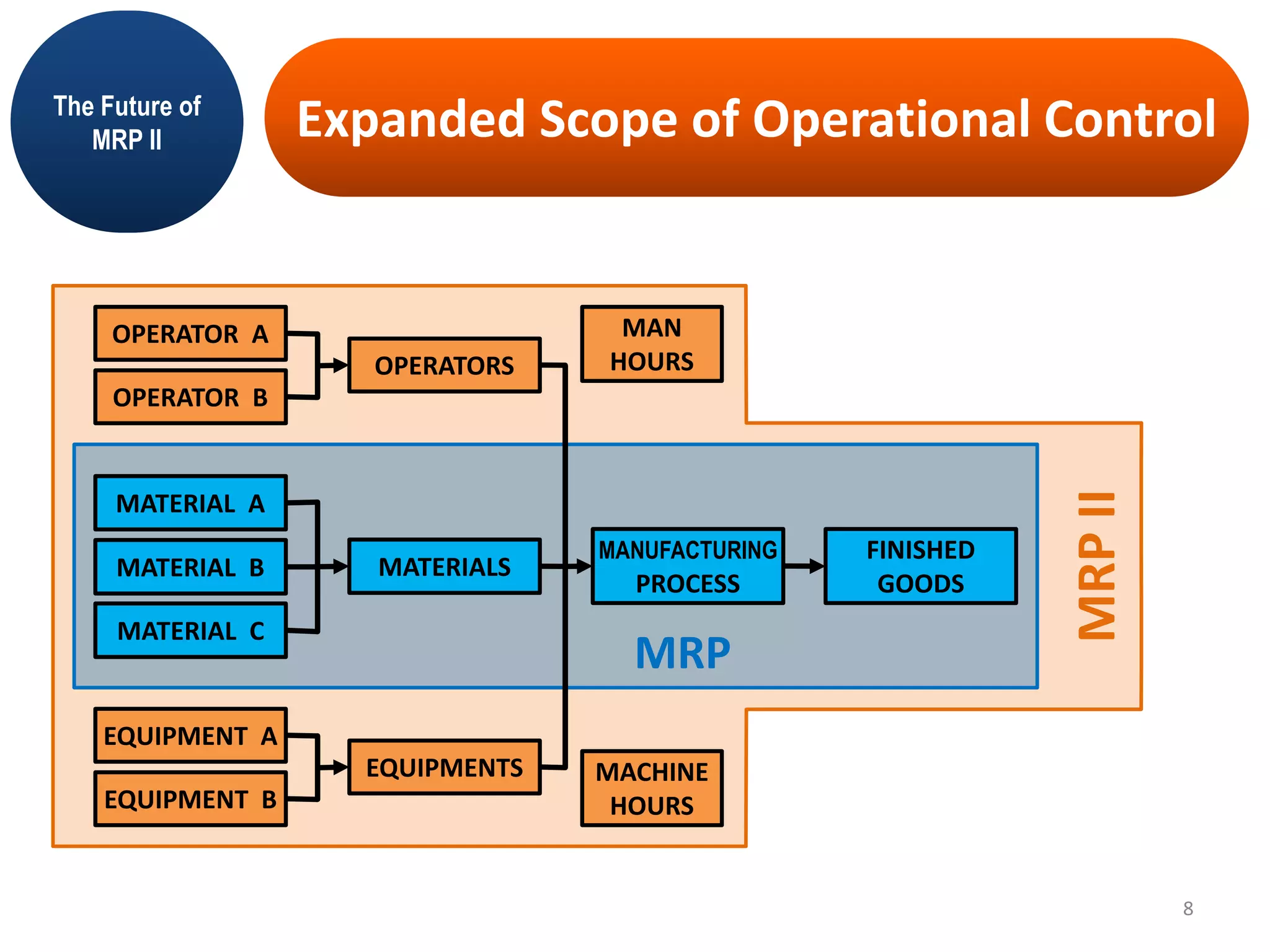
MRPII
MRP
MATERIAL B
MATERIAL A
MATERIAL C
MATERIALS
MANUFACTURING
PROCESS
FINISHED
GOODS
OPERATOR A
OPERATOR B
OPERATORS
EQUIPMENT A
EQUIPMENT B
EQUIPMENTS MACHINE
HOURS
MAN
HOURS
Expanded Scope of Operational ControlThe Future of
MRP II
8
Introducing MRP II
• In 1983 Oliver Wight along with Walter Goddard
developed Manufacturing Resource Planning (MRP II)
from MRP and also led the evolution of Production
Planning into Operations Planning.
• MRP II systems deal with resource capacities and consist
of the basic MRP I modules plus the RCCP (Rough Cut
Capacity Planning), CRP (Capacity Requirement Planning)
and SFC (Shop Floor Control) modules.
Evolution of
MRP II
9
Why MRP II?
• While MRP stops at the receiving dock, MRP II
incorporates the value stream all the way through the
manufacturing unit up to the shipping dock.
• The value stream includes demand forecasting , machine
capacity scheduling, labor planning and quality tracking.
• MRP II extends the Just in Time concept beyond
inventory and expands it into labor availability, raw
material arrival, machine availability and so on.
Evolution of
MRP II
10
Manufacturing
Resource
Planning
(MRP II)
Definition and Features of MRP II
11
Definition of MRP II
Definition and
Features of
MRP II
• Manufacturing Resource Planning (MRP II) is defined by
APICS (American Production and Inventory Control
Society, estd. 1957) as a method for the effective
planning of all resources of a manufacturing company.
• It addresses operational planning in units, financial
planning in dollars, and has a simulation capability to
answer "what-if" questions and extension of closed-
loop MRP.
12
Definition of MRP II
• MRP II is an incremental information integration
business process strategy implemented using hardware
and modular software applications linked to a central
database that stores and delivers business data and
information.
• The goal of MRP II is to provide consistent data to all
players in the manufacturing process as the product
moves through the production line.
Definition and
Features of
MRP II
13
Features of MRP II
• MRP II concentrates on the resources, i.e. material, man
and machine for detailed production scheduling.
• Loading by resource means that capacity is taken into
account , which offers tighter control over the plant.
• The Rough Cut Capacity Planning attempts to match the
order load to the capacity available, by identifying
resource overloads and moving orders to achieve a
balance (knocking the mountains into the valleys).
Definition and
Features of
MRP II
14
Features of MRP II
• It builds on closed-loop MRP by adopting the feedback
principle and extending it to additional areas of the
enterprise such as purchasing, marketing and finance.
• It integrates all aspects of the manufacturing process,
including materials, finance and human relations, for
planning and control purposes.
• This integration extends from strategic to operational
levels and encompasses long term planning up to short
term control.
Definition and
Features of
MRP II
15
Features of MRP II
• Fluctuations in forecast data are taken into account by
including simulation of the master production schedule,
thus creating a long-term control.
• MRP II is a total company management concept for
using human resources more productively.
• The MRP II process is carried out by a synergistic
combination of computer and human resources.
Definition and
Features of
MRP II
16
Manufacturing
Resource
Planning
(MRP II)
Structure and Working of MRP II
17
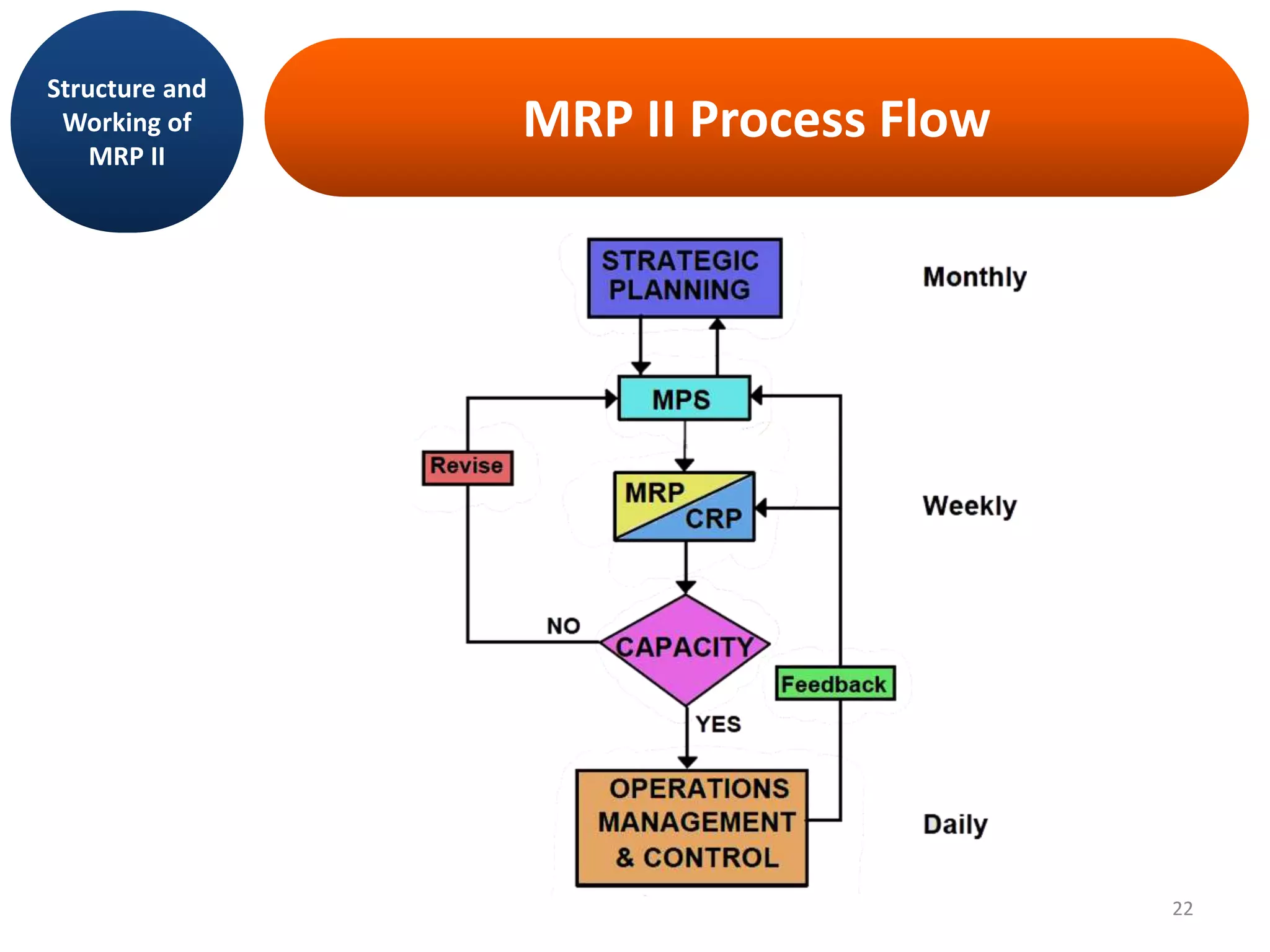
Working of an MRP II System
• MRP II systems begin with MRP, which inputs the sales
forecasts from sales and marketing and determines the
demand of raw materials by analyzing the forecasts.
• The company’s strategic plans for the future are
translated into a Master Production Schedule (MPS).
• MRP II assures that the production facility is capable of
accomplishing the MPS otherwise all these plans will
result in inability to meet the promised delivery dates.
Structure and
Working of
MRP II
18
Working of an MRP II System
• This is performed in an iterative manner.
• MRP schedules are constructed to support this MPS.
• Then Capacity Requirements Planning (CRP) is
performed which tells what equipment, personnel, and
materials would be needed to meet the MRP schedules.
• If this capacity is not available, then the MPS and
possibly the strategic plans must be revised until the
MRP schedules are consistent with the plant capacity.
Structure and
Working of
MRP II
19
Working of an MRP II System
• This revision process facilitates the development of a
detailed production schedule that accounts for labor
and machine capacity.
• The schedules are released to the departments which
perform production and/or purchasing operations.
• The MRP II system draws on the revised MPS and
provides output in the form of a final labor and
machine schedule and schedules the production runs
according to the arrival of materials.
Structure and
Working of
MRP II
20
Working of an MRP II System
• The MRP II systems continuously provide production
data to accounting and finance about the production
costs in terms of machine time, labor time and materials,
as well as the final production numbers.
• The feed back of this information to the MRP/MPS
elements allow plans to be updated thereby creating a
closed loop planning and execution system.
Structure and
Working of
MRP II
21
Structure and
Working of
MRP II
MRP II Process Flow
22
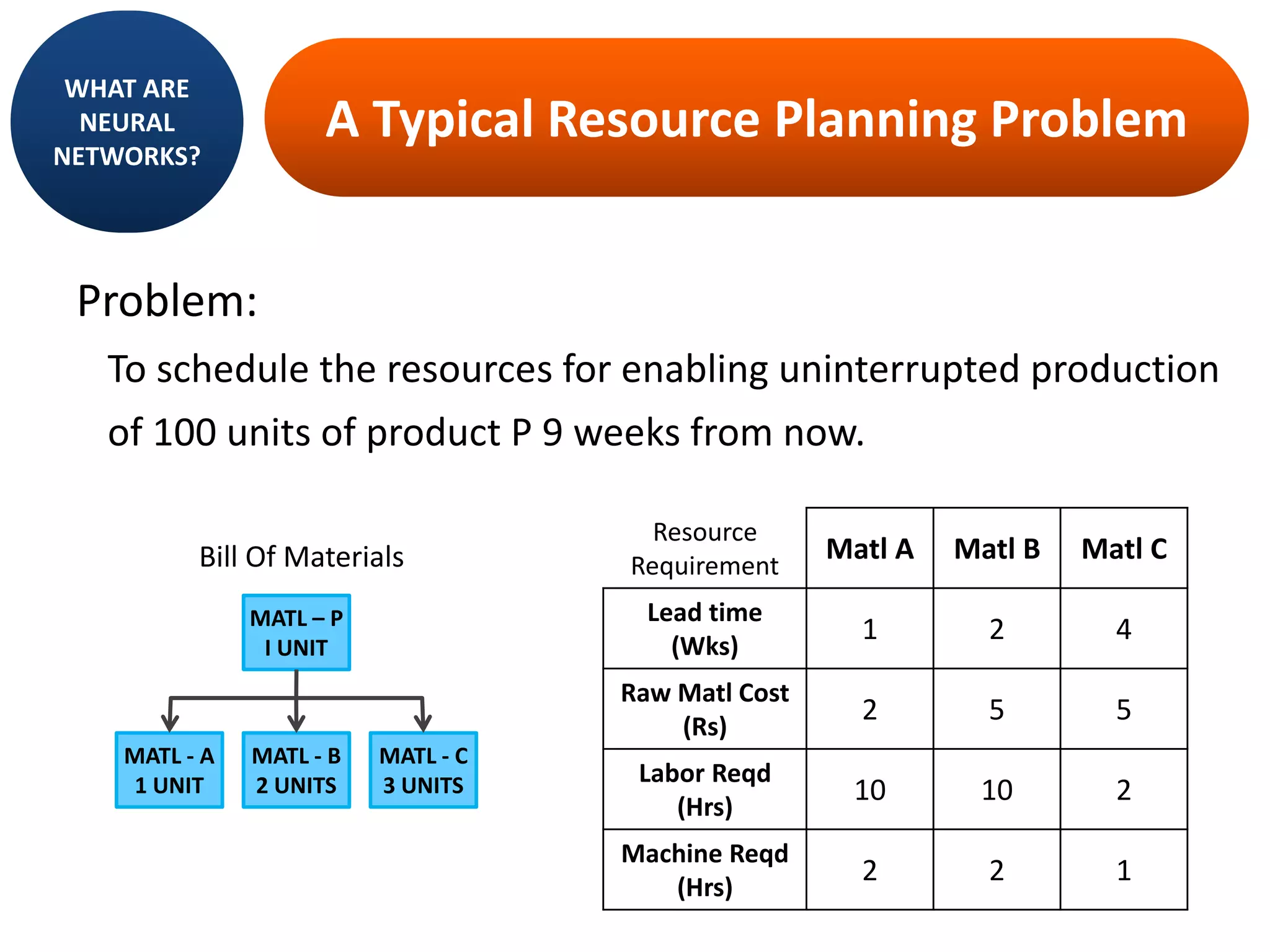
Problem:
To schedule the resources for enabling uninterrupted production
of 100 units of product P 9 weeks from now.
A Typical Resource Planning Problem
WHAT ARE
NEURAL
NETWORKS?
MATL - A
1 UNIT
MATL – P
I UNIT
MATL - C
3 UNITS
MATL - B
2 UNITS
Resource
Requirement
Matl A Matl B Matl C
Lead time
(Wks)
1 2 4
Raw Matl Cost
(Rs)
2 5 5
Labor Reqd
(Hrs)
10 10 2
Machine Reqd
(Hrs)
2 2 1
Bill Of Materials
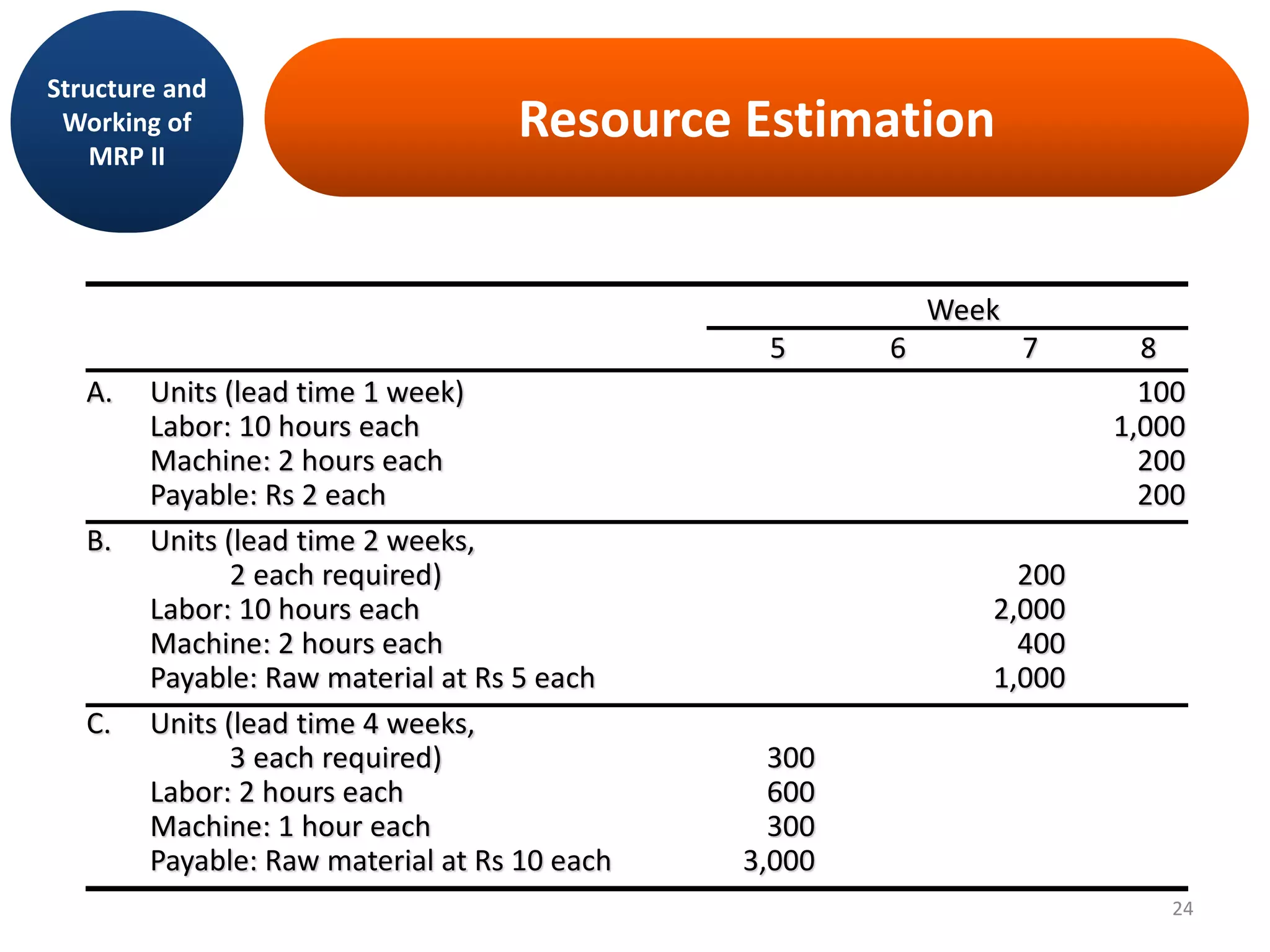
Week
5 6 7 8
A. Units (lead time 1 week) 100
Labor: 10 hours each 1,000
Machine: 2 hours each 200
Payable: Rs 2 each 200
B. Units (lead time 2 weeks,
2 each required) 200
Labor: 10 hours each 2,000
Machine: 2 hours each 400
Payable: Raw material at Rs 5 each 1,000
C. Units (lead time 4 weeks,
3 each required) 300
Labor: 2 hours each 600
Machine: 1 hour each 300
Payable: Raw material at Rs 10 each 3,000
Structure and
Working of
MRP II
Resource Estimation
24
Softwares for MRP II
• A typical MRP II software system employs a modular
construction.
• The modules keep track of and regulate specific
characteristics and functions of the entire organization.
• The MRP II differs fundamentally from point contact
planning, in which individual characteristics and
functions have their own dedicated systems.
Definition and
Features of
MRP II
25
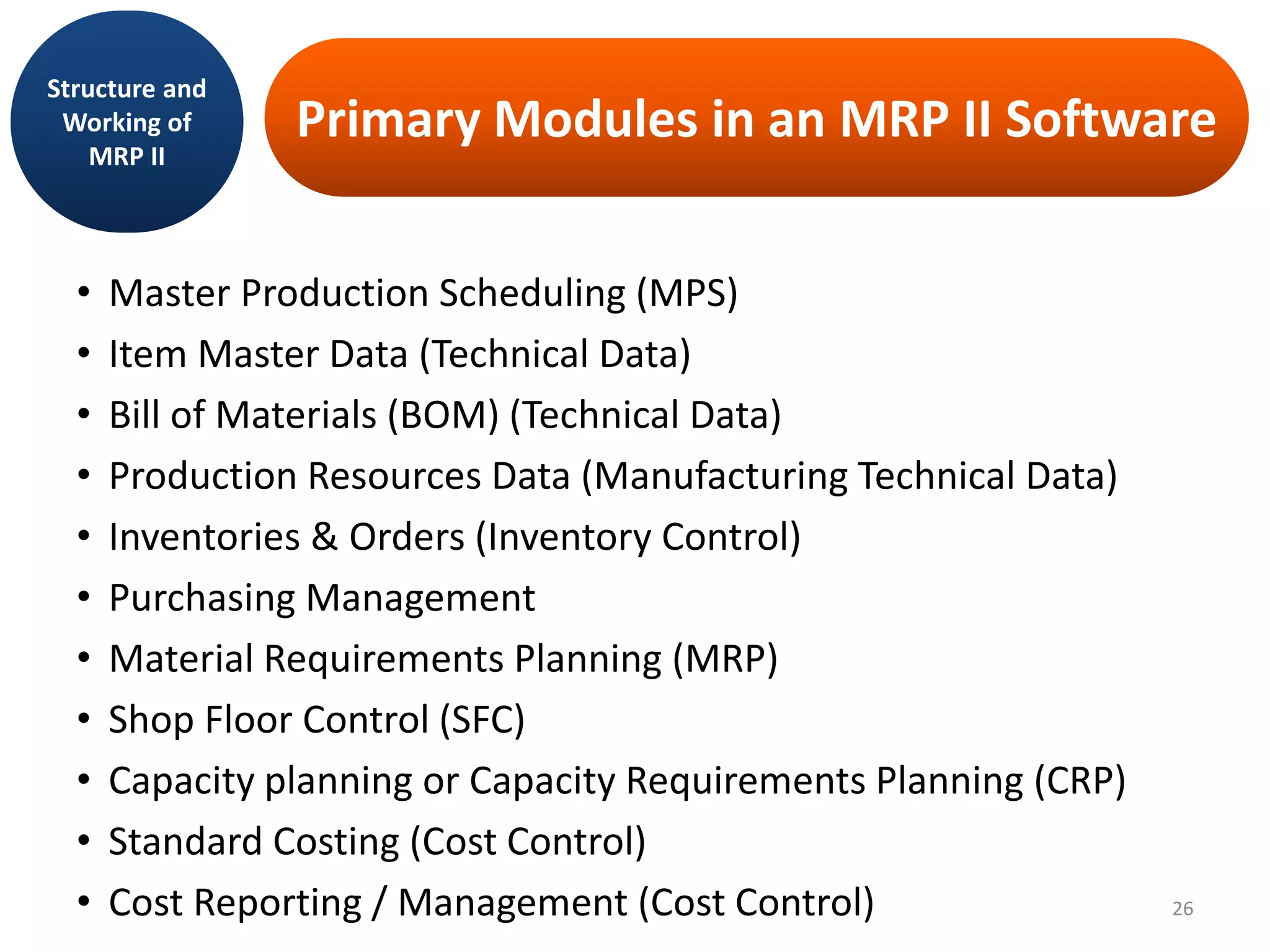
Primary Modules in an MRP II Software
• Master Production Scheduling (MPS)
• Item Master Data (Technical Data)
• Bill of Materials (BOM) (Technical Data)
• Production Resources Data (Manufacturing Technical Data)
• Inventories & Orders (Inventory Control)
• Purchasing Management
• Material Requirements Planning (MRP)
• Shop Floor Control (SFC)
• Capacity planning or Capacity Requirements Planning (CRP)
• Standard Costing (Cost Control)
• Cost Reporting / Management (Cost Control)
Structure and
Working of
MRP II
26
Ancillary Modules in a MRP II Software
• Business Planning
• Lot Traceability
• Contract Management
• Tool Management
• Engineering Change Control
• Configuration Management
• Shop Floor Data Collection
• Sales Analysis and Forecasting
• Finite Capacity Scheduling (FCS)
• General Ledger
• Accounts Payable (Purchase Ledger)
• Accounts Receivable (Sales Ledger)
• Sales Order Management
Structure and
Working of
MRP II
• Distribution Requirements Planning
• Distribution Resource Planning (DRP)
• [Automated] Warehouse Management
• Project Management
• Employee attendance
• Labour productivity
• Quality tracking tools
• Technical Records
• Estimating
• Computer-aided design/Computer-
aided manufacturing (CAD/CAM)
• Computer Aided Process Planning
(CAPP) 27
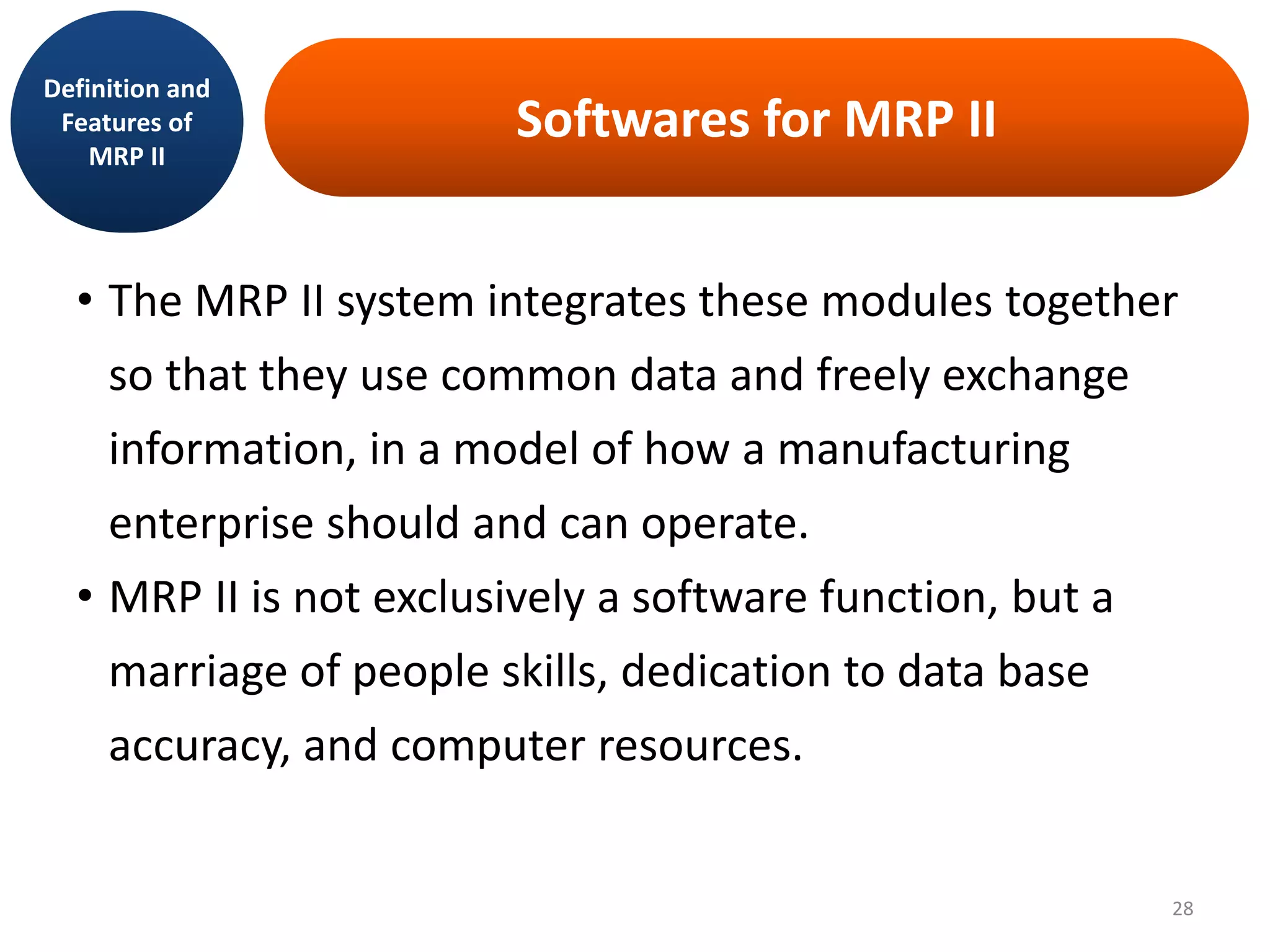
Softwares for MRP II
• The MRP II system integrates these modules together
so that they use common data and freely exchange
information, in a model of how a manufacturing
enterprise should and can operate.
• MRP II is not exclusively a software function, but a
marriage of people skills, dedication to data base
accuracy, and computer resources.
Definition and
Features of
MRP II
28
Manufacturing
Resource
Planning
(MRP II)
Benefits and Limitations of MRP II
29
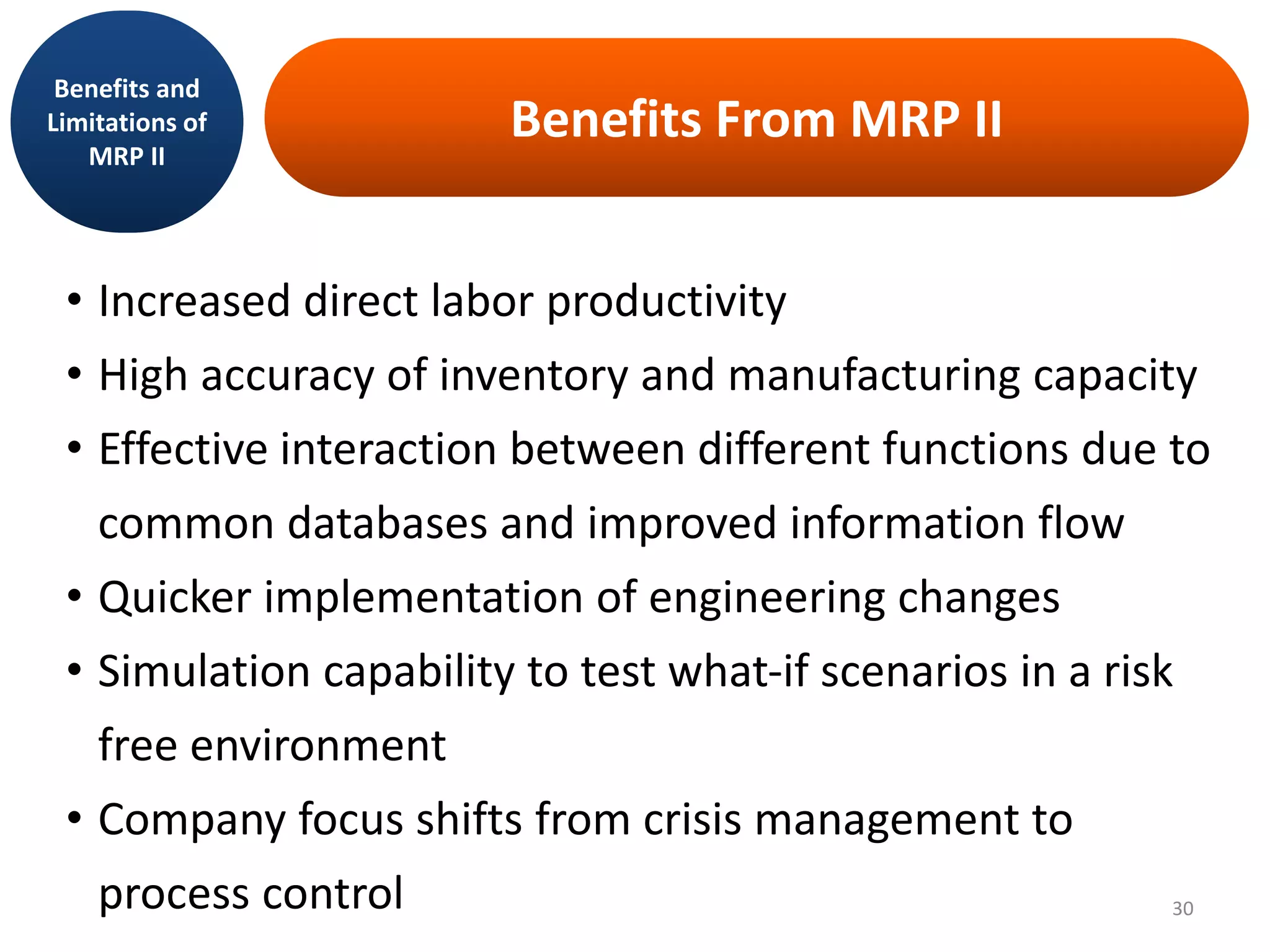
Benefits From MRP II
• Increased direct labor productivity
• High accuracy of inventory and manufacturing capacity
• Effective interaction between different functions due to
common databases and improved information flow
• Quicker implementation of engineering changes
• Simulation capability to test what-if scenarios in a risk
free environment
• Company focus shifts from crisis management to
process control
Benefits and
Limitations of
MRP II
30
Benefits of MRP II to Business Functions
• For Manufacturing Functions:
• Better control of inventories
• Improved scheduling
• Productive relationships with suppliers
• For Financial and Costing Functions :
• Reduced working capital for inventory
• Improved cash flow through quicker deliveries
• Accurate inventory records
• Timely and valid cost and profitability information
• For Design / Engineering Functions :
• Improved design control
• Better quality and quality control
Benefits and
Limitations of
MRP II
31
Limitations of MRP II
• Capacity can be considered only after the MRP schedule
has been prepared.
• It may happen that insufficient time was allowed within
the MRP schedule for the individual operations to be
completed, thus leading to erroneous data.
• All the planning, if done on the basis of misleading data,
will slow down the production process.
• If unexpected input changes occur, the planning process
has to be recalculated from start.
Benefits and
Limitations of
MRP II
32
Limitations of MRP II
• Inefficiencies will be built up in the system if feedback
about problems is not supplied on a timely, regular basis.
• MRP II is mostly run in batch environments, as it enables
rapid lot to lot course corrections to meet real world
conditions. In long production runs, corrections take time.
• MRP II softwares are costly and have a learning curve.
• MRP II does not integrate all aspects of development,
finance, marketing, human resources and information
technology operations .
Benefits and
Limitations of
MRP II
33
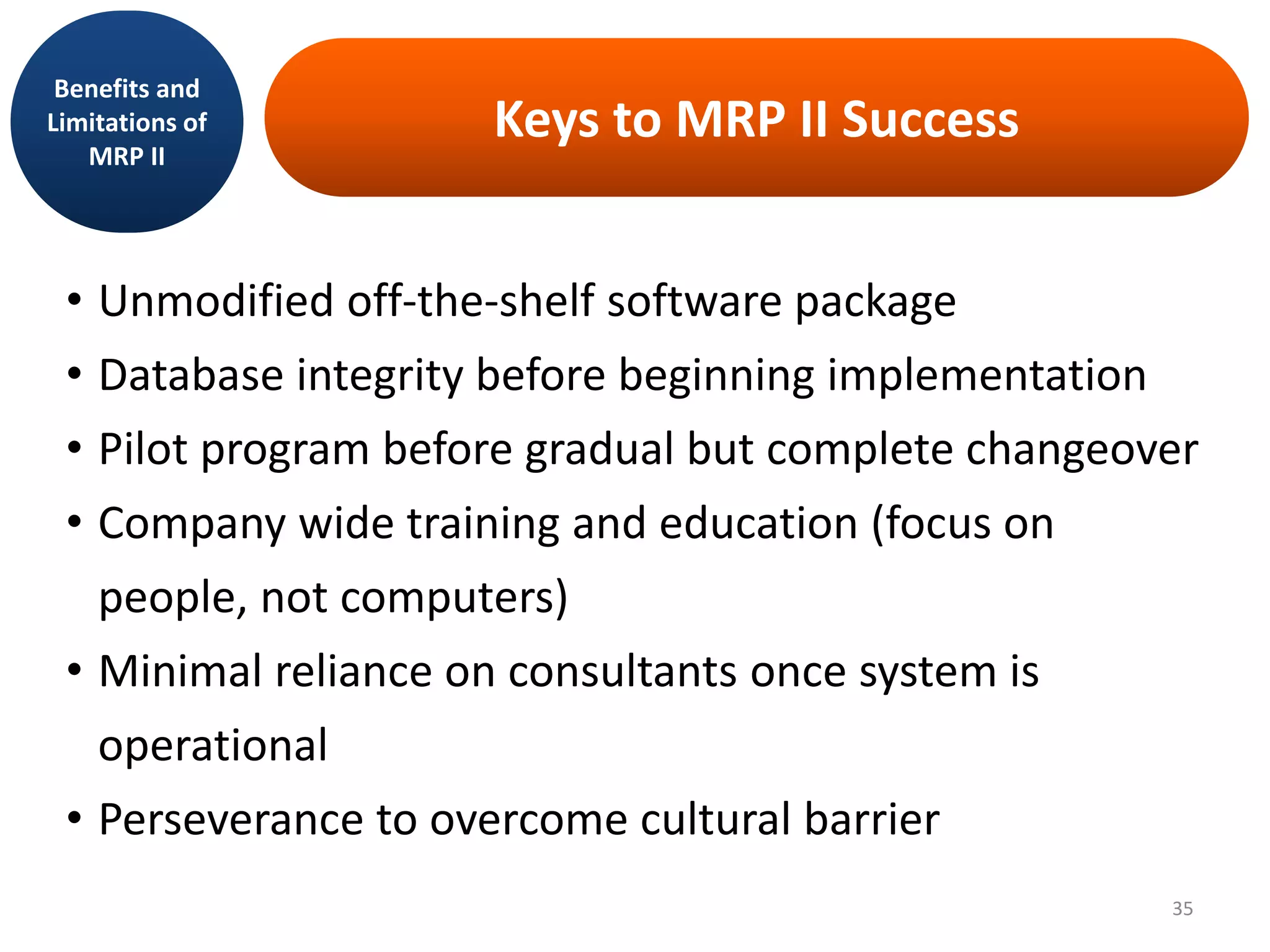
Keys to MRP II Success
• Commitment to change and improvement
• Serious evaluation of current situation and future goals
• Active support from top management
• Full time dedicated project implementation manager
• Implementation of cross functional teams
• Methodical implementation plan
• Implementation schedule that is long enough to be
thorough but short enough to sustain momentum
Benefits and
Limitations of
MRP II
34
Keys to MRP II Success
• Unmodified off-the-shelf software package
• Database integrity before beginning implementation
• Pilot program before gradual but complete changeover
• Company wide training and education (focus on
people, not computers)
• Minimal reliance on consultants once system is
operational
• Perseverance to overcome cultural barrier
Benefits and
Limitations of
MRP II
35
Manufacturing
Resource
Planning
(MRP II)
The Future of MRP II
36
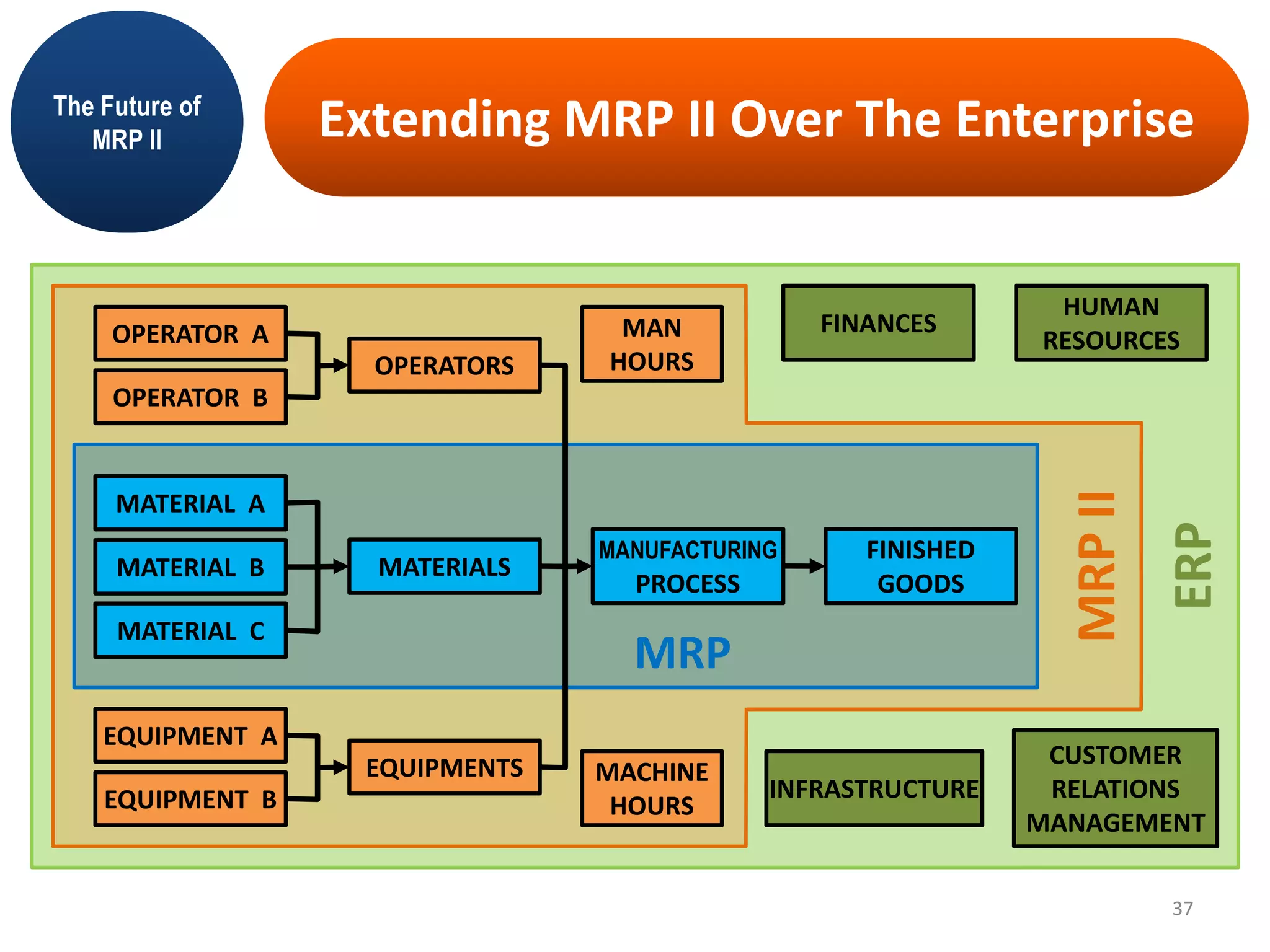
ERP
MRPII
MRP
MATERIAL B
MATERIAL A
MATERIAL C
MATERIALS
MANUFACTURING
PROCESS
FINISHED
GOODS
OPERATOR A
OPERATOR B
OPERATORS
EQUIPMENT A
EQUIPMENT B
EQUIPMENTS MACHINE
HOURS
MAN
HOURS
INFRASTRUCTURE
CUSTOMER
RELATIONS
MANAGEMENT
FINANCES
HUMAN
RESOURCES
Extending MRP II Over The EnterpriseThe Future of
MRP II
37
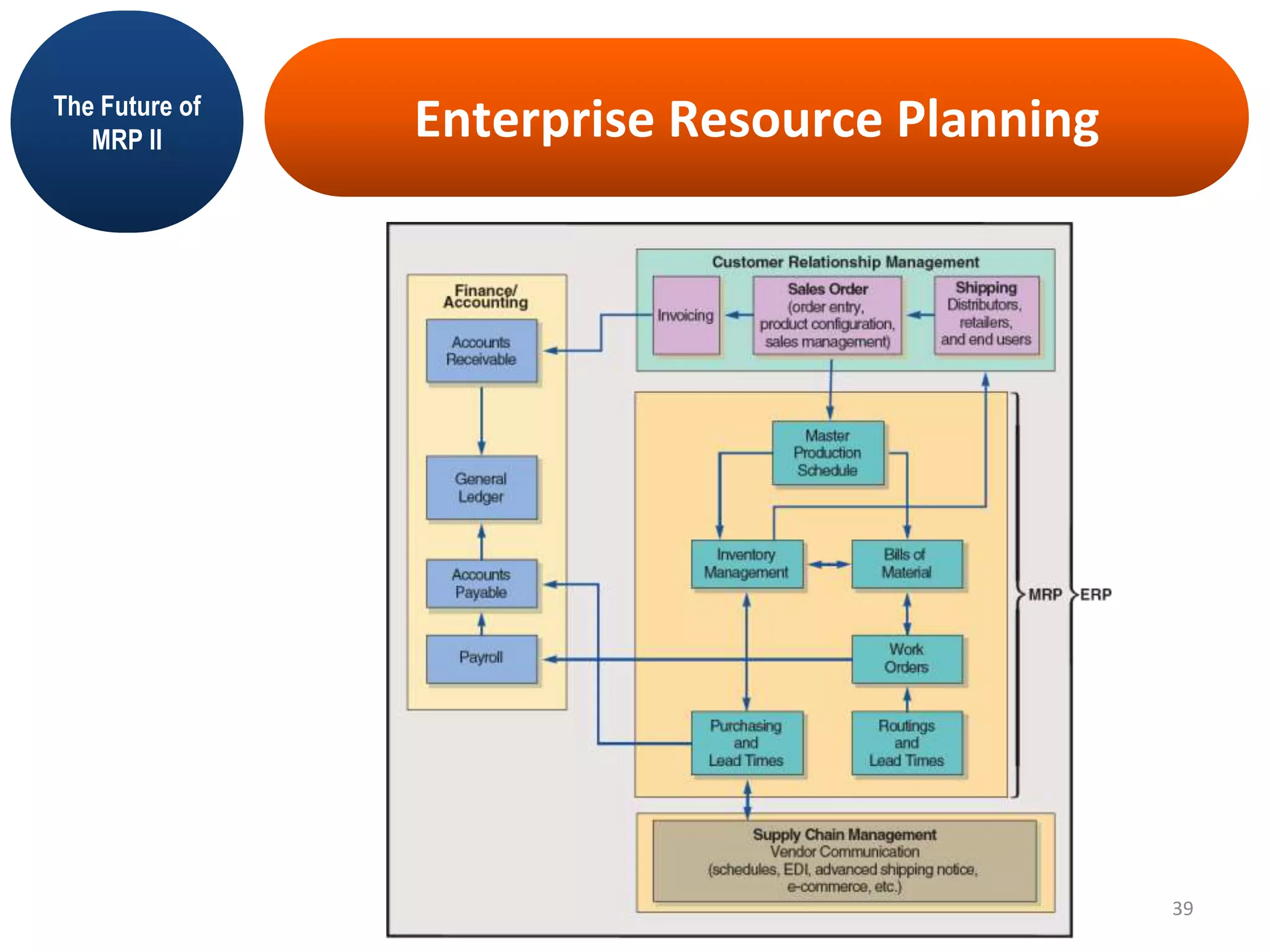
Enterprise Resource Planning
• ERP is the next evolution of the MRP system.
• It attempts to integrate the information flow from all
departments of the company: finance, marketing,
production, logistics and human resources.
• A properly set up ERP system allows all departments to
intercommunicate and monitor a customer order at any
point in time.
The Future of
MRP II
38
Enterprise Resource PlanningThe Future of
MRP II
39
Manufacturing
Resource
Planning
(MRP II)
End of Presentation
40

mohsin dalvi mrp ii presentation

  • 1.
    MANUFACTURING RESOURCE PLANNING (MRPII) Presented By - MOHSIN DALVI 13MT07IND014 M. Tech (Indl. Engg), Sem-II MANUFACTURING RESOURCE PLANNING (MRP II)
  • 2.
  • 3.
    • Manufacturing processesare at the centre of all value addition activities. • In 1962, in response to Toyota Manufacturing Program, Joseph Orlicky developed Material Requirements Planning (MRP). MRP MATERIAL B MATERIAL A MATERIAL C MANUFACTURING PROCESS MATERIALS FINISHED GOODS Manufacturing Operations ControlThe Future of MRP II 3
  • 4.
    Material Requirements Planning •Black & Decker was first the company to use MRP in 1964. • MRP systems help to better manage material procurement for supporting manufacturing operations • MRP translates the master production schedule into component level demand using a bill of materials and direct the purchasing group when to procure based on the component lead times loaded into the MRP system and the current inventory levels. Evolution of MRP II 4
  • 5.
  • 6.
    Problems With MRP •The user has to specify how long it takes a factory to make a product from its component parts. • The system design assumes that manufacturing lead time will be constant every time. • It takes no account of capacity in its calculations. Thus it will give results that are impossible to implement due to manpower or machine or supplier capacity constraints. Evolution of MRP II 6
  • 7.
    Opportunities Beyond MRP •Once an MRP system is in place, inventory data can be augmented by other useful information • Labor hours • Material costs • Capital costs • Virtually any resource Evolution of MRP II 7
  • 8.
    MRPII MRP MATERIAL B MATERIAL A MATERIALC MATERIALS MANUFACTURING PROCESS FINISHED GOODS OPERATOR A OPERATOR B OPERATORS EQUIPMENT A EQUIPMENT B EQUIPMENTS MACHINE HOURS MAN HOURS Expanded Scope of Operational ControlThe Future of MRP II 8
  • 9.
    Introducing MRP II •In 1983 Oliver Wight along with Walter Goddard developed Manufacturing Resource Planning (MRP II) from MRP and also led the evolution of Production Planning into Operations Planning. • MRP II systems deal with resource capacities and consist of the basic MRP I modules plus the RCCP (Rough Cut Capacity Planning), CRP (Capacity Requirement Planning) and SFC (Shop Floor Control) modules. Evolution of MRP II 9
  • 10.
    Why MRP II? •While MRP stops at the receiving dock, MRP II incorporates the value stream all the way through the manufacturing unit up to the shipping dock. • The value stream includes demand forecasting , machine capacity scheduling, labor planning and quality tracking. • MRP II extends the Just in Time concept beyond inventory and expands it into labor availability, raw material arrival, machine availability and so on. Evolution of MRP II 10
  • 11.
  • 12.
    Definition of MRPII Definition and Features of MRP II • Manufacturing Resource Planning (MRP II) is defined by APICS (American Production and Inventory Control Society, estd. 1957) as a method for the effective planning of all resources of a manufacturing company. • It addresses operational planning in units, financial planning in dollars, and has a simulation capability to answer "what-if" questions and extension of closed- loop MRP. 12
  • 13.
    Definition of MRPII • MRP II is an incremental information integration business process strategy implemented using hardware and modular software applications linked to a central database that stores and delivers business data and information. • The goal of MRP II is to provide consistent data to all players in the manufacturing process as the product moves through the production line. Definition and Features of MRP II 13
  • 14.
    Features of MRPII • MRP II concentrates on the resources, i.e. material, man and machine for detailed production scheduling. • Loading by resource means that capacity is taken into account , which offers tighter control over the plant. • The Rough Cut Capacity Planning attempts to match the order load to the capacity available, by identifying resource overloads and moving orders to achieve a balance (knocking the mountains into the valleys). Definition and Features of MRP II 14
  • 15.
    Features of MRPII • It builds on closed-loop MRP by adopting the feedback principle and extending it to additional areas of the enterprise such as purchasing, marketing and finance. • It integrates all aspects of the manufacturing process, including materials, finance and human relations, for planning and control purposes. • This integration extends from strategic to operational levels and encompasses long term planning up to short term control. Definition and Features of MRP II 15
  • 16.
    Features of MRPII • Fluctuations in forecast data are taken into account by including simulation of the master production schedule, thus creating a long-term control. • MRP II is a total company management concept for using human resources more productively. • The MRP II process is carried out by a synergistic combination of computer and human resources. Definition and Features of MRP II 16
  • 17.
  • 18.
    Working of anMRP II System • MRP II systems begin with MRP, which inputs the sales forecasts from sales and marketing and determines the demand of raw materials by analyzing the forecasts. • The company’s strategic plans for the future are translated into a Master Production Schedule (MPS). • MRP II assures that the production facility is capable of accomplishing the MPS otherwise all these plans will result in inability to meet the promised delivery dates. Structure and Working of MRP II 18
  • 19.
    Working of anMRP II System • This is performed in an iterative manner. • MRP schedules are constructed to support this MPS. • Then Capacity Requirements Planning (CRP) is performed which tells what equipment, personnel, and materials would be needed to meet the MRP schedules. • If this capacity is not available, then the MPS and possibly the strategic plans must be revised until the MRP schedules are consistent with the plant capacity. Structure and Working of MRP II 19
  • 20.
    Working of anMRP II System • This revision process facilitates the development of a detailed production schedule that accounts for labor and machine capacity. • The schedules are released to the departments which perform production and/or purchasing operations. • The MRP II system draws on the revised MPS and provides output in the form of a final labor and machine schedule and schedules the production runs according to the arrival of materials. Structure and Working of MRP II 20
  • 21.
    Working of anMRP II System • The MRP II systems continuously provide production data to accounting and finance about the production costs in terms of machine time, labor time and materials, as well as the final production numbers. • The feed back of this information to the MRP/MPS elements allow plans to be updated thereby creating a closed loop planning and execution system. Structure and Working of MRP II 21
  • 22.
    Structure and Working of MRPII MRP II Process Flow 22
  • 23.
    Problem: To schedule theresources for enabling uninterrupted production of 100 units of product P 9 weeks from now. A Typical Resource Planning Problem WHAT ARE NEURAL NETWORKS? MATL - A 1 UNIT MATL – P I UNIT MATL - C 3 UNITS MATL - B 2 UNITS Resource Requirement Matl A Matl B Matl C Lead time (Wks) 1 2 4 Raw Matl Cost (Rs) 2 5 5 Labor Reqd (Hrs) 10 10 2 Machine Reqd (Hrs) 2 2 1 Bill Of Materials
  • 24.
    Week 5 6 78 A. Units (lead time 1 week) 100 Labor: 10 hours each 1,000 Machine: 2 hours each 200 Payable: Rs 2 each 200 B. Units (lead time 2 weeks, 2 each required) 200 Labor: 10 hours each 2,000 Machine: 2 hours each 400 Payable: Raw material at Rs 5 each 1,000 C. Units (lead time 4 weeks, 3 each required) 300 Labor: 2 hours each 600 Machine: 1 hour each 300 Payable: Raw material at Rs 10 each 3,000 Structure and Working of MRP II Resource Estimation 24
  • 25.
    Softwares for MRPII • A typical MRP II software system employs a modular construction. • The modules keep track of and regulate specific characteristics and functions of the entire organization. • The MRP II differs fundamentally from point contact planning, in which individual characteristics and functions have their own dedicated systems. Definition and Features of MRP II 25
  • 26.
    Primary Modules inan MRP II Software • Master Production Scheduling (MPS) • Item Master Data (Technical Data) • Bill of Materials (BOM) (Technical Data) • Production Resources Data (Manufacturing Technical Data) • Inventories & Orders (Inventory Control) • Purchasing Management • Material Requirements Planning (MRP) • Shop Floor Control (SFC) • Capacity planning or Capacity Requirements Planning (CRP) • Standard Costing (Cost Control) • Cost Reporting / Management (Cost Control) Structure and Working of MRP II 26
  • 27.
    Ancillary Modules ina MRP II Software • Business Planning • Lot Traceability • Contract Management • Tool Management • Engineering Change Control • Configuration Management • Shop Floor Data Collection • Sales Analysis and Forecasting • Finite Capacity Scheduling (FCS) • General Ledger • Accounts Payable (Purchase Ledger) • Accounts Receivable (Sales Ledger) • Sales Order Management Structure and Working of MRP II • Distribution Requirements Planning • Distribution Resource Planning (DRP) • [Automated] Warehouse Management • Project Management • Employee attendance • Labour productivity • Quality tracking tools • Technical Records • Estimating • Computer-aided design/Computer- aided manufacturing (CAD/CAM) • Computer Aided Process Planning (CAPP) 27
  • 28.
    Softwares for MRPII • The MRP II system integrates these modules together so that they use common data and freely exchange information, in a model of how a manufacturing enterprise should and can operate. • MRP II is not exclusively a software function, but a marriage of people skills, dedication to data base accuracy, and computer resources. Definition and Features of MRP II 28
  • 29.
  • 30.
    Benefits From MRPII • Increased direct labor productivity • High accuracy of inventory and manufacturing capacity • Effective interaction between different functions due to common databases and improved information flow • Quicker implementation of engineering changes • Simulation capability to test what-if scenarios in a risk free environment • Company focus shifts from crisis management to process control Benefits and Limitations of MRP II 30
  • 31.
    Benefits of MRPII to Business Functions • For Manufacturing Functions: • Better control of inventories • Improved scheduling • Productive relationships with suppliers • For Financial and Costing Functions : • Reduced working capital for inventory • Improved cash flow through quicker deliveries • Accurate inventory records • Timely and valid cost and profitability information • For Design / Engineering Functions : • Improved design control • Better quality and quality control Benefits and Limitations of MRP II 31
  • 32.
    Limitations of MRPII • Capacity can be considered only after the MRP schedule has been prepared. • It may happen that insufficient time was allowed within the MRP schedule for the individual operations to be completed, thus leading to erroneous data. • All the planning, if done on the basis of misleading data, will slow down the production process. • If unexpected input changes occur, the planning process has to be recalculated from start. Benefits and Limitations of MRP II 32
  • 33.
    Limitations of MRPII • Inefficiencies will be built up in the system if feedback about problems is not supplied on a timely, regular basis. • MRP II is mostly run in batch environments, as it enables rapid lot to lot course corrections to meet real world conditions. In long production runs, corrections take time. • MRP II softwares are costly and have a learning curve. • MRP II does not integrate all aspects of development, finance, marketing, human resources and information technology operations . Benefits and Limitations of MRP II 33
  • 34.
    Keys to MRPII Success • Commitment to change and improvement • Serious evaluation of current situation and future goals • Active support from top management • Full time dedicated project implementation manager • Implementation of cross functional teams • Methodical implementation plan • Implementation schedule that is long enough to be thorough but short enough to sustain momentum Benefits and Limitations of MRP II 34
  • 35.
    Keys to MRPII Success • Unmodified off-the-shelf software package • Database integrity before beginning implementation • Pilot program before gradual but complete changeover • Company wide training and education (focus on people, not computers) • Minimal reliance on consultants once system is operational • Perseverance to overcome cultural barrier Benefits and Limitations of MRP II 35
  • 36.
  • 37.
    ERP MRPII MRP MATERIAL B MATERIAL A MATERIALC MATERIALS MANUFACTURING PROCESS FINISHED GOODS OPERATOR A OPERATOR B OPERATORS EQUIPMENT A EQUIPMENT B EQUIPMENTS MACHINE HOURS MAN HOURS INFRASTRUCTURE CUSTOMER RELATIONS MANAGEMENT FINANCES HUMAN RESOURCES Extending MRP II Over The EnterpriseThe Future of MRP II 37
  • 38.
    Enterprise Resource Planning •ERP is the next evolution of the MRP system. • It attempts to integrate the information flow from all departments of the company: finance, marketing, production, logistics and human resources. • A properly set up ERP system allows all departments to intercommunicate and monitor a customer order at any point in time. The Future of MRP II 38
  • 39.
  • 40.