http://www.slideshare.net/anandsubramani
am/lot-sizing-techniques
*Computerized Inventory Control
*Production Planning System
*Management Information System
*Manufacturing Control System


     *
*This is the most comprehensive approach to
 manufacturing inventory and other dependents
 which demand an efficient inventory management
 system.


                     *
*The MRP system determines item-by-item,
 what is to be processed and when, as well as
 what is to be manufactured when.


*This is based on order priorities and available
 capacities.
An MRP system is intended to simultaneously
meet three objectives:

* Ensure materials and products are available for
 production and delivery to customers.
*Maintain the lowest possible level of inventory.
*Plan manufacturing activities, delivery schedules and
 purchasing activities
*Forecasting
*Order, Planning and Control
*Priority Planning and Control
*Planning Capacity Requirement and
 Development of Broad Business Plans


                 *
*

 Manufacturing organizations, whatever their
   products, face the same daily practical
problem - that customers want products to be
  available in a shorter time than it takes to
  make them. This means that some level of
             planning is required.
Making a bad decision in any of these areas will make the
company lose money. A few examples are given below:
* If a company purchases insufficient quantities of an item used in
 manufacturing, or the wrong item, they may be unable to meet
 contracts to supply products by the agreed date.
* If a company purchases excessive quantities of an item, money is
 being wasted - the excess quantity ties up cash while it remains as
 stock and may never even be used at all. This is a particularly
 severe problem for food manufacturers and companies with very
 short product life cycles. However, some purchased items will have a
 minimum quantity that must be met, therefore, purchasing excess is
 necessary.
* Beginning production of an order at the wrong time can cause
 customer deadlines to be missed.
Independent demand: Demand for final products.
 Dependent demand: Demand fort items that are subassemblies or component parts to
   be used in production of finished goods.


                           A                            Independent Demand


             B(4)                     C(2)                 Dependent Demand


      D(2)          E(1)       D(3)          F(2)


                                                    *
Independent demand is uncertain.
Dependent demand is certain.
*
* Reduce Inventory Levels    * Reduce Purchasing Cost
* Reduce Component           * Improve Production
 Shortages                    Schedules
* Improve Shipping           * Reduce Manufacturing Cost
 Performance                 * Reduce Lead Times
* Improve Customer Service   * Less Scrap and Rework
* Improve Productivity       * Higher Production Quality
* Simplified and Accurate
 Scheduling
*
* Improve Communication      * Reduce Overtime
* Improve Plant Efficiency   * Improve Supply Schedules
* Reduce Freight Cost        * Improve Calculation of
* Reduction in Excess         Material Requirements
 Inventory                   * Improve Competitive
                              Position
*Identifying Requirements
*Running MRP – Creating the
Suggestions
*Firming the Suggestions

          *
*
*Quantity on Hand
*Quantity on Open Purchase Order
*Quantity in/or Planned for Manufacturing
*Quantity Committed to Existing Orders
*Quantity Forecasted
*

*Company Sensitive
*Location Sensitive
*Date Sensitive
*


*Critical Items
*Expedite Items
*Delay Items
*Manufacturing Orders
*Purchasing Orders
*Various Reports

     *
*
                        Master
       Product                         Inventory
                      Production
    Structure File                    Master File
                      Schedule


                       Material
                     Requirements
                       Planning


    Manufacturing     Purchase
                                    Various Reports
      Orders           Orders
*
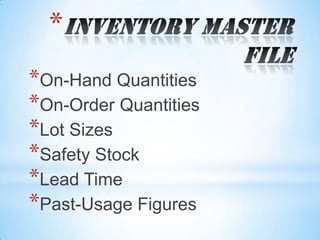
*Product Structure File
*Master Production Schedule
*Inventory Master File


               18
*Bill of Materials:
     * It is a materials list that provides
      information useful to reconstruct the
      manufacturing process. It is the
      master product definition that contains
      “as designed” information.


                             *
                        19
*Schedule of Finished Products
*Represents Production, not Demand
*Combination of Customer Orders and
 Demand Forecasts
*What Needs to be Produced

       *

                  21
*
*On-Hand Quantities
*On-Order Quantities
*Lot Sizes
*Safety Stock
*Lead Time
*Past-Usage Figures
*
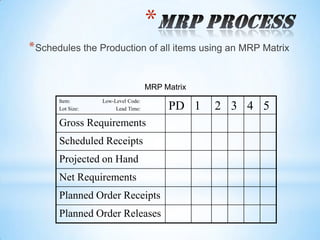
* Schedules the Production of all items using an MRP Matrix


                                    MRP Matrix
      Item:       Low-Level Code:
      Lot Size:        Lead Time:        PD 1    2 3 4 5
      Gross Requirements
      Scheduled Receipts
      Projected on Hand
      Net Requirements
      Planned Order Receipts
      Planned Order Releases
*
*Item – name or number for the item being
 scheduled
*Low-Level Code – the lowest level of the item on
 the product structure file
*Lot Size – order multiples of quantity
*Lead Time – the time from when an order is
 placed to when it is received
*PD – Past Due Time Bucket, orders behind
 schedule
*
*Gross Requirements – demand for an item by
 time period
*Scheduled Receipts – material already ordered
*Projected on Hand – expected ending inventory
*Net Requirements – number of items to be
 provided and when
*Planned Order Receipts – net requirements
 adjusted for lot size
*Planned Order Releases – planned order
 receipts offset for lead times
*
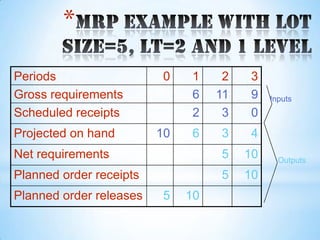
*Gross requirements: (Forecasted)Demand period by
 period
*Net requirements(t)
  =Gross requirements(t)-Projected inventory(t-1)
   -Scheduled receipt(t)
*If Net requirement(t) > 0
     set Planned order receipts(t)>=Net requirement(t)


                                                26
*Planned-order receipts is the production planned
*Projected inventory(t)
  =Projected inventory(t-1)+Scheduled receipt(t)
  +Planned order receipts(t)-Gross requirements(t)
*Planned order release(t-LT)=Planned-order receipts(t)
*
Periods                   0   1   2    3
Gross requirements            6   11   7   Inputs

Scheduled receipts            2   3    0
Projected on hand        10   6   0    0
Net requirements              0   2    7     Outputs

Planned order receipts            2    7
Planned order releases    2   7
*
*
*Safety Stock
  *Not much for items with dependent demand
*Lot sizing
  *Lot-for-lot ordering
  *Economic order quantity
  *Fixed-period ordering
  *Part-period model
*
Periods                   0    1    2    3
Gross requirements             6   11    9   Inputs
Scheduled receipts             2    3    0
Projected on hand        10    6   3     4
Net requirements                   5    10     Outputs

Planned order receipts             5    10
Planned order releases    5   10
*
    32
*
                      Marketing
 Production           Customer               Finance
   Capacity           Demand                Cash Flow
  Inventory

                    Aggregate                     Human
Procurement      Production Plan                Resources
  Supplier
                                                Manpower
Performance
                                                 Planning

         Management               Engineering
          Return on                 Design
         Investment               Completion
           Capital
*
Production Plan        Master Production
                           Schedule

                           Material
                         Requirements
                             Plan

                           Capacity
                         Requirements
                             Plan

                  No     Realistic??
                        Yes
                       Execute Capacity
                            Plans

                       Execute Material
                           Plans
*Manufacturing Orders
*Purchasing Orders
*Various Reports
       *
*
*Improved Business Results
*Improved Manufacturing Results
*More Accurate And Timely Information
*Less Inventory
*Less Materials Obsolescence
*Time Phased Ordering Of Materials
*Higher Reliability
*More Responsiveness To Market Demand
*Reduced Production Cost
* Increase In Material Acquisition Cost
* Higher Transportation Costs And Higher Unit Cost
* Potential Hazard Of A Production Slowdown Or Shutdown
* Use Of Standardized Software Packages
* Does not Take Into Account Plant Capacity And Distribution
 Capacity
* High Stock-Out Costs.


                    *

Materials requirements planning

  • 1.
  • 2.
    *Computerized Inventory Control *ProductionPlanning System *Management Information System *Manufacturing Control System *
  • 3.
    *This is themost comprehensive approach to manufacturing inventory and other dependents which demand an efficient inventory management system. *
  • 4.
    *The MRP systemdetermines item-by-item, what is to be processed and when, as well as what is to be manufactured when. *This is based on order priorities and available capacities.
  • 5.
    An MRP systemis intended to simultaneously meet three objectives: * Ensure materials and products are available for production and delivery to customers. *Maintain the lowest possible level of inventory. *Plan manufacturing activities, delivery schedules and purchasing activities
  • 6.
    *Forecasting *Order, Planning andControl *Priority Planning and Control *Planning Capacity Requirement and Development of Broad Business Plans *
  • 7.
    * Manufacturing organizations,whatever their products, face the same daily practical problem - that customers want products to be available in a shorter time than it takes to make them. This means that some level of planning is required.
  • 8.
    Making a baddecision in any of these areas will make the company lose money. A few examples are given below: * If a company purchases insufficient quantities of an item used in manufacturing, or the wrong item, they may be unable to meet contracts to supply products by the agreed date. * If a company purchases excessive quantities of an item, money is being wasted - the excess quantity ties up cash while it remains as stock and may never even be used at all. This is a particularly severe problem for food manufacturers and companies with very short product life cycles. However, some purchased items will have a minimum quantity that must be met, therefore, purchasing excess is necessary. * Beginning production of an order at the wrong time can cause customer deadlines to be missed.
  • 9.
    Independent demand: Demandfor final products. Dependent demand: Demand fort items that are subassemblies or component parts to be used in production of finished goods. A Independent Demand B(4) C(2) Dependent Demand D(2) E(1) D(3) F(2) * Independent demand is uncertain. Dependent demand is certain.
  • 10.
    * * Reduce InventoryLevels * Reduce Purchasing Cost * Reduce Component * Improve Production Shortages Schedules * Improve Shipping * Reduce Manufacturing Cost Performance * Reduce Lead Times * Improve Customer Service * Less Scrap and Rework * Improve Productivity * Higher Production Quality * Simplified and Accurate Scheduling
  • 11.
    * * Improve Communication * Reduce Overtime * Improve Plant Efficiency * Improve Supply Schedules * Reduce Freight Cost * Improve Calculation of * Reduction in Excess Material Requirements Inventory * Improve Competitive Position
  • 12.
    *Identifying Requirements *Running MRP– Creating the Suggestions *Firming the Suggestions *
  • 13.
    * *Quantity on Hand *Quantityon Open Purchase Order *Quantity in/or Planned for Manufacturing *Quantity Committed to Existing Orders *Quantity Forecasted
  • 14.
  • 15.
  • 16.
  • 17.
    * Master Product Inventory Production Structure File Master File Schedule Material Requirements Planning Manufacturing Purchase Various Reports Orders Orders
  • 18.
    * *Product Structure File *MasterProduction Schedule *Inventory Master File 18
  • 19.
    *Bill of Materials: * It is a materials list that provides information useful to reconstruct the manufacturing process. It is the master product definition that contains “as designed” information. * 19
  • 21.
    *Schedule of FinishedProducts *Represents Production, not Demand *Combination of Customer Orders and Demand Forecasts *What Needs to be Produced * 21
  • 22.
    * *On-Hand Quantities *On-Order Quantities *LotSizes *Safety Stock *Lead Time *Past-Usage Figures
  • 23.
    * * Schedules theProduction of all items using an MRP Matrix MRP Matrix Item: Low-Level Code: Lot Size: Lead Time: PD 1 2 3 4 5 Gross Requirements Scheduled Receipts Projected on Hand Net Requirements Planned Order Receipts Planned Order Releases
  • 24.
    * *Item – nameor number for the item being scheduled *Low-Level Code – the lowest level of the item on the product structure file *Lot Size – order multiples of quantity *Lead Time – the time from when an order is placed to when it is received *PD – Past Due Time Bucket, orders behind schedule
  • 25.
    * *Gross Requirements –demand for an item by time period *Scheduled Receipts – material already ordered *Projected on Hand – expected ending inventory *Net Requirements – number of items to be provided and when *Planned Order Receipts – net requirements adjusted for lot size *Planned Order Releases – planned order receipts offset for lead times
  • 26.
    * *Gross requirements: (Forecasted)Demandperiod by period *Net requirements(t) =Gross requirements(t)-Projected inventory(t-1) -Scheduled receipt(t) *If Net requirement(t) > 0 set Planned order receipts(t)>=Net requirement(t) 26
  • 27.
    *Planned-order receipts isthe production planned *Projected inventory(t) =Projected inventory(t-1)+Scheduled receipt(t) +Planned order receipts(t)-Gross requirements(t) *Planned order release(t-LT)=Planned-order receipts(t)
  • 28.
    * Periods 0 1 2 3 Gross requirements 6 11 7 Inputs Scheduled receipts 2 3 0 Projected on hand 10 6 0 0 Net requirements 0 2 7 Outputs Planned order receipts 2 7 Planned order releases 2 7
  • 29.
  • 30.
    * *Safety Stock *Not much for items with dependent demand *Lot sizing *Lot-for-lot ordering *Economic order quantity *Fixed-period ordering *Part-period model
  • 31.
    * Periods 0 1 2 3 Gross requirements 6 11 9 Inputs Scheduled receipts 2 3 0 Projected on hand 10 6 3 4 Net requirements 5 10 Outputs Planned order receipts 5 10 Planned order releases 5 10
  • 32.
    * 32
  • 33.
    * Marketing Production Customer Finance Capacity Demand Cash Flow Inventory Aggregate Human Procurement Production Plan Resources Supplier Manpower Performance Planning Management Engineering Return on Design Investment Completion Capital
  • 34.
    * Production Plan Master Production Schedule Material Requirements Plan Capacity Requirements Plan No Realistic?? Yes Execute Capacity Plans Execute Material Plans
  • 35.
  • 36.
    * *Improved Business Results *ImprovedManufacturing Results *More Accurate And Timely Information *Less Inventory *Less Materials Obsolescence *Time Phased Ordering Of Materials *Higher Reliability *More Responsiveness To Market Demand *Reduced Production Cost
  • 37.
    * Increase InMaterial Acquisition Cost * Higher Transportation Costs And Higher Unit Cost * Potential Hazard Of A Production Slowdown Or Shutdown * Use Of Standardized Software Packages * Does not Take Into Account Plant Capacity And Distribution Capacity * High Stock-Out Costs. *

Editor's Notes

  • #9 Companies need to control the types and quantities of materials they purchase, plan which products are to be produced and in what quantities and ensure that they are able to meet current and future customer demand, all at the lowest possible cost.