SALES FORECASTINGAslı KARABULUT264012017-2D
AGENDASales ForecastingLevels of ForecastingSales Forecasting ProcedureImportance of Sales ForecastingSales Forecasting ProcessForecasting ErrorsSales Forecasting TechniquesBudgetingTypes of BudgetingBudget DeterminationThe Sales BudgetBudget AllocationReferences
SALES FORECASTINGForecasting is the art of estimating future demand by anticipating what buyers are likely to do under a given set of future conditions.A sales forecast is a projection into the future of expected demand given a stated set of environmental conditions.
SALES FORECASTINGSales Manageraccountants
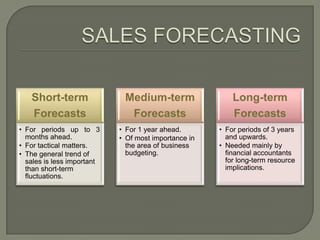
SALES FORECASTING
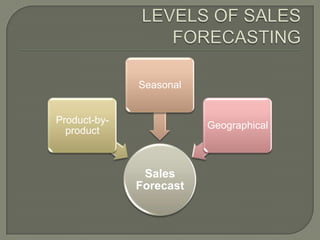
LEVELS OF SALES FORECASTING
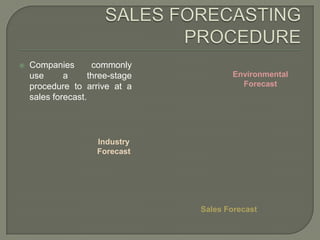
SALES FORECASTING PROCEDURECompanies commonly use a three-stage procedure to arrive at a sales forecast.EnvironmentalForecastIndustryForecastSales Forecast
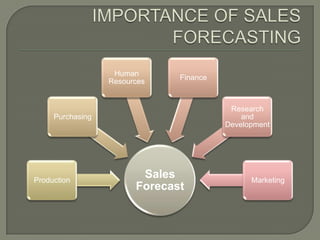
IMPORTANCE OF SALES FORECASTING
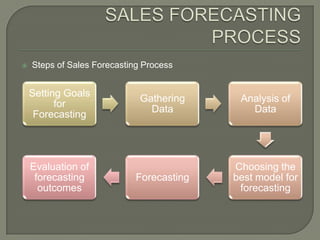
SALES FORECASTING PROCESSSteps of Sales Forecasting Process
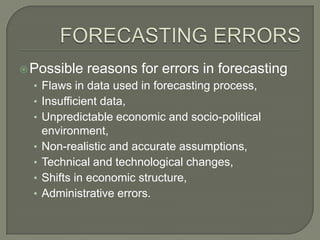
FORECASTING ERRORSPossible reasons for errors in forecastingFlaws in data used in forecasting process,Insufficient data,Unpredictable economic and socio-political environment,Non-realistic and accurate assumptions,Technical and technological changes,Shifts in economic structure,Administrative errors.
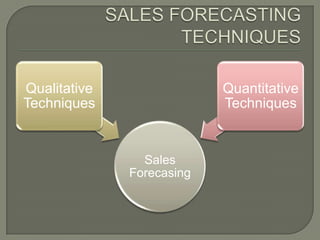
SALES FORECASTING TECHNIQUES
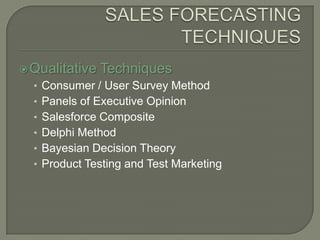
SALES FORECASTING TECHNIQUESQualitative TechniquesConsumer / User Survey MethodPanels of Executive OpinionSalesforce CompositeDelphi MethodBayesian Decision TheoryProduct Testing and Test Marketing
SALES FORECASTING TECHNIQUESQualitative TechniquesConsumer / User Survey Model (Market Research Method)Involves asking customers about their likely purchases for the forecast period.Best possible use: A small numbers of users who are prepared to state their intentions with a reasonable degree of accuracy.Limitations: Organisational Buying.Problems: to ascertain what proportion of likely purchases will accrue to your company. Customers and salespeople tend to be optimistic when making predictions for the future.
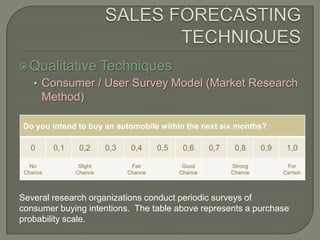
SALES FORECASTING TECHNIQUESQualitative TechniquesConsumer / User Survey Model (Market Research Method)Several research organizations conduct periodic surveys of  consumer buying intentions.  The table above represents a purchase probability scale.
SALES FORECASTING TECHNIQUESQualitative TechniquesPanels of Executive Opinion (Jury Method)Specialists or experts are consulted who have knowledge of the industry being examined.Best possible use:Developing a general, rather than specific product-by-product forecast.Problems:  Difficulty in allocating the forecast among individual products and sales territories because the statistics have not been collected from basic market data. Such allocation will probably be arbitrary.
SALES FORECASTING TECHNIQUESQualitative TechniquesSalesforce CompositeEach salesperson makes a product-by-product forecast for their particular sales territory. Thus individual forecasts are built up to produce a company forecast.Problems: When the forecast is used for remuneration there might be a tendency for salespeople to produce a pessimistic forecast. When remuneration is not linked to the sales forecast there is a temptation to produce an optimistic forecast.
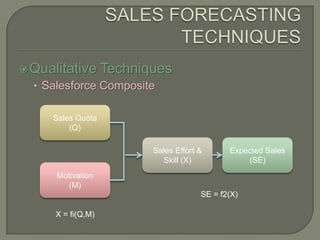
SALES FORECASTING TECHNIQUESQualitative TechniquesSalesforce CompositeSales Quota(Q)Sales Effort & Skill (X)Expected Sales(SE)Motivation(M)SE = f2(X)X = fi(Q,M)
SALES FORECASTING TECHNIQUESQualitative TechniquesDelphi MethodA project administers a questionnaire to each member of the team which asks questions, usually of a behavioural nature. The questioning then proceeds to a more detailed or pointed second stage which asks questions about the individual company.Objective: To translate opinion into some form of forecast.Best possible use: Providing general data about industry trends and as a technological forecasting tool. Providing information about new products or processes that the company intends to develop for ultimate manufacture and sale.
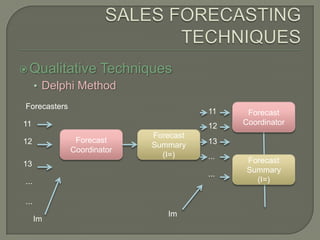
SALES FORECASTING TECHNIQUESQualitative TechniquesDelphi MethodForecastersForecastCoordinator111112ForecastCoordinatorForecastSummary(I=)1312...ForecastSummary(I=)13.........ImIm
SALES FORECASTING TECHNIQUESQualitative TechniquesBayesian Decision TheoryTo use the Bayesian approach, the decision maker must be able to assign a probability of each specified event or state of  nature. The sum of these probabilities must add to one. These probabilities represent the strength of the decision maker’s feelings regarding the likelihood of the occurence of the various elements of the overall problem.
SALES FORECASTING TECHNIQUESQualitative TechniquesProduct Testing and Test MarketingInvolves placing the pre-production model(s) with a sample of potential users beforehand and noting their reactions to the product over a period of time asking them to fill in a diary noting product deficiencies, how it worked, general reactions etc. Best possible use: New or modified products for which no previous sales figures exist and where it is difficult to estimate likely demand.
SALES FORECASTING TECHNIQUESQuantative TechniquesTime Series AnalysisCausal  Techniques
SALES FORECASTING TECHNIQUESQuantitative TechniquesTime Series AnalysisThey are relatively simple to apply, but the danger is that too much emphasis might be placed upon past events to predict the future. Time Series Analysis include:Moving AveragesExponential SmoothingTime SeriesZ (or Zee) Charts
SALES FORECASTING TECHNIQUESQuantitative TechniquesTime Series AnalysisMoving Averages: This method averages out and smooths data in a time series. The longer the time series, the greater will be the smoothing. The principle is that one substracts the earliest sales figure and adds the latest sales figure.
SALES FORECASTING TECHNIQUESQuantitative TechniquesTime Series AnalysisExponential Smoothing:  It apportions varying weightings to different parts of the data from which the forecast is to be calculated. In this technique the forecaster apportions appropriate degrees of “typicality” to different parts of the time series.
SALES FORECASTING TECHNIQUESQuantitative TechniquesTime Series AnalysisTime Series: It is useful when seasonality occurs in a data pattern. It is of particular use for fashion products and for products that respond to seasonal changes throughout the year.
SALES FORECASTING TECHNIQUESQuantitative TechniquesTime Series AnalysisZ (or Zee) Charts: In addition to providing the moving annual total, it also shows the monthly sales and cumulative sales; an illustration of the technique shows why it is termed Z chart. Each Z chart represents one year’s data and is best  applied using monthly sales data. As a vehicle for forecasting it provides a useful medium where sales for one year can be compared with previous years using three criteria.
SALES FORECASTING TECHNIQUESQuantitative TechniquesCausal TechniquesIt is assumed that there is a relationship between the measurable independent variable and the forecasted dependent variable. The forecast is produced by putting the value of the independent variable into the calculation. Causal techniques include:Leading IndicatorsSimulationDiffusion Models
SALES FORECASTING TECHNIQUESQuantitative TechniquesCausal TechniquesLeading Indicators:  This method seeks to define and establish a linear regression relationship between some measurable phenomenon and whatever is to be forecasted.
SALES FORECASTING TECHNIQUESQuantitative TechniquesCausal TechniquesSimulation: Simulation uses a process of iteration, or trial and error, to arrive at the forecasting relationship.
SALES FORECASTING TECHNIQUESQuantitative TechniquesCausal TechniquesDiffusion Models:  Diffusion theory assumes that the new product has four basic units:The innovation: 1) Continuous 2) Dynamically continuous 3) DiscontinuousThe communication of the innovation among individuals: 1) Formal communication 2) Informal CommunicationThe social systemTimeOnce the innovation has been launched, a measure of the rate of adoption is needed in order to produce a useful forecast. A forecast can be made using only a small amount of data covering the early launch period.
BUDGETINGAn organization needs to budget to ensure that expenditure does not exceed planned income.The sales forecast is the starting point for business planning activities. Taking the medium-term sales forecast as the starting point the budgets are allocated to departments.Budgets are a means of control.
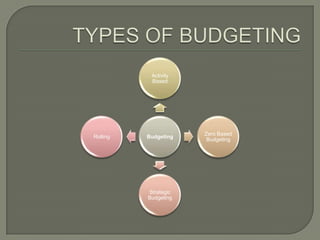
TYPES OF BUDGETING
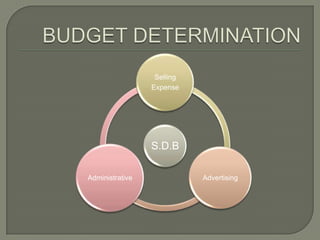
BUDGET DETERMINATIONDepartmental manager determines how the overall departmental budget will be utilised in achieving the planned-for sales.The overall sales forecast is the basis for company plans, and the sales department budget is the basis for marketing plans in achieving those forecasted sales. The sales department budget is consequently a reflection of marketing’s forthcoming expenditure in achieving those forecasted sales.
BUDGET DETERMINATION
SALES BUDGETThe Sales Budget;Is the total revenue expected from all products that are sold.Comes directly after the sales forecast.Is the starting point of the company budgeting procedure because all other company activities are dependent upon sales and total revenue anticipated from the various products that the company sells.
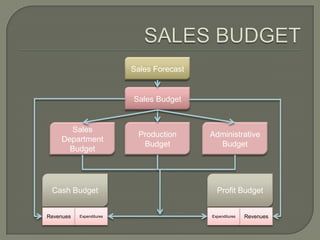
SALES BUDGETSales ForecastSales BudgetSales Department BudgetProduction BudgetAdministrative BudgetCash BudgetProfit BudgetRevenuesExpendituresExpendituresRevenues
BUDGET ALLOCATIONThe sales budget is statement of projected sales by individual salespeople. The amount that must be sold in order to achieve the forecasted sales is the sales quota.
BUDGET ALLOCATIONThe most common practice of budget allocation is simply to increase / decrease last year’s individual budgets or quotas by an appropriate percentage, depending on the change in the overall sales budget.By assessing sales potential for territories and allowing for workload, the overall sales budget can be allocated in as fair a manner as possible between salespeople.
REFERENCESBOOKSJobber, D. and Lancaster, G., Selling and Sales Management, Chapter 16, 8th Edition, Prentice Hall, Essex, 2009.Kotler, P. And Armstrong, G., Principles of Marketing, Appendix 2, 11th Edition, Pearson Education, New Jersey, 2006.THESISArslan, S., “Satış Gelirlerinin Bütçelenmesinde Uygulanacak Teknikler ve Sürdürülebilir Uygulama Modeli”, T.C. Marmara Üniversitesi – Muhasebe  Finansman Bilim Dalı Yüksek Lisans Tezi, İstanbul, 2007.Ekmekçi, A.S., “Endüstriyel Pazarlarda Satış Tahmin Yöntemlerinin Kullanılabilirliği ve Hazır Beton Sektöründe Bir Uygulama”, T.C. Marmara Üniversitesi – Üretim Yönetimi ve Pazarlama Bilim Dalı Yüksek Lisans Tezi, İstanbul, 2006.ARTICLESBardhan, A.K. and Chanda, U., “A Model for First and Substitution Adoption of Successive Generations of a Product”, International Journal of Modelling and Simulation, Vol.28 Issue 4: p487-494.Das, P. and Chaudhury, S., “Prediction of retail sales of footwear using feedforward and recurrent neural networks”,Neural Comput & Applic, Vol.16 : p491-502.Kumar, M. And Patel, N.R., “Using Clustering to Improve Sales Forecasts in Retail Merchandising”,  Ann Oper Res, Vol.174: p.33-46.Mentzer, J.T., “A Telling Fortune: Supply Chain Demand Management is where forecasting meets lean methods”, Industrial Engineer, Vol.38 Issue 4: p42-47.Siriram,R. and Snaddon, D.R., “Forecasting New Product Sales”, South African Journal of Industrial Engineering, Vol.21 Issue 1: p123-135.Zhou, S. and et.al, “The Evolution of Family Level Sales Forecast into Product Level Forecasts: Modelling and Estimation”, Johnson Graduate School of Management, 2006.

Sales Forecasting

  • 1.
  • 2.
    AGENDASales ForecastingLevels ofForecastingSales Forecasting ProcedureImportance of Sales ForecastingSales Forecasting ProcessForecasting ErrorsSales Forecasting TechniquesBudgetingTypes of BudgetingBudget DeterminationThe Sales BudgetBudget AllocationReferences
  • 3.
    SALES FORECASTINGForecasting isthe art of estimating future demand by anticipating what buyers are likely to do under a given set of future conditions.A sales forecast is a projection into the future of expected demand given a stated set of environmental conditions.
  • 4.
  • 5.
  • 6.
    LEVELS OF SALESFORECASTING
  • 7.
    SALES FORECASTING PROCEDURECompaniescommonly use a three-stage procedure to arrive at a sales forecast.EnvironmentalForecastIndustryForecastSales Forecast
  • 8.
  • 9.
    SALES FORECASTING PROCESSStepsof Sales Forecasting Process
  • 10.
    FORECASTING ERRORSPossible reasonsfor errors in forecastingFlaws in data used in forecasting process,Insufficient data,Unpredictable economic and socio-political environment,Non-realistic and accurate assumptions,Technical and technological changes,Shifts in economic structure,Administrative errors.
  • 11.
  • 12.
    SALES FORECASTING TECHNIQUESQualitativeTechniquesConsumer / User Survey MethodPanels of Executive OpinionSalesforce CompositeDelphi MethodBayesian Decision TheoryProduct Testing and Test Marketing
  • 13.
    SALES FORECASTING TECHNIQUESQualitativeTechniquesConsumer / User Survey Model (Market Research Method)Involves asking customers about their likely purchases for the forecast period.Best possible use: A small numbers of users who are prepared to state their intentions with a reasonable degree of accuracy.Limitations: Organisational Buying.Problems: to ascertain what proportion of likely purchases will accrue to your company. Customers and salespeople tend to be optimistic when making predictions for the future.
  • 14.
    SALES FORECASTING TECHNIQUESQualitativeTechniquesConsumer / User Survey Model (Market Research Method)Several research organizations conduct periodic surveys of consumer buying intentions. The table above represents a purchase probability scale.
  • 15.
    SALES FORECASTING TECHNIQUESQualitativeTechniquesPanels of Executive Opinion (Jury Method)Specialists or experts are consulted who have knowledge of the industry being examined.Best possible use:Developing a general, rather than specific product-by-product forecast.Problems: Difficulty in allocating the forecast among individual products and sales territories because the statistics have not been collected from basic market data. Such allocation will probably be arbitrary.
  • 16.
    SALES FORECASTING TECHNIQUESQualitativeTechniquesSalesforce CompositeEach salesperson makes a product-by-product forecast for their particular sales territory. Thus individual forecasts are built up to produce a company forecast.Problems: When the forecast is used for remuneration there might be a tendency for salespeople to produce a pessimistic forecast. When remuneration is not linked to the sales forecast there is a temptation to produce an optimistic forecast.
  • 17.
    SALES FORECASTING TECHNIQUESQualitativeTechniquesSalesforce CompositeSales Quota(Q)Sales Effort & Skill (X)Expected Sales(SE)Motivation(M)SE = f2(X)X = fi(Q,M)
  • 18.
    SALES FORECASTING TECHNIQUESQualitativeTechniquesDelphi MethodA project administers a questionnaire to each member of the team which asks questions, usually of a behavioural nature. The questioning then proceeds to a more detailed or pointed second stage which asks questions about the individual company.Objective: To translate opinion into some form of forecast.Best possible use: Providing general data about industry trends and as a technological forecasting tool. Providing information about new products or processes that the company intends to develop for ultimate manufacture and sale.
  • 19.
    SALES FORECASTING TECHNIQUESQualitativeTechniquesDelphi MethodForecastersForecastCoordinator111112ForecastCoordinatorForecastSummary(I=)1312...ForecastSummary(I=)13.........ImIm
  • 20.
    SALES FORECASTING TECHNIQUESQualitativeTechniquesBayesian Decision TheoryTo use the Bayesian approach, the decision maker must be able to assign a probability of each specified event or state of nature. The sum of these probabilities must add to one. These probabilities represent the strength of the decision maker’s feelings regarding the likelihood of the occurence of the various elements of the overall problem.
  • 21.
    SALES FORECASTING TECHNIQUESQualitativeTechniquesProduct Testing and Test MarketingInvolves placing the pre-production model(s) with a sample of potential users beforehand and noting their reactions to the product over a period of time asking them to fill in a diary noting product deficiencies, how it worked, general reactions etc. Best possible use: New or modified products for which no previous sales figures exist and where it is difficult to estimate likely demand.
  • 22.
    SALES FORECASTING TECHNIQUESQuantativeTechniquesTime Series AnalysisCausal Techniques
  • 23.
    SALES FORECASTING TECHNIQUESQuantitativeTechniquesTime Series AnalysisThey are relatively simple to apply, but the danger is that too much emphasis might be placed upon past events to predict the future. Time Series Analysis include:Moving AveragesExponential SmoothingTime SeriesZ (or Zee) Charts
  • 24.
    SALES FORECASTING TECHNIQUESQuantitativeTechniquesTime Series AnalysisMoving Averages: This method averages out and smooths data in a time series. The longer the time series, the greater will be the smoothing. The principle is that one substracts the earliest sales figure and adds the latest sales figure.
  • 25.
    SALES FORECASTING TECHNIQUESQuantitativeTechniquesTime Series AnalysisExponential Smoothing: It apportions varying weightings to different parts of the data from which the forecast is to be calculated. In this technique the forecaster apportions appropriate degrees of “typicality” to different parts of the time series.
  • 26.
    SALES FORECASTING TECHNIQUESQuantitativeTechniquesTime Series AnalysisTime Series: It is useful when seasonality occurs in a data pattern. It is of particular use for fashion products and for products that respond to seasonal changes throughout the year.
  • 27.
    SALES FORECASTING TECHNIQUESQuantitativeTechniquesTime Series AnalysisZ (or Zee) Charts: In addition to providing the moving annual total, it also shows the monthly sales and cumulative sales; an illustration of the technique shows why it is termed Z chart. Each Z chart represents one year’s data and is best applied using monthly sales data. As a vehicle for forecasting it provides a useful medium where sales for one year can be compared with previous years using three criteria.
  • 28.
    SALES FORECASTING TECHNIQUESQuantitativeTechniquesCausal TechniquesIt is assumed that there is a relationship between the measurable independent variable and the forecasted dependent variable. The forecast is produced by putting the value of the independent variable into the calculation. Causal techniques include:Leading IndicatorsSimulationDiffusion Models
  • 29.
    SALES FORECASTING TECHNIQUESQuantitativeTechniquesCausal TechniquesLeading Indicators: This method seeks to define and establish a linear regression relationship between some measurable phenomenon and whatever is to be forecasted.
  • 30.
    SALES FORECASTING TECHNIQUESQuantitativeTechniquesCausal TechniquesSimulation: Simulation uses a process of iteration, or trial and error, to arrive at the forecasting relationship.
  • 31.
    SALES FORECASTING TECHNIQUESQuantitativeTechniquesCausal TechniquesDiffusion Models: Diffusion theory assumes that the new product has four basic units:The innovation: 1) Continuous 2) Dynamically continuous 3) DiscontinuousThe communication of the innovation among individuals: 1) Formal communication 2) Informal CommunicationThe social systemTimeOnce the innovation has been launched, a measure of the rate of adoption is needed in order to produce a useful forecast. A forecast can be made using only a small amount of data covering the early launch period.
  • 32.
    BUDGETINGAn organization needsto budget to ensure that expenditure does not exceed planned income.The sales forecast is the starting point for business planning activities. Taking the medium-term sales forecast as the starting point the budgets are allocated to departments.Budgets are a means of control.
  • 33.
  • 34.
    BUDGET DETERMINATIONDepartmental managerdetermines how the overall departmental budget will be utilised in achieving the planned-for sales.The overall sales forecast is the basis for company plans, and the sales department budget is the basis for marketing plans in achieving those forecasted sales. The sales department budget is consequently a reflection of marketing’s forthcoming expenditure in achieving those forecasted sales.
  • 35.
  • 36.
    SALES BUDGETThe SalesBudget;Is the total revenue expected from all products that are sold.Comes directly after the sales forecast.Is the starting point of the company budgeting procedure because all other company activities are dependent upon sales and total revenue anticipated from the various products that the company sells.
  • 37.
    SALES BUDGETSales ForecastSalesBudgetSales Department BudgetProduction BudgetAdministrative BudgetCash BudgetProfit BudgetRevenuesExpendituresExpendituresRevenues
  • 38.
    BUDGET ALLOCATIONThe salesbudget is statement of projected sales by individual salespeople. The amount that must be sold in order to achieve the forecasted sales is the sales quota.
  • 39.
    BUDGET ALLOCATIONThe mostcommon practice of budget allocation is simply to increase / decrease last year’s individual budgets or quotas by an appropriate percentage, depending on the change in the overall sales budget.By assessing sales potential for territories and allowing for workload, the overall sales budget can be allocated in as fair a manner as possible between salespeople.
  • 40.
    REFERENCESBOOKSJobber, D. andLancaster, G., Selling and Sales Management, Chapter 16, 8th Edition, Prentice Hall, Essex, 2009.Kotler, P. And Armstrong, G., Principles of Marketing, Appendix 2, 11th Edition, Pearson Education, New Jersey, 2006.THESISArslan, S., “Satış Gelirlerinin Bütçelenmesinde Uygulanacak Teknikler ve Sürdürülebilir Uygulama Modeli”, T.C. Marmara Üniversitesi – Muhasebe Finansman Bilim Dalı Yüksek Lisans Tezi, İstanbul, 2007.Ekmekçi, A.S., “Endüstriyel Pazarlarda Satış Tahmin Yöntemlerinin Kullanılabilirliği ve Hazır Beton Sektöründe Bir Uygulama”, T.C. Marmara Üniversitesi – Üretim Yönetimi ve Pazarlama Bilim Dalı Yüksek Lisans Tezi, İstanbul, 2006.ARTICLESBardhan, A.K. and Chanda, U., “A Model for First and Substitution Adoption of Successive Generations of a Product”, International Journal of Modelling and Simulation, Vol.28 Issue 4: p487-494.Das, P. and Chaudhury, S., “Prediction of retail sales of footwear using feedforward and recurrent neural networks”,Neural Comput & Applic, Vol.16 : p491-502.Kumar, M. And Patel, N.R., “Using Clustering to Improve Sales Forecasts in Retail Merchandising”, Ann Oper Res, Vol.174: p.33-46.Mentzer, J.T., “A Telling Fortune: Supply Chain Demand Management is where forecasting meets lean methods”, Industrial Engineer, Vol.38 Issue 4: p42-47.Siriram,R. and Snaddon, D.R., “Forecasting New Product Sales”, South African Journal of Industrial Engineering, Vol.21 Issue 1: p123-135.Zhou, S. and et.al, “The Evolution of Family Level Sales Forecast into Product Level Forecasts: Modelling and Estimation”, Johnson Graduate School of Management, 2006.