MATERIALS
REQUIREMENTS
PLANNING
MRP
 What is MRP?
 MRP Input:
 Master Production Schedule (MPS)
 Bill of Materials (BOM)
 MRP Processing & Output
 Exploding
 Netting
 Offsetting
 Advantages & Disadvantages of MRP
 Manufacturing Resource Planning (MRPII)
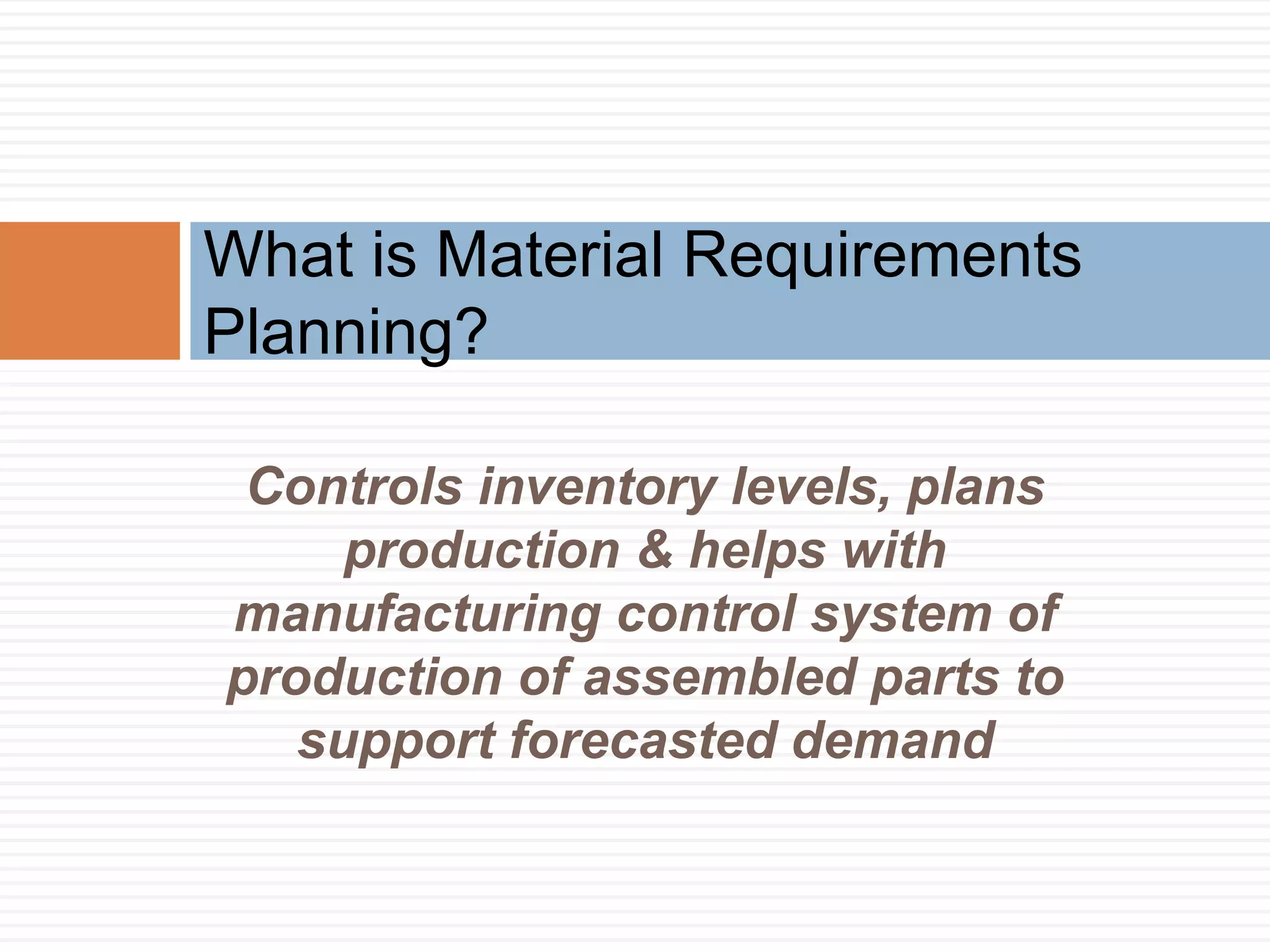
Controls inventory levels, plans
production & helps with
manufacturing control system of
production of assembled parts to
support forecasted demand
What is Material Requirements
Planning?
What is MRP?
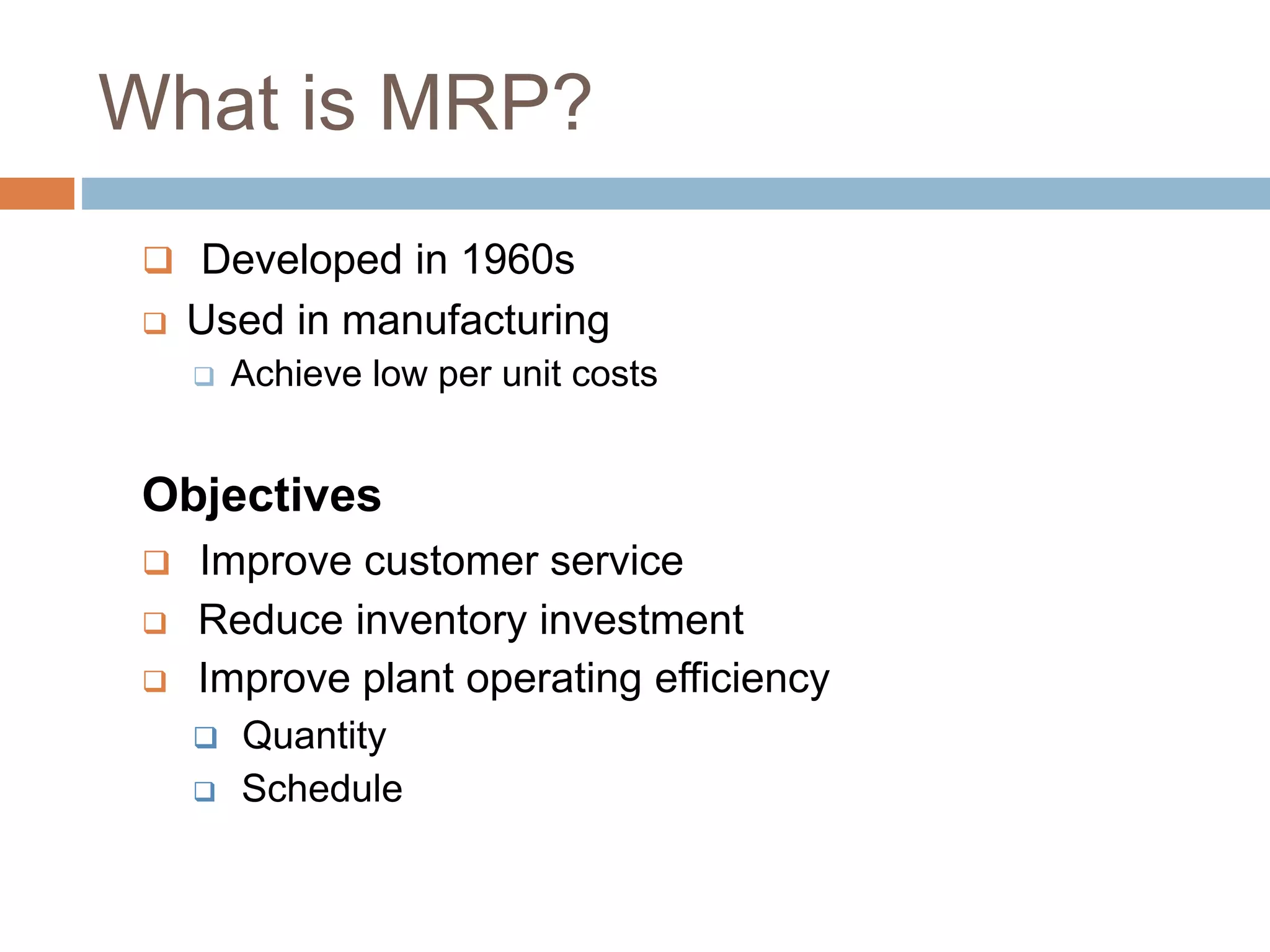
 Developed in 1960s
 Used in manufacturing
 Achieve low per unit costs
Objectives
 Improve customer service
 Reduce inventory investment
 Improve plant operating efficiency
 Quantity
 Schedule
What is MRP?
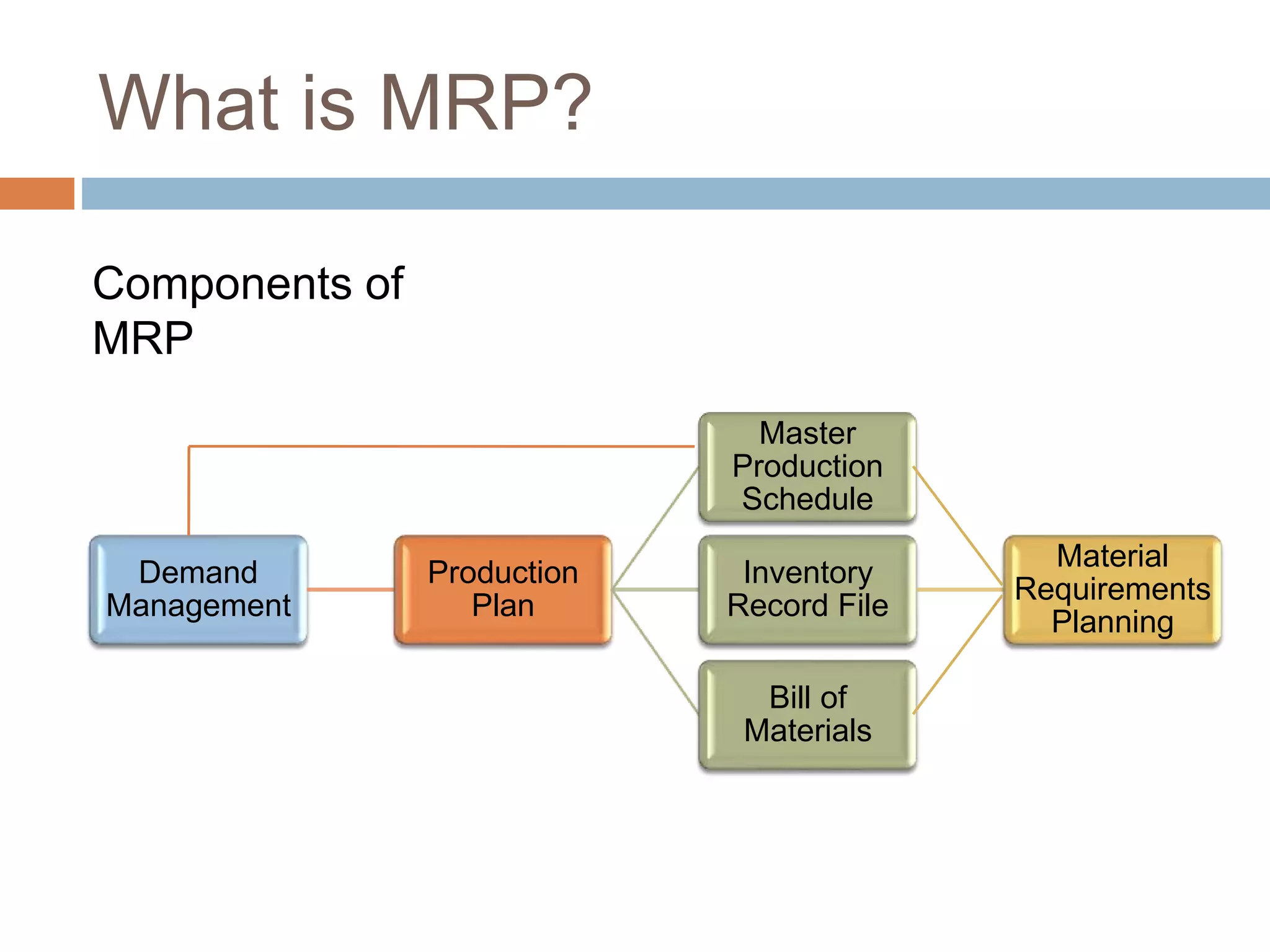
Demand
Management
Production
Plan
Master
Production
Schedule
Inventory
Record File
Material
Requirements
Planning
Bill of
Materials
Components of
MRP
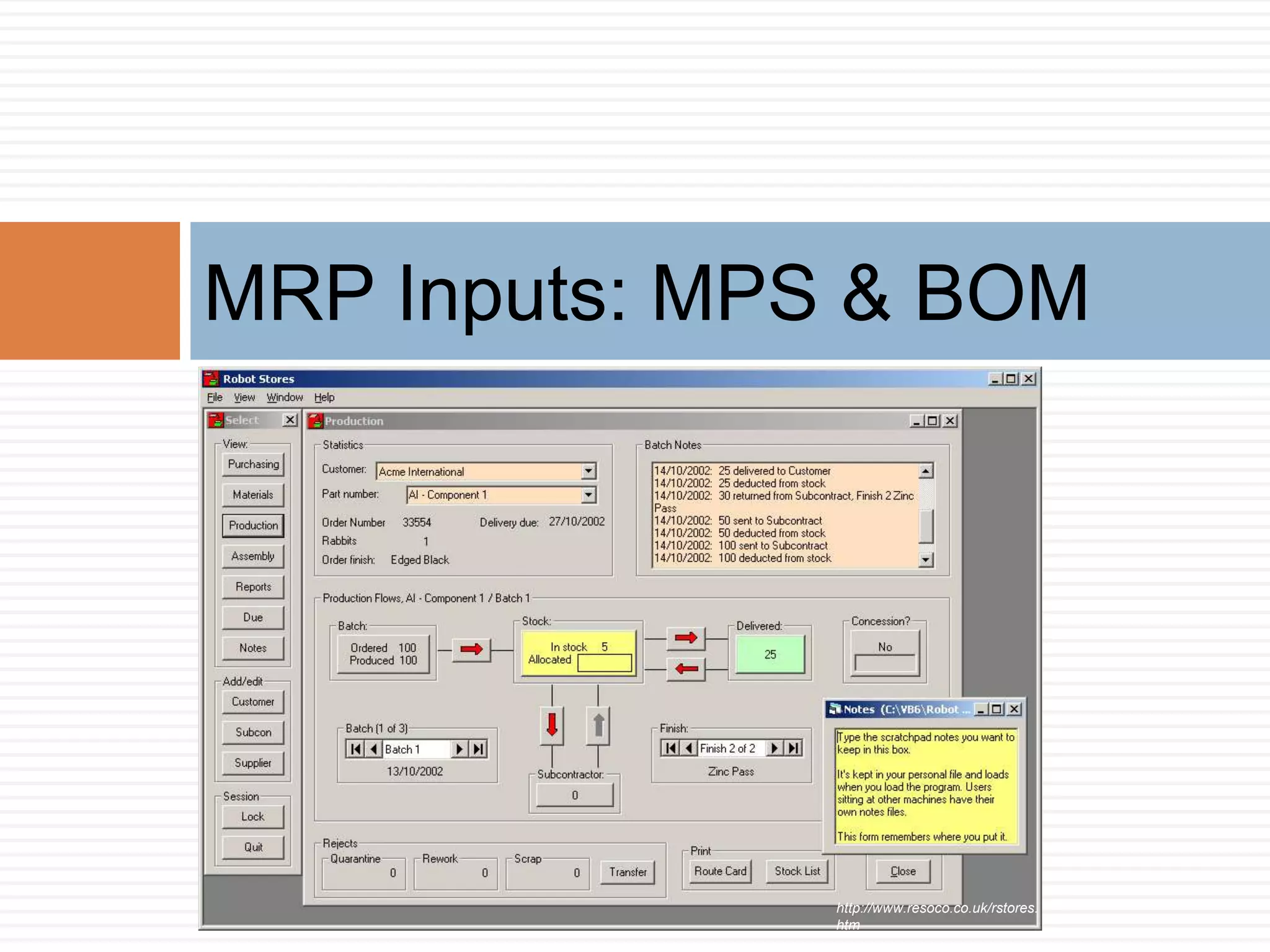
MRP Inputs: MPS & BOM
http://www.resoco.co.uk/rstores.
htm
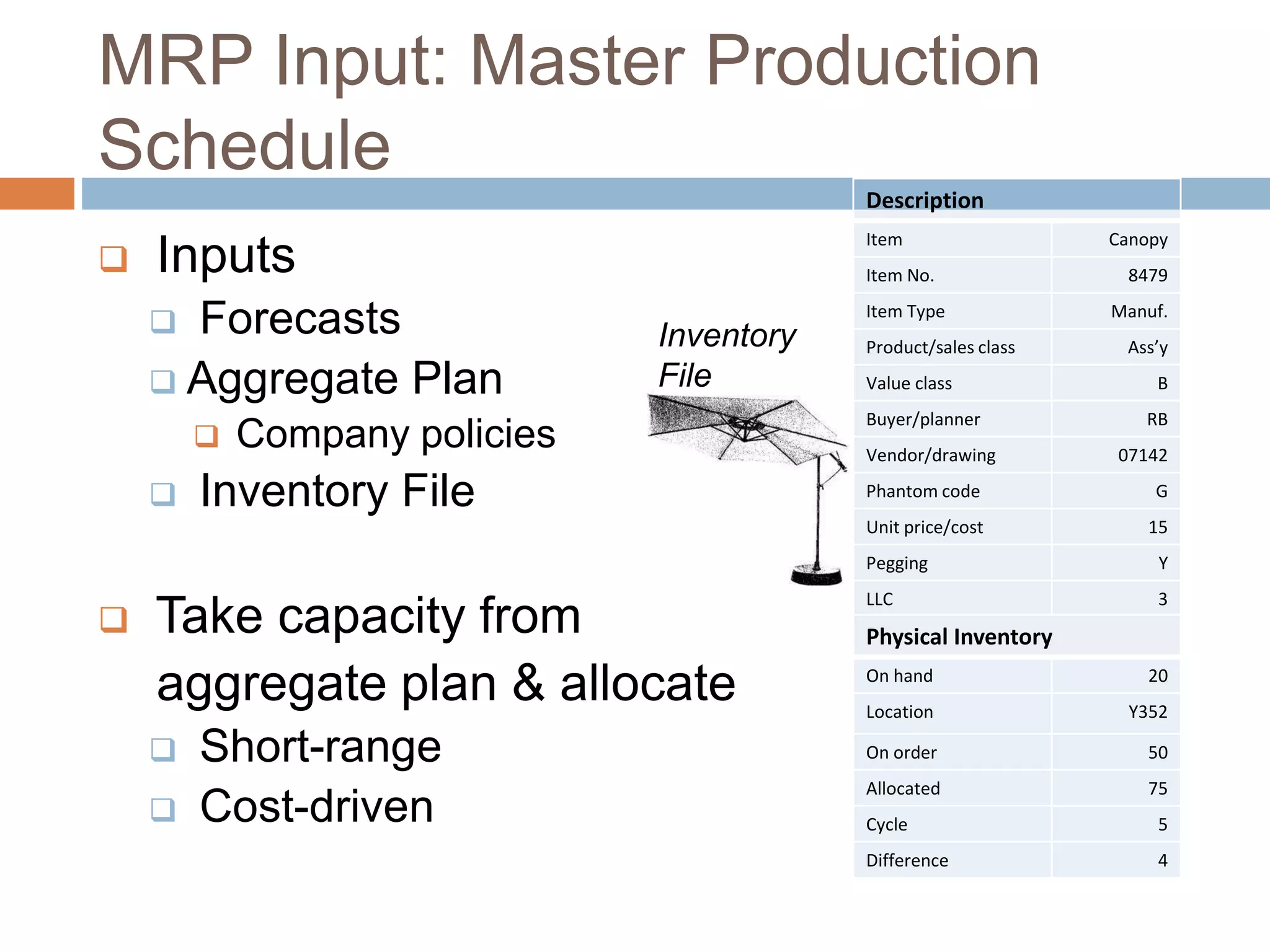
MRP Input: Master Production
Schedule
 Inputs
 Forecasts
 Aggregate Plan
 Company policies
 Inventory File
 Take capacity from
aggregate plan & allocate
 Short-range
 Cost-driven
Description
Item Canopy
Item No. 8479
Item Type Manuf.
Product/sales class Ass’y
Value class B
Buyer/planner RB
Vendor/drawing 07142
Phantom code G
Unit price/cost 15
Pegging Y
LLC 3
Physical Inventory
On hand 20
Location Y352
On order 50
Allocated 75
Cycle 5
Difference 4
Inventory
File
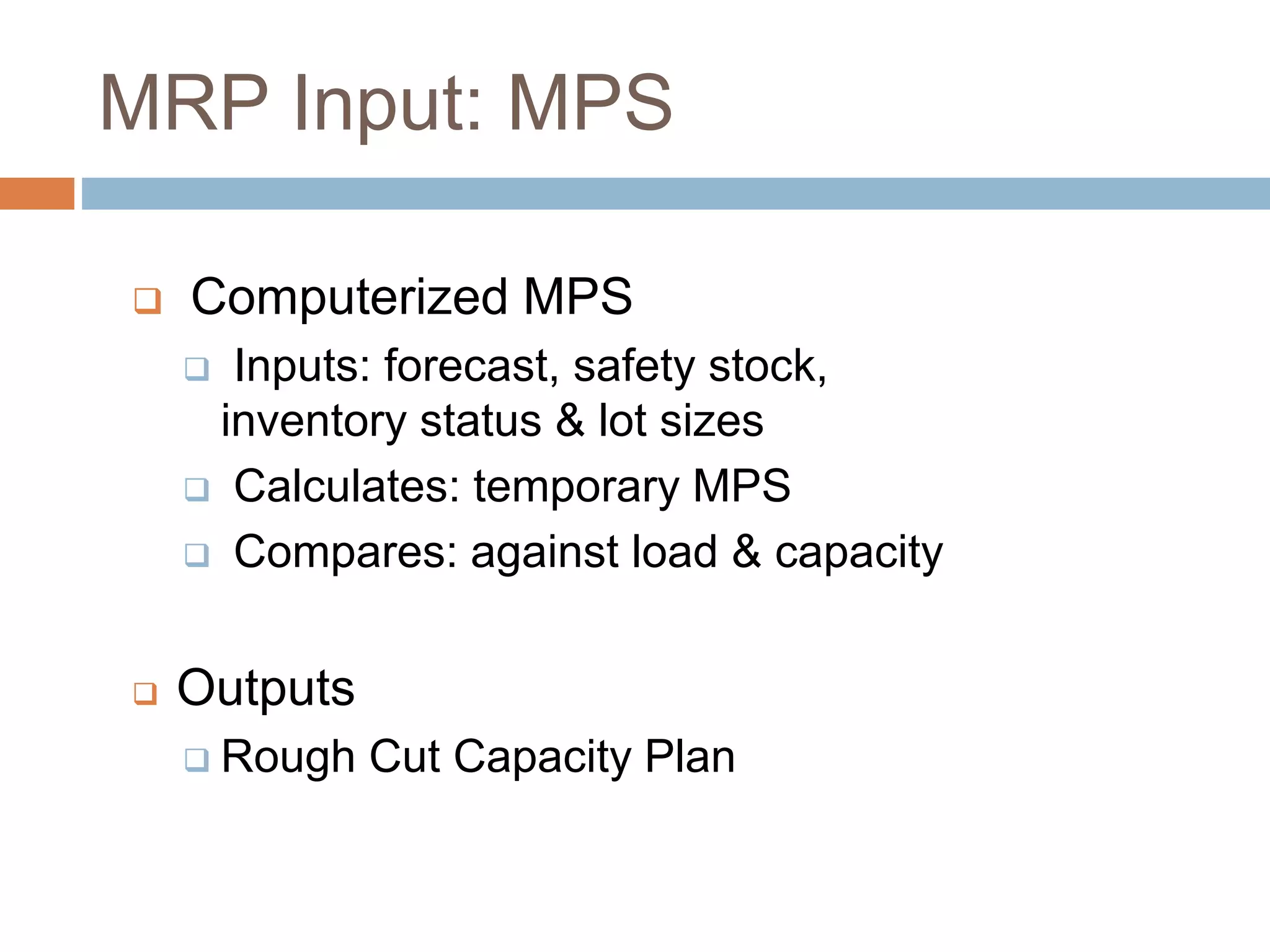
MRP Input: MPS
 Computerized MPS
 Inputs: forecast, safety stock,
inventory status & lot sizes
 Calculates: temporary MPS
 Compares: against load & capacity
 Outputs
 Rough Cut Capacity Plan
MRP Input: Bill of Materials
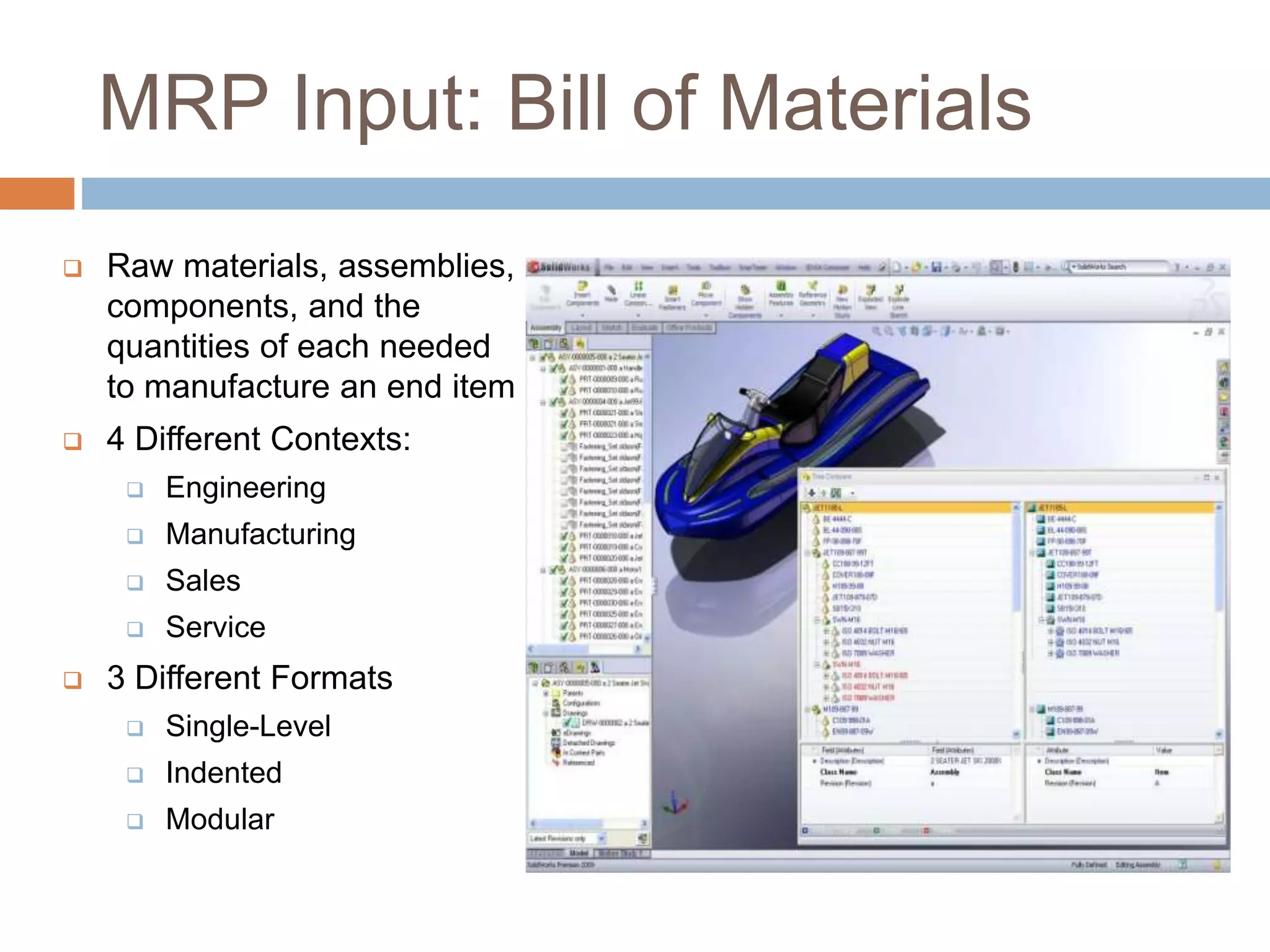
 Raw materials, assemblies,
components, and the
quantities of each needed
to manufacture an end item
 4 Different Contexts:
 Engineering
 Manufacturing
 Sales
 Service
 3 Different Formats
 Single-Level
 Indented
 Modular
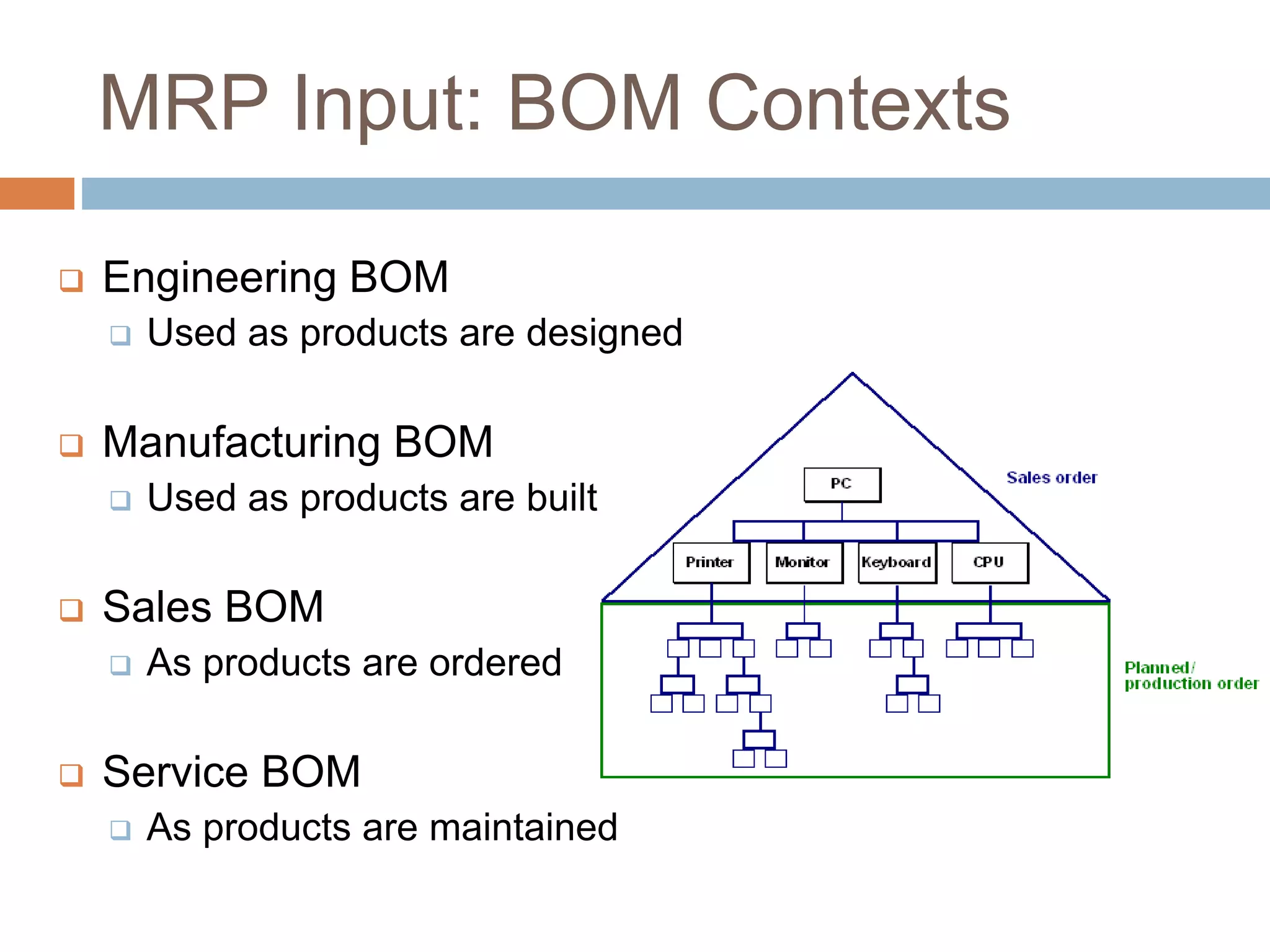
MRP Input: BOM Contexts
 Engineering BOM
 Used as products are designed
 Manufacturing BOM
 Used as products are built
 Sales BOM
 As products are ordered
 Service BOM
 As products are maintained
MRP Input: BOM Formats
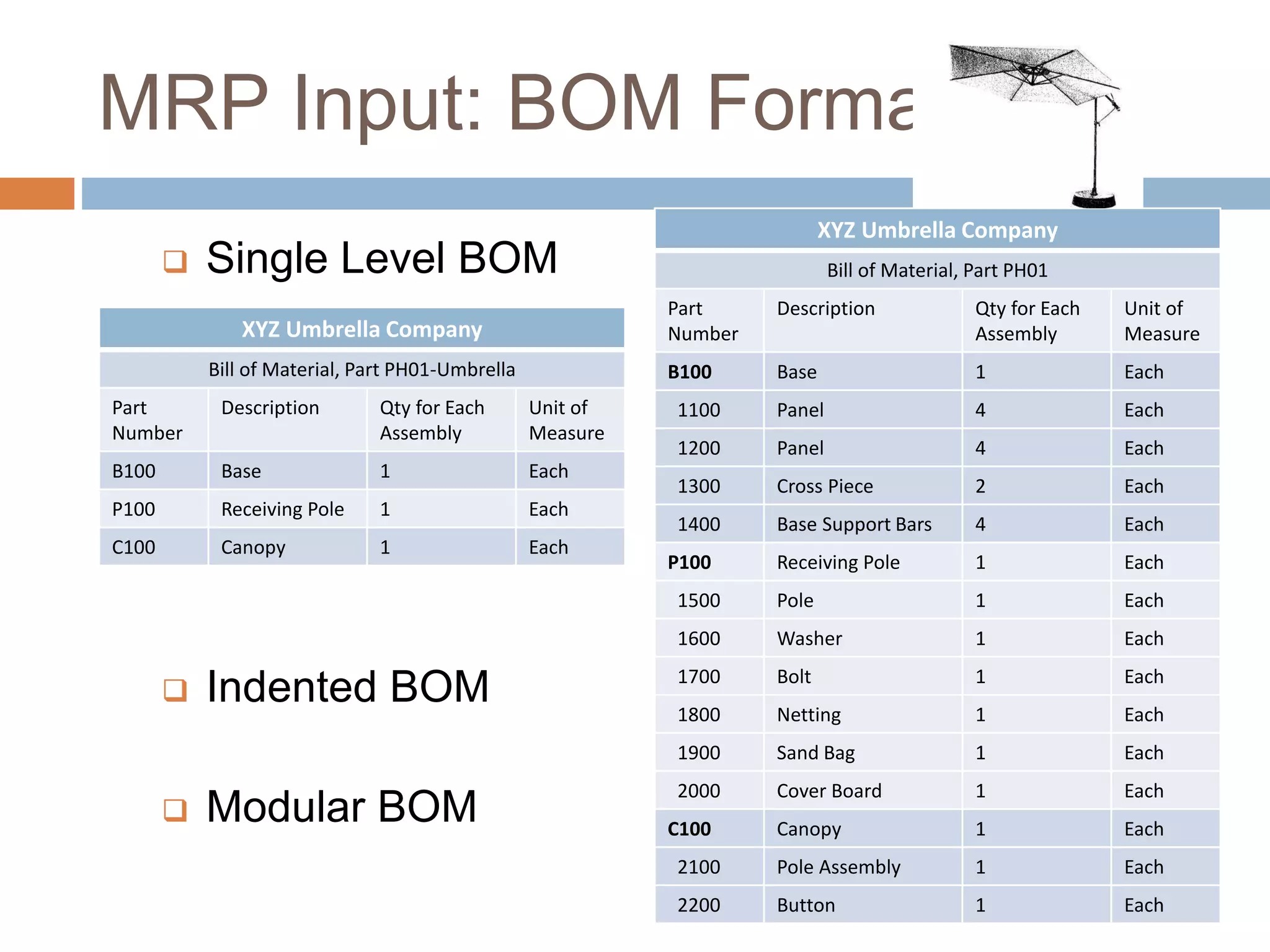
 Single Level BOM
 Indented BOM
 Modular BOM
XYZ Umbrella Company
Bill of Material, Part PH01
Part
Number
Description Qty for Each
Assembly
Unit of
Measure
B100 Base 1 Each
1100 Panel 4 Each
1200 Panel 4 Each
1300 Cross Piece 2 Each
1400 Base Support Bars 4 Each
P100 Receiving Pole 1 Each
1500 Pole 1 Each
1600 Washer 1 Each
1700 Bolt 1 Each
1800 Netting 1 Each
1900 Sand Bag 1 Each
2000 Cover Board 1 Each
C100 Canopy 1 Each
2100 Pole Assembly 1 Each
2200 Button 1 Each
XYZ Umbrella Company
Bill of Material, Part PH01-Umbrella
Part
Number
Description Qty for Each
Assembly
Unit of
Measure
B100 Base 1 Each
P100 Receiving Pole 1 Each
C100 Canopy 1 Each
MRP Processing & Output
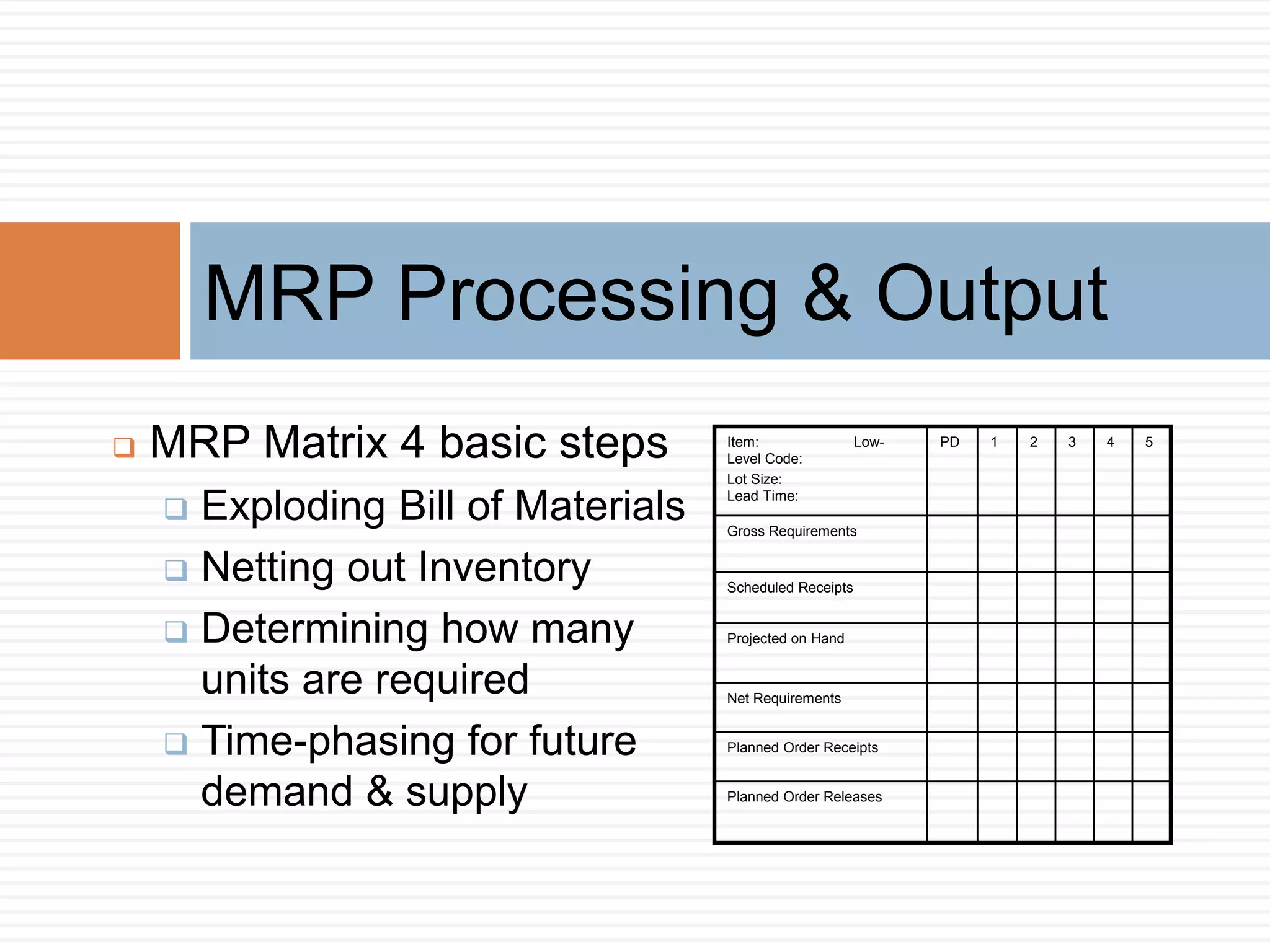
 MRP Matrix 4 basic steps
 Exploding Bill of Materials
 Netting out Inventory
 Determining how many
units are required
 Time-phasing for future
demand & supply
Item: Low-
Level Code:
Lot Size:
Lead Time:
PD 1 2 3 4 5
Gross Requirements
Scheduled Receipts
Projected on Hand
Net Requirements
Planned Order Receipts
Planned Order Releases
MRP Processing
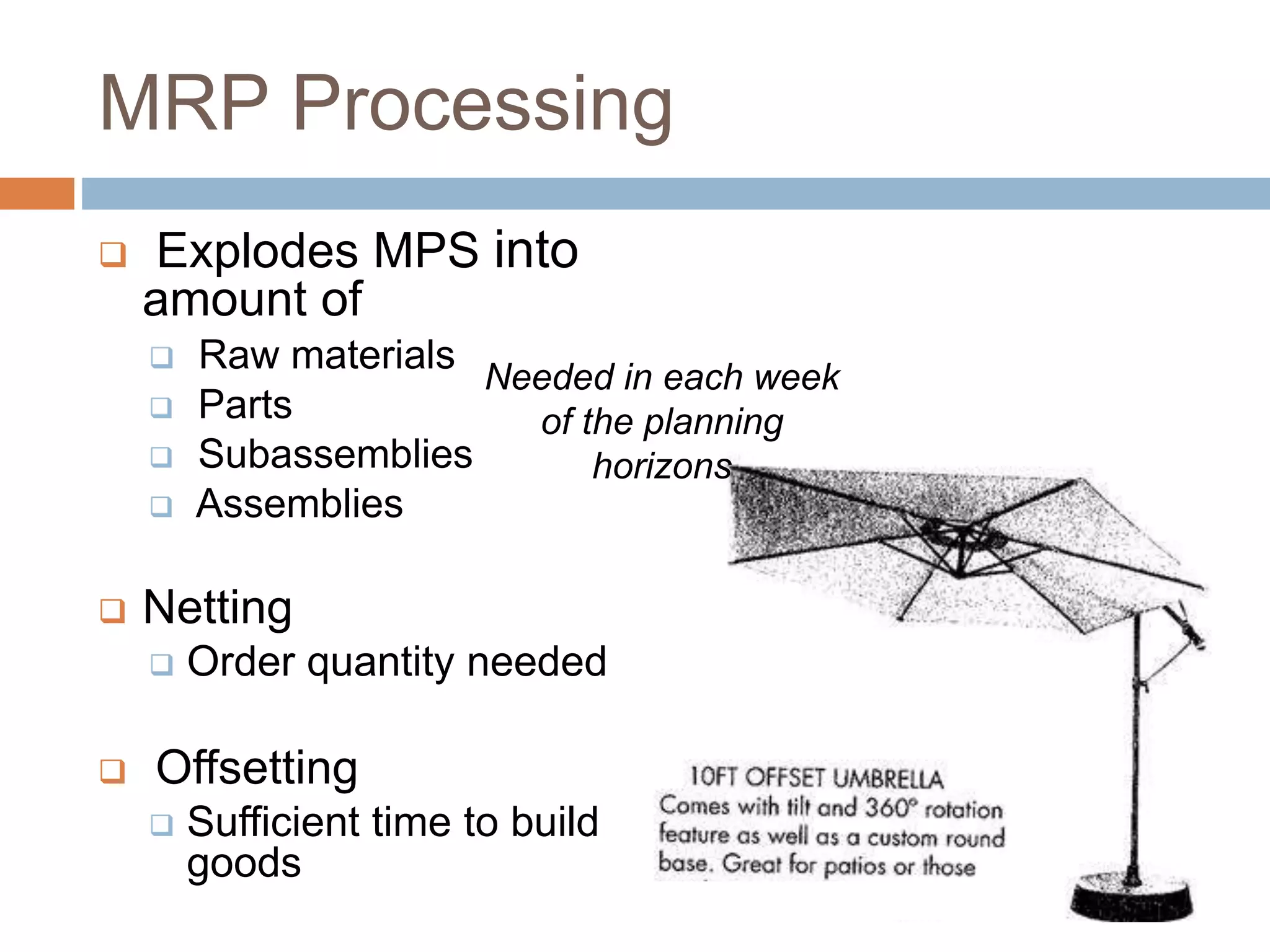
 Explodes MPS into
amount of
 Raw materials
 Parts
 Subassemblies
 Assemblies
 Netting
 Order quantity needed
 Offsetting
 Sufficient time to build
goods
Needed in each week
of the planning
horizons
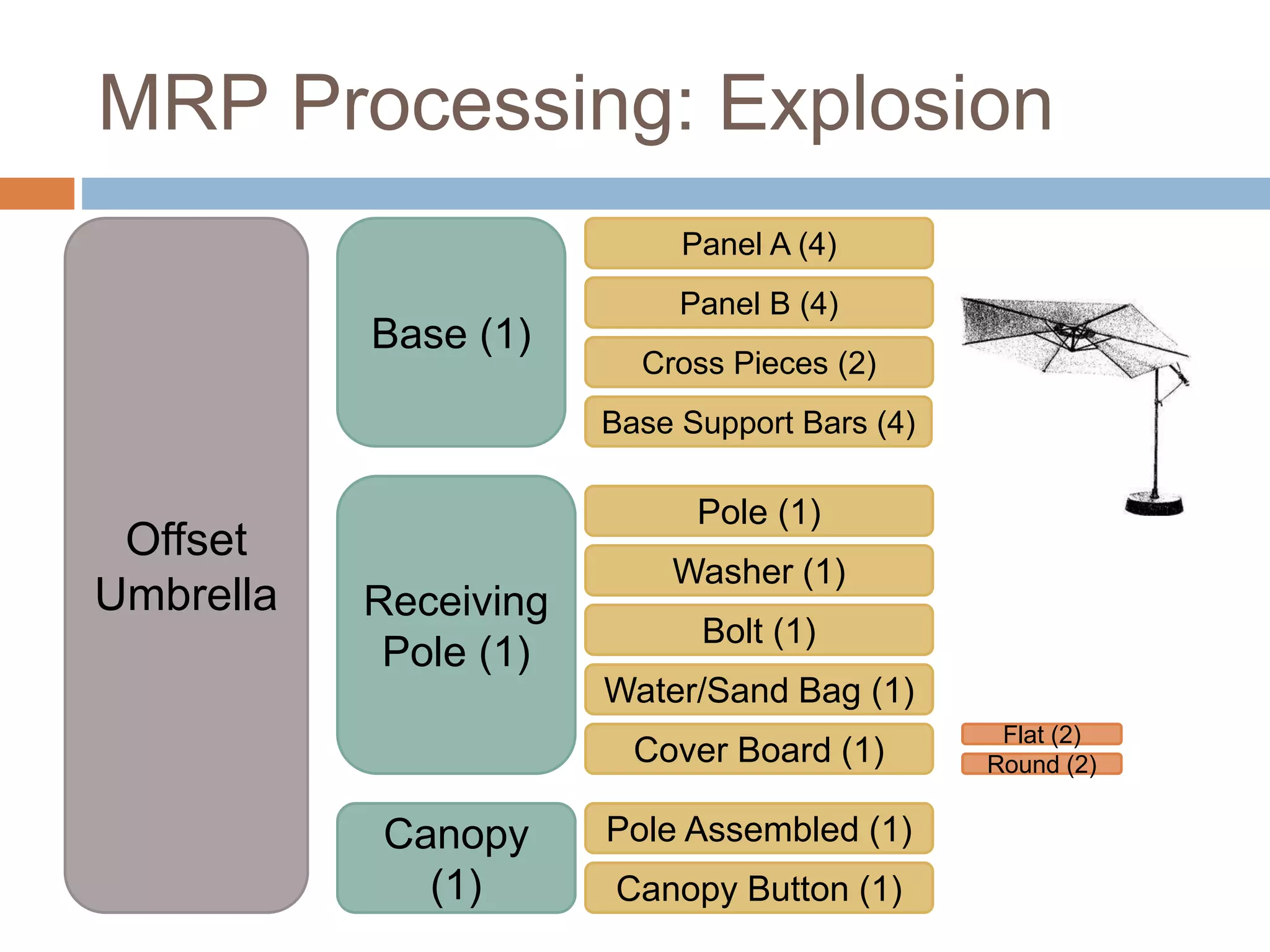
MRP Processing: Explosion
Offset
Umbrella
Base (1)
Receiving
Pole (1)
Canopy
(1)
Panel A (4)
Panel B (4)
Cross Pieces (2)
Base Support Bars (4)
Pole (1)
Washer (1)
Bolt (1)
Water/Sand Bag (1)
Cover Board (1)
Pole Assembled (1)
Canopy Button (1)
Flat (2)
Round (2)
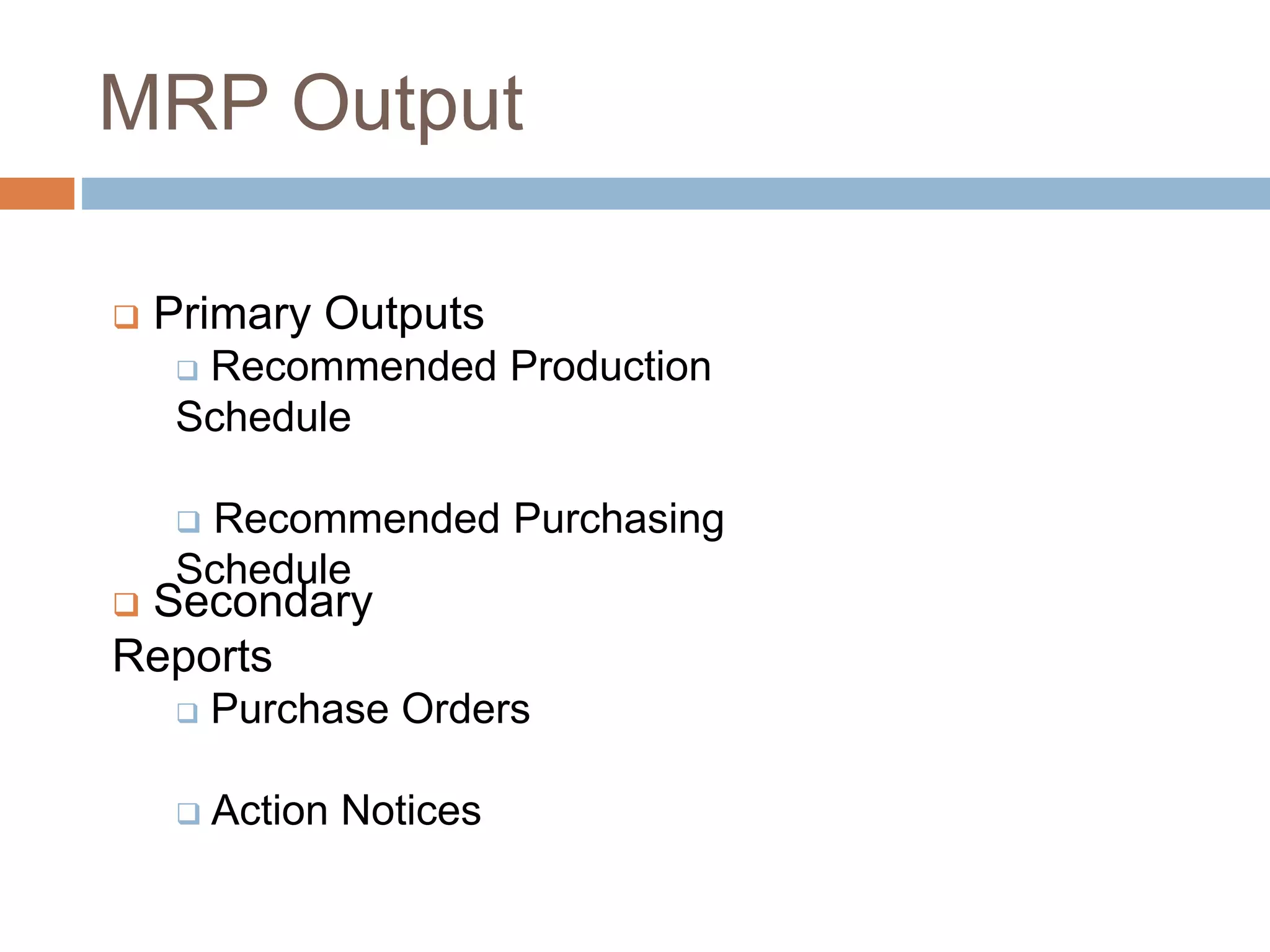
MRP Output
 Primary Outputs
 Recommended Production
Schedule
 Recommended Purchasing
Schedule
 Secondary
Reports
 Purchase Orders
 Action Notices
Advantages & Disadvantages of
MRP
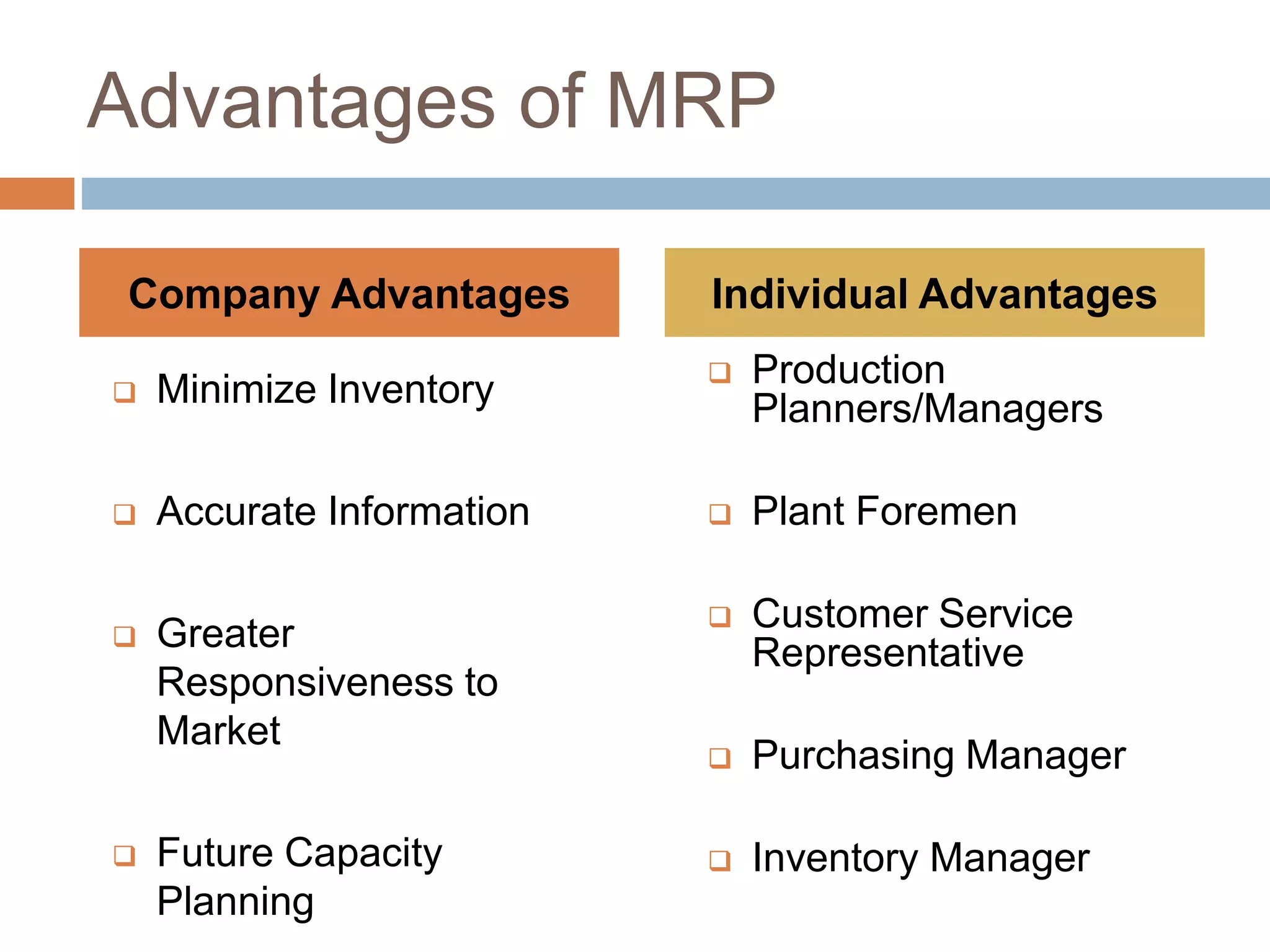
Advantages of MRP
 Minimize Inventory
 Accurate Information
 Greater
Responsiveness to
Market
 Future Capacity
Planning
 Production
Planners/Managers
 Plant Foremen
 Customer Service
Representative
 Purchasing Manager
 Inventory Manager
Company Advantages Individual Advantages
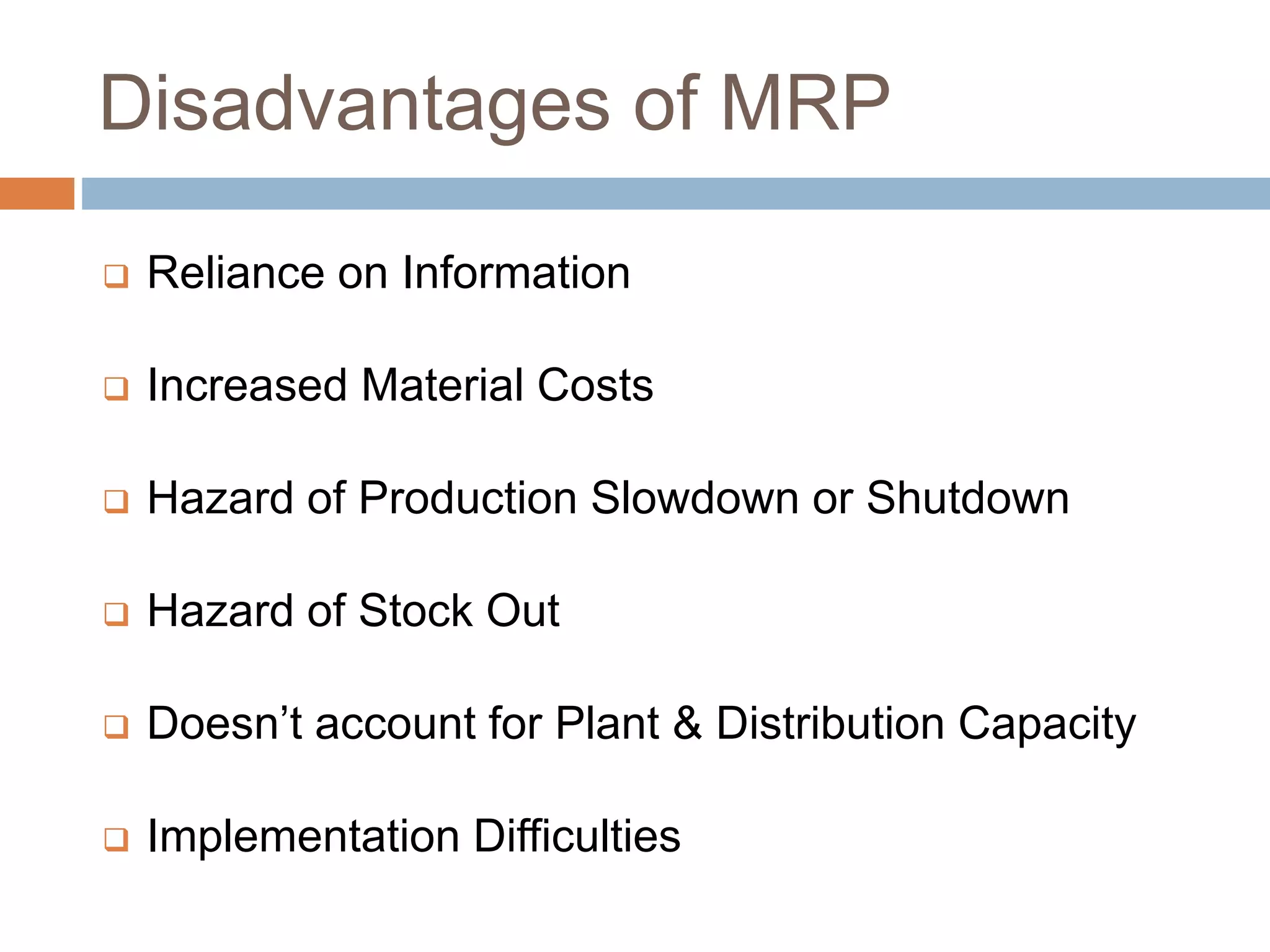
Disadvantages of MRP
 Reliance on Information
 Increased Material Costs
 Hazard of Production Slowdown or Shutdown
 Hazard of Stock Out
 Doesn’t account for Plant & Distribution Capacity
 Implementation Difficulties
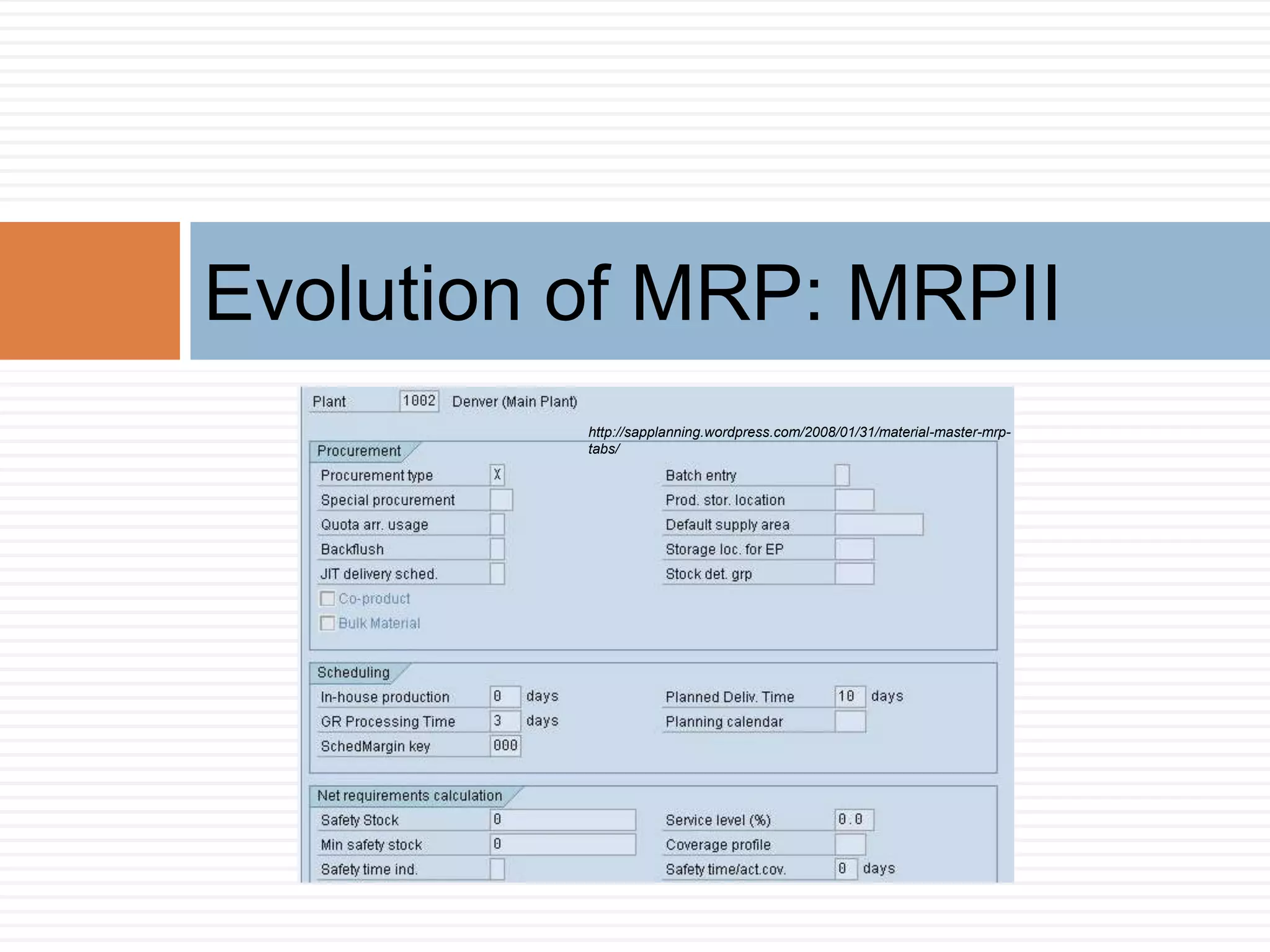
Evolution of MRP: MRPII
http://sapplanning.wordpress.com/2008/01/31/material-master-mrp-
tabs/
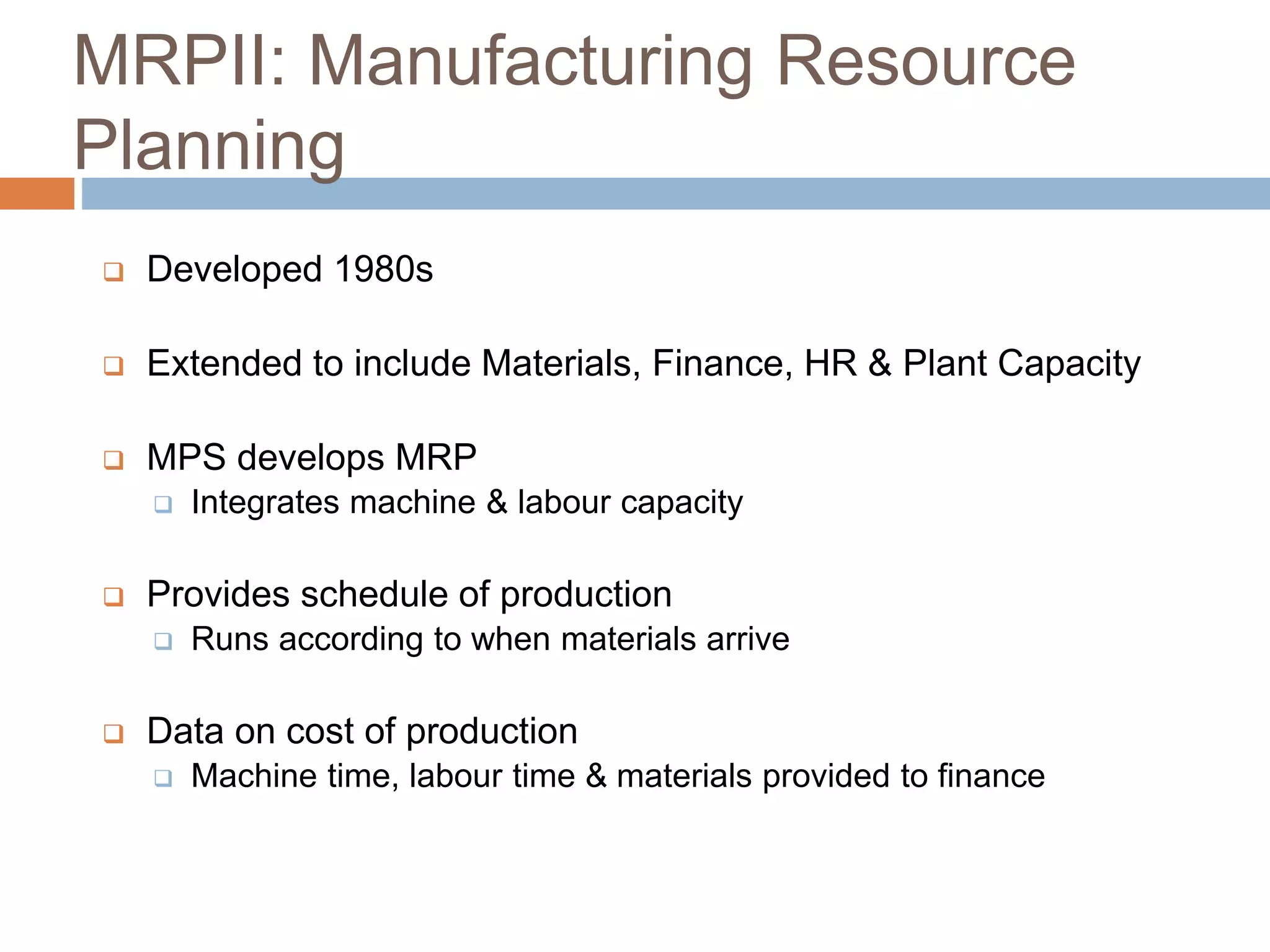
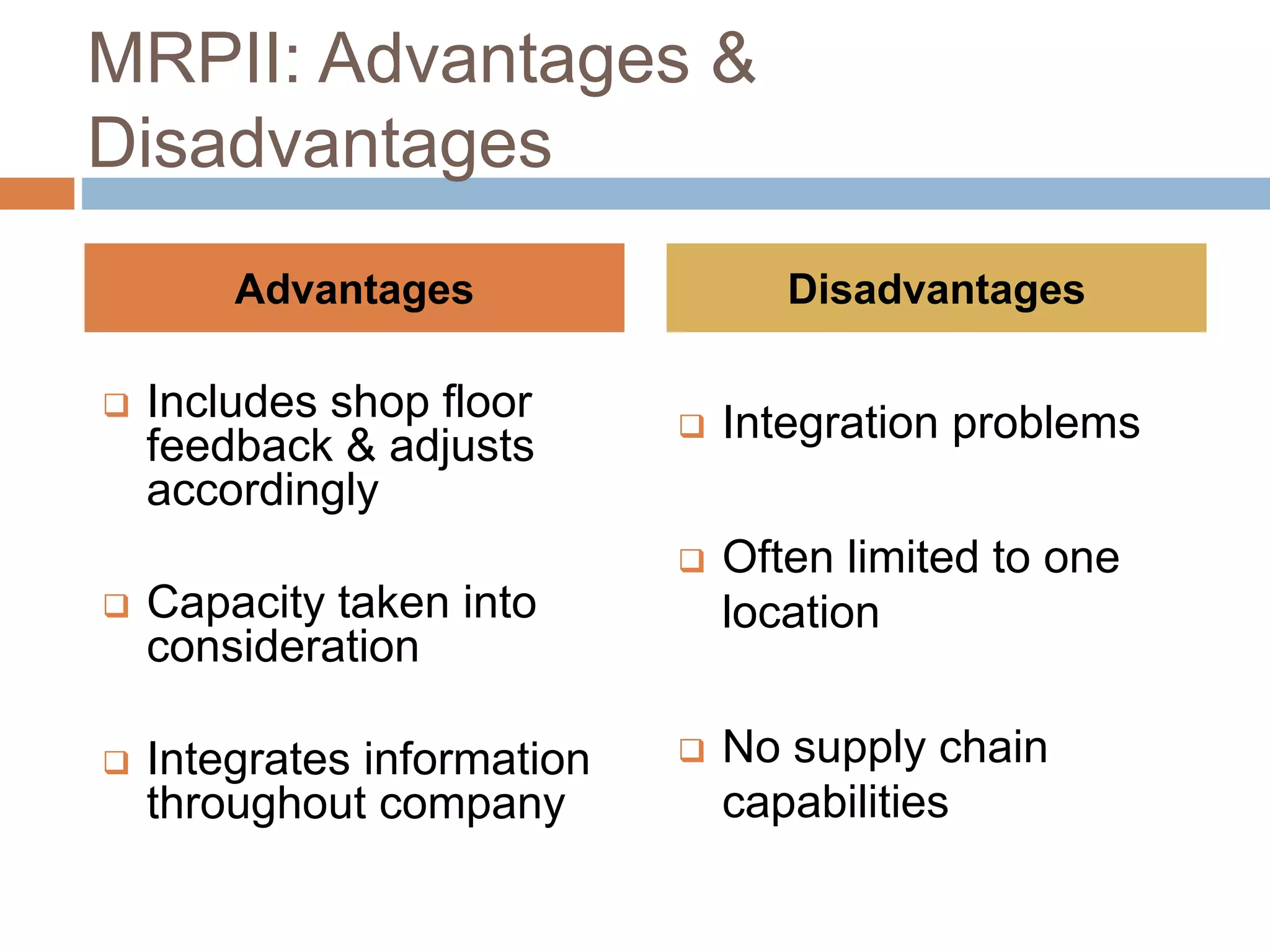
MRPII: Manufacturing Resource
Planning
 Developed 1980s
 Extended to include Materials, Finance, HR & Plant Capacity
 MPS develops MRP
 Integrates machine & labour capacity
 Provides schedule of production
 Runs according to when materials arrive
 Data on cost of production
 Machine time, labour time & materials provided to finance
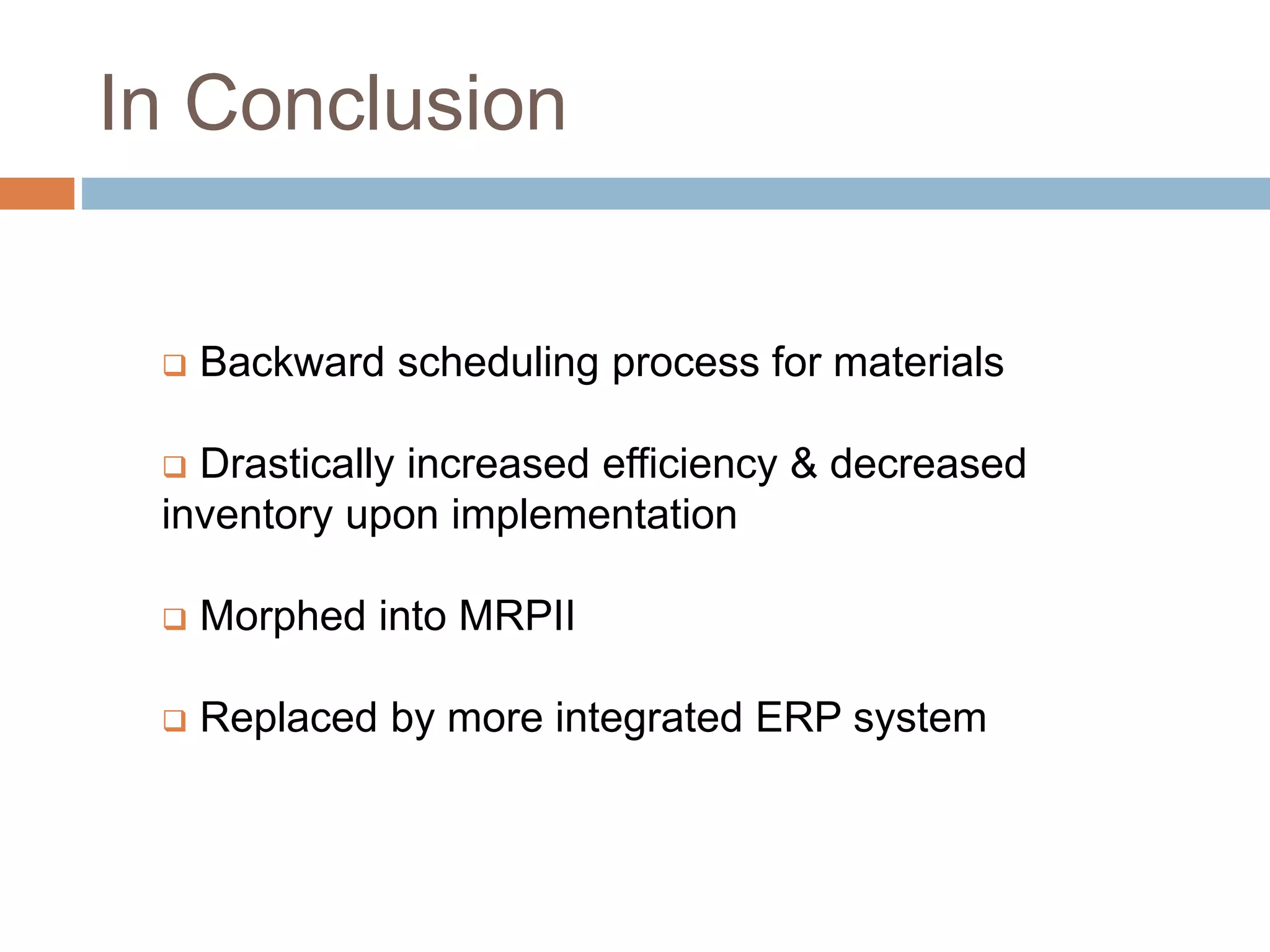
MRPII: Advantages &
Disadvantages
 Includes shop floor
feedback & adjusts
accordingly
 Capacity taken into
consideration
 Integrates information
throughout company
 Integration problems
 Often limited to one
location
 No supply chain
capabilities
Advantages Disadvantages
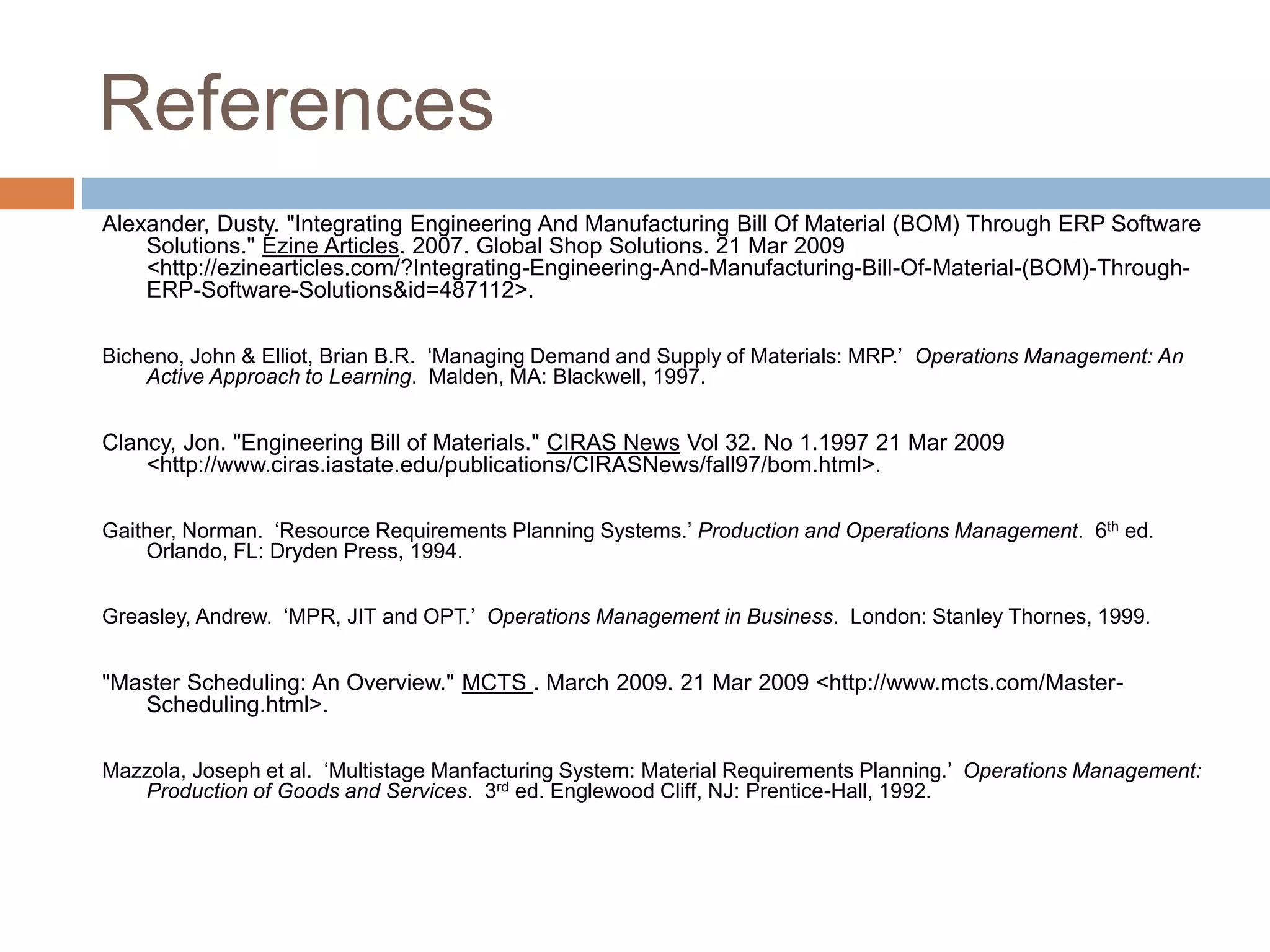
In Conclusion
 Backward scheduling process for materials
 Drastically increased efficiency & decreased
inventory upon implementation
 Morphed into MRPII
 Replaced by more integrated ERP system
Questions
References
Alexander, Dusty. "Integrating Engineering And Manufacturing Bill Of Material (BOM) Through ERP Software
Solutions." Ezine Articles. 2007. Global Shop Solutions. 21 Mar 2009
<http://ezinearticles.com/?Integrating-Engineering-And-Manufacturing-Bill-Of-Material-(BOM)-Through-
ERP-Software-Solutions&id=487112>.
Bicheno, John & Elliot, Brian B.R. ‘Managing Demand and Supply of Materials: MRP.’ Operations Management: An
Active Approach to Learning. Malden, MA: Blackwell, 1997.
Clancy, Jon. "Engineering Bill of Materials." CIRAS News Vol 32. No 1.1997 21 Mar 2009
<http://www.ciras.iastate.edu/publications/CIRASNews/fall97/bom.html>.
Gaither, Norman. ‘Resource Requirements Planning Systems.’ Production and Operations Management. 6th ed.
Orlando, FL: Dryden Press, 1994.
Greasley, Andrew. ‘MPR, JIT and OPT.’ Operations Management in Business. London: Stanley Thornes, 1999.
"Master Scheduling: An Overview." MCTS . March 2009. 21 Mar 2009 <http://www.mcts.com/Master-
Scheduling.html>.
Mazzola, Joseph et al. ‘Multistage Manfacturing System: Material Requirements Planning.’ Operations Management:
Production of Goods and Services. 3rd ed. Englewood Cliff, NJ: Prentice-Hall, 1992.
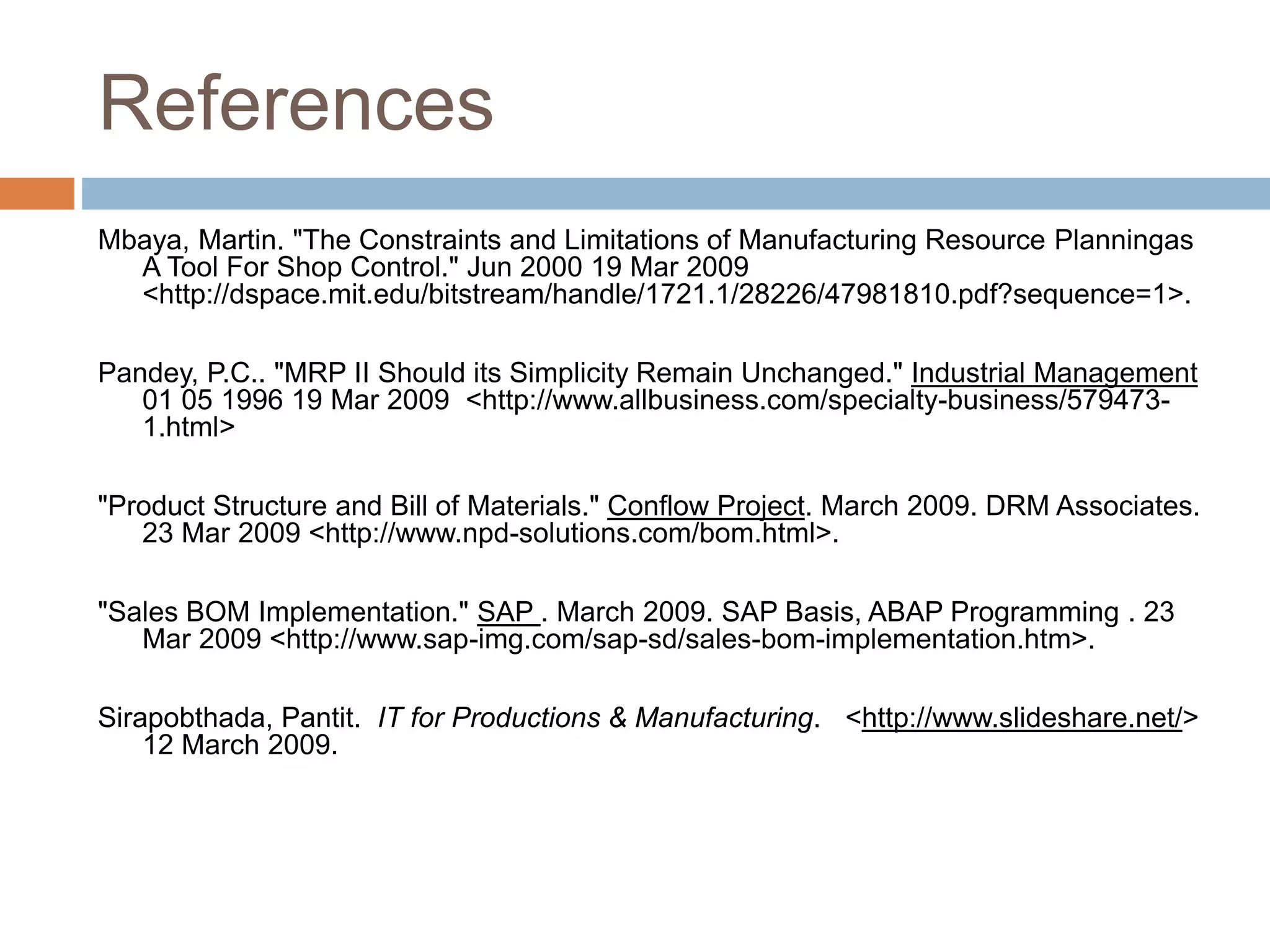
References
Mbaya, Martin. "The Constraints and Limitations of Manufacturing Resource Planningas
A Tool For Shop Control." Jun 2000 19 Mar 2009
<http://dspace.mit.edu/bitstream/handle/1721.1/28226/47981810.pdf?sequence=1>.
Pandey, P.C.. "MRP II Should its Simplicity Remain Unchanged." Industrial Management
01 05 1996 19 Mar 2009 <http://www.allbusiness.com/specialty-business/579473-
1.html>
"Product Structure and Bill of Materials." Conflow Project. March 2009. DRM Associates.
23 Mar 2009 <http://www.npd-solutions.com/bom.html>.
"Sales BOM Implementation." SAP . March 2009. SAP Basis, ABAP Programming . 23
Mar 2009 <http://www.sap-img.com/sap-sd/sales-bom-implementation.htm>.
Sirapobthada, Pantit. IT for Productions & Manufacturing. <http://www.slideshare.net/>
12 March 2009.

Operations MRP

  • 1.
  • 2.
     What isMRP?  MRP Input:  Master Production Schedule (MPS)  Bill of Materials (BOM)  MRP Processing & Output  Exploding  Netting  Offsetting  Advantages & Disadvantages of MRP  Manufacturing Resource Planning (MRPII)
  • 3.
    Controls inventory levels,plans production & helps with manufacturing control system of production of assembled parts to support forecasted demand What is Material Requirements Planning?
  • 4.
    What is MRP? Developed in 1960s  Used in manufacturing  Achieve low per unit costs Objectives  Improve customer service  Reduce inventory investment  Improve plant operating efficiency  Quantity  Schedule
  • 5.
    What is MRP? Demand Management Production Plan Master Production Schedule Inventory RecordFile Material Requirements Planning Bill of Materials Components of MRP
  • 6.
    MRP Inputs: MPS& BOM http://www.resoco.co.uk/rstores. htm
  • 7.
    MRP Input: MasterProduction Schedule  Inputs  Forecasts  Aggregate Plan  Company policies  Inventory File  Take capacity from aggregate plan & allocate  Short-range  Cost-driven Description Item Canopy Item No. 8479 Item Type Manuf. Product/sales class Ass’y Value class B Buyer/planner RB Vendor/drawing 07142 Phantom code G Unit price/cost 15 Pegging Y LLC 3 Physical Inventory On hand 20 Location Y352 On order 50 Allocated 75 Cycle 5 Difference 4 Inventory File
  • 8.
    MRP Input: MPS Computerized MPS  Inputs: forecast, safety stock, inventory status & lot sizes  Calculates: temporary MPS  Compares: against load & capacity  Outputs  Rough Cut Capacity Plan
  • 9.
    MRP Input: Billof Materials  Raw materials, assemblies, components, and the quantities of each needed to manufacture an end item  4 Different Contexts:  Engineering  Manufacturing  Sales  Service  3 Different Formats  Single-Level  Indented  Modular
  • 10.
    MRP Input: BOMContexts  Engineering BOM  Used as products are designed  Manufacturing BOM  Used as products are built  Sales BOM  As products are ordered  Service BOM  As products are maintained
  • 11.
    MRP Input: BOMFormats  Single Level BOM  Indented BOM  Modular BOM XYZ Umbrella Company Bill of Material, Part PH01 Part Number Description Qty for Each Assembly Unit of Measure B100 Base 1 Each 1100 Panel 4 Each 1200 Panel 4 Each 1300 Cross Piece 2 Each 1400 Base Support Bars 4 Each P100 Receiving Pole 1 Each 1500 Pole 1 Each 1600 Washer 1 Each 1700 Bolt 1 Each 1800 Netting 1 Each 1900 Sand Bag 1 Each 2000 Cover Board 1 Each C100 Canopy 1 Each 2100 Pole Assembly 1 Each 2200 Button 1 Each XYZ Umbrella Company Bill of Material, Part PH01-Umbrella Part Number Description Qty for Each Assembly Unit of Measure B100 Base 1 Each P100 Receiving Pole 1 Each C100 Canopy 1 Each
  • 12.
    MRP Processing &Output  MRP Matrix 4 basic steps  Exploding Bill of Materials  Netting out Inventory  Determining how many units are required  Time-phasing for future demand & supply Item: Low- Level Code: Lot Size: Lead Time: PD 1 2 3 4 5 Gross Requirements Scheduled Receipts Projected on Hand Net Requirements Planned Order Receipts Planned Order Releases
  • 13.
    MRP Processing  ExplodesMPS into amount of  Raw materials  Parts  Subassemblies  Assemblies  Netting  Order quantity needed  Offsetting  Sufficient time to build goods Needed in each week of the planning horizons
  • 14.
    MRP Processing: Explosion Offset Umbrella Base(1) Receiving Pole (1) Canopy (1) Panel A (4) Panel B (4) Cross Pieces (2) Base Support Bars (4) Pole (1) Washer (1) Bolt (1) Water/Sand Bag (1) Cover Board (1) Pole Assembled (1) Canopy Button (1) Flat (2) Round (2)
  • 15.
    MRP Output  PrimaryOutputs  Recommended Production Schedule  Recommended Purchasing Schedule  Secondary Reports  Purchase Orders  Action Notices
  • 16.
  • 17.
    Advantages of MRP Minimize Inventory  Accurate Information  Greater Responsiveness to Market  Future Capacity Planning  Production Planners/Managers  Plant Foremen  Customer Service Representative  Purchasing Manager  Inventory Manager Company Advantages Individual Advantages
  • 18.
    Disadvantages of MRP Reliance on Information  Increased Material Costs  Hazard of Production Slowdown or Shutdown  Hazard of Stock Out  Doesn’t account for Plant & Distribution Capacity  Implementation Difficulties
  • 19.
    Evolution of MRP:MRPII http://sapplanning.wordpress.com/2008/01/31/material-master-mrp- tabs/
  • 20.
    MRPII: Manufacturing Resource Planning Developed 1980s  Extended to include Materials, Finance, HR & Plant Capacity  MPS develops MRP  Integrates machine & labour capacity  Provides schedule of production  Runs according to when materials arrive  Data on cost of production  Machine time, labour time & materials provided to finance
  • 21.
    MRPII: Advantages & Disadvantages Includes shop floor feedback & adjusts accordingly  Capacity taken into consideration  Integrates information throughout company  Integration problems  Often limited to one location  No supply chain capabilities Advantages Disadvantages
  • 22.
    In Conclusion  Backwardscheduling process for materials  Drastically increased efficiency & decreased inventory upon implementation  Morphed into MRPII  Replaced by more integrated ERP system
  • 23.
  • 24.
    References Alexander, Dusty. "IntegratingEngineering And Manufacturing Bill Of Material (BOM) Through ERP Software Solutions." Ezine Articles. 2007. Global Shop Solutions. 21 Mar 2009 <http://ezinearticles.com/?Integrating-Engineering-And-Manufacturing-Bill-Of-Material-(BOM)-Through- ERP-Software-Solutions&id=487112>. Bicheno, John & Elliot, Brian B.R. ‘Managing Demand and Supply of Materials: MRP.’ Operations Management: An Active Approach to Learning. Malden, MA: Blackwell, 1997. Clancy, Jon. "Engineering Bill of Materials." CIRAS News Vol 32. No 1.1997 21 Mar 2009 <http://www.ciras.iastate.edu/publications/CIRASNews/fall97/bom.html>. Gaither, Norman. ‘Resource Requirements Planning Systems.’ Production and Operations Management. 6th ed. Orlando, FL: Dryden Press, 1994. Greasley, Andrew. ‘MPR, JIT and OPT.’ Operations Management in Business. London: Stanley Thornes, 1999. "Master Scheduling: An Overview." MCTS . March 2009. 21 Mar 2009 <http://www.mcts.com/Master- Scheduling.html>. Mazzola, Joseph et al. ‘Multistage Manfacturing System: Material Requirements Planning.’ Operations Management: Production of Goods and Services. 3rd ed. Englewood Cliff, NJ: Prentice-Hall, 1992.
  • 25.
    References Mbaya, Martin. "TheConstraints and Limitations of Manufacturing Resource Planningas A Tool For Shop Control." Jun 2000 19 Mar 2009 <http://dspace.mit.edu/bitstream/handle/1721.1/28226/47981810.pdf?sequence=1>. Pandey, P.C.. "MRP II Should its Simplicity Remain Unchanged." Industrial Management 01 05 1996 19 Mar 2009 <http://www.allbusiness.com/specialty-business/579473- 1.html> "Product Structure and Bill of Materials." Conflow Project. March 2009. DRM Associates. 23 Mar 2009 <http://www.npd-solutions.com/bom.html>. "Sales BOM Implementation." SAP . March 2009. SAP Basis, ABAP Programming . 23 Mar 2009 <http://www.sap-img.com/sap-sd/sales-bom-implementation.htm>. Sirapobthada, Pantit. IT for Productions & Manufacturing. <http://www.slideshare.net/> 12 March 2009.

Editor's Notes

  • #8 Inputs to MPS: Forecast (expected demand, past sales) and Aggregate Planning (resources needed & available, lead time, safety stock) Policies: level, chase, backorders or not, hire/fire or not, etc
  • #9 RCCP: compare labour, capital & resources to MPS Computerized due to conflicting/interacting schedules (dependent demand – lumpy - batches) Were it independent demand, one could simply use EOQ
  • #10 Inventory File & BOM: structural inputs Any changes that affect product structure fed thru BOM
  • #14 Netting: gross requirements – inventory on hand – inventory ordered
  • #16 gross & net – most important, involved in netting Shop floor – how machines loaded in next couple wks Exceptions – action notices Rescheduling can be accommodated in the ‘Open’ time frame from the MPS
  • #18 Advantages: Inv – carrying costs – insurance, obsolete, theft Material requirements – correct time and material can be allocated appropriately since known Production Planner - balance work loads across departments and make decisions about scheduling work plant foremen - for issuing work orders and maintaining production schedules Customer Service Representative - supply customers with projected delivery dates
  • #19 Disadvantages: Increased Material Costs – transportation costs, unit costs Reliance – missing parts, excessive order, delays, missed delivery date – must have at least accurate MPS with good lead time estimates, current inv records, Implementation Difficulties – time, costs, resistance