Material
Requirement
Planning (MRP1)
DEEPAK KU. KUSHWAHA
MTCH-IND,
1
Contributors to MRP
• Joseph Orlicky(1964)
• Oliver Wight(1983)
• MRP started in the late 1960s. The technique was applied
first to mobile and airplane industry. As the technique
became well known, many large and small businesses
adopted MRP method in order to increase their
productivity and decrease the production cost.
INTRODUCTION
• The main function of material requirements planning is to
guarantee material availability, that is, it is used to procure
or produce the required quantities on time both for internal
purposes and for sales and distribution.
• This process involves
- monitoring of stocks,
- automatic creation of procurement proposals for
purchasing and production.
• In doing so, MRP tries to strike the best balance possible
between
- optimizing the service level and
-minimizing costs and capital lockup.
MRP is
• Production Planning System
• Computerized Inventory Control
• Management Information System
• Manufacturing Control System
MRP software- Tuppus, Eci M1, E2 shop system
4
MRP system Gives answer
• What items are required?
• How many are required?
• When are they required?
5
Objectives
• Materials and products are available for
production and delivery to customers.
• Maintain the lowest possible level of
inventory.
• Plan manufacturing activities, delivery
schedules and purchasing activities.
6
When to use MRP?
It is useful for…..
• Independent Demand vs Dependent
Demand
• Lumpy demand
• Lead time( order lead time, manufacturing lead time )
• Common use items
7
8
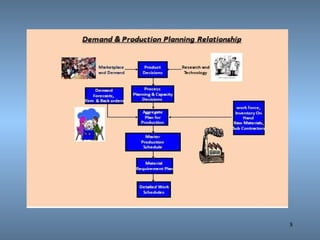
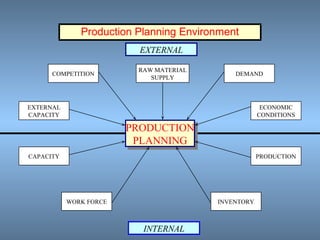
PRODUCTION
PLANNING
PRODUCTION
PLANNING
CAPACITY
WORK FORCE
PRODUCTION
INVENTORY
INTERNAL
EXTERNAL
EXTERNAL
CAPACITY
COMPETITION
RAW MATERIAL
SUPPLY
DEMAND
ECONOMIC
CONDITIONS
Production Planning Environment
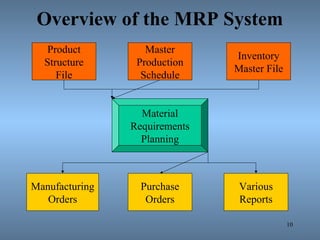
Overview of the MRP System
Product
Structure
File
Master
Production
Schedule
Inventory
Master File
Material
Requirements
Planning
Manufacturing
Orders
Purchase
Orders
Various
Reports
10
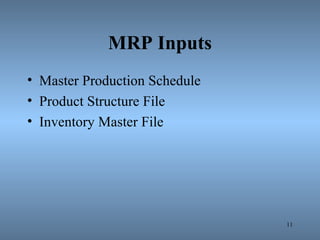
MRP Inputs
• Master Production Schedule
• Product Structure File
• Inventory Master File
11
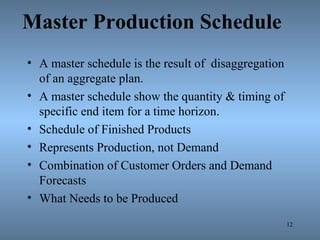
Master Production Schedule
• A master schedule is the result of disaggregation
of an aggregate plan.
• A master schedule show the quantity & timing of
specific end item for a time horizon.
• Schedule of Finished Products
• Represents Production, not Demand
• Combination of Customer Orders and Demand
Forecasts
• What Needs to be Produced
12
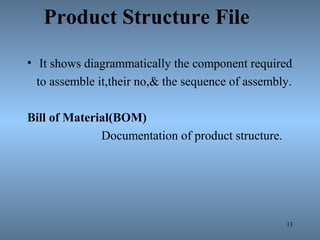
Product Structure File
• It shows diagrammatically the component required
to assemble it,their no,& the sequence of assembly.
Bill of Material(BOM)
Documentation of product structure.
13
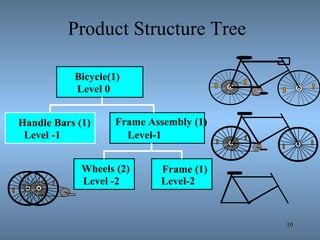
10
Bicycle(1)
Level 0
Handle Bars (1)
Level -1
Frame Assembly (1)
Level-1
Wheels (2)
Level -2
Frame (1)
Level-2
Product Structure Tree
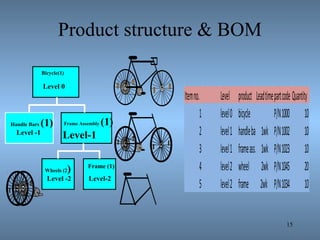
Product structure & BOM
15
Bicycle(1)
Level 0
Handle Bars (1)
Level -1
Frame Assembly (1)
Level-1
Wheels (2)
Level -2
Frame (1)
Level-2
Itemno. Level product LeadtimepartcodeQuantity
1 level0 bicycle P/N1000 10
2 level1 handlebar 1wk P/N1002 10
3 level1 frameass. 1wk P/N1023 10
4 level2 wheel 2wk P/N1045 20
5 level2 frame 2wk P/N1034 10
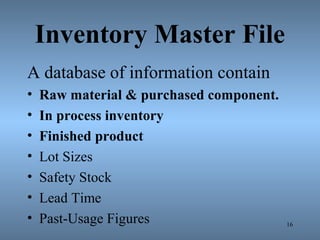
Inventory Master File
A database of information contain
• Raw material & purchased component.
• In process inventory
• Finished product
• Lot Sizes
• Safety Stock
• Lead Time
• Past-Usage Figures 16
MRP Outputs
• Planned order report
1. Time for order(Lead time)
2. Helps in preparing founds.
• Order release report
1. Order size*, release date.
2. Purchase order taking care of lead time.
• Order change report
1. Changing demand ,order,leadtime.
17
Order size in MRP
Lot for lot method
EOQ methd
Least total cost method
Least unit cost method
18
MRP PROCESS
19
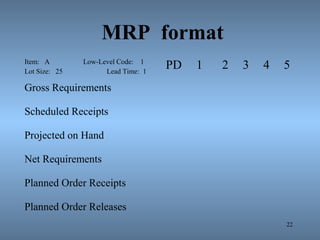
Terms Defined
• Item – name or number for the item being
scheduled
• Low-Level Code – the lowest level of the item on
the product structure file
• Lot Size – order multiples of quantity
• Lead Time – the time from when an order is
placed to when it is received
• PD – Past Due Time Bucket, orders behind
schedule
20
Terms Defined
• Gross Requirements – demand for an item by
time period
• Scheduled Receipts – material already ordered
• Projected on Hand – expected ending inventory
• Net Requirements – number of items to be
provided and when
• Planned Order Receipts – net requirements
adjusted for lot size
• Planned Order Releases – planned order receipts
offset for lead times
21
MRP format
Item: A Low-Level Code: 1
Lot Size: 25 Lead Time: 1
PD 1 2 3 4 5
Gross Requirements
Scheduled Receipts
Projected on Hand
Net Requirements
Planned Order Receipts
Planned Order Releases
22
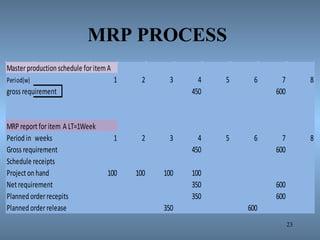
MRP PROCESS
23
Masterproduction schedule foritemA
Period(w) 1 2 3 4 5 6 7 8
gross requirement 450 600
MRP report foritemBA LT=1Week
Period in weeks 1 2 3 4 5 6 7 8
Gross requirement 450 600
Schedule receipts
Projecton hand 100 100 100 100
Netrequirement 350 600
Planned orderrecepits 350 600
Planned orderrelease 350 600
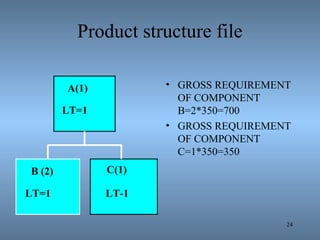
• GROSS REQUIREMENT
OF COMPONENT
B=2*350=700
• GROSS REQUIREMENT
OF COMPONENT
C=1*350=350
24
A(1)
LT=1
B (2)
LT=1
C(1)
LT-1
Product structure file
25
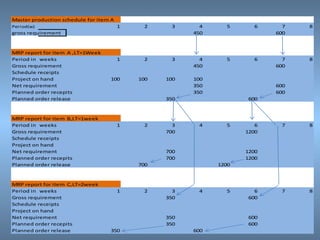
Master production schedule for item A
Period(w) 1 2 3 4 5 6 7 8
gross requirement 450 600
MRP report for item BA ,LT=1Week
Period in weeks 1 2 3 4 5 6 7 8
Gross requirement 450 600
Schedule receipts
Project on hand 100 100 100 100
Net requirement 350 600
Planned order recepits 350 600
Planned order release 350 600
MRP report for item BB,LT=1week
Period in weeks 1 2 3 4 5 6 7 8
Gross requirement 700 1200
Schedule receipts
Project on hand
Net requirement 700 1200
Planned order recepits 700 1200
Planned order release 700 1200
MRP report for item BC,LT=2week
Period in weeks 1 2 3 4 5 6 7 8
Gross requirement 350 600
Schedule receipts
Project on hand
Net requirement 350 600
Planned order recepits 350 600
Planned order release 350 600
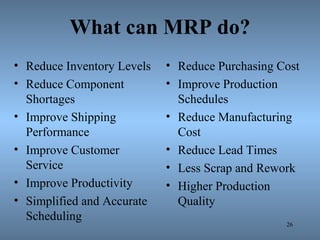
What can MRP do?
• Reduce Inventory Levels
• Reduce Component
Shortages
• Improve Shipping
Performance
• Improve Customer
Service
• Improve Productivity
• Simplified and Accurate
Scheduling
• Reduce Purchasing Cost
• Improve Production
Schedules
• Reduce Manufacturing
Cost
• Reduce Lead Times
• Less Scrap and Rework
• Higher Production
Quality
26
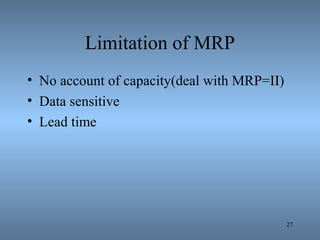
Limitation of MRP
• No account of capacity(deal with MRP=II)
• Data sensitive
• Lead time
27
28
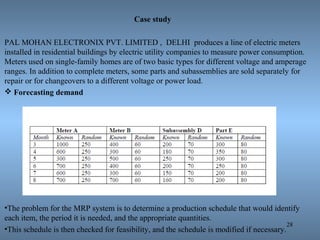
Case study
PAL MOHAN ELECTRONIX PVT. LIMITED , DELHI produces a line of electric meters
installed in residential buildings by electric utility companies to measure power consumption.
Meters used on single-family homes are of two basic types for different voltage and amperage
ranges. In addition to complete meters, some parts and subassemblies are sold separately for
repair or for changeovers to a different voltage or power load.
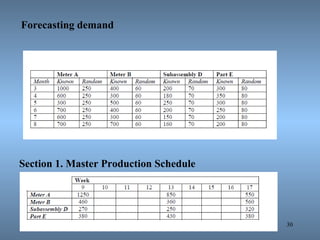
 Forecasting demand
•The problem for the MRP system is to determine a production schedule that would identify
each item, the period it is needed, and the appropriate quantities.
•This schedule is then checked for feasibility, and the schedule is modified if necessary.
29
Structure of the study
Section 1. Master Production Schedule
Section 2. Bill of Materials (Product Structure) File
Section 3. Inventory Records (Item Master) File
Section 4. Running the MRP Program
Section 5. Obtainability control
30
Section 1. Master Production Schedule
Forecasting demand
31
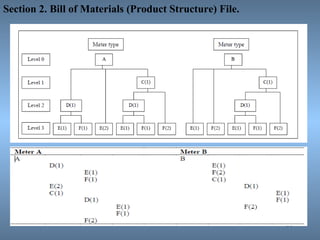
Section 2. Bill of Materials (Product Structure) File.
32
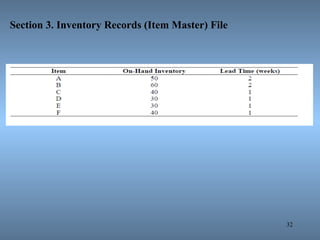
Section 3. Inventory Records (Item Master) File
33
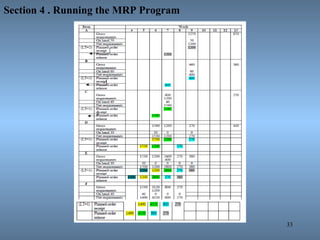
Section 4 . Running the MRP Program
34
Section 5-Obtainability Control
• ROUGH-CUT CAPACITY PLANNING(MRP-2)
• PREPARE REPORT
•It should have to be asked after applying the MRP that
whether the MRP schedule was feasible or not. If it is not so,
then the new revised MPS has to be applied with MRP
packages
Refernce
• Cad/Cam-Mikell P. Groover
• Automation & production,CIM-Mikell P.
Groover
• wikipedia.org/wiki/Material requirements
planning
35
Query session
Thank You
36

Mrp 1 deepak 12mt07ind009

  • 1.
  • 2.
    Contributors to MRP •Joseph Orlicky(1964) • Oliver Wight(1983) • MRP started in the late 1960s. The technique was applied first to mobile and airplane industry. As the technique became well known, many large and small businesses adopted MRP method in order to increase their productivity and decrease the production cost.
  • 3.
    INTRODUCTION • The mainfunction of material requirements planning is to guarantee material availability, that is, it is used to procure or produce the required quantities on time both for internal purposes and for sales and distribution. • This process involves - monitoring of stocks, - automatic creation of procurement proposals for purchasing and production. • In doing so, MRP tries to strike the best balance possible between - optimizing the service level and -minimizing costs and capital lockup.
  • 4.
    MRP is • ProductionPlanning System • Computerized Inventory Control • Management Information System • Manufacturing Control System MRP software- Tuppus, Eci M1, E2 shop system 4
  • 5.
    MRP system Givesanswer • What items are required? • How many are required? • When are they required? 5
  • 6.
    Objectives • Materials andproducts are available for production and delivery to customers. • Maintain the lowest possible level of inventory. • Plan manufacturing activities, delivery schedules and purchasing activities. 6
  • 7.
    When to useMRP? It is useful for….. • Independent Demand vs Dependent Demand • Lumpy demand • Lead time( order lead time, manufacturing lead time ) • Common use items 7
  • 8.
  • 9.
  • 10.
    Overview of theMRP System Product Structure File Master Production Schedule Inventory Master File Material Requirements Planning Manufacturing Orders Purchase Orders Various Reports 10
  • 11.
    MRP Inputs • MasterProduction Schedule • Product Structure File • Inventory Master File 11
  • 12.
    Master Production Schedule •A master schedule is the result of disaggregation of an aggregate plan. • A master schedule show the quantity & timing of specific end item for a time horizon. • Schedule of Finished Products • Represents Production, not Demand • Combination of Customer Orders and Demand Forecasts • What Needs to be Produced 12
  • 13.
    Product Structure File •It shows diagrammatically the component required to assemble it,their no,& the sequence of assembly. Bill of Material(BOM) Documentation of product structure. 13
  • 14.
    10 Bicycle(1) Level 0 Handle Bars(1) Level -1 Frame Assembly (1) Level-1 Wheels (2) Level -2 Frame (1) Level-2 Product Structure Tree
  • 15.
    Product structure &BOM 15 Bicycle(1) Level 0 Handle Bars (1) Level -1 Frame Assembly (1) Level-1 Wheels (2) Level -2 Frame (1) Level-2 Itemno. Level product LeadtimepartcodeQuantity 1 level0 bicycle P/N1000 10 2 level1 handlebar 1wk P/N1002 10 3 level1 frameass. 1wk P/N1023 10 4 level2 wheel 2wk P/N1045 20 5 level2 frame 2wk P/N1034 10
  • 16.
    Inventory Master File Adatabase of information contain • Raw material & purchased component. • In process inventory • Finished product • Lot Sizes • Safety Stock • Lead Time • Past-Usage Figures 16
  • 17.
    MRP Outputs • Plannedorder report 1. Time for order(Lead time) 2. Helps in preparing founds. • Order release report 1. Order size*, release date. 2. Purchase order taking care of lead time. • Order change report 1. Changing demand ,order,leadtime. 17
  • 18.
    Order size inMRP Lot for lot method EOQ methd Least total cost method Least unit cost method 18
  • 19.
  • 20.
    Terms Defined • Item– name or number for the item being scheduled • Low-Level Code – the lowest level of the item on the product structure file • Lot Size – order multiples of quantity • Lead Time – the time from when an order is placed to when it is received • PD – Past Due Time Bucket, orders behind schedule 20
  • 21.
    Terms Defined • GrossRequirements – demand for an item by time period • Scheduled Receipts – material already ordered • Projected on Hand – expected ending inventory • Net Requirements – number of items to be provided and when • Planned Order Receipts – net requirements adjusted for lot size • Planned Order Releases – planned order receipts offset for lead times 21
  • 22.
    MRP format Item: ALow-Level Code: 1 Lot Size: 25 Lead Time: 1 PD 1 2 3 4 5 Gross Requirements Scheduled Receipts Projected on Hand Net Requirements Planned Order Receipts Planned Order Releases 22
  • 23.
    MRP PROCESS 23 Masterproduction scheduleforitemA Period(w) 1 2 3 4 5 6 7 8 gross requirement 450 600 MRP report foritemBA LT=1Week Period in weeks 1 2 3 4 5 6 7 8 Gross requirement 450 600 Schedule receipts Projecton hand 100 100 100 100 Netrequirement 350 600 Planned orderrecepits 350 600 Planned orderrelease 350 600
  • 24.
    • GROSS REQUIREMENT OFCOMPONENT B=2*350=700 • GROSS REQUIREMENT OF COMPONENT C=1*350=350 24 A(1) LT=1 B (2) LT=1 C(1) LT-1 Product structure file
  • 25.
    25 Master production schedulefor item A Period(w) 1 2 3 4 5 6 7 8 gross requirement 450 600 MRP report for item BA ,LT=1Week Period in weeks 1 2 3 4 5 6 7 8 Gross requirement 450 600 Schedule receipts Project on hand 100 100 100 100 Net requirement 350 600 Planned order recepits 350 600 Planned order release 350 600 MRP report for item BB,LT=1week Period in weeks 1 2 3 4 5 6 7 8 Gross requirement 700 1200 Schedule receipts Project on hand Net requirement 700 1200 Planned order recepits 700 1200 Planned order release 700 1200 MRP report for item BC,LT=2week Period in weeks 1 2 3 4 5 6 7 8 Gross requirement 350 600 Schedule receipts Project on hand Net requirement 350 600 Planned order recepits 350 600 Planned order release 350 600
  • 26.
    What can MRPdo? • Reduce Inventory Levels • Reduce Component Shortages • Improve Shipping Performance • Improve Customer Service • Improve Productivity • Simplified and Accurate Scheduling • Reduce Purchasing Cost • Improve Production Schedules • Reduce Manufacturing Cost • Reduce Lead Times • Less Scrap and Rework • Higher Production Quality 26
  • 27.
    Limitation of MRP •No account of capacity(deal with MRP=II) • Data sensitive • Lead time 27
  • 28.
    28 Case study PAL MOHANELECTRONIX PVT. LIMITED , DELHI produces a line of electric meters installed in residential buildings by electric utility companies to measure power consumption. Meters used on single-family homes are of two basic types for different voltage and amperage ranges. In addition to complete meters, some parts and subassemblies are sold separately for repair or for changeovers to a different voltage or power load.  Forecasting demand •The problem for the MRP system is to determine a production schedule that would identify each item, the period it is needed, and the appropriate quantities. •This schedule is then checked for feasibility, and the schedule is modified if necessary.
  • 29.
    29 Structure of thestudy Section 1. Master Production Schedule Section 2. Bill of Materials (Product Structure) File Section 3. Inventory Records (Item Master) File Section 4. Running the MRP Program Section 5. Obtainability control
  • 30.
    30 Section 1. MasterProduction Schedule Forecasting demand
  • 31.
    31 Section 2. Billof Materials (Product Structure) File.
  • 32.
    32 Section 3. InventoryRecords (Item Master) File
  • 33.
    33 Section 4 .Running the MRP Program
  • 34.
    34 Section 5-Obtainability Control •ROUGH-CUT CAPACITY PLANNING(MRP-2) • PREPARE REPORT •It should have to be asked after applying the MRP that whether the MRP schedule was feasible or not. If it is not so, then the new revised MPS has to be applied with MRP packages
  • 35.
    Refernce • Cad/Cam-Mikell P.Groover • Automation & production,CIM-Mikell P. Groover • wikipedia.org/wiki/Material requirements planning 35
  • 36.

Editor's Notes

  • #2 Today we will discuss what Material Requirements Planning is and how we can use it in our organization.
  • #3 Material Requirements Planning was introduced in the 1970’s. Much of the credit goes to three individuals by the names of Joseph Orlicky, George Plossl, and Oliver Wight. The American Production and Inventory Control Society (APICS), which was endorsed by Orlicky, Plossl, and Wight, was also credited with the introduction of MRP.
  • #5 MRP is a system that controls inventory levels, plans production, helps supply management with important information, and helps with the manufacturing control system with respect to the production of assembled parts.
  • #11 The is an overview of how the MRP system works. The Orange boxes indicate the inputs into the MRP system. The MRP system then processes the information and delivers outputs as indicated by the yellow boxes.
  • #12 The three main inputs into the MRP system are product structure files, master production schedules, and inventory master files. These three main inputs summarize the input requirements described earlier.
  • #13 The master production schedule specifies which end items or finished products the company is to produce, how many are needed, and when they are needed. The numbers that are on the master production schedule represent production, not demand, may be a combination of customer orders and demand forecasts, and gives what needs to be produced.
  • #14 The master production schedule specifies which end items or finished products the company is to produce, how many are needed, and when they are needed. The numbers that are on the master production schedule represent production, not demand, may be a combination of customer orders and demand forecasts, and gives what needs to be produced.
  • #17 This file includes all the numbers from inventory. The MRP system keeps track of your inventory and when more items need to be ordered. It is important that you inventory numbers are accurate from the beginning in order for the MRP system to work properly.
  • #18 The MRP system delivers two main outputs along with various other reports. The two main outputs are manufacturing orders which can be released to shop floors for in-house production and purchasing orders which are sent to outside suppliers. The various reports offer suggested changes in previous plans or existing schedules.
  • #21 Some of the terms that are used with the MRP matrix are defined above. This should help the user understand how the MRP calculates everything.
  • #22 More terms defined.
  • #23 Here’s an example of how the MRP process works. This is a preliminary schedule that the MRP system gathered from the master production schedule, inventory master file, and product structure file. The question now is in what period should orders be released and what should be the size of those orders?
  • #27 MRP can do many things to help your company succeed. Probably the most important quality of MRP is the fact that it will help your company with inventory. It plans production so that the right materials are at the right place at the right time.