INDUSTRIAL ECONOMICS AND
MANGEMENT
MUHAMMAD ASIM
14ME127
SECTION-A
INTRODUCTION
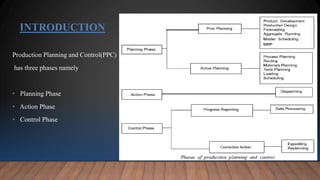
Production Planning and Control(PPC)
has three phases namely
• Planning Phase
• Action Phase
• Control Phase
“Getting the right materials to the right place at the right time”.
WHAT IS MATERIAL REQUIREMENT
PLANNING??
“Materials Requirement Planning (MRP) is a technique for determining
the quantity and timing for the acquisition of dependent demand items
needed to satisfy master production schedule requirements.”
MATERIAL REQUIREMENT PLANNING(MRP)
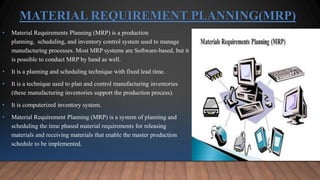
• Material Requirements Planning (MRP) is a production
planning, scheduling, and inventory control system used to manage
manufacturing processes. Most MRP systems are Software-based, but it
is possible to conduct MRP by hand as well.
• It is a planning and scheduling technique with fixed lead time.
• It is a technique used to plan and control manufacturing inventories
(these manufacturing inventories support the production process).
• It is computerized inventory system.
• Material Requirement Planning (MRP) is a system of planning and
scheduling the time phased material requirements for releasing
materials and receiving materials that enable the master production
schedule to be implemented.
HISTORY
• In 1964, as a response to the Toyota Manufacturing
Program(TMP), Joseph Orlicky developed Material Requirements
Planning (MRP). The first company to use MRP was Black & Decker in
1964, with Dick Alban as project leader.
WHEN IT IS REQUIRED
• Manufacturing industries generally face the problems that demand is
high than production. This requires some level of planning.
• Information Technology plays a major role in designing and
implementing. Material Requirements Planning systems and processes
provides information about manufacturing needs and also about
inventory
OBJECTIVES
The MRP system should have at least these objectives.
• To assure that the materials and components are available for planned production.
• Maintain the lowest possible level of inventory.
• Plan manufacturing activities, delivery schedules and purchasing activities
• Reduction in the manufacturing and delivery lead times
• Realistic delivery commitments
• Increased efficiency
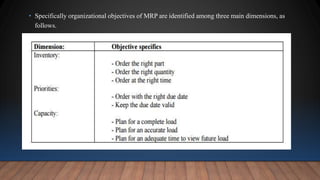
• Specifically organizational objectives of MRP are identified among three main dimensions, as
follows.
MRP SYSTEM
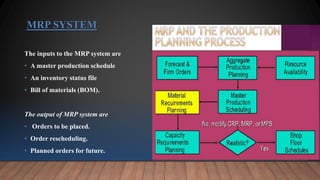
The inputs to the MRP system are
• A master production schedule
• An inventory status file
• Bill of materials (BOM).
The output of MRP system are
• Orders to be placed.
• Order rescheduling.
• Planned orders for future.
CLASSES OF MRP USER/COMPANIES
MRP systems fall into four categories, in terms of use and organizational implementation.
• Class A represents full implementation of MRP. System is tied up with company’s
financial system as well as capacity planning etc.
• Class B represents a less than full implementation. MRP system is confined in the
manufacturing area.
• Class C represents a classical MRP approach in which the system is confined to
management of inventories.
• Class D represents a data processing application of MRP. System is used for keeping
track of data rather than as decision-making tool.
ADVANTAGES OF MRP
• Improved Business Results
• Improved Manufacturing Results
• More Accurate And Timely Information
• Less Inventory
• Material wastage is less
• Higher Reliability
• More Responsiveness To Market Demand
DISADVANTAGES OF MRP
• Increase In Material Acquisition Cost
• Higher Transportation Costs And Higher Unit Cost
• Potential Hazard Of A Production Slowdown Or Shutdown
• Use Of Standardized Software Packages
Don’t become a follower, be a leader, and
become a Entrepreneur

Material Requirement and Planning

  • 1.
  • 2.
    INTRODUCTION Production Planning andControl(PPC) has three phases namely • Planning Phase • Action Phase • Control Phase
  • 3.
    “Getting the rightmaterials to the right place at the right time”.
  • 4.
    WHAT IS MATERIALREQUIREMENT PLANNING?? “Materials Requirement Planning (MRP) is a technique for determining the quantity and timing for the acquisition of dependent demand items needed to satisfy master production schedule requirements.”
  • 5.
    MATERIAL REQUIREMENT PLANNING(MRP) •Material Requirements Planning (MRP) is a production planning, scheduling, and inventory control system used to manage manufacturing processes. Most MRP systems are Software-based, but it is possible to conduct MRP by hand as well. • It is a planning and scheduling technique with fixed lead time. • It is a technique used to plan and control manufacturing inventories (these manufacturing inventories support the production process). • It is computerized inventory system. • Material Requirement Planning (MRP) is a system of planning and scheduling the time phased material requirements for releasing materials and receiving materials that enable the master production schedule to be implemented.
  • 6.
    HISTORY • In 1964,as a response to the Toyota Manufacturing Program(TMP), Joseph Orlicky developed Material Requirements Planning (MRP). The first company to use MRP was Black & Decker in 1964, with Dick Alban as project leader.
  • 7.
    WHEN IT ISREQUIRED • Manufacturing industries generally face the problems that demand is high than production. This requires some level of planning. • Information Technology plays a major role in designing and implementing. Material Requirements Planning systems and processes provides information about manufacturing needs and also about inventory
  • 8.
    OBJECTIVES The MRP systemshould have at least these objectives. • To assure that the materials and components are available for planned production. • Maintain the lowest possible level of inventory. • Plan manufacturing activities, delivery schedules and purchasing activities • Reduction in the manufacturing and delivery lead times • Realistic delivery commitments • Increased efficiency
  • 9.
    • Specifically organizationalobjectives of MRP are identified among three main dimensions, as follows.
  • 10.
    MRP SYSTEM The inputsto the MRP system are • A master production schedule • An inventory status file • Bill of materials (BOM). The output of MRP system are • Orders to be placed. • Order rescheduling. • Planned orders for future.
  • 11.
    CLASSES OF MRPUSER/COMPANIES MRP systems fall into four categories, in terms of use and organizational implementation. • Class A represents full implementation of MRP. System is tied up with company’s financial system as well as capacity planning etc. • Class B represents a less than full implementation. MRP system is confined in the manufacturing area. • Class C represents a classical MRP approach in which the system is confined to management of inventories. • Class D represents a data processing application of MRP. System is used for keeping track of data rather than as decision-making tool.
  • 12.
    ADVANTAGES OF MRP •Improved Business Results • Improved Manufacturing Results • More Accurate And Timely Information • Less Inventory • Material wastage is less • Higher Reliability • More Responsiveness To Market Demand
  • 13.
    DISADVANTAGES OF MRP •Increase In Material Acquisition Cost • Higher Transportation Costs And Higher Unit Cost • Potential Hazard Of A Production Slowdown Or Shutdown • Use Of Standardized Software Packages
  • 14.
    Don’t become afollower, be a leader, and become a Entrepreneur

Editor's Notes

  • #9  Realistic delivery commitments: Production can give marketing timely information about likely delivery times to prospective customers. Increased efficiency: Provides a close coordination among various work centers and hence help to achieve uninterrupted flow of materials through the production line. This increases the efficiency of production system.
  • #11 Using these three information sources, the MRP processing logic (computer programme) provides three kinds of information (output) for each product component: order release requirements, order rescheduling and planned orders. 1. MASTER PRODUCTION SCHEDULE (MPS) MPS is a series of time phased quantities for each item that a company produces, indicating how many are to be produced and when. MPS is initially developed from firm customer orders or from forecasts of demand before MRP system begins to operate. The MRP system whatever the master schedule demands and translates MPS end items into specific component requirements. Many systems make a simulated trial run to determine whether the proposed master can be satisfied. 2. INVENTORY STATUS FILE Every inventory item being planned must have an inventory status file which gives complete and up to date information on the on-hand quantities, gross requirements, scheduled receipts and planned order releases for an item. It also includes planning information such as lot sizes, lead times, safety stock levels and scrap allowances. 3. BILL OF MATERIALS (BOM) BOM identifies how each end product is manufactured, specifying all subcomponents items, their sequence of build up, their quantity in each finished unit and the work centres performing the build up sequence. This information is obtained from product design documents, workflow analysis and other standard manufacturing information.