MATERIAL REQUIREMENT PLANNING
PRESENTATION BY
SURYAKUMAR T
VIT BS
MRP
 Developed by Joseph orlicky in 1964.
 Time phased priority-planning technique that calculates material requirement and schedules supply.
 A Production planning, scheduling and inventory control system, manages manufacturing process.
 Has drawn attention and support as computer power has become increasingly available at low price
 Inventory control is accomplished using order point system for independent demand.
 Order point system – Inventory control based on Re-order point and fixed order level
DEPENDENT VS INDEPENDENT
DEMAND
 INDEPENDENT
 Demand for an item is independent of the
demand for other items. These demands are
typically determined by outside customers and
are end-item demands
 Example : Bicycle
Computers
 DEPENDENT
 Demand for a component (raw material, part,
sub-assembly) is dependent on the demand for
the end-item into which the component goes.
 Example : Tyres,
Microchip
OBJECTIVES
OBJECTIVES
 Ensures availability of materials for production and delivery to customers.
 Maintains lowest possible material in the store.
 Plans manufacturing activities and delivery schedule.
NECESSITIES
 To avoid over ordering and under ordering of materials for production.
 To reduce unwanted expenses due to ordering at the last minute.
 To reduce capital locked up in excess.
 To have material ready for production.
 To avoid stoppage of production due to lack of inventory.
FUNCTIONS OF MRP
 Forecasting - Accurate Material Forecasting.
 Reducing waste - Changes in production can trigger automatic responses in BOM handling.
 Floor control and scheduling - Data integration is key here. Material receipts is compared to data from
customer demand that ensures customer demands are met without shortage.
ADDITIONAL FEATURES:
 Cost estimates
 Order entry
 Vendor relationship Management
 Reduces Lead Time
CLASSES OF MRP USER/COMPANIES
MRP systems fall into four categories, often identified as ABCD, in terms of use and organizational
implementation.
 CLASS A represents full implementation of MRP. MRP system is tied up with company’s financial
system and includes capacity planning, shop floor dispatching, and vendor scheduling as well as
links with human resource planning.
 CLASS B represents a less than full implementation. MRP system is confined in the manufacturing
area; however, it encompasses master production scheduling.
 CLASS C represents a classical MRP approach in which the system is confined to management of
inventories.
 CLASS D represents a data processing application of MRP. System is used for keeping track of data
rather than as decision-making tool.
MRP INPUTS
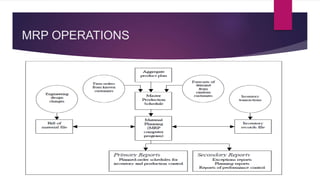
 Master production schedule
 Aggregate production planning is a capacity of generic product to be produced.
 Expressed in terms of Time buckets.
 Ex: No of gallons of paint to be produced , MPS converts this number to time-phased plan.
 Order promising – sales dept. making a delivery date commitment to customers.
 Bills of Materials
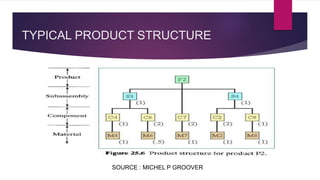
 Product structure and list of components for each products.
 Ex: BOM for a Dinner party is cook’s shopping List. (Formula, Recipe and Ingredients list)
 Single/Multi-level/Modular level
 Inventory status file – Time phased record of Inventory status (stock in hand & supplier lead time)
TYPICAL PRODUCT STRUCTURE
SOURCE : MICHEL P GROOVER
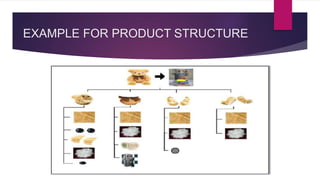
EXAMPLE FOR PRODUCT STRUCTURE
MRP OUTPUTS
 Primary reports
 Work orders
 Purchase orders
 Action notices
 Secondary reports
 Exception report
 Planning report
 Performance control report
 Inventory Transaction
MRP OPERATIONS
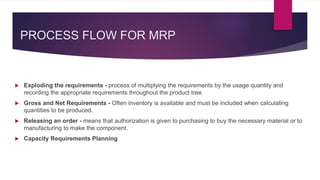
PROCESS FLOW FOR MRP
 Exploding the requirements - process of multiplying the requirements by the usage quantity and
recording the appropriate requirements throughout the product tree.
 Gross and Net Requirements - Often inventory is available and must be included when calculating
quantities to be produced.
 Releasing an order - means that authorization is given to purchasing to buy the necessary material or to
manufacturing to make the component.
 Capacity Requirements Planning
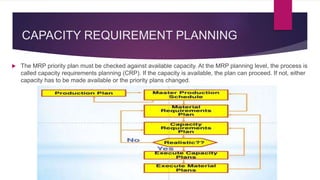
CAPACITY REQUIREMENT PLANNING
 The MRP priority plan must be checked against available capacity. At the MRP planning level, the process is
called capacity requirements planning (CRP). If the capacity is available, the plan can proceed. If not, either
capacity has to be made available or the priority plans changed.
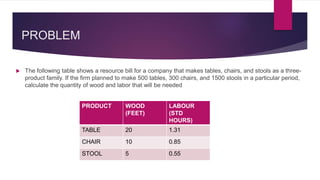
PROBLEM
 The following table shows a resource bill for a company that makes tables, chairs, and stools as a three-
product family. If the firm planned to make 500 tables, 300 chairs, and 1500 stools in a particular period,
calculate the quantity of wood and labor that will be needed
PRODUCT WOOD
(FEET)
LABOUR
(STD
HOURS)
TABLE 20 1.31
CHAIR 10 0.85
STOOL 5 0.55
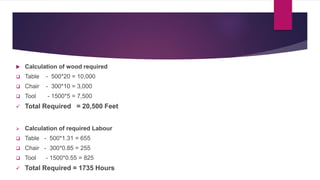
 Calculation of wood required
 Table - 500*20 = 10,000
 Chair - 300*10 = 3,000
 Tool - 1500*5 = 7,500
 Total Required = 20,500 Feet
 Calculation of required Labour
 Table - 500*1.31 = 655
 Chair - 300*0.85 = 255
 Tool - 1500*0.55 = 825
 Total Required = 1735 Hours
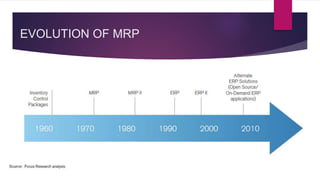
EVOLUTION OF MRP
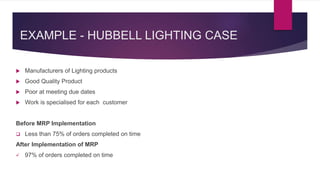
EXAMPLE - HUBBELL LIGHTING CASE
 Manufacturers of Lighting products
 Good Quality Product
 Poor at meeting due dates
 Work is specialised for each customer
Before MRP Implementation
 Less than 75% of orders completed on time
After Implementation of MRP
 97% of orders completed on time
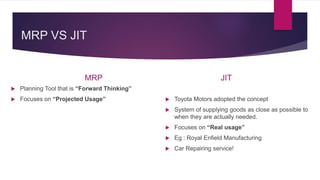
MRP VS JIT
MRP
 Planning Tool that is “Forward Thinking”
 Focuses on “Projected Usage”
JIT
 Toyota Motors adopted the concept
 System of supplying goods as close as possible to
when they are actually needed.
 Focuses on “Real usage”
 Eg : Royal Enfield Manufacturing
 Car Repairing service!
BENEFITS OF MRP
 Keep inventory levels to a cost – effective minimum.
 Keeps track of Inventory.
 Set safety stock levels for emergencies.
 Determine the best lot sizes to fulfil orders.
 Better machine utilization
DRAWBACKS OF MRP
 Inaccurate information can result in mis-planning, over-stock, under-stock
 MRP system can be costly and time- consuming to set up.
Material requirement planning - Production and Operation Management

Material requirement planning - Production and Operation Management

  • 1.
  • 2.
    MRP  Developed byJoseph orlicky in 1964.  Time phased priority-planning technique that calculates material requirement and schedules supply.  A Production planning, scheduling and inventory control system, manages manufacturing process.  Has drawn attention and support as computer power has become increasingly available at low price  Inventory control is accomplished using order point system for independent demand.  Order point system – Inventory control based on Re-order point and fixed order level
  • 3.
    DEPENDENT VS INDEPENDENT DEMAND INDEPENDENT  Demand for an item is independent of the demand for other items. These demands are typically determined by outside customers and are end-item demands  Example : Bicycle Computers  DEPENDENT  Demand for a component (raw material, part, sub-assembly) is dependent on the demand for the end-item into which the component goes.  Example : Tyres, Microchip
  • 4.
    OBJECTIVES OBJECTIVES  Ensures availabilityof materials for production and delivery to customers.  Maintains lowest possible material in the store.  Plans manufacturing activities and delivery schedule.
  • 5.
    NECESSITIES  To avoidover ordering and under ordering of materials for production.  To reduce unwanted expenses due to ordering at the last minute.  To reduce capital locked up in excess.  To have material ready for production.  To avoid stoppage of production due to lack of inventory.
  • 6.
    FUNCTIONS OF MRP Forecasting - Accurate Material Forecasting.  Reducing waste - Changes in production can trigger automatic responses in BOM handling.  Floor control and scheduling - Data integration is key here. Material receipts is compared to data from customer demand that ensures customer demands are met without shortage. ADDITIONAL FEATURES:  Cost estimates  Order entry  Vendor relationship Management  Reduces Lead Time
  • 7.
    CLASSES OF MRPUSER/COMPANIES MRP systems fall into four categories, often identified as ABCD, in terms of use and organizational implementation.  CLASS A represents full implementation of MRP. MRP system is tied up with company’s financial system and includes capacity planning, shop floor dispatching, and vendor scheduling as well as links with human resource planning.  CLASS B represents a less than full implementation. MRP system is confined in the manufacturing area; however, it encompasses master production scheduling.  CLASS C represents a classical MRP approach in which the system is confined to management of inventories.  CLASS D represents a data processing application of MRP. System is used for keeping track of data rather than as decision-making tool.
  • 8.
    MRP INPUTS  Masterproduction schedule  Aggregate production planning is a capacity of generic product to be produced.  Expressed in terms of Time buckets.  Ex: No of gallons of paint to be produced , MPS converts this number to time-phased plan.  Order promising – sales dept. making a delivery date commitment to customers.  Bills of Materials  Product structure and list of components for each products.  Ex: BOM for a Dinner party is cook’s shopping List. (Formula, Recipe and Ingredients list)  Single/Multi-level/Modular level  Inventory status file – Time phased record of Inventory status (stock in hand & supplier lead time)
  • 9.
  • 10.
  • 11.
    MRP OUTPUTS  Primaryreports  Work orders  Purchase orders  Action notices  Secondary reports  Exception report  Planning report  Performance control report  Inventory Transaction
  • 12.
  • 13.
    PROCESS FLOW FORMRP  Exploding the requirements - process of multiplying the requirements by the usage quantity and recording the appropriate requirements throughout the product tree.  Gross and Net Requirements - Often inventory is available and must be included when calculating quantities to be produced.  Releasing an order - means that authorization is given to purchasing to buy the necessary material or to manufacturing to make the component.  Capacity Requirements Planning
  • 14.
    CAPACITY REQUIREMENT PLANNING The MRP priority plan must be checked against available capacity. At the MRP planning level, the process is called capacity requirements planning (CRP). If the capacity is available, the plan can proceed. If not, either capacity has to be made available or the priority plans changed.
  • 15.
    PROBLEM  The followingtable shows a resource bill for a company that makes tables, chairs, and stools as a three- product family. If the firm planned to make 500 tables, 300 chairs, and 1500 stools in a particular period, calculate the quantity of wood and labor that will be needed PRODUCT WOOD (FEET) LABOUR (STD HOURS) TABLE 20 1.31 CHAIR 10 0.85 STOOL 5 0.55
  • 16.
     Calculation ofwood required  Table - 500*20 = 10,000  Chair - 300*10 = 3,000  Tool - 1500*5 = 7,500  Total Required = 20,500 Feet  Calculation of required Labour  Table - 500*1.31 = 655  Chair - 300*0.85 = 255  Tool - 1500*0.55 = 825  Total Required = 1735 Hours
  • 17.
  • 18.
    EXAMPLE - HUBBELLLIGHTING CASE  Manufacturers of Lighting products  Good Quality Product  Poor at meeting due dates  Work is specialised for each customer Before MRP Implementation  Less than 75% of orders completed on time After Implementation of MRP  97% of orders completed on time
  • 19.
    MRP VS JIT MRP Planning Tool that is “Forward Thinking”  Focuses on “Projected Usage” JIT  Toyota Motors adopted the concept  System of supplying goods as close as possible to when they are actually needed.  Focuses on “Real usage”  Eg : Royal Enfield Manufacturing  Car Repairing service!
  • 20.
    BENEFITS OF MRP Keep inventory levels to a cost – effective minimum.  Keeps track of Inventory.  Set safety stock levels for emergencies.  Determine the best lot sizes to fulfil orders.  Better machine utilization
  • 21.
    DRAWBACKS OF MRP Inaccurate information can result in mis-planning, over-stock, under-stock  MRP system can be costly and time- consuming to set up.

Editor's Notes

  • #3 For example, if a company plans to produce 200 cars in a day, it would need 800 wheels, 400 windshield wipers, and 200 braking systems. The number of wheels, windshield wipers, braking systems, and other component parts is dependent upon the quantity of the independent demand item from which it is derived.